Lesson 56 of 60 · about 9 minutes
Benjamin Rush: The Doctor Who Titled Common Sense and Crossed Washington
You'll be able to
- Place Rush at the signing of the Declaration and explain why he was not present for the vote
- Describe his part in Common Sense and his quarrel with the army's medical chief
- Follow the 1778 anonymous letter from York to Valley Forge and note where sources disagree on its date
- Weigh his antislavery work against the fact that he owned a man
Benjamin Rush was not in the room on July 4, 1776. He had not been elected yet. He took his seat on July 22 and signed on August 2, and thirty-five years later he could still hear how quiet it was.12 He wrote to John Adams in 1811 and asked if he remembered "the pensive and awful silence which pervaded the house when we were called up," one by one, "to subscribe what was believed by many at that time to be our own death warrants."1
Then Rush told a joke. Colonel Harrison of Virginia leaned over to Elbridge Gerry at the table and said that "From the size and weight of my body I shall die in a few minutes," while Gerry, being light, would "dance in the air an hour or two before you are dead." Rush says it got a passing smile and the solemn work went on.1
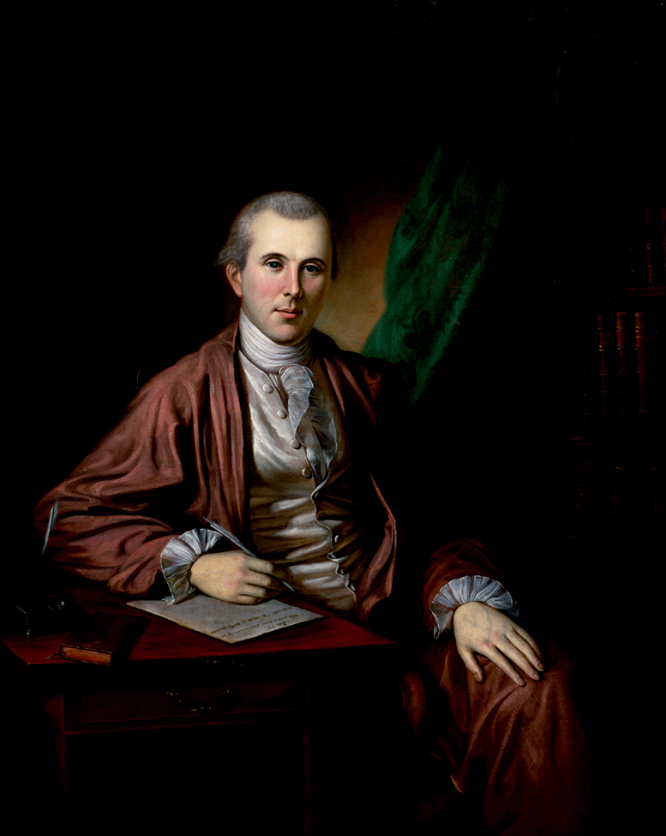
A Boy from Byberry
He was born at Byberry, outside Philadelphia, on December 24, 1745 by the old calendar. Britannica converts that to January 4, 1746.34 His father died when he was six, and an uncle, the Presbyterian minister Samuel Finley, saw to his schooling. He finished at the College of New Jersey (Princeton) in 1760, at fourteen by the Battlefield Trust's count and fifteen by the signers site.32 Then came an apprenticeship with a Philadelphia doctor and, in 1766, a ship to Scotland. He took his medical degree at Edinburgh in 1768.32
Edinburgh mattered for more than medicine. Richard Stockton came through in 1766 looking for a president for Princeton, and Rush, then a student there, helped him work on John Witherspoon, a minister in Paisley.5 The story of that recruiting is in the Witherspoon lesson. On January 11, 1776, Rush married Stockton's daughter Julia.2
The Title of Common Sense
Rush met Thomas Paine in Robert Aitken's Philadelphia shop, and the American Philosophical Society credits him with three things. He urged Paine to write a pamphlet on why separation from England was necessary. He suggested the Scottish-born printer Robert Bell as publisher. And he suggested the title. In the Society's words, "Under the title Rush suggested, Bell published Common Sense."6 Paine read him sections as he finished them. Rush wrote none of it. The name that colonists remembered may have come from a physician.
Surgeon General Rush and the Letter from York
In April 1777 Rush was named Surgeon General of the army's Middle Department, and in July physician general. The Declaration signers site says he took no pay.2 What he found in the hospitals angered him. He blamed the army's chief physician, William Shippen Jr., for waste and for undercounting the dead.3 On December 8, 1777 he wrote that he would not run the department under the existing system "for the riches of India." At Bethlehem, Pennsylvania, surgeons certified 420 patients and 40 deaths in December, against Shippen's 320 and 21, a gap Rush offered as proof of false reporting. Those are Rush's numbers, not a neutral count.7
Rush asked Congress for a hearing on January 25, 1778 and resigned on January 30.7 Shippen stayed in his post until 1781, the Battlefield Trust says. Congress did not settle his case until 1780, after a court acquitted him largely on procedural grounds.37
Eighteen days before he quit, Rush had written an unsigned letter to Patrick Henry from York, Pennsylvania, dated January 12, 1778. It criticized the army, Congress and the supply departments, and held that a Gates, a Lee or a Conway would soon make the army irresistible.8 Henry sent it on to Washington on February 20 with a note that the writer "may be too insignificant to deserve any Notice." Henry did not know the handwriting.8 Washington did, or thought he did. On March 28 he told Henry it was "written by Doctor Rush, so far as I can judge from a similitude of hands."9 In 1784 William Gordon, who knew Rush's handwriting, wrote that he had "not the least doubt but what it was written by him."8
Myth: Rush's letter to Henry was written in October 1778
Some online summaries date Rush's anonymous letter to October 13, 1778. The Washington Papers say the letter Henry forwarded is dated January 12, 1778, and Washington was answering it by late March.89 The Battlefield Trust gives only the year, 1778, and says Washington recognized the handwriting. It adds that Rush also sent a critical letter to John Adams, which is a separate document.3
The day before, without naming anyone, Washington had told Henry that to censure a public man is "the prerogative of freemen." What stung him was the mask. He had always received "the strongest professions of attachment and regard" from the writer, and he judged him short of "a great degree of candor and honest sincerity."10 That is the right test for a citizen who wants to hold government to account. Say it under your own name.
Bleeding a City, 1793
Rush returned to private practice and the Pennsylvania Hospital. He was a strong advocate of heroic medicine, the belief that bleeding and purging cured most things, and he put it to work in the yellow fever epidemic of 1793.3 Nearly 5,000 Philadelphians died.11 Rush stayed in the city and caught the fever himself.2 He also wrote to Richard Allen and Absalom Jones to ask Black Philadelphians to nurse the sick. He thought they were less likely to catch the disease. They were not, and the Historical Society of Pennsylvania says death rates were about the same.11 Rush kept no careful case records, other doctors doubted his cure, and Battlefield Trust says it fell out of favor by the early 1800s.3 Britannica faults his insistence on bloodletting and purging.4
The Abolitionist Who Owned a Man
On January 20, 1773 Rush published An Address to the Inhabitants of the British Settlements in America, Upon Slave-Keeping. In April 1787 he became secretary of the revived Pennsylvania Abolition Society, with Franklin as president, and in 1795 he became president of the national body of abolition societies.12 In 1791 he drew up a plan for Philadelphia's first free Black church.12
Myth: Rush never held anyone in bondage
Around 1780 Rush bought a cook named William Grubber from a sea captain. In May 1788 he filed papers saying Grubber would be freed in February 1794, though a letter from May 1793 suggests it came sooner. After Grubber died in 1799, Rush's notes called him "a native African whom I bought, and liberated after he had served me for ten years." The Penn Libraries guide says the ten years is probably wrong, and that nothing shows his ownership was public in his lifetime. It also warns against a claim that Rush owned a man when he signed in 1776, a claim that rests on one editor's footnote with no evidence behind it.12
In 1792 Rush told the Abolition Society that Black skin came from a form of leprosy. He meant it to defeat the idea that Black people were a lesser kind of human. It was bad science in a good cause, and Penn calls it speculation he never tried to prove.12
Republic Machines and a Mended Friendship
Rush wanted schools that made citizens. In his essay on education in a republic he wrote, "I consider it is possible to convert men into republican machines."13 He wanted schools that fitted citizens to a republic, and he said so bluntly.
In 1797 President Adams made him treasurer of the U.S. Mint, a post he kept until he died.2 And in 1811 he did the thing that may matter most to readers now. Rush wrote to Adams on December 16, 1811 and told him to "Bury in silence all the causes of your separation." Monticello credits him with orchestrating the reconciliation.1415 On January 21, 1812 Jefferson thanked Rush for his "kind interposition" in bringing "two old friends" together.16 Adams and Jefferson both died on July 4, 1826.17
Rush died of typhus in Philadelphia on April 19, 1813, at 67, in the middle of a typhus outbreak. The Declaration signers site says he was 68.24
Rush's Life at a Glance
- 1745 Born December 24 at Byberry, Old Style (January 4, 1746 by the new calendar).
- 1760 Graduates from the College of New Jersey at fourteen.
- 1768 Takes his medical degree at Edinburgh.
- January 11, 1776 Marries Julia Stockton.
- August 2, 1776 Signs the Declaration.
- April 1777 Named Surgeon General of the Middle Department.
- January 1778 Writes the anonymous York letter on the 12th and resigns on the 30th.
- 1793 Treats yellow fever patients in Philadelphia and catches it himself.
- 1797 Becomes treasurer of the U.S. Mint.
- April 19, 1813 Dies in Philadelphia.
Learn more
- Rush to John Adams, 20 July 1811: his own account of signing day, in his own words
- American Philosophical Society: Common Sense Revealed: Rush, Paine and the publisher Bell
- Penn Libraries: Rush on Abolition and Race: the Grubber record laid out with dates
- Historical Society of Pennsylvania: The Yellow Fever Epidemic: 1793 and the Black nurses who carried it
- Washington to Patrick Henry, 28 March 1778: Washington names Rush
Notes
- Benjamin Rush to John Adams, 20 July 1811, Founders Online, on the silence at the signing and the exchange between Harrison and Gerry. Read it online. ↩
- Declaration of Independence Signers site, "Benjamin Rush," on his graduation at fifteen, Edinburgh degree in 1768, marriage to Julia Stockton on January 11, 1776, his seat on July 22, the signing on August 2, his army posts without pay, his yellow fever case, the Mint treasurership from 1797 to 1813 and his death at 68 of typhus. Read it online. ↩
- American Battlefield Trust, "Benjamin Rush," on his birth, schooling, Shippen, the letter to Henry, heroic medicine and 1793. Read it online. ↩
- Encyclopaedia Britannica, "Benjamin Rush," on the new-style birth date, his death at 67 and his insistence on bloodletting and purging. Read it online. ↩
- Founder of the Day, "Future Signers in Edinburgh: The Persuasive Richard Stockton," on Stockton's 1766 trip and Rush's help with Witherspoon. Read it online. ↩
- American Philosophical Society, "Common Sense Revealed," on Rush's meeting with Paine in Aitken's shop, the publisher Bell and the title. Read it online. ↩
- Military.com feature, "The Continental Army's Medical Crisis: Benjamin Rush's Whistleblowing in 1778," on the December 8, 1777 letter and the quoted phrase, the Bethlehem figures, Rush's request for a hearing on January 25, 1778, his resignation on January 30 and the 1780 outcome of Shippen's case. Read it online. ↩
- Patrick Henry to George Washington, 20 February 1778, Founders Online, with editorial notes on the unsigned letter of 12 January 1778 from York and a quotation from William Gordon's 1784 judgment of the handwriting. Read it online. ↩
- George Washington to Patrick Henry, 28 March 1778, Founders Online, naming Rush as the author "so far as I can judge from a similitude of hands." Read it online. ↩
- George Washington to Patrick Henry, 27 March 1778, Founders Online, on censure as "the prerogative of freemen" and the writer's professions of regard; the editors' note says Washington believed Rush wrote the letter. Read it online. ↩
- Historical Society of Pennsylvania, "The Yellow Fever Epidemic," on the toll, Rush's letter to Allen and Jones, and the death rates. Read it online. ↩
- Penn Libraries, "Rush on Abolition and Race," on the 1773 address, the Abolition Society, the 1791 church plan, William Grubber and the leprosy talk. Read it online. ↩
- Benjamin Rush, "Of the Mode of Education Proper in a Republic," in The Founders' Constitution, vol. 1, ch. 18, doc. 30 (University of Chicago Press). Read it online. ↩
- Editorial note, Thomas Jefferson Papers, Founders Online, on Rush's letters of 2 January and 16 December 1811 urging the reconciliation. Read it online. ↩
- Monticello, "The Adams Family," crediting Rush with orchestrating the reconciliation. Read it online. ↩
- Thomas Jefferson to Benjamin Rush, 21 January 1812, Founders Online, on Rush's "kind interposition" and the enclosed letters between Adams and Jefferson. Read it online. ↩
- Library of Congress, Headlines and Heroes, "Deaths of John Adams and Thomas Jefferson on July 4th." Read it online. ↩
Terms in this lesson
- Surgeon General of the Middle Department
- The Continental Army medical post Rush held from April 1777 to early 1778, covering the hospitals from New York to Maryland.
- Heroic medicine
- The belief that most illness called for heavy bleeding and purging. Rush taught it and used it in 1793.
- Yellow fever
- A mosquito-borne disease that killed nearly 5,000 people in Philadelphia in 1793. Doctors of the day did not know how it spread.
- Manumission
- The legal act of freeing an enslaved person. Rush filed papers for William Grubber in 1788.
- Conway Cabal
- The later name for criticism of Washington in 1777 and 1778 that favored replacing him with Horatio Gates or another general.
Sources
- Founders Online, Benjamin Rush to John Adams, 20 July 1811 checked 2026-10
- Founders Online, Patrick Henry to Washington, 20 February 1778 checked 2026-10
- Founders Online, Washington to Patrick Henry, 28 March 1778 checked 2026-10
- American Philosophical Society, Common Sense Revealed checked 2026-10
- Penn Libraries, Rush on Abolition and Race checked 2026-10
- Historical Society of Pennsylvania, The Yellow Fever Epidemic checked 2026-10
- American Battlefield Trust, Benjamin Rush checked 2026-10