Lesson 51 of 60 · about 9 minutes
Thomas Paine: The Pamphleteer Who Argued for Independence
You'll be able to
- Trace Paine from Thetford and the excise service to Philadelphia in 1774
- Read the arguments of Common Sense in Paine's own words, including his use of Scripture against monarchy
- Weigh the competing figures for its sales and the evidence for the Trenton legend
- Follow Paine through his service with Greene, the French Revolution and his lonely death
Thomas Paine reached Philadelphia at the end of November 1774, after a crossing in which a fever ran through the ship. He wrote that five people were buried at sea. He was too sick to walk off, and a Philadelphia doctor sent two men with a chaise to fetch him. It took him six weeks ashore to recover.1 He was thirty-seven, with little money, a failed career in England and a letter of introduction from Benjamin Franklin. Thirteen months later the pamphlet he wrote there went on sale, and the American Battlefield Trust says it electrified the colonies.2
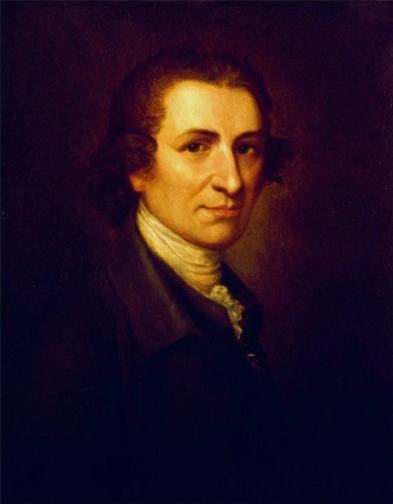
A Staymaker's Son From Thetford
Paine was born in Thetford, Norfolk. The date comes in two forms because of the calendar change. The Battlefield Trust gives February 9, 1737. Britannica prints January 29, 1737.23 Britain used the Julian calendar, called Old Style, until 1752, and it ran eleven days behind, so a January 29 birthday in the old reckoning falls on February 9 in ours. His father was a Quaker and a stay-maker, and his mother was an Anglican who taught him the Bible. He left grammar school at thirteen.2 The Battlefield Trust says the story that the Paines made corset stays is probably a joke his enemies invented. They made stays for sailing ships.2
He worked as a privateer, a teacher and a customs officer, and wound up as an excise officer in Lewes, in Sussex, where he spoke up for the welfare of his fellow officers. That got him sacked. Both of his wives were gone by then, one dead in childbirth and one separated from him.2 Franklin, in London lobbying for the colonies, offered him a path to Pennsylvania.2 Once he had recovered from the voyage he found work as a writer and editor for the Pennsylvania Magazine.2
Common Sense
The pamphlet went on sale in Philadelphia on January 10, 1776, from the printer Robert Bell.4 It carried no name. It was published anonymously.5 Paine opens with a plain division between society and government.
"Society is produced by our wants, and government by our wickedness; the former promotes our happiness positively by uniting our affections, the latter negatively by restraining our vices."
Thomas Paine, Common Sense, 1776. 6
Paine knew his Bible. To attack monarchy he went to the book of Samuel, where Israel demands a king and God sends thunder and rain as a rebuke.6 Then came his proposal for America, a charter "placed on the divine law, the word of God," so that "in America the law is king." As he put it, "in free countries the law ought to be King; and there ought to be no other."6 That is the rule of law in one line, and a farmer could repeat it.
He was less patient with his readers' habits. "Time makes more converts than reason," he wrote, and he told them "We have it in our power to begin the world over again."6 John Adams thought the plan was foolish. Looking back in his autobiography, he recalled telling Paine that his plan was "so democratical, without any restraint or even an Attempt at any Equilibrium or Counterpoise."7
How Many Copies?
Nobody knows. Paine wrote in April 1776, as "Forester," that "I am certain that I am within compass when I say one hundred twenty thousand."4 Moncure Conway guessed half a million in 1892, and the figure was repeated in textbooks for a century. In 2007 Trish Loughran put the ceiling at 75,000. No sales records survive.4 Paine took no royalties and quickly fell out with Bell. In 1791 he wrote that he had given the copyright to every state in the union.4
Myth: John Adams said the pen of Paine and the sword of Washington won the war
The line "Without the pen of the author of 'Common Sense,' the sword of Washington would have been raised in vain" appears on the Battlefield Trust page and in many books, credited to Adams.2 Kenneth Burchell writes that it cannot be found in Adams's writings and traces it to an unsigned introduction in a 1793 London edition of Rights of Man, which he attributes to Joel Barlow.8 That is one researcher's claim, made on a Substack page, and it is unconfirmed. What can be checked is that Adams disliked Paine's plan of government, as the quotation above shows.
The Crisis and the Army
After independence was declared Paine first served as secretary to a Pennsylvania militia general, and then went on to Fort Lee, New Jersey, to volunteer with the Continental Army. General Nathanael Greene made him an aide-de-camp and introduced him to Washington.9 Paine said he began the first Crisis at Newark during the retreat across New Jersey, and its opening is among the best-known lines of the war.5
Congress used him too. He served as secretary to its Committee for Foreign Affairs from 1777 until he resigned on January 8, 1779, after a public quarrel over the diplomat Silas Deane.1011
"THESE are the times that try men's souls. The summer soldier and the sunshine patriot will, in this crisis, shrink from the service of their country; but he that stands it now, deserves the love and thanks of man and woman."
Thomas Paine, The American Crisis, No. I, December 1776. 12
Myth: Washington had the Crisis read to his men before Trenton
The Battlefield Trust tells it this way, with the reading on December 23.2 Jett Conner, writing in the Journal of the American Revolution, says he could find no direct evidence that Washington ordered it read.5 He also corrects the claim that the first Crisis ran in the Pennsylvania Journal on December 19. That paper stopped publishing on December 4 and did not resume until January 22. The first known newspaper printing was in the Pennsylvania Packet on December 27, after the battle. The printers Styner and Cist issued it first as an undated pamphlet, and Paine himself said it was printed in Philadelphia on December 19.5
Rights of Man, Prison and The Age of Reason
The war left Paine poor. Washington wrote asking, "Can nothing be done in our Assembly for poor Paine?" and Virginia did nothing. New York gave Paine a confiscated Loyalist farm at New Rochelle, and Congress and Pennsylvania granted him cash.9 He went back to England in 1787, then to France, where he defended the Revolution in Rights of Man in 1791 and 1792 and was made an honorary citizen.2 The Jacobins jailed him, and James Monroe, the American minister, got him out.2 In 1796 he published a bitter public letter attacking Washington. Washington did not answer.9
Paine's deism made him a hated man among churchgoers.2 In The Age of Reason he wrote, "I believe in one God, and no more; and I hope for happiness beyond this life." He also wrote that he did not believe the creed of the Protestant church "nor by any church that I know of." "My own mind is my own church."13 The man who had cited Samuel against kings in 1776 now said he belonged to no church, Protestant included.
He came home in 1802 to a cold welcome. He died in New York on June 8, 1809. The funeral was poorly attended, and a local paper wrote that he had done "some good and much harm."2 The Thomas Paine Cottage in New Rochelle says only six people came.14 He was buried on his farm at New Rochelle. In 1819 the English journalist William Cobbett dug up the bones and took them to England. After Cobbett's death they passed through several hands, the skull and right hand were separated, and the main skeleton has not been seen since.15
Thomas Paine's Life at a Glance
- 1737 Born in Thetford, England (February 9 in the modern calendar; January 29 by the old one).
- Late November 1774 Arrives in Philadelphia with a letter from Franklin.
- January 10, 1776 Common Sense goes on sale.
- December 1776 The first American Crisis is printed, by Paine's own account on December 19.
- 1777 Becomes secretary to Congress's Committee for Foreign Affairs; resigns in January 1779.
- 1791 Publishes Rights of Man; later jailed by the Jacobins in France and freed through James Monroe.
- June 8, 1809 Dies in New York; Cobbett digs up the bones in 1819.
Learn more
- Common Sense, full text on Project Gutenberg: the whole pamphlet, short enough to read in an hour
- The American Crisis on Project Gutenberg: the Crisis papers in one volume
- Thomas Paine's Inflated Numbers: why the sales figures are guesses
- Publication history of the Times That Try Men's Souls: what is and is not known about the first Crisis
- Nathanael Greene: the general whose staff Paine joined
- John Laurens: the envoy to France whose 1781 mission Paine joined
Notes
- Thomas Paine to Benjamin Franklin, March 4, 1775, Founders Online, National Archives, on the fever aboard ship ("We buried five"), Dr. Kearsley's chaise and the six weeks ashore. Read it online. The arrival date of November 30, 1774 is the one usually given, for example in Emerging Revolutionary War, "On This Date: An America 250th Anniversary"; the editors of the Franklin Papers note that the ship's arrival was reported in the Pennsylvania Gazette of December 14. ↩
- American Battlefield Trust, "Thomas Paine," on his family, the stay-maker legend, Lewes, Franklin, the Pennsylvania Magazine, Rights of Man, the Jacobin arrest and Monroe, his deism, the newspaper's verdict of "some good and much harm," and the Adams and Trenton stories. Read it online. ↩
- Encyclopaedia Britannica, "Thomas Paine," giving his birth date as January 29, 1737 and his death as June 8, 1809. Read it online. ↩
- Journal of the American Revolution, "Thomas Paine's Inflated Numbers," on Robert Bell, the January 10, 1776 sale, the "Forester" claim of April 8, 1776, Conway's half a million, Loughran's 75,000, the lack of sales records and Paine's lack of royalties. Read it online. ↩
- Jett Conner, Journal of the American Revolution, "A Brief Publication History of the 'Times That Try Men's Souls,'" January 4, 2016, on the anonymous publication of Common Sense, Paine's own accounts of writing the first Crisis, the December 19 date, Styner and Cist, the Journal's suspension, the Packet printing and the lack of evidence for Washington's order. Read it online. ↩
- Thomas Paine, Common Sense (1776), Project Gutenberg text, in the introduction and the sections on government and monarchy. Quoted: society and government; Samuel; "the law ought to be King"; "Time makes more converts than reason"; "begin the world over again." Read it online. ↩
- John Adams, Autobiography, part 1, "John Adams," through 1776, sheet 23 of 53, Adams Family Papers: An Electronic Archive, Massachusetts Historical Society. Read it online. ↩
- Kenneth Burchell, "PBS Falls on the Sword of Washington," Substack, on the unsourced Adams line and its claimed origin. A single researcher's claim. Read it online. ↩
- Journal of the American Revolution, "George Washington and Thomas Paine: Friendship in a Revolutionary Age" (2025), on his militia service, Fort Lee, Greene, Washington's wish for Paine's reward, the New Rochelle farm and the 1796 letter. Read it online. ↩
- Benjamin Franklin Papers, "Paine, Thomas (1737-1809)," biographical note, on his appointment as secretary to the Committee for Foreign Affairs in 1777 and his resignation after the Deane affair. Read it online. ↩
- Thomas Paine to Congress, January 8, 1779, in the John Jay Papers, Founders Online, resigning the office of secretary to the Committee for Foreign Affairs. Read it online. ↩
- Thomas Paine, The American Crisis, No. I, Project Gutenberg text (the Conway edition, which reads "their country"; the Battlefield Trust prints "his country"). Read it online. ↩
- Thomas Paine, The Age of Reason, Part I, in Writings of Thomas Paine, vol. 4, Project Gutenberg text, on his profession of faith. Read it online. ↩
- Thomas Paine Cottage, New Rochelle, "Paine's Farm part II," on his burial on the farm and the six people who attended. Read it online. ↩
- Thomas Paine National Historical Association, "An Extended History of the Remains of Thomas Paine," on Cobbett's exhumation in 1819, the later owners, the separated skull and right hand, and the unresolved fate of the skeleton. Read it online. ↩
Terms in this lesson
- Common Sense
- Paine's pamphlet of January 10, 1776, which argued for independence and for a republic.
- The American Crisis
- A series of pamphlets Paine wrote from December 1776 to 1783. The first opens with 'These are the times that try men's souls.'
- Excise officer
- A tax collector on goods such as liquor and tobacco. Paine held the job in England.
- Deism
- Belief in one God known by reason and conscience, without a church or revealed scripture. Paine described his faith this way in The Age of Reason.
- Old Style and New Style
- The two calendars in use in Paine's day. Britain moved from the Julian to the Gregorian calendar in 1752, which moved dates forward by eleven days.
- Secretary to the Committee of Foreign Affairs
- Paine held this post in Congress from 1777 until January 1779.
Sources
- Founders Online, Thomas Paine to Benjamin Franklin, 4 March 1775 checked 2026-10
- Thomas Paine, Common Sense (1776), Project Gutenberg checked 2026-10
- Thomas Paine, The American Crisis, in Writings of Thomas Paine vol. 1, Project Gutenberg checked 2026-10
- Thomas Paine, The Age of Reason, in Writings of Thomas Paine vol. 4, Project Gutenberg checked 2026-10
- American Battlefield Trust, Thomas Paine checked 2026-10
- Journal of the American Revolution, Thomas Paine's Inflated Numbers checked 2026-10
- Journal of the American Revolution, A Brief Publication History of the Times That Try Men's Souls checked 2026-10
- Thomas Paine National Historical Association, An Extended History of the Remains of Thomas Paine checked 2026-10