Lesson 39 of 60 · about 9 minutes
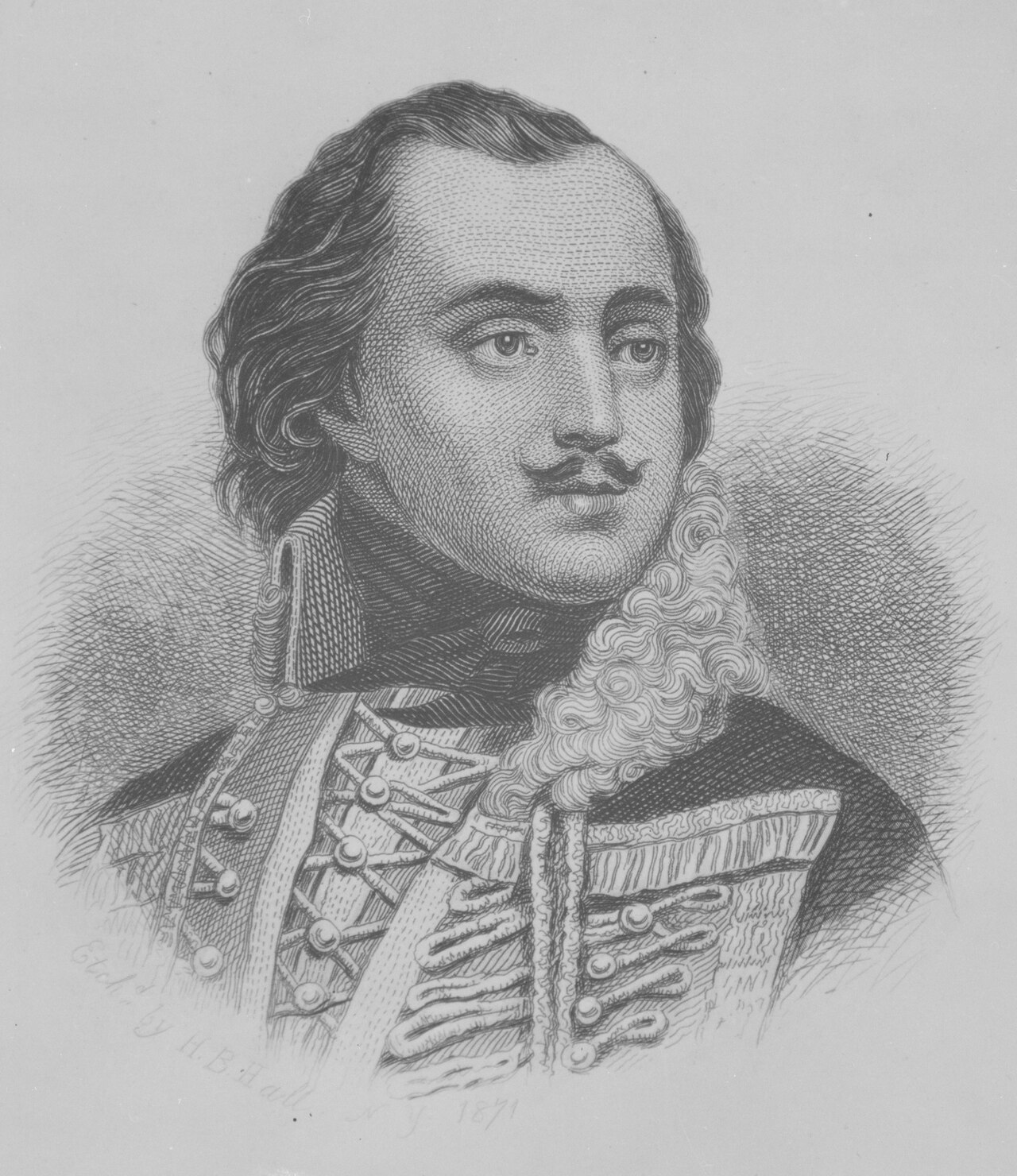
Casimir Pulaski: The Polish Cavalryman Who Fell at Savannah
You'll be able to
- Trace Pulaski from the Bar Confederation in Poland to Franklin's letter and the Continental Army
- Explain why he resigned as Commander of Horse and what Pulaski's Legion was
- Describe the Egg Harbor attack and where the sources give different numbers
- Weigh the competing accounts of how he was buried and what the 1996 and 2019 studies found
"An Officer famous throughout Europe for his Bravery and Conduct in Defence of the Liberties of his Country." Benjamin Franklin wrote that to Washington from Paris on May 29, 1777, introducing a Polish count.1 Washington forwarded the letter to Congress on August 21 with the count himself standing by to deliver it, and asked Congress to decide how to use him.2 Within a month the man was leading a cavalry charge. Barely two years later he was dead.
The Bar Confederation
Pulaski's family had a knightly tradition, and Pulaskis had fought in King John III Sobieski's wars against the Turks.3 Sources disagree about where he was born. The Battlefield Trust says Warsaw, on March 4 or 6, 1745. The Park Service says March 6 at Warka on the Pilica. Wikipedia reports that modern sources prefer Warsaw and that older ones suggested a manor at Winiary near Warka.435
In 1768 he helped form the Confederation of the Bar, nobles who wanted to end Russian influence over Poland. He won a string of small and unlikely victories and helped defend the Jasna Gora monastery at Czestochowa through a siege that ended in January 1771.45 A plot to kidnap the pro-Russian King Stanislaw II Augustus failed and cost the Confederation support from France and Austria. Pulaski, Wikipedia says, first opposed the plan and then backed it on condition that the king not be harmed.45 The Confederation fell in 1772, Poland faced its first partition, and Pulaski fled through Prussia, the Ottoman Empire and France.4
Brandywine and a Commission
He met Franklin in the spring of 1777, left France on June 13 and landed in Boston forty days later.4 Mount Vernon says he asked Washington for temporary command of some cavalry at Brandywine on September 11 and Washington agreed.6 The Battlefield Trust says Washington saw his right flank about to collapse and gave Pulaski his mounted guard, about thirty men, and that Pulaski's charge delayed the British long enough for the Continentals to withdraw.4 On September 15 Congress made him a brigadier general and Commander of Horse.7
Myth: Pulaski saved Washington's life at Brandywine
The claim is repeated on monuments and in school books. The Battlefield Trust itself says only that the charge "possibly" saved him.4 All Things Liberty offers a smaller claim, that guarding the retreat with Washington's Life Guard likely led to his promotion.7 The record supports a bold charge, a delay and a quick promotion. It does not prove a rescue.
Why He Resigned
The job went badly. Pulaski spoke Polish, Russian, German and French but not English. He wanted cavalry as a main striking arm in the European style, while American commanders used mounted troops mostly for scouting, messages and guard duty. Regimental officers resented a foreign superior, and Washington passed along complaints that his training was too severe.7 After General Anthony Wayne ordered him to join him on February 26, 1778, Pulaski took the wording as an insult and resigned on February 28.7 Washington answered on March 3 that "Your intention to resign is founded on reasons which I presume make you think the measure necessary."8 Writing to the president of Congress on March 14, Washington put the trouble down to the lack of "harmony which is inseparable from the well being and consequent utility of a corps."9
Pulaski's Legion
Congress then let him raise an independent corps. The Battlefield Trust says he presented it on March 28, 1778, while the Park Service dates the start of recruiting to May 1778. Recruits came mostly from around Baltimore, armed and equipped as lancers and dragoons.43 The Legion joined the Continental Army in September 1778.7 The Battlefield Trust notes friction with Washington over seizing supplies from suspected Loyalists.4
The Legion's worst day came on October 15, 1778, at Egg Harbor, New Jersey. Gustav Juliat, a Hessian who had deserted to the Americans, slipped away to the British and gave away the Legion's position. The infantry post was hit before dawn, while the main body of the Legion lay about a mile away at Willets Farm. All Things Liberty says the British had left by the time Pulaski and the cavalry arrived. He buried the dead and blamed Juliat. The same article counts over forty Legion dead, including Lieutenant Colonel Charles von Bose.10 The accounts differ. Pulaski reported 25 to 30 casualties, a figure that article takes from Howard Peckham's casualty study.10 His own report says he hastened up with his cavalry and the enemy fled in disorder. Patrick Ferguson, who led the British raid, claimed about fifty Legion dead and reported two dead and two wounded of his own.11
Savannah and the Question of the Grave
In May 1779 the Legion helped defend Charleston.4 On October 9 the allies failed to retake Savannah. Pulaski tried to rally fleeing French troops by charging a British position and took a charge of grapeshot.43 The Park Service says he died October 11 aboard the Wasp, on the way to Charleston, and was buried at sea. Mount Vernon says the exact date is unknown, and All Things Liberty notes that some authors give October 15.367
The burial is harder. NBC News reports that two of his officers wrote of a watery grave and that his aide claimed to have seen it. It also reports that bones were taken from a grave at a ruined plantation in 1854 and moved to Savannah's Monterey Square, where a monument rose a year later.12 Wikipedia says remains were found in 1853 and the monument was built in 1854, so the sources differ by a year.5 The bones were exhumed in 1996. A draft report led by the Chatham County coroner said the circumstantial evidence pointed to Pulaski but the failure to obtain a DNA match left no viable conclusion.12 Researchers later compared mitochondrial DNA with a relative and reported a match, and said the skeleton was likely that of an intersex person. One of them, Virginia Estabrook, called earlier theories "super speculative." Smithsonian Magazine reports the match rests on a single maternal line.13 Wikipedia notes that a 2022 article disputed the bone evidence.5
What He Left
In 1833 the fort being built on Cockspur Island near Savannah was named Fort Pulaski.3 Congress made him an honorary citizen in 2009 (Public Law 111-94, signed November 6), and the Senate passed the resolution on October 22.14 He was the seventh person so honored, after Churchill, Wallenberg, William Penn, Hannah Penn, Mother Teresa and Lafayette. Bernardo de Galvez became the eighth in 2014.14 The resolution's text repeats the claim that he saved Washington's life at Brandywine, which the Battlefield Trust puts only as "possibly" and Mount Vernon's account does not describe as a rescue.146 Another foreign volunteer, Thaddeus Kosciuszko, is covered in his own lesson, as are Lafayette and von Steuben.
Pulaski's Life at a Glance
- 1745 Born March 4 or 6 in Warsaw or Warka, depending on the source.
- 1768 Helps form the Confederation of the Bar.
- 1772 The Confederation is defeated; he flees into exile.
- May 29, 1777 Franklin recommends him to Washington.
- September 11, 1777 Leads a charge at Brandywine; made Commander of Horse September 15.
- February 28, 1778 Resigns as Commander of Horse.
- March 28, 1778 Presents Pulaski's Legion (the Park Service dates recruiting to May).
- October 15, 1778 Legion hit at Egg Harbor, New Jersey.
- October 9, 1779 Wounded at Savannah; dies by most accounts October 11.
- 2009 Congress makes him an honorary U.S. citizen.
Learn more
- American Battlefield Trust: Casimir Pulaski: a compact biography from Poland to Savannah
- All Things Liberty: The Winter of His Discontent: why he quit as Commander of Horse
- All Things Liberty: The Affair at Egg Harbor: the Juliat betrayal
- Smithsonian Magazine: Was Casimir Pulaski Intersex?: the 2019 identification and its caveats
Notes
- Benjamin Franklin to George Washington, Paris, 29 May 1777, Founders Online, Franklin Papers, which spells the name "Pulawski." Read it online. ↩
- George Washington to John Hancock, 21 August 1777, Founders Online, Washington Papers, on forwarding Franklin's letter with Pulaski. Read it online. ↩
- National Park Service, "Casimir Pulaski," on the March 6 birth at Warka, Sobieski's wars, the death on the Wasp, burial at sea, Fort Pulaski and the start of the Legion's recruiting in May 1778. Read it online. ↩
- American Battlefield Trust, "Casimir Pulaski," on Warsaw, the Bar Confederation, the voyage, Brandywine, the Legion, Charleston and Savannah. Read it online. ↩
- Wikipedia, "Casimir Pulaski," on the birthplace question, Czestochowa, the kidnapping plot, the 1853 and 1854 dates, the 2022 dispute and the 2009 resolution. Read it online. ↩
- Mount Vernon, Digital Encyclopedia, "Casimir Pulaski," on his request for temporary command at Brandywine and the unknown date of death. Read it online. ↩
- All Things Liberty, "The Winter of His Discontent: Casimir Pulaski's Resignation as Commander of Horse" (2016), on the September 15 commission, his language and doctrine problems, the February 28, 1778 resignation and the Legion's acceptance in September 1778. Read it online. ↩
- George Washington to Casimir Pulaski, Valley Forge, 3 March 1778, Founders Online, Washington Papers. Read it online. ↩
- George Washington to Henry Laurens, Valley Forge, 14 March 1778, Founders Online, Washington Papers. Read it online. ↩
- All Things Liberty, "The Affair at Egg Harbor: Massacre of the Pulaski Legion" (2017), on October 15, 1778, Juliat, the Willets Farm camp, the Legion's losses and Pulaski's 25 to 30 figure from Peckham. Read it online. ↩
- Monmouth County Historical Association, "Pulaski's Legion and the Osborn Island Massacre," on Ferguson's claim, his own losses and Pulaski's own report of the raid. Read it online. ↩
- NBC News, "Revolutionary War mystery still unsettled," on the burial accounts, the 1854 move, the monument and the draft report of the 1996 investigation. Read it online. ↩
- Smithsonian Magazine, "Was Revolutionary War Hero Casimir Pulaski Intersex?" (April 9, 2019), on the DNA comparison, Estabrook and the caveats. Read it online. ↩
- Senator Dick Durbin, press release of October 22, 2009, on the Senate vote and the list of earlier honorary citizens (Pulaski made the seventh person); Public Law 111-94 (H.J.Res. 26), signed November 6, 2009, whose text repeats the Washington rescue claim; Public Law 113-229 (December 16, 2014), which honored Bernardo de Galvez. Read it online. Public Law 111-94. ↩
Terms in this lesson
- Bar Confederation
- A 1768 alliance of Polish nobles against Russian influence over their country. Pulaski was one of its commanders.
- Commander of Horse
- The title Congress gave Pulaski on September 15, 1777, as head of the Continental cavalry.
- Pulaski's Legion
- An independent corps of cavalry and infantry he raised in 1778, mostly around Baltimore.
- Grapeshot
- A load of small iron balls fired from a cannon. A charge of it wounded Pulaski at Savannah.
- Honorary citizen
- A person Congress declares an American citizen by resolution, without the legal rights of citizenship. Pulaski received the honor in 2009.
Sources
- American Battlefield Trust, Casimir Pulaski checked 2026-10
- National Park Service, Casimir Pulaski checked 2026-10
- Founders Online, Franklin to Washington, 29 May 1777 checked 2026-10
- Founders Online, Washington to Henry Laurens, 14 March 1778 checked 2026-10
- All Things Liberty, The Winter of His Discontent checked 2026-10
- Smithsonian Magazine, Was Revolutionary War Hero Casimir Pulaski Intersex? checked 2026-10