Lesson 44 of 60 · about 9 minutes
George Rogers Clark: The Frontier General of the Northwest
You'll be able to
- Trace Clark from Kentucky surveyor to the Illinois campaign of 1778 and 1779, including the winter march to Vincennes
- Separate what the record shows about Henry Hamilton and the 'Hair Buyer' label from what it does not
- Describe plainly what Clark's wars and treaties meant for the Shawnee and their neighbors
- Follow the money: Oliver Pollock's loans, Virginia's refusal to repay, and Clark's poverty and death
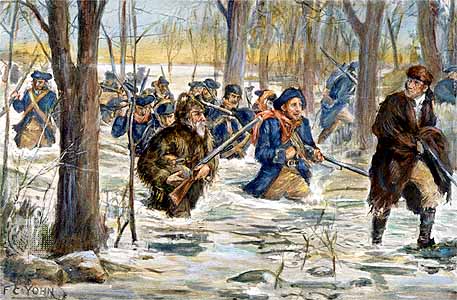
On the evening of February 23, 1779, a note was carried into Vincennes on the Wabash River. It told the townspeople that the writer was "within two miles of your village with my army" and meant to take the British fort that night.1 George Rogers Clark had somewhere between 127 and 200 men, depending on who counted.2 He marched and countermarched them in full view of the town, he wrote later, "in such a manner that we appeared numerous."1 It was a bluff built on exhaustion, and it worked.
A Surveyor in Kentucky
Clark was born November 19, 1752, in Albemarle County, Virginia, and was a surveyor by nineteen. He explored the upper Ohio Valley in the early 1770s and took part in the Point Pleasant campaign of 1774, which ended Dunmore's War. The treaty that followed made the Native nations involved give up their hunting grounds south of the Ohio, and that is how Kentucky was opened to settlers.2 Clark's career began on that land and on that bargain. In 1776 he helped get Kentucky made a Virginia county, which killed a rival land company's plan for a colony of its own.2
Patrick Henry's Secret Orders
Raids on Kentucky settlers came from British-held posts north of the Ohio, so Clark proposed to take the posts.2 He laid the plan before Governor Patrick Henry in Williamsburg in late 1777. Henry doubted the Assembly would approve it and gave Clark secret orders dated January 2, 1778. Jefferson and George Mason backed the plan and promised to push the Assembly to give each man 300 acres if it worked.3
In May 1778 Clark's flatboats started down the Ohio with about 150 men aboard. After a 120-mile march the regiment reached Kaskaskia on the evening of July 4 and took it, by the National Park Service's account, without firing a shot.24 The French townspeople expected the worst. Clark told them they could keep their property and their church, and in his memoir the bells were soon ringing.5 Cahokia and Vincennes came over within weeks. Encyclopedia Virginia says by July 20, while the Park Service has Vincennes surrendering in August.24 Spanish officials across the river at Saint Louis offered him help.2
Winter at Vincennes
Henry Hamilton, the British lieutenant governor at Detroit, took Vincennes back on December 17, 1778.2 Clark left Kaskaskia on February 6 and covered 180 miles in the worst of the weather. One stretch was a flooded plain five miles wide with shallows three feet deep.24 On February 24 he demanded surrender, and Hamilton answered that his garrison was "not disposed to be awed into any action Unworthy of British subjects."6 Hamilton later blamed the Canadian volunteers in his garrison for the loss.7 The garrison of 79 men gave up the next morning, and his journal says the British flag stayed down "that we might be spared the mortification of hawling them down."8
While the two commanders talked, Clark's men caught a party of Native men coming back from a raid. Captain Bowman's journal says they "tomahawked them and threw them into the River" in front of the fort gate. The Park Service counts five dead. Clark wrote that he had wanted "an excuse to put them to death," and Hamilton's accounts, one of them secondhand, say Clark took part himself.46
Myth: Hamilton paid a bounty for American scalps
The Dictionary of Canadian Biography says American historians took about 150 years to admit there was "no positive proof that he had ever offered rewards for scalps."7 Clark had called him "The Famous Hair Buyer General" in a letter of February 3, 1779. But the raids were real. A 1778 inventory lists 1,800 scalping knives, and Hamilton wrote on June 17, 1778, that a Delaware war party gave him "two pieces of dryed meat (scalps)."9 He supplied the war parties and feted them when they came back, which is not the same as posting a price per scalp.
Virginia treated him as a criminal anyway. The Council under Governor Jefferson ordered him into irons in Williamsburg on June 16, 1779. Washington first agreed, then changed his mind, and the irons came off by autumn. Hamilton was paroled in October 1780 and exchanged in the spring of 1781.9
Who Paid for It
Clark's campaign ran on credit. The National Archives says Oliver Pollock, an Irish-born merchant in New Orleans, "almost single-handedly bankrolled" it through bills of exchange. Pollock became the liable party, went bankrupt in 1782, and spent more than a year in a Cuban debtors' jail until the Spanish governor, Bernardo de Galvez, bailed him out. He recovered only $108,605.02 from the United States, in 1792.10 His story has its own lesson.
The Northwest and the People Who Lived There
The Treaty of Paris of 1783 gave the United States the land north of the Ohio. Encyclopedia Virginia says it "belonged to the United States by virtue of Clark's military leadership," while Wikipedia notes his importance "has been the subject of much debate among historians."211 Clark never took Detroit. In 1781 he wrote, "my chain appears to have run out."2
The country he helped win belonged to others. On August 8, 1780, he led nearly 1,000 Kentucky militia against the Shawnee town of Piqua, battered its stockade with artillery and burned the town and its fields. A twelve-year-old named Tecumseh was among the eyewitnesses.12 In 1782 Clark destroyed six more Shawnee towns. In January 1785 he was present at Fort McIntosh, where four nations were pressed to sign away most of their land north of the Ohio.2 In 1786 he helped negotiate the Fort Finney treaty with the Shawnee.13 That October Kentucky militia under Benjamin Logan burned seven Shawnee villages and killed Moluntha, an elderly chief who had signed the treaty and was holding a copy of it.14 Clark's own 1786 expedition against the Wabash tribes ended when his inadequately supplied troops mutinied.2
Debts and a Cabin
Virginia owed him nearly 3,400 pounds, to be paid in certificates, and it held him liable for debts he had signed in the state's name. Auditors lost many of his vouchers. In 1791 the Assembly turned down his claim, and in 1913 several thousand of the vouchers turned up in the Capitol.2 Accused of drunkenness after the 1786 affair, he was repudiated by the state government. By 1793 he held a French general's commission (Encyclopedia Virginia says 1792), and Washington ordered Kentucky's governor, Isaac Shelby, to have him arrested. Shelby, who had fought at Kings Mountain, refused.215
In 1803 Clark moved to a cabin across from Louisville and ran a gristmill, which Wikipedia says he worked with two enslaved men he owned.11 A stroke in 1809 and the loss of his right leg sent him to his sister's home at Locust Grove. Virginia gave him a $400 pension and a sword in 1812.2 He died there on February 13, 1818. At his funeral Judge John Rowan said, "The mighty oak of the forest has fallen, and now the scrub oaks sprout all around."4
His much younger brother William, who lived in the West and later governed Missouri Territory, led the Lewis and Clark expedition with Meriwether Lewis.2 Jefferson had asked George in 1783 to lead an expedition west. It never happened, and George later brought William to Jefferson's attention.15
Clark's Life at a Glance
- November 19, 1752 Born in Albemarle County, Virginia.
- October 1774 Takes part in the Point Pleasant campaign of Dunmore's War.
- January 2, 1778 Receives Patrick Henry's secret orders.
- July 4, 1778 Takes Kaskaskia.
- December 17, 1778 Hamilton retakes Vincennes.
- February 25, 1779 Hamilton surrenders Fort Sackville.
- August 8, 1780 Burns the Shawnee town of Piqua.
- 1783 Treaty of Paris ends the war.
- 1791 Virginia rejects his claim for repayment.
- February 13, 1818 Dies at Locust Grove, Kentucky.
Learn more
- Encyclopedia Virginia: George Rogers Clark: the best short life, with a full timeline
- Indiana Historical Bureau exhibit: Clark's memoir and the Bowman and Hamilton journals, day by day
- Journal of the American Revolution on the Hair Buyer: Hamilton, Jefferson and Washington on the irons
- National Archives on Oliver Pollock: the man who paid the bills
Notes
- Indiana Historical Bureau, "March to Vincennes, February 23, 1779, Warriors Island," quoting Clark's placard to the inhabitants of Vincennes and his memoir on marching his men in view of the town. Read it online. ↩
- Donald W. Gunter, "George Rogers Clark (1752-1818)," Encyclopedia Virginia (Virginia Humanities, 2020), on his birth and early career, Dunmore's War, Kentucky County, the expedition and its dates and numbers, the winter march, the Treaty of Paris, the 1781 letter, the Shawnee campaigns, Fort McIntosh, the debts, the 1913 vouchers, the French commission, his pension and sword, and his brother William. Read it online. ↩
- Indiana Historical Bureau, "Clark's Daring Plan," on the secret orders of January 2, 1778 and the 300-acre promise. Read it online. ↩
- National Park Service, "George Rogers Clark," on Kaskaskia taken without a shot, the August date for Vincennes, the march of February 6 to 23, the five Native men executed, the 1809 injury and Judge Rowan's funeral words. Read it online. ↩
- Indiana Historical Bureau, "Taking Kaskaskia," quoting Clark's memoir on the town, Father Pierre Gibault and the church bells. Read it online. ↩
- Indiana Historical Bureau, "The Fort under Siege, February 24, 1779," quoting Hamilton's reply, Bowman's journal and Clark's memoir. Read it online. ↩
- Dictionary of Canadian Biography, "Hamilton, Henry," on his blaming the defection of Canadian volunteers, the finding of "no positive proof" and the label "hair-buyer general." Read it online. ↩
- Indiana Historical Bureau, "Terms of Surrender Determined, February 24, 1779," on the garrison of 79 men and Hamilton's journal entries for February 24 and 25. Read it online. ↩
- Journal of the American Revolution, "Stern Measures: Thomas Jefferson Confronts the Hair Buyer," on Clark's letter of February 3, 1779, the 1,800 scalping knives, the "dryed meat" entry and the fate of Hamilton in Virginia. Read it online. ↩
- National Archives, "Oliver Pollock: Supporter of the Revolution, Creator of '$'," The Text Message, on his loans, bankruptcy, Cuban jail, bail by Galvez and the 1792 payment. Read it online. ↩
- Wikipedia, "George Rogers Clark," on the historians' debate over his importance and the two enslaved men at his mill. Encyclopedia Virginia does not mention the enslaved men. Read it online. ↩
- American Battlefield Trust, "The Proving Ground: Revolutionary Ohio," on the attack on Piqua on August 8, 1780 and Tecumseh as an eyewitness. Read it online. ↩
- American Battlefield Trust, "George Rogers Clark," on his work as a commissioner for the treaties of Fort McIntosh and Fort Finney. Read it online. ↩
- Wikipedia, "Moluntha," on the Treaty of Fort Finney in January 1786 and the Kentucky raid of October 6, 1786 in which Moluntha was killed. Read it online. ↩
- Historic Locust Grove, "George Rogers Clark," on the French commission, Washington's order to Shelby, Jefferson's 1783 request and William Clark. Read it online. ↩
Terms in this lesson
- Illinois campaign
- Clark's 1778 and 1779 expedition that took Kaskaskia, Cahokia and Vincennes from the British and their French-speaking allies.
- Fort Sackville
- The British fort at Vincennes on the Wabash River. Clark took it on February 25, 1779.
- Lieutenant governor
- The second-ranking British official of a province. Henry Hamilton held the post at Detroit and supplied Native war parties that raided the frontier.
- Bill of exchange
- A written order to pay a sum of money later. Clark and Oliver Pollock paid for supplies with these, and the people holding them came looking for payment.
- Northwest Territory
- The land north of the Ohio River and east of the Mississippi that Britain gave up in the Treaty of Paris of 1783.
- Cession
- A treaty in which one nation gives up land to another. Several Native nations signed cessions under pressure in the 1780s.
Sources
- Encyclopedia Virginia, George Rogers Clark (1752-1818) checked 2026-10
- Indiana Historical Bureau, George Rogers Clark 225th Anniversary Exhibit checked 2026-10
- National Park Service, George Rogers Clark checked 2026-10
- Dictionary of Canadian Biography, Henry Hamilton checked 2026-10
- Journal of the American Revolution, Stern Measures: Thomas Jefferson Confronts the Hair Buyer checked 2026-10
- National Archives, Oliver Pollock: Supporter of the Revolution checked 2026-10