Lesson 50 of 60 · about 9 minutes
Ethan Allen: The Green Mountain Boy Who Took Ticonderoga
You'll be able to
- Trace Allen from Litchfield and the New Hampshire Grants to the Green Mountain Boys
- Describe the capture of Ticonderoga, including the quarrel with Benedict Arnold and the cannon taken
- Explain why the famous demand for surrender comes from Allen's own account
- Follow his capture at Montreal, his release, and the secret talks with the British governor of Quebec
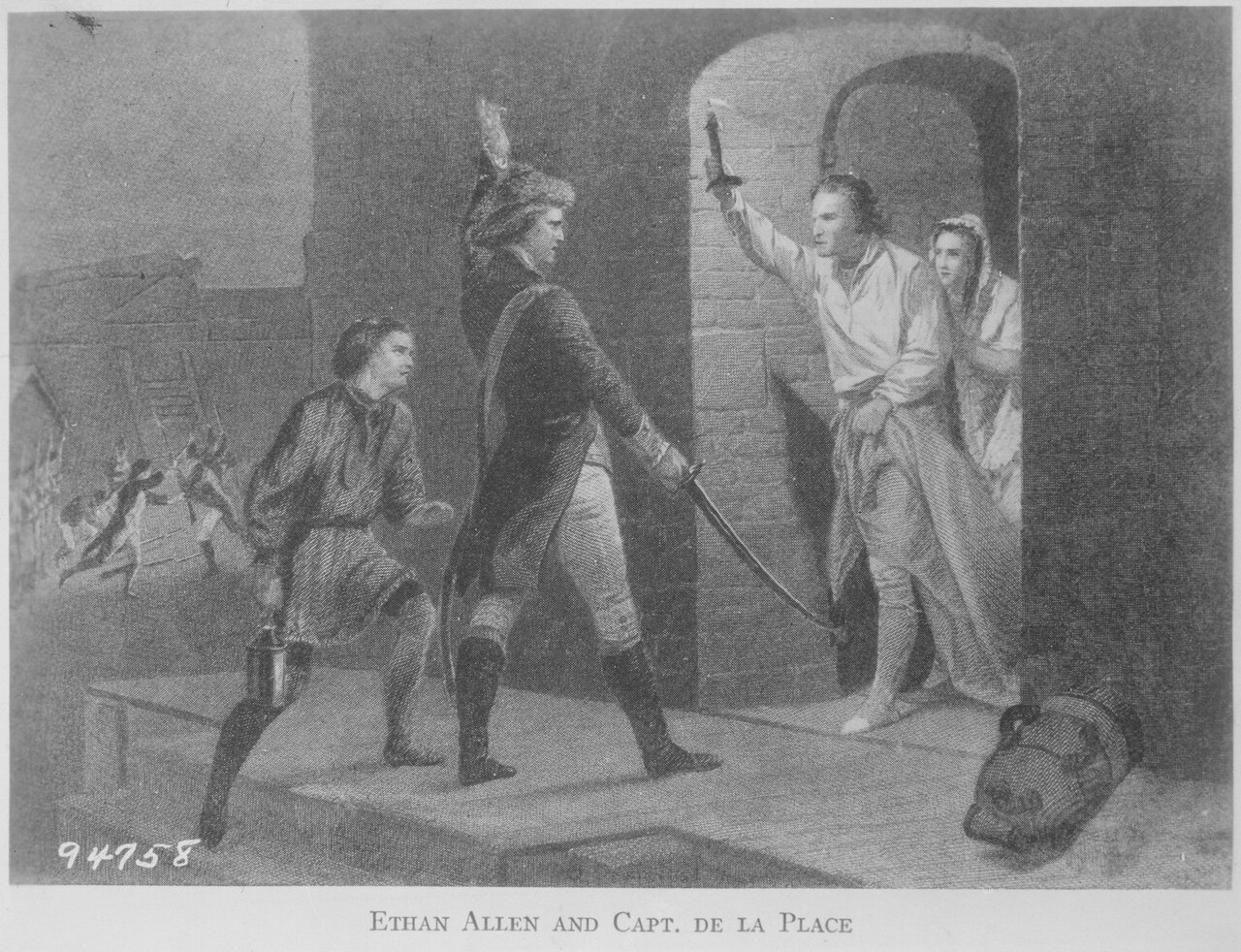
Dawn, May 10, 1775. A sentry at Fort Ticonderoga on Lake Champlain pulled the trigger on his musket and the flint snapped without firing. Ethan Allen ran at him. Behind Allen came eighty-odd men from the hills of what is now Vermont, and in a few minutes they owned a fort that held about a hundred cannon.1 The garrison was asleep. The American Battlefield Trust says the fort fell without a shot fired.2
Land Fights in the Green Mountains
Allen was born in Litchfield, Connecticut. The American Battlefield Trust gives his birth as January 21, 1738, and the Vermont Historical Society agrees on the year.23 He bought land in the New Hampshire Grants in 1770. New York claimed the ground, and so did the settlers who held New Hampshire titles. Allen and his cousin Remember Baker organized a militia to defend those settlers against the New York claimants, who were called Yorkers.3 The sources disagree on when the Green Mountain Boys began. The American Battlefield Trust puts it in the late 1760s, and Britannica says 1770 at Bennington.24
These were not choirboys. Britannica says the Boys stopped New York sheriffs and terrorized settlers who held New York grants, burning buildings, stealing cattle and flogging men with birch rods.4 So when Lexington and Concord came, Allen already had a small army that disliked authority sent from far away.
Ticonderoga, May 1775
Allen says that Connecticut privately sent him directions to raise the Green Mountain Boys and take the fort. He reached the lake opposite Ticonderoga on the evening of May 9 with 230 men, found boats scarce, and landed 83 before daylight forced his hand.1 He gave a short speech, offering to lead and asking volunteers to "poise your firelocks."1
He was not alone at the head. Benedict Arnold had come with orders from Massachusetts to raise men and take the fort, and he had no troops to back the orders. The two men argued over who commanded. The Dartmouth Alumni Magazine says they went in together, drew swords on each other over it, and that Arnold later complained that Allen "positively insisted that I should have no command."5 Allen's own narrative leaves Arnold out of the account of the attack, though the 1849 editors' note names him.1 One reference work puts it plainly: effective command lay with Allen, because his were the men who would obey.6
By Allen's count the surprise took Captain Delaplace, Lieutenant Feltham, a conductor of artillery, a gunner, two sergeants and forty-four rank and file, about one third of the garrison, along with about a hundred cannon, a thirteen-inch mortar and a number of swivels.1 Arnold counted as many as 130 guns worth saving.5 The guns were later hauled to Boston, where they helped force the British out in the spring of 1776.6 One more disagreement: Allen dates the capture to the tenth, and the same reference work says the eleventh.16 The tenth is the date Allen gave and the one this lesson uses.
Myth: Allen shouted "In the name of the great Jehovah and the Continental Congress"
Allen printed those words in his narrative, whose preface is dated March 25, 1779, in the form "In the name of the great Jehovah, and the Continental Congress."1 The phrase comes from his own account, and the sources checked for this lesson turn up no other eyewitness record of it. Fort Ticonderoga's own history page treats Allen's story as full of tall tales and says the garrison was more complicated than he made it sound. Lieutenant Feltham later wrote a deposition that tried to implicate his captain.7 The 1849 editors of Allen's book added a dry footnote of their own: "neither of the authorities he mentioned were much known in a British camp."1 Treat the sentence as Allen's version, which is still a good one.
Montreal and Captivity
Allen then went north with the invasion of Canada, with no commission from Congress. In late September 1775 he crossed the St. Lawrence by night with about 110 men, nearly 80 of them Canadians, to take Montreal in a pincer with Major John Brown. Brown's party never appeared. Allen fought for an hour and three quarters and surrendered.8 The Battlefield Trust calls the attempt foolhardy, and a newspaper of the day said he acted "without orders from the general."29
General Richard Prescott shook his cane over his captive. Allen says that Prescott ordered thirteen of the Canadians in the party killed, and that he stepped between them and the bayonets and told Prescott to kill him instead. Prescott answered that he would not execute him then, but that he would "grace a halter at Tyburn."8 Allen was put in irons on the schooner Gaspee and shipped to England, then held at Pendennis Castle in Cornwall.8 All of this is his own account, and he was a man who improved a story.
He came back through Halifax and New York. On Staten Island he was exchanged for Colonel Archibald Campbell, and the Battlefield Trust gives the date of his release as May 6, 1778.82 Congress gave him the brevet rank of colonel with back pay. He did not serve in the war again.2
Vermont and the British
He spent the rest of the war arguing for Vermont, which wanted to be a state apart from New York.2 That fight led to the part of his career that Vermonters still argue over. In October 1780 Allen met the Loyalist Justus Sherwood at Castleton, and the two agreed to a truce and a prisoner exchange. Sherwood also offered Vermont the privileges it had been denied if it came back into the British Empire.10
Allen said he wanted no part of a "damned Arnold plan to sell his country," and kept the talks open anyway.10 Vermont wrote to Congress that the talks were not serious and to the British that they were.10 Historians now accept that the negotiations happened.9 Benjamin Anderson calls it hedging and argues that survival, and the Allen family's land, outweighed patriotism. Sherwood wrote to the British that Vermonters seemed to "have two strings in their bows."10 Allen's domestic opponents suspected treachery but found no compelling evidence, and days later Yorktown ended any chance of Vermont returning to the Empire, though Allen kept up contact with the British through the 1780s.10
Reason and a Sudden Death
After the war Allen turned to religion, and not on the side of the churches. His book Reason the Only Oracle of Man attacked the Bible and the clergy and argued for natural religion. Published in 1785, it challenged Christian orthodoxy from a deist position and drew a flurry of negative press that damaged his reputation more than the Haldimand talks did. One Connecticut writer called him "prayerless and graceless."9 He moved to Burlington in 1787 and farmed land along the Winooski River.3 He died on February 12, 1789.2
Ethan Allen's Life at a Glance
- 1738 Born in Litchfield, Connecticut (January 21 per the American Battlefield Trust).
- 1770 Buys land in the New Hampshire Grants; the Green Mountain Boys form between the late 1760s and 1770, depending on the source.
- May 10, 1775 Takes Fort Ticonderoga; Arnold disputes who is in command.
- Late September 1775 Captured near Montreal; shipped to England in irons.
- May 6, 1778 Released in exchange for Archibald Campbell.
- 1780 Meets Justus Sherwood at Castleton on October 29.
- February 12, 1789 Dies at Burlington, Vermont.
Learn more
- Allen's own narrative on Project Gutenberg: the Ticonderoga, Montreal and captivity chapters in his own words
- American Battlefield Trust: Ethan Allen: a short biography
- Dartmouth Alumni Magazine: Seizing Fort Ticonderoga: the Allen and Arnold quarrel
- Hedging His Bets: the talks with Quebec
- Benedict Arnold: the man Allen quarreled with at the gate
Notes
- Ethan Allen, Of the Capture of Ticonderoga: His Captivity and Treatment by the British (fifth edition, with notes, Burlington, 1849), chapters on the capture of Ticonderoga. Source of the speech to his men, the 83 men landed, the garrison count, the cannon, the date and the demand for surrender, with the editors' footnote. Read it online. ↩
- American Battlefield Trust, "Ethan Allen," on his birth on January 21, 1738, the Green Mountain Boys in the late 1760s, the failed attempt on Montreal, his release on May 6, 1778, his brevet rank, his death on February 12, 1789 and the fort falling without a shot. Read it online. ↩
- Vermont Historical Society, "Freedom and Unity: Ethan Allen," on his 1738 birth, the 1770 land purchase, the founding of the Green Mountain Boys with Remember Baker, and the move to Burlington in 1787. Read it online. ↩
- Encyclopaedia Britannica, "Green Mountain Boys," on the militia forming in 1770 at Bennington, stopping New York sheriffs and terrorizing settlers who held New York grants. Read it online. ↩
- Dartmouth Alumni Magazine, "Seizing Fort Ticonderoga," on the entry through the wicket gate, the swords drawn between Allen and Arnold, Arnold's complaint and his count of 130 guns. Read it online. ↩
- History of War, "Capture of Ticonderoga, 11 May 1775," on effective command, the cannon taken to Boston and the date given as the eleventh. Read it online. ↩
- Fort Ticonderoga, "26th Regiment of Foot," on Captain Delaplace, Lieutenant Feltham and the history of the garrison compared with Allen's telling. Read it online. ↩
- Allen, Narrative, same edition, chapters on Montreal, Prescott, the Gaspee, Pendennis Castle, Staten Island and the exchange for Archibald Campbell. Read it online. ↩
- Journal of the American Revolution, "The Highs and Lows of Ethan Allen's Reputation as Reported by Revolutionary-Era Newspapers," on press criticism after Montreal, the acceptance by historians that the Haldimand talks occurred, and the reaction to Reason. Read it online. ↩
- Benjamin Anderson, "Hedging His Bets: Ethan Allen, the Haldimand Negotiations, and Allegiance in the American Revolution," Early Canadian History, February 28, 2022, on the Castleton meeting of October 29, 1780, the quoted words of Allen and Sherwood, the two letters and the end of the talks after Yorktown. Read it online. ↩
Terms in this lesson
- New Hampshire Grants
- The land between the Connecticut River and Lake Champlain that New Hampshire's governor sold to settlers. New York claimed the same ground, and the fight over it produced the Green Mountain Boys.
- Yorkers
- The settlers and officials holding New York titles to land in the Grants, whom Allen's neighbors opposed.
- Green Mountain Boys
- The militia of the Grants, started by Allen and his cousin Remember Baker to defend settlers holding New Hampshire titles against New York.
- Brevet rank
- An honorary promotion. Congress gave Allen the brevet rank of colonel after his release.
- Deism
- A belief in a Creator who can be known by reason, without revelation. Allen's book Reason the Only Oracle of Man argued from it.
- Haldimand negotiations
- Talks that began in 1780 between Vermont leaders, Allen among them, and Frederick Haldimand, the British governor of Quebec.
Sources
- Ethan Allen, Of the Capture of Ticonderoga: His Captivity and Treatment by the British (fifth edition with notes, Burlington, 1849), Project Gutenberg checked 2026-10
- American Battlefield Trust, Ethan Allen checked 2026-10
- Vermont Historical Society, Freedom and Unity: Ethan Allen checked 2026-10
- Dartmouth Alumni Magazine, Seizing Fort Ticonderoga checked 2026-10
- Benjamin Anderson, Hedging His Bets: Ethan Allen, the Haldimand Negotiations, and Allegiance in the American Revolution checked 2026-10
- Journal of the American Revolution, The Highs and Lows of Ethan Allen's Reputation checked 2026-10
- Fort Ticonderoga, 26th Regiment of Foot checked 2026-10
- Encyclopaedia Britannica, Green Mountain Boys checked 2026-10
- History of War, Capture of Ticonderoga, 11 May 1775 checked 2026-10