Lesson 10 of 60 · about 9 minutes
Friedrich von Steuben: The Drillmaster of Valley Forge
You'll be able to
- Explain what Steuben actually was in Prussia and how his rank was inflated on the way to America
- Describe how he trained the Continental Army at Valley Forge with a model company
- Say who helped him translate the drills and why sources disagree
- Name the Blue Book, its publication date and its long use
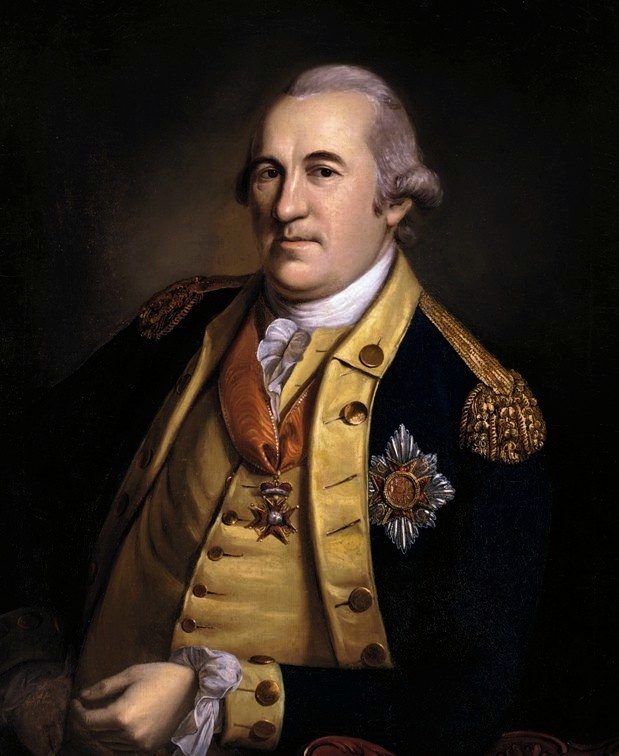
Friedrich von Steuben arrived at Valley Forge on February 23, 1778, speaking almost no English. Washington rode out to meet him.1 One soldier wrote that the new arrival "seemed to me a perfect personification of Mars."2 He was not, by any measure that mattered to the Prussian army, a great general. He turned out to be something more useful, a man who knew how to train soldiers.
A Captain with a Title
Steuben was born September 17, 1730, in Magdeburg, Prussia, and joined the Prussian army at seventeen as a lance-corporal.3 He fought in the Seven Years' War and was discharged as a captain in 1763.3 In 1771 a German prince gave him the title baron.3 Mount Vernon puts it more bluntly: after the war the king cut military spending and let him go, and he spent about twelve years as a chamberlain at a small court, where he restyled himself a baron.4 He was short of money and wanted a post.
In Paris in 1777, Benjamin Franklin described him as a lieutenant general from a noble Prussian family. The Park Service attributes the rank to a mistranslation of a Prussian post, Deputy to the Quartermaster General. Washington learned that the man had risen only to captain.5 Congress did not mind. It commissioned him a major general and Inspector General on May 6, 1778.6The Mount Vernon essay adds that his skill at training soldiers was "second to none."4
Franklin had met Steuben in Paris and judged him an experienced soldier who could bring order to the Continental Army.4 The Battlefield Trust adds the terms. The American envoys in France, Franklin and Silas Deane, could offer only a volunteer's post with no rank and no pay, and Congress later agreed to pay him according to the outcome of the war and his contribution.7 A man who had been a chamberlain with a borrowed title took that deal and crossed the Atlantic in winter.
The Model Company
He found an army short of supplies and short of method. Because he could not yet write English, he wrote the drills in French, and his secretary Pierre Duponceau translated them with help from John Laurens and Alexander Hamilton.8 History.com says Hamilton and Greene did the translating, so the sources differ on who stood beside him.9
He trained a model company of about 120 men, drawn from Washington's guard and from each state, and wrote new lessons at night, staying only a few days ahead of the army.10 He worked directly with the men, which some American officers resented.10 On June 15, 1778, Washington issued orders governing the Inspector General's office, which suggests the friction was real enough to need rules.10 He also taught camp hygiene, including placing kitchens and latrines on opposite sides of the camp, with latrines facing downhill.9
Monmouth and the Blue Book
When the army left Valley Forge in June 1778, its trained soldiers nearly beat the British at Monmouth Courthouse, New Jersey, a battle the Park Service calls essentially a draw.11 Washington asked Steuben to write a manual once the troops were trained.12 It was published in Philadelphia by Styner and Cist in March 1779 as Regulations for the Order and Discipline of the Troops of the United States. The first printing was 1,500 copies of 150 pages with 8 plates in blue covers, which gave it its nickname, the Blue Book.12 It went through about seventy editions and stayed a key reference until the War of 1812.12
Myth: Steuben was a Prussian lieutenant general
The rank came from Franklin's letter, and the Park Service blames a mistranslation.5 His actual Prussian rank was captain.3 The sources here do not say whether Steuben had a hand in the inflation, and the safest reading is that Franklin's letter carried the claim and nobody corrected it until Washington asked.5
Who wrote the Blue Book?
The Park Service says Steuben wrote the manual at Washington's request, in French, and had it translated.12 Mount Vernon says he wrote the Blue Book with Hamilton and Lafayette.4 The two accounts are not far apart. Steuben supplied the system and the Americans around him supplied the English. Neither source says which of the helpers did the most.
After Valley Forge
He served as an instructor and supply officer for Nathanael Greene in the Carolinas and was present at Yorktown, where Washington gave him a battalion to command.13 On December 23, 1783, Washington wrote to thank him for his "faithful and meritorious Services."14 The states gave him land grants. He became an American citizen. He died on November 28, 1794, and was buried on his farm near Rome, New York.15 The Mount Vernon essay gives the place of death as Utica, so the sources vary on that detail as well.15
Steuben's Life at a Glance
- 1730 Born September 17 in Magdeburg, Prussia.
- 1747 Enlists in the Prussian army.
- 1763 Discharged as a captain.
- 1771 Receives the title baron from a German prince.
- 1777 Meets Franklin in Paris and sails for America.
- February 23, 1778 Reaches Valley Forge.
- May 6, 1778 Commissioned major general and Inspector General.
- June 1778 Trained army fights at Monmouth.
- March 1779 Blue Book published in Philadelphia.
- 1781 Present at Yorktown.
- November 28, 1794 Dies in New York.
Learn more
- NPS: General von Steuben: the Park Service on his rank, the model company and the translators
- NPS: Steuben's Regulations Book: the first edition and how it was made
- Mount Vernon: Baron von Steuben: a clear life with Washington's letter of thanks
- History.com: Steuben arrives at Valley Forge: the camp hygiene and the translators
Notes
- Mount Vernon Digital Encyclopedia, "Baron von Steuben," on Washington riding out to meet him on February 23, 1778. Read it online. ↩
- National Park Service, "General von Steuben," Valley Forge National Historical Park (updated February 23, 2024), quoting an unnamed soldier. Read it online. ↩
- American Battlefield Trust, "Baron von Steuben," on his birth on September 17, 1730, in Magdeburg, his enlistment in 1747, his discharge as a captain on April 29, 1763, and the title baron given in 1771 by Prince Hohenzollern-Hechingen. Read it online. ↩
- Mount Vernon, same article, on Franklin's view of Steuben as an experienced soldier who could bring order to the Continental Army, his dismissal after the Seven Years' War, about twelve years as chamberlain at Hohenzollern-Hechingen, restyling himself a baron, and his expertise in training soldiers being "second to none." Read it online. ↩
- National Park Service, same article, on Franklin's letter of introduction calling him a lieutenant general and the mistranslation; Mount Vernon, same article, on Washington learning that he had risen only to captain. Read it online. ↩
- National Park Service, same article, on his commission as major general and Inspector General on May 6, 1778. Read it online. ↩
- American Battlefield Trust, same article, on the offer of a volunteer's post without rank or pay and on Congress's agreement to pay him according to the war's outcome and his contribution. Read it online. ↩
- National Park Service, same article, on drills written in French, Duponceau as secretary and translator, and help from John Laurens and Alexander Hamilton. Read it online. ↩
- History.com, "Friedrich von Steuben arrives at Valley Forge," on Hamilton and Greene as translators and the camp layout rules for kitchens and latrines. Read it online. ↩
- National Park Service, same article, on the model company of about 120 men drawn from Washington's guard and each state, the night writing of lessons, and officers who resented his working directly with the troops. Read it online. ↩
- Mount Vernon, same article, on the near victory at Monmouth in June 1778; National Park Service, same article, calling the battle essentially a draw. Read it online. ↩
- National Park Service, "Steuben's Regulations Book," on Washington's request, the Blue Book published by Styner and Cist in March 1779, its 1,500 copies, 150 pages, 8 plates, about seventy editions and use until the War of 1812. Read it online. ↩
- American Battlefield Trust, same article, on Steuben assisting Greene in the South; Mount Vernon, same article, on his battalion at Yorktown. Read it online. ↩
- Mount Vernon, same article, quoting Washington to Steuben, December 23, 1783. Read it online. ↩
- American Battlefield Trust, same article, on his death on November 28, 1794; Mount Vernon, same article, on burial near Rome, New York, and Utica as the place of death. Read it online. ↩
Terms in this lesson
- Inspector General
- The officer responsible for drill, discipline and inspection. Washington made Steuben temporary Inspector General, and Congress confirmed it.
- Model company
- A picked unit of about 120 men that Steuben trained first, so they could teach the rest.
- Close-order drill
- Training soldiers to march, turn and load together in ranks.
- Blue Book
- The nickname of Regulations for the Order and Discipline of the Troops of the United States, published in 1779.
- Freiherr
- A German noble title, usually translated baron.
Sources
- National Park Service, General von Steuben, Valley Forge checked 2026-10
- Mount Vernon Digital Encyclopedia, Baron von Steuben checked 2026-10
- American Battlefield Trust, Baron von Steuben checked 2026-10
- National Park Service, Steuben's Regulations Book checked 2026-10
- History.com, Friedrich von Steuben arrives at Valley Forge checked 2026-10