Lesson 32 of 60 · about 9 minutes
Sybil Ludington: The Midnight Ride the Record Cannot Confirm
You'll be able to
- Separate the documented Danbury raid from the undocumented ride
- Trace the ride through its first printed accounts of 1880 and 1907
- Say what historians find missing from the record, and what the family tradition has going for it
- Describe what is known of Sybil's marriage, widowhood and death
On the evening of Saturday, April 26, 1777, a worn-out horseman is said to have reached Colonel Henry Ludington's house at Fredericksburg, New York, with news that Danbury was burning.1 The colonel's regiment was scattered across the farms of the county. Someone had to ride and call the men in. According to a book printed 130 years later, he turned to his oldest daughter, who had just passed her sixteenth birthday.1 The burning of Danbury is documented. The ride is a family story, and no one has found a document from 1777 that confirms it.

The Raid That Is Documented
On April 25, 1777, British regulars and Loyalists landed at Compo Beach on Long Island Sound, 1,500 by one count and about 1,850 by another. Major General William Tryon led them inland and reached Danbury about a day later.2 Washington had made the town a supply depot. The British had no wagons to carry the stores away, so they burned them, 22 storehouses in all, while sparing Loyalist homes. General Howe's report counted 1,000 barrels of flour, 1,020 tents and 5,000 pairs of shoes and stockings among the losses.2
The American response came at Ridgefield. General David Wooster was mortally wounded leading about 200 men against the British rear guard, and Benedict Arnold fortified a strong point on the Ridgefield road, where the combined American force numbered about 400.2 The next day the British reached their ships. Tryon was no stranger to the Ludingtons. Johnson's memoir says Henry had once held a commission under him.1
Colonel Ludington and His Daughter
Henry Ludington was born May 25, 1739, in Branford, Connecticut (some records say 1738), served in the French and Indian War, and settled in what is now Kent, New York.31 By 1777 he commanded a Dutchess County militia regiment of about 400 men.4 A family register printed in the memoir gives Sybil's birth as April 5, 1761, the first of twelve children.1
The memoir's version is short. Johnson says Henry's regiment was disbanded and its men were at home, that the messenger could ride no farther, and that Henry stayed to muster arrivals. So he "bade her to take a horse, ride for the men, and tell them to be at his house by daybreak."1 It lays out no route, gives no distance, and does not name the horse. Later tellers supplied those. Historic Patterson, a town history site, describes about 40 miles through Mahopac and Stormville in rain, and the American Battlefield Trust names the horse Star.45
Myth: She rode 40 miles on a horse named Star
Johnson's 1907 account has no mileage, no route and no horse's name.1 Smithsonian Magazine notes that tellers even disagree on whether she rode bareback or sidesaddle and whether the horse was called Star.6 Detail that appears only in later retellings is the retellers' work.
The First Three Accounts: 1854, 1880, 1907
The earliest known mention is a letter of 1854 from Sybil's nephew, Charles H. Ludington, asking that she be honored at a ceremony for Revolutionary heroes. It describes her riding "on horseback in the dead of night" to inform General Putnam.6 Historian Vincent Dacquino found the letter, according to Smithsonian.6
The first printed account came in 1880, in Martha J. Lamb's History of the City of New York. Lamb has the messenger reach Colonel Ludington at Carmel, with his men scattered over many miles, "his daughter Sibyl Ludington, a spirited young girl of sixteen, mounted her horse in the dead of night and performed this service."7 The book cites no source for the passage.6 The Clio history site says Lamb drew partly on correspondence with the Ludington family.8
In 1907 two of Henry's grandchildren, Lavinia Elizabeth and Charles Henry Ludington, had Willis Fletcher Johnson's Colonel Henry Ludington: A Memoir printed. The preface says Charles received papers from a descendant of Sybil Ludington Ogden.1 Johnson expands the scene, with a "hempen halter" and a comparison to Paul Revere. He says, "There is no extravagance in comparing her ride with that of Paul Revere."1 Hunt found that the ride never spread beyond Lamb's and Johnson's local histories, even though stories of heroic women filled books and magazines by the 1870s.9
What the Record Does Not Hold
Henry's own papers are the obvious place to look. Johnson's memoir reproduces many of them, including a state Convention resolution and affidavits Henry gathered in 1815 to establish a pension for his French and Indian War service.1 The ride passage cites none of them. Sybil's surviving letters do not mention it either, Smithsonian reports.6 Paula Hunt, in a 2015 study in the New England Quarterly, found the story absent from other Revolutionary histories of the New York area and from books on women's contributions to the war.10 Alexander Hamilton wrote to Gouverneur Morris in praise of the people's spirit during the Danbury expedition, and Johnson prints the passage. It does not mention a girl.1
The family has points in its favor. The memoir records Sybil and her sister Rebecca serving as sentries with muskets and helping the spy Enoch Crosby, and prints a relative's letter in which "Aunt Ogden" describes the sisters firing guns to make soldiers think men were in the house.1 Militia calls often went unrecorded, and a girl who knew the roads is plausible. But the passage Johnson prints about the guns says nothing of a ride. Plausible is where the evidence stops. Hunt treats the ride as unproven. In 1996 the national Daughters of the American Revolution refused a local chapter's request to mark her grave as that of a recognized patriot, because the chapter did not give conclusive evidence of her service. A DAR exhibition in 2006 and 2007 put it this way: "It's a great story, but there is no way to know whether or not it is true."9
How the Legend Got a Statue and a Stamp
In the 1930s the Enoch Crosby chapter of the DAR pushed for markers honoring Sybil and her father.8 New York State began installing markers in 1934, and the Ludington markers went up the next year. Hunt says the route they follow was devised speculatively by the project managers.9 Doubts had been raised by 1956.9 In 1961 Anna Hyatt Huntington's bronze of Sybil on horseback, a stick in her hand, was dedicated at Lake Gleneida in Carmel.8
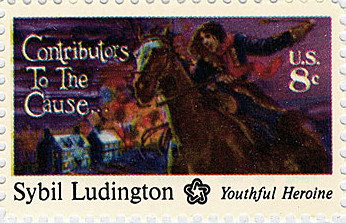
The Postal Service issued the stamp on March 25, 1975, as one of four honoring unrecognized heroes of the Revolution, and it was an 8-cent stamp.1112 Hunt traces how the character changed with the times, a patriotic youth in the 1950s, a feminist icon in the 1960s and 1970s, and later a classroom staple.10
Marriage, Widowhood and Death
The memoir's register has Sybil marrying "Edward Ogden," a name it says is elsewhere given as Edmund or Henry, on October 21, 1784, the same date Hunt gives for her marriage to Edmund Ogden, a sergeant in a Connecticut regiment.19 Historic Patterson, citing her pension application, gives October 24, 1785, and says some accounts make Ogden a lawyer while other research has him running a tavern. Hunt says the lawyer in the family was their son Henry.49 The couple had a son, Henry, and moved to the Catskill area, where she ran an inn. Edmond died in 1799 of yellow fever.64 Henry became a lawyer and a state assemblyman in 1819.6
In April 1838 Sybil applied for a widow's pension based on her husband's service. It was denied because she could not prove the marriage. Hunt reports that none of the sworn affidavits about his service and the marriage mentioned a ride by her.69 She died on February 26, 1839, at 77, and was buried near her father.54 Even her name is unsettled. Her gravestone reads "Sibbell," she signed her pension papers "Sebal," and the form "Sybil" appears on no official document.4
Sybil Ludington's Life at a Glance
- April 5, 1761 Born at Fredericksburg, New York, eldest of twelve children.
- April 25 to 27, 1777 British land at Compo, burn the Danbury stores, and fight at Ridgefield.
- 1784 or 1785 Marries Edmond Ogden; sources give different dates.
- 1799 Ogden dies; she runs the family inn.
- 1838 Applies for a widow's pension and is turned down.
- February 26, 1839 Dies at 77.
- 1854 First known mention of the ride, in a nephew's letter.
- 1880 Martha Lamb prints the ride in her history of New York.
- 1907 Johnson's memoir of Henry Ludington expands it.
- 1961 Statue dedicated at Carmel, New York.
- March 25, 1975 U.S. stamp issued.
Learn more
- Colonel Henry Ludington: A Memoir (1907): the book that expanded the story, free to read; the ride is on page 90
- Smithsonian Magazine: Did the Midnight Ride of Sibyl Ludington Ever Happen?: the 1854 letter and the missing evidence
- Historic Patterson: Sybil Ludington: the local version, with the family details
- Connecticut History: The British Raid on Danbury: the documented raid
Notes
- Willis Fletcher Johnson, Colonel Henry Ludington: A Memoir (New York: printed by his grandchildren Lavinia Elizabeth Ludington and Charles Henry Ludington, 1907), the chapter on the Revolution (ride at about p. 90), the family register, the preface, the affidavits of September 1815, and the family letter quoting "Aunt Ogden." Quotations checked against the scanned text. Read it online. ↩
- Connecticut History, "The British Raid on Danbury" (Richard Buel), on the landing at Compo Beach on April 25, 1777, Tryon's force, the burning of 22 storehouses, Howe's list of losses, Wooster's wound and Arnold's stand at Ridgefield. Read it online. ↩
- Wikipedia, "Henry Ludington," on his French and Indian War service and his settlement in Kent, and on a birth date of May 25, 1738. Johnson (note 1) gives May 25, 1739, and says the weight of authority favors that year. Read it online. ↩
- Historic Patterson (Town of Patterson, New York), "Sybil Ludington," on the 7th Dutchess County Militia of about 400 men, the 40-mile route, the spellings of her name, the marriage date in her pension application, Ogden's occupation and her burial near her father. Read it online. ↩
- American Battlefield Trust, "Sybil Ludington," on the horse Star, her dates of April 5, 1761, to February 26, 1839, and her burial. The page cites no sources. Read it online. ↩
- Abigail Tucker, "Did the Midnight Ride of Sibyl Ludington Ever Happen?", Smithsonian Magazine, March 2022, on the 1854 letter, Dacquino's findings, the uncited 1880 account, her letters, her marriage, widowhood, son and the denied pension. Read it online. ↩
- Martha J. Lamb, History of the City of New York, vol. 2 (New York: A. S. Barnes, 1880), pp. 159 to 160, the passage on the burning of Danbury. Read it online. ↩
- Clio, "Sybil Ludington Statue," on Lamb's use of family correspondence, the DAR chapter's work in the 1930s, and the 1961 dedication of Huntington's statue at Lake Gleneida. Read it online. ↩
- Paula D. Hunt, "Sybil Ludington, the Female Paul Revere: The Making of a Revolutionary War Heroine," New England Quarterly 88, no. 2 (June 2015): 187 to 222, on Lamb and Johnson as the only published accounts (p. 195), the speculative route and the markers of 1934 and 1935 (pp. 196 to 199), the 1996 DAR decision and the DAR exhibition quotation (pp. 217 to 218), the 1956 doubts (p. 220, note 114), and, on p. 189, the marriage on 21 October 1784, Ogden's service as a sergeant, the son Henry, the April 1838 pension claim and the affidavits. Hunt calls Johnson's memoir "a not wholly reliable source." Read it online. ↩
- Kat Eschner, "Was There Really a Teenage, Female Paul Revere?", Smithsonian Magazine, reporting Hunt's findings that the ride is absent from other histories of Revolutionary New York and from books on women's contributions, and how the character changed from a patriotic youth in the 1950s to a feminist icon in the 1960s and 1970s and a classroom staple. Read it online. ↩
- National Postal Museum, "Sybil Ludington," on the issue date of March 25, 1975, the series of four stamps and the inscription "Youthful Heroine." Read it online. ↩
- Mystic Stamp Company, "1975 8c Contributors to the Cause: Sybil Ludington," Scott number 1559, on the denomination and series. Read it online. ↩
Terms in this lesson
- Militia
- Part-time citizen soldiers called out by local colonels. Henry Ludington commanded a Dutchess County regiment of about 400 men.
- Danbury raid
- The British expedition of April 25 to 28, 1777, led by Major General William Tryon, that destroyed the Continental Army's stores at Danbury, Connecticut.
- Family tradition
- A story handed down by relatives. It can preserve true events, but it needs outside evidence before historians treat it as fact.
- Contemporary evidence
- Letters, orders, diaries or newspapers made at the time of the event. The Ludington ride has none.
- Skinners
- Bands of armed marauders who preyed on civilians in the lower Hudson Valley during the war.
- Widow's pension
- A federal payment to the widow of a Revolutionary veteran, which required proof of her marriage and of his service.
Sources
- Willis Fletcher Johnson, Colonel Henry Ludington: A Memoir (1907), full text checked 2026-10
- Martha J. Lamb, History of the City of New York, vol. 2 (1880), the Danbury passage checked 2026-10
- Smithsonian Magazine, Did the Midnight Ride of Sibyl Ludington Ever Happen? checked 2026-10
- Paula D. Hunt, Sybil Ludington, the Female Paul Revere: The Making of a Revolutionary War Heroine, New England Quarterly 88 (2015) checked 2026-10
- Smithsonian Magazine, Was There Really a Teenage, Female Paul Revere? checked 2026-10
- Connecticut History, The British Raid on Danbury checked 2026-10
- Historic Patterson, Sybil Ludington checked 2026-10