Lesson 5 of 60 · about 8 minutes
Margaret Corbin: The Woman Who Kept the Gun Firing
You'll be able to
- Describe what Margaret Corbin did at Fort Washington on November 16, 1776
- Explain the pension Congress gave her in 1779 and why it was unusual
- Tell the difference between Corbin and Mary Hays, the woman most often linked to the name Molly Pitcher
- Judge which parts of the Molly Pitcher story rest on records and which on tradition
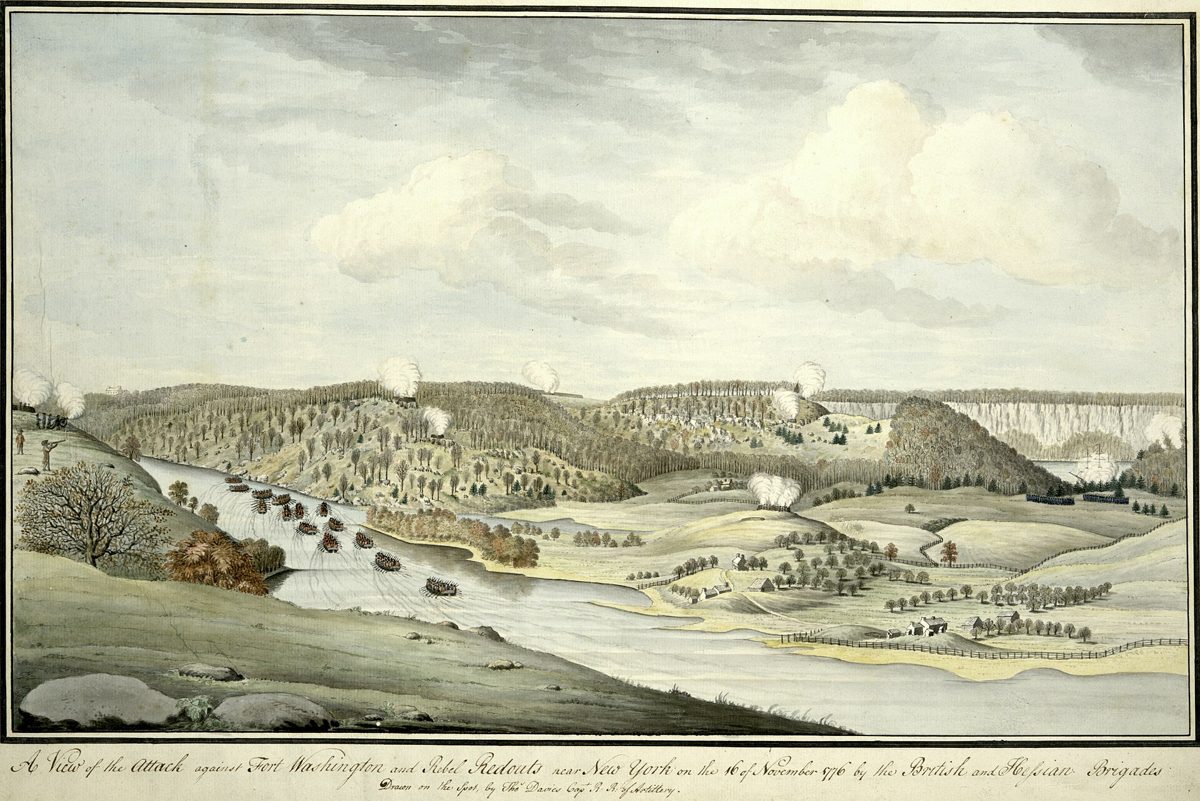
On November 16, 1776, British and Hessian troops stormed Fort Washington, an earthwork on the northern end of Manhattan. Inside, a Pennsylvania artillery crew was firing a cannon until a shot killed the man working it. His wife stepped into his place and kept loading and firing.1 Her name was Margaret Corbin. She was twenty-five years old.
From Pennsylvania to Manhattan
Margaret Cochran was born on November 12, 1751, in what is now Franklin County, Pennsylvania, near Chambersburg.2 She married John Corbin in 1772, and he joined the Pennsylvania military in 1775.2 Women followed armies in the eighteenth century as a matter of course. They cooked, washed, nursed and sometimes drew rations, and the army tolerated them because soldiers did better when their families stayed near. Margaret went with her husband to the Hudson.3
The Fall of Fort Washington
The attack on November 16 overwhelmed the garrison. John Corbin was killed at his gun. Margaret took over the cannon and fired until grapeshot hit her in the left arm, chest and jaw.4 Fraunces Tavern Museum calls her "the last one to cease firing" before the fort fell.5 The British captured the garrison. One account has Margaret taken to an army hospital in Philadelphia, and another says she was paroled.6 Either way she survived, and she never regained use of her left arm.4
Soldiers in the army knew her as "Captain Molly."7 That nickname is one reason the two women later got mixed up.
The Pension of 1779
On July 6, 1779, the Continental Congress voted her a lifetime pension of half the pay of a male soldier, and a suit of clothes.8 Half-pay was less than a man got. It was still a wage from the national government to a woman for military service, and the grant came in the form of relief for a disabled soldier. She was attached to the Corps of Invalids at West Point and stayed until her discharge in 1783.9
In 1782 she married a wounded soldier, who died about a year later.10 After the war she lived near West Point for roughly twenty years. She died there in 1800, before turning fifty.10 Her grave on the Hudson was not marked well, and in 1926 the New York Daughters of the American Revolution had her remains moved to the West Point cemetery. She was buried with military honors on April 24, 1926.11
Corbin and Molly Pitcher
Everyone has heard of Molly Pitcher, and almost no one can say who she was. The usual story puts her at the Battle of Monmouth, New Jersey, on June 28, 1778, carrying water to the gunners in the heat and then taking over her husband's cannon when he fell. Fraunces Tavern Museum identifies the woman most often named as Mary Ludwig Hays. In its account she joined her husband William Hays in the Fourth Pennsylvania Artillery, carried pitchers of water on the field, and manned the gun when he collapsed.12
The details past that point turn soft. The museum says Washington "supposedly asked" about her and "allegedly" made her a non-commissioned officer.13 The Pennsylvania legislature gave her a veteran's pension of $40 a year in 1822, and she died in 1832.13 Her service rests on later recollection and on that pension, not on a roster entry from Monmouth.
Myth: Molly Pitcher was Margaret Corbin
Some sources treat the two as one woman, and Women History Blog says Corbin "is sometimes confused" with Molly Pitcher.14 The records point to two women at two battles two years apart. Corbin fought at Fort Washington in 1776, was wounded and was pensioned by Congress. Hays is linked to Monmouth in 1778. Fraunces Tavern Museum treats the name Molly Pitcher as a collective label for the women who worked the guns and carried water, which is probably the safest way to hold it.15
Where the sources about Corbin differ
The accounts of Corbin disagree on small points. The National Women's History Museum gives Franklin County, Pennsylvania, as her birthplace and says John Corbin joined the Pennsylvania military. Women History Blog says she was born near Chambersburg, which is in Franklin County, and calls John Corbin a Virginia farmer.24 The museum says she was captured and paroled. The blog says she was taken to a hospital in Philadelphia.6 The blog also lists a $30 payment from Pennsylvania dated June 26, 1776, a date that sits oddly with a battle in November, and the page does not explain it.4 None of this changes the central facts: a woman at a gun, a crippling wound, and a pension from Congress.
Why the confusion lasted
Both women were nicknamed Molly, both were gunners' wives, and both showed up in the story of an artillery piece losing its crew. Over time retellers fused them into a single heroine with a bucket. The bucket is the part with the least documentary support.
Corbin has the paper. The pension resolution of July 6, 1779, is a congressional record, and it gives her the one thing the legend cannot give anyone else: a government acknowledging that she was wounded in the line of duty.
Corbin's Life at a Glance
- 1751 Born November 12 near Chambersburg, Pennsylvania.
- 1772 Marries John Corbin.
- 1775 John Corbin joins the Pennsylvania artillery.
- 1776 Takes over her husband's cannon at Fort Washington on November 16 and is badly wounded.
- 1779 Congress grants her a lifetime pension on July 6.
- 1782 Marries a wounded soldier, who dies about a year later.
- 1783 Leaves the Corps of Invalids at West Point.
- 1800 Dies near West Point.
- 1926 Reburied at West Point with military honors on April 24.
Learn more
- National Women's History Museum: Margaret Cochran Corbin: a clear short biography with the 1926 reburial
- Fraunces Tavern Museum: Women with Guns: Hays and Corbin side by side, with the careful use of "supposedly" and "allegedly"
- Women History Blog: Heroine of the Battle of Fort Washington: a more detailed account of her wounds
Notes
- National Women's History Museum, "Margaret Cochran Corbin," on the attack on Fort Washington on November 16, 1776. Read it online. ↩
- National Women's History Museum, same article, on her birth on November 12, 1751, in Franklin County, her marriage in 1772 and John Corbin's enlistment in 1775. Read it online. ↩
- Fraunces Tavern Museum, "Women with Guns," on women who accompanied the army; the museum notes that the number of camp followers during the war is unknown. Read it online. ↩
- Women History Blog, "Heroine of the Battle of Fort Washington," on John Corbin's death, the grapeshot wounds to her left arm, chest and jaw, and the loss of use of her arm. Read it online. ↩
- Fraunces Tavern Museum, same page, on Corbin as "the last one to cease firing" before the Continental troops left the fort. Read it online. ↩
- Women History Blog, same article, on the army hospital in Philadelphia; National Women's History Museum, same article, on her capture and parole. Read it online. ↩
- National Women's History Museum, same article, on the nickname "Captain Molly." Read it online. ↩
- National Women's History Museum, same article, on the Continental Congress resolution of July 6, 1779: half the pay of a male soldier and a suit of clothes. Read it online. ↩
- National Women's History Museum, same article, on the Invalid Regiment at West Point and her discharge in 1783; Women History Blog, same article, on the Corps of Invalids. Read it online. ↩
- National Women's History Museum, same article, on her 1782 marriage and her death in 1800. Read it online. ↩
- Fraunces Tavern Museum, same page, on her grave being located in 1926 and her reburial at West Point on April 24, 1926. Read it online. ↩
- Fraunces Tavern Museum, same page, on Mary Ludwig Hays, William Hays, the Fourth Pennsylvania Artillery and Monmouth on June 28, 1778. Read it online. ↩
- Fraunces Tavern Museum, same page, on the words "supposedly" and "allegedly" attached to Washington's reported interest in her, the 1822 Pennsylvania pension of $40 a year and her death in 1832. Read it online. ↩
- Women History Blog, same article, saying Corbin "is sometimes confused" with Molly Pitcher. Read it online. ↩
- Fraunces Tavern Museum, same page, on "Molly Pitcher" as a collective name for women who worked on battlefields. Read it online. ↩
Terms in this lesson
- Fort Washington
- An American earthwork on the northern end of Manhattan, taken by British and Hessian troops on November 16, 1776.
- Matross
- A soldier who assisted the gunners of an artillery piece by loading, sponging and moving it. Corbin's husband served in such a role.
- Invalid Corps
- A unit of wounded or disabled soldiers given lighter duty. Corbin was attached to it at West Point.
- Camp follower
- A civilian, often a wife, who traveled with the army and cooked, washed and nursed.
- Composite legend
- A single story built from several real people. Molly Pitcher is often described this way.
Sources
- National Women's History Museum, Margaret Cochran Corbin checked 2026-10
- Fraunces Tavern Museum, Women with Guns: Molly Pitcher checked 2026-10
- Women History Blog, Heroine of the Battle of Fort Washington checked 2026-10