Lesson 47 of 60 · about 9 minutes
Light-Horse Harry Lee: The Cavalryman Who Eulogized Washington
You'll be able to
- Describe Lee's Legion, the raid on Paulus Hook and his service under Greene in the Carolinas
- Separate Lee's own account of the Champe plot against Arnold from what documents can confirm
- Explain who wrote the words "first in war, first in peace, and first in the hearts of his countrymen" and how the wording changed
- Trace his fall into debt and the 1812 Baltimore riot that broke his health
On December 26, 1799, twelve days after George Washington died, Major General Henry Lee stood in the German Lutheran Church in Philadelphia and delivered the funeral oration, written at the request of Congress.1 Reports put the crowd near 4,000.2 Lee was forty-three. He had ridden for Washington, fought under Greene, and run Virginia as governor. Within twenty years he would be broke, jailed for debt and beaten half to death by a mob.
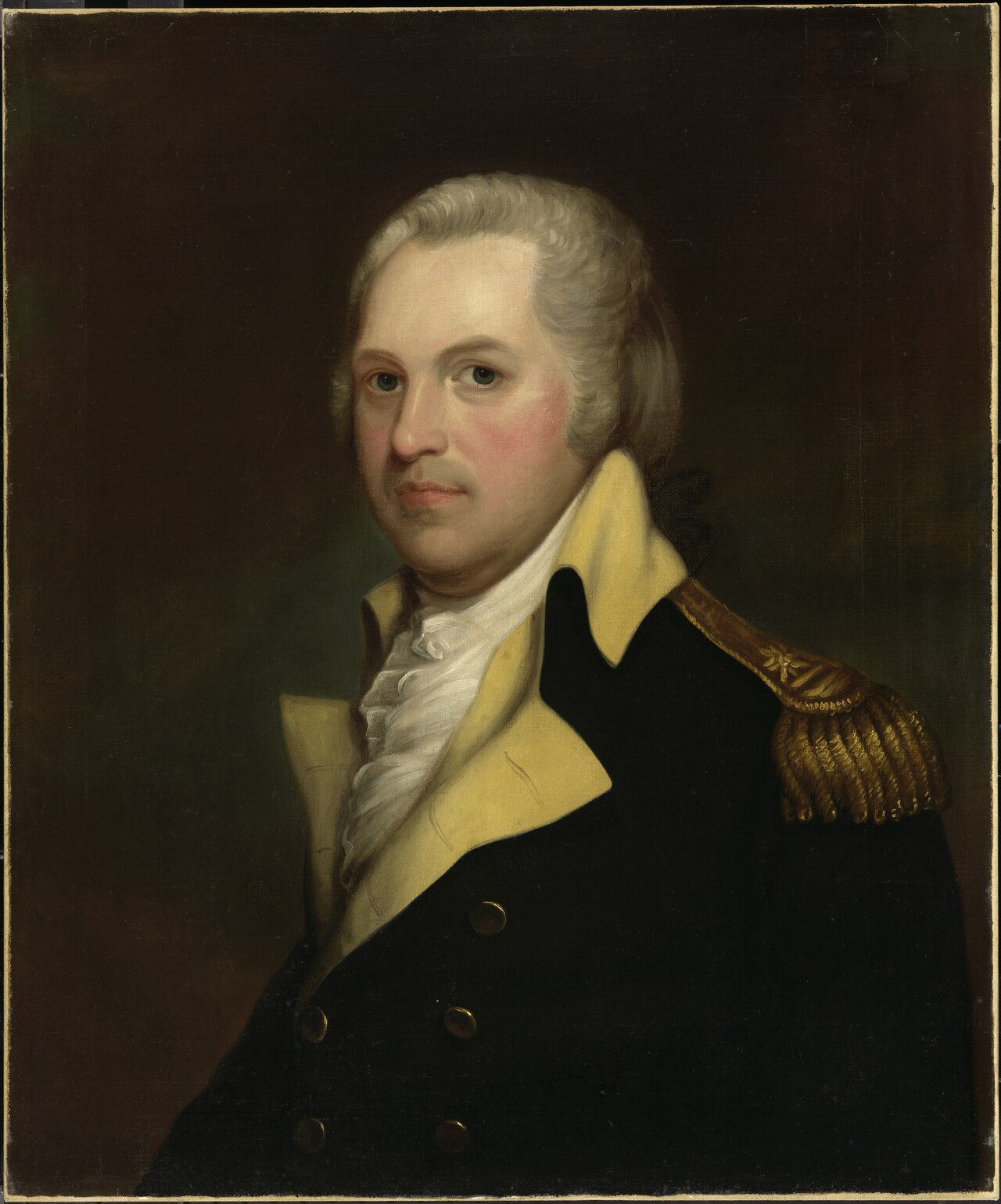
From Princeton to the Partisan Corps
Lee was born January 29, 1756, at Leesylvania in Prince William County, Virginia, and graduated from the College of New Jersey (Princeton) in 1773. In June 1776 Patrick Henry commissioned him a captain of Virginia light horse. By the next January he was with Washington's army, scouting and raiding.3 His speed on reconnaissance in the Philadelphia campaign earned him the name "Light-Horse Harry."2 In January 1778 he was promoted to major and given a mixed command of cavalry and infantry. On November 6, 1780, he became a lieutenant colonel with a legion of about 300 picked men.2
He was a hard officer. He once had a deserter beheaded and the head displayed, and Washington ordered him not to do it again.2 The Trust calls him impetuous and an aggressive fighter, and says he quarreled with many officers.3
Paulus Hook, August 19, 1779
After Anthony Wayne took Stony Point in July 1779, Lee proposed a similar night attack on Paulus Hook, the British fort at today's Jersey City. Washington thought it too risky until the plan added an escape by boat across the Hackensack.4 Lee marched about 400 men out of New Bridge on the evening of August 18. A guide got them lost, the column ran three hours late, and somewhere between 100 and 200 Virginians strayed off in the woods. Lee reached the ditch around 3 a.m. with half his force, with the tide rising.42
It took twenty minutes. The fort fell with two Americans killed and three wounded, and 159 prisoners taken. Lee failed to spike the guns or break into the magazine, and a handful of Hessians held a small redoubt. He had meant to burn the barracks. "On finding a number of sick soldiers, and women with young children in them, humanity forbade the execution of my intention," he wrote.4 The boats at Douw's Ferry had gone, and the column slogged fourteen miles back to New Bridge.4 Congress thanked him and voted him a gold medal, an honor given to no other officer below the rank of general. He was court-martialed on eight charges and acquitted on every one.25
Greene's Cavalry in the South
At Greene's personal request Lee brought his Legion to the Carolinas in January 1781. He joined Francis Marion against Georgetown, screened Greene's retreat to the Dan River, and on February 25 ambushed a Loyalist column under John Pyle that had mistaken his green-coated riders for Tarleton's. The Trust counts 93 Loyalists dead and 250 wounded against one Legion casualty, and notes that Lee was widely criticized for it.3 He fought on Greene's left at Guilford Courthouse on March 15, helped take Fort Watson, Fort Motte and Fort Granby, and sat through the failed siege of Ninety Six.3 In July he rode in the Dog Days raid under Thomas Sumter with Marion's men.6
Eutaw Springs, September 8, 1781, soured things. Some in the army blamed Lee's men for failing to roll up the British left. Greene's report said Lee's cavalry was "baffled in an attempt on the right," and Lee resented the lack of credit.3 He carried dispatches to Washington in time for Yorktown, took leave in February 1782 and did not return.2
The Plot to Seize Arnold
On October 14, 1780, soon after Benedict Arnold's treason came to light, Washington asked Lee to devise a way to kidnap him. About October 20 Lee reported that he had a sergeant for the job. He described him as "a very promising youth of uncommon taciturnity, & inflexible perseverance." Washington approved on October 20 with an "express stipulation & pointed injunction" that Arnold be taken alive.7 The sergeant was John Champe. He deserted that night. On October 25 Lee wrote that Champe had met Arnold in the street.7
Myth: Champe came within a day of delivering Arnold
That is Lee's version. In his Memoirs he tells of a plan to gag Arnold in his garden at night, carry him through the alleys like a drunken soldier and row him to Hoboken, ruined when Arnold moved quarters and the Legion was shipped out the day before. The Library of Virginia's biographer says the story cannot be confirmed: Arnold's expedition did not sail until mid-December, by which time Lee had already left for the Carolinas. The account is dramatized, and an 1834 magazine piece pretending to be Champe's own was adapted from it.7 The letters between Lee and Washington prove the plan existed. They do not prove it came close.
Whiskey Rebellion and the Washington Resolutions
Lee sat in the Confederation Congress from 1786, backed the Constitution at Virginia's 1788 ratifying convention, and served as governor from 1791 to 1794.2 In 1794 Washington marched about 13,000 militia west to put down the Whiskey Rebellion, then at Bedford, Pennsylvania, turned command over to Lee. Lee had opposed the excise tax. He raised Virginia's quota anyway.8 On November 13 the army arrested about 150 men at Pittsburgh, and about twenty went to Philadelphia for trial. Washington pardoned the rebels.8
The famous line came five years later. Washington died December 14, 1799, and Lee, then in the House, was away from the floor when the news arrived.9 John Marshall later told the story: Lee wrote the resolutions that night and meant to offer them himself, but the House had already adjourned on Marshall's motion, so Lee asked Marshall to present them the next day.9 A National Archives release on the House Journal says the resolutions were written by Lee.10 The official record for December 19, 1799, reads:
"That a joint committee of both Houses be appointed to report measures suitable to the occasion, and expressive of the profound sorrow with which Congress is penetrated on the loss of a citizen, first in war, first in peace, and first in the hearts of his countrymen."
Resolutions of the House of Representatives, December 19, 1799, as transcribed from the House record by J. L. Bell. 9
The wording drifted. In his Life of Washington, Marshall printed Lee's resolutions with "fellow-citizens" in place of "countrymen." Bell notes that the authors he read cannot say whether Marshall misremembered or printed Lee's first draft, which the House then changed. "Countrymen" was in the House and Senate resolutions within days, and Lee used it in the oration.9 So Lee wrote the line, in some form, and Marshall delivered it.
Debt, Prison and Baltimore
Lee was a poor manager of money. He bought large tracts of land on credit, and the debts caught up with him.211 The Lee family's tobacco was worked by scores of enslaved people, and the family lost Stratford Hall in the 1820s.2 In 1809 he went to the debtors' prison in Montross, Virginia, for a year. His son Robert was two. He began his Memoirs of the War in the Southern Department there, and published it in 1812.2 The Trust says the book gives a full but sometimes altered view of the southern campaign, and that Lee wrote it to dig himself out of debt.3
In July 1812 Lee went to Baltimore to stand with his friend Alexander Contee Hanson, editor of the Federal Republican, whose editorials against the War of 1812 had already got his press smashed. Lee and a score or so of other Federalists held Hanson's house on the night of July 27, then accepted a move to the city jail. The mob broke into the jail the next day and killed General James Lingan with a knife to the chest. Eleven others were badly hurt.12 Lee's cheek was slashed and his attackers tried to gouge his eyes. He never recovered.212 He sailed for the West Indies in 1813, started home and died March 25, 1818, on Cumberland Island, Georgia, nursed by Louisa, the daughter of Nathanael Greene.2 His son Robert Edward Lee, born January 19, 1807, became the Confederacy's best-known general, and the shadow of that son has covered much of what the father did.3
Lee's Life at a Glance
- 1756 Born January 29 at Leesylvania, Virginia.
- 1773 Graduates from Princeton.
- August 19, 1779 Takes Paulus Hook.
- October 1780 Organizes the plot to seize Benedict Arnold.
- 1781 Fights with Greene at Guilford Courthouse and Eutaw Springs.
- 1791 to 1794 Governor of Virginia; commands the Whiskey Rebellion army.
- December 26, 1799 Delivers the funeral oration for Washington.
- 1809 Spends a year in debtors' prison.
- July 1812 Badly beaten by the Baltimore mob.
- March 25, 1818 Dies on Cumberland Island, Georgia.
Learn more
- HistoryNet: Battle of Paulus Hook: the raid hour by hour
- Library of Virginia: John Champe: the Arnold plot, with Lee's and Washington's letters
- Boston 1775: "First in the hearts of his fellow-citizens" first?: the wording problem, with Marshall's own account
- National Park Service: Baltimore riots of 1812: the mob and the jail
Notes
- Grub Street Project, entry for Henry Lee, A funeral oration, in honor of the memory of George Washington (New Haven: Read and Morse, 1800), "Prepared and delivered at the request of Congress, at the German Lutheran Church, Philadelphia, on Thursday, the 26th December." Read it online. ↩
- Harrison W. Mark, "Henry Lee III," World History Encyclopedia (July 10, 2024), on the crowd of 4,000, the nickname, the promotion to major in 1778, the Legion, the strayed Virginians and the time of the attack at Paulus Hook, the gold medal, the court-martial, the beheading of a deserter, Eutaw Springs and Yorktown, his leave, his time in the Confederation Congress, the Virginia convention and the governorship, the debts, Stratford Hall, the Montross prison, the Memoirs, the Baltimore injuries and his death on Cumberland Island. Read it online. ↩
- American Battlefield Trust, "Henry Lee III," on his birth, Princeton, the Virginia Light Horse, Pyle's Defeat, Guilford, Eutaw Springs, the quarrel with Greene, the quoted Greene phrase, the Memoirs and his son. Read it online. ↩
- HistoryNet, "Battle of Paulus Hook," on Lee's plan, the route, the missing boats, the 159 prisoners, the casualties, and Lee's words on the barracks. Read it online. ↩
- All Things Liberty, "7 Gold Medals of America's Revolutionary Congress," on Congress's thanks and the gold medal voted on September 24, 1779; the rarity of the honor for an officer below general, the court-martial and the acquittal are in the World History Encyclopedia article cited above. Read it online. ↩
- C. Leon Harris and Charles B. Baxley, "Thunder Even at the Gates of Charlestown: Thomas Sumter's Raid of the Dog Days of 1781," Journal of the Southern Campaigns of the American Revolution (August 9, 2024), on the July 1781 raid by Sumter's and Marion's brigades and Lee's Legion. Read it online. ↩
- Library of Virginia, Dictionary of Virginia Biography, "John Champe," on Washington's request of October 14, 1780, Lee's description of the sergeant, Washington's approval, Champe's desertion, Lee's Memoirs account, and the problem with its dates. Read it online. ↩
- ExplorePAhistory, "Whiskey Rebellion" historical marker, on the militia, the handover at Bedford, Lee's opposition to the tax, the arrests of November 13 and the pardons. Read it online. ↩
- J. L. Bell, "'First in the hearts of his fellow-citizens' first?" and "Celebrating Washington in Cambridge and South Boston," Boston 1775 (February 20 and 21, 2016), quoting the House record of December 19, 1799, Marshall's 1832 letter and Marshall's Life of Washington. Read it online. ↩
- National Archives, press release "The National Archives Commemorates the 200th Anniversary of George Washington's Death" (December 19, 2000), on Washington's death on December 14, 1799, and the resolutions "written by Representative Henry Lee." Read it online. ↩
- Encyclopedia Virginia, "Henry Lee (1756-1818)," on his buying large tracts of land on credit. Read it online. ↩
- National Park Service, "Baltimore residents riot against antiwar dissenters," on Hanson, the jail, Lingan killed with a knife to the chest, eleven others severely injured, and Lee's injuries; the Maryland State Archives biography of James Lingan gives the night of July 27 at the house and the attack on the jail the next day. Read it online and the Lingan biography. ↩
Terms in this lesson
- Legion
- A mixed unit of cavalry and infantry under one commander. Lee's Legion numbered about 300 and could scout, raid and fight on its own.
- Paulus Hook
- A British-held fort on the Hudson River at what is now Jersey City, New Jersey, taken by Lee's night attack on August 19, 1779.
- Whiskey Rebellion
- The 1794 uprising in western Pennsylvania against the federal excise tax on distilled spirits. A militia army put it down.
- Federalist
- A supporter of a strong national government and of Washington and Adams. Lee was one for life.
- Memoirs
- Lee's 1812 book on the war in the South. It is a valuable first-hand source and sometimes a self-flattering one.
Sources
- American Battlefield Trust, Henry Lee III checked 2026-10
- World History Encyclopedia, Henry Lee III checked 2026-10
- HistoryNet, Battle of Paulus Hook checked 2026-10
- Library of Virginia, Dictionary of Virginia Biography, John Champe checked 2026-10
- J. L. Bell, Boston 1775, "First in the hearts of his fellow-citizens" first? checked 2026-10
- National Archives, 200th Anniversary of George Washington's Death checked 2026-10
- ExplorePAhistory, Whiskey Rebellion historical marker checked 2026-10
- All Things Liberty, 7 Gold Medals of America's Revolutionary Congress checked 2026-10
- Encyclopedia Virginia, Henry Lee (1756-1818) checked 2026-10
- Maryland State Archives, James Lingan biography checked 2026-10
- National Park Service, Baltimore residents riot against antiwar dissenters checked 2026-10