Lesson 6 of 60 · about 9 minutes
Henry Knox: The Bookseller Who Hauled the Guns
You'll be able to
- Describe how Knox moved about 60 tons of artillery 300 miles in winter
- Explain how the guns were used at Dorchester Heights in March 1776
- List the main posts Knox held after Boston, including Secretary of War
- Notice where sources give different dates and figures for the noble train
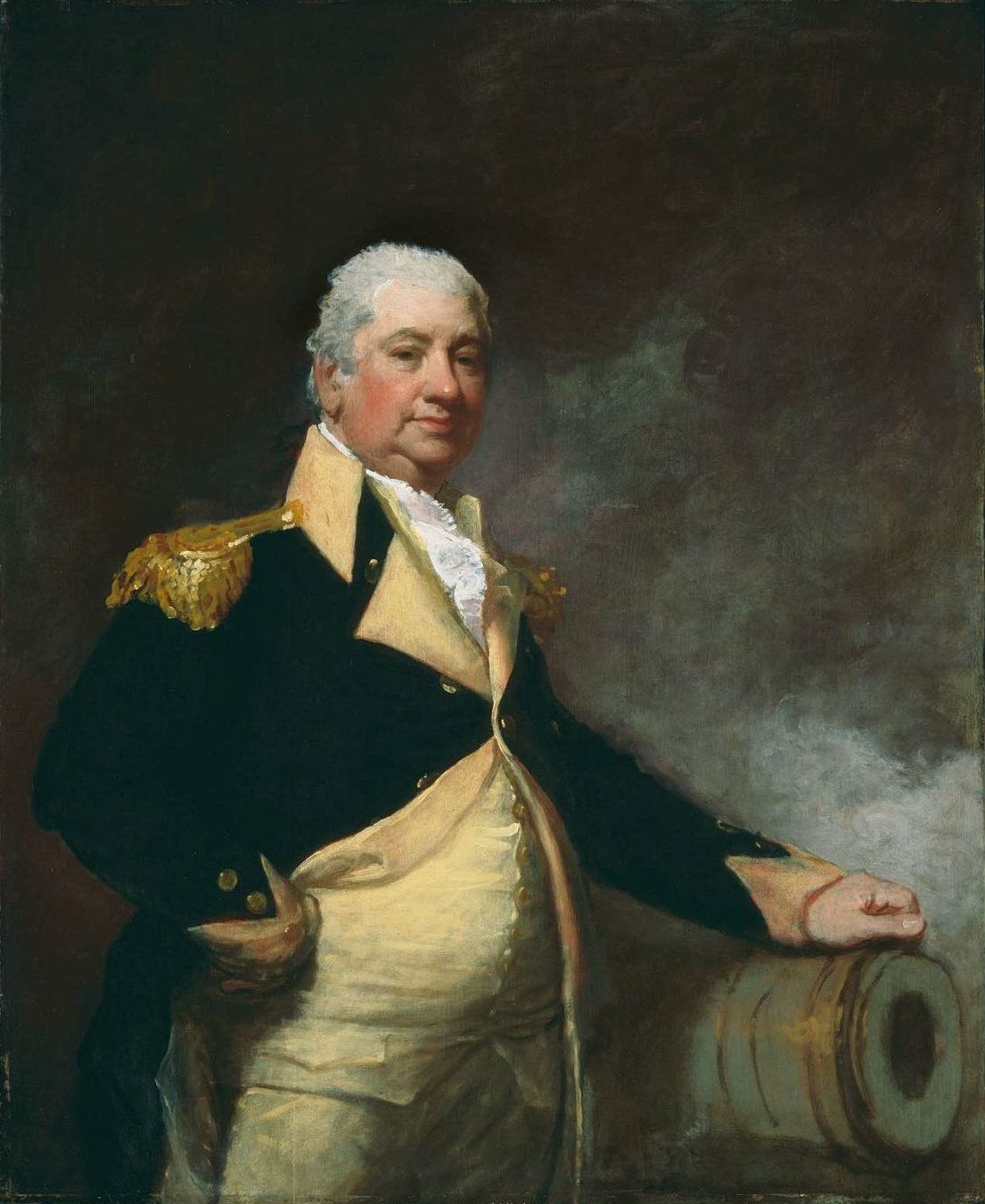
Henry Knox was twenty-five and sold books. He ran a shop in Boston and had no rank in a regular army. In November 1775 George Washington sent him on an errand that sounded impossible: go to Fort Ticonderoga, on Lake Champlain, and bring back the cannon.1
A Bookseller in Boston
Knox was born in Boston on July 25, 1750, one of ten children of a shipmaster.2 The sources split on what happened next. The Battlefield Trust says his father died and he left school to clerk in a bookstore. Mount Vernon says his father left for the West Indies in 1759 and nine-year-old Henry left school to work at a bookbindery to support his mother and younger brother.32 Either way he ended up among books, and he taught himself military science from them, including Sharpe's military guide and Caesar's Commentaries. He opened the London Book Store, one of the most fashionable shops in Boston, and John Adams was among his customers.2 In June 1774 he married Lucy Flucker, despite her father's disapproval.3 Washington was impressed by Knox's command of artillery, which is how the Ticonderoga job came to him.3 Adams had recommended him for a Continental position in 1775.2
Fifty-Nine Pieces and 300 Miles
Knox left Washington's camp on November 17, 1775, and reached Ticonderoga on December 5. Washington authorized 1,000 pounds, and Knox reported that he spent 521.4 The haul was 59 pieces of cannon, mortars and howitzers, about 119,000 pounds, or 60 tons. The big 24-pounders were eleven feet long and weighed more than 5,000 pounds each.4
At Fort George, at the southern end of Lake George, Knox's men spent eight or nine days gathering 42 strong sleds and eight teams of oxen to haul the artillery once snow covered the ground, in the telling of a 2025 anniversary report.5 Ahead of them lay a trek of about 300 miles.4
The route ran by water and by land. The guns went across the northern end of Lake George, down the lake in a gundalow, and then overland by sled through Saratoga to Albany. On December 17 Knox wrote to Washington that he had built "forty two exceeding strong sleds" and hoped to present "a Noble train of Artillery" in sixteen or seventeen days.6 He was off by weeks. Knox expected two weeks and the trip took about ten.4
The first cannon reached Albany on January 4, 1776. The Hudson ice was thin, so the guns crossed in stages, and the last piece was over on January 9.7 By January 11 the train was at Blandford, Massachusetts, in the Berkshires. On January 25 John Adams watched it pass through Framingham.7
Where the sources differ
The arrival date depends on the source. Wikipedia's chronology, drawn from Knox's reports, has him reporting to Washington at Cambridge on January 27.7 A local newspaper account of a 2025 reenactment says January 24.8 Either way it was late January, about ten weeks after he left. Knox's own diary also contradicts his December letter on one point. He wrote of oxen, but the diary records that he rented horses.6
Small disagreements in the numbers
Mount Vernon puts the weight at 120,000 pounds and Wikipedia at about 119,000, and Mount Vernon dates the Dorchester Heights victory to March 17, 1776, the day the British sailed, where Wikipedia dates the occupation to March 4.94 These are not contradictions so much as different ways of counting. The Heights were occupied on March 4 and the British left on March 17.
Dorchester Heights
The guns changed what Washington could do. On the night of March 2 batteries using the Ticonderoga cannon opened fire on Boston. Washington's plan was to draw the British out, using the Ticonderoga guns to bombard Boston while Continental troops fortified Dorchester Heights.10 Two nights later, on March 4, Continental troops occupied the Heights.10 From there the guns could reach both the town and the ships in the harbor. General William Howe first planned to attack the position, but a snowstorm stopped him. He decided instead to leave. The British and Loyalists sailed for Halifax on March 17.10
Myth: Howe said one night's work beat three months
A line often credited to Howe says the Americans had done more work in one night than his whole army could have done in three months. Modern commemorations repeat it, but the account that carries it names no source for the words.8 It is better treated as a remark that fits the moment than as a quotation. The facts are enough. A heavy gun placed on a hill overnight forced a professional army out of a city.
The Rest of a Career
Knox helped manage the move across the Delaware before Trenton, and after Trenton and Princeton he was made a brigadier general.11 He directed the artillery at Yorktown and became the army's youngest major general in March 1782.11 At Fraunces Tavern in 1783, when Washington said goodbye to his officers, Knox was the first to embrace him.11
In March 1785 Knox became Secretary of War under the Confederation. In 1789 he became the first Secretary of War of the new government, and he served until 1794.11 Mount Vernon credits him with a plan for a national militia, with helping start military academies, with work on Shays's Rebellion in 1787 and with urging federal action against the Whiskey Rebellion in 1794.12 Washington reported to Congress that Knox's "genius supplied the deficit of means."12 At the end of 1794 Knox left office to manage personal money troubles and turned to land speculation and business in Maine, on land that had belonged to Loyalists or came through his wife.12 He died on October 25, 1806, at his home in Thomaston, in what was then the District of Maine, after a chicken bone lodged in his throat and caused a fatal infection.11 He was fifty-six.
Knox's Life at a Glance
- 1750 Born July 25 in Boston.
- 1774 Marries Lucy Flucker in June.
- 1775 Leaves Washington's camp for Ticonderoga on November 17; arrives December 5.
- January 1776 Last cannon crosses the Hudson on January 9; Knox reports at Cambridge in late January.
- March 1776 Batteries open fire March 2; Continental troops hold Dorchester Heights March 4; British sail March 17.
- 1777 Promoted to brigadier general after Trenton and Princeton.
- 1782 Becomes major general in March.
- 1785 Takes over as Secretary of War; serves as the first Secretary under the Constitution from 1789 to 1794.
- 1806 Dies October 25 at Thomaston, Maine.
Learn more
- Mount Vernon: Henry Knox: Knox the bookseller, the Secretary of War and the Maine years
- Wikipedia: Noble train of artillery: a day-by-day timeline with citations to Knox's letters
- American Battlefield Trust: Henry Knox: a short life through the Secretary of War years
- Lake George Examiner on the 250th anniversary: how the route is remembered along the Knox Trail
Notes
- Wikipedia, "Noble train of artillery," on Knox leaving camp on November 17, 1775, and reaching Ticonderoga on December 5. Read it online. ↩
- Mount Vernon Digital Encyclopedia, "Henry Knox," on his birth as one of ten children of a shipmaster, leaving school at nine, his self-education, the London Book Store, John Adams as a customer and Adams's recommendation in 1775. Read it online. ↩
- American Battlefield Trust, "Henry Knox," on his birth on July 25, 1750, his bookstore work, his marriage to Lucy Flucker in June 1774 over her father's objection, and Washington's regard for his artillery command. Read it online. ↩
- Wikipedia, same article, on the 1,000 pounds authorized and 521 spent, the count of 59 pieces, about 119,000 pounds, the 24-pounders, the roughly 300 miles, and the two weeks expected against about ten taken. Read it online. ↩
- Lake George Examiner, "Knox's Noble Train of Artillery arrives at Fort George," 2025 anniversary report, narration by Walt Adams on the 42 sleds, eight teams of oxen and eight or nine days at Fort George. Read it online. ↩
- Henry Knox to George Washington, December 17, 1775, Founders Online, National Archives, for the sleds and the "noble train" passage. Read it online. The diary note that he rented horses in place of oxen is from Wikipedia, "Noble train of artillery," citing Brooks (1900) and Ware (2000). Read it online. ↩
- Wikipedia, same article, on the Albany crossing, Blandford on January 11, John Adams seeing the train at Framingham on January 25, and Knox reporting at Cambridge on January 27. Read it online. ↩
- Lake George Examiner, same report, giving January 24 as Knox's arrival at Cambridge and repeating the Howe quotation without a source. Read it online. ↩
- Mount Vernon, same article, giving 120,000 pounds of guns and March 17, 1776, for the victory at Dorchester Heights. Read it online. ↩
- Wikipedia, same article, on Washington's plan, the batteries of March 2, the occupation of Dorchester Heights on March 4, Howe's abandoned attack in a snowstorm and the sailing for Halifax on March 17. Read it online. ↩
- American Battlefield Trust, "Henry Knox," on Trenton and Princeton, Yorktown, the March 1782 promotion, the farewell at Fraunces Tavern in 1783, his years as Secretary of War from March 1785 and under Washington from 1789 to 1794, and his death on October 25, 1806, at Thomaston. Read it online. ↩
- Mount Vernon, same article, on the national militia plan, military academies, Shays's Rebellion, the Whiskey Rebellion, Washington's remark that Knox's "genius supplied the deficit of means," and Knox's years in Maine after 1794. Read it online. ↩
Terms in this lesson
- Noble train of artillery
- Knox's own phrase for the cannon and mortars he brought from Ticonderoga to Boston.
- Dorchester Heights
- Hills south of Boston that overlooked the harbor. American guns placed there in March 1776 threatened the British fleet.
- Gundalow
- A flat-bottomed boat used on lakes and rivers. Knox's men used one to carry cannon down Lake George.
- Secretary of War
- The cabinet officer in charge of the army. Knox held the post under the Confederation and then under Washington.
- Howitzer
- A short cannon that fires shells in a high arc.
Sources
- Mount Vernon Digital Encyclopedia, Henry Knox checked 2026-10
- Wikipedia, Noble train of artillery (dates, weights, route, with citations to Knox's letters) checked 2026-10
- American Battlefield Trust, Henry Knox checked 2026-10
- Lake George Examiner, Knox's Noble Train of Artillery arrives at Fort George checked 2026-10