Lesson 9 of 60 · about 9 minutes
Francis Marion: The Swamp Fox Behind the Legend
You'll be able to
- Describe Marion's partisan campaign in the South Carolina lowcountry in 1780 and 1781
- Explain what is and is not known about how he got the name Swamp Fox
- Separate Parson Weems's version of Marion from the record
- State plainly what the sources say about his slaveholding and his service in the Cherokee war
In November 1780 Banastre Tarleton ran Francis Marion more than twenty miles through the South Carolina lowcountry, to a place called Ox Swamp, and then gave up. According to a story told for two centuries, Tarleton stopped his horse and said of his quarry, "But as for this damned old Fox, the devil himself could not catch him!"1 The words may be Tarleton's. They are certainly the only reason most people have heard of Marion.
A Planter and a Frontier Soldier
Marion was born around 1732 on a plantation in Berkeley County, South Carolina.2 He joined the militia and served in the Cherokee War of 1759 to 1761, a frontier campaign that the Smithsonian describes as brutal.3 The National Park Service suggests that this experience shaped his later partisan tactics.2 He bought his own plantation, Pond Bluff, in 1773, and in 1775 was elected to the first South Carolina Provincial Congress and commissioned a captain.3 He fought at Fort Sullivan on June 28, 1776, and at the failed siege of Savannah in 1779.2
He missed the fall of Charleston in May 1780. The Battlefield Trust says he was recovering from a broken ankle. The Smithsonian adds a detail, that he broke it jumping from a second-story window to get away from a dinner party.4 That is the sort of anecdote that sticks, and the sources do not say who first told it.
The Partisan War of 1780
With Charleston gone and Camden lost in August 1780, South Carolina had no American army. Horatio Gates ordered Marion to destroy boats to keep British troops from escaping. Colonel Otho Holland Williams described Marion's ragged band as a "burlesque," which may explain why the army let him go.5 Marion made the best use of the freedom. Between August and December 1780 he won small fights at Great Savannah, Black Mingo, Tearcoat Swamp and Georgetown.6
He raided supply lines and escaped through terrain the British could not cross. He made Snow's Island, in the swamps, his base.7 In March 1781 Marion wrote of the capture of Captain John Postell under a flag of truce, warning that mistreatment of prisoners "will be retaliated, if a stop is not put to such proceedings."8
With Greene in 1781
In 1781 Marion worked with Nathanael Greene's army. With Henry Lee's Legion he captured Fort Watson in April and Fort Motte in May, actions the Park Service says forced the British to evacuate Camden.9 On August 30, at Parker's Ferry, Marion with 445 men met more than 600 Loyalist, British and German troops, and the Battlefield Trust reports 125 British killed and 80 wounded to one American dead and three wounded. The fight cut the British horses available at Eutaw Springs nine days later.10 At Eutaw Springs on September 8, Marion commanded the right militia line. His last battle was at the Avenue of the Cedars on August 29, 1782.10
"History affords no instance where an officer has kept possession of a country under so many disadvantages as you have."
Nathanael Greene to Francis Marion, April 1781, as quoted by the American Battlefield Trust. 11
Weems and the Movies
The Marion most people know came from Mason Locke Weems, called Parson Weems. Marion's friend Peter Horry wrote a history of the brigade, and Weems reworked it into a popular life. In an 1807 letter to Horry, Weems said he had put the story into the form of "a military romance."12 The South Carolina Encyclopedia says Weems badly distorted Horry's history.12
Myth: The breakfast on Snow's Island
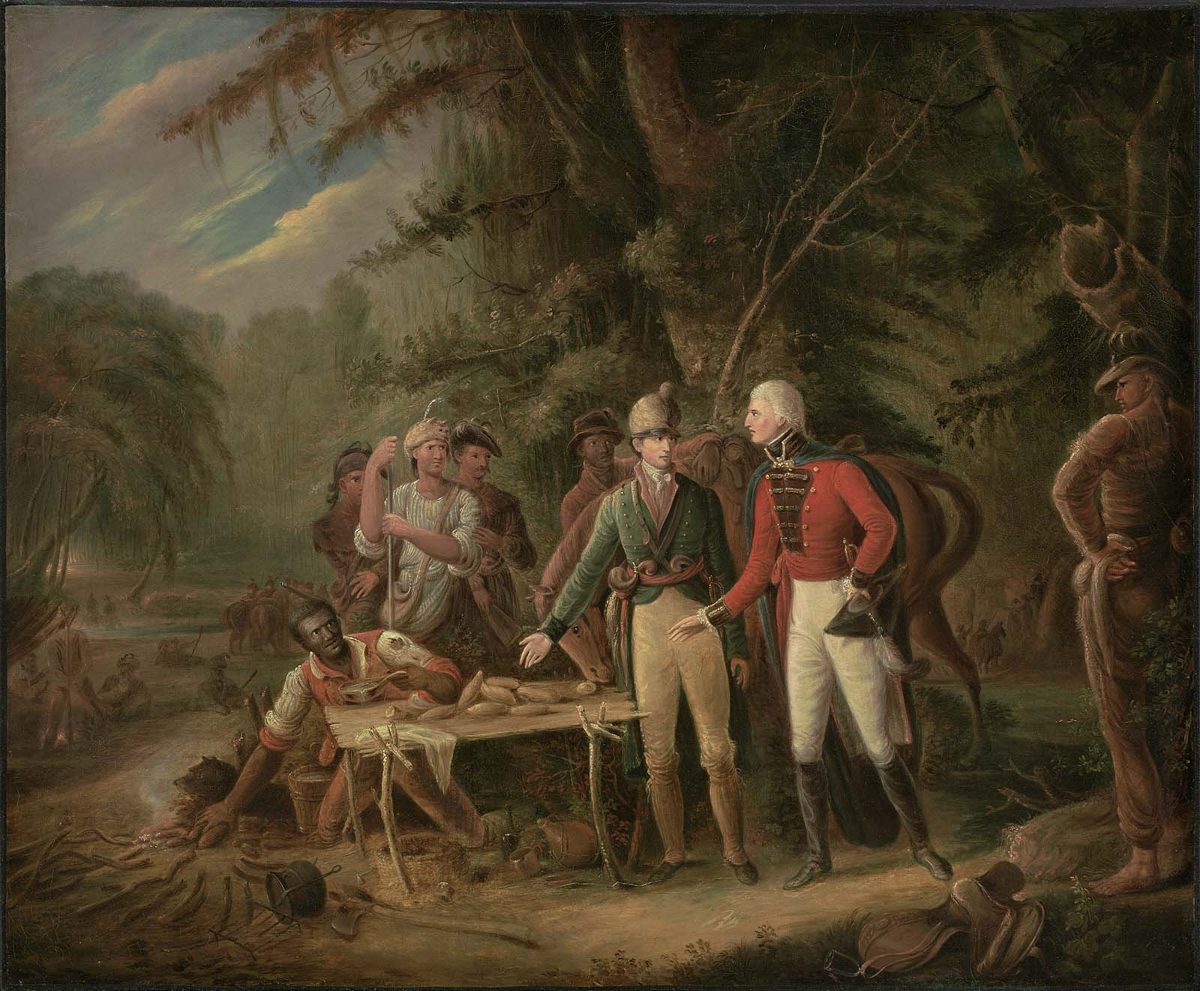
The most famous scene in the legend has a British officer invited to dinner in the swamp, served a plain meal of sweet potatoes, and so struck by the poverty of Marion's men that he goes home and resigns. The Smithsonian calls the officer's change of sides a legend.13 The 2000 film The Patriot built a fictional hero loosely on Marion. Historian Sean Busick called the choice to make him an "18th century Rambo" one of the silliest things the movie did.13
Slavery, the Cherokee and the Rest
Marion owned enslaved people. By the end of his life he owned over 1,800 acres and 73 enslaved people.14 The Smithsonian notes the enslaved man traditionally identified as Oscar, who may appear in White's painting of the Snow's Island meal and who was honored in a presidential proclamation of December 2006. Little is known about him.13 That is the problem with the story. The legend honors one man in the swamp and keeps the others out of view.
After the war Marion served in the state senate and in the 1790 constitutional convention. He married his cousin Mary Esther Videau in 1786 and retired from the militia in 1794.14 He died on February 27, 1795, at Pond Bluff.14
Marion's Life at a Glance
- About 1732 Born in Berkeley County, South Carolina.
- 1759 to 1761 Serves in the Cherokee War.
- 1773 Buys Pond Bluff plantation.
- 1776 Fights at Fort Sullivan on June 28.
- 1780 Misses the fall of Charleston; leads partisans August to December.
- November 1780 Escapes Tarleton at Ox Swamp.
- 1781 Takes Fort Watson and Fort Motte; Parker's Ferry on August 30; Eutaw Springs on September 8.
- 1782 Fights his last battle at the Avenue of the Cedars on August 29.
- 1786 Marries Mary Esther Videau.
- February 27, 1795 Dies at Pond Bluff.
Learn more
- American Battlefield Trust: Ambush: Marion's battles, with numbers
- Smithsonian: The Swamp Fox: the legends, with the historian's view of Weems and the movie
- South Carolina Encyclopedia: Francis Marion: the fullest summary of his career and property
- National Park Service: Francis Marion: a short life with places to visit
Notes
- American Battlefield Trust, "Ambush: Francis Marion and the Art of Guerrilla Warfare," on Tarleton's pursuit of Marion for more than 20 miles to Ox Swamp on November 8, 1780, and the remark attributed to him. The Smithsonian and the Park Service word it slightly differently, which suggests it was passed on and not recorded. Read it online. ↩
- National Park Service, "Francis Marion," on his birth around 1732 in Berkeley County, the Cherokee War of 1759 to 1761, Fort Sullivan on June 28, 1776, and the siege of Savannah in 1779. Read it online. ↩
- Smithsonian Magazine, "The Swamp Fox," on the brutal Cherokee campaign, Pond Bluff in 1773 and his election to the Provincial Congress in 1775. Read it online. ↩
- American Battlefield Trust, same article, on Marion escaping Charleston's surrender while recuperating from a broken ankle; Smithsonian Magazine, same article, on the ankle broken in March 1780 by jumping from a second-story window. Read it online. ↩
- American Battlefield Trust, same article, on Gates's order of August 1780 to destroy boats and Williams's description of Marion as a "burlesque." Read it online. ↩
- National Park Service, same article, on the engagements at Great Savannah, Black Mingo, Tearcoat Swamp and Georgetown between August and December 1780. Read it online. ↩
- South Carolina Encyclopedia, "Francis Marion," on Snow's Island as his base. Read it online. ↩
- American Battlefield Trust, same article, quoting Marion's letter of March 1781 on the capture of Captain John Postell under a flag of truce. Read it online. ↩
- National Park Service, same article, on Fort Watson in April 1781, Fort Motte in May 1781 and the British evacuation of Camden. Read it online. ↩
- American Battlefield Trust, same article, on Parker's Ferry on August 30, 1781, with 445 men against more than 600, Eutaw Springs on September 8, 1781, and the Avenue of the Cedars on August 29, 1782. Read it online. ↩
- American Battlefield Trust, same article, quoting Greene's letter of April 1781 written the day before Hobkirk's Hill. Read it online. ↩
- Smithsonian Magazine, same article, on Weems's 1807 letter to Peter Horry; South Carolina Encyclopedia, same article, on Horry's history and Weems's distortion of it. Read it online. ↩
- Smithsonian Magazine, same article, on the Snow's Island breakfast as legend, the film The Patriot, Sean Busick's remark, and Oscar and the December 2006 proclamation. Read it online. ↩
- South Carolina Encyclopedia, same article, on his 1,800 acres and 73 enslaved people, his marriage in 1786, his retirement in 1794 and his death on February 27, 1795. Read it online. ↩
Terms in this lesson
- Partisan
- A fighter who operates on his own or with a small band behind enemy lines, outside the regular army's chain of command.
- Swamp Fox
- The nickname Marion earned after escaping Banastre Tarleton in the swamps of the Santee region in November 1780.
- Parson Weems
- Mason Locke Weems, a minister and book peddler who wrote the earliest popular biography of Washington and also a life of Marion that mixed fact and invention.
- Cherokee War
- The 1759 to 1761 frontier war between South Carolina and the Cherokee, in which Marion served as a young militia officer.
- Burlesque
- A mocking imitation. Colonel Otho Holland Williams used it to describe Marion's ragged appearance.
Sources
- American Battlefield Trust, Ambush: Francis Marion and the Art of Guerrilla Warfare checked 2026-10
- National Park Service, Francis Marion checked 2026-10
- South Carolina Encyclopedia, Francis Marion checked 2026-10
- Smithsonian Magazine, The Swamp Fox checked 2026-10