Lesson 37 of 60 · about 9 minutes
John Andre: The British Spy Master Hanged at Tappan
You'll be able to
- Describe Andre's rise from London to adjutant general and head of British intelligence
- Follow his 1780 dealings with Benedict Arnold from the Hudson meeting to his capture
- Weigh the evidence for the bribe story and for Washington's refusal of a firing squad
- Explain why the Americans hanged him and why Britain later brought his body home
On the afternoon of May 18, 1778, about four hundred British officers and elite Philadelphians boarded boats on the Delaware River. A regatta opened the day. Then came a mock tournament, a procession through two triumphal arches, dancing, fireworks and a dinner in a mirrored tent.1 The man who planned the party was a twenty-eight-year-old captain. Two and a half years later the Americans hanged him.
A London Merchant's Son
John Andre was born in London on May 2, 1750, to wealthy Huguenot parents. He studied at Saint Paul's and Westminster, then in Geneva, spoke several languages, drew well and wrote short plays. He bought a commission in the British army in 1771.2 He was captured during the 1775 Canadian campaign, paroled, and exchanged about a year later. In January 1777 he became a captain in the 26th Foot.2 By 1779 he was a major and adjutant general of the British army in North America, and by April he headed its secret service.2
The Meschianza
The Meschianza honored General Sir William Howe, who was leaving command, and his brother Admiral Richard Howe. Andre helped organize it. Two teams of officers, the Knights of the Blended Rose and the Knights of the Burning Mountain, staged a mock jousting match. The name comes from an Italian word for a medley.1 General Anthony Wayne mocked the whole affair after the Battle of Monmouth that June, joking that the knights had resigned their laurels.1
Among the young women in that circle was seventeen-year-old Peggy Shippen, daughter of a Loyalist. The Battlefield Trust says it is suspected she was at one point Andre's paramour.2 She later married Benedict Arnold, and in 1780 she was one of the go-betweens in his secret letters to Andre.3
Arnold and the Offer for West Point
Britannica says Andre began writing to Arnold in May 1779. For more on Arnold, see Benedict Arnold. In August 1780 Arnold took command of West Point, and on September 21 he agreed to give up the fort for 20,000 pounds.4 Wikipedia puts Andre on the Hudson aboard the British ship Vulture on September 20. He and Arnold talked in the woods below Stony Point until nearly dawn, then rode to a house at Haverstraw. American guns drove the Vulture away and left Andre stuck ashore.5 He carried a pass from Arnold in the name of "John Anderson." Six papers about the West Point defenses were hidden on him.5 Whether they were in his stockings or his boot depends on the account.46
Traveling under a false name with plans of an American fort in his clothing, he was a spy by the customs of war, whatever his rank.
Three Militiamen at Tarrytown
On September 23, John Paulding, David Williams and Isaac Van Wart stopped him on the road near Tarrytown. Andre at first hoped they were Loyalists, then showed Arnold's pass. They searched him and found the papers.6 They took him to Lieutenant Colonel John Jameson at North Castle. Jameson sent a letter about the capture to Arnold instead of holding him, and Arnold fled to the Vulture.5
Myth: The captors turned down a fortune
Everyone knows Paulding said that not even ten thousand guineas would move him. That line appears in American Heritage's 1975 telling, which quotes Paulding, and it is a tradition. The 1780 documents give other figures.7 The paper trail is shorter. Jameson wrote on September 23 that Anderson "offered the Men that took him one hundred Guineas and as many goods as they wou'd please to ask." Washington told Congress on September 26 that they "were offered, I am informed, a large sum of money for his release." Hamilton, in an October 1780 letter, wrote that Andre offered his watch, his horse and "any sum of money they should name."8 So an offer was made, and the captors refused. The figure grew with the telling. In 1817 Tallmadge, then a congressman opposing a pension increase for the captors, said Andre had told him they robbed him and acted from hope of gain. Egbert Benson answered him in print with a Vindication of the captors.8
Congress was in no doubt. On November 3, 1780 it praised them for "nobly disdaining to sacrifice their country for the sake of gold," gave each a pension of 200 dollars a year in specie and ordered each a silver medal inscribed "Fidelity."8
The Board, and Washington's Decision
On September 29 a board of fourteen general officers met under Nathanael Greene. Their members included Lafayette, Henry Knox, Baron von Steuben and John Stark. They found that Andre was a spy and recommended death.5 Washington accepted the finding. His own letter to Sir Henry Clinton of September 30 offered no exchange. An unsigned letter to Clinton the same day, attributed to Hamilton, said Andre "might be released for General Arnold." Clinton did not give up Arnold.9
Andre asked for a soldier's death. Hamilton quoted him: "I am reconciled to my fate (said he) but not to the mode." Hamilton added that the request was judged incompatible with the customs of war.10
Myth: Washington coldly refused the firing squad
The usual telling says Washington refused. Hamilton, who was there, wrote that it "was therefore determined in both cases to evade an answer," and the Journal of the American Revolution says Washington did not reply.1011 Andre walked to the gallows on October 2 apparently not knowing, and paused when he saw it.9 No firing squad came, so the silence worked as a refusal. It was a harder one than the usual telling suggests.
Tappan, October 2, 1780
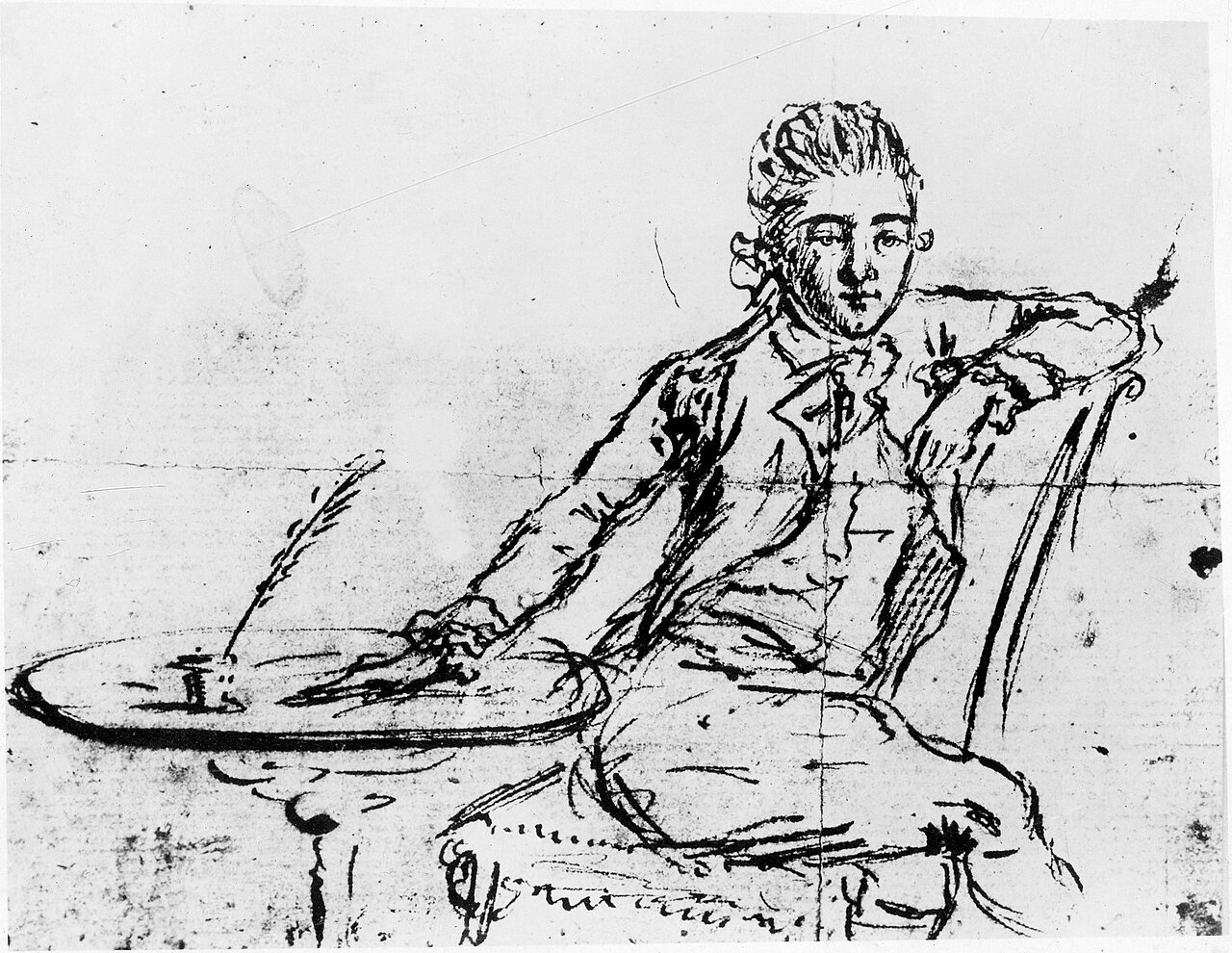
The night before, Andre drew a pen-and-ink sketch of himself and gave it to an officer of his guard.12 On October 2, near noon, he walked to the gallows at Tappan in his scarlet coat. Benjamin Tallmadge, who admired him, was in the crowd. For Tallmadge's story, see Benjamin Tallmadge and the Culper Ring. He later said Andre went "with as much ease and cheerfulness of countenance as if he had been going to an assembly."9 Tradition says Andre put the noose around his own neck. His last words were a request that the onlookers "bear witness to the world that I die like a brave man."9 James Thacher recorded them a little differently: "I pray you to bear me witness that I meet my fate like a brave man."11
Hamilton wrote the line most often quoted about him: "Never perhaps did any man suffer death with more justice, or deserve it less."10 Fair to both sides, it cuts two ways. Andre took on a mission that the rules of war punished with the rope, and he went to it bravely, wearing his king's scarlet.
Home to Westminster Abbey
Andre was buried in a shallow grave at Tappan.11 King George III had a monument raised to him in Westminster Abbey in 1782. In 1821, at the Duke of York's request, the British consul James Buchanan removed the remains from Tappan on August 10. They were buried at the Abbey in front of the monument on November 28, 1821.13
Andre's Life at a Glance
- 1750 Born May 2 in London.
- 1771 Buys a commission in the British army.
- May 18, 1778 Helps plan the Meschianza in Philadelphia.
- May 1779 Begins secret letters to Benedict Arnold.
- September 21 and 22, 1780 Meets Arnold near Stony Point and Haverstraw.
- September 23, 1780 Captured near Tarrytown.
- September 29, 1780 Board of officers finds him guilty of spying.
- October 2, 1780 Hanged at Tappan.
- November 28, 1821 Reburied in Westminster Abbey.
Learn more
- American Battlefield Trust: John Andre: a short life of the spy master
- Journal of the American Revolution: The Fidelity Medallion: the captors and the bribe sources
- Emerging Revolutionary War: The Execution of Major Andre: the last day at Tappan
- Westminster Abbey: John Andre: the monument and its inscription
Notes
- "Meschianza," The Encyclopedia of Greater Philadelphia, on the May 18, 1778 date, the 400 guests, Andre as organizer, the knights, and Wayne's joke. Read it online. ↩
- American Battlefield Trust, "John Andre," on his birth, schooling, army career, 1775 capture, promotion, the Shippen suspicion and his rise to head of intelligence; Westminster Abbey, "John Andre," on the purchase of his commission on January 25, 1771. Read it online. Westminster Abbey. ↩
- American Battlefield Trust, "John Andre," on Peggy Shippen as a go-between; Wikipedia, "John Andre," on the Vulture, Haverstraw and capture. American Battlefield Trust. Wikipedia. ↩
- Encyclopaedia Britannica, "John Andre," on the letters from May 1779, Arnold's command at West Point and the 20,000 pound price. Read it online. ↩
- Wikipedia, same article, on the Vulture, the meeting below Stony Point, the pass, Jameson, the board members and the dates. Read it online. ↩
- "Three Forgotten Heroes," American Heritage, on the capture near Tarrytown, the pass, and papers found in his stockings. Read it online. ↩
- American Heritage, same article, for the "ten thousand guineas" quotation. Read it online. ↩
- Journal of the American Revolution, "The Fidelity Medallion" (2023), on Jameson's letter, Washington's report to Congress, Hamilton's letter, Tallmadge's 1817 speech, the November 3, 1780 resolution; Egbert Benson, Vindication of the Captors of Major Andre (1817). Read it online. Benson (Internet Archive). ↩
- Emerging Revolutionary War, "Arnold's Treason: 240 Years Later, The Execution of Major Andre" (2020), on the board, the gallows, Tallmadge and the last words; Washington to Henry Clinton, September 30, 1780, and the unsigned letter to Clinton of the same date, Founders Online, on the exchange suggestion. Read it online. Washington to Clinton. Unsigned letter. ↩
- Alexander Hamilton to Lieutenant Colonel John Laurens, [11 October 1780], Founders Online, National Archives, on the request for a professional death, the evasion of an answer and the sentence on justice. Read it online. ↩
- Journal of the American Revolution, "The Death and Resurrection of Major John Andre" (2018), on Washington's silence about the firing squad request, Thacher's version of the last words and the shallow grave at Tappan. Read it online. ↩
- Fraunces Tavern Museum, "Self-Portrait of Major John Andre," on the sketch of October 1, 1780 and Yale's ownership. Read it online. ↩
- Westminster Abbey, "John Andre," on the 1782 monument, the removal of August 10, 1821 and burial of November 28, 1821. Read it online. ↩
Terms in this lesson
- Adjutant general
- The staff officer who handles an army's orders, records and, in Andre's case, much of its intelligence work.
- Meschianza
- A grand fete held in Philadelphia on May 18, 1778 for General William Howe. Andre helped plan it.
- Board of officers
- A panel of senior officers that heard Andre's case on September 29, 1780 and recommended death.
- Spy
- Under the customs of war, a man who gathers information in disguise behind enemy lines. Spies were hanged, not shot.
- Fidelity medal
- A silver medal Congress ordered for each of the three men who captured Andre.
Sources
- American Battlefield Trust, John Andre checked 2026-10
- Alexander Hamilton to Lieutenant Colonel John Laurens, [11 October 1780], Founders Online checked 2026-10
- Journal of the American Revolution, The Fidelity Medallion checked 2026-10
- Westminster Abbey, John Andre checked 2026-10
- Emerging Revolutionary War, The Execution of Major Andre checked 2026-10
- Encyclopaedia Britannica, John Andre checked 2026-10