Lesson 40 of 60 · about 9 minutes
Rochambeau: The French General Who Marched to Yorktown
You'll be able to
- Describe Rochambeau's career before 1780 and the orders he carried to Newport
- Explain what the Wethersfield conference decided and what turned the armies south in August 1781
- Follow the march from Newport to Yorktown and the part that coin played in it
- Tell what happened to Rochambeau in the French Revolution and where the sources disagree
On September 5, 1781, a French army marched through Philadelphia. The Freeman's Journal said that "the appearance of these troops far exceeds any thing of the kind seen on this continent, and presages the happiest success to the cause of America."1 The man who commanded them was fifty-six and had never liked the idea of attacking New York, which was the plan Washington had carried into the summer. By the time the column reached Pennsylvania, the plan had changed, and Rochambeau had a good deal to do with the change.1
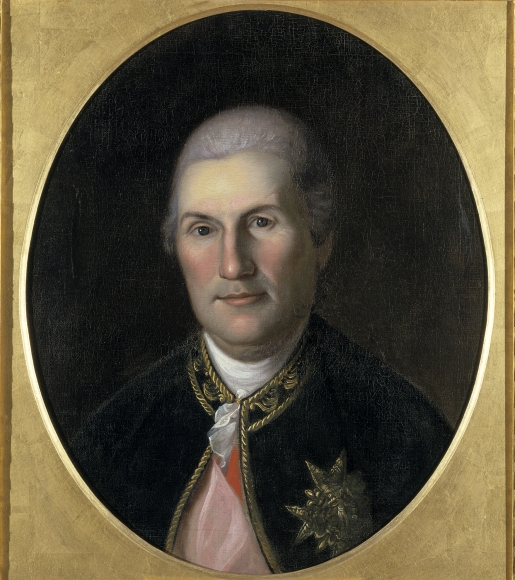
A Third Son in the Army
Jean-Baptiste Donatien de Vimeur, comte de Rochambeau, was born on July 1, 1725, at the family chateau near Vendome, roughly ninety-five miles southwest of Paris. His family had a title and not much money. As the third son he was headed for the church until his older brother died and the army took him instead.2 By 1761, at thirty-six, he was a marechal de camp and inspector general of the French infantry, and he spent the next fifteen years on training and discipline.2 The Park Service adds that he turned down the post of Minister of War in 1771, and that in 1778 he was picked to lead an invasion of Britain that fell apart the next year.3
That failed invasion left France with a trained army and no use for it. In 1780 the king sent it across the Atlantic, with Rochambeau promoted to lieutenant general. The foreign minister, Vergennes, told him to put himself under Washington's command.3 The Marquis de Lafayette had helped plan the deployment and urged that the commander be sensitive to American leaders.3
Newport and a Year of Waiting
The fleet anchored off Newport, Rhode Island, in July 1780. Colonial Williamsburg gives July 10 and about 5,500 troops. The Park Service gives July 11 and counts 5,300 men and 450 officers.24 Either way it was an army of former enemies, Catholic and foreign, and Newport greeted it with shuttered doors. The town lit candles for the French two days later.5
Rochambeau told the townspeople he would pay for everything in silver, and he hired local workmen to repair houses the British had wrecked.5 The army sat in Newport through the winter while Washington's army was too thin to attack anyone. When the two generals met at Hartford in September 1780, Washington wanted New York and had to admit that the French had come too late in the season, with too many men sick.6
Wethersfield and the Turn South
They met again in Wethersfield, Connecticut, on May 21 and 22, 1781, at the house of Joseph Webb. Washington still favored New York. Rochambeau doubted that their combined 8,300 men could take it and doubted the fleet could help. They agreed to join forces outside the city and to consider a march to the Chesapeake if New York looked hopeless.7
Six days later Rochambeau wrote to Admiral de Grasse in the West Indies: "There are two points at which an offensive can be made against the enemy: Chesapeake and New York." He expected de Grasse to prefer the Chesapeake.6 On August 1 Washington wrote in his diary that he "could scarce see a ground upon which to continue my preparations against New York." On August 14, a fast frigate brought word that de Grasse was headed for the Chesapeake with every ship and soldier he could gather, and the armies turned south.6
Myth: Washington picked Yorktown and the French followed
The record gives each man a share. Washington held to New York through the spring, Rochambeau pushed for the Chesapeake, and the American Battlefield Trust says the choice finally belonged to de Grasse, who could have gone to either place.8 Rochambeau's letter of May 28 shows he had made up his mind before Washington did.6
Six Hundred Eighty Miles
The French had left Providence in four divisions, one a day starting June 18. Reveille came at 2 a.m., the columns were moving by 4, and they camped by noon, twelve to fifteen miles on.6 They joined Washington's 4,000 Continentals at Philipsburg, New York, on July 6. The march south began August 18 and 19. To keep Sir Henry Clinton guessing, the staffs built ovens in New Jersey, built boats said to be for crossing to Staten Island, and sent letters by roads where the British would catch them.6
The National Historic Trail that marks the route runs 680 miles through nine states and the District of Columbia.9 At Head of Elk there were too few ships for both armies. French infantry under the baron de Vioménil reached Annapolis on September 18 and boarded vessels sent by de Grasse for the run to Jamestown.6
The coin in the wagons
American soldiers had gone months without pay, and some were deserting. Washington asked Robert Morris for at least a month's wages, and Morris, who had nothing to give, asked Rochambeau for a loan. Rochambeau agreed, though it took half of what he had left.10 Joseph Plumb Martin, a sapper, remembered it for the rest of his life: "we each of us received a MONTH'S PAY, in specie," which he said was the first that could be called money since 1776.10 Martin put the payment in Philadelphia. The Park Service puts it at Elkton, September 6 to 8.6
The silver went both ways. The French bought food, wood and fodder from local merchants along the route, and Rochambeau had promised silver at Newport.5 An army that paid in coin was a welcome sight in a country with worthless paper.
Yorktown
Rochambeau reached Williamsburg on September 14. Colonial Williamsburg says the siege was run mostly by him, because he had the experience.11 On the night of October 14 the French took Redoubt No. 9 while Alexander Hamilton's men took No. 10.6 On October 19 the British marched out between two lines, Americans on one side and French on the other.4 The French spent the winter around Williamsburg and began the march north on July 1, 1782. Rochambeau sailed for France in January 1783.36
Revolution at Home
Rochambeau had hoped to retire. The French Revolution would not let him. In 1791 he was made a marshal of France and given command of the northern army, then resigned in 1792 and was succeeded by Lafayette.12 He went home to find his house ravaged and his neighbors hostile. He was arrested during the Terror and held in the Conciergerie, the Paris prison. The Park Service dates the arrest to 1794 and Colonial Williamsburg to 1793. The Park Service says the Terror ended only days before he was scheduled for the guillotine, and Colonial Williamsburg says Robespierre's fall in 1794 cancelled the appointment.311
He met Napoleon in 1801 and received the Legion of Honor in 1804.3 Britannica gives his death as May 10, 1807, and Colonial Williamsburg gives May 12. French sources and EBSCO also say May 10.13 His son, who commanded grenadiers at Yorktown, later took charge of French forces in Saint-Domingue and earned a name for brutality there.14
Rochambeau's Life at a Glance
- July 1, 1725 Born near Vendome, France.
- 1761 Marechal de camp and inspector general of infantry.
- July 1780 Lands at Newport with about 5,500 men.
- May 21-22, 1781 Meets Washington at Wethersfield.
- August 14, 1781 News that de Grasse is sailing for the Chesapeake; the armies turn south.
- September 5, 1781 French army marches through Philadelphia.
- October 19, 1781 Cornwallis surrenders at Yorktown.
- 1791 Made a marshal of France.
- 1793 or 1794 Arrested during the Terror; freed when it ends.
- May 1807 Dies at Thore (May 10 or 12, by source).
Learn more
- NPS: The Washington-Rochambeau Revolutionary Route: the day-by-day march, with the marching order and the deception plan
- NPS: General Rochambeau: a short life from Vendome to the Conciergerie
- All Things Liberty: Planning the Final Action: the Wethersfield conference and the Webb house
- New England Historical Society: Seven Fun Facts: Newport, silver and the numbers in the wagon train
Notes
- National Park Service, Washington-Rochambeau Revolutionary Route National Historic Trail, "The Washington-Rochambeau Revolutionary Route" (Robert Selig, 2006), quoting the Freeman's Journal of September 5, 1781, and noting that Rochambeau "never liked the idea of attacking New York." Read it online. ↩
- Colonial Williamsburg, The American Revolution, "Jean-Baptiste-Donatien de Vimeur, Comte de Rochambeau (1725-1807)," on his birth, family, promotion in 1761 (the entry calls him inspector of cavalry, while the Park Service and French sources say infantry), command in 1780 and arrival at Newport on July 10, 1780. Read it online. ↩
- National Park Service, "General Jean Baptiste Donatien de Vimeur, comte de Rochambeau" (based on Albert Durfee McJoynt, 1990), on the 1771 offer, the 1778 invasion plan, Vergennes's orders, Lafayette's advice, the Conciergerie, Napoleon and the Legion of Honor. Read it online. ↩
- National Park Service, Washington-Rochambeau Revolutionary Route, "History & Culture," on the landing on July 11, 1780, with 5,300 men and 450 officers, and the surrender of October 19, 1781. Read it online. ↩
- New England Historical Society, "The Rochambeau Expedition Through CT and RI: 7 Fun Facts," on the cool welcome at Newport, the candlelit welcome of July 13 and 14, the promise to pay in silver and the purchases made along the road. Read it online. ↩
- Selig, "The Washington-Rochambeau Revolutionary Route," National Park Service, on the Hartford meeting of September 1780, Rochambeau's letter to de Grasse of May 28, 1781, Washington's diary entry of August 1, the news of August 14, the order of march, the deception measures, Annapolis, the payment at Elkton, Redoubt No. 9 and the return to France. Read it online. ↩
- "Planning the Final Action: George Washington and Rochambeau, May 1781," All Things Liberty, on the Wethersfield conference of May 21 and 22, 1781, and the 8,300 men. Read it online. ↩
- American Battlefield Trust, "Comte de Grasse," on de Grasse's choice of the Chesapeake over New York. Read it online. ↩
- National Park Service, Washington-Rochambeau Revolutionary Route, "History & Culture," on the 680-mile length and the nine states and the District of Columbia. Read it online. ↩
- National Museum of the United States Army, "Washington and Morris Secure A Loan from Rochambeau," quoting Joseph Plumb Martin, A Narrative of a Revolutionary Soldier (Signet Classic, 2001), 191. Read it online. ↩
- Colonial Williamsburg, same entry, on the arrival at Williamsburg on September 14, 1781, the siege, the arrest during the Terror in 1793 and the death on May 12, 1807. Read it online. ↩
- EBSCO Research Starters, "Jean-Baptiste Donatien de Vimeur, comte de Rochambeau," on his marshal's rank, his resignation in 1792 and Lafayette succeeding him. Read it online. ↩
- Encyclopaedia Britannica, "Jean-Baptiste-Donatien de Vimeur, comte de Rochambeau," giving the death date as May 10, 1807, at Thore. Read it online. ↩
- Nathan D. Jensen, "General Donatien Marie Joseph de Vimeur de Rochambeau," frenchempire.net, on the son's service at Yorktown and in Saint-Domingue, citing Philippe Girard, The Slaves Who Defeated Napoleon (University of Alabama Press, 2011). Read it online. ↩
Terms in this lesson
- Expedition Particuliere
- The French name for the army sent to America in 1780 under Rochambeau, about 5,500 men at the start.
- Wethersfield conference
- The meeting of Washington and Rochambeau at the Joseph Webb house in Wethersfield, Connecticut, on May 21 and 22, 1781.
- Specie
- Gold and silver coin, as opposed to paper money or promises to pay. Continental paper had collapsed in value, so coin was scarce and prized.
- Head of Elk
- The head of Chesapeake Bay, now Elkton, Maryland, where the allied armies tried to find ships in September 1781.
- Reign of Terror
- The period of mass arrests and executions in France in 1793 and 1794. It ended after Robespierre's fall in July 1794.
Sources
- National Park Service, Washington-Rochambeau Revolutionary Route (Robert Selig) checked 2026-10
- National Park Service, General Jean Baptiste Donatien de Vimeur, comte de Rochambeau checked 2026-10
- Colonial Williamsburg, The American Revolution: Rochambeau checked 2026-10
- All Things Liberty, Planning the Final Action: George Washington and Rochambeau, May 1781 checked 2026-10
- National Museum of the United States Army, Washington and Morris Secure a Loan from Rochambeau checked 2026-10
- New England Historical Society, The Rochambeau Expedition Through CT and RI: 7 Fun Facts checked 2026-10