Lesson 30 of 60 · about 9 minutes
Anna Strong and Agent 355: The Women of the Culper Ring
You'll be able to
- Explain how the Culper Ring passed messages from Setauket to Washington's army
- State exactly what the surviving letters say about the woman numbered 355, and what they leave out
- Trace the petticoat and handkerchief signal to Pennypacker's 1939 printing and judge the evidence for it
- Tell what is documented and what is tradition about Selah Strong's imprisonment
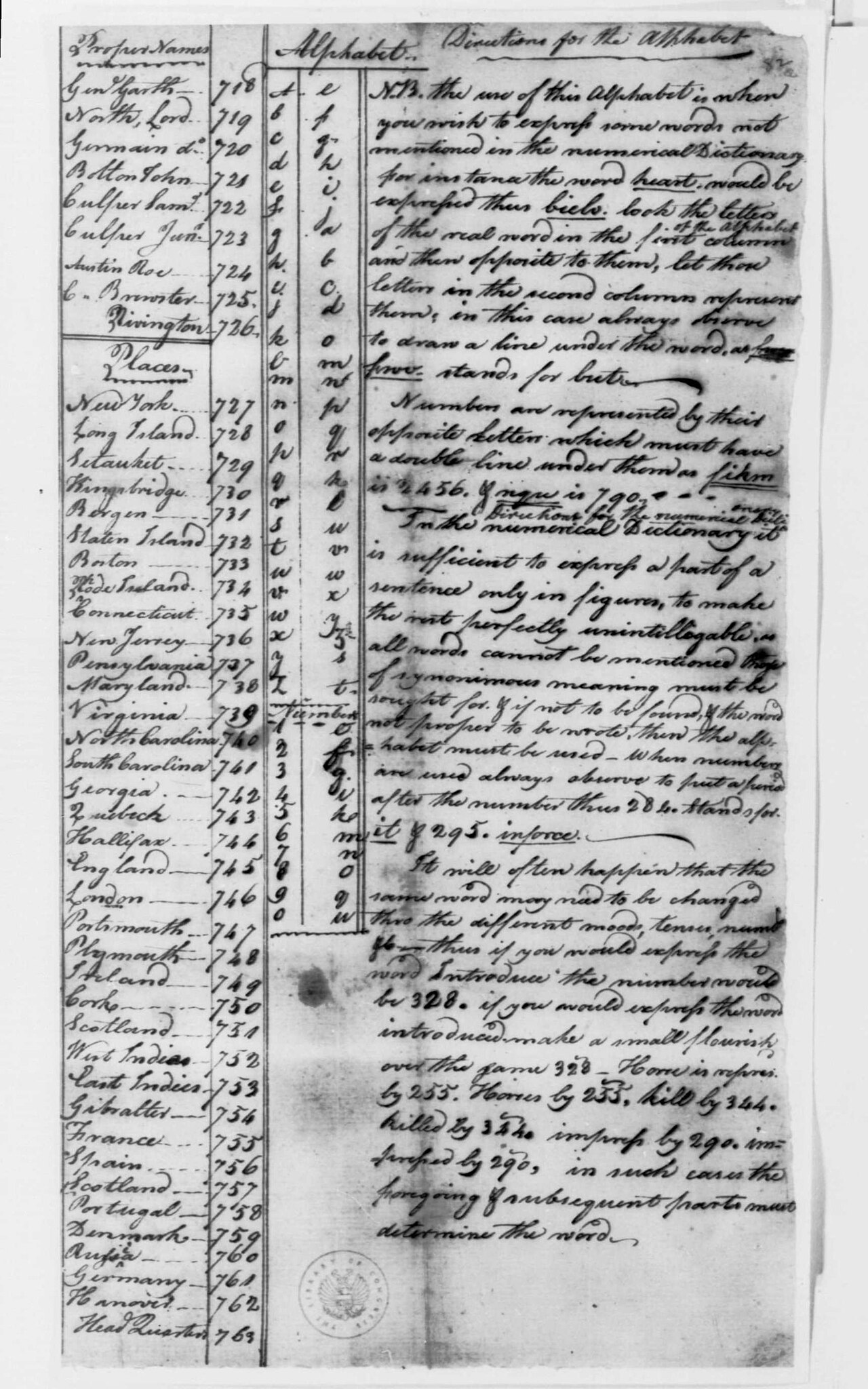
On August 15, 1779, a Long Island farmer named Abraham Woodhull sat down to write to George Washington's spymaster in code. British guards were opening every letter and searching every man at the entrance to New York City, he said, and he meant to get past them. He planned to visit the city soon and thought that "by the assistance of a 355 of my acquaintance," he could "out wit them all."1 In the ring's code book, 355 meant one word. Lady.1
That is the whole contemporary record of the woman history calls Agent 355. Everything else was added later.
A Spy Ring Behind British Lines
New York City was the British headquarters, and Long Island lay behind it. In November 1778 Washington put Major Benjamin Tallmadge in charge of military intelligence and told him to build a network inside the city.2 Tallmadge has his own lesson in this module. Here it is enough to say that he stayed in Connecticut and the work was done by others.
Robert Townsend, a merchant and coffeehouse owner who passed as a Loyalist, gathered news in the city. Austin Roe rode it out to Setauket. Woodhull, who signed as Samuel Culper, collected it on his farm. And Caleb Brewster, a whaleboat captain, rowed it across Long Island Sound to Tallmadge.2 The ring used a code of 763 numbers and invisible ink, and Mount Vernon says no spy was ever unmasked.2
What the Documents Say About 355
The letter above is the one place the number appears. Of the roughly 193 surviving letters from ring members, the Smithsonian reports, it is the only one that mentions a woman, and it never calls her a spy.3 Woodhull wrote of a lady he knew who might help him through the searches. A woman who could help him through the searches is one reading. A trained agent is not what the sentence says.
A second letter gets pulled into the case. In November 1780 Woodhull reported the imprisonment of "one that hath been ever serviceable to this correspondence," and said the news left Townsend dejected. He gave no name and no sex.4 Writers who want 355 jailed point to it. The words do not connect the two.
Who She Might Have Been
The candidates are many. The Long Island historian Morton Pennypacker is credited with the story that 355 was Townsend's lover, jailed on a British prison ship where she bore his child. Colonial Williamsburg dates that claim to 1948, and the Smithsonian places it in his books of the 1930s.34 The 1939 volume, free online, prints the letter and the code table and tells no such story.1
Others followed. John Burke and Andrea Meyer argued in 2009 that she was a friend of the British officer John André, or posed as one. Brian Kilmeade and Don Yaeger wrote in 2013 that she came from a Loyalist family, and the Smithsonian notes their book is not footnoted, though it lists selected sources. Alexander Rose proposed Anna Strong. The historian Claire Bellerjeau points to Liss, an enslaved woman held by the Townsend family, who may have been a mole in a British officer's household.34 Every one of these rests on inference. There is no proof for any of them, and the honest answer to who she was is that no one knows. She may have been several women.
Anna Strong and the Petticoat
Anna Smith was born in Setauket on April 14, 1740, and died there in 1812.5 Her neighbors included Woodhull. The story attached to her runs like this. A black petticoat on her clothesline told Woodhull that Brewster had landed. Handkerchiefs told him which of six coves held the boat.
The petticoat story appears in print in Pennypacker's book of 1939, published by the Long Island Historical Society. He describes Woodhull spotting the black petticoat on the line across the creek on Strong's Neck and four handkerchiefs on a line about half a mile away, which meant the landing was at the Neck. Then he adds that it "was long a question" who had used the signal, until "a clue was found among the papers of the Floyd family" and compared with the Woodhull account book. He names Anna, the wife of Judge Selah Strong, and gives their marriage as November 9, 1760.6 He prints neither the clue nor the entry.
Myth: Anna Strong's clothesline is a documented fact
The Floyd papers clue and the Woodhull account book entry come to us through Pennypacker, who prints neither. Claire Bellerjeau says, "There is actually no documentation of Anna Strong being involved with the Culpers."3 Mount Vernon's article and the National Security Agency's biography both tell the signal story as fact.2 The NSA page cites no source for it, and it admits that "no one knows" how she would have known where the boat was hidden.7
What supports it? The method is sensible, since a clothesline is visible and unremarkable. Her husband really was a Patriot, and a neighbor of a ring member. Local tradition has repeated the story ever since. What cuts against it is plain too. The story rests on Pennypacker's 1939 book, and the one writer who gave it a source did not show the source. The fair verdict is possible, unproved.
Selah Strong in the Provost
The record on Selah is firmer, and it corrects a favorite detail. Tradition, repeated by the Daughters of the American Revolution, says the British held him on the prison ship Jersey.5 Rivington's Gazette of January 3, 1778 put him in the sugar house.8 Mark Sternberg's archival work, published in 2022, finds that he was arrested on December 29, 1777, for sending information to the American general Samuel Parsons, and was held in the Provost, a Manhattan prison run by the feared jailer William Cunningham.9
Sternberg also shows that Selah signed a local election certificate on June 23, 1778, so he was back in Setauket, freed or paroled, in under seven months. He never fled to Connecticut and left Anna behind, as older tellings have it. That story grew from a transcription error that turned "Mrs. Strong" into "Mr. Strong."9 The Jersey, like the petticoat, belongs to family memory more than to the papers.
Anna Strong's Life at a Glance
- April 14, 1740 Anna Smith is born in Setauket, New York.
- November 9, 1760 She marries Selah Strong (date from Pennypacker).
- December 29, 1777 The British arrest Selah and hold him in the Provost.
- November 1778 Washington puts Tallmadge in charge of intelligence and the Culper network forms.
- August 15, 1779 Woodhull writes of "a 355 of my acquaintance."
- 1812 Anna dies in Setauket (DAR gives August 12; Pennypacker says August 2).
- 1939 The petticoat signal appears in print in Pennypacker's book.
Learn more
- Smithsonian: The Myth of Agent 355: the clearest skeptical account of the evidence
- Colonial Williamsburg: Who Was Agent 355?: a survey of every major theory
- Pennypacker, General Washington's Spies (1939): the full text, including the code table and his account of the petticoat signal
- Mount Vernon: Culper Spy Ring: how the ring worked and what it found
- New York State Archives, Fall 2022: Sternberg's article on Selah Strong
Notes
- Morton Pennypacker, General Washington's Spies on Long Island and in New York (Brooklyn: Long Island Historical Society, 1939), the Woodhull letter of "15th 1779" in the chapter on ciphers, and the code table listing 355 as "lady." Read it online. ↩
- Mount Vernon, "Culper Spy Ring," Digital Encyclopedia, on Tallmadge's appointment in November 1778, the roles of Woodhull, Townsend, Roe and Brewster, the 763-number code, the claim that no spy was unmasked, and the petticoat signal told as fact. Read it online. ↩
- Bill Bleyer, "The Myth of Agent 355," Smithsonian Magazine, March 21, 2022, on the single reference to a woman among the ring's letters, Pennypacker's 1930s books, Kilmeade and Yaeger's sourcing, Bellerjeau's research on Liss, and her statement that Anna Strong's role is undocumented. Read it online. ↩
- Colonial Williamsburg, "Who Was Agent 355?" Trend and Tradition, Spring 2024, on the letters of August 15, 1779 and November 1780 and the theories of Pennypacker, Burke and Meyer, Rose, and Kilmeade and Yaeger. Read it online. ↩
- Daughters of the American Revolution, Honoring Our Patriots, "Anna Smith Strong," on her birth on April 14, 1740, her family, her husband, and the tradition that Selah Strong was held on the prison ship Jersey. Read it online. ↩
- Pennypacker, General Washington's Spies (1939), pp. 15 to 16, the passage on the black petticoat, the four handkerchiefs and the "clue" among the Floyd family papers; the index lists "Petticoat and Handkerchiefs, 15." Read it online. ↩
- National Security Agency, "Anna Strong," Cryptologic History, Historical Figures, on the petticoat and handkerchief signal and the statement that "no one knows" how she knew where the boat was hidden. Read it online. ↩
- Frederic Gregory Mather, The Refugees of 1776 from Long Island to Connecticut (Albany: J. B. Lyon, 1913), p. 582, quoting Rivington's Gazette of January 3, 1778 that Selah Strong was confined in the sugar house "for surreptitious correspondence with the enemy," and recording the family tradition of the prison ship Jersey. Read it online. ↩
- New York State Archives Partnership Trust, New York Archives, Fall 2022, Mark Sternberg, "Selah Strong," on the arrest of December 29, 1777, the Provost, the certificate of June 23, 1778 and the correction of the Connecticut story. Read it online. ↩
Terms in this lesson
- Culper Ring
- The spy network run for Washington by Major Benjamin Tallmadge from 1778 to 1783, reporting from British-held New York City and Long Island.
- Cipher number
- A number standing for a word, name or place in the ring's code book. In the ring's numbers, 727 meant New York and 355 meant lady.
- Provost
- A military prison in British-held Manhattan. Recent archival work places Selah Strong there.
- Oral tradition
- A story handed down by word of mouth in a family or community, often long before anyone writes it down.
- Primary source
- A document made at the time of the events, such as a letter, a code book or a newspaper issue.
Sources
- Morton Pennypacker, General Washington's Spies on Long Island and in New York (1939), Project Gutenberg checked 2026-10
- Colonial Williamsburg, Who Was Agent 355? checked 2026-10
- Smithsonian Magazine, The Myth of Agent 355 checked 2026-10
- Mount Vernon, Culper Spy Ring checked 2026-10
- New York State Archives Partnership Trust, Fall 2022 issue (Mark Sternberg on Selah Strong) checked 2026-10