Lesson 17 of 60 · about 9 minutes
Joseph Brant: The Mohawk Who Chose the Crown
You'll be able to
- Describe Brant's schooling under Eleazar Wheelock and his work translating Anglican texts into Mohawk
- Explain why most Mohawk sided with Britain, using the Covenant Chain, the Johnson family and the fight over land
- Tell what the record says about Brant at Cherry Valley and Wyoming and where historians disagree
- Explain the 1784 Haldimand grant on the Grand River and note that Brant held enslaved people
On November 11, 1778, a force of Loyalist rangers and Native warriors fell on the fort and village at Cherry Valley, New York. When it was over, the dead included the American commander, Colonel Ichabod Alden, and by one count 13 to 16 soldiers in all, along with about 30 civilians.1 Joseph Brant, a Mohawk war leader, is placed in that force by most accounts. For two centuries Americans put the blame on him. The record is more mixed than the legend, and it does not clear him of everything.
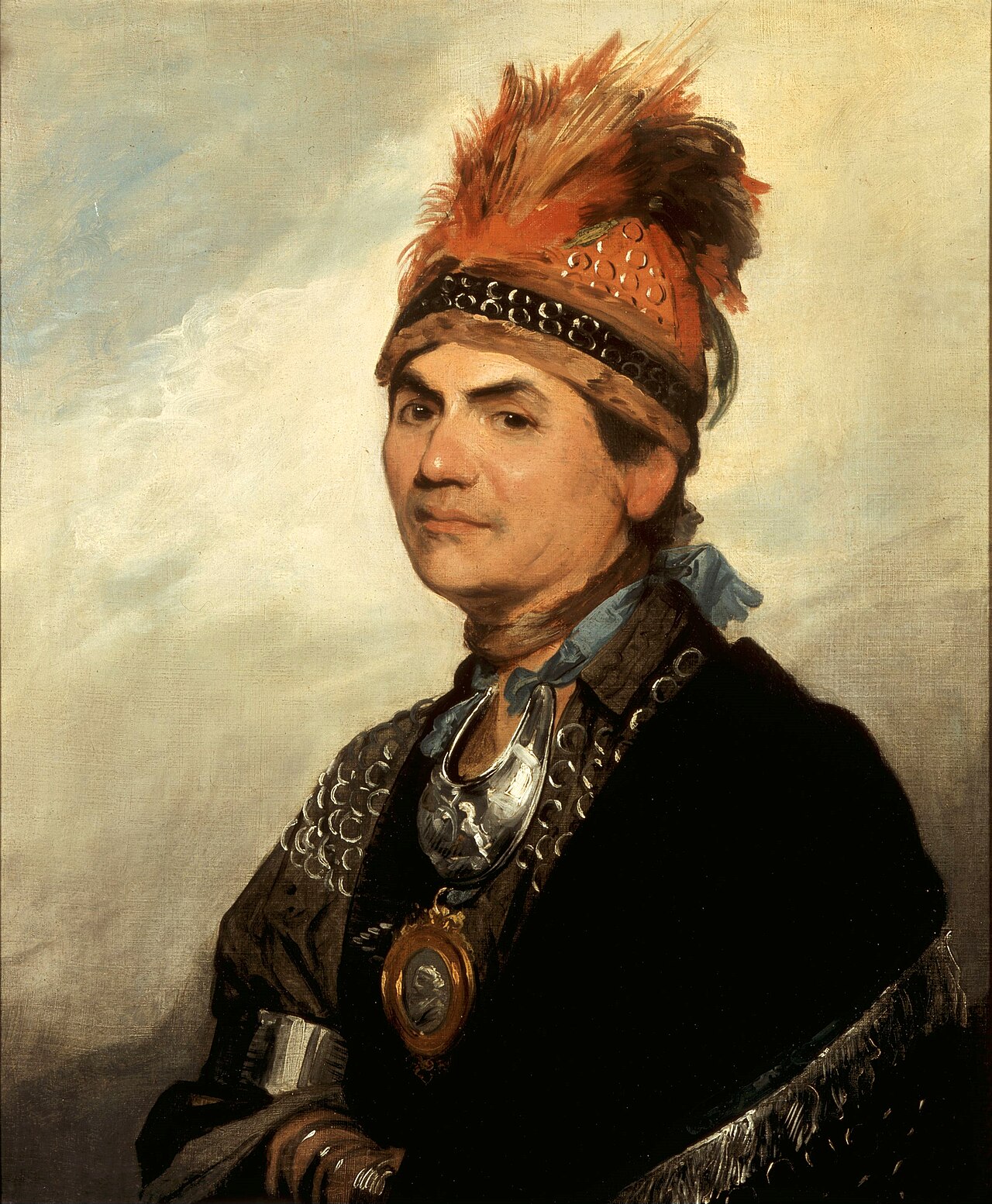
From Wheelock's School to the Johnson Hall
Brant was born around March 1742 or 1743 near the Cuyahoga River in what is now Ohio, and his family settled at Canajoharie in the Mohawk Valley.3 Sir William Johnson, the Crown's Superintendent for Indian Affairs, took an interest in him. In the summer of 1761 Johnson sent him with two other Mohawk boys to Eleazar Wheelock's Moor's Indian Charity School in Lebanon, Connecticut. Wheelock later moved to New Hampshire and founded Dartmouth College there.34 Wheelock thought well of him. Brant learned to read and write English, and he taught Mohawk to a fellow student named Samuel Kirkland, who went on to be the missionary to the Oneida.3 His sister called him home in 1763 because his people were unhappy that he was away.3
The schooling stayed with him. Working with the Anglican missionary John Stuart at Fort Hunter, he helped put the Gospel of Mark, a short Bible history and a catechism into Mohawk. By 1789 he had translated a primer and the Church of England liturgy as well.3 Britannica dates the prayer book and Mark translations to 1787.5 The sources differ on dates, but they agree he was a working translator who stayed a Mohawk war chief.
Why Most Mohawk Chose the Crown
The Haudenosaunee had a long alliance with the Crown called the Covenant Chain.6 Among the Mohawk the alliance ran through one family. Johnson had been adopted into the Mohawk Nation, and he took Brant's sister Molly Brant as his common-law wife.7 Land mattered as much as friendship. Britain's Proclamation of 1763 reserved the land west of the Appalachians, and the American Battlefield Trust says that most of the Native people on the land Britain gave up in 1783 had sided with Britain precisely to block further white settlement.8 Johnson's boundary treaty at Fort Stanwix in 1768 had pushed the line farther west than London had authorized and satisfied few people.7
In November 1775 Brant sailed to England with Guy Johnson to press Iroquois land complaints. Lord George Germain promised "of every Support England could render Them."3 The Mohawk also lived closest to the colonists who wanted their farms. Historian James Paxton argues that the Crown was the rational choice, since Britain at least promised to respect Haudenosaunee land rights, and he points out that the Oneida and Tuscarora lost most of theirs to American treaties.9 That argument looks stronger after the war than it did before it.
War Leader
In 1777 Brant brought about 300 warriors to Oswego to join Barry St. Leger's campaign against Fort Stanwix and fought at Oriskany. In 1778 his forces hit Cobleskill and German Flats. In July 1779 he attacked Minisink, and on August 29, 1779, he fought at Newtown, where the Sullivan and Clinton expedition beat the Native and Loyalist force.3 Washington had ordered that expedition to bring "the total destruction and devastation" of Iroquois settlements.4 Sullivan's army burned villages and crops, and the Iroquois gave Washington the name Town Destroyer.8 Britain made Brant a captain on July 13, 1780.3
Cherry Valley and Wyoming
The Dictionary of Canadian Biography says that at Cherry Valley the Senecas "killed indiscriminately, friend and foe alike," and that Brant and his followers tried, with some success, to save non-combatants. It quotes Mason Bolton, the British commandant at Niagara, who wrote that Brant "behaved with great humanity to all those who fell into his hands at Cherry Valley."3 The same dictionary's life of Walter Butler, who commanded the expedition, says Butler and Brant both tried to restrain the Senecas, and that the evidence points to the Seneca warrior Little Beard.16 So most of the evidence puts Brant at the scene and says he tried to limit the killing. It does not show a man in command of the dead. Not every source agrees he was there. The American Battlefield Trust's biography says he was not present at Cherry Valley at all and calls his reputation for it undeserved.17
Myth: Brant led the Wyoming massacre
At Wyoming Valley, Pennsylvania, on July 3, 1778, Major John Butler's rangers and Seneca and Cayuga warriors beat a militia force, and Americans long blamed Brant.10 The record puts him at Onaquaga that day.10 The legend owes much to the Scottish poet Thomas Campbell, whose poem Gertrude of Wyoming (1809) called him "the monster, Brant." In a letter of January 20, 1822, reprinted in William W. Campbell's Annals of Tryon County, the poet wrote that Brant's son had said he was far from the battle and added, "I cannot but admit the assertion."11 The nickname outlived the correction.
The Grand River Grant
The Treaty of Paris in 1783 made no provision for Britain's Native allies, and Brant, hearing its terms, said that England had "sold the Indians to Congress."3 Governor Frederick Haldimand first offered land on the Bay of Quinte. The Senecas objected to the place, and through Brant the Mohawk asked for a tract nearer their homeland.3 On October 25, 1784, Haldimand signed the proclamation granting land along the Grand River in what is now Ontario, which the Mississaugas had given up that May.12 It ran six miles deep on each side of the river, beginning at Lake Erie.13 Sources give the size anywhere from about 550,000 acres to about two million, depending on how far up the river the grant was meant to reach.133
The settlement at Brant's Ford became Brantford, Ontario.14 Title was a fight from the start. Brant argued that Haldimand had promised freehold, and the Crown read the proclamation as barring the Six Nations from selling or leasing to anyone but the Crown.12 The reserve of Six Nations of the Grand River is only a part of the original grant, and the Confederacy still disputes the loss of the rest.126
An Enslaver
Brant held enslaved people. The Canadian Encyclopedia says he began to own Black slaves about five years before 1784, possibly as many as 30.14 The Dictionary of Canadian Biography records that he kept about 20 white and Black servants and was waited on by Black servants in full livery, without saying whether they were free.3 The clearest voice is a woman he held. Sophia Pooley, kidnapped as a child from Fishkill, New York, told the abolitionist Benjamin Drew in 1855, "The white men sold us at Niagara to old Indian Brant, the king." She said that Brant scolded his wife for abusing her, because he had adopted her into the family, and that he later sold her for a hundred dollars to Samuel Hatt of Ancaster. Her own dates do not add up, and she gave them "as nigh as I can tell."15
Brant died on November 24, 1807, and was reburied in 1850 beside the Mohawk Chapel in Brantford.14
Joseph Brant's Life at a Glance
- About 1742 Born near the Cuyahoga River in present-day Ohio (some sources say 1743).
- 1761 Enters Wheelock's Moor's Indian Charity School in Connecticut.
- 1775 and 1776 Travels to England with Guy Johnson.
- August 6, 1777 Fights at Oriskany with St. Leger's force.
- November 11, 1778 Takes part in the Cherry Valley raid.
- August 29, 1779 Fights at Newtown against Sullivan's army.
- October 25, 1784 Haldimand grants Grand River land to the Six Nations.
- 1787 to 1789 Anglican prayer book and liturgy appear in Mohawk (sources differ on the date).
- November 24, 1807 Dies at Burlington Bay, Upper Canada.
Learn more
- Dictionary of Canadian Biography: Thayendanegea: the longest scholarly life, with the Cherry Valley and Grand River detail
- The Canadian Encyclopedia: Haldimand Proclamation: the grant, the surveys and the long dispute over title
- Sophia Pooley in The Refugee: her own 1855 testimony about the man who held her
- Mount Vernon: Joseph Brant: how Washington saw him as an enemy and later as a man to be courted
Notes
- American Battlefield Trust, "Cherry Valley," on November 11, 1778, Alden's death, 13 to 16 soldiers killed and 30 civilians killed. Other accounts differ by a few on the soldier count. Read it online. ↩
- British Museum, oil portrait of Thayendanegea, museum number Am2006,Ptg.1, catalogued as Gilbert Stuart, 1786, painted in London during Brant's visit of 1785 and 1786. The museum notes doubt about whether its own version is by Stuart himself. Read it online. ↩
- Dictionary of Canadian Biography, "Thayendanegea," on birth, Wheelock's school, translations, the 1775 England trip and Germain's promise, the war record from 1777 to 1779, the captain's commission of July 13, 1780, Cherry Valley and Bolton's letter, "sold the Indians to Congress," the Bay of Quinte offer, and the household servants. Read it online. ↩
- George Washington's Mount Vernon, "Joseph Brant," on Washington's instructions to Sullivan for "the total destruction and devastation" of the settlements. Read it online. ↩
- Encyclopaedia Britannica, "Joseph Brant," on the 1787 prayer book and Gospel of Mark translations. Read it online. ↩
- The Canadian Encyclopedia, "Haudenosaunee (Iroquois)," on the Covenant Chain as an agreement between the Crown and the Haudenosaunee, the Mohawk loss of their homes to rebel settlers, and the Grand River reserve as a part of the original grant. Read it online. ↩
- National Park Service, "Sir William Johnson," on his adoption into the Mohawk Nation, Molly Brant, and the Fort Stanwix treaty of 1768. Read it online. ↩
- American Battlefield Trust, "Roles of Native Americans during the Revolution," on the Proclamation of 1763, the split of the Six Nations, and Washington's name Town Destroyer. Read it online. ↩
- James Paxton, Joseph Brant and His World (Toronto: James Lorimer, 2008), as summarized in Wikipedia, "Joseph Brant," for the argument that siding with the Crown was the most rational choice. I did not open the book. Read it online. ↩
- Wikipedia, "Battle of Wyoming," used as a lead: the date, the commanders, and Brant at Onaquaga that day, citing Graymont (1972) and Kelsay, Joseph Brant, 1743 to 1807: Man of Two Worlds (Syracuse University Press, 1984). Read it online. ↩
- William W. Campbell, Annals of Tryon County (1831), Appendix, Note C, reprinting the letter from London dated January 20, 1822, on Gertrude of Wyoming and Brant's absence from the battle. Read it online. ↩
- The Canadian Encyclopedia, "Haldimand Proclamation," on the order of October 25, 1784, the Mississauga accord of May 22, 1784, and the dispute between freehold and Crown-only sale. Read it online. ↩
- Wikipedia, "Haldimand Proclamation," on the six-mile depth from Lake Erie and the competing acreage figures of about 550,000 acres and 674,910 acres (Ridout survey, 1821). The Dictionary of Canadian Biography in note 3 calls the original grant approximately two million acres. Read it online. ↩
- The Canadian Encyclopedia, "Joseph Brant," on Brant's Ford and Brantford, the number of slaves, his death on November 24, 1807, and the reburial of November 1850. Read it online. ↩
- Sophia Pooley, testimony taken by Benjamin Drew in 1855, in The Refugee: or Narratives of Fugitive Slaves in Canada (1856). She was about ninety when she spoke. Read it online. ↩
- Dictionary of Canadian Biography, "Butler, Walter," on the attack of November 11, 1778, the efforts of Butler and Brant to restrain the Senecas, over 30 inhabitants killed, and Little Beard. Read it online. ↩
- American Battlefield Trust, "Joseph Brant," which says he "was not present at the Cherry Valley Massacre." The Dictionary of Canadian Biography in note 3 places him there. Read it online. ↩
Terms in this lesson
- Thayendanegea
- Joseph Brant's Mohawk name. One source renders it roughly as he places two bets together.
- Covenant Chain
- A long-standing alliance between the British Crown and the Haudenosaunee, kept up by councils, gifts and treaties.
- Loyalist
- A person in America who stayed loyal to the Crown during the Revolution.
- Haldimand Proclamation
- The order of October 25, 1784, in which Governor Frederick Haldimand granted the Six Nations land along the Grand River in what is now Ontario.
- Butler's Rangers
- A Loyalist military unit that raided frontier settlements in New York and Pennsylvania with Native allies.
Sources
- Dictionary of Canadian Biography, Thayendanegea (Joseph Brant) checked 2026-10
- The Canadian Encyclopedia, Joseph Brant checked 2026-10
- The Canadian Encyclopedia, Haldimand Proclamation checked 2026-10
- George Washington's Mount Vernon, Joseph Brant checked 2026-10
- National Park Service, The Six Nations Confederacy During the American Revolution checked 2026-10
- Sophia Pooley's testimony in Benjamin Drew, The Refugee (1856) checked 2026-10