Lesson 33 of 60 · about 9 minutes
Nathan Hale: The Schoolteacher Hanged as a Spy
You'll be able to
- Trace Hale from Yale and the schoolroom to a captain's commission in Knowlton's Rangers
- Compare the accounts of how he was captured, including the Robert Rogers story
- Explain where the famous last words come from and why they cannot be treated as a record
- Describe how Hale came to be remembered in statues and at the CIA
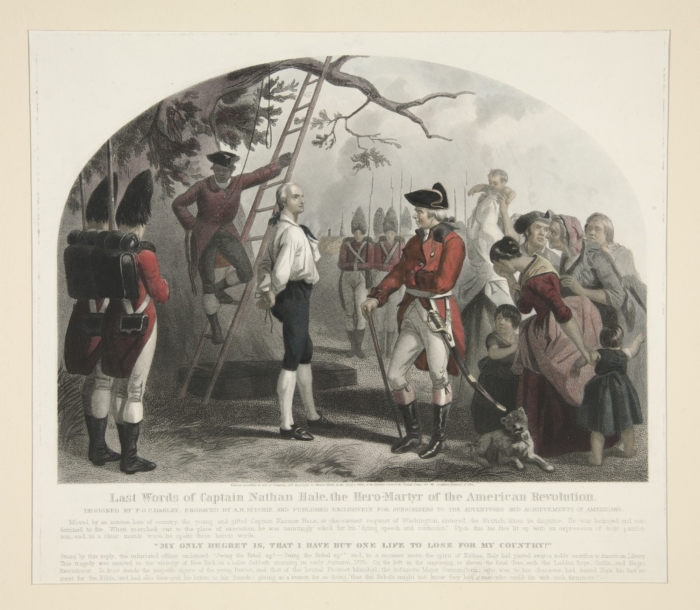
On the morning of September 22, 1776, a young man was led along the Post Road on Manhattan Island to a spot near a public house called the Dove Tavern and hanged. He was twenty-one.1 Two other places in Manhattan also claim to be the site. He was a Connecticut captain, a Yale graduate and, until the year before, a schoolteacher. No eyewitness wrote down the sentence he is famous for. That has not stopped anyone from quoting it.
A Schoolteacher From Coventry
Hale was born on June 6, 1755, in Coventry, Connecticut, to Deacon Richard Hale and Elizabeth Strong.2 He entered Yale at fourteen, in 1769, and graduated in 1773 with first-class honors. One of his classmates was a Long Island boy named Benjamin Tallmadge.2 After Yale he taught school, first in East Haddam and then in New London.3
War found him in a classroom. Tallmadge wrote him in July 1775, on the 4th by one account, urging him to take on "the more extensive service."23 Hale joined a Connecticut regiment that year, was commissioned a captain in 1776, and marched to New York with the army.4
Knowlton's Rangers
In August 1776 Washington had Lieutenant Colonel Thomas Knowlton pick 130 men and 20 officers from New England regiments for a scouting unit. Hale served in it.5
The Americans lost the Battle of Long Island in late August and pulled back to Manhattan. Washington wanted a spy behind British lines. Knowlton himself was killed scouting at Harlem Heights on September 16.5
The Mission, September 1776
Knowlton asked his officers for a volunteer to go behind British lines, and Hale was the only officer to step forward on the second call.6 Wikipedia gives September 8 for his offer and September 12 for his crossing to Huntington, Long Island, but Henry Phelps Johnston's 1901 biography, working from a British ship's log, put the landing on the night of the 15th or 16th.37 He planned to pass as a Dutch schoolteacher.7 The British took New York City on September 15. On September 21 a great fire destroyed roughly a quarter of the lower city.3
It was a thin plan. Historians Thompson and O'Toole, summarized by the Library of Congress, judged the mission poorly prepared. Hale had no training in tradecraft, no code and no secret ink, and he had a Loyalist cousin, Samuel Hale, working with Howe's forces.8 Compare that with the network Tallmadge built two years later, in the next lesson.
How He Was Caught
The sources do not agree on the details. The earliest known account of the arrest is a manuscript by Consider Tiffany, a Connecticut storekeeper who sided with the Crown. His family gave it to the Library of Congress in 2000.8 Tiffany says Major Robert Rogers, the old French and Indian War ranger now recruiting Loyalists for Howe, suspected Hale was a spy, posed as a fellow patriot to draw him out, and invited him to dinner. Hale repeated his story to Rogers's friends. Soldiers then surrounded the house and seized him. Hale at first denied his name and purpose, until "several persons knew him and called him by name."8
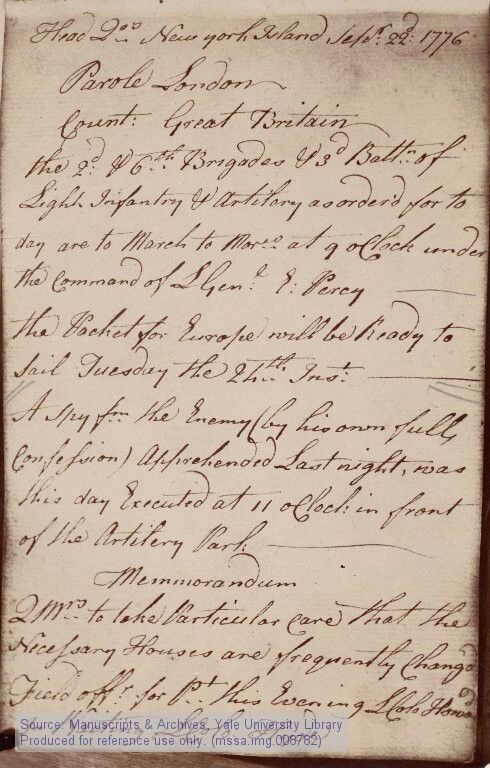
Other versions differ. The Battlefield Trust notes that the Rogers story places the arrest in a tavern, in Queens, and that a second account blames Hale's cousin Samuel.2 Hale's servant, Asher Wright, said the British searched him and found "drawings of the works, with descriptions in Latin."6 Britannica says only that he was taken on September 21 while trying to return to his lines.4 A British orderly book, quoted by the Library of Congress, says he was "apprehended last night" and hanged the next morning.8 Samuel Hale's own surviving letter appears to deny betraying his cousin.6
Hale was questioned at Howe's headquarters in the Beekman house. Later accounts say the provost marshal, William Cunningham, refused him a clergyman and a Bible.37 There was no trial. Tiffany himself wrote that he was hanged "some say, without being brought before a court martial."8 Armies of the day hanged spies as unlawful combatants.2
The Last Words
Myth: We have Hale's last words on the record
The line printed on statues is "I only regret that I have but one life to lose for my country."9 No eyewitness wrote it down. The Battlefield Trust says there are no official records of his speech.2 The words are secondhand, and probably paraphrased.
The closest thing to a contemporary record is a British officer's diary. Lieutenant Frederick Mackenzie wrote that Hale "behaved with great composure and resolution," and that he "desired the Spectators to be at all times prepared to meet death in whatever shape it might appear."10 Mackenzie gives no famous line.
The famous line comes down through two hands. Captain William Hull, who knew Hale, recorded years later that the British Captain John Montresor had told him, under a flag of truce the next day, that Hale declared his name, rank and purpose, and said: "I only regret, that I have but one life to lose for my country."6 Hull was not at the hanging and did not hear the words himself.11 It is a report of a report.
Then there is Joseph Addison's play Cato, a favorite of the patriots, which has the line "What pity is it / That we can die but once to serve our country!"11 Britannica notes the resemblance.4 The play was well known in colonial America. Whether Hale echoed it or Hull's memory did is a guess nobody can check.
Other early versions exist. The Essex Journal of February 13, 1777, has Hale saying that if he "had ten thousand lives" he would give them all. A newspaper of 1781 has him sorry only that he had no more than one to give.3 The Library of Congress cites historian James Hutson's point that there is no contemporary evidence he spoke the famous words.8
Statues and the CIA
His body was never found. An empty grave, a cenotaph, stands in Nathan Hale Cemetery in Coventry.3 A granite obelisk went up at the cemetery entrance in 1846, and Connecticut named Hale its state hero in 1985.123 Frederick MacMonnies's statue in City Hall Park in New York was unveiled on November 25, 1893.13 Bela Pratt's statue of 1912 stands in front of Connecticut Hall at Yale.3
The CIA put a life-size copy of the Yale statue on its grounds in 1973, two hundred years after Hale's graduation. The agency says no known portrait of him exists, so the sculptor worked from written descriptions. The statue shows him with hands and feet bound, and the words quoted above circle its base.9
Nathan Hale's Life at a Glance
- 1755 Born June 6 in Coventry, Connecticut.
- 1773 Graduates from Yale; teaches in East Haddam, then New London.
- 1775 Tallmadge urges him to join the fight; Hale joins a Connecticut regiment.
- August 1776 Serves in Knowlton's Rangers.
- Mid-September 1776 Crosses to Long Island to gather intelligence; sources give September 12 to 16.
- September 21, 1776 Captured; a fire burns much of lower New York.
- September 22, 1776 Hanged in Manhattan at 21.
- 1973 The CIA installs a copy of the Yale statue at its headquarters.
Learn more
- American Battlefield Trust: Nathan Hale: a short biography that sets out both capture stories
- Library of Congress: The Tiffany Manuscript: the earliest known account of the arrest
- Connecticut History: Nathan Hale Hanged in New York: Mackenzie's diary and the execution
- CIA: Nathan Hale Statue: what the agency says the statue means
Notes
- ConnecticutHistory.org, "Nathan Hale Hanged in New York," on the morning of September 22, the Post Road, the Dove Tavern and Hale's age. Read it online. ↩
- American Battlefield Trust, "Nathan Hale," on his birth, Yale, Tallmadge, the two capture accounts, the hanging of spies and the absence of official records of his speech. Read it online. ↩
- Wikipedia, "Nathan Hale," on the text of Tallmadge's letter of July 1775, the September 8 and 12 dates, the Great Fire, the Beekman house, the variant last words from the Essex Journal of 1777 and an independent newspaper of 1781, the cenotaph, the state-hero designation of 1985 and the later statues. Treated here as a lead; see the other notes for better-sourced points. Read it online. ↩
- Encyclopaedia Britannica, "Nathan Hale," on his captaincy, his arrest on September 21, the hanging without trial and the resemblance to a line in Addison's Cato. Read it online. ↩
- Wikipedia, "Knowlton's Rangers," on the formation of the unit in August 1776, its size, Hale's service and Knowlton's death at Harlem Heights on September 16, 1776. Read it online. ↩
- American Heritage, "The Last Days and Valiant Death of Nathan Hale," on Hale's volunteering after Knowlton's second call, Hull's memoir, Montresor's account, Asher Wright's statement and Samuel Hale's letter. Read it online. ↩
- Henry Phelps Johnston, Nathan Hale, 1776: Biography and Memorials (New York: privately printed, 1901), pp. 104 to 106 on the crossing from Norwalk to Huntington, the ship's log of HMS Halifax and the Dutch schoolmaster disguise, and pp. 119 to 122 on the Beekman house and the tradition that Cunningham refused a clergyman and a Bible. Read it online. ↩
- Library of Congress Information Bulletin, "The Tiffany Manuscript," on Consider Tiffany's account, Major Rogers, the orderly book, the assessment by Thompson and O'Toole and James Hutson's remark on the last words. Read it online. ↩
- Central Intelligence Agency, "Nathan Hale Statue," on the 1973 installation, the lack of a known portrait and the words around the base. Read it online. ↩
- ConnecticutHistory.org, same article, quoting the diary of British officer Frederick Mackenzie (spelled "MacKensie" on the page). Read it online. ↩
- Royal Examiner, "The Famous Last Words No One Wrote Down," on Hull's later account and the line from Addison's Cato. The line is in Act 4 of the play, and the printed text of 1713 ends it with an exclamation point. Cato (1713), online. Read it online. ↩
- Clio, "Captain Nathan Hale Monument," on the obelisk erected at Coventry in 1846. Sources differ on its height, 42 and 45 feet. Read it online. ↩
- Wikipedia, "Statue of Nathan Hale (New York City)," on MacMonnies and the unveiling on November 25, 1893. Read it online. ↩
Terms in this lesson
- Knowlton's Rangers
- A scouting unit Washington formed in August 1776 under Lieutenant Colonel Thomas Knowlton. Hale served in it.
- Orderly book
- An army record of daily orders and events. A British orderly book noted Hale's execution.
- Cato
- Joseph Addison's 1713 play about a Roman republican, popular with American patriots. One of its lines resembles Hale's reported words.
- Secondhand account
- A report by someone who heard the story from another person and did not witness the event.
- Loyalist
- An American colonist who stayed loyal to the Crown. Hale's cousin Samuel and the storekeeper Consider Tiffany were Loyalists.
Sources
- American Battlefield Trust, Nathan Hale checked 2026-10
- Library of Congress Information Bulletin, The Tiffany Manuscript on Nathan Hale checked 2026-10
- Connecticut History, Nathan Hale Hanged in New York checked 2026-10
- American Heritage, The Last Days and Valiant Death of Nathan Hale checked 2026-10
- CIA, Nathan Hale Statue checked 2026-10
- Encyclopaedia Britannica, Nathan Hale checked 2026-10
- Henry Phelps Johnston, Nathan Hale, 1776: Biography and Memorials (1901) checked 2026-10