Lesson 13 of 14 · about 55 minutes · Updated October 28, 2026
Charles Hodge and Princeton, Nathaniel Taylor and New Haven: Old School and New School
You'll be able to
- Explain what the Old School and the New School disagreed about (sin, Adam's sin, ability, church agencies, revival methods), quoting Taylor, Hodge and the Westminster Confession.
- Quote Hodge's 1872 'new idea' remark in its setting and explain how his hearers took it.
- Describe the Beecher (1835) and Barnes (1835 to 1836) trials and their outcomes from the printed records.
- State what the General Assembly of 1837 did to the Plan of Union, the four synods and the voluntary societies, and how each side explained it.
- Trace the later divisions of 1857 and 1861 (with the Gardiner Spring Resolutions and Hodge's protest) and the basis of the reunion of 1869 to 1870.
- Separate documented fact, party claims, later tradition and scholarly interpretation in popular claims about Princeton and New Haven.
Start here: the short version
The revivals of the early nineteenth century raised hard questions for the theologians who trained ministers. Is a person guilty for a sinful nature he did not choose, or only for his own acts? Can a sinner be told he is able to repent? Should Presbyterians and Congregationalists keep working together on the frontier, and through voluntary societies they did not control? Two schools gave rival answers. At Princeton Theological Seminary, founded by the Presbyterian General Assembly in 1812, Archibald Alexander, Samuel Miller and their student Charles Hodge (1797 to 1878) taught the Westminster Confession in its received sense and defended it for half a century in the Biblical Repertory and Princeton Review. At Yale, Nathaniel William Taylor (1786 to 1858), Timothy Dwight's former pupil and Dwight Professor of Didactic Theology from 1822, argued in his sermon Concio ad Clerum (1828) that moral depravity "is man's own act, consisting in a free choice." New England critics led by Bennet Tyler founded a rival seminary at East Windsor, Connecticut, in 1834. Inside the Presbyterian Church the quarrel joined disputes about polity, missions and slavery: Lyman Beecher was tried for heresy and acquitted in 1835, Albert Barnes was suspended by his synod in 1835 and restored in 1836, and in 1837 an Old School majority abrogated the Plan of Union of 1801 and declared four synods no longer part of the church. The New School formed its own assembly in 1838. Both branches later divided along the line of North and South (the New School in 1857, the Old School in 1861 over the Gardiner Spring Resolutions), and the northern branches reunited in 1869 and 1870 "on the doctrinal and ecclesiastical basis of our common Standards." Hodge's famous remark at his jubilee in 1872, that "a new idea never originated in this Seminary," was a boast of fidelity, made about his teachers, and it was answered on the spot with a joke from a New England guest.
This lesson follows the theologians behind the revivals of lessons 08 to 12. Finney's own doctrines and Hodge's 1847 review of his Systematic Theology are taught in lesson 10, and the Old Side and New Side schism of 1741 to 1758 in lesson 04. The outline history of American Presbyterians, including the division of 1837 in brief, is in Module 80, lesson 02, and the Calvinist and Arminian positions in Module 80, lesson 03. This lesson goes into the documents: the Princeton jubilee proceedings of 1872, Taylor's sermon of 1828, the Plan of Union of 1801 and the acts of 1837 that abrogated it, the printed reports of the Beecher and Barnes trials, the Old School minutes of 1861, and the Plan of Reunion of 1869.
Two schools and what they argued about
The words "Old School" and "New School" were used in the 1820s and 1830s for two parties in the Presbyterian Church in the United States of America, and, by extension, for two styles of Reformed theology in the northern states. They were never tidy parties. The Old School was strongest in Pennsylvania, New Jersey and the South, among Presbyterians of Scottish and Scots-Irish descent who read the Westminster Confession as a binding statement of doctrine and the Presbyterian Form of Government as a binding church order. The New School was strongest in New York, Ohio and the upper Midwest, among congregations formed by New England settlers, many of them gathered under the Plan of Union of 1801, whose ministers had learned theology from the heirs of Jonathan Edwards (the New Divinity of lesson 07) or from Nathaniel Taylor at Yale.
Charles Hodge's son and biographer, Archibald Alexander Hodge, writing in 1880, sorted the opinions current among the New England emigrants into three kinds: "the old Calvinism identical with the original and constitutional orthodoxy of the Presbyterian church"; the variation "styled Hopkinsianism, which, while maintaining the essentials of Calvinism, denied the imputation of Adam's sin, the absolute inability of the sinner to repent, and a definite atonement," which Presbyterians had "never regarded as so far injurious as to be a bar to ministerial communion"; and "the heresies associated at that time with the School of New Haven," which he called "far more radical."1 That is the Princeton reading. A New School historian of the Western Reserve, William S. Kennedy, wrote in 1856 that "scarcely any two persons could agree in a definition of that great heresy," and that "to this day it remains a profound mystery to most persons, what the real difference, between New and Old School Theology, is."2 Both statements are partisan, and both are evidence of how the parties saw each other.
The questions in dispute fall under five heads, and each recurs through the lesson:
- Sin. Is sin only a voluntary act (Taylor), or also a "condition or state of the mind" that is truly sin before any act (Hodge, following the Westminster Confession)?
- Adam. Is Adam's first sin imputed (reckoned) to his descendants, so that they are guilty in him, or do they become sinners only when they themselves first sin, with Adam's fall as the occasion that makes their sinning certain?
- Ability. Can a sinner be told that he is able, in the full sense, to repent and believe, or does the Confession's statement that fallen man "is not able, by his own strength, to convert himself" forbid the preacher to say so?
- Church order and agencies. Should missions and the education of ministers run through voluntary, interdenominational societies (the American Home Missionary Society and the American Education Society) or through boards answerable to the General Assembly? And may churches formed on the Plan of Union, with Congregational committee men in place of elders, sit in Presbyterian courts?
- Revival methods. Were Finney's "new measures" (the anxious seat, protracted meetings, women praying in mixed meetings) a lawful means of grace, or a disorder? That question is treated in lesson 09 and lesson 10.
Slavery ran under all five. The Old School majority of 1837 included many southern commissioners, and the synods it cut off were among the most active centers of antislavery feeling in the church. How much weight slavery carried in 1837 is one of the disputed questions taken up below.
Princeton Theological Seminary
The founding, 1812
Princeton Theological Seminary was founded by the General Assembly of the Presbyterian Church in 1812 as the denomination's first school devoted only to the training of ministers. The seminary's own report on its ties to slavery states the date and adds that Archibald Alexander, who as pastor of the Third Presbyterian Church in Philadelphia had urged the Assembly to found a seminary, "was named the first professor."3 The Hodge biography records the early years in plain numbers. Alexander "was the first professor, and sole instructor, until the accession of the Rev. Samuel Miller, D. D., December 3d, 1813." At first "there were neither public buildings nor libraries," and the professors' houses served for recitation and worship. The main building, with dormitories, library, oratory and refectory, "was opened for use in the autumn of 1817, when only the two lower stories were finished." The matriculations were nine in 1812, sixteen in 1813, fifteen in 1814, twenty-two in 1815, twenty-six in 1816 and twenty-three in 1817.1
The seminary was the church's answer to two pressures. The revivals of the Second Great Awakening were multiplying congregations faster than the colleges could supply educated ministers, and Andover Seminary in Massachusetts (1808) had shown New England Congregationalists how a graduate school of theology could guard doctrine. The College of New Jersey in the same town, founded in 1746 by New Side Presbyterians (see lesson 04) and led from 1768 to 1794 by John Witherspoon (see lesson 07), had trained many ministers, but its course was general.
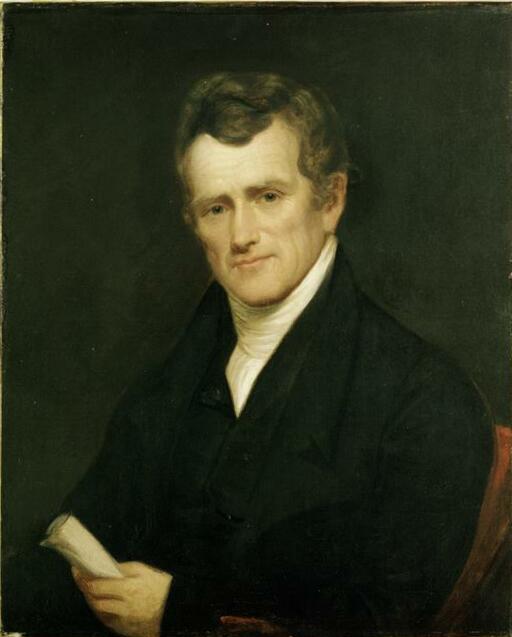

Archibald Alexander and Samuel Miller
Alexander, a Virginian who had been president of Hampden-Sydney College and had seen the southern revivals of the 1780s and 1790s at first hand, taught didactic and polemic theology. Miller, formerly a pastor in New York City, taught church history and church government. Hodge, speaking in 1872, said that the seminary "is what it is ... because Archibald Alexander and Samuel Miller were what they were," and he described the piety they taught: when a despondent student came to Alexander, "the venerable man was sure to tell him, 'Look not so much within. Look to Christ. Dwell on his person, on his work, on his promises, and devote yourself to his service, and you will soon find peace.'"4 That advice is a mark of the Princeton type of piety: it accepted revival but distrusted the long self-examination and the measured emotional crisis that some revival preachers required.
The seminary report of 2019 also records the founders' relation to slavery. It states that Alexander "did not hold any slaves" during his tenure at the seminary, though he had "acquired a slave through his wife," that Miller, in the words of his son that the report quotes, "held several slaves under the laws providing in that state for the gradual abolition of human bondage," that he "did not consider the use of slave labor as sinful," and that both men supported the colonization of freed Black Americans in Africa. Miller had condemned slavery in an address of 1797 to the New York Society for Promoting the Manumission of Slaves.3 New Jersey's gradual emancipation act of 1804 freed only children born after that date, and only in adulthood, so slaveholding remained lawful in Princeton through the seminary's first decades.
Charles Hodge
Charles Hodge was born in Philadelphia at a moment he described himself: "at midnight, in the last moments of the 27th or the first moments of the 28th of December, 1797, I, the fifth and last child, was born." His father died the following July.1 He graduated from the College of New Jersey in 1815, matriculated at the seminary on November 9, 1816, became an assistant instructor in 1820, and was elected professor by the General Assembly in May 1822.1 The proceedings of his jubilee state that he "was by the General Assembly elected a professor" in May 1822 and that "the fiftieth year of his professorship accordingly terminated with the academic year ending April 23d, 1872."4 He taught at Princeton until his death on June 19, 1878, interrupted only by two years of study in Paris, Halle and Berlin (1826 to 1828), where he heard August Tholuck and August Neander.1
His platform was the quarterly he founded. "In the beginning of 1825, he founded the Biblical Repertory," his son wrote; at first it was "a Collection of Tracts in Biblical Literature," mostly translations, "making no pretensions to originality." A new series began in January 1829; in 1830 the title became "Biblical Repertory and Theological Review," and in 1837 "Biblical Repertory and Princeton Review."1 Through that journal Hodge reviewed nearly every American theologian of his time, including Taylor, Beecher, Barnes, Finney, Horace Bushnell and Edwards A. Park. His son's footnote on Taylor describes him as the author of "the modification of New England Theology, called 'Taylorism,' against which the polemic guns of the Princeton Review were trained for forty years."1
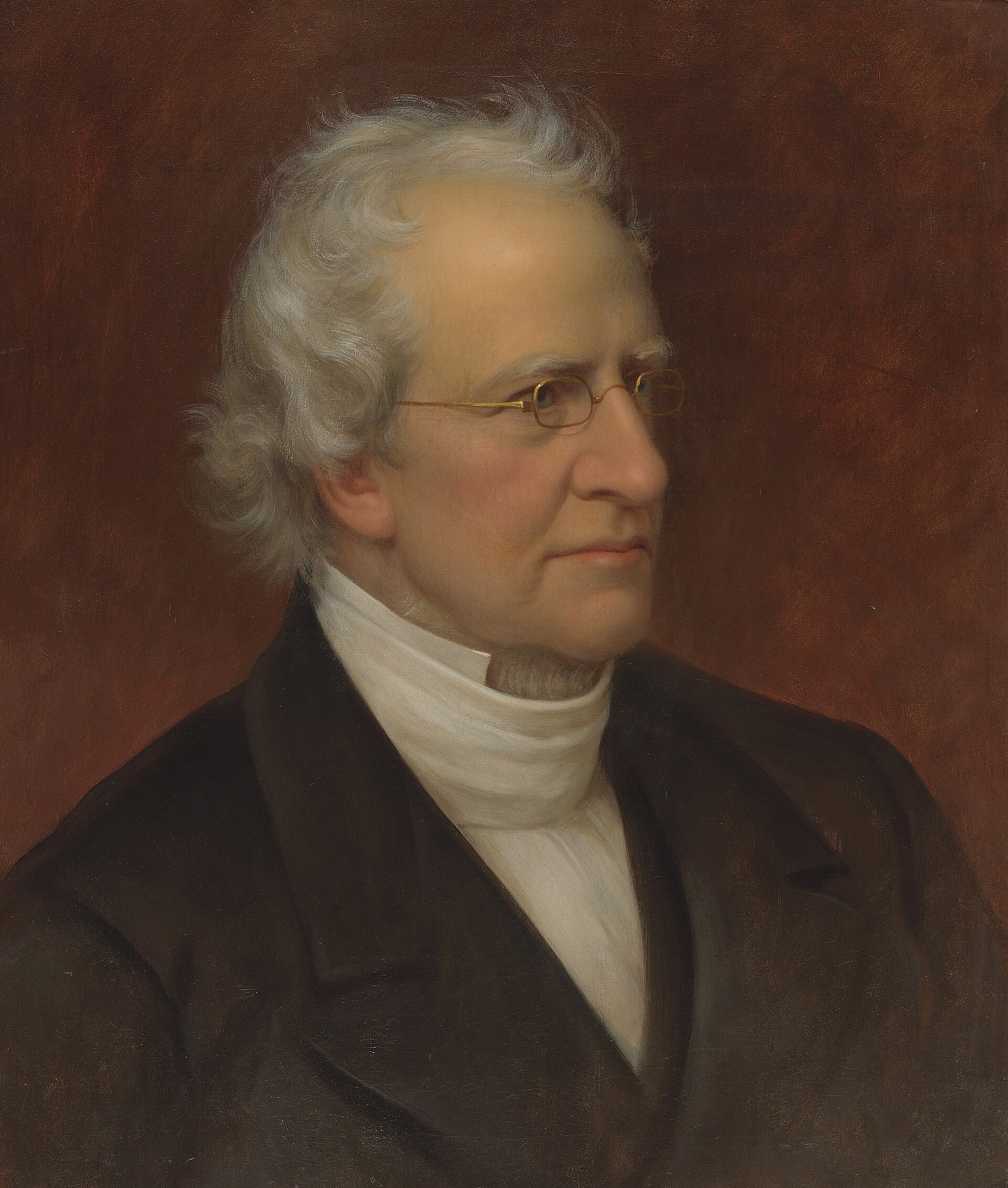

Hodge's three-volume Systematic Theology (1872 to 1873) gathered fifty years of lectures. Its method is stated in a sentence from the second volume, in the section on the Augustinian scheme of salvation: "If the office of the theologian, as is so generally admitted, be to take the facts of Scripture as the man of science does those of nature, and found upon them his doctrines, instead of deducing his doctrines from the principles or primary truths of his philosophy, it seems impossible to resist the conclusion that the doctrine of Augustine is the doctrine of the Bible."5 The comparison of theology with natural science, and the confidence that ordinary readers can grasp the facts of Scripture, owe much to the Scottish common sense philosophy that Witherspoon had brought to Princeton (see Liberty module 58, lesson 03). Taylor at Yale drew on the same philosophy, and Mark Noll (America's God, 2002) has argued that this shared philosophical ground is one reason the two schools could argue so closely and so long.6
In 1874 Hodge published a short book, What Is Darwinism? He defined Darwin's theory by three elements, "evolution, natural selection, and the denial of design in nature," and gave his answer: "What is Darwinism? It is Atheism. This does not mean, as before said, that Mr. Darwin himself and all who adopt his views are atheists; but it means that his theory is atheistic; that the exclusion of design from nature is, as Dr. Gray says, tantamount to atheism." He also wrote: "It is conceded that a man may be an evolutionist and yet not be an atheist and may admit of design in nature."7 The book is often quoted for its four-word answer alone; its target was the denial of design, and Hodge's distinction between the theory and the man is in the same paragraph.
The jubilee of 1872 and the "new idea" remark
On April 24, 1872, alumni, professors and delegates from other seminaries gathered at Princeton to mark the fiftieth year of Hodge's professorship. The printed Proceedings record the speeches. A delegate from Allegheny Seminary spoke of "the twenty-seven hundred children mentioned here to-day," meaning the students Hodge had taught, and another speaker of "nearly three thousand students now gone abroad and preaching everywhere."4 Those are round figures spoken at a celebration, not a count from the seminary's register, and should be read as estimates.
Hodge's own address contains the sentence quoted ever since. Its full setting matters, because the sentence is usually quoted alone:
"Again, Drs. Alexander and Miller were not speculative men. They were not given to new methods or new theories. They were content with the faith once delivered to the saints. I am not afraid to say that a new idea never originated in this Seminary. Their theological method was very simple. The Bible is the word of God. That is to be assumed or proved. If granted; then it follows, that what the Bible says, God says. That ends the matter."4
Three things follow from the text. The remark was made in 1872, at the jubilee, and it is printed on page 52 of the Proceedings. It was spoken about Alexander and Miller and the seminary's teaching, in a passage praising their refusal of "new methods or new theories." And it was heard as a boast of fidelity, not as an admission of dullness. Later in the day Dr. R. G. Vermilye, speaking for the Theological Institute of Connecticut, answered with a joke: "Dr. Hodge was right to-day, when he witnessed a good confession, in saying you never originated a new idea here. We have all the theology, and had I suppose before Princeton was founded, in the archives of New England, ... all the theology that you teach here." He added that he doubted whether Princeton had "the right to put your imprimatur especially on it, as the 'Princeton Theology.' [Laughter.] It is the theology of the Reformation."4 The exchange shows that Hodge's admirers in New England (Vermilye's institute was the one Bennet Tyler had founded, described below) took the line as a claim that Princeton taught the old Reformed faith and nothing else.
Critics of Princeton have used the sentence for the opposite purpose, as proof that the school was closed to learning. Hodge's own record complicates that reading: he studied in Germany, reviewed German theology at length, and gave a whole book to Darwin. The fair statement is that Hodge claimed no originality of doctrine and counted that a virtue, while his critics, then and later, held that a theology which claims never to change cannot answer new questions honestly. Both judgments start from the same printed words.

Hodge on slavery
Hodge's writings on slavery are part of the record of the Old School and must be stated in his own words. The seminary's 2019 report states that Hodge "purchased Henrietta" in 1828 and "a few years later acquired Lena," possibly through his mother's estate, and that he employed two other African American servants in the 1830s whose status, enslaved or paid, cannot be determined.3
In 1836 he reviewed William Ellery Channing's book Slavery in the Biblical Repertory. The essay, reprinted in his Essays and Reviews (1857), argues from the conduct of Christ and the apostles: "An equally obvious deduction from the fact above referred to, is, that slaveholding is not necessarily sinful. The assumption of the contrary is the great reason why the modern abolitionists have adopted their peculiar course." He distinguished slaveholding "in itself considered" from the laws that governed it, which "may be reasonable or unreasonable, just or unjust, at different times and places," and he wrote: "The fact is, that the great duty of the South, is not emancipation, but improvement." He also predicted what would follow if the opposite opinion prevailed: "We shall become two nations in feeling, which must soon render us two nations in fact."8 The same volume prints a second essay, "Emancipation," written during Kentucky's debate over a new state constitution, in which Hodge restated that slaveholding was not in itself sinful and that "the right to hold slaves does not imply the right to treat them as brutes, or as mere chattels." He quoted Robert J. Breckinridge's list of the Kentucky laws that gave enslaved people no rights of property, no legal marriage and no legal tie of parent and child, and he wrote: "Slaveholding may be justifiable, and yet the laws made by slaveholders be atrociously unjust."8 In 1861 he opposed secession and defended the Union while protesting, as described below, against the General Assembly's right to decide a citizen's allegiance.
On the other side of the same church stood Albert Barnes, the New School pastor whose trials are described below, who published An Inquiry into the Scriptural Views of Slavery (1846) against Hodge's reading of the New Testament, and Theodore Sedgwick Wright, the first African American to attend Princeton Seminary (class of 1828), who became an abolitionist and a founder of the American Anti-Slavery Society.3
New Haven and Nathaniel William Taylor
Taylor, Dwight and the Yale chair
Nathaniel William Taylor was born at New Milford, Connecticut, on June 23, 1786, and died at New Haven on March 10, 1858. The sermons preached after his death and printed as a Memorial (1858) supply the outline of his life. Samuel W. S. Dutton, pastor of the North Church in New Haven, said that after graduating from Yale he spent five years studying theology, "being two years of the time in the family of President Dwight, as his amanuensis and private pupil." In 1812 he was ordained pastor of the First Church in New Haven, succeeding Moses Stuart, who had gone to Andover. "Ten years after, in 1822," when the Yale corporation established a theological school, "he was chosen, at the age of thirty-six, to the Dwight Professorship of Didactic Theology," a chair endowed by Timothy Dwight's eldest son "chiefly that it might be filled by his admired friend, Dr. Taylor." He held it for thirty-six years.9
Dwight himself (Yale president 1795 to 1817, Jonathan Edwards's grandson) is treated in lesson 07. Taylor always claimed to be his teacher's faithful heir. The preface to the printed Concio ad Clerum states that the author was "not aware of any change in his own views on these points, since he entered the ministry; nor of any departure in any article of doctrinal belief, from his revered instructor in theology, the former President of the College."10 Dutton, a friend, made a candid exception. He judged that one part of Taylor's system would "not bear the test of time": "the self-love theory, or desire of happiness theory," that "all motives that come to the mind find their ultimate ground of appeal in the desire of personal happiness." Dutton added that the theory "was plainly taught before him, by Dwight and the elder Edwards," though Taylor gave it "greater prominence than they."9
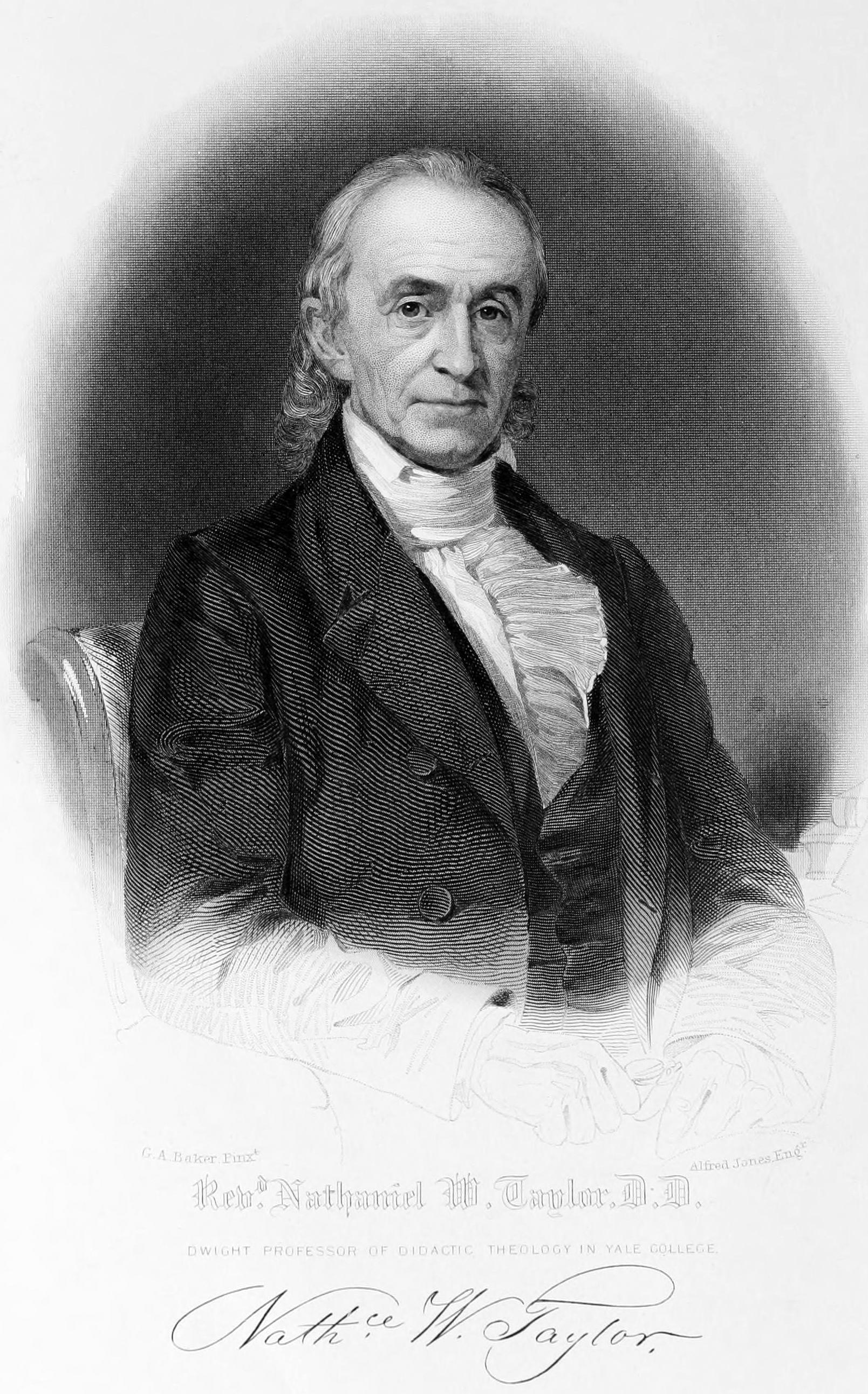

Concio ad Clerum, September 10, 1828
A "concio ad clerum" is an address to the clergy. Taylor delivered his in the chapel of Yale College on September 10, 1828, and published it the same year; the copy used here is the New Haven reprint of 1842. His text was Ephesians 2:3, "And were by nature the children of wrath, even as others" (KJV). He announced his thesis in capitals: "THE ENTIRE MORAL DEPRAVITY OF MANKIND IS BY NATURE." The sermon's argument turns on what "by nature" means.10
He first said what moral depravity is not. It does not consist "in any essential attribute or property of the soul ... not in any thing created in man by his Maker. On this point, I need only ask, does God create in men a sinful nature, and damn them for the very nature he creates? Believe this, who can." Nor does it consist "in a sinful nature, which they have corrupted by being one with Adam, and by acting in his act." To believe that he was one being with Adam, Taylor said, "and that by virtue of this identity I truly acted in his act, and am therefore as truly guilty of his sin as himself, to believe this, I must renounce the reason which my Maker has given me." Nor does it consist in natural appetites and desires: "Who does not know that a perfectly holy man must be subject to all these propensities? The man Christ Jesus was subject to every one of them."10
Then came his positive definition: "The question then still recurs, what is the moral depravity for which man deserves the wrath of God? I answer, it is man's own act, consisting in a free choice of some object rather than God, as his chief good; or a free preference of the world and of worldly good, to the will and glory of God."10 He appealed to Calvin and to the Westminster Confession for support, quoting the Confession's phrase "every sin both original and actual being a transgression of the righteous law of God" and asking: "is not transgression, action? is it not something done, and done knowingly and voluntarily?"10 And he pressed the point about infants: "Is it then said, that we sin before we are born? But there is no such thing as sinning without acting."10
The second half of the sermon kept the words "by nature." Taylor wrote: "What then are we to understand, when it is said that mankind are depraved by nature? I answer, that such is their nature, that they will sin and only sin in all the appropriate circumstances of their being." He explained that he did not mean "that their nature is the physical or efficient cause of their sinning," but that "their nature is the occasion, or reason of their sinning." He framed the question as one between Calvinists and Arminians, "whether the depravity or sinfulness of mankind is truly and properly ascribed to their nature or to their circumstances of temptation," and he answered for nature, because "all mankind sin in all the appropriate circumstances of their being." And he insisted on the work of the Spirit: "to be born once, involves the certainty of sin, to become a human being is to become a sinner, unless there be a second birth of the Spirit."10
The slogan "sin is in the sinning" is often given as a quotation from this sermon. The words do not appear in the text of the 1842 reprint consulted for this lesson. The idea is Taylor's (the nearest sentences are "it is man's own act" and "there is no such thing as sinning without acting"), but the five-word phrase is a later summary and should be cited as such.
The Confession and Princeton's answer
Taylor's Presbyterian readers measured his sermon against the Westminster Confession, which Presbyterian ministers had vowed to receive "as containing the system of doctrine taught in the Holy Scriptures." Its chapter on the fall says: "From this original corruption, whereby we are utterly indisposed, disabled, and made opposite to all good, and wholly inclined to all evil, do proceed all actual transgressions." And: "This corruption of nature, during this life, doth remain in those that are regenerated; and although it be, through Christ, pardoned, and mortified; yet both itself, and all the motions thereof, are truly and properly sin." The next section is the one Taylor quoted: "Every sin, both original and actual, being a transgression of the righteous law of God, and contrary thereunto, doth, in its own nature, bring guilt upon the sinner." Chapter IX adds that fallen man "hath wholly lost all ability of will to any spiritual good accompanying salvation: so as, a natural man, being altogether averse from that good, and dead in sin, is not able, by his own strength, to convert himself, or to prepare himself thereunto."11
Both sides read the same sentences. Taylor took "transgression" to mean an act and concluded that original sin must be the first sinful act that nature makes certain. The Old School read "corruption of nature ... is truly and properly sin" as a plain statement that a state, not only an act, is sinful. Hodge gave the Old School answer at length in his Systematic Theology, under the heading "Sin not Confined to Acts of the Will." He distinguished three senses of "voluntary" (deliberate choice, spontaneous feeling, and "whatever inheres in the will as a habit or disposition") and wrote: "According to the Bible and the dictates of conscience there is a sinfulness as well as sins; there is such a thing as character as distinguished from transient acts by which it is revealed; that is, a sinful state, abiding, inherent, immanent forms of evil, which are truly and properly of the nature of sin. All sin, therefore, is not an agency, activity, or act; it may be and is also a condition or state of the mind."5 He appealed to the believer's experience: the Christian "recognizes as evil in their own nature the first risings of malice, envy, pride, or cupidity," and knows "that they spring from an evil or imperfectly sanctified nature."5
Hodge treated the New Haven theory as a modern form of an old position. In an 1851 essay in his long exchange with Edwards A. Park of Andover, he wrote that the denial of certain inherited Reformed principles had not appeared among New England divines "reputed orthodox" "until the rise of what is popularly called New Havenism."8 Elsewhere in the Systematic Theology he classed under "Pelagian and Rationalistic Doctrine" the view that moral character belongs only to acts of the will.5 Taylor and his defenders answered that he taught a real, universal and certain depravity "by nature," that no one was saved without the Spirit's new birth, and that Augustine himself held sin to be voluntary. Whether the New Haven position deserves the Pelagian label is the same question asked of Finney in lesson 10; the original dispute between Pelagius and Augustine is taught in Module 79, lesson 06. Taylor's own sermon affirmed what Pelagius denied (that every human being, because of the fall, will certainly sin and needs supernatural regeneration), and denied what Augustine affirmed (that infants are guilty before any act). On the evidence of the text, "Pelagian" is a polemical label for the New Haven view, and "semi-Augustinian" or "modified Edwardsean" are the labels its friends preferred; Douglas Sweeney (Nathaniel Taylor, New Haven Theology, and the Legacy of Jonathan Edwards, 2003) has argued that Taylor is best read as an Edwardsean who revised his tradition, not as one who left it.6
Why it mattered to preachers
The quarrel was not academic. If sin is only a voluntary act and the sinner has full power to choose otherwise, the preacher may call for immediate repentance as a duty the hearer can perform now, and he may use every lawful means (urgent appeals, protracted meetings, the anxious seat) to bring the hearer to choose. That is the logic of Finney's Lectures on Revivals (1835), and Taylor's school supplied much of its vocabulary. If sin is also a state of the heart that only God can change, the preacher still calls for repentance, as the Westminster divines and Edwards did, but he warns that a decision produced by pressure may be no conversion at all. The Old School and the New School both preached for revival; they differed on what a sinner could be told he was able to do, and on what methods were safe. The practical side of the argument, including Asahel Nettleton's and Lyman Beecher's objections to Finney in 1827, is told in lesson 09.
Bennet Tyler and the Tylerites
Taylor's sharpest opponents in his own state were Connecticut Congregationalists who stood in the line of Edwards and the New Divinity. Bennet Tyler (1783 to 1858), a former president of Dartmouth College and then pastor in Portland, Maine, answered Taylor in a series of published letters, and the debate between "Taylorites" and "Tylerites" filled Connecticut journals through the early 1830s. The Christian Spectator, edited in New Haven, carried the Taylor side.
The Tylerite party gave its objection an institutional form. A memorial volume published by the school fifty years later records that "thirty-six Connecticut Congregational ministers met in convention at East (now South) Windsor, Sept. 10, 1833, 'for the purpose of consultation and taking such measures as may be deemed expedient for the defense and promotion of evangelical principles.'" Among the "more prominent members" it names Asahel Nettleton, the revival preacher who had opposed Finney's methods. "The result was the organization of the Conn. Pastoral Union, and shortly after the Theological Institute of Connecticut." On May 13, 1834, the cornerstone of the seminary building was laid at East Windsor and "two professors were inducted into office: Dr. Bennett Tyler, Professor of Theology, and Dr. Jonathan Cogswell, Professor of Sacred History." Sixteen students began the regular course that autumn.12
The same volume reports that "in the fall of 1834 the theological Professors of Yale College published a statement denying that any good reason could be assigned for the new enterprise," and that the trustees answered with an "Appeal to the Public."12 The institute moved to Hartford in 1865 and became Hartford Theological Seminary. It was a professor of that school, R. G. Vermilye, who in 1872 brought its congratulations to Hodge's jubilee and told Princeton that New England had held "all the theology that you teach here" before Princeton was founded.4
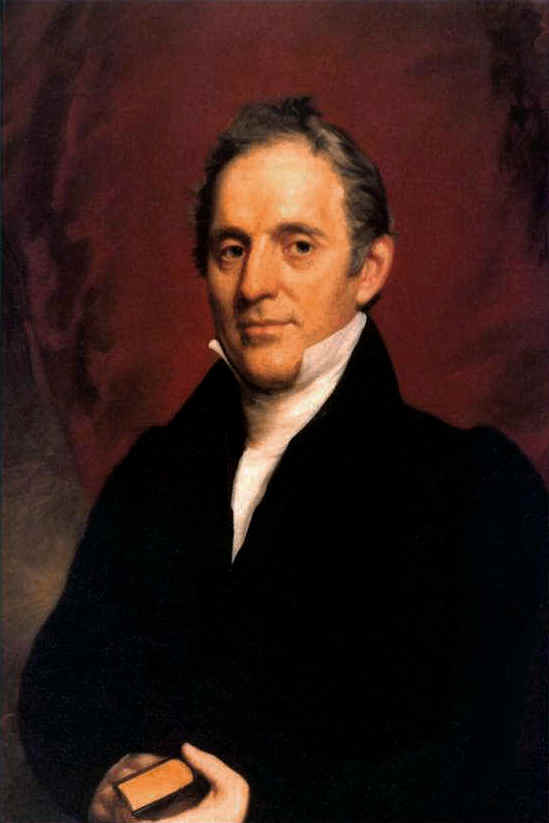

The heresy trials of the 1830s
Lyman Beecher, 1835
Lyman Beecher (1775 to 1863), Taylor's close friend and another of Dwight's students, had been the leading Congregational pastor of Connecticut and Boston before he moved west to become president of Lane Theological Seminary in Cincinnati and a Presbyterian minister. In 1835 Joshua Lacy Wilson, pastor of the First Presbyterian Church of Cincinnati and an Old School man, brought charges against him before the Presbytery of Cincinnati. The trial was reported verbatim for the New York Observer and published the same year. The presbytery met on Tuesday, June 9, 1835.13
Wilson's charges, in his own numbering, were these: "I. I charge Dr. Beecher with propagating doctrines contrary to the word of God and the standards of the Presbyterian church on the subject of the depraved nature of man"; II, on "Total Depravity and the work of the Holy Spirit in effectual calling"; III, with "propagating a doctrine of perfection contrary to the standards"; IV, with "the sin of slander," for claiming that his views had been "the received doctrine of the orthodox church in all ages"; V, with preaching those doctrines in the Second Presbyterian Church; and VI, with "the sin of hypocrisy," on the ground that if he held such views he could not honestly have adopted the Confession.13 Under the third charge Wilson quoted a perfectionist letter to Theodore Weld, then a student at Lane, which claimed that "christian perfection, substantially as we hold it, is the legitimate product of New England divinity," because "we have been taught in their schools that sin lies wholly in the will."13 The link Wilson drew between the New Haven doctrine of sin and Oberlin perfectionism (see lesson 11) is a link Old School writers made for decades.
The presbytery voted charge by charge. On the first, twelve members voted "Sustained" and twenty-three "Not Sustained." The second went the same way. The third was not voted on, because Beecher admitted the facts it alleged. On the fourth, fifth and sixth, six voted to sustain and twenty-nine not to sustain.13 The presbytery's minute stated its reasons. On depravity, Beecher "holds and teaches that in consequence of the fall of Adam and the divinely appointed connexion of all his posterity with him, man is born with such a constitutional bias to evil that his first moral act and all subsequent moral acts, until regenerated, are invariably sinful; which bias to evil is properly denominated a depraved nature, or original sin, as in the standards of our church." On ability, he held that fallen man "has all the constitutional powers or faculties to constitute moral agency," and also "that man by the fall is morally disabled, being so entirely and obstinately averse from that which is good, and dead in sin, so that he is not able to convert himself or prepare himself thereunto." The charges of perfectionism, slander and hypocrisy were "altogether constructive and inferential, and wholly unsustained by the evidence."13
Wilson appealed to the Synod of Cincinnati. Beecher's own account, in the introduction to his Views in Theology (1836), which carries the line "Published by request of the Synod of Cincinnati," says the synod asked him to publish "a concise statement of the argument and design of my Sermon on Native Depravity, and of my views of total depravity, original sin, and regeneration," and that it "saw nothing in my views, as explained by myself, to justify any suspicion of unsoundness in the faith." He also speaks of "the terms of my acquiescence in their decision," which shows that the synod's decision included something he had to accept.14 The exact wording of the synod's judgment was not examined for this lesson. The case shows the New School argument in a single sentence of the presbytery's minute: a man could hold the New England account of the will and still affirm, in the Confession's words, that fallen man "is not able to convert himself."
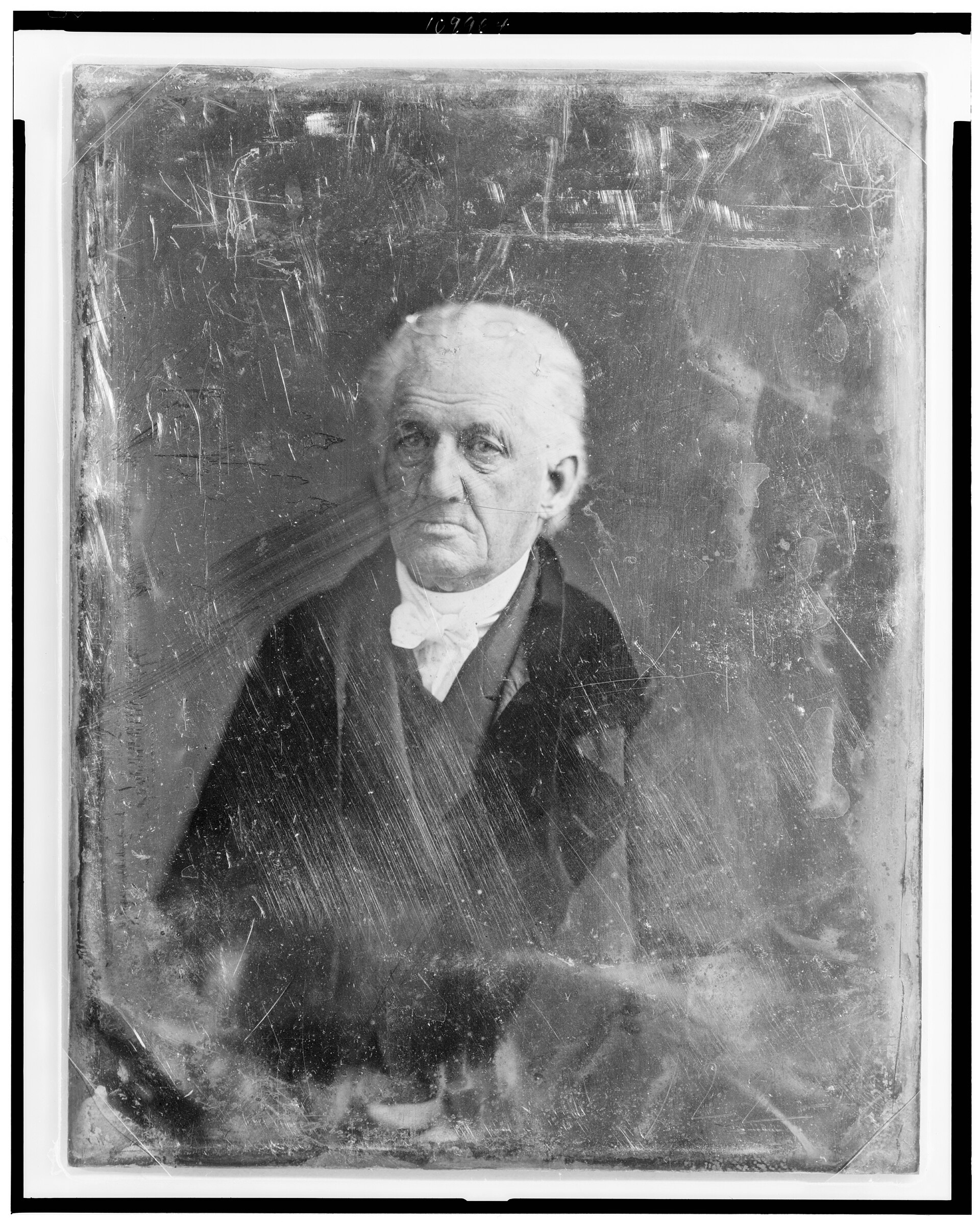

Albert Barnes, 1830 to 1836
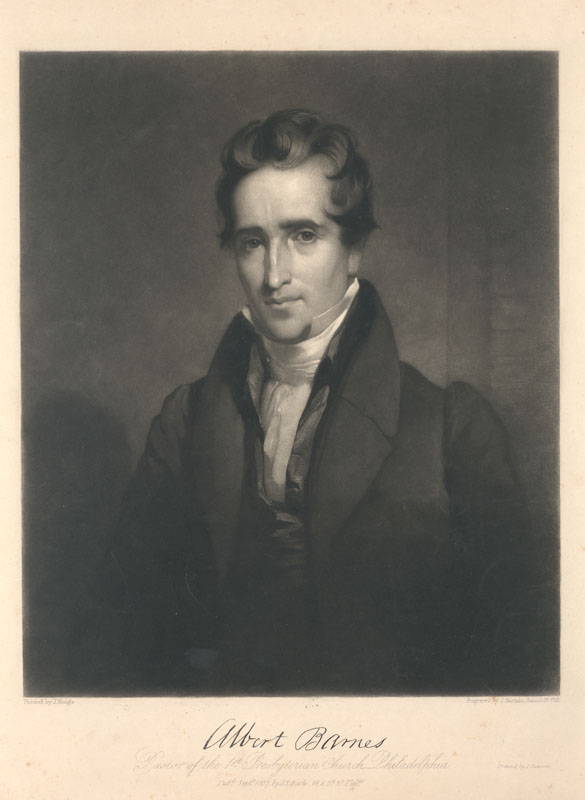
Albert Barnes (1798 to 1870), a Princeton Seminary graduate of 1823 and pastor of the First Presbyterian Church of Philadelphia from 1830, was the most widely read New School author of his generation through his popular Notes on the New Testament. His installation in Philadelphia was opposed because of a sermon, "The Way of Salvation" (1829), and the Old School Presbyterian Isaac V. Brown later wrote that "the case of Albert Barnes was the torch applied by the New School faction in Philadelphia, to the mass of combustibles which had been accumulating in that city and its vicinity for years."15 In 1835 George Junkin, president of Lafayette College, charged Barnes with heresy on the basis of his Notes on the Epistle to the Romans. Barnes's own presbytery (the Second Presbytery of Philadelphia) acquitted him. Junkin appealed to the Synod of Philadelphia, which met at York, Pennsylvania, in October 1835.16
The synod reversed the presbytery. Its resolutions, printed by Junkin in his Vindication (1836), declared the presbytery's decision "reversed, as contrary to truth and righteousness," found "that some of the errors alleged in the charges to be held by the said Albert Barnes are fundamental; and all of them contrary to the standards of the Presbyterian Church," and ordered "that the said Albert Barnes be, and he hereby is suspended from the exercise of all the functions proper to the gospel ministry, until he shall retract the errors hereby condemned, and give satisfactory evidence of repentance." Junkin reported the final vote as 116 for (58 ministers and 58 elders) to 31 against (29 ministers and 2 elders), and drew his own lesson: "the hope of orthodoxy lies in the popular branch of our ecclesiastical organization," meaning the ruling elders.17 The verbatim report of the trial prints the same 31 names among the noes.16
Barnes appealed to the General Assembly of 1836, which met at Pittsburgh with a New School majority. The Assembly removed the suspension. Samuel Miller of Princeton then moved a resolution that, while the Assembly "has thought proper to remove the sentence of suspension," Barnes had "published opinions materially at variance with the Confession of Faith ... especially with regard to original sin, the relation of man to Adam, and justification by faith in the atoning sacrifice and righteousness of the Redeemer," and should be "solemnly" admonished. According to Brown's Old School history, the motion "was rejected by a vote of 122 to 109."15 The narrowness of that vote is a fair measure of how evenly the church was divided a year before the break.
A. A. Hodge's biography adds a point often lost: the Princeton professors thought the York proceedings irregular. He wrote that the "Princeton men" objected to "the procedure by the Synod of Philadelphia to try the appeal of Dr. Junkin in the trial of Mr. Barnes while the records of the inferior court were absent," and to the use of the Old School "Act and Testimony" of 1834 "as a test of loyalty to Presbyterianism."1

The Plan of Union, 1801
The arrangement that brought New England theology into Presbyterian courts was made in 1801, when the General Assembly and the General Association of Connecticut adopted matching rules for the settlements then filling up in western New York and northern Ohio. Kennedy's history of the Western Reserve prints the text. It opens: "With a view to prevent alienations, and promote union and harmony, in those new settlements which are composed of inhabitants from Presbyterian and Congregational bodies," and its first article enjoins all missionaries "to promote mutual forbearance and accommodation between those inhabitants of the new settlements, who hold the Presbyterian, and those who hold the Congregational, form of church government."2
The other articles worked out the details. A Congregational church that settled a Presbyterian minister could keep its own discipline, and a Presbyterian church that settled a Congregational minister could keep its own. A mixed congregation could unite in one church and "choose a standing committee from the communicants of said church," whose business was "to call to account every member of the church, who shall conduct himself inconsistently with the laws of Christianity." A Presbyterian condemned by the committee could appeal to the presbytery; a Congregationalist could appeal "to the body of the male communicants of the church."2 In practice, the committee men of such churches were sent to presbyteries and synods with the rights of ruling elders, and whole presbyteries in western New York and the Western Reserve of Ohio came to be made up largely of Plan of Union churches.
Kennedy, writing from the Reserve, described the Plan as an act of "kindred liberality and christian charity," made "to prevent denominational strife and jealousies, and the consequent neutralization of evangelizing efforts." He called its later abrogation a violent repudiation: "The General Assembly was tired of that Plan, determined to get free from it; and violently repudiated it and all that had grown up under it." He also asked why it had taken the Assembly thirty-six years to discover that the Plan was unconstitutional.2 Brown, writing for the Old School the year before, argued from the Plan's own heading ("A Plan of Union for the New Settlements") that it "was designed to be only a temporary arrangement," and that it set aside the church's constitution by giving Congregational committee men seats in Presbyterian courts without ordination.15
The General Assembly of 1837
In May 1837 the Old School party held a majority in the General Assembly at Philadelphia. It used that majority in a series of acts the Old School called "reform measures" and the New School called the "excision."15
The abrogation. The Assembly resolved that it was "expedient to continue the plan of friendly intercourse between this church and the Congregational Churches of New England, as it now exists," and then: "But as the Plan of Union adopted for the new settlements in 1801, was originally an unconstitutional act on the part of that Assembly, these important standing rules having never been submitted to the Presbyteries; and as they were totally destitute of authority, as proceeding from the General Association of Connecticut, which is invested with no power to legislate in such cases ... therefore it is resolved, that the act of the Assembly of 1801, entitled 'A Plan of Union,' be, and the same is hereby abrogated." Brown records that the third resolution passed "by a majority of thirty-three votes."15
The Western Reserve. The Assembly then voted: "That by the operation of the abrogation of the 'Plan of Union of 1801,' the Synod of the Western Reserve is, and is hereby declared to be no longer a part of the Presbyterian Church in the United States of America." It passed "by a majority of twenty-seven votes."15
Utica, Geneva and Genesee. A further resolution declared that "in consequence of the abrogation, by this Assembly, of the 'Plan of Union of 1801,' ... as utterly unconstitutional, and, therefore, null and void from the beginning, the Synods of Utica, Geneva, and Genessee, which were formed and attached to this body, under and in execution of said 'Plan of Union,' be, and are hereby declared to be out of the ecclesiastical connexion of the Presbyterian Church of the United States of America." The Assembly added that it had "no intention ... to affect, in any way, the ministerial standing of any members of any of said Synods, nor to disturb the pastoral relation in any church," and directed churches and ministers "strictly Presbyterian in doctrine and order" in those synods to apply to the nearest Old School presbyteries.15
The voluntary societies. The Assembly declared that "the organization and operations of the so called American Home Missionary Society, and American Education Society, and its branches, of whatever name, within our bounds, are exceedingly injurious to the peace and purity of the Presbyterian Church," and recommended "that they should cease to operate within any of our churches."15 In their place the Old School built denominational Boards of Domestic Missions, Education and Foreign Missions.
The four synods covered most of western and central New York and the Western Reserve of Ohio, the region where Finney had preached in the 1820s and 1830s (see lesson 09 and lesson 12). A. A. Hodge reports that the "Princeton men," as represented by Archibald Alexander, "voted for the abrogation of the 'Plan of Union,' for the establishment of ecclesiastical boards, and for the excision of the Synod of Western Reserve," but "regretted the peremptory excision of the three Synods in western New York," accepting it as "substantial justice" while preferring a plan that would have required those synods to reorganize themselves.1 Charles Hodge wrote in 1871 that in all the controversies leading to the division "the conductors of this Review were in entire sympathy with the Old School party" on doctrine and on boards, but differed "from many, and apparently from a majority of their Old School brethren, as to the wisdom of the measures adopted."1
The division of 1838
When the General Assembly met in Philadelphia in May 1838, the clerks refused to enroll commissioners from presbyteries in the four disowned synods. The memorial volume published at the reunion describes what followed in neutral terms: "the New School commissioners to the Assembly of 1838, refused to recognize an organization of this judicatory which excluded representatives from the disowned constituency, and formed another, and, as they claimed, the only true Assembly." Each side then claimed to be the Presbyterian Church in the United States of America. The sorting of presbyteries and congregations took several years: "Minorities in many cases seceded from majorities, and frequently claimed the true succession, yet in general without open strife."18
Both bodies claimed the church's property and its seminaries. The New School brought suit in Pennsylvania, where the trustees of the General Assembly were incorporated. The trial began "early in March, 1839," before Judge Rogers and a jury. Under the judge's charge "sustaining the New School in every important point, the jury gave a verdict in their favor." On a motion for a new trial, decided on May 8, 1839, "Chief-Justice Gibson delivered the opinion of the court, Judge Rogers only dissenting. The judgment at nisi prius was entirely reversed, a new trial granted, and the whole case really settled in favor of the Old School." The New School discontinued the suit about three years later.18 The same account preserves a small scene from the trial: spectators asked "What is the difference between the Old School and the New?", and a court officer tried to answer that "the Old School hold that whatever is to be will be," but "broke down in trying to reverse the proposition plausibly."18
How large were the two churches?
The memorial volume gives the numbers available and warns that they are approximate: "By the statistical tables of 1837, the whole number of ministers in the yet united church was twenty-one hundred and forty, of congregations twenty-eight hundred and sixty-five." Because the New School adopted a triennial assembly in 1840, the first comparable report came in 1843, when the New School "reported twelve hundred and sixty-three ministers, and fourteen hundred and ninety-six congregations; the Old School, fourteen hundred and thirty-four of the one, two thousand and ninety-two of the other." By 1869 the New School reported 113 presbyteries, 1,848 ministers and 1,631 churches.18 These are counts reported by presbyteries to their assemblies, and the volume itself notes that many churches failed to report. They show two bodies of similar size in ministers, with the Old School larger in congregations.
What divided them? Doctrine, polity and slavery
Every account agrees that more than one cause was at work, and they differ on the weight of each.
- The Old School account puts doctrine and order first. Brown's 1855 Vindication argues that the Plan of Union had let into Presbyterian courts ministers who held the New Haven doctrines and churches without elders, and that the church had a duty under its constitution to remove them. A. A. Hodge wrote that the Old School "did fight for all Presbyterians of all time, New as well as Old," and noted that the New School itself later abrogated the Plan of Union and organized its own boards.151
- The New School account puts party and section first. Kennedy wrote that the Assembly of 1837 "was largely controlled by southern men, full of indignation against the anti-slavery enthusiasm, which was burning fiercest in the regions covered by the obnoxious Synods," and that "the outcry about doctrines has been mainly, either a misapprehension, or a device by which to justify and gratify prejudices, founded upon something else." He granted that "the Plan of Union had introduced temporarily, a small heterodox element," including followers of Taylor and "some of the Oberlin men."2
- Historians have weighed these claims since. George Marsden (The Evangelical Mind and the New School Presbyterian Experience, 1970) treated the New School as a distinct and serious evangelical tradition, and later historians of the division have debated how far southern votes and the fear of abolitionism decided the outcome in 1837. The Old School majority did include most southern commissioners, and the New School did contain most of the church's organized antislavery opinion; it is also true that many northern Old School men voted for the excision on grounds of doctrine and order, and that the Princeton professors, who did not favor abolitionism, opposed parts of the excision.6 The record supports the statement that doctrine, polity and slavery were all present; it does not settle which was decisive.
The two churches, 1838 to 1869
For thirty-one years there were two Presbyterian Churches in the United States of America, each using the same name and the same Westminster standards. The Old School built its boards, kept Princeton Seminary and the larger share of the church's property, and gave the "Princeton Theology" a national platform. The New School kept Auburn Seminary in New York, Lane in Cincinnati and (from 1836) Union Seminary in New York City, and cooperated with Congregationalists through the American Home Missionary Society and the American Board of Commissioners for Foreign Missions. Over time, as A. A. Hodge pointed out, the New School too "abrogated the 'Plan of Union,' formed and exclusively patronized their own ecclesiastical boards, except in the department of foreign missions," so that by 1869 the two bodies were more alike in order than they had been in 1837.1

The New School and slavery, 1857
The New School, with most of its strength in the North and many antislavery members, moved toward a church condemnation of slaveholding through the 1840s and 1850s. In 1857 its southern synods withdrew and formed the United Synod of the South. The reunion volume of 1870 notes the loss in passing: "the retirement from it of the southern synods in 1857, greatly reduced its numbers, but they were soon replenished; and whereas, in 1843, there were but 94 Presbyteries, 1,263 ministers, and 1,496 churches, in 1869, there were 113 Presbyteries, 1,848 ministers, and 1,631 churches."18
The Old School and the Gardiner Spring Resolutions, 1861
The Old School, with members on both sides of the line between free and slave states, had avoided a deliverance on slavery that would divide it. The outbreak of war forced the issue. The General Assembly met in Philadelphia in May 1861, weeks after the firing on Fort Sumter. Gardiner Spring, pastor of the Brick Presbyterian Church in New York, offered resolutions that, as amended and adopted, read in part:
"Resolved, 1. That in view of the present agitated and unhappy condition of this country, the first day of July next be hereby set apart as a day of prayer throughout our bounds ... Resolved, 2. That this General Assembly, in the spirit of that Christian patriotism which the Scriptures enjoin, and which has always characterized this Church, do hereby acknowledge and declare our obligations to promote and perpetuate, so far as in us lies, the integrity of these United States, and to strengthen, uphold, and encourage, the Federal Government in the exercise of all its functions under our noble Constitution: and to this Constitution in all its provisions, requirements, and principles, we profess our unabated loyalty."19
The Assembly added that by "Federal Government" it meant no "particular administration, or the peculiar opinions of any particular party," but "that central administration" which "is the visible representative of our national existence." The minutes record the vote as 156 yeas to 66 nays. Hodge was among the nays and gave notice of a protest.19
The protest, signed by Hodge and others and printed in the minutes, is a statement of the Old School doctrine that the church may not decide political questions. It begins: "We make this protest, not because we do not acknowledge loyalty to our country to be a moral and religious duty, according to the word of God, which requires us to be subject to the powers that be; nor because we deny the right of the Assembly to enjoin that, and all other like duties, on the ministers and churches under its care; but because we deny the right of the General Assembly to decide the political question, to what government the allegiance of Presbyterians as citizens is due, and its right to make that decision a condition of membership in our Church." It notes that "many of our ministers and members conscientiously believe that the allegiance of the citizens of this country is primarily due to the States to which they respectively belong," and states the question as "whether the allegiance of our citizens is primarily to the State or to the Union." It then says: "However clear our own convictions of the correctness of this decision may be, or however deeply we may be impressed with its importance, yet it is not a question which this Assembly has the right to decide."19
The southern presbyteries did not wait for a further vote. In December 1861 they organized the Presbyterian Church in the Confederate States of America.20 The historians D. G. Hart and John Muether summarize the result: Spring's proposal passed, "the Southerners withdrew," and the division cost the northern Old School "some of its ablest theologians and churchmen."21 Southern Presbyterians, with James Henley Thornwell as their leading theologian, developed the doctrine of the "spirituality of the church," the principle that the church may speak only where Scripture speaks. Hodge's protest appealed to a similar limit on the Assembly's power, while he himself, by his own words in the protest, held "clear" convictions in favor of the Union.
The reunion of 1869 and 1870
After the war the northern Old School and New School assemblies, both meeting in New York in May 1869 (the Old School in the Brick Church, the New School in the Church of the Covenant), adopted a Plan of Reunion. Its central article reads:
"The reunion shall be effected on the doctrinal and ecclesiastical basis of our common Standards; the Scriptures of the Old and New Testaments shall be acknowledged to be the inspired word of God, and the only infallible rule of faith and practice; the Confession of Faith shall continue to be sincerely received and adopted as containing the system of doctrine taught in the Holy Scriptures; and the government and discipline of the Presbyterian Church in the United States shall be approved as containing the principles and rules of our polity."18
The plan required each presbytery to vote yes or no on that basis by November 1, 1869, and called both assemblies to meet at Pittsburgh "on the second Wednesday of November, 1869." If two thirds of the presbyteries of each branch approved, the basis would be "of binding force," and a united assembly would meet in May 1870.18 At Pittsburgh on November 10, 1869, the New School stated clerk reported that all 113 of its presbyteries had answered yes, with a single negative vote cast in each of three of them. The Old School report counted 144 presbyteries: 128 had answered yes in writing, three (Hudson, Rio de Janeiro and West Lexington) no, and the rest had not reported in time or could not meet.18 Both assemblies declared the basis binding and dissolved, and the moderator called the next General Assembly "to meet in the City of Philadelphia, on the third Thursday of May, Anno Domini, 1870, in the First Presbyterian Church."18 Hart and Muether describe the scene at Pittsburgh as the two bodies marched to meet one another and, in the words of a participant, "met in the middle of the street, shook hands."21
The phrase "the Standards pure and simple" was the slogan of the reunion: no added doctrinal guarantees, no explanations of which readings of the Confession were allowed. Hodge opposed reunion on those terms. In his pamphlet The Reunion of the Old and New-School Presbyterian Churches (1867) he wrote: "The simple truth is, that Taylorism, or the New Divinity, is, in the judgment of Old-school men, utterly inconsistent with Calvinism. The adoption of the one is the rejection of the other." He granted the other side its own description, "We know that Dr. Taylor called himself a Calvinist," and answered that "it is no matter what men may call themselves."22 In the same pamphlet he restated the Princeton line of 1837: the Old School, "although averse to the modified Calvinism of New England" and "still more averse to the hyper-Calvinism of the Hopkinsians, never desired that men adopting those views should be excluded from the ministry," and "it was not until the rise of Taylorism ... that it was felt that fidelity to our standards demanded the intervention of church authority."22 Hart and Muether note that Hodge was "particularly adamant" in 1867 that the Old School had distinct traditions that would be lost.21 The reunited church grew quickly, and within a generation it faced new disputes over biblical criticism in which Princeton again took the conservative side.
A small detail in the reunion volume connects the two reunions of this lesson. The New School moderator who preached at the reunited assembly in 1870 chose as his text Ephesians 4:4, "There is one body, and one Spirit, even as ye are called in one hope of your calling," and noticed, when "the preparation of this discourse was somewhat advanced," that Francis Alison had preached on the same verse at Philadelphia on May 24, 1758, at the reunion of the Old Side and New Side synods.18
What came of the two schools
Princeton kept the Old School theology through the rest of the century. Hodge's son Archibald Alexander Hodge and Benjamin B. Warfield, who came to Princeton in 1887, carried it forward, and the doctrine of the inerrancy of Scripture that A. A. Hodge and Warfield set out in an 1881 article became a defining mark of the "Princeton Theology." Warfield's later essays on perfectionism, which criticized Oberlin and Finney, belong to the same line (see lesson 11). Paul Gutjahr's biography (Charles Hodge: Guardian of American Orthodoxy, 2011) traces Hodge's influence through his biblical commentaries, his Systematic Theology and more than four decades of editing the Princeton Review.6
New Haven's line ran differently. Taylor's students and colleagues included Chauncey Goodrich and Eleazar Fitch, and his influence passed through Lyman Beecher and the New School into the revivalism of the Midwest. Horace Bushnell of Hartford, a Yale graduate, moved away from both the New Haven and the Princeton positions toward a theology of Christian nurture that Hodge reviewed critically (the review is printed in his Essays and Reviews).8 Yale Divinity School in the later nineteenth century became one of the centers of liberal Protestant theology in the theological sense of the word. Historians debate how far that later development grew from Taylor's own premises: Sweeney argues for strong continuity with Edwards, while older accounts (for example Sidney Mead's Nathaniel William Taylor, 1942) stressed Taylor's practical aim of making Calvinism preachable in a revival age.6

What the record shows and what it does not
- Documented fact. Princeton Seminary was founded by the General Assembly in 1812, with Archibald Alexander as first professor and Samuel Miller added on December 3, 1813. Hodge was elected professor in May 1822 and his jubilee was held on April 24, 1872. Taylor became Dwight Professor at Yale in 1822 and preached Concio ad Clerum on September 10, 1828. The East Windsor convention met on September 10, 1833, and the seminary's cornerstone was laid on May 13, 1834. The Presbytery of Cincinnati acquitted Beecher in June 1835 (23 to 12 on the first charge). The Synod of Philadelphia suspended Barnes in October 1835 (116 to 31 on the final vote), and the Assembly of 1836 removed the suspension. The Assembly of 1837 abrogated the Plan of Union (by 33 votes) and declared four synods out of the church. The Old School Assembly of 1861 adopted the Spring resolutions 156 to 66, with Hodge's protest. The Plan of Reunion of 1869 was approved by all 113 New School presbyteries and 128 of 144 Old School presbyteries.
- A school's own claim. That the Old School acted only to restore constitutional order and sound doctrine (Brown, A. A. Hodge). That the excision was driven by sectional prejudice and the doctrinal charge was "a device" (Kennedy). That Taylor departed in no article from Dwight (Taylor's own preface).
- Later tradition. The five-word phrase "sin is in the sinning" as a quotation from Taylor. The reading of Hodge's "new idea" remark as an admission that Princeton never thought for itself.
- Scholarly reading. How far slavery decided the vote of 1837; whether Taylor is best read as an heir of Edwards (Sweeney) or as a practical reviser of Calvinism (Mead); how much the two schools shared through Scottish common sense philosophy (Noll).
- Open question. Whether the New Haven doctrine of sin is compatible with the Westminster Confession. The 1869 reunion avoided deciding it by adopting "the Standards pure and simple."
Claims checked
"Hodge said no new idea was ever taught at Princeton"
Rating: Partly supported. Hodge said, at his jubilee on April 24, 1872: "I am not afraid to say that a new idea never originated in this Seminary." The words are printed on page 52 of the Proceedings. He said "originated," not "taught," and he said it of the founders Alexander and Miller, who "were not given to new methods or new theories" and "were content with the faith once delivered to the saints." It was meant and received as praise of fidelity: a Connecticut guest replied the same day that New England had all of Princeton's theology already.4 Quoting the sentence alone, as an admission of intellectual poverty, leaves out its setting.
"Taylor preached that 'sin is in the sinning'"
Rating: Partly supported. The doctrine is Taylor's: moral depravity "is man's own act, consisting in a free choice," and "there is no such thing as sinning without acting." The exact phrase "sin is in the sinning" was not found in the text of Concio ad Clerum consulted for this lesson (the 1842 New Haven reprint). It should be given as a summary of his view, not as his words.10
"Taylor denied original sin" or "Taylor was a Pelagian"
Rating: Unresolved (the label depends on the definition). Taylor denied that infants are guilty of Adam's sin or of a sinful nature before any act. He affirmed that "the entire moral depravity of mankind is by nature," that all people "will sin and only sin in all the appropriate circumstances of their being," and that no one escapes sin "unless there be a second birth of the Spirit."10 Pelagius denied that the fall made sin certain for all; Taylor affirmed it. Old School critics called the view Pelagian because it located all sin in acts of the will, a position Hodge discussed under "Pelagian and Rationalistic Doctrine."5 Whether that makes Taylor Pelagian is a judgment about definitions, not a fact the record settles. See Module 79, lesson 06.
"The Old School and New School split of 1837 was really about slavery"
Rating: Partly supported. Kennedy, writing for the Western Reserve in 1856, said the Assembly of 1837 was "largely controlled by southern men, full of indignation against the anti-slavery enthusiasm" of the disowned synods.2 The acts themselves name the Plan of Union's constitutionality, doctrinal error and the voluntary societies, and say nothing of slavery.15 Old School leaders in the North, including the Princeton professors, gave doctrinal and constitutional reasons. Slavery was a real factor in alignments; the claim that it was the only cause goes beyond the record.
"The Old School was the proslavery church and the New School the antislavery church"
Rating: Partly supported. The New School contained most organized Presbyterian antislavery opinion and lost its southern synods in 1857 over the issue. The Old School avoided condemning slaveholding as such, and Hodge argued in 1836 that "slaveholding is not necessarily sinful."8 But the Old School Assembly of 1861 voted 156 to 66 to pledge loyalty to the federal government, and its southern members left over that vote; Hodge, while protesting the Assembly's right to decide the question, made clear his own convictions for the Union.19 Many New School members were not abolitionists, and the New School kept southern synods until 1857. The labels describe tendencies, not uniform positions.
"Princeton opposed revivals"
Rating: Refuted as stated. Alexander had seen and valued the Virginia revivals, Princeton Seminary's founding was a response to revival growth, and the Princeton writers praised revivals they judged orderly. Their objections were to particular doctrines (the New Haven account of sin and ability) and particular measures (see lesson 09). Hodge's description of Alexander's advice to anxious students, "Look not so much within. Look to Christ," shows a piety of conversion, not a rejection of it.4
"The Plan of Union was unconstitutional from the start"
Rating: Unresolved. The Assembly of 1837 declared it "originally an unconstitutional act," because it had never been submitted to the presbyteries.15 Kennedy answered that the church had operated under it for thirty-six years, and that the discovery of unconstitutionality "was not made when the Constitution of the Presbyterian Church was revised and adopted ... twenty years after the Plan of Union was in operation."2 The civil courts of Pennsylvania in 1839 decided the property question for the Old School but did not decide the theology.18
"Lyman Beecher was convicted of heresy"
Rating: Refuted. The Presbytery of Cincinnati voted not to sustain every charge Wilson brought, by 23 to 12 on the first and 29 to 6 on the charges of slander and hypocrisy, and its minute found his teaching consistent with "the Bible and standards of our church."13 The Synod of Cincinnati asked him to publish his views and, by his account, "saw nothing in my views, as explained by myself, to justify any suspicion of unsoundness in the faith."14
"Hodge called Darwin an atheist"
Rating: Refuted. Hodge called Darwin's theory atheistic because it excluded design, and in the same paragraph wrote: "This does not mean, as before said, that Mr. Darwin himself and all who adopt his views are atheists." Elsewhere: "He believes in a Creator."7
"The reunion of 1869 settled the dispute between the schools"
Rating: Unsupported. The Plan of Reunion adopted the Confession "as containing the system of doctrine taught in the Holy Scriptures" without defining which readings of it were allowed, and Hodge opposed the reunion on exactly that ground.1822 The reunited church faced new disputes about subscription and Scripture within a generation.
Hard questions and answers
If both sides subscribed the same Confession, how could they disagree so deeply?
Because a confession can be received in more than one way. Ministers vowed to receive the Westminster Confession "as containing the system of doctrine taught in the Holy Scriptures," and the phrase "the system" invited argument over which articles belonged to the system and which could be explained differently. Taylor quoted the Confession itself for his view that sin is "transgression" and therefore action; the Old School read its statements that the corruption of nature "and all the motions thereof, are truly and properly sin" as excluding that view.1110 The Beecher case shows the New School method: the presbytery found that Beecher's teaching, read "with the limitations furnished by the context," agreed with the standards.13 The reunion of 1869 restated the same vow without settling the question, which is one reason Hodge opposed it.22
A Wesleyan or Arminian reader asks: were the New Haven men simply becoming Arminians?
Taylor did not think so, and his sermon framed the question as one between Calvinists and Arminians and took the Calvinist side: sin is ascribed to nature, not to circumstances, because "all mankind sin in all the appropriate circumstances of their being."10 He kept the necessity of the Spirit's regenerating work, and he called himself a Calvinist; Hodge granted as much in 1867 ("We know that Dr. Taylor called himself a Calvinist") while denying that the system deserved the name.22 What Taylor shared with Wesleyans was a conviction that guilt requires a voluntary act and that obligation implies some kind of power. The Wesleyan answer to the same problem was prevenient grace, a gift given to all that restores the ability to respond (see Module 80, lesson 07). Taylor's answer was "natural ability," a power belonging to human nature as created. The two answers start from different places even where they reach similar sermons.
A Calvinist reader asks: was the Old School right to cut off whole synods without trial?
The Old School argued that no trial was needed because the Plan of Union was void and the synods formed under it had never been constitutionally part of the church; the Assembly said it did not intend "to affect, in any way, the ministerial standing" of any member, and invited sound churches to apply to Old School presbyteries.15 The New School answered that synods recognized for decades could not be declared out of the church by a resolution, and the Princeton professors themselves "regretted the peremptory excision of the three Synods in western New York" and preferred a plan that would have required reorganization first.1 A Pennsylvania jury agreed with the New School in March 1839; the state's Supreme Court reversed that verdict in May.18 Within the Reformed tradition the question remains a matter of judgment about church order.
A Catholic reader asks: what kind of church authority was being exercised here?
Presbyterian authority rests in courts of elders (session, presbytery, synod, General Assembly), each bound by a written constitution and the Westminster standards, with appeals upward. Every event in this lesson is a court acting under that system: a presbytery acquitting Beecher, a synod suspending Barnes, an Assembly restoring him and later abrogating a plan its predecessors had adopted. The 1861 protest drew a limit: the Assembly may enjoin moral duties, Hodge said, but may not "decide the political question, to what government the allegiance of Presbyterians as citizens is due."19 Catholic teaching places doctrinal authority in the bishops in communion with the Pope; the Presbyterian answer places it in Scripture as interpreted by representative courts under a confession. The divisions of 1837 and 1861 show how that system worked when its courts disagreed: each side claimed to be the true continuation of the church, and civil courts decided only the property.
A skeptic asks: was any of this about ideas, or only about power and property?
The record shows both. The arguments over sin and ability fill long sermons, trial transcripts and quarterly reviews written by people who had nothing to gain from them, and those arguments changed how ministers preached to anxious hearers. The votes of 1836 and 1837 also turned on control of seminaries, boards and funds, and the parties went to law over property in 1839.18 Kennedy himself named "a growing denominational feeling" and a desire to "control exclusively their own missionary operations" as causes alongside doctrine.2 An honest account keeps both kinds of evidence.
A Latter-day Saint reader asks: why does this matter for the history of the Burned-over District?
The four synods cut off in 1837 covered the same western New York and Ohio country where Finney preached, where the Erie Canal ran, and where new movements arose in the same years (see lesson 12). The Plan of Union churches there were Congregational and Presbyterian at once, and their ministers had learned theology from New England. The Old School's charge was that this region's churches had become doctrinally unstable; the region's own historians answered that its churches remained "strictly Calvinistic."2 Either way, the Presbyterian quarrel and the rise of new churches in the same counties belong to the same period of rapid settlement, revival and religious competition that Whitney Cross described in The Burned-over District (1950).
Where to go next
Finney's own theology and Hodge's review of it: lesson 10. Oberlin perfectionism and Warfield's critique: lesson 11. The New Divinity of Bellamy, Hopkins and Dwight, from which Taylor came: lesson 07. Witherspoon and Scottish common sense: Liberty module 54, lesson 57. The review of the whole module: lesson 14. Presbyterian history in outline: Module 80, lesson 02. The Holiness movement and Oberlin perfectionism in outline: Module 77, lesson 01.
Learn more
- Proceedings of Hodge's semi-centennial (1872): Read pp. 50 to 53 for the 'new idea' remark in full and pp. 79 to 81 for the New England reply.
- Taylor, Concio ad Clerum (1828): The short sermon that started the New Haven controversy; read it beside chapter VI of the Westminster Confession.
- Trial and Acquittal of Lyman Beecher (1835): A verbatim report of a nineteenth century heresy trial, with every charge and vote.
- Presbyterian Reunion: A Memorial Volume (1870): The division of 1838 and the reunion of 1869 to 1870 told by participants, with the texts of the Plan of Reunion.
- Princeton Seminary and Slavery report: The seminary's own account of its founders' ties to slavery and colonization.
- Hodge, What Is Darwinism? (1874): Short enough to read in an evening; check the famous answer against the whole argument.
Still being checked (15 items)
These points could not be confirmed against a primary source when this lesson was written and fact checked in October 2026. The text above states each one as uncertain.
- The phrase 'sin is in the sinning' was not found in the 1842 reprint of Concio ad Clerum; the lesson treats it as a later summary. The 1828 first printing was not compared.
- Concio ad Clerum page numbers are taken from page markers in the OCR text of the 1842 reprint and may be off by one page.
- Archibald Alexander's first-hand experience of the Virginia revivals of the 1780s and 1790s was not checked against a primary source (his presidency of Hampden-Sydney from 1797 is confirmed by the seminary's 2019 report, and Andover's founding in 1808 by a speaker in the 1872 Proceedings).
- The verdict of the Synod of Cincinnati on Wilson's appeal against Beecher was not examined; the lesson relies on Beecher's own summary in Views in Theology (1836).
- Joshua L. Wilson's pastorate (First Presbyterian Church, Cincinnati), Barnes's pastorate at First Presbyterian Church, Philadelphia, from 1830, and the date of his sermon 'The Way of Salvation' (1829) were not checked against primary sources.
- The final vote of the Synod of Philadelphia on Barnes (116 to 31) is from Junkin's Vindication; the yeas total in the verbatim trial report is illegible in the OCR, though its 31 noes match.
- The meeting place of the General Assembly of 1837 (Philadelphia) was not checked against the 1837 Minutes.
- The organization of the Presbyterian Church in the Confederate States in December 1861 (the PHS page gives only 1861) was not checked against a primary record; the union of the United Synod of the South with that church in 1864 is confirmed only by Hart and Muether (2005), a secondary source.
- The 1810 date for the Cumberland Presbyterians in the diagram is taken from the module's lesson 08 scope and was not checked for this lesson.
- Union Seminary (New York, 1836) and Auburn Seminary as New School schools, Goodrich and Fitch as Taylor's colleagues, Warfield's arrival at Princeton in 1887 and the A. A. Hodge and Warfield article of 1881 on inspiration are stated from general knowledge.
- The theses attributed to Noll, Sweeney, Marsden, Gutjahr and Mead are summarized from general knowledge of these books; no page was consulted.
- The date of Hodge's 'Emancipation' essay (written during the Kentucky constitutional debate, probably 1849) was not fixed from the text.
- IMAGES.md lists two Peale portraits of Hodge (13-charles-hodge.jpg and 10-charles-hodge-peale.jpg) that appear to be the same painting; only 13-charles-hodge.jpg is used.
- A stray scratch file, src\13.svg1.old.txt (an earlier draft of the split diagram), was created by mistake while writing; it is not part of the lesson and can be removed by the build.
- Concio ad Clerum is online only in the 1842 reprint (one scan, read in two copies of its OCR text and checked against the Princeton Theological Commons record); no second edition was available to compare the quotations.
Notes
- A. A. Hodge, The Life of Charles Hodge, D.D., LL.D. (New York: Charles Scribner's Sons, 1880), pp. 9 (birth), 46 to 47 (founding of the seminary, Miller's accession, matriculations), 99 to 100 (Biblical Repertory), 79 note (Taylor), 287 to 292 (the disruption, the four parties, Hodge's 1871 Retrospect). Internet Archive (retrieved Oct. 28, 2026). Read it online. ↩
- William S. Kennedy, The Plan of Union: or a History of the Presbyterian and Congregational Churches of the Western Reserve; with Biographical Sketches of the Early Missionaries (Hudson, Ohio: Pentagon Steam Press, 1856), pp. 149 to 151 (text of the Plan of Union, 1801), 222 to 225 (the action of the General Assembly). Internet Archive (retrieved Oct. 28, 2026). The author's name is on the title page; the volume is a New School account. Read it online. ↩
- Princeton Theological Seminary, Princeton Seminary and Slavery: The Report (2019), sections on Archibald Alexander, Samuel Miller and Charles Hodge; and the accompanying Historical Timeline (1797, 1804, 1812, 1823, 1828) (retrieved Oct. 28, 2026). The report quotes Samuel Miller's son for the words on Miller's slaves. Read it online. ↩
- Proceedings Connected with the Semi-Centennial Commemoration of the Professorship of Rev. Charles Hodge, D.D., LL.D., in the Theological Seminary at Princeton, N.J., April 24, 1872 (New York: Anson D. F. Randolph, 1872), pp. 5 (preliminary statement), 50 to 53 (Hodge's address, including the 'new idea' remark on p. 52), 74 (twenty-seven hundred students), 79 to 81 (R. G. Vermilye's reply). Internet Archive (retrieved Oct. 28, 2026). Read it online. ↩
- Charles Hodge, Systematic Theology, vol. 2 (New York: Charles Scribner and Company, 1872), pp. 106 to 115 (Pelagian and Rationalistic Doctrine), 186 to 188 ('Sin not Confined to Acts of the Will'), 347 (the theologian and the facts of Scripture). Internet Archive (retrieved Oct. 28, 2026). Read it online. ↩
- Interpretive works cited by name and thesis only (not quoted): Mark A. Noll, America's God: From Jonathan Edwards to Abraham Lincoln (New York: Oxford University Press, 2002); Douglas A. Sweeney, Nathaniel Taylor, New Haven Theology, and the Legacy of Jonathan Edwards (New York: Oxford University Press, 2003); George M. Marsden, The Evangelical Mind and the New School Presbyterian Experience (New Haven: Yale University Press, 1970); Paul C. Gutjahr, Charles Hodge: Guardian of American Orthodoxy (New York: Oxford University Press, 2011); Sidney E. Mead, Nathaniel William Taylor, 1786 to 1858 (Chicago: University of Chicago Press, 1942). ↩
- Charles Hodge, What Is Darwinism? (New York: Scribner, Armstrong, and Company, 1874), concluding section. Project Gutenberg eBook 19192 (retrieved Oct. 28, 2026). Read it online. ↩
- Charles Hodge, Essays and Reviews: Selected from the Princeton Review (New York: Robert Carter and Brothers, 1857): 'Slavery' (1836), pp. 473 to 511, quoted from pp. 482, 485 and 507; 'Emancipation,' pp. 513 to 539, quoted from p. 532; 'Bushnell on Christian Nurture,' p. 303; 'The Theology of the Intellect and that of the Feelings,' Article III, p. 632 ('New Havenism'). Internet Archive (retrieved Oct. 28, 2026). Read it online. ↩
- Leonard Bacon, Samuel W. S. Dutton and George P. Fisher, Memorial of Nathaniel W. Taylor, D.D.: Three Sermons (New Haven: Thomas H. Pease, 1858); Dutton's sermon in the North Church, March 14, 1858, pp. 12 to 14 and 21 to 22, with the New Haven Daily Palladium death notice of March 10, 1858. Internet Archive (retrieved Oct. 28, 2026). Read it online. ↩
- Nathaniel W. Taylor, Concio ad Clerum: A Sermon Delivered in the Chapel of Yale College, September 10, 1828 (New Haven, 1828; reprinted New Haven: A. H. Maltby and Homan Hallock, 1842), preface and pp. 5 to 8, 13 to 15, 19 and 24 to 25. Internet Archive (1842 reprint, Princeton Theological Seminary Library copy) (retrieved Oct. 28, 2026). Read it online. ↩
- The Westminster Confession of Faith (1646), chapters VI.4 to 6, IX.3, as published by the Orthodox Presbyterian Church (retrieved Oct. 28, 2026). Read it online. ↩
- A Memorial of the Semi-Centenary Celebration of the Founding of the Theological Institute of Connecticut (Hartford, 1884), pp. 18 to 20 (the East Windsor convention of Sept. 10, 1833; the cornerstone and professors, May 13, 1834; the Yale professors' statement of 1834). Internet Archive (retrieved Oct. 28, 2026). Read it online. ↩
- Trial and Acquittal of Lyman Beecher, D.D., before the Presbytery of Cincinnati, on Charges Preferred by Joshua L. Wilson, D.D., reported for the New York Observer by Mr. Stansbury (Cincinnati: Eli Taylor, 1835), pp. 3 to 6 (the charges and the perfectionist letter) and 105 to 107 (votes and the presbytery's minute). Internet Archive (retrieved Oct. 28, 2026). Read it online. ↩
- Lyman Beecher, Views in Theology, 'Published by request of the Synod of Cincinnati' (Cincinnati: Truman and Smith, 1836), Introduction, pp. vii to viii. Internet Archive (retrieved Oct. 28, 2026). Read it online. ↩
- Isaac V. Brown, A Historical Vindication of the Abrogation of the Plan of Union by the Presbyterian Church in the United States of America (Philadelphia: William S. and Alfred Martien, 1855), pp. 26 (1741, 1758), 68 (Barnes), 209 to 210 (Assembly of 1836), 227 to 228 (abrogation of the Plan of Union, 1837), 239 to 241 (the Western Reserve and the three New York synods; the voluntary societies). An Old School account. Internet Archive (retrieved Oct. 28, 2026). Read it online. ↩
- Trial of the Rev. Albert Barnes, before the Synod of Philadelphia, in Session at York, October 1835, on a Charge of Heresy, Preferred against Him by the Rev. Geo. Junkin (New York: Van Nostrand and Dwight, 1836), pp. 283 to 286 (vote on suspension). Internet Archive (retrieved Oct. 28, 2026). Read it online. ↩
- George Junkin, The Vindication, Containing a History of the Trial of the Rev. Albert Barnes (Philadelphia: William S. Martien, 1836), Introduction, pp. xxv to xxvi (the synod's resolutions and votes). Internet Archive (retrieved Oct. 28, 2026). Read it online. ↩
- Presbyterian Reunion: A Memorial Volume, 1837 to 1871 (New York: De Witt C. Lent and Company, 1870), pp. 5 to 10 (historical review: 1838, the Pennsylvania suit, statistics), the New School statistics of 1843 and 1869, pp. 310 to 311 (Plan of Reunion, 1869), 374 to 377 (reports of the presbytery votes at Pittsburgh, November 10, 1869), and the account of the opening sermon of 1870. Internet Archive (retrieved Oct. 28, 2026). Read it online. ↩
- Minutes of the General Assembly of the Presbyterian Church in the United States of America, vol. 16, A.D. 1861 (Philadelphia: Presbyterian Board of Publication, 1861), pp. 329 to 330 (the Spring resolutions as adopted and the vote) and 339 to 340 (Protest of Dr. Hodge and others). Internet Archive (retrieved Oct. 28, 2026). Read it online. ↩
- Presbyterian Historical Society, 'History of the Church' (1706, 1717, 1788 to 1789, 1861) (retrieved Oct. 28, 2026). Read it online. ↩
- D. G. Hart and John R. Muether, 'Turning Points in American Presbyterian History,' New Horizons (Orthodox Presbyterian Church), July 2005 (retrieved Oct. 28, 2026). Read it online. ↩
- Charles Hodge, The Reunion of the Old and New-School Presbyterian Churches (New York: Charles Scribner and Company, 1867), pp. 5 to 6 and 38 to 39 (on Taylorism). Internet Archive (retrieved Oct. 28, 2026). Read it online. ↩
Check yourself
1. In what year and on what occasion did Charles Hodge say "a new idea never originated in this Seminary"?
The remark is printed on p. 52 of the Proceedings of the semi-centennial commemoration held on April 24, 1872, in a passage about Alexander and Miller.
2. How did Taylor's Concio ad Clerum (1828) define the moral depravity for which man deserves God's wrath?
Taylor's own words; he denied that depravity consists in a created nature or in being one with Adam.
3. What did the General Assembly of 1837 declare about the Plan of Union of 1801?
The resolution, printed in Brown's Historical Vindication, passed by a majority of thirty-three votes.
4. Which four synods did the Assembly of 1837 declare out of the Presbyterian Church?
The Western Reserve was declared out first, then Utica, Geneva and Genesee, all formed under the Plan of Union.
5. What was the outcome of Lyman Beecher's trial before the Presbytery of Cincinnati in June 1835?
The presbytery's minute found his teaching consistent with the standards and the charges of perfectionism, slander and hypocrisy unsustained.
6. What did the Synod of Philadelphia do to Albert Barnes in October 1835, and what happened in 1836?
The synod suspended him by 116 to 31; the Assembly of 1836 lifted the suspension, and Miller's motion to admonish him failed 122 to 109.
7. On what ground did Hodge protest the Gardiner Spring Resolutions in 1861?
The protest, printed in the 1861 Minutes, affirms loyalty as a duty but denies the Assembly's right to decide the political question.
8. On what basis were the Old School and New School reunited in 1869 to 1870?
The Plan of Reunion's second article; the slogan was "the Standards pure and simple."
Terms in this lesson
- Old School
- The Presbyterian party, and from 1838 the church, that held strictly to the Westminster standards in their received sense, opposed the Plan of Union and the voluntary societies, and abrogated the Plan in 1837.
- New School
- The Presbyterian party, and from 1838 the church, made up largely of congregations of New England origin, that tolerated New England theology, cooperated with Congregationalists and opposed the acts of 1837.
- New Haven theology (Taylorism)
- Nathaniel W. Taylor's revision of New England Calvinism, teaching that sin is a voluntary act, that human nature makes sin certain without being itself sinful, and that sinners have natural ability to obey.
- Princeton Theology
- The Reformed theology taught at Princeton Seminary by Alexander, Miller, Charles Hodge and their successors, marked by strict confessionalism, Scottish common sense philosophy and, later, a doctrine of biblical inerrancy.
- Concio ad Clerum
- Latin for 'address to the clergy'; Taylor's sermon of September 10, 1828, in the Yale chapel, on Ephesians 2:3, the founding statement of the New Haven doctrine of sin.
- Imputation
- The reckoning of one person's act to another; in Reformed theology, the doctrine that Adam's first sin is counted to his descendants, which Hopkinsians and the New Haven school denied.
- Natural and moral ability
- The New England distinction (from Edwards) between the faculties needed to obey God, which all have, and the inclination to obey, which sinners lack; New Haven stressed the first, the Old School the second.
- Plan of Union (1801)
- Rules adopted by the Presbyterian General Assembly and the General Association of Connecticut allowing mixed Presbyterian and Congregational churches in the new settlements; abrogated by the Old School in 1837.
- Exscinding acts (excision)
- The resolutions of 1837 declaring the synods of Western Reserve, Utica, Geneva and Genesee out of the Presbyterian Church.
- Voluntary societies
- Interdenominational bodies such as the American Home Missionary Society and the American Education Society, governed by their members, which the Old School replaced with boards answerable to the General Assembly.
- Tylerites
- Followers of Bennet Tyler, Connecticut Congregationalists who opposed Taylor and founded the Theological Institute of Connecticut at East Windsor in 1834.
- Gardiner Spring Resolutions
- Resolutions adopted by the Old School General Assembly in May 1861 (156 to 66) pledging to 'strengthen, uphold, and encourage, the Federal Government'; their adoption preceded the southern withdrawal.
- Spirituality of the church
- The principle, developed especially by southern Presbyterians, that the church as an institution may speak only where Scripture speaks and should not decide political questions.
- The Standards pure and simple
- The slogan of the reunion of 1869 to 1870: reunion on the Westminster standards without added doctrinal explanations or guarantees.
Sources
- Proceedings Connected with the Semi-Centennial Commemoration of the Professorship of Rev. Charles Hodge (1872) (1872) checked 2026-10
- A. A. Hodge, The Life of Charles Hodge (1880) (1880) checked 2026-10
- Nathaniel W. Taylor, Concio ad Clerum (1828; 1842 reprint) (1828) checked 2026-10
- Memorial of Nathaniel W. Taylor, D.D.: Three Sermons (1858) (1858) checked 2026-10
- Charles Hodge, Systematic Theology, vol. 2 (1872) (1872) checked 2026-10
- Charles Hodge, Essays and Reviews (1857) (1857) checked 2026-10
- Charles Hodge, What Is Darwinism? (1874) (1874) checked 2026-10
- Charles Hodge, The Reunion of the Old and New-School Presbyterian Churches (1867) (1867) checked 2026-10
- Westminster Confession of Faith (OPC text) (1646) checked 2026-10
- William S. Kennedy, The Plan of Union: or a History of the Presbyterian and Congregational Churches of the Western Reserve (1856) (1856) checked 2026-10
- Isaac V. Brown, A Historical Vindication of the Abrogation of the Plan of Union (1855) (1855) checked 2026-10
- Trial and Acquittal of Lyman Beecher before the Presbytery of Cincinnati (1835) (1835) checked 2026-10
- Lyman Beecher, Views in Theology (1836) (1836) checked 2026-10
- Trial of the Rev. Albert Barnes before the Synod of Philadelphia (1836) (1836) checked 2026-10
- George Junkin, The Vindication (1836) (1836) checked 2026-10
- A Memorial of the Semi-Centenary Celebration of the Founding of the Theological Institute of Connecticut (1884) (1884) checked 2026-10
- Minutes of the General Assembly of the Presbyterian Church in the U.S.A., 1861 (Old School) (1861) checked 2026-10
- Presbyterian Reunion: A Memorial Volume, 1837 to 1871 (1870) (1870) checked 2026-10
- Princeton Theological Seminary, Princeton Seminary and Slavery: The Report (2019) checked 2026-10
- Princeton Seminary and Slavery: Historical Timeline (2019) checked 2026-10
- Presbyterian Historical Society, History of the Church (undated web page) checked 2026-10
- D. G. Hart and John R. Muether, Turning Points in American Presbyterian History, New Horizons (2005) (2005) checked 2026-10
- Mark A. Noll, America's God (2002) (2002) checked 2026-10
- Douglas A. Sweeney, Nathaniel Taylor, New Haven Theology, and the Legacy of Jonathan Edwards (2003) (2003) checked 2026-10
- George M. Marsden, The Evangelical Mind and the New School Presbyterian Experience (1970) (1970) checked 2026-10
- Paul C. Gutjahr, Charles Hodge: Guardian of American Orthodoxy (2011) (2011) checked 2026-10