Lesson 2 of 14 · about 55 minutes · Updated October 28, 2026
The First Great Awakening: Edwards at Northampton, Sinners in the Hands of an Angry God and the Connecticut Valley Revivals
You'll be able to
- Describe the Northampton revival of 1734 and 1735 from Edwards's own account, including its causes, its spread to the Connecticut Valley towns and its end after Joseph Hawley's death.
- Quote and evaluate Edwards's numbers (about 620 communicants, about 160 admissions, "more than 300" hoped conversions) and explain why they are estimates.
- Explain the structure, doctrine and images of Sinners in the Hands of an Angry God, and what the eyewitness and biographical sources say about its delivery and effect.
- State the negative signs and the five positive signs of The Distinguishing Marks and the main arguments of Some Thoughts Concerning the Present Revival.
- Set out how Calvinist, Wesleyan, Catholic and skeptical readers have interpreted these revivals, and how historians (Butler, Lambert, Kidd, Marsden) debate the label "Great Awakening."
- Rate common claims about Edwards and the revival against the primary sources.
Start here: the short version
In the winter of 1734 to 1735 the town of Northampton, Massachusetts, went through a religious revival that its young minister, Jonathan Edwards, described in a long letter to the Boston pastor Benjamin Colman. Printed in London in 1737 as A Faithful Narrative of the Surprising Work of God, the letter told how a town of about two hundred families turned almost wholly to religion, how Edwards hoped that "more than 300 souls" had been converted in half a year, how the work spread to more than two dozen towns along the Connecticut River and in Connecticut, and how it faded after a respected townsman (Edwards's uncle by marriage, Joseph Hawley) took his own life in June 1735. The book became the model for revival reports on both sides of the Atlantic. A second and wider revival began in 1740, after George Whitefield preached at Northampton in October, and reached its height in 1741 and 1742. In that season Edwards preached Sinners in the Hands of an Angry God at Enfield on July 8, 1741, a sermon whose hearers, by the account of the Longmeadow pastor Stephen Williams, cried out so loudly that the preacher had to stop. Edwards then wrote two defenses and critiques of the revival, The Distinguishing Marks of a Work of the Spirit of God (1741) and Some Thoughts Concerning the Present Revival of Religion in New England (1742). This lesson reads those texts closely, sets out what the records show about numbers, places and dates, and separates the documented story from the legends that grew up around it.
This lesson follows the colonial church systems described in lesson 01: the Congregational establishment of Massachusetts and Connecticut, Solomon Stoddard's open communion at Northampton, and the seasons of revival that Stoddard called "harvests." The Puritans and Congregational church order are taught in outline in Module 80, lesson 05, and the Calvinist and Arminian positions that appear throughout this lesson in Module 80, lesson 03. George Whitefield, who appears here only at Northampton, has his own lesson (lesson 03). Gilbert Tennent, the critics of the revival such as Charles Chauncy, and the split into Old Lights and New Lights are in lesson 04. Edwards's later books, his dismissal from Northampton, and his ownership of enslaved people are in lesson 05. Here the subject is narrower: what happened at Northampton and in the Connecticut Valley from 1734 to 1742, what Edwards wrote about it while it was happening, and how the sermon preached at Enfield became the best known sermon in American history.
A note on the texts. The standard critical edition of Edwards is The Works of Jonathan Edwards, published by Yale University Press in 26 volumes and now freely available, with further volumes, as the Works of Jonathan Edwards Online at the Jonathan Edwards Center at Yale. The revival writings (A Faithful Narrative, The Distinguishing Marks and Some Thoughts) are in volume 4, The Great Awakening, edited by C. C. Goen (1972). Sinners in the Hands of an Angry God is in volume 22, Sermons and Discourses, 1739 to 1742, edited by Harry S. Stout and Nathan O. Hatch with Kyle P. Farley (2003).1 The quotations in this lesson are taken from the older public domain edition, The Works of Jonathan Edwards, edited by Edward Hickman (London, 1834), as transcribed by the Christian Classics Ethereal Library, and, where noted, from the first London printing of A Faithful Narrative (1737) and the first Boston printing of Sinners (1741). Hickman modernized spelling and punctuation, so his wording sometimes differs in small ways from the first editions, and the Yale edition should be used for any close textual work.2
Northampton before the revival
Edwards comes to Northampton
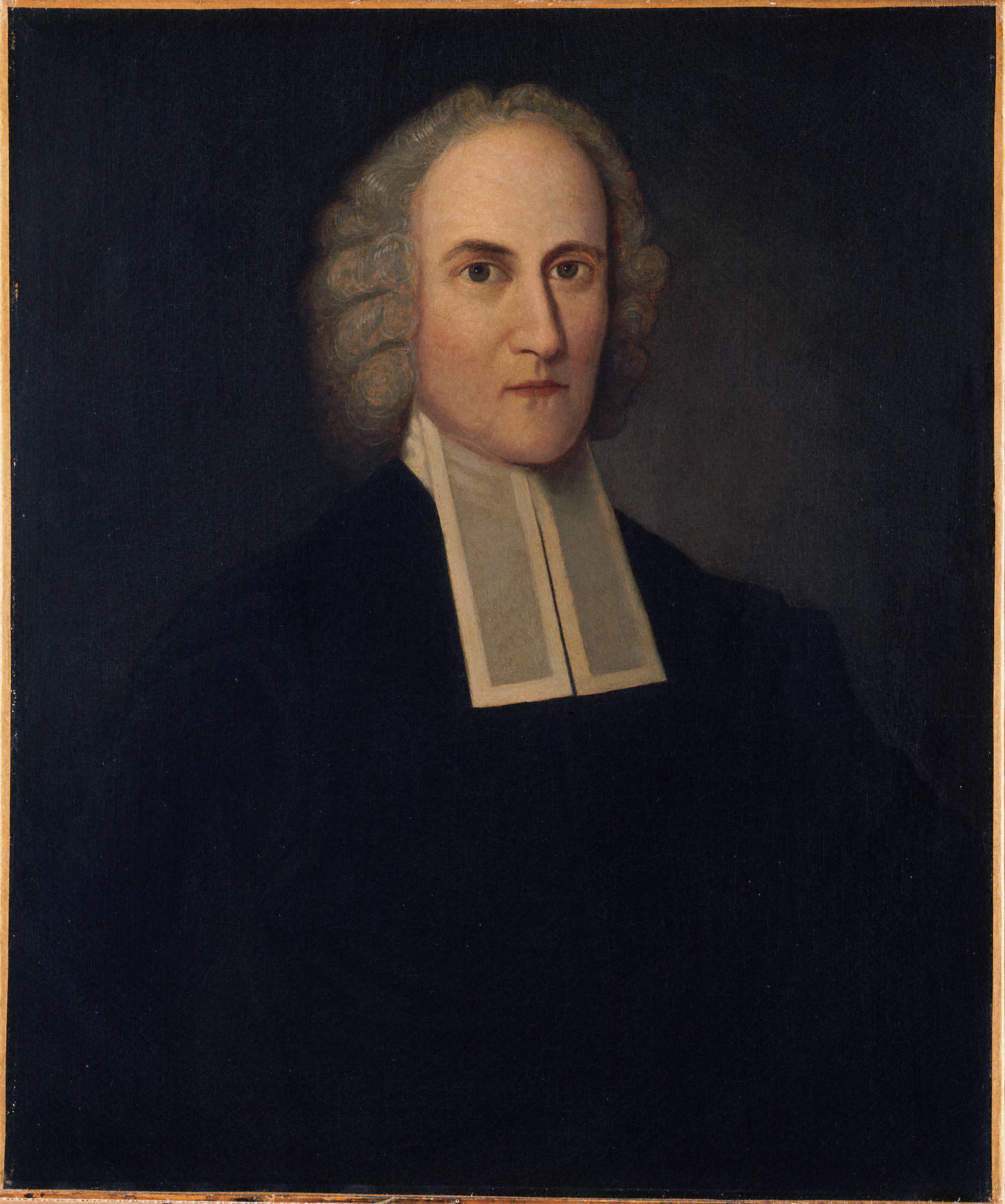
Jonathan Edwards was born on October 5, 1703, at East Windsor, Connecticut, the only son of the Rev. Timothy Edwards and Esther Stoddard Edwards, Solomon Stoddard's daughter. He graduated from Yale College in 1720, studied theology there, preached briefly to a Presbyterian congregation in New York in 1722 and 1723, and served as a tutor at Yale. In 1726 the Northampton church called him to assist his grandfather, and he was ordained as Stoddard's colleague on February 15, 1727. In July of the same year he married Sarah Pierpont of New Haven.3 When Stoddard died, Edwards became sole pastor of the largest and most influential church in western Massachusetts. Edwards himself gave the dates of Stoddard's ministry in A Faithful Narrative: Stoddard "came first to the town the November after" Eleazer Mather's death, "but was not ordained till September 11, 1672, and died February 11, 1728-9."2 The double year in that last date is the Old Style calendar, in which the year began on March 25; in modern reckoning Stoddard died on February 11, 1729.

The town Edwards described
A Faithful Narrative begins with a description of the county and the town, and it is the best contemporary account of the place. Edwards wrote that the people of Hampshire County "in general, I suppose, are as sober, orderly, and good sort of people, as in any part of New England," and that their distance from the seaports had preserved them from "error, and variety of sects and opinions."2 He credited the religious order of the county to "the great abilities, and eminent piety, of my venerable and honoured grandfather Stoddard."2 Northampton itself was "of about 82 years standing, and has now about 200 families; which mostly dwell more compactly together than any town of such a size in these parts of the country."2 Edwards drew a conclusion from that compactness: it was, he thought, the reason that "both our corruptions and reformations have been, from time to time, the more swiftly propagated from one to another through the town."2
Edwards then placed the revival of 1734 to 1735 in a local history of revivals. He was "the third minister who has been settled in the town," after Eleazer Mather (ordained July 1669) and Stoddard. Of Stoddard he wrote: "He had five harvests, as he called them. The first was about 57 years ago; the second about 53; the third about 40; the fourth about 24; the fifth and last about 18 years ago."2 Counting back from 1736, when the letter was finished, those harvests fall in about 1679, 1683, 1696, 1712 and 1718. Edwards added that the harvests of about 53, 40 and 24 years earlier were the greatest, and that "in each of them, I have heard my grandfather say, the greater part of the young people in the town, seemed to be mainly concerned for their eternal salvation."2 The Northampton revival of 1735 was therefore the sixth such season in sixty years, by Edwards's own count, and he did not present it as the first revival New England had seen.
The years just before were, in his account, a low point. "Just after my grandfather's death, it seemed to be a time of extraordinary dullness in religion. Licentiousness for some years prevailed among the youth of the town; there were many of them very much addicted to night-walking, and frequenting the tavern, and lewd practices, wherein some, by their example, exceedingly corrupted others."2 The young people held mixed gatherings "for mirth and jollity, which they called frolics," often lasting most of the night, and Edwards admitted that "family government did too much fail in the town."2 The town was also divided politically: "There had also long prevailed in the town a spirit of contention between two parties, into which they had for many years been divided; by which they maintained a jealousy one of the other, and were prepared to oppose one another in all public affairs."2 Historians, Marsden among them, have connected these parties to quarrels over land, town offices and the influence of the leading families, but Edwards himself named no parties and gave no causes.4
The awakening of 1734 and 1735
The young people reform
The first change came among the young. Edwards dated it to "the latter end of the year 1733," when there appeared "a very unusual flexibleness, and yielding to advice, in our young people."2 The custom of the town was to keep the Sabbath from Saturday evening to Sunday evening (Edwards added a note that "it has never been our manner, to observe the evening that follows the sabbath, but that which precedes it, as part of the holy time"), so the young treated Sunday evening and the evening after the weekday lecture as times for "mirth, and company-keeping."2 Edwards preached against the practice, the heads of families agreed in neighborhood meetings to keep their children at home, and, as he reported, "parents found little or no occasion for the exercise of government in the case. The young people declared themselves convinced by what they had heard from the pulpit, and were willing of themselves to comply with the counsel that had been given."2
Next came a "remarkable religious concern at a little village belonging to the congregation called Pascommuck, where a few families were settled, at about three miles distance from the main body of the town."2 Then two deaths moved the young people. In April 1734 "a young man in the bloom of his youth" was "violently seized with a pleurisy" and died in about two days, and soon after a young married woman died "very full of comfort, in a most earnest and moving manner warning and counselling others."2 In the fall of 1734 Edwards proposed that the young people "agree among themselves to spend the evenings after lectures in social religion," dividing into companies that met in different parts of the town, and "those meetings have been since continued, and the example imitated by elder people."2 These small religious societies, meeting in houses without a minister present, were one of the institutions that the revival spread across New England.
Arminianism and justification by faith
Edwards gave a doctrinal reason for what followed. "About this time began the great noise, in this part of the country, about Arminianism, which seemed to appear with a very threatening aspect upon the interest of religion here."2 The "noise" was a regional controversy, and Edwards's own footnote in the Narrative mentions the "Springfield contention," a dispute over the settlement of a minister at Springfield that divided pastors and people "on account of their different apprehensions about his principles."2 Historians identify the minister as Robert Breck, whom the Hampshire County ministers suspected of Arminian views, and whose ordination at Springfield in 1736 was contested for months.4
"Arminianism" in New England in the 1730s meant, to its critics, any teaching that made human effort or moral improvement a ground of God's acceptance, after the Dutch theologian Jacob Arminius (1560 to 1609), whose followers the Synod of Dort had condemned in 1619. The Calvinist and Arminian positions are set out in their own terms in Module 80, lesson 03. Edwards's response was to preach on justification by faith alone, in a series of lectures in late 1734 that he later published as the lead piece in Discourses on Various Important Subjects (Boston, 1738).4 In the Narrative he described their effect. Many who were afraid of being led into error "seemed, with much concern and engagedness of mind, to inquire what was indeed the way in which they must come to be accepted with God. There were some things said publicly on that occasion, concerning justification by faith alone."2 Some disapproved: "great fault was found with meddling with the controversy in the pulpit, by such a person, and at that time," and "it was ridiculed by many elsewhere," yet "it proved a word spoken in season here; and was most evidently attended with a very remarkable blessing of heaven to the souls of the people in this town."2
An Arminian reader of the period would have objected that the label was unfair and that the Springfield candidate's views were being judged by rumor. A Calvinist reader would have answered, with Edwards, that the doctrine of justification by faith alone was the issue the Reformation had been fought over, and that teaching people to rely on their own moral reform endangered their souls. Edwards's own account is careful on one point: what moved his hearers, he said, was "trembling fear" that God was about to give the land up "to heterodoxy and corrupt principles," and with it their own chance of salvation.2
"The noise amongst the dry bones"
"And then it was, in the latter part of December, that the Spirit of God began extraordinarily to set in, and wonderfully to work amongst us."2 Five or six persons were converted in quick succession, among them "a young woman, who had been one of the greatest company-keepers in the whole town."2 Edwards feared that her conversion would harden others, but "the event was the reverse, to a wonderful degree. God made it, I suppose, the greatest occasion of awakening to others, of any thing that ever came to pass in the town."2 "The news of it seemed to be almost like a flash of lightning, upon the hearts of young people, all over the town, and upon many others."2
Within weeks, in Edwards's words, "a great and earnest concern about the great things of religion, and the eternal world, became universal in all parts of the town, and among persons of all degrees, and all ages. The noise amongst the dry bones waxed louder and louder; all other talk but about spiritual and eternal things, was soon thrown by."2 The phrase about dry bones is from Ezekiel's vision, "and as I prophesied, there was a noise, and behold a shaking, and the bones came together, bone to his bone" (Ezekiel 37:7, KJV).5 Edwards was careful to correct rumors. Reports spread "in distant parts of the land, as though the people here had wholly thrown by all worldly business, and betook themselves entirely to reading and praying"; that was a misrepresentation, he said, "although people did not ordinarily neglect their worldly business; yet religion was with all sorts the great concern, and the world was a thing only by the bye."2
The best known passage of the Narrative describes the spring of 1735:
"This work of God, as it was carried on, and the number of true saints multiplied, soon made a glorious alteration in the town: so that in the spring and summer following, anno 1735, the town seemed to be full of the presence of God: it never was so full of love, nor of joy, and yet so full of distress, as it was then. There were remarkable tokens of God's presence in almost every house. It was a time of joy in families on account of salvation being brought unto them; parents rejoicing over their children as new born, and husbands over their wives, and wives over their husbands."2
Public worship changed with it. "Our public assemblies were then beautiful: the congregation was alive in God's service, every one earnestly intent on the public worship, every hearer eager to drink in the words of the minister as they came from his mouth; the assembly in general were, from time to time, in tears while the word was preached; some weeping with sorrow and distress, others with joy and love, others with pity and concern for the souls of their neighbours."2 Edwards singled out the singing. The congregation already sang well, "the men generally carrying regularly, and well, three parts of music, and the women a part by themselves," but now "they were evidently wont to sing with unusual elevation of heart and voice, which made the duty pleasant indeed."2 That detail is a small piece of evidence for the "regular singing" movement of the 1720s, which taught New England congregations to sing in parts from written music.
Visitors noticed the change. Edwards reported that the people who came to town "on occasion of the court that sat here in the beginning of March" were struck by it, and that many who came "on visits, or on business" went home awakened, "till at length the same work began evidently to appear and prevail in several other towns in the county."2
Edwards counts the converts
The Narrative is the main source for every number later writers have repeated about the Northampton revival, and Edwards gave his numbers with care and with qualifications. He began with the size of the church: "We have about six hundred and twenty communicants, which include almost all our adult persons."2 Because Stoddard had opened the Lord's Supper to all baptized adults of good life (see lesson 01), the communicant roll at Northampton was much larger than at churches that still required a conversion narrative. Edwards noted the difference himself: he had "very sufficient evidence of the conversion of their souls," he wrote of new members, "though it is not the custom here, as it is in many other churches in this country, to make a credible relation of their inward experiences the ground of admission to the Lord's supper."2 He would later reverse his grandfather's practice, and that reversal cost him his pulpit in 1750 (lesson 05).
Admissions came in two large groups. "Our sacraments are eight weeks asunder, and I received into our communion about a hundred before one sacrament, fourscore of them at one time, whose appearance, when they presented themselves together to make an open explicit profession of Christianity, was very affecting to the congregation. I took in near sixty before the next sacrament day."2 Then came the estimate that every history repeats:
"I am far from pretending to be able to determine how many have lately been the subjects of such mercy; but if I may be allowed to declare any thing that appears to me probable in a thing of this nature, I hope that more than 300 souls were savingly brought home to Christ, in this town, in the space of half a year, and about the same number of males as females."2
Three features of that sentence matter for anyone who quotes the figure. It is a hope, framed as what "appears to me probable," and Edwards said in the same breath that he could not determine the number. It is a count of persons he judged to be converted, which no outside observer could check, and it is different from the roughly 160 admissions to communion he reported in the same paragraph. And it carries a social observation: Stoddard, Edwards wrote, had "observed that in his time, many more women were converted than men," while in 1735 the numbers were about equal.2
Edwards also broke down his hopeful converts by age. "I suppose there were upwards of fifty persons converted in this town above forty years of age; more than twenty of them above fifty; about ten of them above sixty; and two of them above seventy years of age."2 At the other end, "near thirty were, to appearance, savingly wrought upon, between ten and fourteen years of age; two between nine and ten, and one of about four years of age."2 He gave a rate for the height of the work: in March and April 1735, "it appears to have been at the rate, at least, of four persons in a day; or near thirty in a week, take one with another, for five or six weeks together."2 And he recorded the conversion of Black residents of the town: "There are several negroes, who from what was seen in them then, and what is discernible in them since, appear to have been truly born again in the late remarkable season."2 Some of those men and women were enslaved. Edwards himself had bought an enslaved woman named Venus at Newport in 1731, a fact documented by the surviving bill of sale and discussed in lesson 05.4
Two cases: Abigail Hutchinson and Phebe Bartlet
The third section of the Narrative gives two case histories, and they were the parts most read and most argued over. The first was "a young woman whose name was Abigail Hutchinson," chosen, Edwards said, "because she is now dead, and so it may be more fit to speak freely of her than of living instances."2 She came, he wrote, "of an intelligent family: there could be nothing in her education that tended to enthusiasm, but rather to the contrary extreme."2 "Enthusiasm" in the eighteenth century meant a claim to direct inspiration or a religious excitement without basis in reason, and Edwards's choice of words shows that he expected skeptical readers.
Abigail Hutchinson was awakened in the winter, "on Monday, by something she heard her brother say of the necessity of being in good earnest in seeking regenerating grace, together with the news of the conversion of the young woman before mentioned."2 The news, Edwards wrote with unusual frankness, "stirred up a spirit of envy in her towards this young woman, whom she thought very unworthy of being distinguished from others by such a mercy."2 She resolved to read the whole Bible; on Thursday a sense of her sinfulness came on her "as a flash of lightning"; by Monday morning she felt "easiness and calmness" and words of Scripture came to her mind, and "her mind was led into such contemplations and views of Christ, as filled her exceeding full of joy."2 Later, "as those four words passed through her mind, wisdom, justice, goodness, and truth, her soul was filled with a sense of the glory of each of these divine attributes, but especially the last. Truth, said she, sunk the deepest!"2 She had long been ill, and the Narrative goes on to describe her last illness and death in the same terms.
The second case was a child. "Her name is Phebe Bartlet, daughter of William Bartlet. I shall give the account as I took it from the mouth of her parents, whose veracity none who know them doubt of. She was born in March, 1731."2 In late April or early May 1735 she was "greatly affected by the talk of her brother, who had been hopefully converted a little before, at about eleven years of age," and began to retire for secret prayer "five or six times a day."2 Edwards expected disbelief: he introduced her case in Section I with the words "because I suppose this last will be with most difficulty believed, I will hereafter give a particular account of it."2 A note added to the Hickman edition records that "She was living in March, 1789, and maintained the character of a true convert."2
Readers have answered these cases in very different ways. Edwards's Reformed admirers have read them as evidence that God converts whom he will, at any age and through ordinary means. Critics in Edwards's own time, of whom Charles Chauncy became the best known (lesson 04), thought such narratives encouraged imitation and excitement in the impressionable. Modern readers ask what a four year old could understand of sin and grace. Edwards anticipated the question and rested his case on the parents' testimony and the child's later conduct; he did not claim that her experience could be verified by anyone else.
The Connecticut Valley revivals
In the spring of 1735 the awakening spread along the Connecticut River. Edwards named the places in order, and his list is the basis of every map of the revival. In Hampshire County: "In the month of March, the people in South-Hadley begun to be seized with deep concern about the things of religion; which very soon became universal."2 Then "the west part of Suffield," then Sunderland, then "a part of Deerfield, called Green River," then "the south part of Hatfield, in a place called the Hill," where "the whole town, in the second week in April, seemed to be seized, as it were at once, with concern about the things of religion."2 There was "a very general awakening at West-Springfield, and Long Meadow; and in Enfield there was for a time a pretty general concern amongst some who before had been very loose persons."2 At Westfield, the pastor Nehemiah Bull reported "that more had been done in one week, than in seven years before."2 The list for the county ends with the first precinct of Springfield, "Hadley old town," and Northfield.
The work reached Connecticut as well, and here Edwards stressed that it began independently. "The first parish in Windsor, under the pastoral care of the Rev. Mr. Marsh, was thus blest about the same time as we in Northampton, while we had no knowledge of each other's circumstances."2 East Windsor, his father's parish, followed, and he noted it had seen "four or five seasons of the pouring out of the Spirit" during his father's ministry.2 He named Coventry (under the Rev. Joseph Meacham, where he heard of "the surprising change that appeared in the most rude and vicious persons there"), "a part of Lebanon, called the Crank, where the Rev. Mr. Wheelock, a young gentleman, is lately settled," Durham, Stratford and its parish of Ripton, New Haven, part of Guilford, Mansfield, Tolland, Hebron, Bolton, the north parish of Preston and Woodbury.2 The "Mr. Wheelock" is Eleazar Wheelock, who would become one of the most active itinerant preachers of 1741 and later founded Dartmouth College.
Edwards also reported what he had heard of New Jersey. On a journey to New York for his health he met "the Rev. William Tennent," who told him of a great awakening in a place called the Mountains, of a revival under "his brother the Rev. Gilbert Tennent," and of another "under the ministry of a very pious young gentleman, a Dutch minister, whose name as I remember was Freelinghousa."2 The Dutch minister was Theodorus Jacobus Frelinghuysen of the Raritan Valley, whose preaching in the 1720s historians often count as the first stirring of the colonial awakening. Edwards's misspelling of his name shows how slight the contact between the regional revivals still was in 1735. The Tennents and Frelinghuysen are treated in lesson 04.
Counting the places Edwards named gives thirteen in Hampshire County (including Suffield and Enfield, which Massachusetts then governed) and about fifteen in Connecticut, plus the New Jersey reports. The London preface of 1737 by Isaac Watts and John Guyse summarized the core of it as "twelve or fourteen Towns and Villages ... within the compass of thirty Miles."6 Popular accounts that give a single figure, such as "thirty-two towns," are counting in different ways, and the reader should go to Edwards's own list.
The end of the 1735 revival
The death of Joseph Hawley
Edwards dated the turn to late May 1735. "In the latter part of May, it began to be very sensible that the Spirit of God was gradually withdrawing from us, and after this time Satan seemed to be more let loose, and raged in a dreadful manner. The first instance wherein it appeared, was a person putting an end to his own life by cutting his throat."2 Edwards did not name the man in the Narrative. He described him as "a gentleman of more than common understanding, of strict morals, religious in his behaviour, and a useful and honourable person in the town; but was of a family that are exceedingly prone to the disease of melancholy, and his mother was killed with it."2
The man was Joseph Hawley (1682 to 1735), a Northampton merchant and the husband of Rebekah Stoddard, the sister of Edwards's mother, which made him Edwards's uncle by marriage. His son, also named Joseph Hawley (1723 to 1788), would become a lawyer, a leader of the Massachusetts patriots in the 1770s, and, in 1750, one of the leaders of the party that voted Edwards out of his pulpit.4 Hawley's death is usually dated June 1, 1735, a Sunday. Edwards's letter to Benjamin Colman of May 30, 1735, printed in the Yale edition, carried news of it to Boston in an addition written after the death.7
Edwards's account of the illness is close and specific. Hawley "had, from the beginning of this extraordinary time, been exceedingly concerned about the state of his soul, and there were some things in his experience that appeared very hopeful; but he durst entertain no hope concerning his own good estate."2 "He was kept awake at nights, meditating terror, so that he had scarce any sleep at all for a long time together; and it was observed at last, that he was scarcely well capable of managing his ordinary business, and was judged delirious by the coroner's inquest."2 The coroner's verdict mattered in law and in church practice: a person judged delirious was not treated as a self-murderer, and could be buried in the ordinary way.
Then Edwards recorded something that critics of the revival seized on and modern readers find disturbing:
"The news of this extraordinarily affected the minds of people here, and struck them as it were with astonishment. After this, multitudes in this and other towns seemed to have it strongly suggested to them, and pressed upon them, to do as this person had done. And many who seemed to be under no melancholy, some pious persons who had no special darkness or doubts about the goodness of their state, nor were under any special trouble or concern of mind about any thing spiritual or temporal, had it urged upon them as if somebody had spoke to them, Cut your own throat, now is a good opportunity. Now! now! So that they were obliged to fight with all their might to resist it, and yet no reason suggested to them why they should do it."2
Earlier in the Narrative Edwards had mentioned another case, in which "a poor weak man who belongs to the town, being in great spiritual trouble, was hurried with violent temptations to cut his own throat, and made an attempt, but did not do it effectually," and later recovered.2 In the same weeks there were "two remarkable instances of persons led away with strange enthusiastic delusions; one at Suffield, and another at South Hadley." The South Hadley man believed he was "divinely instructed" to direct a despairing man to pray certain words from Psalm 116:4; Edwards knew him, vouched for his piety, and reported that he "since exceedingly laments the dishonour he has done to God."2
Edwards interpreted these events in the language of his theology: Satan, he wrote, "took the advantage, and drove him into despairing thoughts." He also gave natural causes alongside the spiritual one: a family "exceedingly prone to the disease of melancholy," a mother who had died of it, and long sleeplessness. The modern reader will see something like severe depression, and the record supports that reading without requiring it. The skeptic's question, whether the preaching of terror contributed, is one Edwards's critics raised in the 1740s and that historians still discuss. Marsden, a sympathetic biographer, treats the death as a crisis that Edwards met with candor in print.4 What the record establishes is that Edwards reported the suicide and the wave of suicidal temptation himself, in the book meant to advertise the revival, rather than leaving them out.
The decline Edwards reported
"After these things, the instances of conversion were rare here in comparison of what they had before been."2 Edwards then listed ordinary causes for the decline as well as spiritual ones: "Several things have happened since, which have diverted people's minds, and turned their conversation more to other affairs; particularly, his excellency the Governor's coming up, and the committee of general court, on the treaty with the Indians. Afterwards, the Springfield controversy; and since that, our people in this town have been engaged in the building of a new meeting-house."2 The Governor's visit was Jonathan Belcher's conference with Native nations at Deerfield in August 1735. The new meetinghouse was raised in 1736 and, according to a story Edwards told Colman, a gallery collapsed during worship in March 1737 without killing anyone; that event belongs to the history of the town rather than this lesson.
Edwards closed the Narrative on Nov. 6, 1736 with a judgment and a confession. The converts "generally seem to have had an abiding change wrought on them," and "I know of no one young person in the town who has returned to former ways of looseness and extravagance in any respect." But "we are not so pure, but that we have great cause to be humbled and ashamed that we are so impure; nor so religious, but that those who watch for our halting, may see things in us, whence they may take occasion to reproach us and religion."2 The last sentence of the narrative proper, before his closing requests to Colman, placed Northampton in the light of the Sermon on the Mount: "here, in this corner of the world, God dwells, and manifests his glory."2 He also reported that when he heard that Watts and Guyse had taken notice of the revival, he preached from the words "A city that is set upon a hill cannot be hid," the same text that lies behind Winthrop's "citty upon a hill" (lesson 01).2 Within a few years Edwards would describe the town very differently, as the next sections show.
From letter to book: A Faithful Narrative in print
A Faithful Narrative began as private correspondence, and its route to print shows how news of revival traveled. Sereno Dwight, Edwards's great-grandson and nineteenth century biographer, set out the sequence. "On the 30th of May, 1735, Mr. Edwards, in answer to a letter from the Rev. Dr. Colman, of Boston, wrote a succinct account of the work of Divine grace at Northampton; which, being published by him, and forwarded to the Rev. Dr. Watts and the Rev. Dr. Guyse, in London, those gentlemen discovered so much interest in the facts recited ... that the author, at the request of his correspondent, was induced to prepare a much fuller statement, in a letter to the same gentleman, bearing date, Nov. 6, 1736."8 Colman first printed an abridgment of the short letter at the end of a volume of sermons by William Williams of Hatfield, Edwards's uncle, published in Boston in 1736; the London preface of 1737 mentions "Sermons of Mr. Williams publish'd lately in New-England" to which "Dr. Colman subjoin'd a most judicious and accurate Abridgement of this Epistle."6
The full letter was published in London in 1737 by John Oswald under the title A Faithful Narrative of the Surprizing Work of God in the Conversion of Many Hundred Souls in Northampton, "published, with a large preface, by Dr. Watts and Dr. Guyse."6 Isaac Watts, the hymn writer, and John Guyse were leading Independent (Congregational) ministers in London. Their preface vouched for the account: "We are abundantly satisfy'd of the Truth of this Narrative, not only from the pious Character of the Writer, but from the concurrent Testimony of many other Persons in New-England; for this Thing was not done in a Corner."6 The London editors made a geographical slip that New England readers noticed. The 1737 printing describes the towns as "chiefly situate in New-Hampshire near the Banks of the River of Connecticut"; the place meant was Hampshire County, Massachusetts. Later editions corrected the phrase, and the text reprinted in Dwight's Memoirs reads "chiefly situate in the county of Hampshire."68 Edwards complained to Colman about errors in the London edition, and an edition printed in Boston in 1738 carried a new attestation by Boston ministers; the Yale editor C. C. Goen gives the details of these editions.1
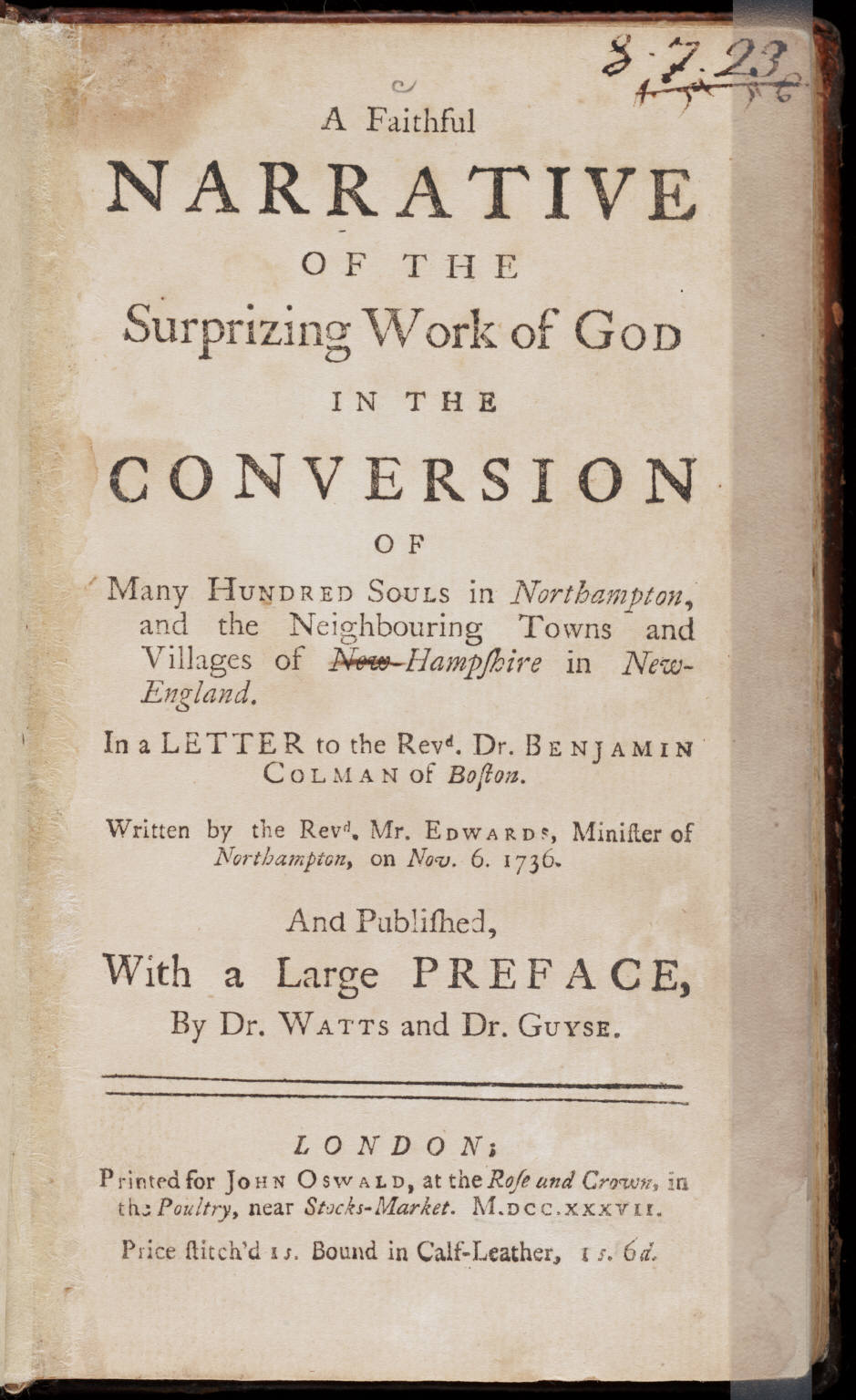

The book's influence was out of proportion to its size. It gave the revival a pattern: a town in spiritual decline, a few striking conversions, a general concern that sweeps through all ages, a minister's careful sorting of true conversion from false, and the spread of the work to neighboring towns. The historian Frank Lambert, in Inventing the "Great Awakening" (1999), argues that the revivalists of the 1730s and 1740s used print and correspondence to present local revivals as one connected work of God, and he treats A Faithful Narrative as a founding text of that effort.9 Thomas Kidd, in The Great Awakening: The Roots of Evangelical Christianity in Colonial America (2007), likewise places the Narrative at the start of the movement and notes its readers in Britain, among them the Methodists.10 John Wesley later printed Edwards's revival writings, abridged, in his Christian Library for Methodist readers, which shows that Edwards's accounts crossed the line between Calvinist and Arminian evangelicals even while their theologies divided them.11
The revival of 1740 to 1742
Whitefield at Northampton, October 1740
For five years Northampton was quiet by its own standard. Edwards later wrote that "in the spring before Mr. Whitefield came to this town, there was a visible alteration: there was more seriousness and religious conversation, especially among young people."12 George Whitefield, the young Anglican field preacher whose tours are the subject of lesson 03, arrived on his first New England tour in September 1740 and came to Northampton in the middle of October. Edwards's own account, in a letter to Thomas Prince of Boston dated December 12, 1743, is the best source:
"And thus it continued until Mr. Whitefield came to town, which was about the middle of October following: he preached here four sermons in the meeting-house (besides a private lecture at my house), one on Friday, another on Saturday, and two upon the Sabbath. The congregation was extraordinarily melted by every sermon; almost the whole assembly being in tears for a great part of sermon time."12
Dwight's Memoirs give the dates: Whitefield came "on the evening of Thursday, the 16th of October, 1740," and "remained there until the morning of the 20th," and Dwight counts "five sermons," evidently including the private lecture.13 Whitefield's own journal records that Edwards wept during the service; that detail is widely quoted, and the reader can check it in Whitefield's published journal for October 1740 (see lesson 03).
The two men also disagreed, privately. According to Dwight, on the Monday when Edwards and others rode with Whitefield as far as East Windsor, Edwards "took an opportunity to converse with Mr. Whitefield alone, at some length, on the subject of impulses, and assigned the reasons which he had to think, that he gave too much heed to such things. Mr. Whitefield received it kindly, but did not seem inclined to have much conversation on the subject." Edwards also spoke to him about "his too customary practice of judging other persons to be unconverted."13 The two objections, to reliance on inner impulses and to public judgments that particular ministers or people were unconverted, are the same ones Edwards would press in print in 1741 and 1742.
The effect in the town was gradual. In Edwards's words, "The revival at first appeared chiefly among professors and those that had entertained hope that they were in a state of salvation, to whom Mr. Whitefield chiefly addressed himself. But in a very short time there appeared an awakening and deep concern among some young persons, that looked upon themselves in a Christless state."12 By the middle of December "a considerable work of God appeared among those that were very young," and by the spring of 1741 "an engagedness of spirit about the things of religion was become very general amongst young people and children."12 ("Professors" in this usage means people who professed faith, that is, church members who considered themselves converted.)
Outcries and faintings in 1741
What was new in 1741 was the physical expression of religious feeling. Edwards dated its start at Northampton to May 1741, at a sermon in a private house: "Near the conclusion of the discourse, one or two persons, that were professors, were so greatly affected with a sense of the greatness and glory of divine things, and the infinite importance of the things of eternity, that they were not able to conceal it, the affection of their minds overcoming their strength, and having a very visible effect upon their bodies."12 The young people moved to another room to ask them what they had experienced, and "the affection was quickly propagated throughout the room ... so that the whole room was full of nothing but outcries, faintings, and the like."12
Edwards then called together the children under seventeen after the Sabbath service, and "the room was filled with cries; and when they were dismissed, they almost all of them went home crying aloud through the streets, to all parts of the town."12 He did not treat all of this as genuine. "In many, they appeared indeed but childish affections, and in a day or two would leave them as they were before. Others were deeply impressed; their convictions took fast hold of them, and abode by them."12 In the summer "there first began to be cryings out in the meeting-house," and "the months of August and September were the most remarkable of any this year," with "a house full of out-cries, faintings, convulsions, and such like, both with distress, and also with admiration and joy."12 He added that "it was not the manner here to hold meetings all night, as in some places," though some people were so overcome that they could not go home and stayed where they were.12
Edwards drew a comparison with 1735 that is important for judging both revivals. The work of 1740 and 1741, he wrote, "seemed to be much more pure, having less of a corrupt mixture than in the former great outpouring of the Spirit in 1735 and 1736," and it fell "almost wholly upon a new generation, those that were not come to years of discretion in that wonderful season, nine years ago."12 Those who had lived through 1735 "without any appearance of saving benefit, seemed now to be almost wholly passed over and let alone."12
The itinerants
The 1741 revival was carried from town to town by preachers who left their own parishes for days or weeks. Eleazar Wheelock of Lebanon and Benjamin Pomeroy of Hebron were among the most active in Connecticut, and Edwards invited them. In a letter of June 9, 1741 printed by Dwight, Edwards asked Wheelock to preach at Scantic, a struggling part of his father's parish, and to come to Northampton: "There has been a reviving of religion among us of late; but your labours have been much more remarkably blessed than mine. Other ministers, I have heard, have shut up their pulpits against you; but here I engage you shall find one open."13 Edwards himself traveled. Dwight writes that he "received frequent invitations from churches, near and more remote, to come and labour among them for a little period," and that "with the consent of his people, (his own pulpit always being supplied,) he often went forth on these missionary tours."8 It was on one of these journeys that he preached at Enfield.
Sinners in the Hands of an Angry God
Enfield, July 8, 1741
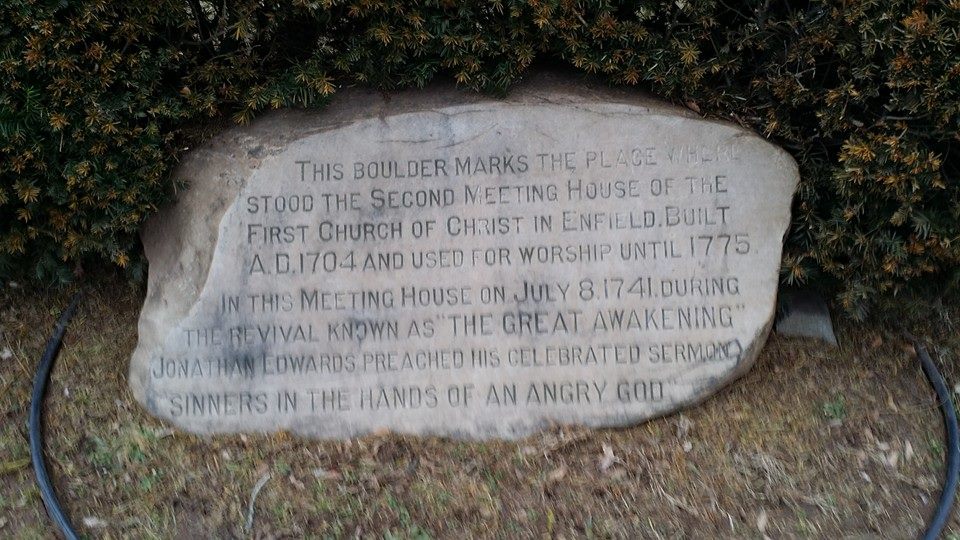
Enfield lay on the east bank of the Connecticut River, about twenty miles south of Northampton. In 1741 it was a town governed by Massachusetts, though its boundary was disputed, and it passed to Connecticut in 1749; nineteenth century writers such as Dwight already called it "Enfield in Connecticut."8 Edwards had listed it among the revival towns of 1735, where "there was for a time a pretty general concern amongst some who before had been very loose persons."2 In the sermon itself he contrasted Enfield with Suffield, the neighboring town across the river, where the revival was strong in 1741: "Are not your souls as precious as the souls of the people at Suffield, where they are flocking from day to day to Christ?"14
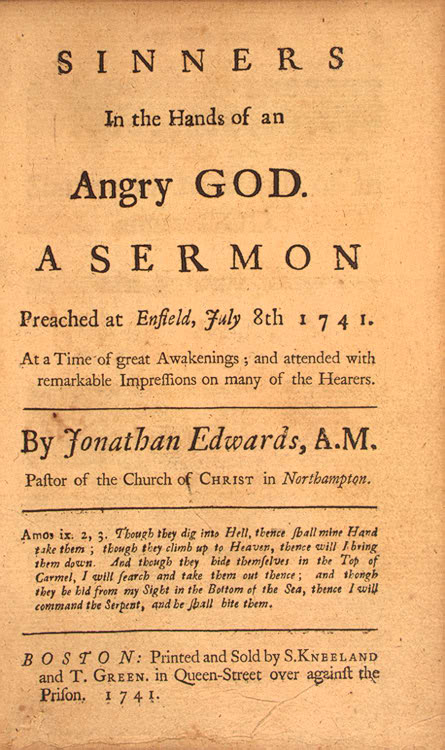
The day was a Wednesday, July 8, 1741, by the Old Style calendar then in use (July 19 in modern reckoning). Dwight's summary is brief: Edwards "spent some little time at Enfield in Connecticut, where he preached, on the 8th of July, 1741, the well-known sermon, entitled, 'Sinners in the hands of an angry God,' from Deut. xxxii. 35.; which was the cause of an immediate and general revival of religion throughout the place. It was soon afterwards published."8 The sermon appeared in Boston later in 1741, printed by S. Kneeland and T. Green, under a title page that reads: "Sinners in the Hands of an Angry God. A Sermon Preached at Enfield, July 8th 1741. At a Time of great Awakenings; and attended with remarkable Impressions on many of the Hearers. By Jonathan Edwards, A.M. Pastor of the Church of Christ in Northampton."15 The phrase "great Awakenings" on that title page, in the plural and with a small "a" in common use, is one of the earliest printed uses of the word that later historians turned into the name of the whole movement.
Edwards preached more than one sermon at Enfield. In a letter to Joseph Bellamy dated January 21, 1742, printed by Dwight, he wrote, "I have also sent one of those sermons I preached at Enfield; as to the other, I have but one of them in the world."16 The sermon printed in 1741 was the one that the hearers' response made famous.

The text and the doctrine
The sermon follows the Puritan plain style: a Scripture text, an explanation of the text, a "doctrine" drawn from it, a series of reasons or considerations, and an "application" to the hearers. The text is Deuteronomy 32:35, "Their foot shall slide in due time" (KJV).5 Edwards explained that the verse threatens "the wicked unbelieving Israelites, who were God's visible people, and who lived under the means of grace," and that the image implies four things: they "were always exposed to destruction; as one that stands or walks in slippery places is always exposed to fall"; the destruction would be "sudden unexpected"; they were "liable to fall of themselves, without being thrown down by the hand of another"; and the only reason they had not fallen already "is only that God's appointed time is not come."14
The doctrine is a single sentence: "There is nothing that keeps wicked men at any one moment out of hell, but the mere pleasure of God."14 Edwards defined his terms at once: "By the mere pleasure of God, I mean his sovereign pleasure, his arbitrary will, restrained by no obligation, hindered by no manner of difficulty."14 The word "arbitrary" here carries its older sense of "depending on the will" (from Latin arbitrium), and it is a statement about God's freedom: no promise binds God to spare the unconverted. Edwards then gave ten considerations: that God has the power to cast the wicked into hell at any moment; that they deserve it; that they are "already under a sentence of condemnation"; that they are the objects of the same wrath expressed in hell; that the devil "stands ready to fall upon them"; that there are corruptions in the soul that would kindle into hellfire if God's restraint were removed; that their natural health and prudence give no security; that their own care to preserve themselves gives none; that "all wicked men's pains and contrivance which they use to escape hell" give none; and that God "has laid himself under no obligation by any promise to keep any natural man out of hell one moment."14 At the end of the doctrinal part comes the summary: "all that preserves them every moment is the mere arbitrary will, and uncovenanted, unobliged forbearance of an incensed God."14
The images
The application is addressed directly to the congregation, and it is here that Edwards placed the images for which the sermon is remembered. "The use of this awful subject may be for awakening unconverted persons in this congregation. This that you have heard is the case of every one of you that are out of Christ."14 In the doctrine he had already said that "unconverted men walk over the pit of hell on a rotten covering, and there are innumerable places in this covering so weak that they will not bear their weight, and these places are not seen."14 In the application he added:
- The spider's web: all the hearer's righteousness "would have no more influence to uphold you and keep you out of hell, than a spider's web would have to stop a falling rock."14
- The dammed waters: "The wrath of God is like great waters that are dammed for the present; they increase more and more, and rise higher and higher, till an outlet is given; and the longer the stream is stopped, the more rapid and mighty is its course, when once it is let loose."14
- The bow: "The bow of God's wrath is bent, and the arrow made ready on the string, and justice bends the arrow at your heart, and strains the bow, and it is nothing but the mere pleasure of God, and that of an angry God, without any promise or obligation at all, that keeps the arrow one moment from being made drunk with your blood."14
- The spider over the fire: "The God that holds you over the pit of hell, much as one holds a spider, or some loathsome insect over the fire, abhors you, and is dreadfully provoked: his wrath towards you burns like fire."14 The next sentence is the one most often left out of anthologies: "and yet it is nothing but his hand that holds you from falling into the fire every moment."14
Many of the images are taken from Scripture. The bow and the arrow "drunk with blood" echo Deuteronomy 32:42 ("I will make mine arrows drunk with blood"), from the same chapter as the text, and the waters held back echo the prophets' language of flood and judgment.5 The sermon then turns from images to the hearers' situation. "There is reason to think, that there are many in this congregation now hearing this discourse, that will actually be the subjects of this very misery to all eternity. We know not who they are, or in what seats they sit, or what thoughts they now have."14 "And it would be no wonder if some persons, that now sit here, in some seats of this meeting-house, in health, quiet and secure, should be there before tomorrow morning."14
The appeal: "an extraordinary opportunity"
The sermon does not end with the threat. Its last pages are an invitation, framed by the revival happening around the hearers:
"And now you have an extraordinary opportunity, a day wherein Christ has thrown the door of mercy wide open, and stands in calling and crying with a loud voice to poor sinners; a day wherein many are flocking to him, and pressing into the kingdom of God. Many are daily coming from the east, west, north and south; many that were very lately in the same miserable condition that you are in, are now in a happy state, with their hearts filled with love to him who has loved them, and washed them from their sins in his own blood, and rejoicing in hope of the glory of God."14
Edwards then addressed the old, "you, young men, and young women," and "you, children, who are unconverted," in turn.14 He placed the moment in a scheme of history: "God seems now to be hastily gathering in his elect in all parts of the land; and probably the greater part of adult persons that ever shall be saved, will be brought in now in a little time."14 The last words are a call to flight, using the angel's command to Lot in Genesis 19:17: "Therefore, let every one that is out of Christ, now awake and fly from the wrath to come. The wrath of Almighty God is now undoubtedly hanging over a great part of this congregation. Let every one fly out of Sodom: 'Haste and escape for your lives, look not behind you, escape to the mountain, lest you be consumed.'"14
What the hearers did: Stephen Williams's diary
The only eyewitness account of the congregation's response that historians cite is the diary of Stephen Williams (1693 to 1782), minister of Longmeadow, Massachusetts, from 1716 until his death, who rode to Enfield that day with other ministers.17 The manuscript belongs to the First Church of Christ in Longmeadow. It was transcribed in ten typewritten volumes in the 1930s with funds from the Works Progress Administration, and scans of that typescript are published by the Richard Salter Storrs Library of Longmeadow.17 The entry for July 8, 1741, on page 375 of volume 3 of that typescript, says that "Mr E- of N. H." preached "a most awakening Sermon from those words Deut - 32. 35," and that "before ye Sermon - was done there was a great moaning - & crying out throughout ye whole House - what shall I do to be Saved - oh I am going to Hell - oh what shall I do for a christ," so that "ye minister - was obliged to desist," and the "shreiks & crys - were piercing & Amazing." (The typescript abbreviates "Saved" and "obliged" with raised letters; they are written out here.)17 The spelling "ye" is the old abbreviation for "the." The same entry goes on: after "Some time of waiting" the congregation grew still, a prayer was made by "Mr W-," and the ministers "descended from the pulpitt and discoursed with the people - Some in one place & Some in another"; Williams added that "Severall Souls were hopfully wrought upon" that night. The typescript is a 1930s transcription, and the manuscript itself remains with the Longmeadow church.
Two points follow from Williams's account. The outcry happened before the sermon was finished, which means the congregation did not hear the printed ending as Edwards wrote it, or at least not without interruption. And the account says nothing about how Edwards spoke. The legends about his delivery come from elsewhere.
How Edwards preached
The closest witness to Edwards's manner was his student and friend Samuel Hopkins, who lived in his household and published The Life and Character of the Late Reverend Mr. Jonathan Edwards in Boston in 1765. Hopkins wrote: "His Appearance in the Desk was with a good Grace, and his delivery easy, natural and very solemn. He had not a strong, loud Voice; but appear'd with such gravity and solemnity ... that few Speakers have been so able to demand the Attention of an Audience as he."18 He added: "His Words often discover'd a great degree of inward fervor, without much Noise or external Emotion, and fell with great weight on the Minds of his Hearers. He made but little Motion of his Head or Hands in the Desk."18 (The "desk" is the pulpit.) Edwards's surviving sermon manuscripts, described by the Yale editors, show that he wrote out his early sermons in full and in later years often preached from shorter notes.1
A later tradition says that Edwards read Sinners with his eyes fixed on the bell rope at the back of the meetinghouse. No eighteenth century source for that detail has been found for this lesson, and it should be treated as tradition. Hopkins's description supports the general picture of a quiet, intense reader of a prepared text; it does not describe the Enfield sermon in particular.

How the sermon has been read
The sermon has been read in at least four ways, and each reading has its own evidence.
The Reformed reading, which is Edwards's own, takes the sermon as an act of pastoral love. If the doctrine is true, the preacher who does not warn is the cruel one. Edwards stated the principle in The Distinguishing Marks (1741), where he defended preaching that frightens: "if I am in danger of going to hell, I should be glad to know as much as possibly I can of the dreadfulness of it."19 On this reading the hand of God that holds the sinner over the fire is also the hand that keeps him from falling, and the sermon ends with the "door of mercy wide open."
Arminian and Wesleyan hearers preached judgment and hell as plainly as Edwards did; John Wesley's sermons on hell and on the wrath to come are as direct in their warnings. Their disagreement was with the sermon's claim that God's forbearance is "uncovenanted, unobliged." For the Arminian, God has bound himself by promise to offer grace to every person, and grace that enables a response is given to all, so that the sinner's condition is not resting on a will "restrained by no obligation." Wesley's later quarrel with Whitefield over predestination (Module 80, lesson 03) turned on exactly that point. Yet Wesley printed Edwards's revival writings for his own followers, which shows that the Wesleyans accepted Edwards's account of revival while rejecting parts of his doctrine of election.11
A third reading treats Sinners as literature. From the late nineteenth century it was the Edwards text most often printed in American literature anthologies and school readers, usually alone, so that generations of students met Edwards only as a preacher of terror. Historians of Edwards, including Marsden and the editors of the Yale edition, point out that it was not typical of his preaching. Of the more than a thousand sermon manuscripts that survive, most deal with other themes, among them the beauty of God, the excellency of Christ, and the joys of heaven, and the sermon "Heaven Is a World of Love" is as characteristic of him as Sinners.41
A fourth reading is the skeptic's: that the preaching of hell to an anxious population, including children, produced fear and group emotion that Edwards then labeled as the work of God. Edwards answered a version of this charge himself in The Distinguishing Marks, which he preached two months after Enfield. His answer was that bodily effects proved nothing either way, and that the question was what the experience produced in the person's beliefs and life afterward. The skeptic and the believer can agree on what happened at Enfield (the outcry is documented) while disagreeing about its cause.
The Distinguishing Marks of a Work of the Spirit of God (1741)
The Yale commencement sermon
Two months after Enfield, Edwards was invited to preach at the Yale commencement in New Haven. Dwight records that he "attended the public commencement at New-Haven, and on the 10th of that month [September 1741] preached his celebrated sermon entitled, 'Distinguishing Marks of a Work of the Spirit of God,' which, in consequence of a general request from the clergy, and other gentlemen attending the commencement, was published soon after at Boston, accompanied with a Preface from the Rev. Mr. Cooper; and in Scotland the ensuing year, with a preface from the Rev. Mr. Willison."13 William Cooper was a minister of the Brattle Street Church in Boston, and John Willison of Dundee was a leader of the Scottish revival party; their prefaces show the Atlantic network that A Faithful Narrative had begun. The setting was tense. Yale's rector and trustees were alarmed by itinerant preaching and by students who judged their tutors unconverted, and in the same week the trustees resolved that a student who called a tutor or trustee a hypocrite or unconverted should make a public confession for the first offense and be expelled for the second (the student David Brainerd was expelled the following winter under that rule; see lesson 05).4
The sermon is an exposition of 1 John 4:1, "Beloved, believe not every spirit, but try the spirits whether they are of God: because many false prophets are gone out into the world" (KJV).5 It has two main parts: a list of things that are no evidence one way or the other, and a list of the signs that Scripture gives.
What proves nothing
Edwards's first section is titled "Negative Signs; or, What are no signs by which we are to judge of a work."19 He named nine such signs. The first was novelty: "Nothing can be certainly concluded from this, That a work is carried on in a way very unusual and extraordinary; provided the variety or difference be such, as may still be comprehended within the limits of scripture rules."19 "What the church has been used to, is not a rule by which we are to judge; because there may be new and extraordinary works of God."19 The second was the body:
"A work is not to be judged of by any effects on the bodies of men; such as tears, trembling, groans, loud outcries, agonies of body, or the failing of bodily strength. The influence persons are under, is not to be judged of one way or other, by such effects on the body; and the reason is, because the Scripture nowhere gives us any such rule."19
That sentence cuts both ways, and Edwards meant it to. Against the revival's critics, outcries did not prove that the work was false; against its enthusiasts, outcries did not prove that it was true. The other negative signs in the same section deal with a great deal of noise about religion, strong impressions on the imagination, the influence of example, imprudence and irregularity, errors of judgment and delusions of Satan mixed with the work, the scandalous falls of some who had seemed converted, and preaching that stresses the terrors of the law. On that last point Edwards gave the defense quoted above: "If I am in danger of going to hell, I should be glad to know as much as possibly I can of the dreadfulness of it."19
The five signs from 1 John 4
The second section, "What are distinguishing scripture evidences of a work of the Spirit of God," gives five marks, taken "in the order in which I find them in the chapter."19 Each is quoted here from the Hickman text:
- "When the operation is such as to raise their esteem of that Jesus who was born of the Virgin, and was crucified without the gates of Jerusalem; and seems more to confirm and establish their minds in the truth of what the gospel declares to us of his being the Son of God, and the Saviour of men; is a sure sign that it is from the Spirit of God."19
- "When the spirit that is at work operates against the interests of Satan's kingdom, which lies in encouraging and establishing sin, and cherishing men's worldly lusts; this is a sure sign that it is a true, and not a false spirit."19
- "The spirit that operates in such a manner, as to cause in men a greater regard to the Holy Scriptures, and establishes them more in their truth and divinity, is certainly the Spirit of God."19
- If the spirit at work "operates as a spirit of truth, leading persons to truth, convincing them of those things that are true, we may safely determine that it is a right and true spirit."19
- "If the spirit that is at work among a people operates as a spirit of love to God and man, it is a sure sign that it is the Spirit of God."19
The method is the important thing. Edwards refused to judge the revival by its outward form, which both sides were doing, and judged it by its doctrinal and moral fruit, measured against a single chapter of Scripture. A Catholic or Orthodox reader would note that the test leaves out the judgment of the church and its sacraments, which in their traditions are the ordinary means of discerning a spirit; Edwards, as a Reformed Protestant, placed Scripture alone in that role. Critics of the revival such as Charles Chauncy accepted the test in principle but argued that the fruits Edwards saw were outweighed by the disorders, divisions and censoriousness that came with them; that argument is set out in lesson 04.
Some Thoughts Concerning the Present Revival (1742)
A defense of the work
Edwards's longest revival treatise, Some Thoughts Concerning the Present Revival of Religion in New England, and the Way in Which It Ought to Be Acknowledged and Promoted, bears the date 1742 on its title page and was printed in Boston; it reached readers around the turn of 1742 to 1743.1 It has five parts: that the work is a glorious work of God; the obligations of all to acknowledge and promote it; the ways in which its promoters "have been injuriously blamed"; "what things are to be corrected or avoided"; and "what ought to be done to promote this work."20
The first part restates the method of The Distinguishing Marks. Critics, Edwards wrote, "have greatly erred in the way in which they have gone about to try this work," namely "in judging of it a priori, from the way that it began, the instruments that have been employed, the means that have been used, and the methods that have been taken and succeeded, in carrying it on. Whereas, if we duly consider the matter, it will evidently appear that such a work is not to be judged of a priori, but a posteriori. We are to observe the effect wrought."20 "A priori" here means by its causes and circumstances; "a posteriori," by its results.
Part I also contains the most detailed description of religious experience Edwards ever published, presented anonymously as "the nature of the work in a particular instance." The person, he wrote, "has more than once continued for five or six hours together, without interruption, in a clear and lively view or sense of the infinite beauty and amiableness of Christ's person," and "the soul remained in a kind of heavenly Elysium, and did as it were swim in the rays of Christ's love, like a little mote swimming in the beams of the sun that come in at a window."20 Edwards stressed that this happened "without being in any trance, or at all deprived of the exercise of the bodily senses."20 Dwight, who printed Sarah Edwards's own written account of her experiences of January and February 1742 in his Memoirs, identified the anonymous person as Edwards's wife; historians accept the identification.164
"The latter-day glory is probably to begin in America"
Part II contains the passage that later readers connected with American ideas of national mission. Its heading in the Hickman edition reads "The latter-day glory, is probably to begin in America," and the text begins:
"It is not unlikely that this work of God's Spirit, so extraordinary and wonderful, is the dawning, or, at least, a prelude of that glorious work of God, so often foretold in Scripture, which, in the progress and issue of it, shall renew the world of mankind. ... And there are many things that make it probable that this work will begin in America."20
Edwards's reasons were scriptural and typological, beginning with a reading of Isaiah 60:9 ("Surely the isles shall wait for me, and the ships of Tarshish first") as a prophecy that the work would begin in a remote land reached by sea.20 He set no date, and in later writings, including the Humble Attempt of 1747, he treated the full glory of the church's latter days as still lying in the future. Alan Heimert, in Religion and the American Mind (1966), read this passage as an early root of the revolutionary sense of American destiny; other historians answer that Edwards's hope was for the church and for the conversion of the world, with no political program. That debate belongs to lesson 06.
What must be corrected
Part IV is a critique from inside. "The errors that attend a great revival of religion usually arise from these three things: 1. Undiscerned spiritual pride; 2. Wrong principles; and 3. Ignorance of Satan's advantages and devices."20 Under these heads Edwards criticized reliance on impulses and impressions as if they were revelations, the censuring of professing Christians as unconverted, and errors connected with lay exhorting, and he urged caution about the new practice of "companies singing in the streets, going to or coming from the place of public worship," which he did not condemn in principle.20 Readers who know only Sinners are often surprised by how much of Some Thoughts is a warning against excess. Charles Chauncy, the revival's most learned critic, answered Edwards in Seasonable Thoughts on the State of Religion in New-England (1743); the exchange is covered in lesson 04.
Buell, the covenant and the ebb, 1742 to 1745
The Northampton revival had a second peak in early 1742, while Edwards was away. He told Prince: "About the beginning of February, 1742, Mr. Buell came to this town. I was then absent from home, and continued so till about a fortnight after. Mr. Buell preached from day to day, almost every day, in the meeting-house. I had left to him the free use of my pulpit."12 Samuel Buell was a young Yale graduate and itinerant. "There were very extraordinary effects of Mr. Buell's labors; the people were exceedingly moved, crying out in great numbers in the meeting-house, and a great part of the congregation commonly staying in the house of God for hours after the public service."12 When Edwards returned he "found the town in very extraordinary circumstances, such as, in some respects, I never saw it in before," including "some instances of persons lying in a sort of trance, remaining perhaps for a whole twenty-four hours motionless, and with their senses locked up."12 His judgment was blunt: "But when the people were raised to this height, Satan took the advantage, and his interposition, in many instances, soon became very apparent: and a great deal of caution and pains were found necessary to keep the people, many of them, from running wild."12
Edwards's response was a church covenant. On a day of fasting, March 16, 1742, the people of Northampton who were over fourteen years of age subscribed a written covenant, which Dwight prints, beginning: "Acknowledging God's great goodness to us, a sinful, unworthy, people, in the blessed manifestations and fruits of his gracious presence in this town, both formerly and lately."16 Its first promises bound the signers to "rules of honesty, justice, and uprightness" in their dealings, to pay their honest debts, to make restitution for past wrongs, and not to "allow ourselves in backbiting," quoting Titus 3:2, "Speak evil of no man." The list reads as an inventory of the quarrels and sharp dealing of a small town.16
The decline followed anyway. "In the beginning of the summer of 1742, there seemed to be an abatement of the liveliness of people's affections in religion," Edwards wrote, and "in the general, people's engagedness in religion, and the liveliness of their affections have been on the decline; and some of the young people especially have shamefully lost their liveliness and vigor in religion."12 He blamed in part the influence of more extreme revivals elsewhere: "the work continued more pure till we were infected from abroad," when his people, seeing "a greater visible commotion" in other places, "were ready to think that the work in those places far excelled what was amongst us."12 The most extreme of those revivals, James Davenport's at New London, ended with a public burning of books and luxury goods in March 1743 (lesson 04).
The letter to Prince closes with the lesson Edwards drew, which became the subject of his Treatise Concerning Religious Affections (1746): "That the degree of grace is by no means to be judged of by the degree of joy, or the degree of zeal; and that indeed we cannot at all determine by these things who are gracious and who are not; and that it is not the degree of religious affections but the nature of them that is chiefly to be looked at."12 He feared "lest there be a considerable number that have woefully deceived themselves," and yet found "not a few in whose disposition and walk there are amiable appearances of eminent grace."12 Prince published the letter in his weekly Christian History, a magazine founded in 1743 to report revivals in America and Britain, in early 1744.12 By 1745 the colonial revival had ebbed in most of New England, though Whitefield's second American tour (1744 to 1748) and the revivals in the middle and southern colonies continued it in other forms.

Timeline, 1734 to 1745
The chart below sets the Northampton and Connecticut Valley revivals beside Edwards's publications and the wider events of the colonial awakening. Dates are Old Style, as the sources give them, with the year counted from January 1.
Historians and the "Great Awakening"
The capitalized name "the Great Awakening" was not used by Edwards or his contemporaries as a title for the whole movement. They spoke of "the late revival," "the present revival," "the work of God," and, as on the Enfield title page, "great awakenings." The name became standard after Joseph Tracy, a Congregational minister and editor, published The Great Awakening: A History of the Revival of Religion in the Time of Edwards and Whitefield (Boston, 1842), a history built largely from the documents quoted in this lesson.21
Modern historians divide over how much unity the name implies. Jon Butler, in "Enthusiasm Described and Decried: The Great Awakening as Interpretative Fiction" (Journal of American History, 1982), argued that the label joins scattered regional revivals of different dates and kinds into a single event that did not exist as such, and that historians have used it to carry claims about the Revolution that the evidence will not bear.22 Frank Lambert (1999) agreed that the Awakening was in part constructed, but argued that the revivalists constructed it themselves, at the time, through print, correspondence and publications like Prince's Christian History, so that the name describes something contemporaries believed they were part of.9 Thomas Kidd (2007) defends the category and widens it: he treats the revivals as the beginning of a "long" awakening that ran from the 1730s through the end of the century and that created American evangelicalism.10 George Marsden's biography (2003) places Edwards inside this story while insisting that he was also a pastor of one town with local quarrels, a family and a congregation that would eventually reject him.4 These positions return in lesson 06 and lesson 14.
The Northampton documents themselves support parts of each view. Edwards's 1735 Narrative describes a regional revival that began independently in Northampton and Windsor and spread by news and visits, which fits Butler's emphasis on local revivals. His 1741 and 1742 writings speak of a single "work of God" across "many parts of this land," and his letter to Prince was written for a magazine meant to report that work as one, which fits Lambert's. And Edwards's own sense that the revival had a long past (Stoddard's harvests) and might have a long future (the "latter-day glory") fits Kidd's longer frame.
Reading Edwards today: the texts and where to find them
- The Works of Jonathan Edwards Online, Jonathan Edwards Center at Yale University: the full Yale edition, free, with transcriptions of unpublished sermons. Volume 4 (The Great Awakening) and volume 22 (Sermons and Discourses, 1739 to 1742) cover this lesson.1
- The Hickman edition (London, 1834), at the Christian Classics Ethereal Library: the text quoted in this lesson, in modernized spelling, together with Dwight's Memoirs of Jonathan Edwards.28
- The London first edition of A Faithful Narrative (1737), with the Watts and Guyse preface, digitized at the Internet Archive.6
- The first Boston printing of Sinners (1741), in the Library of Congress and other rare book collections, and in digital facsimile through the Early American Imprints series.15
- Samuel Hopkins's Life and Character of Edwards (1765), the first biography, at the Evans Text Creation Partnership of the University of Michigan.18
What the record shows and what it does not
- Documented fact: a revival at Northampton began in December 1734 and peaked in March and April 1735; Edwards admitted about 100 and then near 60 new communicants; the work was reported in some 28 named towns of western Massachusetts and Connecticut; Joseph Hawley took his own life at the start of June 1735 (usually dated Sunday, June 1); A Faithful Narrative was printed in London in 1737; Whitefield preached at Northampton October 16 to 20, 1740; Edwards preached Sinners at Enfield on July 8, 1741; The Distinguishing Marks was preached at Yale on September 10, 1741; the Northampton covenant is dated March 16, 1742.
- The minister's own claim: that "more than 300 souls" were converted in half a year, that the converts by age numbered as he listed them, and that converts generally persevered. These are Edwards's estimates and judgments, honestly qualified, with no independent check.
- Eyewitness report: the outcry at Enfield that forced the preacher to stop, from Stephen Williams's diary, known through a 1930s transcript.
- Later tradition: that Edwards read Sinners in a monotone with his eyes on the bell rope; that he thundered it; that people clung to the pews to keep from sliding into hell. None is in an eighteenth century source checked for this lesson.
- Scholarly reading: whether these revivals formed one "Great Awakening" (Kidd, Lambert) or a set of local events later joined under one name (Butler); whether the revival's emotional expressions were the work of God, of social contagion, or both.
- Open question: how far the preaching of terror contributed to the despair that Edwards himself recorded in 1735, a question his own critics raised and that no document can settle.
Claims checked
"Edwards read Sinners in a thundering voice and people fainted."
Rating: Partly supported. The outcry is documented: Stephen Williams's diary records "a great moaning - & crying out throughout ye whole House" and says the minister "was obliged to desist."17 The "thundering voice" is contradicted by the closest witness to Edwards's preaching, Samuel Hopkins, who wrote that "He had not a strong, loud Voice" and that his words carried "inward fervor, without much Noise or external Emotion."18 Fainting is reported at Northampton meetings in 1741 by Edwards himself, but the Enfield account speaks of moaning, crying and shrieks.12
"Sinners is a typical Edwards sermon; he was mainly a hellfire preacher."
Rating: Unsupported. Edwards believed in and preached eternal punishment, and Sinners states his view without softening. But it is one of a very large body of surviving sermons, most of them on other subjects, and the revival writings of the same years dwell on joy, love and the beauty of Christ, as in the "particular instance" of Some Thoughts.20 Its fame comes largely from its place in later school anthologies, a point made by Marsden and the Yale editors.41
"The Northampton revival converted 300 people."
Rating: Partly supported. The figure is Edwards's, but he gave it as a hope ("I hope that more than 300 souls were savingly brought home to Christ") and said he could not determine the number. The documented figure is admissions to communion, about 100 and then near 60.2 Repeating "300 converts" as a count, without the qualification, overstates what the source says.
"The Northampton revival of 1734 to 1735 was the first revival in America."
Rating: Refuted. Edwards himself listed five earlier "harvests" under Stoddard at Northampton, four or five seasons at East Windsor under his father, and contemporary revivals in New Jersey under the Tennents and Frelinghuysen.2 The 1735 revival was the largest and best publicized of its time, which is a different claim.
"The revival ended because of Joseph Hawley's suicide."
Rating: Partly supported. Edwards dated the Spirit's "withdrawing" to "the latter part of May," before the death, called the suicide "the first instance" of Satan's raging that followed, and listed other causes of the decline: the Governor's visit, the Springfield controversy and the building of a new meetinghouse.2 The death was a turning point in his account, one of several.
"Edwards encouraged emotional excess and treated outcries as proof of conversion."
Rating: Refuted. In The Distinguishing Marks he wrote that a work "is not to be judged of by any effects on the bodies of men; such as tears, trembling, groans, loud outcries," one way or the other.19 In Some Thoughts he devoted Part IV to errors arising from "undiscerned spiritual pride," wrong principles such as following impulses, censuring others, and lay exhorting.20 He did defend the revival against critics who treated outcries as proof that it was false, which is why both sides could quote him.
"Edwards predicted that the millennium would begin in America in his own time."
Rating: Partly supported. He wrote that it was "not unlikely" that the revival was "the dawning, or, at least, a prelude" of the latter-day glory, and that it was "probable that this work will begin in America."20 He set no date, spoke of a beginning or prelude, and in later writings placed the full millennium further in the future.
"People at the time called it the Great Awakening."
Rating: Partly supported. The words appear, as on the 1741 title page of Sinners ("At a Time of great Awakenings"), but as a description in the plural.15 The capitalized name for the movement became standard after Joseph Tracy's history of 1842.21
"Edwards preached Sinners at Enfield, Connecticut."
Rating: Partly supported. The place is today Enfield, Connecticut, and nineteenth century writers already described it so.8 In 1741, however, Enfield was governed by Massachusetts, and it came under Connecticut in 1749. The 1741 title page says only "Enfield."15
"The congregation gripped the pews and pillars to keep from sliding into hell."
Rating: Unsupported. The detail circulates in popular retellings and sermons. It is not in Stephen Williams's diary as quoted by historians, in Dwight's Memoirs, or in Hopkins's Life, and no eighteenth century source for it was found for this lesson.178
Hard questions and answers
A Wesleyan asks: does Sinners teach that God is arbitrary and cruel?
Edwards used "arbitrary will" to mean that God's restraint of judgment depends on his free choice and on no obligation owed to the sinner, and he defined it at once as "his sovereign pleasure ... restrained by no obligation."14 The Wesleyan objection is that God has bound himself by promise to offer saving grace to all people, so that the unconverted are not resting on a will without obligation. Edwards's reply, inside the sermon, is that God's only promises of deliverance "are contained in the covenant of grace, the promises that are given in Christ," which the unconverted have not received; and the sermon ends with Christ's door "wide open" to all present.14 The two sides agree that the sinner deserves judgment and that the gospel is offered to everyone in the room. They disagree about whether the offer carries with it grace sufficient for every hearer to respond, the question that divided Wesley and Whitefield (Module 80, lesson 03).
A skeptic asks: was this mass hysteria?
The documents describe group emotion spreading quickly: "the affection was quickly propagated throughout the room," Edwards wrote of May 1741.12 A skeptic can read that as social contagion, and Edwards accepted part of the description, listing "example" among the things that prove nothing either way in The Distinguishing Marks.19 His argument was that the cause of an emotion and its truth are separate questions, and that the test is what remains afterward in belief and conduct. The skeptic's case is strengthened by the Buell weeks and by Edwards's own admission that many children's affections vanished in "a day or two"; Edwards's case is strengthened by his reports of lasting change, which he admitted were his own judgments.12 The records allow both readings and settle neither.
A Calvinist asks: if God alone converts, why the urgent appeals?
Edwards preached that "there is nothing that keeps wicked men at any one moment out of hell, but the mere pleasure of God," and in the same sermon urged "every one that is out of Christ, now awake and fly from the wrath to come."14 The Reformed answer, stated in the confessions used in New England (lesson 01), is that God ordains the means as well as the end, so that preaching and the call to repent are the ordinary instruments by which he brings the elect to faith. Edwards would develop the philosophical side of this in Freedom of the Will (1754), with its distinction between natural ability and moral inability (lesson 05). Later revivalists, above all Charles Finney, would argue that the call to repent implies a natural power in every hearer to obey it (lesson 10).
A Catholic reader asks: what did "conversion" mean here, and who decided it had happened?
In Northampton, conversion meant an inward change of heart, the new birth, which a person experienced and could describe, and which the minister judged by conversation and later conduct. Edwards's own phrase was "I had very sufficient evidence of the conversion of their souls."2 Catholic teaching places regeneration in baptism and the ongoing life of grace in the sacraments and the church's discipline, so a Catholic reader would ask by what authority the minister's judgment rests; Edwards himself was uneasy with the question and grew more cautious, concluding in 1743 that "we cannot at all determine by these things who are gracious and who are not."12 His later attempt to require a credible profession of faith for communion was, in part, an answer to that uncertainty.
Why did both Northampton revivals fade within about a year?
Edwards gave several answers himself: Satan's opposition, the shock of Hawley's death, distracting public business, quarrels (the Springfield controversy in 1736, outside influences in 1742), and the natural cooling of strong emotion.212 Historians add the ordinary pattern of revivals, in which a community's young people pass through a season of concern together and then settle into adult life. Edwards's own conclusion, that "it is not the degree of religious affections but the nature of them that is chiefly to be looked at," became the theme of his Religious Affections.12
What did the Northampton revival have to do with slavery?
Edwards recorded that "several negroes" in Northampton appeared to have been "truly born again" in 1735.2 He was also a slaveholder: he had bought a woman named Venus at Newport in 1731, and the bill of sale survives. His writings on the subject, including a draft letter defending a minister who owned slaves while criticizing the slave trade, are discussed in lesson 05.4 His son Jonathan Edwards Jr. and his student Samuel Hopkins later preached against the slave trade and slavery (lesson 07). The revival opened church membership to enslaved converts without challenging their enslavement, a pattern that historians of Black Christianity trace through the whole colonial awakening.
Learn more
- Works of Jonathan Edwards Online (Yale): The standard critical text of every work quoted in this lesson, free, with editors' introductions; volume 4 for the revival writings and volume 22 for Sinners.
- A Faithful Narrative, London 1737, at the Internet Archive: See the first edition as English readers met it, with the Watts and Guyse preface and its "New-Hampshire" slip.
- Sinners in the Hands of an Angry God (CCEL): Read the whole sermon, including the closing invitation that anthologies often leave out.
- The Distinguishing Marks of a Work of the Spirit of God (CCEL): Edwards's short test for judging a revival, still read by Protestants of many traditions.
- Stephen Williams Diary scans (Storrs Library): The source of the only eyewitness account of Enfield; volume III covers 1741.
- Dwight's Memoirs of Jonathan Edwards (CCEL): A nineteenth century life by Edwards's great-grandson that prints many letters, the 1742 covenant and Sarah Edwards's narrative.
Still being checked (12 items)
These points could not be confirmed against a primary source when this lesson was written and fact checked in October 2026. The text above states each one as uncertain.
- The date of Joseph Hawley's death (June 1, 1735) rests on genealogical records and secondary accounts; the exact wording and dating of Edwards's report of the death in his correspondence with Colman (an addition to the letter of May 30, 1735) was not checked against the Yale edition.
- Enfield's transfer from Massachusetts to Connecticut jurisdiction is given as 1749 from general knowledge, not from a document opened for this lesson.
- The detail that Edwards complained to Colman about errors in the London edition, and the attestation in the Boston edition of 1738, are given on the authority of the Yale editor's introduction, not checked page by page.
- Some Thoughts is dated 1742 on its title page; the statement that it reached readers around the turn of 1742 to 1743 is from secondary accounts.
- The identification of the Yale trustees' resolution of September 1741 and Brainerd's expulsion the following winter is from Marsden, not from the Yale records.
- The statements that Sinners was the Edwards text most anthologized in later school readers, and that more than a thousand Edwards sermon manuscripts survive, are general scholarly observations (Marsden, the Yale editors) not counted for this lesson.
- Governor Belcher's conference with Native nations at Deerfield (August 1735) and the gallery collapse in the new Northampton meetinghouse (March 1737) are given from secondary knowledge.
- Whitefield's journal note that Edwards wept during his Northampton sermons is mentioned but not quoted; lesson 03 should quote it from the Journals.
- The later tradition that Edwards read Sinners with his eyes on the bell rope, and that hearers gripped the pews, was not found in any eighteenth century source checked; both are rated as tradition.
- The Hickman (1834) text quoted throughout modernizes the spelling of the first editions; wording was checked against the CCEL transcription, and against the 1737 first edition only for the Watts and Guyse preface.
- The purchase of Venus at Newport in 1731 is stated from Marsden and the known bill of sale; lesson 05 should verify the document's date and place.
- The Stephen Williams entry was checked against the 1930s WPA typescript (vol. 3, p. 375), not against the manuscript; the typescript's own accuracy was not tested.
Notes
- The Works of Jonathan Edwards Online, Jonathan Edwards Center at Yale University: the Yale critical edition, including vol. 4, The Great Awakening, ed. C. C. Goen (New Haven: Yale University Press, 1972), with the editor's introduction on the editions of A Faithful Narrative; vol. 16, Letters and Personal Writings, ed. George S. Claghorn (1998); and vol. 22, Sermons and Discourses, 1739 to 1742, ed. Harry S. Stout and Nathan O. Hatch with Kyle P. Farley (2003) (retrieved Oct. 28, 2026). Read it online. ↩
- Jonathan Edwards, A Faithful Narrative of the Surprising Work of God in the Conversion of Many Hundred Souls in Northampton (letter to Benjamin Colman dated Nov. 6, 1736; first printed London, 1737), Sections I to III, in The Works of Jonathan Edwards, ed. Edward Hickman (London, 1834), vol. 1, pp. 344 to 364, as transcribed by the Christian Classics Ethereal Library (Section I at works1.viii.ii; Section II at works1.viii.iii; Section III at works1.viii.iv) (retrieved Oct. 28, 2026). Read it online. ↩
- Sereno E. Dwight, Memoirs of Jonathan Edwards, chapters I to VI (birth Oct. 5, 1703, at Windsor; Yale, entered 1716, graduated Sept. 1720; ordination Feb. 15, 1727; marriage to Sarah Pierrepont July 28, 1727), in Works, ed. Hickman (1834), vol. 1, CCEL; the New York pastorate and the Yale tutorship are from George M. Marsden, Jonathan Edwards: A Life (2003) (retrieved Oct. 28, 2026). Read it online. ↩
- George M. Marsden, Jonathan Edwards: A Life (New Haven: Yale University Press, 2003), on Northampton's factions, the Breck controversy at Springfield, Joseph Hawley and his son, the Yale trustees and the itinerants in 1741, Sarah Edwards's experiences, Edwards's preaching, and Edwards and slavery (the 1731 purchase of Venus) Read it online. ↩
- The Holy Bible, King James Version (1611): Ezekiel 37:7; Deuteronomy 32:35 and 32:42; 1 John 4:1; Genesis 19:17; Isaiah 60:9; Matthew 5:14 (retrieved Oct. 28, 2026). Read it online. ↩
- Jonathan Edwards, A Faithful Narrative of the Surprizing Work of God in the Conversion of Many Hundred Souls in Northampton ... published, with a large preface, by Dr. Watts and Dr. Guyse (London: John Oswald, 1737), preface by Isaac Watts and John Guyse, digitized at the Internet Archive (text and scans; the preface's "New-Hampshire" reading is on the preface pages) (retrieved Oct. 28, 2026). Read it online. ↩
- Jonathan Edwards to Benjamin Colman, May 30, 1735, the first, short account of the Northampton revival, printed in The Works of Jonathan Edwards, vol. 4 (ed. Goen, 1972) and vol. 16 (ed. Claghorn, 1998). The wording of the letter's report of Hawley's death was not checked for this lesson; see the unverified list Read it online. ↩
- Sereno E. Dwight, Memoirs of Jonathan Edwards, chapter VIII (the letter of May 30, 1735, the London edition and its preface, Edwards's preaching tours, Enfield, July 8, 1741), in Works, ed. Hickman (1834), vol. 1, pp. xlviii to lii, CCEL (retrieved Oct. 28, 2026). Read it online. ↩
- Frank Lambert, Inventing the "Great Awakening" (Princeton: Princeton University Press, 1999) Read it online. ↩
- Thomas S. Kidd, The Great Awakening: The Roots of Evangelical Christianity in Colonial America (New Haven: Yale University Press, 2007) Read it online. ↩
- John Wesley, ed., A Christian Library, vol. 30, which includes an abridgment of Edwards's revival writings (The Distinguishing Marks), Wesley Center Online, Northwest Nazarene University (retrieved Oct. 28, 2026). Read it online. ↩
- Jonathan Edwards to Thomas Prince, Northampton, Dec. 12, 1743, "The State of Religion at Northampton," printed in The Christian History (Boston, early 1744) and in Dwight's Memoirs, chapter X; text as given by the Revival Library (retrieved Oct. 28, 2026). Read it online. ↩
- Sereno E. Dwight, Memoirs of Jonathan Edwards, chapter IX (Whitefield at Northampton, Oct. 16 to 20, 1740; the conversation on impulses; Edwards to Eleazar Wheelock, June 9, 1741; the Yale commencement sermon of Sept. 10, 1741 and its prefaces), in Works, ed. Hickman (1834), vol. 1, CCEL (retrieved Oct. 28, 2026). Read it online. ↩
- Jonathan Edwards, Sinners in the Hands of an Angry God, preached at Enfield, July 8, 1741, text as published by the Christian Classics Ethereal Library from the Works (retrieved Oct. 28, 2026). Read it online. ↩
- Sinners in the Hands of an Angry God. A Sermon Preached at Enfield, July 8th 1741. At a Time of great Awakenings; and attended with remarkable Impressions on many of the Hearers. By Jonathan Edwards, A.M. (Boston: S. Kneeland and T. Green, 1741); title page as catalogued by Texas A&M University Libraries (digital copy via Eighteenth Century Collections Online) (retrieved Oct. 28, 2026). Read it online. ↩
- Sereno E. Dwight, Memoirs of Jonathan Edwards, chapters X and XI (Edwards to Joseph Bellamy, Jan. 21, 1742; Buell's visit; the Northampton covenant of March 16, 1742; Sarah Edwards's experiences), in Works, ed. Hickman (1834), vol. 1, CCEL (retrieved Oct. 28, 2026). Read it online. ↩
- Stephen Williams, Diary, entry for July 8, 1741 (manuscript at the First Church of Christ, Longmeadow), Works Progress Administration typescript of the 1930s, vol. 3, p. 375, scan published by the Richard Salter Storrs Library, Longmeadow (PDF "steven-williams-diary_vol-03", image 191); wording checked against the scan (retrieved Oct. 28, 2026). Read it online. ↩
- Samuel Hopkins, The Life and Character of the Late Reverend, Learned, and Pious Mr. Jonathan Edwards (Boston: S. Kneeland, 1765), Part III, Section I, p. 48, Evans Early American Imprint Collection, Text Creation Partnership, University of Michigan (retrieved Oct. 28, 2026). Read it online. ↩
- Jonathan Edwards, The Distinguishing Marks of a Work of the Spirit of God (preached at New Haven Sept. 10, 1741; Boston, 1741), Sections I and II, in Works, ed. Hickman (1834), vol. 2, CCEL (retrieved Oct. 28, 2026). Read it online. ↩
- Jonathan Edwards, Some Thoughts Concerning the Present Revival of Religion in New England (Boston, 1742), Parts I to IV, in Works, ed. Hickman (1834), vol. 1, CCEL (retrieved Oct. 28, 2026). Read it online. ↩
- Joseph Tracy, The Great Awakening: A History of the Revival of Religion in the Time of Edwards and Whitefield (Boston: Tappan and Dennet, 1842), public domain, digitized at the Internet Archive Read it online. ↩
- Jon Butler, "Enthusiasm Described and Decried: The Great Awakening as Interpretative Fiction," Journal of American History 69, no. 2 (September 1982): 305 to 325 Read it online. ↩
Check yourself
1. To whom did Jonathan Edwards address the letter that became A Faithful Narrative?
Edwards wrote to Benjamin Colman, first briefly on May 30, 1735, then at length in a letter dated Nov. 6, 1736; Watts and Guyse published it in London in 1737.
2. How did Edwards present his figure of "more than 300" converts at Northampton?
He wrote that he was "far from pretending to be able to determine" the number and that he hoped "more than 300 souls" had been converted; admissions to communion were about 100 and then near 60.
3. What text did Edwards preach on at Enfield on July 8, 1741?
Sinners in the Hands of an Angry God expounds Deuteronomy 32:35; 1 John 4 is the text of The Distinguishing Marks.
4. What does Stephen Williams's diary report about the Enfield sermon?
The typescript of Williams's diary (vol. 3, p. 375) records "a great moaning - & crying out throughout ye whole House" and that "ye minister - was obliged to desist."
5. According to Samuel Hopkins (1765), how did Edwards speak in the pulpit?
Hopkins wrote, "He had not a strong, loud Voice" and that he "made but little Motion of his Head or Hands in the Desk."
6. In The Distinguishing Marks, what did Edwards say about tears, trembling, groans and loud outcries?
His second negative sign: "A work is not to be judged of by any effects on the bodies of men," because "the Scripture nowhere gives us any such rule."
7. Which of these is one of the five positive signs in The Distinguishing Marks?
The third sign: a spirit that causes "a greater regard to the Holy Scriptures" is the Spirit of God. The others are esteem of Jesus, opposition to Satan's kingdom, a spirit of truth, and love to God and man.
8. Who made the capitalized name "the Great Awakening" standard?
Contemporaries spoke of revivals and "great awakenings"; Tracy's The Great Awakening (1842) fixed the name. Butler later called it an "interpretative fiction."
Terms in this lesson
- Harvest
- Solomon Stoddard's word for a season of revival at Northampton; Edwards recorded five under Stoddard, about 1679, 1683, 1696, 1712 and 1718.
- A Faithful Narrative
- Edwards's account of the 1734 to 1735 Northampton revival, written as a letter to Benjamin Colman (dated Nov. 6, 1736) and printed in London in 1737 with a preface by Isaac Watts and John Guyse.
- Communicant
- A church member admitted to the Lord's Supper. At Northampton, under Stoddard's practice, almost all adults of good life were communicants, about 620 in 1735.
- Professor
- In eighteenth century usage, a person who professed faith, that is, a church member who considered himself or herself converted.
- Frolic
- Edwards's word (and the young people's) for the mixed evening gatherings for "mirth and jollity" that the Northampton youth gave up in 1733 and 1734.
- Enthusiasm
- In the eighteenth century, a claim to direct inspiration or a religious excitement without basis in reason; critics charged the revival with it.
- Plain style sermon
- The Puritan sermon form of text, explanation, doctrine, reasons and application, which Sinners in the Hands of an Angry God follows.
- Arbitrary will
- In Sinners, God's sovereign pleasure "restrained by no obligation"; Edwards used "arbitrary" in the older sense of depending on the will.
- The Distinguishing Marks
- Edwards's Yale commencement sermon of Sept. 10, 1741, on 1 John 4:1, listing nine things that prove nothing about a revival and five scriptural signs of a true work of the Spirit.
- Some Thoughts Concerning the Present Revival
- Edwards's treatise of 1742 defending the revival as a work of God while setting out the errors that should be corrected, from spiritual pride to the censuring of others.
- Itinerant
- A preacher who traveled from parish to parish, often uninvited by the local minister, such as Whitefield, Wheelock, Pomeroy, Buell and Davenport.
- Latter-day glory
- The expected future flourishing of the church before Christ's return; in Some Thoughts Edwards wrote that it would probably begin in America.
- Old Style dating
- The Julian calendar used in the British colonies until 1752, with the year beginning March 25; hence Stoddard's death date "February 11, 1728-9."
Sources
- A Faithful Narrative of the Surprising Work of God (Hickman ed., CCEL) (1737 (Hickman ed. 1834)) checked 2026-10
- A Faithful Narrative, first London edition, 1737 (Internet Archive) (1737) checked 2026-10
- Sinners in the Hands of an Angry God (CCEL) (1741) checked 2026-10
- Sinners in the Hands of an Angry God, Boston 1741, catalogue record (Texas A&M) (1741) checked 2026-10
- The Distinguishing Marks of a Work of the Spirit of God (CCEL) (1741) checked 2026-10
- Some Thoughts Concerning the Present Revival of Religion in New England (CCEL) (1742) checked 2026-10
- Edwards to Thomas Prince, Dec. 12, 1743, The State of Religion at Northampton (1743) checked 2026-10
- Sereno E. Dwight, Memoirs of Jonathan Edwards, chapters I to XI (CCEL) (1829 (Hickman ed. 1834)) checked 2026-10
- Samuel Hopkins, The Life and Character of Mr. Jonathan Edwards (1765), Evans TCP (1765) checked 2026-10
- Stephen Williams Diary, Storrs Library, Longmeadow (1716 to 1782 (typescript 1930s)) checked 2026-10
- Works of Jonathan Edwards Online, Jonathan Edwards Center at Yale (1957 to present) checked 2026-10
- John Wesley, A Christian Library, vol. 30 (Wesley Center Online) (1750s) checked 2026-10
- King James Bible (Bible Gateway) (1611) checked 2026-10
- George M. Marsden, Jonathan Edwards: A Life (2003) checked 2026-10
- Thomas S. Kidd, The Great Awakening (2007) checked 2026-10
- Frank Lambert, Inventing the "Great Awakening" (1999) checked 2026-10
- Jon Butler, "Enthusiasm Described and Decried" (Journal of American History) (1982) checked 2026-10
- Joseph Tracy, The Great Awakening (1842) (1842) checked 2026-10