Lesson 5 of 14 · about 55 minutes · Updated October 28, 2026
Jonathan Edwards the Thinker: Religious Affections, Freedom of the Will and the Stockbridge Years
You'll be able to
- You'll be able to explain what Edwards meant by the affections and name several of the signs he said prove nothing and the signs he said distinguish true grace, including "the sign of signs."
- You'll be able to state Edwards's distinction between natural and moral inability in his own words and give John Wesley's reply.
- You'll be able to tell the story of the Northampton communion controversy from the Humble Inquiry to the council's one-vote result of June 22, 1750, and weigh historians' explanations of it.
- You'll be able to describe the Stockbridge mission, its Mohican and Mohawk communities and what Edwards wrote there.
- You'll be able to summarize the arguments of Original Sin, The End for Which God Created the World and The Nature of True Virtue.
- You'll be able to set out the documented facts of Edwards's slaveholding and his views on slavery and the slave trade, and separate the record of his death and last words from later tradition.
Start here: the short version
Jonathan Edwards (1703 to 1758) is remembered for the Northampton revival and for Sinners in the Hands of an Angry God, the subjects of lesson 02. Most of what made him a lasting thinker was written after that revival had passed. In A Treatise Concerning Religious Affections (Boston, 1746) he asked how anyone could tell true religion from its counterfeit, set aside twelve signs that prove nothing either way, and gave twelve that he held do distinguish grace, ending with holy practice as "the sign of signs." In 1749 he published the diary of the missionary David Brainerd, who had died in his house, and a book arguing that only those who profess saving faith should come to the Lord's Supper. That book reversed the practice of his grandfather Solomon Stoddard, and on June 22, 1750 a church council, by a majority of one vote, dissolved his pastorate. From 1751 to 1757 he served at Stockbridge, Massachusetts, as minister to a small English congregation and missionary to the Mohican (Housatonic) people, and there he wrote Freedom of the Will (1754), his defense of the Calvinist account of choice through the distinction between natural and moral inability, and Original Sin (1758), with the two dissertations on God's end in creation and on true virtue that appeared after his death (1765). Elected president of the College of New Jersey (later Princeton) in 1757, he took the oaths on February 16, 1758, was inoculated against smallpox, and died of the disease on March 22, 1758. He and his wife Sarah Pierpont Edwards owned enslaved people, beginning with a girl named Venus bought at Newport in 1731. This lesson sets out each work in his own words, the record of each event, and how Calvinist, Wesleyan and modern readers have judged him.
The First Great Awakening made Edwards famous as its narrator and defender. His Faithful Narrative (1737), The Distinguishing Marks (1741) and Some Thoughts Concerning the Present Revival (1742) are taught in lesson 02, and the quarrel between New Lights and Old Lights, with Charles Chauncy's attacks on the revival, in lesson 04. The Puritan church order Edwards inherited is outlined in Module 80, lesson 05, and the Calvinist and Arminian positions in Module 80, lesson 03. This lesson begins where those leave off, with the books Edwards wrote between 1743 and his death, the break with his Northampton congregation, the Stockbridge mission, and the household in which he wrote. His students and their heirs (Joseph Bellamy, Samuel Hopkins, Jonathan Edwards Jr., Timothy Dwight) are the subject of lesson 07, and the later quarrel over the will between Princeton, New Haven and Charles Finney is taken up in lesson 10 and lesson 13.
Edwards after the revival, 1743 to 1758
The life in outline
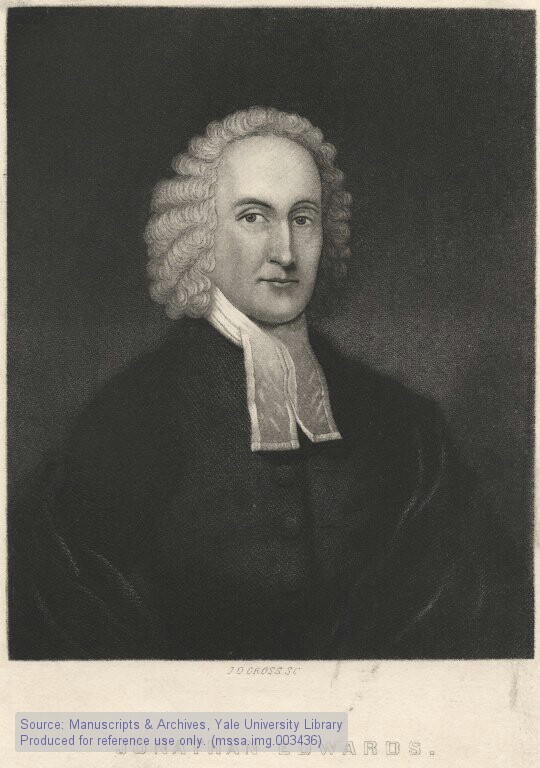
Edwards kept a family record in his own hand in the family Bible, and his great-grandson Sereno Edwards Dwight printed it in the memoir that opens the 1834 London edition of the Works. It reads, in part: "I was born Oct. 5, 1703. I was ordained at Northampton, Feb. 15, 1727. I was married to Miss Sarah Pierrepont, July 28, 1727."1 The same record notes eleven children born between 1728 and 1750, and closes with two entries in his hand that frame this lesson: "I was dismissed from my pastoral relation to the first church in Northampton, June 22d, 1750," and "I was properly initiated President of New Jersey college, by taking the previous oaths, Feb. 16, 1758." A later hand added that he "died of the small pox, March 22, 1758, and was buried March 24th."1
He was the only son among the eleven children of Timothy Edwards, minister at Windsor, Connecticut, for about sixty years, and of Esther Stoddard, daughter of Solomon Stoddard of Northampton.2 He studied at Yale, preached briefly to a Presbyterian congregation in New York, served as a tutor at Yale, and in 1726 went to Northampton as assistant to his grandfather, whose death on February 11, 1729 left him sole pastor of the Northampton church.23 The revival of 1734 and 1735 and the larger Awakening of 1740 to 1742 followed. After 1743 the revival faded in Northampton, and Edwards's work turned to the questions the revival had raised: how to tell true conversion from false, who belongs at the Lord's Table, what the will is, how sin passes from Adam to his descendants, and what God intended in making the world.

The books, and where to read them
The appendix to Dwight's memoir gives a catalogue of the works "heretofore published." It lists the Treatise on Religious Affections (Boston, 1746), the Life and Diary of the Rev. David Brainerd (Boston, 1749), Qualifications for Full Communion in the Visible Church (Boston, 1749, the book usually called the Humble Inquiry), the Farewell Sermon (Boston, 1750), On the Freedom of the Will (Boston, 1754) and On Original Sin (Boston, 1758).4 Dwight's list dates Nature of Virtue and God's Last End in the Creation to a Boston printing of 1788; the Yale edition dates their first printing, together in one volume, to Boston in 1765, seven years after his death, and the editor's preface to that volume is reprinted in the 1834 Works.5
The standard text today is the Yale edition, The Works of Jonathan Edwards (26 volumes, 1957 to 2008), with a further 47 volumes of sermons, notebooks and letters published online by the Jonathan Edwards Center at Yale University (edwards.yale.edu).6 The Yale volumes edit the treatises from the first printings: Freedom of the Will (volume 1, edited by Paul Ramsey), Religious Affections (volume 2, John E. Smith), Original Sin (volume 3, Clyde A. Holbrook), The Life of David Brainerd (volume 7, Norman Pettit), the two dissertations in Ethical Writings (volume 8, Paul Ramsey), the communion writings in Ecclesiastical Writings (volume 12, David D. Hall) and the letters in volume 16 (George S. Claghorn).6 The quotations in this lesson are taken from the public domain texts that can be checked online: the Christian Classics Ethereal Library's editions of Religious Affections and Freedom of the Will, and the two-volume London edition of the Works prepared by Edward Hickman (1834), which reprints Dwight's memoir. These nineteenth-century texts modernize some spelling and punctuation, and readers who need the exact wording of the first printings should check the Yale volumes.
A Treatise Concerning Religious Affections (1746)
The question the treatise asks
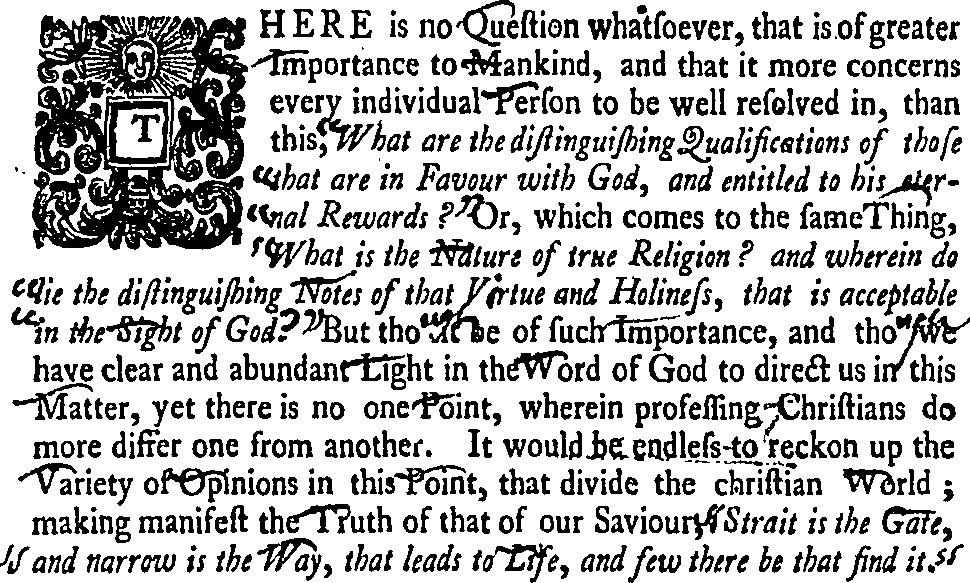
By 1743 the revival had divided New England. Its friends counted thousands of conversions; its critics, led in Boston by Charles Chauncy, pointed to outcries, faintings, lay exhorters and the book burning at New London (see lesson 04). Edwards had answered the critics in 1741 and 1742. In the Religious Affections he turned to a question that both sides had to face, and he opened the book with it: "There is no question whatsoever, that is of greater importance to mankind, and what is more concerns every individual person to be well resolved in, than this: What are the distinguishing qualifications of those that are in favor with God, and entitled to his eternal rewards? Or, which comes to the same thing, What is the nature of true religion?"7 He wrote that he was writing "in the midst of the dust and smoke of such a state of controversy, as this land is now in," and he named the danger he saw on the revival's own side: "It is by the mixture of counterfeit religion with true, not discerned and distinguished, that the devil has had his greatest advantage against the cause and kingdom of Christ."7
The treatise is built on one verse, 1 Peter 1:8, which Edwards quotes in the King James wording: "Whom having not seen, ye love; in whom, though now ye see him not, yet believing, ye rejoice with joy unspeakable and full of glory."7 From it he draws a single proposition, set in capitals in the old editions: "DOCTRINE. True religion, in great part, consists in holy affections."7 The book has three parts. Part I explains what affections are and why religion lies largely in them. Part II lists twelve things that are "no certain signs" either way. Part III gives twelve signs that do distinguish "truly gracious and holy affections." The editor of the Yale edition, John E. Smith, traced the book to sermons Edwards preached at Northampton on this text in the early 1740s.6
What Edwards meant by affections
The word did not mean passing feelings. Edwards held that the soul has two faculties. The first is the understanding, "that by which it is capable of perception and speculation, or by which it discerns, and views, and judges of things." The second "is that by which the soul does not merely perceive and view things, but is some way inclined with respect to the things it views or considers," and this "is sometimes called the inclination: and, as it has respect to the actions that are determined and governed by it, is called the will: and the mind, with regard to the exercises of this faculty, is often called the heart."7 The affections, he wrote, "are no other than the more vigorous and sensible exercises of the inclination and will of the soul." He added: "The will, and the affections of the soul, are not two faculties; the affections are not essentially distinct from the will, nor do they differ from the mere actings of the will, and inclination of the soul, but only in the liveliness and sensibleness of exercise."7
This definition placed Edwards between the two parties of the 1740s. Against critics who treated strong feeling in religion as a symptom of disorder, he argued that love, hope, joy, fear and sorrow are the will in motion, and that Scripture asks for them. Against revival enthusiasts who took the strength of their feelings as proof of grace, he argued that the strength of a feeling proves nothing about its source. The same psychology of the will reappears in Freedom of the Will, eight years later, where the will is defined in almost the same terms. Readers who know the later quarrel between Finney and the Old School should note that Edwards did not separate the will from the affections or the heart; Finney did (see lesson 10).
Part II: twelve signs that prove nothing either way
Part II answers both parties at once. Each of its twelve headings says that a given mark is no sign one way or the other: it does not prove an experience false and it does not prove it gracious. The first: "It is no sign one way or the other, that religious affections are very great, or raised very high." The second: "It is no sign that affections have the nature of true religion, or that they have not, that they have great effects on the body."8 The others, in Edwards's order, are fluent and fervent talk about religion; affections that a person did not produce "of their own contrivance and by their own strength"; texts of Scripture coming suddenly to mind; an appearance of love; many kinds of affection together; comforts and joys that follow convictions of conscience "in a certain order"; much time spent in religion and in "the external duties of worship"; much praising of God with the mouth; great confidence that one's experience is divine; and accounts of experience that move and please godly hearers.8
Several of these were aimed at the habits of the revival itself. The eighth went against the New England expectation, built up by Puritan preachers and by the conversion narratives required for church membership (see lesson 01), that a true conversion follows set stages of conviction, humiliation and comfort. The twelfth told ministers and church members that a moving testimony, however much it "gain[s] their charity, and win[s] their hearts," settles nothing. The second answered both the critics who took fainting and crying out as proof of delusion and the friends of the revival who took them as proof of the Spirit.
Part III: twelve signs that distinguish
Part III gives the positive marks. Their headings, quoted from the Christian Classics Ethereal Library text, are these:9
- "Affections that are truly spiritual and gracious, do arise from those influences and operations on the heart, which are spiritual, supernatural and divine."
- "The first objective ground of gracious affections, is the transcendently excellent and amiable nature of divine things as they are themselves; and not any conceived relation they bear to self, or self-interest."
- "Those affections that are truly holy, are primarily founded on the loveliness of the moral excellency of divine things."
- "Gracious affections do arise from the mind's being enlightened, richly and spiritually to understand or apprehend divine things." Edwards adds: "Holy affections are not heat without light."
- "Truly gracious affections are attended with a reasonable and spiritual conviction of the judgment, of the reality and certainty of divine things."
- "Gracious affections are attended with evangelical humiliation."
- Gracious affections "are attended with a change of nature."
- They "tend to, and are attended with the lamblike, dovelike spirit and temper of Jesus Christ."
- "Gracious affections soften the heart, and are attended and followed with a Christian tenderness of spirit."
- Gracious affections show "beautiful symmetry and proportion."
- "Gracious affections, the higher they are raised, the more is a spiritual appetite and longing of soul after spiritual attainments increased. On the contrary, false affections rest satisfied in themselves."
- "Gracious and holy affections have their exercise and fruit in Christian practice."
The first sign carries Edwards's most debated idea. Grace, he argued, gives the mind something it did not have before, "a new spiritual sense," which "is in its whole nature different from any former kinds of sensation of the mind, as tasting is diverse from any of the other senses." A saint perceives in divine things something "as entirely diverse from anything that is perceived in them, by natural men, as the sweet taste of honey is diverse from the ideas men have of honey by only looking on it, and feeling of it."9 He was careful to say that this "is not a new faculty of understanding, but it is a new foundation laid in the nature of the soul, for a new kind of exercises of the same faculty of understanding."9 He had used the same image in the sermon A Divine and Supernatural Light, preached and printed in 1734: "There is a difference between having a rational judgment that honey is sweet, and having a sense of its sweetness. A man may have the former that knows not how honey tastes; but a man cannot have the latter unless he has an idea of the taste of honey in his mind."10
The twelfth sign: "the sign of signs"
The longest section of the book is the last. Edwards argued that "Christian practice, or a holy life, is a great and distinguishing sign of true and saving grace," and went further: "it is the chief of all the signs of grace, both as an evidence of the sincerity of professors unto others, and also to their own consciences."9 Later in the same section he called it "the chief of all the marks of grace, the sign of signs, and evidence of evidences, that which seals and crowns all other signs."9 This was the point at which the treatise answered the revival's critics most directly. A conversion was to be judged over years, by conduct, and not on the night of the outcry.
The twelfth sign also shaped the communion controversy of 1749 to 1750. If a credible profession of godliness, borne out by practice, is the mark of a true Christian, a church can ask for that profession before it admits someone to the Lord's Supper. Edwards drew that conclusion in the Humble Inquiry three years later.

How the treatise was read
The treatise became a handbook for pastors in both Calvinist and Wesleyan churches, read in each for different reasons. Calvinists found in it a defense of experimental religion that kept the sovereignty of grace (the first sign says gracious affections arise from operations "spiritual, supernatural and divine"). John Wesley, who disagreed with Edwards on predestination and the will, issued an abridged extract of the book for Methodist readers in 1773, cutting the Calvinist passages; that edition is cited from secondary accounts here and is listed among the unverified items. George Marsden's biography, Jonathan Edwards: A Life (2003), reads the treatise as Edwards's effort to defend the revival while disciplining it.11 The book has also had critics on other grounds: readers in the tradition of Chauncy held that the "new spiritual sense" could not be tested, and modern philosophers have debated whether Edwards's account of a sense of the heart is a theory of perception, of taste, or of moral judgment. Those debates are open.
The break with Northampton, 1744 to 1750
Stoddard's practice and Edwards's inheritance
Solomon Stoddard, Edwards's grandfather and predecessor, had opened the Lord's Supper at Northampton to church members of orderly life who had not given an account of conversion, treating the sacrament as a means by which God might convert them (the practice and its background are set out in lesson 01). Dwight's memoir reports that the Northampton church had been "formed on the plan of strict communion" and that "Mr. Stoddard publicly avowed a change in his opinions in 1704."12 Edwards accepted the practice when he arrived. His first biographer, Samuel Hopkins, whose Life of Edwards (1765) Dwight quotes at length, wrote: "Mr. Edwards had some hesitation about this matter when he first settled at Northampton, but did not receive such a degree of conviction, as to prevent his adopting it with a good conscience, for some years. But at length his doubts increased."12 Hopkins summarized the conclusion Edwards reached: "that to be a visible Christian, was to put on the visibility or appearance of a real Christian; that a profession of Christianity was a profession of that wherein real Christianity consists; and therefore that no person, who rejected Christ in his heart, could make such a profession consistently with truth."12
The 1744 affair of the books
Before the communion dispute, an earlier quarrel had weakened Edwards's standing with many families. Dwight, following Hopkins, dates it to 1744, "about six years before the final separation." Edwards learned "that some young persons in the town, who were members of the church, had licentious books in their possession which they employed to promote obscene conversation among the young people." He asked the church to inquire, and it agreed and named a committee. He then read from the pulpit a list of the young people he wished to see, "but through mere forgetfulness or inadvertence on his part, he did not state to the church, in which of these two classes any particular individual was included," accused or witness.12 Since the list touched most of the leading families, "the town was suddenly all in a blaze," some of those called refused to appear, and "little or nothing could be done further in the affair."12 Dwight judged that it "doubtless laid a foundation for his removal."12 Modern historians usually call it the "bad book" case. Marsden and others identify the books as popular midwives' and sex manuals of the time and date the episode to 1744 or later in the 1740s; the exact year and titles are argued over, and this lesson lists them among the points not settled.11
An Humble Inquiry (1749)
When Edwards's change of view became known in the spring of 1749, Hopkins wrote, "it gave great offence, and the town was put into a great ferment; and before he was heard in his own defence, or it was known by many what his principles were, the general cry was to have him dismissed."12 Edwards asked to explain himself from the pulpit; when that was refused he wrote a book in about two months and sent it to the press in late April 1749. It appeared in August as An Humble Inquiry into the Rules of the Word of God, concerning the Qualifications requisite to a Complete Standing and Full Communion in the Visible Christian Church.12
The preface faced the difficulty directly: "My appearing in this public manner on that side of the question, which is defended in the following sheets, will probably be surprising to many; as it is well known, that Mr. Stoddard, so great and eminent a divine, and my venerable predecessor in the pastoral office over the church in Northampton, as well as my own grandfather, publicly and strenuously appeared in opposition to the doctrine here maintained."13 He appealed to a principle he credited to Stoddard himself, "that we ought to call no man on earth master."13 The thesis of the book, stated at the opening of Part II, is "That none ought to be admitted to the communion and privileges of members of the visible church of Christ in complete standing, but such as are in profession, and in the eye of the church's christian judgment, godly or gracious persons."13
The argument did not require the church to judge hearts infallibly. Edwards asked for a credible profession: a statement that the person believed himself or herself to have saving faith, which the church could accept in "christian judgment" unless conduct contradicted it. Stoddard's defenders, led by Edwards's cousin Solomon Williams of Lebanon, Connecticut, answered in The True State of the Question (1751), and Edwards replied in Misrepresentations Corrected, and Truth Vindicated (1752), both texts reprinted in the 1834 Works.13 Williams held that the church could admit any baptized person of sound knowledge and good life who made a profession of the Christian faith, without a claim to be converted; Edwards held that this made the profession a form of words that need not be true.
The council and the vote
The church and its pastor spent months arguing over how the deciding council would be chosen. Edwards wanted some churches from outside Hampshire County, since "the neighbouring ministers were all youngerly men" and "almost altogether in opposition to me," and since "in this country we have no such thing as appeals from one council to another."14 The church finally agreed that he could name two churches from outside the county. The council met on June 19, 1750. Edwards described the result in a letter to the Scottish minister John Erskine, dated Northampton, July 5, 1750:
"When the church was convened, in order to the council's knowing their minds with respect to my continuance, about twenty-three appeared for it, others staid away, choosing not to act either way; but the generality of the church, which consists of about 230 male members, voted for my dismission. My dismission was carried in the council by a majority of one voice. The ministers were equally divided, but of the delegates one more was for it than against it."14
He explained the margin. The churches chosen by the people all voted for dismissal and the churches he chose all voted against, and "there happening to be one fewer of these than of the other, by the church of Cold Spring not sending a delegate, (which was through that people's prejudice against my opinion,) the vote was carried that way by the voice of one delegate."14 The young lawyer who led the case for the church before the council was Edwards's cousin Joseph Hawley III, whom Edwards described in the same letter, without naming him, as "my grandfather Stoddard's grandson, being my mother's sister's son; a man of lax principles in religion, falling in, in some essential things, with Arminians."14 Dwight identifies him and prints a letter Hawley wrote on May 9, 1760, two years after Edwards's death, to David Hall of Sutton, a member of the council, and published in a Boston weekly. In it Hawley wrote that he had long held it his duty "not only to humble myself before God, for what was unchristian and sinful in my conduct before the said councils, but also to confess my faults to them."15 The figure "about 230 male members" is Edwards's own count of the voting members, given in a letter, and should be read as his estimate.
The result was read to the congregation on Friday afternoon, June 22, 1750, the date Edwards entered in his family Bible.141 Dwight's chapter reports that "on the next sabbath but one, July 1st, Mr. Edwards delivered to them his Farewell Sermon."14 The heading of the sermon in the 1834 Works instead prints a date in June (as "June 32," a misprint); the July 1 date in Dwight is the one usually given.16
The Farewell Sermon
Edwards took his text from 2 Corinthians 1:14, "As also you have acknowledged us in part, that we are your rejoicing, even as ye also are ours in the day of the Lord Jesus," and drew the doctrine: "Ministers, and the people that have been under their care, must meet one another before Christ's tribunal at the day of judgment."16 The sermon describes that meeting at length, as the hearing at which the dispute between pastor and people would be judged without error, and it closes with counsel to the different groups in the congregation, including the young people and the children. In a postscript to a letter to the Scottish minister Thomas Gillespie, dated July 3, 1750, Edwards asked for prayer "that I may take a suitable notice of the frowns of Heaven on me and this people, between whom there once existed so great a union."14
He stayed in Northampton for some months. The committee that supplied the pulpit asked him to preach when no one else could be found, and, as he wrote to Erskine, "they have asked me only from sabbath to sabbath." A minority of his supporters proposed to maintain him as minister of a separate congregation, and, Hopkins wrote, his correspondents in Scotland, "fearing it might be the means of bringing him into worldly straits, generously contributed a considerable sum, and sent it over to him."15
Why he was dismissed: the historians
The record makes the communion question the stated cause: the council's result, Edwards's letters and his family record all speak of the dismissal as arising from the "difference of sentiments, concerning the requisite qualifications of members of the church in complete standing," as the heading of the Farewell Sermon puts it.16 Historians add other causes. Patricia Tracy, in Jonathan Edwards, Pastor: Religion and Society in Eighteenth-Century Northampton (1980), studied the town's records and argued that disputes over Edwards's salary, the 1744 affair and the changing economy of the town had already strained the bond between minister and people.17 Marsden stresses the family politics of the Connecticut Valley, where the Williams and Stoddard relatives held much of the region's church and civil authority, and the force of Stoddard's memory in Northampton.11 Neither denies that the communion question was the occasion. They differ from the older view, found in Dwight, that treated the people's conduct mainly as a moral failure.
David Brainerd and the Life (1749)
Who Brainerd was
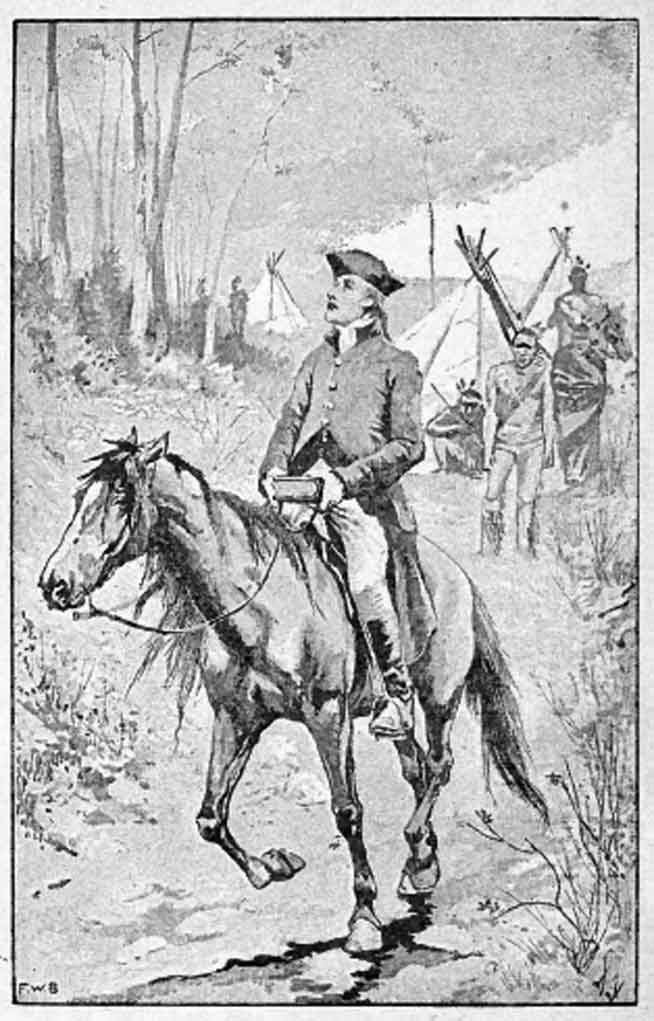
David Brainerd (1718 to 1747) was a Connecticut man who had been expelled from Yale in 1742 during the revival, after it was reported that he had said one of the tutors had no more grace than a chair; the remark is known from Edwards's account in the Life and from later biographies, and is paraphrased here because its wording was not checked against the first edition.6 Commissioned by the Society in Scotland for Propagating Christian Knowledge, he worked as a missionary among Native peoples at Kaunaumeek in New York, at the Forks of the Delaware in Pennsylvania, and at Crossweeksung in New Jersey, where in 1745 and 1746 a revival among the Lenape (Delaware) people was the high point of his work. Dwight's memoir records that Edwards met him at New Haven in September 1743 and "became his counsellor at a most interesting period of his life."18
In March 1747, sick with tuberculosis, Brainerd left New Jersey for New England. Edwards invited him into his house, and he arrived on May 28, "apparently very much improved in health, cheerful in his spirits, and free from melancholy, yet at that time probably in a confirmed consumption."18 Edwards's second daughter Jerusha nursed him, traveling with him to Boston and back. Edwards recorded his words to her on the morning of Sunday, October 4: "Dear Jerusha, are you willing to part with me?--I am quite willing to part with you: I am willing to part with all my friends: though if I thought I should not see you and be happy with you in another world, I could not bear to part with you. But we shall spend a happy eternity together."18 Brainerd died on Friday, October 9, 1747, and Edwards preached the funeral sermon, True Saints, when absent from the Body, are present with the Lord, on 2 Corinthians 5:8.18
Jerusha Edwards died a few months later. Edwards wrote in a note to the Life that God had taken "this my dear child by death, on the 14th of February, next following, after a short illness of five days, in the 18th year of her age," and that "she had constantly taken care of and attended him in his sickness, for nineteen weeks before his death."18 His family record gives the date as "Feb. 14, 1747," the year counted in the Old Style, under which the new year began on March 25; in modern reckoning she died on February 14, 1748.1 Later writers sometimes said Jerusha and Brainerd were engaged. No document from the family says so, and the claim is rated below.

The book and its readers
Brainerd had destroyed the early part of his diary and left the rest with Edwards "to dispose of as he thought best." Edwards edited it with connecting narrative and published it at Boston in 1749 as An Account of the Life of the Late Reverend Mr. David Brainerd, the book Dwight lists as the Life and Diary.184 Edwards presented Brainerd as a model of the religion he had described in the Affections: intense and often melancholy in feeling, but tested by labor, self-denial and practice. Norman Pettit, editor of the Yale edition (volume 7), showed that Edwards cut and shaped the diary, removing passages and softening some of Brainerd's language, so that the published Brainerd is in part Edwards's construction.6
The book became the most reprinted of Edwards's works in the century after his death. Missionaries of the next generation, among them the Baptist William Carey and the Anglican Henry Martyn, are reported by their biographers to have read it and been moved by it, and the American missionary movement that sent Adoniram Judson (see Module 102, lesson 09) drew on the same tradition. Those reports come from biographies and from the introduction to the Yale edition, and are attributed here rather than checked against the missionaries' own papers.6
Stockbridge, 1751 to 1757
The mission before Edwards
The Mohican people of the upper Housatonic valley (called in English records the Housatonic, Housatonnuck or River Indians) had accepted a Congregational mission in the 1730s. The tribe's account of its history, as given on the Mission House pages of the Trustees of Reservations, which refer readers to the Stockbridge-Munsee Community, Band of Mohican Indians (the tribe's present government in Wisconsin), records that "in 1734, a missionary named John Sergeant came to live with the Mohicans in their village of Wnahktukuk," and that "in 1738, the Mohicans gave John Sergeant permission to start a mission in the village," where "a church and school were built."19 Dwight's memoir dates the mission from 1735, when Sergeant was ordained, and says his congregation grew from "about fifty" to "two hundred and fifty" by 1751.20 The Massachusetts government laid out the town of Stockbridge for the mission, and a few English families, among them Ephraim Williams of the powerful Williams family, settled beside the Mohican village. Sergeant died on July 27, 1749.20


The call and the installation
Early in December 1750, Dwight writes, Edwards received proposals from the Stockbridge church and from the Boston commissioners of the "Society in London, for Propagating the Gospel in New England, and the Parts adjacent" to become minister of the town and missionary to the Mohicans. He spent the winter of 1751 at Stockbridge, "preaching both to the English inhabitants, and, by the aid of an interpreter, to the Indians," accepted, moved his family in the first week of August 1751, and "on Thursday, Aug. 8th, was regularly installed as the minister of the congregation in that place, and inducted into the office of missionary to the Indians residing in its vicinity."20 His salary came from three sources: the parish, the London society through its Boston commissioners, and the Massachusetts legislature.20
Edwards as missionary
Edwards did not learn the Mohican language. He preached through an interpreter, as Sergeant had come to recommend, and pressed for English schooling for Mohican children. A group of Mohawk families, drawn by the promise of a boarding school funded by the English minister Isaac Hollis, came to Stockbridge in 1750 and 1751, and Edwards hoped the mission might reach the Iroquois nations. That hope ran into a long quarrel with the town's leading English residents over the school and its funds. Dwight's chapters, drawing on Edwards's letters, name Captain Martin Kellogg, who kept the Mohawk boys' school, and members of the Williams family, who controlled the town's affairs and had opposed Edwards at Northampton, and describe the dispute from Edwards's side.20 The Mohawk families left in the mid-1750s as war with France returned to the frontier.
Edwards's sermons to the Mohicans, many of them preserved in manuscript and published in the Yale edition, are short, plain and built around images: light and darkness, the heart, the coming of Christ to all nations. Rachel Wheeler, in To Live upon Hope: Mohicans and Missionaries in the Eighteenth-Century Northeast (2008), read them beside the Mohicans' own choices and argued that Mohican Christians took up the faith on their own terms and used the mission to protect their land and community, and that Edwards preached the same doctrine of sin to Mohican and English hearers.21 Dwight's nineteenth-century memoir took a darker view of the mission's results, judging that "very little success appears to have attended" Sergeant's labors; the judgment is his.20
What the Mohican record adds
The tribe's own history continues past Edwards. Its published timeline records that by 1774 the tribe's land in Stockbridge was "reduced to 1,200 acres from original 23,000"; that in 1783 the tribe was "forced from Stockbridge lands"; that in 1784 the Oneida Nation gave it a six-mile-square town in Madison County, New York, where about 300 Stockbridges established New Stockbridge; that a "series of sales to New York State" between 1822 and 1829 dispossessed the Mohicans there; that by 1830 between 350 and 400 Mohicans were at Kaukauna, Wisconsin; and that the Treaty of 1856 established the present reservation in Shawano County, Wisconsin.41 Any account of Edwards at Stockbridge is one chapter of that longer history.
The study at Stockbridge
Stockbridge gave Edwards more time to write than Northampton had. Sereno Dwight, summing up his life, wrote that "his greatest work," meaning Freedom of the Will, "was written in four months and a half while each sabbath he delivered two sermons to his English flock, and two others by interpreters, to two distinct auditories of Indians, and catechised the children of both tribes."22 In July 1754 Edwards fell ill with ague and fever that lasted until January, and in the following spring began the two dissertations on God's end in creation and on true virtue.23 Original Sin was in the press when he died. All four of the treatises taught in the rest of this lesson were written in the Stockbridge years.
Freedom of the Will (1754)
The title and the opponents
The full title states the target: A Careful and Strict Inquiry into the Modern Prevailing Notions of that Freedom of Will which is Supposed to be Essential to Moral Agency, Virtue and Vice, Reward and Punishment, Praise and Blame. On the title page stands Romans 9:16, "it is not of him that willeth."24 The opponents Edwards named were English writers on the Arminian side: Daniel Whitby, whose Discourse on the Five Points (1710) defended conditional election and resistible grace, and Thomas Chubb, a lay writer on liberty and religion. He also answered an anonymous Essay on the Freedom of the Will in God and in Creatures (1732), which he cites as the work of "the fore-mentioned author of an Essay on the Freedom of the will"; later editors identify its author as the hymn writer Isaac Watts, whom Edwards did not name.2526 In his letter to the Princeton trustees in 1757 Edwards described the book as his treatment of "one of the main points in dispute between the Arminians and Calvinists," and said he meant to write on "all the other controverted points."27
The preface begins with labels. Edwards noted that many objected to "calling professing Christians, that differ one from another in some matters of opinion, by distinct names; especially calling them by the names of particular men," such as "Arminians, from Arminius," and wrote of himself: "I should not take it at all amiss, to be called a Calvinist, for distinction's sake: though I utterly disclaim a dependence on Calvin, or believing the doctrines which I hold, because he believed and taught them."24 The Calvinist and Arminian positions, and the Synod of Dort that defined them, are set out in Module 80, lesson 03.
The will defined
Part I defines terms. "The Will (without any metaphysical refining) is, That by which the mind chooses any thing. The faculty of the will, is that power, or principle of mind, by which it is capable of choosing: an act of the will is the same as an act of choosing or choice."25 Against John Locke, who had distinguished will from desire, Edwards argued that "a man never, in any instance, wills any thing contrary to his desires, or desires any thing contrary to his will."25
What determines the will? Edwards's answer is the strongest motive, as it appears to the mind at the moment of choice: "it must be true, in some sense, that the will always is, as the greatest apparent good is." He defined "good" in this sense as "of the same import with 'agreeable,'" so that the will chooses "that which appears most agreeable," taking into account everything in the mind's view, including the wish to escape pain.25 His example is a drunkard with liquor before him: whether he drinks "will certainly be done according to what, in the present view of his mind, taken in the whole of it, is most agreeable to him."25
Natural ability and moral inability
The distinction for which the book is best known is between two kinds of necessity and inability. "We are said to be naturally unable to do a thing, when we cannot do it if we will, because what is most commonly called nature does not allow of it, or because of some impeding defect or obstacle that is extrinsic to the Will; either in the Faculty of understanding, constitution of body, or external objects." Moral inability is different: it "consists not in any of these things; but either in the want of inclination; or the strength of a contrary inclination; or the want of sufficient motives in view." Edwards reduced the two to one: "moral Inability consists in the opposition or want of inclination."25
His examples show both directions. "A woman of great honour and chastity may have a moral Inability to prostitute herself to her slave. A child of great love and duty to his parents, may be thus unable to kill his father." On the other side, "a great degree of habitual wickedness may lay a man under an Inability to love and choose holiness; and render him utterly unable to love an infinitely holy Being, or to choose and cleave to him as his chief good."25 The fallen sinner, on this account, has the natural ability to repent and believe: nothing outside his will prevents him. What he lacks is the inclination, and that lack is his fault. Edwards held that only natural inability excuses; moral inability is itself the sin.
The distinction allowed a Calvinist preacher to tell sinners that they could come to Christ if they would, and that their unwillingness was the whole of their guilt, while holding that only God's grace changes that unwillingness. It became a working tool of the New Divinity preachers of lesson 07. Allen Guelzo, in Edwards on the Will: A Century of American Theological Debate (1989), traced how Edwards's heirs and critics, through Nathaniel Taylor at Yale, stretched "natural ability" until Charles Finney could use it to mean a power in the sinner to change his own heart, a conclusion Edwards had not drawn and Old School Calvinists at Princeton rejected (see lesson 10 and lesson 13).26
What liberty is
Edwards gave liberty its ordinary meaning: "The plain and obvious meaning of the words Freedom and Liberty, in common speech, is The power, opportunity, or advantage, that any one has, to do as he pleases. Or in other words, his being free from hindrance or impediment in the way of doing, or conducting in any respect, as he wills."25 He then set out the different meaning he attributed to "Arminians, Pelagians, and others, who oppose the Calvinists," with three parts: "1. That it consists in a self-determining power in the Will, or a certain sovereignty the Will has over itself, and its own acts, whereby it determines its own volitions." "2. Indifference belongs to Liberty in their notion of it, or that the mind, previous to the act of volition, be in equilibrio." "3. Contingence is another thing that belongs and is essential to it," meaning the absence of "any fixed and certain connexion with some previous ground or reason of its existence."25 Arminian writers did not all accept this summary; Wesley, below, framed the question differently.
The argument from regress
Part II attacks the first of these. If the will determines its own acts, Edwards argued, it does so by an act of choosing. If that act is also free in the same sense, it must be chosen by a still earlier act, and so on: "Which brings us directly to a contradiction: for it supposes an act of the Will preceding the first act in the whole train, directing and determining the rest; or a free act of the Will, before the first free act of the Will. Or else we must come at last to an act of the will, determining the consequent acts, wherein the Will is not self-determined, and so is not a free act, in this notion of freedom: but if the first act in the train, determining and fixing the rest, be not free, none of them all can be free."28 The rest of Part II argues that indifference and contingency are equally incoherent, and Parts III and IV argue that praise and blame, commands and exhortations, are consistent with his account of necessity and do not require the Arminian one. He also argued that God's foreknowledge of free acts implies their certainty, so that the Arminian who grants foreknowledge has already granted necessity in his sense.
Wesley's reply
The Wesleyan answer came from John Wesley himself, in Thoughts upon Necessity (1774). Wesley grouped Edwards with writers who made human acts necessary, saying that "Mr. Edwards of New-England" proved "by abundance of deep, metaphysical reasoning" that we "must have such judgments, passions, actions, and no other," and that he "flatly ascribes the necessity of all our actions to Him who united our souls to these bodies."29 Wesley quoted Edwards's defense, that voluntary acts are good or evil because they come from the will, and answered: "I cannot possibly allow the consequence, upon Mr. Edwards's supposition. Still I say, if they are necessitated to commit robbery or murder, they are not punishable for committing it." His central objection was that the will itself, on Edwards's view, "is irresistibly impelled; so that they cannot help willing thus or thus. If so, they are no more blamable for that will, than for the actions which follow it."29 He concluded with the sentence quoted in the diagram above. Wesley also appealed to experience: against the claim that choice always follows what "appears the best upon the whole," he wrote, "This is absolutely false. It is flatly contrary to the experience of all mankind."29
The two positions are still held in their traditions. Reformed theologians have generally received Edwards's distinction between natural and moral ability as consistent with the Westminster Confession of Faith (1646), whose ninth chapter says that the will "is neither forced, nor, by any absolute necessity of nature, determined to good, or evil," and that fallen man "hath wholly lost all ability of will to any spiritual good accompanying salvation."30 Wesleyan and other Arminian theologians have generally answered with Wesley that responsibility requires a power to do otherwise, restored to fallen people by prevenient grace. Philosophers place Edwards among the compatibilists, those who hold that freedom and determination are consistent; the term is modern, and Edwards did not use it.
The Great Christian Doctrine of Original Sin Defended (1758)
The occasion: John Taylor of Norwich
Edwards's book on original sin answered The Scripture-Doctrine of Original Sin Proposed to Free and Candid Examination (1740) by John Taylor, a Presbyterian minister of Norwich, England, who denied that Adam's sin is imputed to his descendants or that they are born with a corrupt nature. Taylor's book circulated widely in New England, and Dwight's memoir notes that in the early 1750s "the principles of Dr. Taylor of Norwich were gaining many converts in the colonies."31 Edwards wrote in his preface that his discourse was "not only intended for an answer to Dr. Taylor, and other opposers of the doctrine of original sin, but for a general defence of that doctrine."32 Wesley, opposed to Edwards on the will, agreed with him on this point and published his own answer to Taylor, The Doctrine of Original Sin, according to Scripture, Reason, and Experience (1757), a fact that shows how the Calvinist and Wesleyan lines divided on the will and agreed on the fall.
The argument from the record of human conduct
Part I argues from evidence before it argues from Scripture. Edwards held that the universal and persistent sinning of every people in every age shows a "tendency" in human nature, as a die that always lands one way shows a weight. He met the objection that it would be unjust for God to bring people into the world corrupt by arguing that the objection, if pressed, must also deny the plain fact: "if men actually are born into the world with a tendency to sin, and to misery and ruin for their sin, which actually will be the consequence, unless mere grace steps in and prevents it," then "the argument from justice is given up."32 Parts II and III take up the scriptural evidence and the doctrine of redemption, which he held presupposes a ruined race.
Identity and the "arbitrary constitution"
Part IV, Chapter III, answers the objection that it is unjust to treat Adam's descendants as one with him. Edwards argued that all created identity through time depends on God. If created things exist "in each successive moment" only by "God's immediate power, in that moment," then "there is no identity or oneness in the case, but what depends on the arbitrary constitution of the Creator; who by his wise sovereign establishment so unites these successive new effects, that he treats them as one."32 He explained his term at once: "When I call this an arbitrary constitution, I mean, that it is a constitution which depends on nothing but the divine will; which divine will depends on nothing but the divine wisdom."32 If God may constitute one person out of successive moments, Edwards reasoned, he may constitute Adam and his posterity "as it were one complex person, or one moral whole," like "the branches of a tree" united "to the root, or the members of the body to the head."32
This argument has troubled friends and critics. Some Reformed theologians, later including Charles Hodge at Princeton, held that Edwards's account of continuous creation came close to making God the only real cause and that his account of imputation departed from the federal theology of the Westminster divines, which grounds imputation in Adam's role as covenant head. New England theologians after Edwards, from Samuel Hopkins to Nathaniel Taylor, moved away from imputation altogether toward the view that sin lies in sinful acts, the view stated in Taylor's phrase discussed in lesson 13. These are attributed positions; the lessons named give the texts.
The Two Dissertations (1765)
Concerning the End for Which God Created the World
Begun at Stockbridge in 1755 and left unpublished at his death, the two dissertations were printed together at Boston in 1765.236 The first asks why God, who lacks nothing, created anything. Edwards's answer is that God's own fullness tends to overflow: "a disposition in God, as an original property of his nature, to an emanation of his own infinite fulness, was what excited him to create the world; and so, that the emanation itself was aimed at by him as a last end of the creation."5 The second half of the dissertation gathers the scriptural language for that end and concludes that "the great end of God's works, which is so variously expressed in Scripture, is indeed but one," the glory of God, "fitly compared to an effulgence or emanation of light from a luminary."5 On this view God's glory and the creatures' good are one end: as light is "the abundant, extensive emanation and communication of the fulness of the sun to innumerable beings that partake of it," so God is glorified in the creatures' knowing, loving and rejoicing in him.5
The Nature of True Virtue
The second dissertation defines virtue by beauty. Edwards distinguished a "particular beauty," by which a thing appears beautiful "with regard to its connexion with, and tendency to, some particular things within a limited, and as it were a private, sphere," from the general beauty a thing has when seen in relation to everything it touches, and he used the image of music: "a few notes in a tune, taken only by themselves, and in their relation to one another, may be harmonious; which, when considered with respect to all the notes in the tune, or the entire series of sounds they are connected with, may be very discordant."33 His definition follows: "True virtue most essentially consists in benevolence to being in general. Or perhaps, to speak more accurately, it is that consent, propensity, and union of heart to being in general, which is immediately exercised in a general good will."33 Since God has the most being and excellence, true virtue is chiefly love to God, and love to creatures is virtuous as it is subordinate to that. The dissertation answers the moral sense philosophers of Scotland and England, especially Francis Hutcheson, who grounded virtue in a natural benevolent sense; Edwards granted that natural affections such as family love, gratitude and pity are good and useful, but held that without love to "being in general" they fall short of true virtue.
Samuel Hopkins turned this definition into the doctrine of "disinterested benevolence," and Hopkins's later opposition to the slave trade drew on it; that history belongs to lesson 07.
Princeton and death, 1757 and 1758
The call to the College of New Jersey
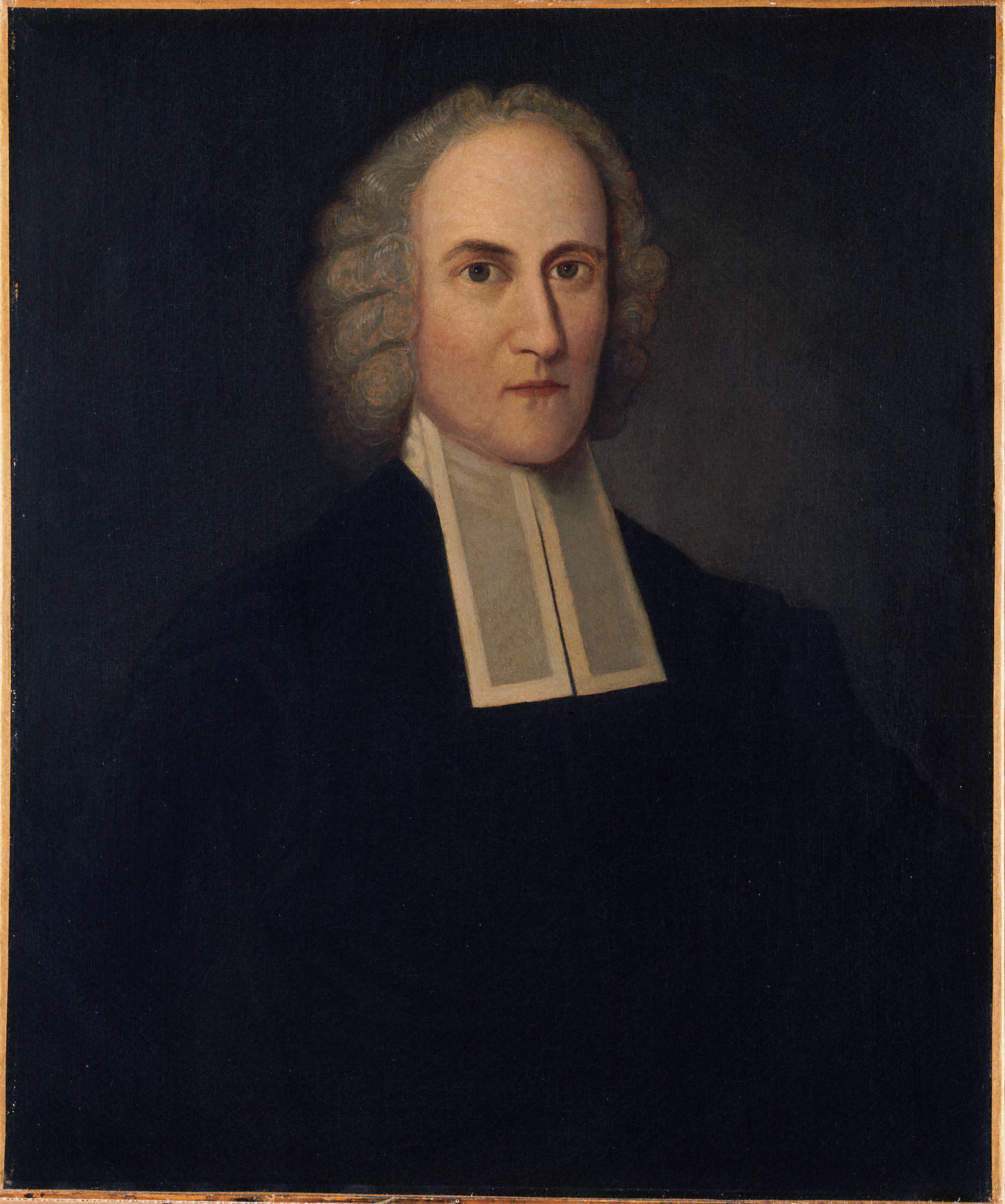
The College of New Jersey had been founded in 1746 by New Side Presbyterians (see lesson 04). Its second president, Aaron Burr Sr., had married Edwards's daughter Esther in 1752, and when Burr died in September 1757 the trustees chose Edwards to succeed him.271 Edwards's reply, dated Stockbridge, October 19, 1757, is among the most quoted of his letters, because in it he described himself:
"I have a constitution, in many respects, peculiarly unhappy, attended with flaccid solids, vapid, sizy, and scarce fluids, and a low tide of spirits; often occasioning a kind of childish weakness and contemptibleness of speech, presence, and demeanour, with a disagreeable dulness and stiffness, much unfitting me for conversation, but more especially for the government of a college."27
He added that he was "deficient in some parts of learning, particularly in algebra, and the higher parts of mathematics, and the Greek classics; my Greek learning having been chiefly in the New Testament."27 His larger objection was his writing. He described his method, "very much by writing; applying myself, in this way, to improve every important hint," and his plan for "a great work, which I call a History of the Work of Redemption, a body of divinity in an entire new method, being thrown into the form of a history."27 A council of ministers advised him to accept, and he went to Princeton in January 1758.34 His family record notes, in his hand, that he "was properly initiated President of New Jersey college, by taking the previous oaths, Feb. 16, 1758."1

The inoculation
Smallpox was in Princeton. Inoculation, which gave a usually milder case of the disease by introducing matter from a smallpox sore, had been practiced in Boston since 1721, with a death rate far lower than natural smallpox but not zero. Samuel Hopkins's Life, as reprinted by Dwight, says that "as Mr. Edwards had never had it, and inoculation was then practised with great success in those parts, he proposed to be inoculated, if the physician should advise to it, and the corporation would give their consent." He "was inoculated February 13th. He had it favourably, and it was thought all danger was over; but a secondary fever set in and, by reason of a number of pustules in his throat, the obstruction was such, that the medicines necessary to check the fever could not be administered. It therefore raged till it put an end to his life, on the 22d of March, 1758, in the 55th year of his age."27
The physician, Dr. William Shippen of Philadelphia, wrote to Sarah Edwards the same day. His letter, dated "Princeton, March 22, 1758," gives the inoculation as "the 23rd of last month," ten days after Hopkins's date, and reports that "this afternoon, between two and three o'clock, it pleased God to let him sleep in that dear Lord Jesus."27 The two dates for the inoculation (February 13 in Hopkins, February 23 in Shippen) cannot both be right; Shippen wrote at the time and Hopkins wrote seven years later, but either text may have been misprinted. The date of death, March 22, is given by Shippen's letter written that afternoon and by the family record. Some modern pages give March 23.34
Last words
Hopkins recorded two sayings. To his daughter Lucy, who nursed him, Edwards gave a message "immediately taken down in writing, as near as could be recollected": "give my kindest love to my dear wife, and tell her, that the uncommon union, which has so long subsisted between us, has been of such a nature, as I trust is spiritual, and therefore will continue for ever." He asked for a plain funeral, "like Mr. Burr's," with any money that might have been spent on it "disposed of to charitable uses."27 At the end, when those standing by were lamenting his death "as a great frown on the college," Hopkins wrote, "to their surprise, not imagining that he heard, or ever would speak another word, he said, Trust in God, and ye need not fear. These were his last words."27 Shippen wrote that "never did any person expire with more perfect freedom from pain."27
He was buried at Princeton on March 24. His daughter Esther Burr died at Princeton on April 7, 1758, aged 26.1
Sarah Pierpont Edwards (1710 to 1758)
"A young lady in New Haven"
Sarah Pierpont was born on January 9, 1710, the daughter of James Pierpont, minister at New Haven and one of the founders of Yale, and of Mary Hooker, granddaughter of Thomas Hooker of Hartford.35 Edwards knew her for years before their marriage. On a blank leaf in 1723, when she was thirteen, he wrote a passage that Dwight printed:
"They say there is a young lady in [New-Haven] who is loved of that Great Being, who made and rules the world, and that there are certain seasons in which this Great Being, in some way or other invisible, comes to her and fills her mind with exceeding sweet delight; and that she hardly cares for any thing, except to meditate on him. ... She is of a wonderful sweetness, calmness, and universal benevolence of mind; especially after this Great God has manifested himself to her mind. She will sometimes go about from place to place, singing sweetly; and seems to be always full of joy and pleasure; and no one knows for what. She loves to be alone, walking in the fields and groves, and seems to have some one invisible always conversing with her."35
They married at New Haven on July 28, 1727, when she was seventeen.1 Over the next twenty-three years she bore eleven children, all of whom survived infancy, a record Edwards entered child by child in the family Bible.1 Dwight describes her as relieving Edwards of the household's daily cares during his hours of study, and as the one who welcomed the visitors, students and ministers who came to the house.35
Her narrative of 1742
At her husband's request Sarah Edwards wrote an account of an experience that began on "Tuesday night, Jan. 19, 1742," during a period of intense religious feeling, in which she was for days "overwhelmed, and as it were swallowed up, in the light and joy of the love of God," in Dwight's summary.35 Edwards described an unnamed person with these experiences in Some Thoughts Concerning the Present Revival (1742) as an example of high affections joined to a sound and humble life, and Dwight, who printed her own narrative from the family papers, made the identification. Dwight added that, according to Edwards, "these transports did not arise from bodily weakness, but were greatest in the best state of health."35 The narrative is one of the fullest first-person accounts of revival experience by a woman of the 1740s. Historians read it in different ways: as evidence for the kind of religion Edwards defended in the Affections, and as a record of a woman's spiritual life in a household whose public voice was her husband's.
Widowhood and death
Sarah Edwards was at Stockbridge when her husband died. Twelve days later, on April 3, 1758, she wrote to her daughter Esther Burr, not knowing that Esther herself would die four days after the letter was written:
"What shall I say? A holy and good God has covered us with a dark cloud. O that we may kiss the rod, and lay our hands on our mouths! The Lord has done it. He has made me adore his goodness, that we had him so long. But my God lives: and he has my heart. O what a legacy my husband, and your father, has left us! We are all given to God; and there I am, and love to be."27
In September 1758 she traveled to Philadelphia to bring home the two orphaned Burr grandchildren, one of whom was the future Vice President Aaron Burr Jr. There, Dwight records, "she was seized with a violent dysentery, which, on the fifth day, put an end to her life, October 2d." (The text of the 1834 edition misprints the year as 1738.)27 She was buried at Princeton beside her husband.1
Edwards and slavery
The bill of sale for Venus, 1731
Edwards was a slaveholder. A bill of sale, now in the Beinecke Rare Book and Manuscript Library at Yale and transcribed by the Jonathan Edwards Center, records that on June 7, 1731 (dated "the Seventh day of June in the Fourth Year of the Reign of our Soveraign Lord George the Second," "Anno Dm 1731"), Richard Perkins of Newport, Rhode Island, mariner, sold to "Jonathan Edwards of Northampton in the County of Hampshire" "a Negro Girle named Venus aged Fourteen years or thereabout" for "Eighty pounds of lawful Current money of said Colony."36 Kenneth Minkema of the Jonathan Edwards Center, summarizing the records for the Yale and Slavery Research Project, writes that Edwards bought several enslaved people over his life: "The first, a teenaged girl named Venus, he acquired in Newport in 1731; the last, a child named Titus, in 1756. Other slaves that we know of that he owned were named Leah, and Rose, and a married couple, Joseph and Sue."37 The same page records that "Leah became a full member of the Northampton church during the mid-century revivals," and that "Rose, long after Edwards died and apparently manumitted, joined the Stockbridge church."37 It states that Sarah Edwards "actively sought to procure slaves from family members and from her husband's ministerial colleagues."37 The Princeton and Slavery Project adds that Edwards moved into the President's House at Princeton in 1758 "with his family and, possibly, two slaves"; it does not name them, and the point is uncertain.34
The draft letter of 1741
The only known document in which Edwards discussed slavery at length is a draft letter, found among his papers and published by Kenneth Minkema in the William and Mary Quarterly in 1997 ("Jonathan Edwards on Slavery and the Slave Trade").38 Edwards wrote it in 1741 in defense of Benjamin Doolittle, minister of Northfield, Massachusetts, some of whose parishioners had attacked him for owning a slave. The draft did not call slavery a sin. It accepted the slaveholding of people born into slavery in the colonies, and it judged that the aim of Doolittle's critics was to stir up uneasiness among the people against their minister. At the same time Edwards criticized the African slave trade, asking, in the words quoted from his notes by later scholars, "whether or no other nations have any power or business to disfranchise all the nations of Africa?"38 Minkema's summary for the Yale project is that Edwards "defended the institution of slavery and considered it as a means by which to 'civilize' and evangelize those in bondage," and that "as Edwards aged, he came to oppose the slave trade."37
Edwards's son Jonathan Edwards Jr. and his student Samuel Hopkins, both drawing on his theology, became public opponents of the slave trade and of slavery itself in the 1770s and 1780s (see lesson 07). Lemuel Haynes, a Black New Divinity minister who studied Edwards's works, preached and wrote against slavery from the same theology (see Module 54, lesson 22). Historians differ on how much credit Edwards's ideas deserve for that turn and how much weight his own slaveholding should carry in judging those ideas; the facts of the slaveholding are not in dispute.
What the record shows and what it does not
- Documented fact: Edwards's own family record gives his birth (October 5, 1703), ordination (February 15, 1727), marriage (July 28, 1727), dismissal (June 22, 1750) and installation at the College of New Jersey (February 16, 1758). Shippen's letter of March 22, 1758 records his death that afternoon. The bill of sale for Venus (June 7, 1731) and the Northampton council's one-vote margin, reported by Edwards in his letter of July 5, 1750, are documents.
- Edwards's own claims: his count of "about twenty-three" members for him and "about 230 male members" in the church; his account of why the council split; his description of his health in October 1757. These are his statements and estimates.
- Earliest testimony, not first-hand documents: his last words, "Trust in God, and ye need not fear," and his message to Sarah come from Samuel Hopkins's Life (1765), written from the family's account; the 1744 affair of the books comes from Hopkins and Dwight.
- Conflicting records: the inoculation date (February 13 in Hopkins, February 23 in Shippen); the Farewell Sermon's date (July 1 in Dwight, a misprinted June date in the 1834 heading); Jerusha's death year (1747 Old Style, 1748 New Style); some modern pages give March 23 for his death.
- Later tradition: that Brainerd and Jerusha were engaged; that Edwards was dismissed for his preaching on hell. Neither appears in the family papers.
- Scholarly readings: Tracy on the town's social strains, Marsden on family politics and Stoddard's memory, Guelzo on the career of "natural ability," Wheeler on the Mohicans' use of the mission, Minkema on slavery.
- Open questions: the books and exact date of the 1744 affair; how far Edwards shaped Brainerd's diary; whether his theology helped or hindered the later antislavery turn of his students.
Claims checked
"Edwards was thrown out of Northampton because his hellfire preaching drove people away." Refuted.
The heading of the Farewell Sermon, Edwards's letters of July 1750 and the account in Hopkins's Life all give the cause as the dispute over "the requisite qualifications of members of the church in complete standing," that is, admission to the Lord's Supper.1614 Sinners in the Hands of an Angry God was preached at Enfield, not Northampton, in 1741, nine years earlier. Historians add the 1744 affair of the books, salary disputes and family politics as background (Tracy, Marsden), but none of them makes his preaching on judgment the cause.1711
"The whole congregation voted him out." Partly supported.
By Edwards's own count, "about twenty-three appeared for" his continuance, others stayed away, and "the generality of the church, which consists of about 230 male members, voted for my dismission." The council itself divided almost evenly: "a majority of one voice."14 The church vote was lopsided; the council vote was not. The figures are Edwards's estimates in a private letter.
"Edwards died from a smallpox inoculation." Supported, with a qualification.
He was inoculated in February 1758 and died of the smallpox it gave him, through a secondary fever and pustules in his throat, on March 22, 1758, according to both Hopkins and the attending physician, William Shippen.27 The procedure was variolation with live smallpox matter, not the cowpox vaccination introduced by Edward Jenner in the 1790s. The two sources disagree on the date of the inoculation.
"His last words were 'Trust in God, and ye need not fear.'" Supported as testimony.
Samuel Hopkins's Life (1765), written from the reports of those present, gives these as "his last words."27 No document written in the sickroom records them; Shippen's letter of the same day does not quote them. They are early and credible testimony, not a contemporary record.
"Edwards opposed slavery." Refuted for slavery; supported for the slave trade.
Edwards bought Venus in 1731 and owned at least five other enslaved people over his life; his 1741 draft letter defended a minister's slaveholding.363738 He did criticize the African slave trade. Opposition to slavery itself came from his son and his student Hopkins in the next generation.
"Freedom of the Will teaches that human beings have no free will." Partly supported.
Edwards affirmed liberty in what he called its "plain and obvious meaning," "the power, opportunity, or advantage, that any one has, to do as he pleases."25 He denied the self-determining power, indifference and contingency that he attributed to the Arminians. Readers who define free will as the power to choose otherwise in the same circumstances, as Wesley did, conclude that Edwards denied it; readers who accept his definition conclude that he defended it.29
"David Brainerd was engaged to Jerusha Edwards." Unsupported.
Edwards's note in the Life says that Jerusha nursed Brainerd for nineteen weeks and was "a person of much the same spirit," and Brainerd's recorded words to her speak of meeting in another world.18 No letter or record from the family speaks of an engagement. The claim appears in later popular retellings.
"Edwards treated Stockbridge as an exile and neglected the Mohicans in order to write." Partly supported.
He wrote his four great treatises there, and Dwight noted that he preached each Sunday to the English and, through interpreters, to the Mohicans and Mohawks, and catechized the children of both.22 He did not learn the Mohican language, and his letters show long struggles over the school and its funds.20 Whether that adds up to neglect is a judgment on which historians differ; Wheeler's study gives the Mohicans' own choices a larger place than the older story of a philosopher in the wilderness.21
"Edwards was America's greatest philosopher and theologian." Unresolved (a judgment, not a fact).
The praise is old. Dwight in 1829 wrote that "few of mankind, hitherto, have possessed either invention, ratiocination, or judgment in so high a degree."22 Perry Miller's Jonathan Edwards (1949) presented him as a thinker of the first rank who had absorbed Locke and Newton, and Marsden's biography gives him a similar place.3911 Wesleyan critics from Wesley onward rejected his account of the will, and many historians object to a ranking that sets aside his slaveholding and the limits of his mission. The facts here are his influence and his readers; "greatest" is a verdict.
"Edwards died on March 23, 1758." Refuted.
Shippen's letter, dated March 22, 1758, says he died "this afternoon, between two and three o'clock," and the family record and Hopkins agree on March 22.271 The March 23 date found on some modern pages is an error.34
Hard questions and answers
A Wesleyan asks: if a sinner is morally unable to repent, how can God justly blame him?
Edwards's answer was that blame attaches to what a person wills, whatever caused the willing: the "very malicious man" who "may be unable to exert benevolent acts to an enemy" is not excused by the strength of his malice, since the malice is the fault.25 Wesley's answer was that this confuses will with liberty: if the will "is irresistibly impelled," then "they are no more blamable for that will, than for the actions which follow it."29 The Wesleyan tradition holds that God's prevenient grace restores to every person a real ability to respond, so that the guilt of refusing is just. The Reformed tradition holds with Edwards that the inability is a moral corruption for which the sinner is answerable and from which only regenerating grace frees him. The disagreement is over what responsibility requires, and both sides state it in their own terms.
A Calvinist of the Old Light kind asks: did the Affections not license the very enthusiasm Chauncy warned against?
Edwards's Part II says the opposite of what an enthusiast wants to hear. Bodily effects, strong feelings, texts coming to mind, confidence and moving testimonies are "no sign" of grace.8 His decisive sign is "Christian practice," "the sign of signs."9 Chauncy, for his part, wanted the reason to govern the passions and doubted that the revival's feelings came from God at all; Edwards granted the danger and argued that the remedy was discernment, not the suppression of affection. Readers can compare Chauncy's own words in lesson 04.
A skeptic asks: how can a slaveholder's account of "benevolence to being in general" be taken seriously as ethics?
The question can be answered at two levels. As history, the record shows that Edwards owned people while writing that true virtue is "benevolence to being in general," and that he defended slaveholding in 1741.3338 As argument, his students Samuel Hopkins and Jonathan Edwards Jr. and the Black minister Lemuel Haynes used that same definition to argue that slavery was a sin, which suggests that the principle could be turned against the practice of its author. Historians weigh these facts differently. The lesson's task is to keep both on the record.
A Catholic or Anglican reader asks: was Edwards's demand for a profession of conversion before communion a new rule?
In New England it was a return to an older rule. The first Massachusetts churches admitted to the Lord's Supper only those who gave an account of saving faith; Stoddard's opening of the table was the innovation Edwards reversed (see lesson 01).1213 Measured against the Catholic, Lutheran and Anglican practice of admitting the baptized and instructed who are not under discipline, Edwards's rule was strict, and his opponent Solomon Williams argued on grounds closer to that wider practice. Edwards claimed only a "profession," judged by "christian judgment," not certainty about the heart.13
A Latter-day Saint asks: does Edwards's doctrine of original sin make children guilty for Adam's act?
Edwards held that it does, in the sense that Adam and his posterity are "as it were one complex person, or one moral whole," so that the corruption and guilt of the first sin belong to the whole.32 The second Article of Faith of The Church of Jesus Christ of Latter-day Saints, written by Joseph Smith in 1842, holds the contrary: "We believe that men will be punished for their own sins, and not for Adam's transgression."40 Taylor of Norwich and Nathaniel Taylor also rejected Edwards's account, each for his own reasons, while Wesley kept a doctrine of inherited corruption and differed from Edwards on other points. Edwards's case rested on what he took to be the universal fact of human sinning and on his theory of identity, both stated above in his own words. Lesson 12 treats the Latter-day Saint movement in its own terms.
Why read Edwards now, if his science and his social world are gone?
Because the questions he wrote about are the ones the later revivals fought over. Finney's Lectures on Revivals and Systematic Theology, Hodge's reviews and Taylor's New Haven theology all argued over Edwards's terms: natural and moral ability, the nature of the will, original sin, the marks of true conversion (see lesson 09, lesson 10 and lesson 13). The Religious Affections remains a standard text for judging revival experience in Reformed, evangelical and Wesleyan circles alike, and the questions about his slaveholding are part of how American churches now read their own history. The primary texts are freely available online, and the Yale edition gives the critical text.6
Learn more
- Religious Affections, full text (CCEL): Read the Introduction and Part III, sign XII, to see how Edwards judged revival experience.
- Freedom of the Will, full text (CCEL): Part I, sections IV and V, give the natural and moral inability distinction and the definition of liberty in a few pages.
- Works of Jonathan Edwards Online (Yale): The critical edition, with the Stockbridge Indian sermons, letters and notebooks.
- John Wesley, Thoughts upon Necessity: The Wesleyan answer to Edwards in Wesley's own words.
- Yale and Slavery Research Project: Jonathan Edwards: A short summary of the records of Edwards's slaveholding by the editor of the Jonathan Edwards Center.
- Stockbridge-Munsee Community: Tribal History Timeline: The Mohican nation's own account of the mission and what followed.
Still being checked (14 items)
These points could not be confirmed against a primary source when this lesson was written and fact checked in October 2026. The text above states each one as uncertain.
- The first printing of the Two Dissertations (Boston, 1765) and its editor are taken from the Yale edition's dating; the 1765 volume itself was not opened, and Dwight's catalogue lists only a 1788 printing.
- John E. Smith's tracing of Religious Affections to Northampton sermons of the early 1740s, and Norman Pettit's findings on Edwards's editing of Brainerd's diary, are stated from the general description of the Yale volumes, not from the introductions themselves.
- John Wesley's abridged extract of Religious Affections (1773) and his book The Doctrine of Original Sin (1757) are cited from general knowledge of Wesley's works; neither text was opened for this lesson.
- The influence of the Life of Brainerd on William Carey and Henry Martyn is reported from biographies and was not checked against their papers.
- The 'bad book' affair: Dwight and Hopkins date it 1744; the identity of the books (midwives' and sex manuals) and the exact year are given from Marsden's general account and are disputed.
- Edwards's 1741 draft letter on Benjamin Doolittle was not opened; its content is summarized from Heejoon Jeon (2020), who cites Minkema (1997) and Marsden, and from the Yale and Slavery Research Project. The quoted phrase on 'disfranchise all the nations of Africa' is taken from Jeon's citation of Works (Yale) vol. 16, p. 73.
- That Edwards brought enslaved people to Princeton in 1758 is stated as possible by the Princeton and Slavery Project; no names are given.
- The inoculation date conflicts in the sources: February 13 (Hopkins, via Dwight) and February 23 (Shippen's letter of March 22, 1758).
- The Farewell Sermon's date: Dwight gives July 1, 1750; the heading in the 1834 Works prints a misprinted June date.
- Brainerd's expulsion from Yale over a remark about a tutor is paraphrased from the standard account; the exact wording was not checked.
- The quotations from the Christian Classics Ethereal Library and the 1834 Hickman edition follow nineteenth-century texts that modernize some spelling and punctuation; they were not collated with the first printings or the Yale edition.
- The Wesley Corpus text of Thoughts upon Necessity is described by the site as not yet collated against a page scan.
- The Stockbridge-Munsee 'Brief History' page formerly cited (mohican.com) no longer loads; the 1734 and 1738 quotations are now cited from the tribe's account as given on the Trustees of Reservations Mission House page, and the later history from the tribe's Tribal History Timeline.
- The Mission House's building date differs by source: 1739 (Wikimedia Commons record), 1736 to 1739 (tribal timeline), about 1742 (Trustees of Reservations).
Notes
- Jonathan Edwards, family record in the family Bible, printed in Dwight's "Memoir," Appendix V, "Family and Descendants of President Edwards," in Works, ed. Hickman (London, 1834), vol. 1, Christian Classics Ethereal Library text (retrieved Oct. 28, 2026). Read it online. ↩
- Sereno E. Dwight, "Memoir of Jonathan Edwards" (first published 1829), in The Works of Jonathan Edwards, ed. Edward Hickman, 2 vols. (London: Ball, 1834), vol. 1, chapters I and VI (parents, birth, early career, Stoddard's death). Christian Classics Ethereal Library text (retrieved Oct. 28, 2026). Read it online. ↩
- "Jonathan Edwards: Christian History Timeline," Christian History magazine, issue 4 (1985), Christianity Today (retrieved Oct. 28, 2026). Read it online. ↩
- Sereno E. Dwight, "Memoir of Jonathan Edwards" (first published 1829), in The Works of Jonathan Edwards, ed. Edward Hickman, 2 vols. (London: Ball, 1834), vol. 1, Appendix VI, "Catalogue of President Edwards's Works, Heretofore Published." (retrieved Oct. 28, 2026). Read it online. ↩
- Jonathan Edwards, "Concerning the End for Which God Created the World," in Two Dissertations (Boston, 1765), with the editor's preface, reprinted in Works, ed. Hickman (London, 1834), vol. 1, chapter I, section III, and chapter II, section VII. Christian Classics Ethereal Library text (retrieved Oct. 28, 2026). Read it online. ↩
- The Works of Jonathan Edwards, 26 vols. (New Haven: Yale University Press, 1957 to 2008), and Works of Jonathan Edwards Online, vols. 27 to 73, Jonathan Edwards Center at Yale University; volume editors as named in the lesson; editorial introductions to vol. 2 (John E. Smith, 1959) and vol. 7 (Norman Pettit, 1985) (retrieved Oct. 28, 2026). Read it online. ↩
- Jonathan Edwards, A Treatise Concerning Religious Affections, in Three Parts (Boston: S. Kneeland and T. Green, 1746), Introduction and Part I, section I, quoting 1 Peter 1:8 (KJV). Christian Classics Ethereal Library text (from a nineteenth-century edition) (retrieved Oct. 28, 2026). Read it online. ↩
- Edwards, Religious Affections (1746), Part II, sections I to XII, "Shewing what are no certain signs that religious affections are truly gracious, or that they are not." Christian Classics Ethereal Library text (retrieved Oct. 28, 2026). Read it online. ↩
- Edwards, Religious Affections (1746), Part III, signs I to XII (sign I on the "new spiritual sense"; sign XII on Christian practice as "the sign of signs"). Christian Classics Ethereal Library text (retrieved Oct. 28, 2026). Read it online. ↩
- Jonathan Edwards, A Divine and Supernatural Light, Immediately Imparted to the Soul by the Spirit of God (Boston, 1734), in Works, ed. Hickman (London, 1834), vol. 2. Christian Classics Ethereal Library text (retrieved Oct. 28, 2026). Read it online. ↩
- George M. Marsden, Jonathan Edwards: A Life (New Haven: Yale University Press, 2003), chapters on the communion controversy, Stockbridge and the treatises; cited for interpretation. Read it online. ↩
- Sereno E. Dwight, "Memoir of Jonathan Edwards" (first published 1829), in The Works of Jonathan Edwards, ed. Edward Hickman, 2 vols. (London: Ball, 1834), vol. 1, chapter XVI (the 1744 affair of the books; Stoddard's change of practice; Hopkins on Edwards's change of view; the writing of the Humble Inquiry). (retrieved Oct. 28, 2026). Read it online. ↩
- Jonathan Edwards, An Humble Inquiry into the Rules of the Word of God, concerning the Qualifications Requisite to a Complete Standing and Full Communion in the Visible Christian Church (Boston, 1749), Author's Preface and Part II; with Misrepresentations Corrected, and Truth Vindicated, in a Reply to the Rev. Mr. Solomon Williams's Book, entitled, The True State of the Question (Boston, 1752); both in Works, ed. Hickman (London, 1834), vol. 1. (retrieved Oct. 28, 2026). Read it online. ↩
- Sereno E. Dwight, "Memoir of Jonathan Edwards" (first published 1829), in The Works of Jonathan Edwards, ed. Edward Hickman, 2 vols. (London: Ball, 1834), vol. 1, chapter XVII (result read June 22, 1750; Farewell Sermon July 1; postscript of July 3, 1750 to Thomas Gillespie; letter to John Erskine, Northampton, July 5, 1750). (retrieved Oct. 28, 2026). Read it online. ↩
- Sereno E. Dwight, "Memoir of Jonathan Edwards" (first published 1829), in The Works of Jonathan Edwards, ed. Edward Hickman, 2 vols. (London: Ball, 1834), vol. 1, chapter XVIII (Edwards's preaching after the dismissal; the letter to Erskine on supply preaching; the gift from Scottish correspondents; Joseph Hawley's letter to the Rev. David Hall of Sutton, Northampton, May 9, 1760). (retrieved Oct. 28, 2026). Read it online. ↩
- Jonathan Edwards, A Farewell Sermon Preached at the First Precinct in Northampton, after the People's Public Rejection of their Minister (Boston, 1751), on 2 Corinthians 1:14, title and doctrine, in Works, ed. Hickman (London, 1834), vol. 1. (retrieved Oct. 28, 2026). Read it online. ↩
- Patricia J. Tracy, Jonathan Edwards, Pastor: Religion and Society in Eighteenth-Century Northampton (New York: Hill and Wang, 1980); cited for interpretation. Read it online. ↩
- Sereno E. Dwight, "Memoir of Jonathan Edwards" (first published 1829), in The Works of Jonathan Edwards, ed. Edward Hickman, 2 vols. (London: Ball, 1834), vol. 1, chapter XV (Brainerd at Northampton, his words to Jerusha, his death October 9, 1747; Edwards's note on Jerusha's death; the diary and the Life). (retrieved Oct. 28, 2026). Read it online. ↩
- Stockbridge-Munsee Mohican history (Sergeant's arrival in 1734 at Wnahktukuk, the 1738 permission for the mission, the church and school), as given on the Trustees of Reservations page "Mission House: Property History," which directs readers to the Stockbridge-Munsee Community for more (retrieved Oct. 28, 2026). The tribe's former "Brief History" page at mohican.com no longer loads. Read it online. ↩
- Sereno E. Dwight, "Memoir of Jonathan Edwards" (first published 1829), in The Works of Jonathan Edwards, ed. Edward Hickman, 2 vols. (London: Ball, 1834), vol. 1, chapter XIX (proposals from Stockbridge, December 1750; the mission under John Sergeant; installation August 8, 1751; the Hollis school, the Mohawks, Captain Martin Kellogg and the town's dissensions). (retrieved Oct. 28, 2026). Read it online. ↩
- Rachel Wheeler, To Live upon Hope: Mohicans and Missionaries in the Eighteenth-Century Northeast (Ithaca: Cornell University Press, 2008); cited for interpretation. Read it online. ↩
- Sereno E. Dwight, "Memoir of Jonathan Edwards" (first published 1829), in The Works of Jonathan Edwards, ed. Edward Hickman, 2 vols. (London: Ball, 1834), vol. 1, chapter XXV (Dwight's assessment of Edwards's mind; Freedom of the Will written in four months and a half). (retrieved Oct. 28, 2026). Read it online. ↩
- Sereno E. Dwight, "Memoir of Jonathan Edwards" (first published 1829), in The Works of Jonathan Edwards, ed. Edward Hickman, 2 vols. (London: Ball, 1834), vol. 1, chapter XXIII (illness of July 1754 to January 1755; the two dissertations begun the following spring). (retrieved Oct. 28, 2026). Read it online. ↩
- Jonathan Edwards, A Careful and Strict Inquiry into the Modern Prevailing Notions of that Freedom of Will which is Supposed to be Essential to Moral Agency, Virtue and Vice, Reward and Punishment, Praise and Blame (Boston: S. Kneeland, 1754), title page and Preface, in Works, ed. Hickman (London, 1834), vol. 1. (retrieved Oct. 28, 2026). Read it online. ↩
- Edwards, Freedom of the Will (1754), Part I, sections I, II, IV and V; and Part II (on the anonymous Essay on the Freedom of the Will). Christian Classics Ethereal Library text (retrieved Oct. 28, 2026). Read it online. ↩
- Allen C. Guelzo, Edwards on the Will: A Century of American Theological Debate (Middletown: Wesleyan University Press, 1989); cited for interpretation and for the identification of the anonymous Essay. Read it online. ↩
- Sereno E. Dwight, "Memoir of Jonathan Edwards" (first published 1829), in The Works of Jonathan Edwards, ed. Edward Hickman, 2 vols. (London: Ball, 1834), vol. 1, chapter XXIV (death of Aaron Burr, September 24, 1757; Edwards to the trustees, Stockbridge, October 19, 1757; Hopkins's account of the inoculation, last words and death; William Shippen to Sarah Edwards, Princeton, March 22, 1758; Sarah Edwards to Esther Burr, Stockbridge, April 3, 1758; death of Sarah Edwards). (retrieved Oct. 28, 2026). Read it online. ↩
- Edwards, Freedom of the Will (1754), Part II, section I, "Showing the manner in which the Arminians talk of the Will determining itself." Christian Classics Ethereal Library text (retrieved Oct. 28, 2026). Read it online. ↩
- John Wesley, Thoughts upon Necessity (1774), sections on Edwards (Part II, section 4; Part III, sections 6 and 7), Wesley Corpus, History of Methodism (text from a public domain edition) (retrieved Oct. 28, 2026). Read it online. ↩
- Westminster Confession of Faith (1646), chapter IX, "Of Free Will," sections 1 and 3, text as published by the Orthodox Presbyterian Church (retrieved Oct. 28, 2026). Read it online. ↩
- Sereno E. Dwight, "Memoir of Jonathan Edwards" (first published 1829), in The Works of Jonathan Edwards, ed. Edward Hickman, 2 vols. (London: Ball, 1834), vol. 1, chapter XX (the reply to Solomon Williams and Edwards's letter to his former people). (retrieved Oct. 28, 2026). Read it online. ↩
- Jonathan Edwards, The Great Christian Doctrine of Original Sin Defended (Boston, 1758), Preface; Part I, chapter I; Part IV, chapter III and its note on "one complex person," in Works, ed. Hickman (London, 1834), vol. 1. Christian Classics Ethereal Library text (retrieved Oct. 28, 2026). Read it online. ↩
- Jonathan Edwards, "The Nature of True Virtue," in Two Dissertations (Boston, 1765), chapter I, in Works, ed. Hickman (London, 1834), vol. 1. Christian Classics Ethereal Library text (retrieved Oct. 28, 2026). Read it online. ↩
- Richard Anderson, "Jonathan Edwards Sr.," Princeton and Slavery Project, Princeton University (retrieved Oct. 28, 2026). Read it online. ↩
- Sereno E. Dwight, "Memoir of Jonathan Edwards" (first published 1829), in The Works of Jonathan Edwards, ed. Edward Hickman, 2 vols. (London: Ball, 1834), vol. 1, chapters VI and XI (Sarah Pierpont's family; the 1723 passage; the marriage; her narrative beginning January 19, 1742, and Edwards's testimony about it); also chapter VII on the household. (retrieved Oct. 28, 2026). Read it online. ↩
- Bill of sale, Richard Perkins of Newport to Jonathan Edwards of Northampton, for "a Negro Girle named Venus," June 7, 1731, Beinecke Rare Book and Manuscript Library, Yale University; transcription by the Jonathan Edwards Center at Yale, reproduced with a copy of the document supplied by Historic Northampton on the page "Venus Bill of Sale," From Wicked to Wedded (author's website) (retrieved Oct. 28, 2026). Read it online. ↩
- Kenneth P. Minkema, "Jonathan Edwards," Yale and Slavery Research Project, Yale University (retrieved Oct. 28, 2026). Read it online. ↩
- Heejoon Jeon, "Jonathan Edwards and the Anti-Slavery Movement," Journal of the Evangelical Theological Society 63, no. 4 (2020): 773 to 788, summarizing Kenneth P. Minkema, "Jonathan Edwards on Slavery and the Slave Trade," William and Mary Quarterly 54, no. 4 (October 1997): 823 to 834, and quoting Edwards's notes from Works (Yale), vol. 16, p. 73 (retrieved Oct. 28, 2026). Read it online. ↩
- Perry Miller, Jonathan Edwards (New York: William Sloane Associates, 1949), American Men of Letters series; cited for interpretation. Read it online. ↩
- The Church of Jesus Christ of Latter-day Saints, Pearl of Great Price, Articles of Faith 1:2 (first published 1842) (retrieved Oct. 28, 2026). Read it online. ↩
- Stockbridge-Munsee Community, Band of Mohican Indians, "Tribal History Timeline" (entries for 1774, 1783, 1784, 1822 to 1829, 1830 and 1856) (retrieved Oct. 28, 2026). Read it online. ↩
Check yourself
1. In Religious Affections, what did Edwards call "the sign of signs"?
Part III, sign XII: Christian practice is "the chief of all the marks of grace, the sign of signs, and evidence of evidences." The other three are among the Part II signs that prove nothing either way.
2. According to Freedom of the Will, a person has a moral inability to do something when:
Edwards: "moral Inability consists in the opposition or want of inclination." An obstacle outside the will is natural inability, which he held excuses.
3. What was the stated cause of Edwards's dismissal from Northampton in 1750?
The dispute was over admission to the Lord's Supper, set out in the Humble Inquiry (1749), which reversed Solomon Stoddard's practice. The Farewell Sermon's heading names the "requisite qualifications of members of the church in complete standing."
4. By what margin did the council vote for Edwards's dismissal, according to his letter to John Erskine of July 5, 1750?
Edwards wrote: "My dismission was carried in the council by a majority of one voice. The ministers were equally divided, but of the delegates one more was for it than against it."
5. Which of these did Edwards write at Stockbridge?
Freedom of the Will (1754), Original Sin (1758) and the two dissertations were written in the Stockbridge years (1751 to 1757). The other three belong to the revival years (lesson 02).
6. How did Edwards define true virtue in The Nature of True Virtue?
"True virtue most essentially consists in benevolence to being in general." He held that natural affections and a moral sense fall short of true virtue without that love.
7. What does the earliest record say about how Edwards died?
Hopkins's Life and Dr. William Shippen's letter of March 22, 1758 both say he was inoculated with smallpox and died of the disease that afternoon. Cowpox vaccination came in the 1790s; Sarah Edwards died of dysentery in Philadelphia in October 1758.
8. What do the documents show about Edwards and slavery?
The bill of sale of June 7, 1731 records the purchase of Venus; the Yale and Slavery Research Project names others; his 1741 draft letter defended Benjamin Doolittle while he criticized the trade. Antislavery writing came from his son and from Samuel Hopkins.
Terms in this lesson
- Religious affections
- In Edwards's usage, "the more vigorous and sensible exercises of the inclination and will of the soul": love, joy, hope, fear and sorrow as acts of the will, not passing feelings.
- New spiritual sense (sense of the heart)
- Edwards's name for the new perception grace gives, as different from mere opinion "as the sweet taste of honey is diverse from the ideas men have of honey by only looking on it."
- The sign of signs
- Edwards's phrase for Christian practice, the twelfth and chief of the distinguishing signs of gracious affections.
- Natural inability
- Being unable to do a thing even if one wills it, because of an obstacle outside the will (the body, the understanding, circumstances). Edwards held that it excuses.
- Moral inability
- Being unable to do a thing because of "the opposition or want of inclination." Edwards held that it does not excuse; in the sinner it is the fault itself.
- Self-determining power
- The Arminian account of liberty that Edwards attacked: the will determining its own acts, with indifference and contingency. He argued that it requires "a free act of the Will, before the first free act of the Will."
- Compatibilism
- A modern philosophical term for the view that freedom and determination are consistent. Edwards is often classed as a compatibilist, though he did not use the word.
- Stoddardeanism
- Solomon Stoddard's practice, announced at Northampton in 1704 by Dwight's account, of admitting church members of orderly life to the Lord's Supper without a profession of conversion, as a means of grace.
- Humble Inquiry
- Edwards's book of 1749 arguing that only those who make a credible profession of godliness should be admitted to full communion; it led to his dismissal in 1750.
- Ecclesiastical council
- In New England Congregational practice, a body of ministers and lay delegates from several churches called to advise or decide a dispute such as the dismissal of a pastor.
- Arbitrary constitution
- Edwards's phrase in Original Sin for an order that "depends on nothing but the divine will; which divine will depends on nothing but the divine wisdom," which he held grounds all identity, including Adam's oneness with his descendants.
- Benevolence to being in general
- Edwards's definition of true virtue: "that consent, propensity, and union of heart to being in general, which is immediately exercised in a general good will."
- Inoculation (variolation)
- The eighteenth-century practice of giving a person a deliberate, usually milder case of smallpox from a smallpox sore; it caused Edwards's fatal illness. It differs from Jenner's cowpox vaccination of the 1790s.
- Stockbridge-Munsee Community
- The present Mohican nation in Wisconsin, descended from the Housatonic Mohicans of the Stockbridge mission, who moved to New York in the 1780s and to Wisconsin in the 1820s and 1830s.
Sources
- Jonathan Edwards, A Treatise Concerning Religious Affections (1746), CCEL text (1746) checked 2026-10
- Jonathan Edwards, Freedom of the Will (1754), CCEL text (1754) checked 2026-10
- The Works of Jonathan Edwards, ed. Edward Hickman, vol. 1 (London, 1834), with Sereno E. Dwight's Memoir, the Humble Inquiry, Farewell Sermon, Original Sin and Two Dissertations, CCEL (1834) checked 2026-10
- The Works of Jonathan Edwards, ed. Edward Hickman, vol. 2 (London, 1834), with A Divine and Supernatural Light, CCEL (1834) checked 2026-10
- Works of Jonathan Edwards Online, Jonathan Edwards Center at Yale University (1957 to 2008 (print); online ongoing) checked 2026-10
- John Wesley, Thoughts upon Necessity (1774), Wesley Corpus (1774) checked 2026-10
- Westminster Confession of Faith, chapter IX, Of Free Will (OPC text) (1646) checked 2026-10
- Venus bill of sale, June 7, 1731 (Beinecke Library; Jonathan Edwards Center transcription), as reproduced on From Wicked to Wedded (1731) checked 2026-10
- Kenneth P. Minkema, "Jonathan Edwards," Yale and Slavery Research Project (accessed 2026) checked 2026-10
- Richard Anderson, "Jonathan Edwards," Princeton and Slavery Project (accessed 2026) checked 2026-10
- Heejoon Jeon, "Jonathan Edwards and the Anti-Slavery Movement," JETS 63.4 (2020) (2020) checked 2026-10
- Stockbridge-Munsee Community, Tribal History Timeline (accessed 2026) checked 2026-10
- "Jonathan Edwards: Christian History Timeline," Christian History issue 4 (1985) (1985) checked 2026-10
- The Church of Jesus Christ of Latter-day Saints, Articles of Faith (1842) checked 2026-10
- George M. Marsden, Jonathan Edwards: A Life (Yale University Press, 2003) (2003) checked 2026-10
- Allen C. Guelzo, Edwards on the Will (1989) (1989) checked 2026-10
- Patricia J. Tracy, Jonathan Edwards, Pastor (1980) (1980) checked 2026-10
- Rachel Wheeler, To Live upon Hope (Cornell University Press, 2008) (2008) checked 2026-10
- Perry Miller, Jonathan Edwards (1949) (1949) checked 2026-10