Lesson 16 of 16 · about 35 minutes · Updated October 28, 2026
Timeline, Glossary and Review
You'll be able to
- Place the main manuscripts, canon lists, printed editions and English versions in order from the oldest copies to 2021.
- Say which Hebrew and Greek text stands behind the KJV, NKJV, NASB, NIV, ESV and other versions.
- Identify the people who made, copied, edited and translated the Bible's text, with their dates.
- Define the key terms of textual criticism and translation used across the module.
- Rate the popular claims about the Bible's history against the record.
- Review each of the sixteen lessons with short questions and answers.
Start here: the short version
This last lesson gathers the whole module in one place. It gives two timelines (one for the whole story, from the oldest biblical words on silver amulets to the versions of 2021, and one for English Bibles alone, from Wycliffe to 2021), a table of which Hebrew and Greek text stands behind which English version, a "who's who" of the people met in lessons 01 to 15, a glossary of the terms used across the module, and a set of review questions with short answers for every lesson. Each item links back to the lesson that tells it in full and gives the evidence.
The story in one paragraph: no original manuscript of any book of the Bible survives, so every Bible rests on copies. The Hebrew scriptures came down through scribes and the Masoretes to the Leningrad Codex of 1008 and the printed Hebrew Bibles, and the Dead Sea Scrolls (found from 1947) showed what the text looked like a thousand years earlier. The Greek New Testament survives in papyri, the great fourth century codices and thousands of later copies. Churches settled which books belonged in lists from the fourth century on. Latin, then English, carried the text to the West: the Latin Vulgate, Wycliffe's Bible from the Latin, then the printed Greek of Erasmus (1516) and Tyndale's New Testament from the Greek (1526), leading through Coverdale, the Great Bible and the Geneva Bible to the King James Version of 1611. From the nineteenth century, older manuscripts and a new critical Greek text produced the Revised Version (1881) and its heirs, and the twentieth century brought the NASB, the NIV, the NKJV, the paraphrases and the gender-inclusive editions, along with a lasting debate over which Greek text and which method of translation is best.
How to use this lesson
Read the two timelines first to fix the order of events. Then use the table of texts and versions to see why two English Bibles can differ in a given verse: often the cause is the Greek or Hebrew text each one translated, and sometimes it is the method. The who's who and the glossary are for looking things up. The review questions are arranged by lesson, so a reader who has finished, say, lesson 08 can test that lesson alone. The quiz at the end of this page has one question for each of the sixteen lessons.
Every date below is given with its basis in the lesson where it first appears, and the notes on this page point to the primary record or to a named scholarly source. Where a date rests on handwriting (paleography) rather than a written date, it is given as a century or a range. Where scholars disagree, the disagreement is stated.
The timeline in words
The Hebrew scriptures and their copies
The oldest known objects bearing words that match a passage of the Old Testament are two tiny rolled silver amulets found in 1979 by the archaeologist Gabriel Barkay at Ketef Hinnom in Jerusalem. Both carry a version of the priestly blessing of Numbers 6:24 to 26, and both date, in the summary of the 2004 re-examination, to "the end of the First Temple period (late seventh or early sixth century B.C.)."1 They are a quotation of a blessing, not a copy of a biblical book, and lesson 01 explains what they do and do not prove.
The Greek translation called the Septuagint began with the Torah, the five books of Moses. The Letter of Aristeas tells how seventy-two elders, six from each tribe, came to Alexandria to translate the law for the library of Ptolemy II Philadelphus (who reigned 285 to 247 BC). Karen Jobes and Moises Silva, in Invitation to the Septuagint (2000), retell the story and treat its details as legend while accepting that the Pentateuch was put into Greek in Alexandria in the third century BC.2 The rest of the Hebrew books followed over the next two centuries or so. The Septuagint was the Bible of most of the first Christians, and the New Testament often quotes it.
The Dead Sea Scrolls were found from 1947, when a Bedouin shepherd first came on them, through the excavations of 1949 to 1956 led by Roland de Vaux and Gerald Lankester Harding.3 According to the Israel Antiquities Authority's Leon Levy Dead Sea Scrolls Digital Library, "About 230 manuscripts are referred to as 'biblical Scrolls,'"4 and "Every book is represented among the Dead Sea Scrolls, except the book of Esther."5 They were copied between the third century BC and the first century AD. The Great Isaiah Scroll (1QIsa-a) has all 66 chapters of Isaiah in the familiar order, with many small differences of spelling and wording from the later Masoretic text.
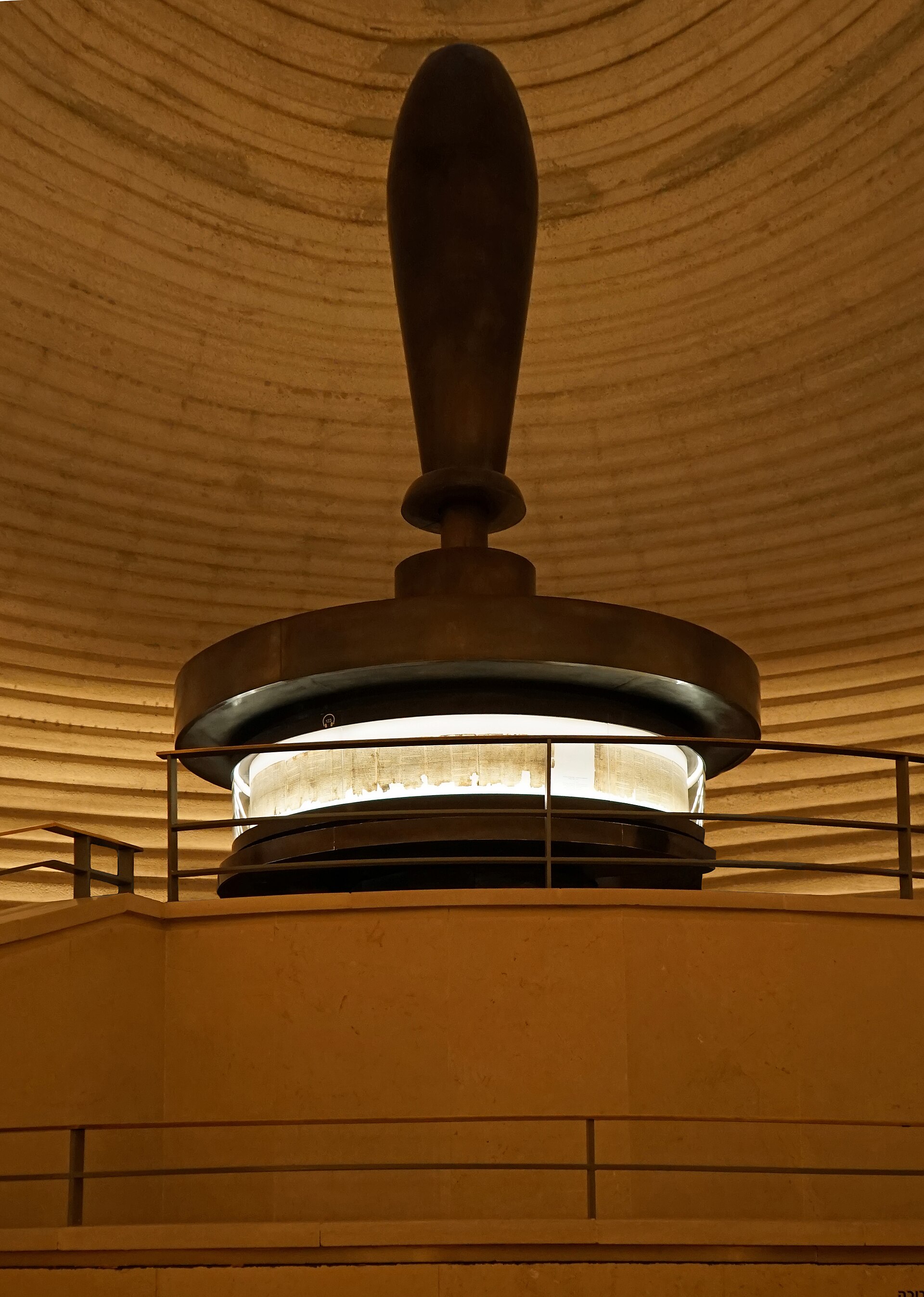

In the later first millennium AD, Jewish scholars called the Masoretes, above all in Tiberias, added vowel points, accents and marginal notes to a consonantal text already fixed in its main lines. Their work survives in the Aleppo Codex (tenth century, badly damaged after 1947) and in the Leningrad Codex, which, as the Internet Archive's facsimile record puts it, "claims to have been written by Samuel ben Jacob in Cairo in 1008 and based on manuscripts by Aaron ben Moses ben Asher."6 It is the oldest complete Hebrew Bible and the base of the standard scholarly editions (BHK in its third edition, BHS and BHQ). Before those editions, the standard printed Hebrew text was the second Rabbinic Bible, edited by Jacob ben Chayyim and printed by Daniel Bomberg in Venice in 1524 to 1525.7
The New Testament and the canon
The New Testament books were written in Greek in the first century, and like the Hebrew books, none survives in its first copy. The smallest famous witness is P52 in the John Rylands Library, Manchester, a scrap of a papyrus codex with John 18:31 to 33 on one side and 18:37 to 38 on the other. The Alands dated it to about AD 125, with a margin of 25 years either way, and others preferred about 140.8 Brent Nongbri argued in 2005 that handwriting alone cannot fix so narrow a date and that a later second or even third century date cannot be excluded. Lesson 02 sets out that debate.
The great parchment codices follow. Codex Sinaiticus, in the words of the Codex Sinaiticus Project, was written in "the middle of the fourth century" and holds the earliest complete copy of the New Testament.9 Constantin von Tischendorf took 43 of its Old Testament leaves from Saint Catherine's Monastery in 1844 and saw the rest on February 4, 1859. The bulk went to the Russian Tsar, and the British Museum bought it from the Soviet government; it "arrived in London on 26 December 1933."10 Codex Vaticanus, in the Vatican Library, is also of the fourth century, and Codex Alexandrinus in the British Library of the fifth.
Which books belonged was settled by use and then by lists. Athanasius of Alexandria, in his Festal Letter 39 of 367, names exactly the 27 books of the New Testament: "the four Gospels," Acts, seven "Epistles (called Catholic)," "fourteen Epistles of Paul," and "the Revelation of John."11 The African councils (Hippo in 393, Carthage in 397 and 419) issued a list that has the same New Testament and an Old Testament that includes Tobit, Judith and two books of Maccabees; the canon as received in 419 ends "The Revelation of John, j. book."12 The Council of Nicaea in 325 made no such list. Lesson 03 tells the Old Testament side, the Apocrypha question and the Council of Trent's decree of 1546.
Latin, Old English and the manuscript centuries
The Latin Vulgate (translated about 382 to 405 at the request of Pope Damasus I) replaced the uneven Old Latin versions and became the Bible of the Western church for a thousand years. The Catholic Encyclopedia of 1912 records that Pope Damasus asked for the revision because the Old Latin text "was found to have variant readings in different parts of the Church."13 The oldest complete Latin Vulgate Bible, Codex Amiatinus, was copied at the twin monastery of Wearmouth and Jarrow in northern England. Bede, writing after 716, says that Abbot Ceolfrid "added three Pandects of a new translation to that of the old translation which he had brought from Rome," and took one of them with him when he set out for Rome in his old age.14 Scholars identify Codex Amiatinus, now in the Biblioteca Medicea Laurenziana in Florence, as that gift. Lesson 04 tells this story with the Old English glosses and translations, from Caedmon and Bede to the Lindisfarne Gospels and the Wessex Gospels.
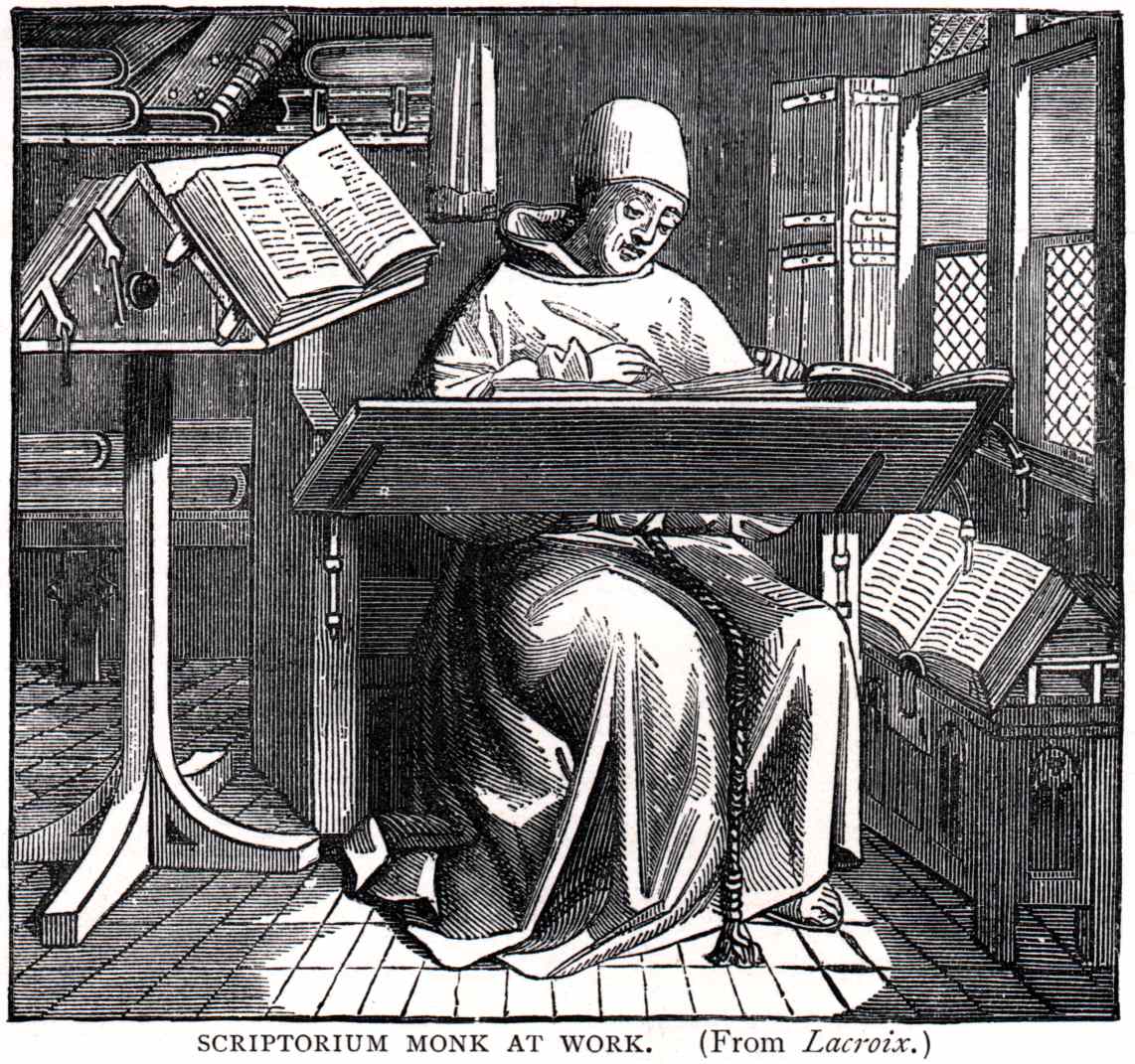

The first complete English Bible was translated from the Latin, not from Hebrew and Greek. The Catholic Encyclopedia gives the usual dates: the Early Version "was probably completed in 1382, the Later Version about 1388," and adds that "it is quite uncertain what part Wyclif himself took in the work that bears his name."13 The same article reports the view that Nicholas Hereford translated the Old Testament as far as Baruch 3:19, with other hands completing the work. The Wycliffite Bible circulated only in handwritten copies, and church law in England soon restricted new English translations, as lesson 04 explains. Module 79, lesson 10 tells Wycliffe and the Lollards as reformers, and module 102, lesson 05 tells their sufferings.
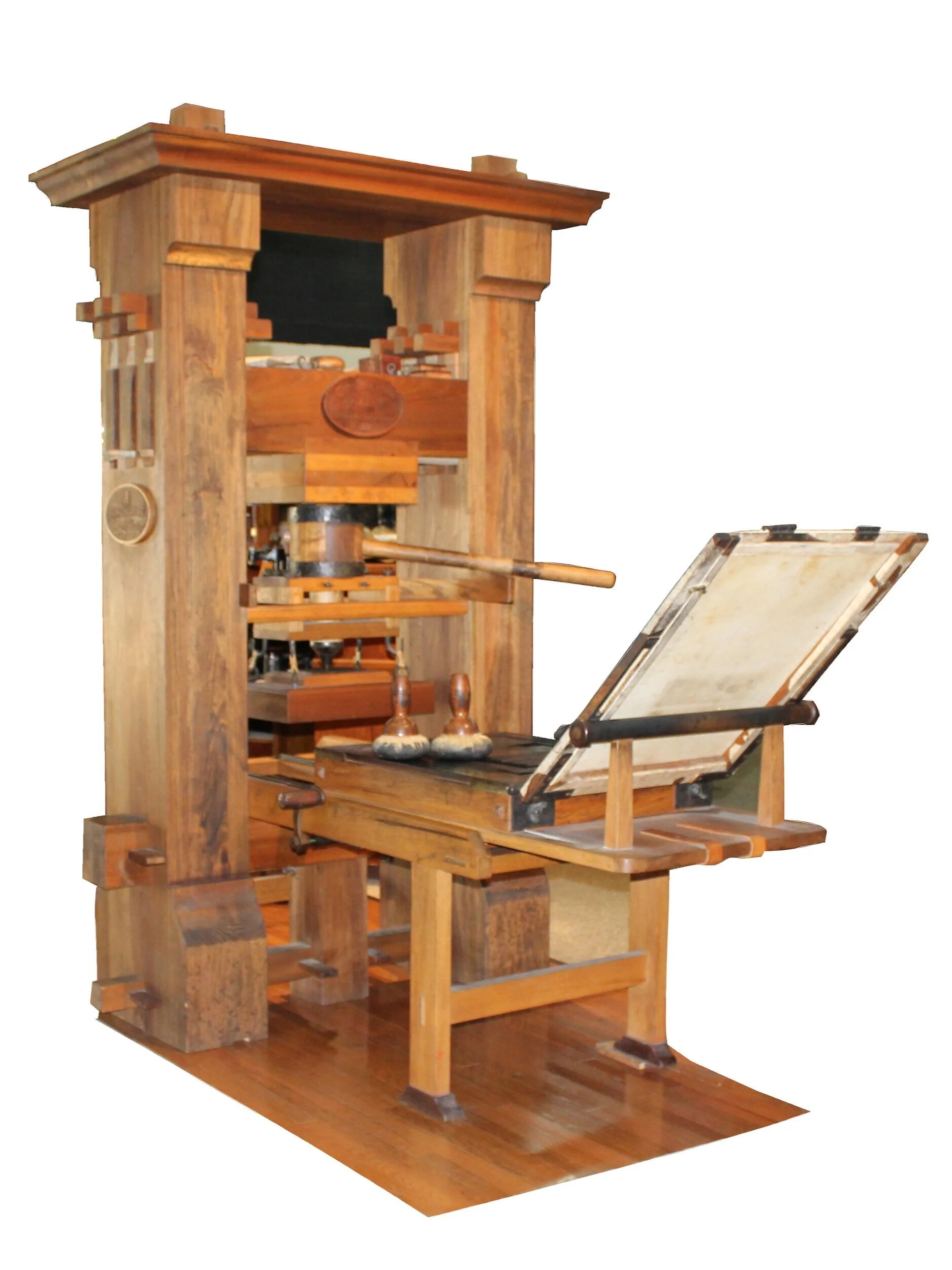
Then came printing. In Mainz in the mid-1450s, the Harry Ransom Center notes, "Johann Gutenberg and his partner Johann Fust published more than 150 large-format copies of the Bible in Latin"; the Center's catalog dates its copy "between 1454 and 1456."15 Printing ended the drift that hand copying brings to any text, and it made possible, for the first time, thousands of identical copies of one edition.

Printing, the Reformation and the Received Text
The Greek New Testament reached print twice within three years. Scholars at Alcala in Spain, under Cardinal Francisco Jimenez de Cisneros, completed the Greek and Latin New Testament of the Complutensian Polyglot in January 1514, though the whole work was not issued until about 1520 to 1522.16 Meanwhile Desiderius Erasmus published his Novum Instrumentum omne at Basel with the printer Johann Froben in 1516, the first Greek New Testament actually put on sale.17 He issued editions in 1516, 1519, 1522, 1527 and 1535; the third (1522) added the words about three heavenly witnesses in 1 John 5:7, the Comma Johanneum, and the fourth borrowed readings from the Complutensian.18 Robert Estienne (Stephanus) printed his royal edition in 1550 and in 1551 an edition with the verse numbers still used. Theodore Beza issued editions from 1565 to 1604; his main folio editions, the ones lesson 05 follows, appeared from 1565 to 1598. The Leiden printers Bonaventure and Abraham Elzevir gave the tradition its name in the preface to their edition of 1633: "Textum ergo habes, nunc ab omnibus receptum: in quo nihil immutatum aut corruptum damus," that is, "Therefore you have the text now received by all, in which we give nothing altered or corrupt."19 From that phrase comes the name Textus Receptus, the Received Text. Lesson 05 tells which manuscripts Erasmus used and what the famous "promise" about 1 John 5:7 really was.
Martin Luther's German New Testament appeared in 1522, the year of Erasmus's third edition.13 Module 79, lesson 11 tells that story. The Catholic answer to the Reformers' Bibles came from the Council of Trent. Its decree on the canonical Scriptures, "celebrated on the eighth day of the month of April, in the year MDXLVI" (1546), named the books of the canon, Tobit, Judith, Wisdom, Ecclesiasticus, Baruch and the two books of Maccabees among them, and declared "that the said old and vulgate edition" be "held as authentic" in public reading, preaching and debate.20

English Bibles from Tyndale to 1611
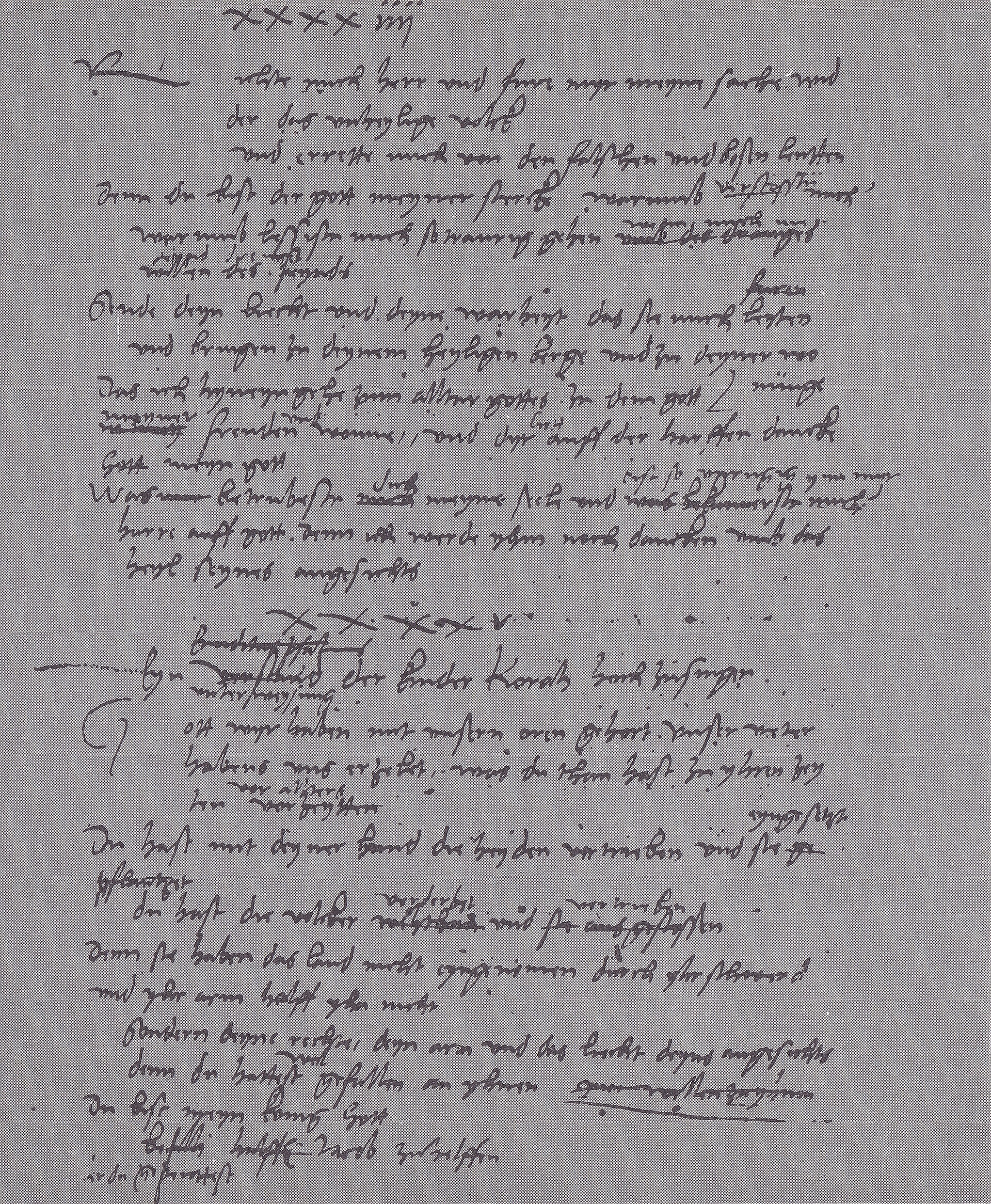
William Tyndale was the first to translate the New Testament into English from the Greek and to print it. According to the Catholic Encyclopedia, he began printing at Cologne in 1525, was "driven from Cologne," and "went to Worms where he printed 3000 copies, and sent them to England in the early summer of 1526." His Pentateuch followed in 1530 and his revised New Testament at Antwerp in 1534.13 His wording runs through every English Bible after him to the King James Version. Lesson 06 tells his translation work; module 102, lesson 05 tells his arrest and death.
The complete printed English Bibles then came quickly. The Newberry Library's catalog of its holdings gives the editions and printers: Coverdale's Bible of 1535 (printed abroad; the catalog suggests, with a question mark, Zurich and Christopher Froschauer, while lesson 06 sets out the newer case for Antwerp), Matthew's Bible of 1537 (printed for Richard Grafton and Edward Whitchurch of London), the Great Bible of 1539 (printed by Grafton and Whitchurch), the Geneva Bible of 1560 (printed at Geneva by Rowland Hall) and the Bishops' Bible of 1568 (printed in London by Richard Jugge).21 "Thomas Matthew" was an alias for John Rogers, Tyndale's friend, whose death is told in module 102, lesson 06. The English exiles at Geneva issued a New Testament in 1557, "probably the work of William Whittingham," the first English Bible to divide its text into verses; the whole Geneva Bible of 1560, with its notes, became the household Bible of English Protestants. The Catholic English New Testament was published at Rheims in 1582, and the Old Testament at Douai in 1609 to 1610.13
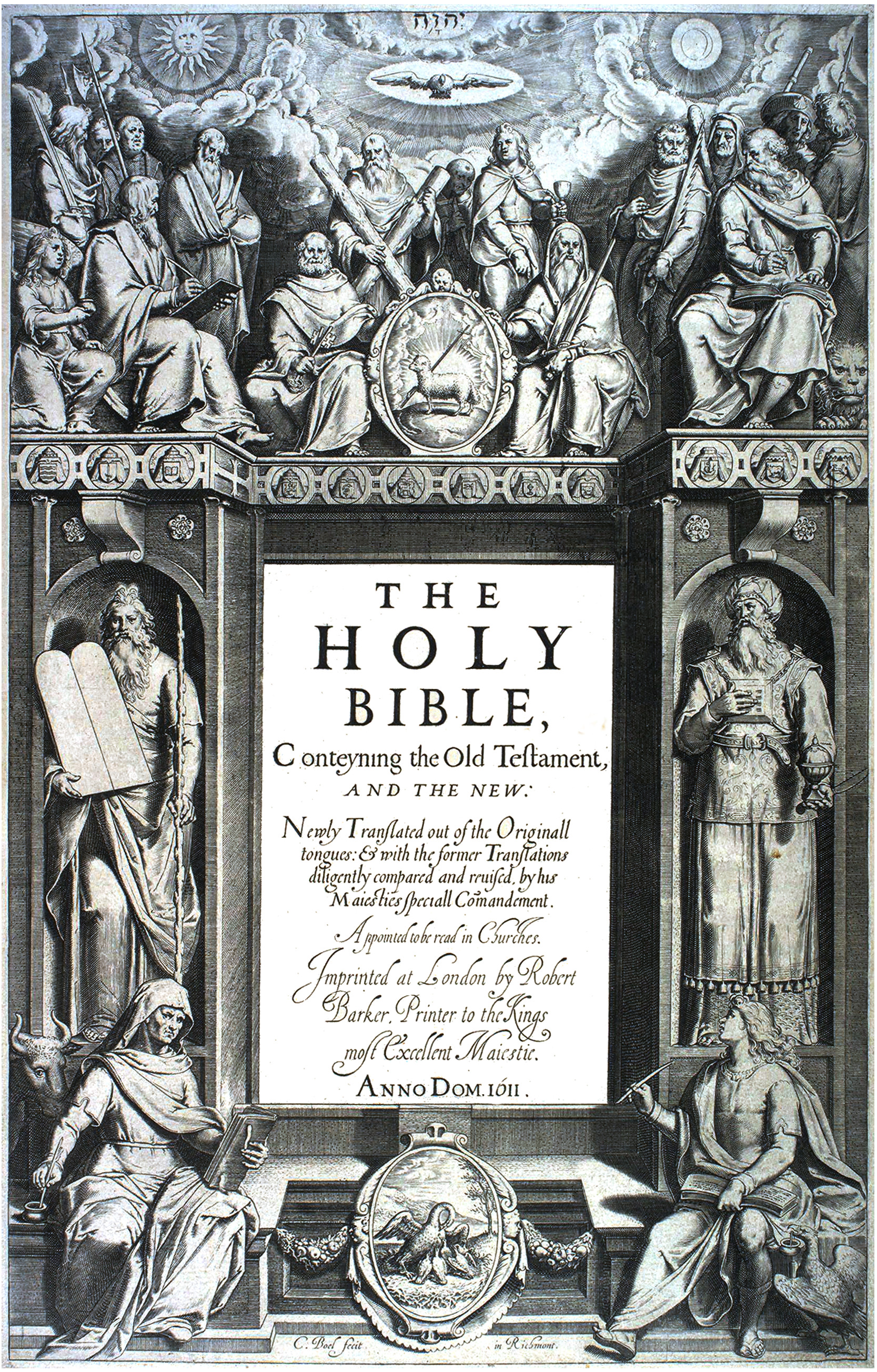
King James I called the Hampton Court Conference, which met in January 1604. On its second day, as Isaac Hall's history of 1881 tells it, "Dr. John Reynolds" (Rainolds), President of Corpus Christi College, Oxford, proposed a new translation, and the king approved the plan, with "the appointment of fifty-four learned men."22 They worked in six companies, two each at Westminster, Oxford and Cambridge; as lesson 07 shows, the surviving lists name about fifty men, and no single list has more than forty-seven. The preface "The Translators to the Reader" says what they meant to do: "we never thought from the beginning, that we should need to make a new Translation, nor yet to make of a bad one a good one ... but to make a good one better, or out of many good ones, one principal good one."23 The New Testament title page of 1611 says it was "Newly Translated out of the Originall Greeke: and with the former Translations diligently compared and reuised," and that it was printed "by Robert Barker, Printer to the Kings most Excellent Maiestie."24 The text in most King James Bibles today is Benjamin Blayney's Oxford edition of 1769; the Schaff-Herzog encyclopedia says Blayney "revised the text of the Authorized Version of the Bible to secure typographical accuracy and added to the marginal references; the edition appeared in 1769 and is the standard for the Oxford press."25 Lesson 07 tells the whole story, including the rules the translators followed and the misprinted "Wicked Bible" of 1631.

Revision and the critical text, 1831 to 1901
In the nineteenth century, editors of the Greek New Testament turned from the printed Received Text to the oldest manuscripts. Karl Lachmann (1831), Constantin von Tischendorf and Samuel Tregelles built texts from early witnesses, and Brooke Foss Westcott and Fenton John Anthony Hort published The New Testament in the Original Greek in 1881, giving great weight to Codex Vaticanus and Codex Sinaiticus. The same year the Revised Version New Testament appeared. The Catholic Encyclopedia records that its revision was "completed in 407 meetings, distributed over more than ten years, and was finally presented to Convocation on 17 May, 1881"; the Old Testament revision was "finished on 20 June, 1884" and published in 1885, and "the revised Apocrypha did not appear until 1895."13 John William Burgon, Dean of Chichester, attacked both the new Greek text and the new English in The Revision Revised (London: John Murray, 1883).26 Eberhard Nestle published the first edition of his handy Greek New Testament in 1898; its descendant, the Nestle-Aland 28th edition (2012), is the standard critical text today. Lesson 08 sets out the three positions in the debate and the disputed passages.
The American scholars who had worked with the English revisers published their own edition. Bible Gateway's notes on the version state: "The RV New Testament was released In 1881; the Old Testament was published in 1885. The ASV was published in 1901 by Thomas Nelson & Sons," and the ASV renders the divine name "consistently" as "Jehovah."27 Lesson 09 tells the story of both.
The modern versions, 1946 to 2023
The twentieth century multiplied English Bibles. The list below gives each version's first complete edition with its source; the lessons give the committees, the prefaces and the reactions.
- Revised Standard Version (RSV). A revision of the ASV for the National Council of Churches; the New Testament in 1946, and the complete Bible "published on September 30, 1952" (copyright 1946, 1952 and 1971).28 Lesson 09.
- Good News for Modern Man and the Good News Bible. The American Bible Society's New Testament, translated by Robert G. Bratcher, appeared in 1966, and the full Bible in 1976.29 Lesson 14.
- New American Standard Bible (NASB). The Lockman Foundation's revision of the ASV, copyright 1960, 1971, 1977 and 1995; "After completion in 1971, the NASB was updated in 1977, 1995, and most recently in 2020."3031 The Legacy Standard Bible, a revision of the NASB 1995, is copyright 2021 by the Lockman Foundation.32 Lesson 10.
- The Living Bible. Kenneth N. Taylor's paraphrase, copyright 1971; Tyndale House Publishers "was founded in 1962 by Dr. Kenneth N. Taylor as a means of publishing The Living Bible."33 Lesson 14.
- New International Version (NIV). Planned at a meeting in Palos Heights, Illinois, in 1965, made by the fifteen-member Committee on Bible Translation, and copyright 1973, 1978, 1984 and 2011.34 Its gender-inclusive revision, Today's New International Version (TNIV), was "first released in 2002" and was phased out when the updated NIV of 2011 appeared.35 Lessons 12 and 13.
- New King James Version (NKJV). "Commissioned in 1975 by Thomas Nelson Publishers, 130 respected Bible scholars, church leaders, and lay Christians worked for seven years"; New Testament 1979, complete Bible copyright 1982.36 Lesson 11.
- New Revised Standard Version (NRSV). The National Council of Churches' revision of the RSV in 1989, updated as the NRSV Updated Edition (NRSVue), copyright 2021.37 Lesson 14.
- The Message. Eugene H. Peterson's paraphrase, copyright 1993, 2002 and 2018, published by NavPress.38 Lesson 14.
- New Living Translation (NLT). Made from the Living Bible by a team of scholars; copyright 1996, 2004 and 2015 by the Tyndale House Foundation.39 Lesson 14.
- English Standard Version (ESV). A revision of the RSV by Crossway, copyright 2001.40 Lesson 09 places it in the RV and ASV family.
- Common English Bible (CEB). Copyright 2011.41 Lesson 14.
- Berean Standard Bible (BSB). Its texts were "officially dedicated to the public domain as of April 30, 2023."42 Lesson 15 uses it, with the KJV, ASV and others, for free comparison.
Which text is behind which version
Two English Bibles can differ in a verse for one of two reasons: they translated different Hebrew or Greek wording, or they translated the same wording by different methods. The table below covers the first reason. For the New Testament there are three main positions, explained in lesson 08: the Received Text (the printed tradition from Erasmus to the Elzevirs, close to the Byzantine manuscripts but not identical with their majority), the Majority Text (the reading found in most surviving Greek manuscripts, which are mostly Byzantine), and the critical text (an eclectic text weighed reading by reading, giving much weight to the oldest manuscripts). For the Old Testament nearly every Protestant and Jewish version translates the Masoretic Hebrew text, consulting the Dead Sea Scrolls, the Septuagint and other versions at disputed points.
| Version | Old Testament base | New Testament base | Lesson |
|---|---|---|---|
| Wycliffite Bible (about 1382 to 1395) | Latin Vulgate | Latin Vulgate | 04 |
| Tyndale (1526, 1530, 1534) | Hebrew (Pentateuch and other books) | Erasmus's printed Greek | 06 |
| Douay-Rheims (1582, 1609 to 1610) | Latin Vulgate | Latin Vulgate | 06 |
| King James Version (1611) | Printed Masoretic Hebrew | Received Text ("Newly Translated out of the Originall Greeke") | 07 |
| Revised Version (1881, 1885) and ASV (1901) | Masoretic Hebrew | The revisers' own Greek text, close to Westcott and Hort | 09 |
| NASB (1971 to 2020) and LSB (2021) | Biblia Hebraica (BHS) | Nestle-Aland critical text | 10 |
| NKJV (1982) | BHS of 1967/1977 compared with Bomberg's 1524 to 1525 edition | Received Text, with footnotes giving the critical ("NU") and Majority ("M") readings | 11 |
| NIV (1978, 1984, 2011) | "the Masoretic Text as published in the latest edition of Biblia Hebraica" | "an eclectic one, based on the latest editions of the Nestle-Aland/United Bible Societies' Greek New Testament" | 12 |
| ESV (2001; text edition 2025) | BHS, 5th edition, 1997 | UBS 5th corrected edition (2014) and Nestle-Aland 28th edition (2012) | 09 |
| Majority Standard Bible (Berean) | As the BSB | Robinson-Pierpont Byzantine Majority Text | 15 |
The sources for the rows: the NKJV preface says that "the text used was the 1967/1977 Stuttgart edition of the Biblia Hebraica, with frequent comparisons being made with the Bomberg edition of 1524-25," and that "the King James New Testament was based on the traditional text of the Greek-speaking churches, first published in 1516, and later called the Textus Receptus or Received Text."7 The NIV's own words come from its 2011 preface.43 The ESV preface says it "is based on the Masoretic text of the Hebrew Bible as found in Biblia Hebraica Stuttgartensia (5th ed., 1997), and on the Greek text in the 2014 editions of the Greek New Testament (5th corrected ed.), published by the United Bible Societies (UBS), and Novum Testamentum Graece (28th ed., 2012), edited by Nestle and Aland."44 The Majority Standard Bible describes itself as "the Byzantine Majority Text version of the BSB," with its New Testament "translated according to the Robinson-Pierpont Byzantine Majority Text."45 The Douay-Rheims, Wycliffite and King James rows follow the Catholic Encyclopedia and the 1611 title page cited above.
Who's who
The people below appear in the lessons of this module. Dates are those of the event named, with its basis given in the lesson linked.
| Person | Role in the story | Date | Lesson |
|---|---|---|---|
| Gabriel Barkay | Archaeologist who found the Ketef Hinnom silver amulets | 1979 | 01 |
| Ptolemy II Philadelphus | King of Egypt in whose reign the Letter of Aristeas sets the Greek translation of the law | reigned 285 to 247 BC | 01 |
| Aaron ben Moses ben Asher | Masorete of Tiberias whose text the Aleppo and Leningrad codices follow | 10th century | 01 |
| Samuel ben Jacob | Scribe of the Leningrad Codex, Cairo | 1008 | 01 |
| Jacob ben Chayyim and Daniel Bomberg | Editor and printer of the second Rabbinic Bible, Venice | 1524 to 1525 | 01, 11 |
| Roland de Vaux and Gerald Lankester Harding | Led the excavations of the Qumran caves | 1949 to 1956 | 01 |
| Constantin von Tischendorf | Brought Codex Sinaiticus to light; edited the Greek New Testament | 1844, 1859 | 02, 08 |
| Brent Nongbri | Scholar who questioned the early dating of P52 | 2005 | 02 |
| Athanasius of Alexandria | Bishop whose Festal Letter 39 lists the 27 New Testament books | 367 | 03 |
| Pope Damasus I | Requested the revision that became the Latin Vulgate | about 382 | 04 |
| Ceolfrid and Bede | Abbot of Wearmouth-Jarrow who had three Vulgate pandects made; the historian who recorded it | about 700 to 716 | 04 |
| John Wycliffe | Oxford theologian after whom the first complete English Bible is named | about 1382 | 04 |
| Johann Gutenberg and Johann Fust | Printed the Latin Bible at Mainz | about 1454 to 1456 | 04 |
| Francisco Jimenez de Cisneros | Cardinal and Archbishop of Toledo who directed the Complutensian Polyglot | 1514 to 1517 | 05 |
| Desiderius Erasmus and Johann Froben | Editor and printer of the first published Greek New Testament | 1516 | 05 |
| Robert Estienne (Stephanus) | Printer of the 1550 Editio Regia and the 1551 edition with verse numbers | 1550, 1551 | 05 |
| Theodore Beza | Calvin's successor at Geneva; editor of the Greek New Testament | 1565 to 1604 | 05 |
| Bonaventure and Abraham Elzevir | Leiden printers whose preface named the "received" text | 1633 | 05 |
| Martin Luther | Published his German New Testament | 1522 | module 79, lesson 11 |
| William Tyndale | First printed English New Testament translated from Greek | 1526 | 06 |
| Myles Coverdale | First complete printed English Bible; worked on the Great Bible | 1535, 1539 | 06 |
| John Rogers ("Thomas Matthew") | Compiled Matthew's Bible from Tyndale and Coverdale | 1537 | 06 |
| William Whittingham | Probable translator of the Geneva New Testament | 1557 | 06 |
| Gregory Martin | Translator of the Rheims New Testament, begun in October 1578 | 1582 | 06 |
| James I | King who called the Hampton Court Conference and approved a new translation | 1604 | 07 |
| John Rainolds (Reynolds) | President of Corpus Christi College, Oxford, who proposed the new translation | 1604 | 07 |
| Robert Barker | King's Printer who printed the King James Version | 1611 | 07 |
| Benjamin Blayney | Oxford editor of the standard King James text | 1769 | 07 |
| Brooke Foss Westcott and Fenton John Anthony Hort | Editors of the Greek text published with the Revised Version | 1881 | 08 |
| John William Burgon | Dean of Chichester, author of The Revision Revised | 1883 | 08 |
| Eberhard Nestle | Editor of the Greek New Testament that became Nestle-Aland | 1898 | 08 |
| Maurice Robinson and William Pierpont | Editors of the Byzantine Majority Text | 2005 | 08 |
| Zane Hodges and Arthur Farstad | Editors of the Majority Text; Farstad was executive editor of the NKJV | 1982 | 11 |
| Eugene Nida | Bible Society translation theorist of dynamic equivalence | 1964 | 12 |
| Kenneth N. Taylor | Paraphraser of The Living Bible; founder of Tyndale House Publishers | 1962, 1971 | 14 |
| Robert G. Bratcher | Translator of Good News for Modern Man | 1966 | 14 |
| Eugene H. Peterson | Author of The Message | 1993, 2002 | 14 |
Glossary roundup
The key terms of the whole module, each with the lesson that explains it.
- Autograph
- The first written copy of a book. No autograph of any biblical book survives. (01, 02)
- Sopherim
- Scribes; in Jewish tradition the early sages who copied the law and counted its letters. (01)
- Masoretes and the Masoretic text (MT)
- Jewish scholars of the later first millennium AD who added vowel points, accents and marginal notes; their text is the base of almost all Old Testament translations. (01; the vowel points are taught in Languages 101, lesson 02)
- Qere and Ketiv
- "What is read" and "what is written": a Masoretic marginal reading that differs from the written consonants. (01)
- Septuagint (LXX)
- The Greek translation of the Hebrew scriptures, begun with the Torah at Alexandria in the third century BC. (01)
- Dead Sea Scrolls
- Manuscripts found from 1947 in caves near Qumran and elsewhere in the Judean desert, about 230 of them biblical. (01)
- Codex and colophon
- A codex is a book of bound leaves, as opposed to a scroll. A colophon is a scribe's closing note giving name, place or date. (01, 02)
- Papyrus, uncial and minuscule
- The three main classes of Greek New Testament manuscripts: papyri (the earliest, written on papyrus, numbered P1, P2 and so on), uncials or majuscules (in capital letters, mostly on parchment, such as Sinaiticus and Vaticanus), and minuscules (in a smaller joined script, from about the ninth century). Lectionaries are service books with Scripture arranged for reading in church. (02)
- Siglum
- The short name or symbol scholars give a manuscript, such as Aleph for Sinaiticus, B for Vaticanus, A for Alexandrinus and D for Bezae. (02, 08)
- Canon
- The list of books a church receives as Scripture. (03)
- Apocrypha (deuterocanonical books)
- Books such as Tobit, Judith, Wisdom, Sirach, Baruch and 1 and 2 Maccabees, found in the Septuagint and the Latin Bible, received as canonical by the Catholic and Orthodox churches and not by most Protestant churches. (03)
- Old Latin (Vetus Latina) and Vulgate
- The early, uneven Latin translations, and the standard Latin Bible that replaced them (translated about 382 to 405 at the request of Pope Damasus I). (04)
- Gloss
- A translation written between the lines or in the margin of a Latin manuscript, as in the Old English gloss of the Lindisfarne Gospels. (04)
- Lollards
- Followers of Wycliffe's teaching in England, who read and copied the Wycliffite Bible. (04)
- Polyglot
- A Bible printed in several languages side by side, such as the Complutensian. (05)
- Textus Receptus (Received Text)
- The printed Greek New Testament tradition from Erasmus through Stephanus, Beza and the Elzevirs, named from the Elzevir preface of 1633; the Greek behind the KJV New Testament. (05)
- Comma Johanneum
- The words about three heavenly witnesses in 1 John 5:7 to 8, found in the Latin tradition and in only a handful of late Greek manuscripts; printed by Erasmus from 1522. (05, 08)
- Text-types
- Families of manuscripts that share readings: Alexandrian (Sinaiticus, Vaticanus, many papyri), Western (Bezae and the Old Latin) and Byzantine (most later manuscripts). (08)
- Majority Text
- A Greek text that follows the reading of most surviving manuscripts, edited by Hodges and Farstad (1982) and by Robinson and Pierpont. (08)
- Critical text and eclectic method
- A Greek text built by weighing each reading on its external evidence (age, spread and quality of manuscripts) and internal evidence (scribal habits and the author's style), as in Westcott and Hort and Nestle-Aland. (08)
- Variant and apparatus
- A variant is a difference in wording between manuscripts. The apparatus is the band of notes at the foot of a critical edition that lists variants and the witnesses for each. (08, 15)
- Authorized Version
- The name by which the KJV is usually known in Britain. The 1611 title page says "Appointed to be read in Churches," but no act of Parliament, order of the king or Privy Council, or proclamation authorizing it has been found, and no record explains where the name came from. (07)
- Italics (supplied words)
- The KJV, ASV, NKJV and NASB print in italics English words that have no direct equivalent in the Hebrew or Greek. (07, 10)
- NU-Text and M-Text
- The NKJV's footnote labels for readings of the Nestle-Aland/United Bible Societies text and of the Majority Text. (11)
- Formal equivalence
- A method of translation that keeps close to the words and grammar of the original, as the NASB, KJV and NKJV aim to do. (10, 12)
- Dynamic (functional) equivalence
- Eugene Nida's method of translating the meaning of a passage into natural English so that it has a like effect on the reader, even where the form changes. (12)
- Paraphrase
- A free restatement of the text, usually by one person, often from an English version rather than from Hebrew and Greek, as The Living Bible began. (14)
- Gender-inclusive (gender-accurate) language
- Renderings such as "brothers and sisters" for Greek adelphoi or "people" for generic "men," adopted in various forms by the NRSV, TNIV, NIV 2011, CEB, NLT and NASB 2020. (13, 14)
- Interlinear, concordance and lexicon
- An interlinear prints the original words with an English word under each; a concordance lists every place a word occurs (Strong's, 1890); a lexicon defines the Hebrew or Greek words (BDB, Thayer). (15; see also Languages 78, lesson 20 and Languages 101, lesson 20)
- BHS, NA28 and UBS5
- Biblia Hebraica Stuttgartensia, the standard printed Hebrew Bible based on the Leningrad Codex; Nestle-Aland's 28th edition (2012) and the United Bible Societies' 5th edition (2014) of the Greek New Testament, which share one text. (08, 15)
Review questions by lesson
Each set below reviews one lesson. Try to answer before reading the answer, then follow the link to check the evidence.
Lesson 01: How the Old Testament was written and kept
Q. What is the oldest complete manuscript of the Hebrew Bible, and how is it dated?
A. The Leningrad Codex, dated by its colophon to 1008, written in Cairo by Samuel ben Jacob from manuscripts of the Ben Asher tradition.6
Q. What did the Dead Sea Scrolls add to the record?
A. Copies of every book of the Hebrew Bible except Esther, about 230 biblical manuscripts in all, from the third century BC to the first century AD, more than a thousand years older than the Leningrad Codex.45 They show a text close to the Masoretic in most books, with many small variants and some readings that agree with the Septuagint. (Lesson 01)
Lesson 02: The New Testament manuscripts
Q. Name the four great early parchment codices and their homes.
A. Codex Sinaiticus (mid fourth century; most of it in the British Library), Codex Vaticanus (fourth century; Vatican Library), Codex Alexandrinus (fifth century; British Library) and Codex Bezae (about 400; Cambridge University Library). (Lesson 02)
Q. What does the large number of Greek manuscripts prove, and what does it not prove?
A. It shows that the New Testament has more and earlier witnesses than any other ancient book. It does not settle any single disputed reading by itself, because most manuscripts are late, many are fragments, and later copies descend from earlier ones.
Lesson 03: How the canon formed
Q. What is the earliest surviving list of exactly the 27 New Testament books?
A. Athanasius's Festal Letter 39 of 367.11
Q. Why do Catholic and Protestant Old Testaments differ?
A. The Catholic canon, defined at Trent in 1546, includes books found in the Septuagint and the Latin Bible (Tobit, Judith, Wisdom, Sirach, Baruch, 1 and 2 Maccabees and parts of Esther and Daniel); the Protestant churches followed the Hebrew canon and placed those books apart as the Apocrypha, or left them out.20 (Lesson 03)
Lesson 04: The Latin Vulgate, Old English and Wycliffe
Q. From what language was the Wycliffite Bible translated?
A. From the Latin Vulgate. The Early Version is dated to about 1382 and the Later Version to about 1388.13
Q. What is Codex Amiatinus?
A. The oldest complete Latin Vulgate Bible, copied at Wearmouth-Jarrow in northern England and identified with one of the three pandects Bede says Abbot Ceolfrid had made; it is now in Florence.14 (Lesson 04)
Lesson 05: Erasmus and the Textus Receptus
Q. Which Greek New Testament was printed first, and which was published first?
A. The Complutensian Polyglot's New Testament was printed first (January 1514), but Erasmus's edition of 1516 was published first.1617
Q. Where does the name "Textus Receptus" come from?
A. From the Elzevir preface of 1633: "Textum ergo habes, nunc ab omnibus receptum," "so you have the text now received by all."19 (Lesson 05)
Lesson 06: Tyndale to the Geneva Bible
Q. Where was Tyndale's New Testament first printed in full, and when did it reach England?
A. At Worms, in an edition reported as 3,000 copies, sent to England in the early summer of 1526, after an earlier attempt at Cologne in 1525 was stopped.13
Q. Put these in order: Geneva Bible, Great Bible, Coverdale, Bishops' Bible, Matthew's Bible.
A. Coverdale (1535), Matthew's (1537), Great Bible (1539), Geneva (1560) and Bishops' (1568).21 (Lesson 06)
Lesson 07: The King James Version of 1611
Q. Who proposed the new translation, and where?
A. John Rainolds (Reynolds), President of Corpus Christi College, Oxford, at the Hampton Court Conference in January 1604.22
Q. Is the King James Bible on a store shelf today the 1611 text?
A. No. It is, with small changes, Benjamin Blayney's Oxford text of 1769, which regularized spelling and corrected printing errors.25 (Lesson 07)
Lesson 08: The textual debate
Q. Name the three positions on the Greek text.
A. The Received Text (Erasmus to the Elzevirs; the KJV and NKJV), the Majority Text (the reading of most manuscripts; Hodges and Farstad, Robinson and Pierpont) and the critical text (Westcott and Hort to Nestle-Aland 28; most modern versions).
Q. Which two early codices end Mark's Gospel at 16:8?
A. Codex Sinaiticus and Codex Vaticanus. Codex Alexandrinus and most later manuscripts contain 16:9 to 20. (Lesson 08)
Lesson 09: The Revised Version and the American Standard Version
Q. When was the Revised Version New Testament presented, and when did the ASV appear?
A. The RV New Testament was presented to Convocation on May 17, 1881; the ASV was published in 1901 by Thomas Nelson and Sons.1327
Q. How does the ASV render the divine name in the Old Testament?
A. As "Jehovah," where the KJV prints "LORD." (Lesson 09)
Lesson 10: The New American Standard Bible
Q. What are the main editions of the NASB?
A. The complete Bible of 1971 and the updates of 1977, 1995 and 2020; the Legacy Standard Bible of 2021 is a further revision of the 1995 text.3132
Q. What do italics mean in the NASB?
A. Words supplied in English that are not in the Hebrew or Greek, as in the KJV. (Lesson 10)
Lesson 11: The New King James Version
Q. What Greek text does the NKJV translate?
A. The Received Text, the same as the KJV, with footnotes giving the critical (NU) and Majority (M) readings where they differ.7
Q. What did the NKJV change from the KJV?
A. It dropped thee, thou and ye, the -eth and -est endings and many words whose meanings have shifted, while keeping the KJV's order and sound as closely as it could. (Lesson 11)
Lesson 12: The NIV and dynamic equivalence
Q. Who makes the NIV, and where did it begin?
A. The fifteen-member Committee on Bible Translation; the project took shape at a meeting in Palos Heights, Illinois, in 1965.34
Q. What is dynamic equivalence?
A. Eugene Nida's method of rendering the meaning of the original in natural English, aiming at a like effect on the reader rather than at matching the original's form word for word. (Lesson 12)
Lesson 13: Why the NIV and similar versions fall short
Q. What are the main grounds of the case made against the NIV?
A. Its critical-text base, which moves verses such as Acts 8:37 from the text to footnotes; interpretive renderings in place of literal ones; gender-inclusive changes in the TNIV and the NIV 2011; and some doctrinally significant word choices, each tied in lesson 13 to verses a reader can check.
Q. Does the NIV deny the virgin birth?
A. No. The NIV reads "virgin" in Isaiah 7:14, as the KJV does;46 lesson 13 rates that popular claim as refuted (the NIV footnotes "Or young woman" and reads "virgin" in the text) and makes its case on other grounds. Its section "The counter view" gives the translators' own answers. (Lesson 13)
Lesson 14: The modern rewrites
Q. What separates a paraphrase from a translation?
A. A translation renders the Hebrew and Greek, usually by a committee working from a stated text; a paraphrase restates the meaning freely, often by one person, and The Living Bible began as a paraphrase of an English version.
Q. Which version grew out of The Living Bible?
A. The New Living Translation (1996), made by a team of scholars from the Hebrew and Greek.39 (Lesson 14; on the Jesus People who read the paraphrases, see module 77, lesson 05)
Lesson 15: How to choose a Bible
Q. What questions does lesson 15 put to any version's preface?
A. Seven: who translated it; from which Hebrew text; from which Greek text; by what method (formal, functional or paraphrase); what its signals (italics, brackets, capitals, footnote code words) mean; how it handles disputed passages; and which edition it is and who owns it. Lesson 14 boils the same test down to four: who made it, from what text, by what method, and who owns it.
Q. Which free tools let a reader check the Greek behind a verse?
A. Interlinear Bibles such as those at Blue Letter Bible, STEPBible and Bible Hub, Strong's concordance and the public domain lexicons of Brown-Driver-Briggs and Thayer, and manuscript images at the Codex Sinaiticus Project and the INTF's New Testament Virtual Manuscript Room. (Lesson 15)
Lesson 16: This lesson
Q. Why can the KJV and the NIV differ at Acts 8:37 even if both translate faithfully?
A. Because they translate different Greek texts: the KJV's Received Text includes the verse, while the critical text behind the NIV omits it with most Greek manuscripts, and the NIV prints it only in a footnote that begins "Some manuscripts include here."46 The difference lies in the text, before any question of method.
What the record shows and what it does not
- Documented fact: No autograph of any biblical book survives. The Leningrad Codex is dated by its colophon to 1008; the Qumran scrolls include about 230 biblical manuscripts; Codex Sinaiticus is of the mid fourth century; Athanasius listed the 27 New Testament books in 367; the Council of Trent issued its decree on the canon on April 8, 1546; Erasmus published his Greek New Testament in 1516; the King James Version was printed by Robert Barker in 1611 with a title page that says "Newly Translated out of the Originall tongues"; the Revised Version New Testament was presented on May 17, 1881.
- A church's own claim or tradition: The Letter of Aristeas's account of 72 translators in 72 days; the Talmud's tradition that the early scribes counted the letters of the Torah; the Catholic Church's teaching, defined at Trent, that the books of its canon are sacred "with all their parts"; the view held by defenders of the Received Text that God providentially preserved the true text in the printed tradition.
- Scholarly reading: The dating of undated manuscripts by handwriting (P52, the great codices, the Isaiah scroll); the share of Wycliffe himself and of Nicholas Hereford in the Wycliffite versions; the weighting of the oldest Greek manuscripts in the critical text and the opposing weighting of the majority in the Majority Text; the estimates of how much of Tyndale's wording passed into the KJV.
- Open question: Which Greek text best preserves the apostolic wording at the disputed passages (Mark 16:9 to 20, John 7:53 to 8:11, 1 John 5:7 to 8 and others); how early P52 really is; and which balance of formal and functional translation serves readers best.
Claims checked
Popular claims met across the module, with the rating each received and the evidence. The lessons named give the full case.
| Claim | Rating | Evidence |
|---|---|---|
| "Constantine chose the books of the Bible at the Council of Nicaea." | Refuted | No canon list survives from Nicaea (325). The first list of exactly the 27 New Testament books is Athanasius's letter of 367, and the first conciliar lists come from Hippo (393) and Carthage (397, 419).1112 Lesson 03; module 79, lesson 04. |
| "The Council of Jamnia closed the Hebrew canon in AD 90." | Unsupported | No record of a council at Jamnia (Yavneh) issuing a canon survives; the idea is a modern scholarly hypothesis, criticized by Jack Lewis (1964) and others. Lesson 03. |
| "The Dead Sea Scrolls prove the Old Testament was changed," and the opposite, "the Isaiah scroll matches the Masoretic text word for word." | Unsupported (the first, in the form usually meant); Refuted (the second, as stated) | The Great Isaiah Scroll has all 66 chapters in the Masoretic order, with many small differences of spelling and wording and a few of substance: the text was copied with care over a thousand years, but not letter for letter. Lesson 01. |
| "There are thousands of Greek manuscripts, so the text is certain." | Partly supported | The number of witnesses is unmatched for an ancient book, but numbers alone do not decide a reading; most copies are late, and the disputed passages are disputed among the witnesses themselves. Lesson 02, lesson 08. |
| "Wycliffe's Bible and Tyndale's were the same kind of translation." | Refuted | The Wycliffite Bible (about 1382 to 1395) was made from the Latin and copied by hand; Tyndale's New Testament (1526) was made from the printed Greek and printed.13 Lessons 04 and 06. |
| "Erasmus promised to add 1 John 5:7 if a single Greek manuscript had it." | Refuted as usually told | He did add the words in 1522 after a Greek manuscript containing them was produced, but the Dutch scholar Henk Jan de Jonge (1980) found no such promise in Erasmus's writings. Lesson 05. |
| "The KJV was translated from the Latin." | Refuted | The 1611 title pages say "Newly Translated out of the Originall tongues" and, for the New Testament, "out of the Originall Greeke," and add that former translations were "diligently compared and reuised."24 Lesson 07. |
| "King James wrote or translated the Bible." | Refuted | The king approved the project; the work was done by six companies of scholars; the king's letter of July 1604 speaks of fifty-four men appointed, and about fifty are known by name.22 Lesson 07. |
| "The King James Version was authorized by an Act of Parliament." | Refuted | No act of Parliament authorizing it exists, and no order or proclamation authorizing it has been found; the title page says "Appointed to be read in Churches." Lesson 07. |
| "The KJV has never been revised." | Refuted | Its text was corrected in many printings, and Blayney's Oxford edition of 1769, the basis of most modern printings, revised it "to secure typographical accuracy."25 Lesson 07. |
| "The NIV denies the virgin birth." | Refuted | The NIV reads "The virgin will conceive" in Isaiah 7:14.46 The case against the NIV in lesson 13 rests on other verses. |
| "The oldest manuscripts are the best manuscripts." | Unresolved | Age is one weight among several in the critical method; defenders of the Majority Text answer that an old manuscript can carry old errors and that late copies may descend from early lost ones. Lessons 02 and 15 rate this claim Unresolved; lesson 08 rates it Partly supported, since age matters but does not settle a reading by itself. |
Hard questions and answers
If the originals are lost, how can anyone know what the Bible said?
By comparing copies made in different places, at different times and in different languages. Where the Hebrew of the Leningrad Codex agrees with Qumran scrolls a thousand years older, and where the Greek of Sinaiticus agrees with Byzantine minuscules copied in a different line of descent, the agreement is strong evidence of an older shared text. The disagreements are the subject of textual criticism. The skeptic is right that no edition is a photograph of the autographs; the evidence shows that the great majority of the text is not in doubt and that the doubtful places can be listed and examined, as lessons 01, 02 and 08 do.
Did the church give the Bible its canon?
A Catholic reader holds that the Church recognized and defined the canon, finally at Trent in 1546. A Protestant reader holds that the church recognized books that already carried their authority. The record supports a process. Eusebius, early in the fourth century, counted the Gospels, Acts and the letters of Paul among the accepted books, and placed "the so-called epistle of James and that of Jude, also the second epistle of Peter, and those that are called the second and third of John" among "the disputed writings, which are nevertheless recognized by many," with opinions divided on Revelation.47 Lists of the whole canon followed: Athanasius's in 367 and the African councils' from 393. On the Old Testament, the Protestant and Catholic canons differ by the deuterocanonical books, and the Orthodox churches receive a somewhat larger set again. Lesson 03 gives the documents.
Why not treat the King James Version as the final English Bible?
A King James Only reader holds that God preserved his word in the Received Text and that the KJV renders it faithfully. Its own translators did not claim finality. Their preface says they set out "to make a good one better," defends the translations before them, saying "the very meanest translation of the Bible in English ... containeth the word of God, nay, is the word of God," and defends putting alternative renderings in the margin, because "variety of Translations is profitable for the finding out of the sense of the Scriptures."23 The KJV most people own is also itself a revision, Blayney's text of 1769. Whether a later version is better is a separate question, taken up verse by verse in lessons 11 and 13.
Is the Received Text only Erasmus's handful of late manuscripts?
A critical-text scholar points out that Erasmus worked from a few late Greek manuscripts available at Basel and that the Received Text was fixed before the great codices were known. Its defenders answer, as the NKJV preface puts it, that although "based on the relatively few available manuscripts, these were representative of many more which existed at the time but only became known later," and that the Byzantine text the Received Text largely follows "has as much right as the Alexandrian or any other tradition to be weighed."7 Both statements are partly true: the Received Text and the Byzantine majority agree in most places and differ in some, including 1 John 5:7 and Acts 8:37, which the Byzantine majority lacks. Lesson 05 and lesson 08 weigh the evidence.
Which Bible should a reader use?
This module does not crown one version for every purpose. It gives the means to decide: read the preface, learn which Hebrew and Greek text a version translates, learn its method, compare a hard passage across versions, and check the original with free tools. Lesson 15 sets out that method; lesson 10 and lesson 11 describe the two most literal modern revisions in the KJV's line, and lesson 13 argues the case against the NIV and similar versions, with the counter view.
Where to go next
To read the original languages, start Introduction to Classical Greek (module 78) or Introduction to Classical Hebrew (module 101); their reading lessons (78, lesson 21, and 101, lesson 21) use biblical passages. For the church history around these Bibles, see Church History, Part A (module 79), module 80, lesson 04 on the Church of England and module 80, lesson 11 on the churches behind the RSV and the NIV. For the men and women who died over the English Bible, see module 102, lesson 05 and lesson 06.
Learn more
- Codex Sinaiticus Project: Page images and transcription of the oldest complete New Testament.
- Leon Levy Dead Sea Scrolls Digital Library: High-resolution images of the Qumran scrolls with background essays.
- The Translators to the Reader (1611): The KJV translators' own account of their aims, in full.
- Catholic Encyclopedia, Versions of the Bible (1912): A detailed early twentieth century survey of Latin, English and other versions, with dates.
- Newberry Library, Printed English Bibles to 1611: A library catalog of the printed English Bibles before the KJV, with printers and places.
Still being checked (13 items)
These points could not be confirmed against a primary source when this lesson was written and fact checked in October 2026. The text above states each one as uncertain.
- Brent Nongbri's 2005 Harvard Theological Review article on P52 was not opened for this lesson; its argument is summarized from the module brief and lesson 02.
- The dates for Lachmann's edition (1831) and for the Robinson and Pierpont Majority Text (2005) follow lesson 08 and were not checked against the editions themselves.
- The Hodges and Farstad Majority Text (1982), Farstad's role as NKJV executive editor and the NKJV New Testament of 1979 are taken from lesson 11 and the brief; only the NKJV's 1975 commissioning, 130 participants and 1982 copyright were checked directly here.
- The NASB New Testament of 1963 and the RSV New Testament of 1946 rest on copyright dates (RSV 1946, 1952, 1971; NASB 1960, 1971, 1977, 1995) and lesson 10, not on a dated publication record.
- The English church law restricting new translations after Wycliffe (Archbishop Arundel's Constitutions of Oxford, 1407 to 1409, per lesson 04) is mentioned without a date here and was not checked by this writer.
- The identification of Codex Amiatinus with one of Ceolfrid's three pandects is a scholarly identification; Bede's text, opened here, does not name the manuscript.
- The statement that surviving lists of KJV translators name about fifty men and none has more than forty-seven follows lesson 07 (Pollard); only the 54 appointed (Hall, 1881) was checked here.
- Eugene Nida's Toward a Science of Translating (1964) and Strong's concordance (1890) dates are from the brief and lessons 12 and 15.
- The statement that NA28 and UBS5 share one text was not checked against the editions' introductions.
- Henk Jan de Jonge's 1980 study on Erasmus and the Comma Johanneum and Jack Lewis's 1964 article on Jamnia were not opened; they are cited as lessons 05 and 03 describe them.
- Codex Bezae (about 400, Cambridge University Library, MS Nn. 2.41) and Codex Alexandrinus (British Library) are consistent with lesson 02, which cites the libraries; the library catalogs were not reopened for this lesson.
- The place of printing of Coverdale's Bible (1535) is disputed: the Newberry catalog gives Zurich and Froschauer with question marks, Kenyon (1909) thought Zurich probable, and Guido Latre argues for Antwerp (lesson 06).
- Ratings in the summary 'Claims checked' table follow the lessons named; lessons 02 and 15 rate 'The oldest manuscripts are the best manuscripts' Unresolved while lesson 08 rates it Partly supported, and the table reports both.
Notes
- Center for Online Judaic Studies, "Ketef Hinnom amulets" (summary of G. Barkay, A. G. Vaughn, M. J. Lundberg and B. Zuckerman, "The Amulets from Ketef Hinnom: A New Edition and Evaluation," Bulletin of the American Schools of Oriental Research 334, 2004) (retrieved Oct. 28, 2026). Read it online. ↩
- Karen H. Jobes and Moises Silva, Invitation to the Septuagint (Grand Rapids: Baker Academic, 2000), excerpt published by Bible and Interpretation, University of Arizona (retrieved Oct. 28, 2026). Read it online. ↩
- Israel Antiquities Authority, Leon Levy Dead Sea Scrolls Digital Library, "Discovery and Publication" (retrieved Oct. 28, 2026). Read it online. ↩
- Israel Antiquities Authority, Leon Levy Dead Sea Scrolls Digital Library, "Introduction" (retrieved Oct. 28, 2026). Read it online. ↩
- Israel Antiquities Authority, Leon Levy Dead Sea Scrolls Digital Library, "Scrolls Content" (retrieved Oct. 28, 2026). Read it online. ↩
- Internet Archive, "The Leningrad Codex (Codex Leningradensis)" by Samuel ben Jacob, digitized facsimile and item description (retrieved Oct. 28, 2026). Read it online. ↩
- Preface to the New King James Version (Nashville: Thomas Nelson, 1982), as reproduced by Blue Letter Bible; short quotations (retrieved Oct. 28, 2026). Read it online. ↩
- Biblical Archaeology Society Library, "Earliest New Testament Fragment" (sidebar on P52, John Rylands Library) (retrieved Oct. 28, 2026). Brent Nongbri's later argument is in "The Use and Abuse of P52: Papyrological Pitfalls in the Dating of the Fourth Gospel," Harvard Theological Review 98 (2005); see lesson 02. Read it online. ↩
- Codex Sinaiticus Project (British Library, Leipzig University Library, National Library of Russia, Saint Catherine's Monastery), "Codex Sinaiticus" (about the codex) (retrieved Oct. 28, 2026). Read it online. ↩
- Codex Sinaiticus Project, "History of Codex Sinaiticus" (retrieved Oct. 28, 2026). Read it online. ↩
- Athanasius of Alexandria, Festal Letter 39 (367), sections 5 and 6, translated by R. Payne-Smith, Nicene and Post-Nicene Fathers, Second Series, vol. 4, ed. Philip Schaff and Henry Wace (Buffalo: Christian Literature Publishing Co., 1892), New Advent, public domain (retrieved Oct. 28, 2026). Read it online. ↩
- The Code of Canons of the African Church (Council of Carthage, AD 419), canon 24 (Greek 27), and the editor's list of the African councils with their dates (Hippo 393; Carthage 397), Nicene and Post-Nicene Fathers, Second Series, vol. 14, ed. Henry R. Percival (1900), New Advent, public domain (retrieved Oct. 28, 2026). Read it online. ↩
- A. J. Maas, "Versions of the Bible," The Catholic Encyclopedia, vol. 15 (New York: Robert Appleton Company, 1912), New Advent, public domain (sections on the Latin, English and German versions and the Revised Version) (retrieved Oct. 28, 2026). Read it online. ↩
- Bede, Lives of the Holy Abbots of Weremouth and Jarrow (written after 716), translated by J. A. Giles, Internet Medieval Sourcebook, Fordham University, public domain (retrieved Oct. 28, 2026). Read it online. ↩
- Harry Ransom Center, University of Texas at Austin, "The Gutenberg Bible" (Biblia latina, Mainz: Johann Gutenberg and Johann Fust, between 1454 and 1456) (retrieved Oct. 28, 2026). Read it online. ↩
- Text and Canon Institute, "The Incredible Complutensian Polyglot Bible" (retrieved Oct. 28, 2026). Read it online. ↩
- Bridwell Library, Southern Methodist University, "The First Published New Testament in Greek" (Novum instrumentum omne, Basel: Johann Froben, 1516, BRA2476) (retrieved Oct. 28, 2026). Read it online. ↩
- Greek New Testament (greeknewtestament.net), "Printed Editions of the Greek New Testament" (Erasmus's five editions; Stephanus 1546 to 1551; Beza 1565 to 1604; Elzevir 1624 to 1633) (retrieved Oct. 28, 2026). Read it online. ↩
- Elzevir Greek New Testament (Leiden, 1633), preface by Daniel Heinsius, Latin text and translation as given in "Elzevir," Textus Receptus Bibles (textusreceptus.thekingsbible.com) (retrieved Oct. 28, 2026). Read it online. ↩
- Council of Trent, Fourth Session (April 8, 1546), Decree concerning the Canonical Scriptures and Decree concerning the Edition and Use of the Sacred Books, translated by J. Waterworth (London, 1848), Papal Encyclicals Online, public domain (retrieved Oct. 28, 2026). Read it online. ↩
- The Newberry Library, Chicago, "Newberry Holdings: Printed English Bibles through the Authorized King James Version (1611)" (catalog, undated PDF) (retrieved Oct. 28, 2026). Read it online. ↩
- Isaac H. Hall, ed., The Revised New Testament and History of Revision (1881), chapter on the history of the King James Version, reproduced at Bible Research (bible-researcher.com), public domain (retrieved Oct. 28, 2026). Read it online. ↩
- Miles Smith, "The Translators to the Reader," preface to the King James Version (London: Robert Barker, 1611), modernized spelling, Bible Research (bible-researcher.com), public domain (retrieved Oct. 28, 2026). Read it online. ↩
- King James Version, first edition (London: Robert Barker, 1611), New Testament title page ("Newly Translated out of the Originall Greeke") and general title page ("Newly Translated out of the Originall tongues ... Appointed to be read in Churches"), facsimiles on Wikimedia Commons with transcriptions; the general title page from the University of Pennsylvania copy, public domain (retrieved Oct. 28, 2026). Read it online. ↩
- "Blayney, Benjamin," The New Schaff-Herzog Encyclopedia of Religious Knowledge, vol. 2 (New York: Funk and Wagnalls, 1908), Christian Classics Ethereal Library, public domain (retrieved Oct. 28, 2026). Read it online. ↩
- John William Burgon, The Revision Revised (London: John Murray, 1883), Internet Archive (Princeton Theological Seminary Library copy), public domain (retrieved Oct. 28, 2026). Read it online. ↩
- Bible Gateway, "American Standard Version (ASV)" version information (retrieved Oct. 28, 2026). Read it online. ↩
- Bible Gateway, "Revised Standard Version (RSV)" version information and copyright notice (copyright 1946, 1952 and 1971, Division of Christian Education of the National Council of the Churches of Christ in the USA) (retrieved Oct. 28, 2026). Read it online. ↩
- Bible Gateway, "Good News Translation (GNT)" version information (American Bible Society) (retrieved Oct. 28, 2026). Read it online. ↩
- Bible Gateway, John 1:1 in the New American Standard Bible 1995, with the copyright notice "Copyright 1960, 1971, 1977, 1995 by The Lockman Foundation" (retrieved Oct. 28, 2026). Read it online. ↩
- Bible Gateway, "New American Standard Bible (NASB)" version information ("New American Standard Bible 2020 Update") (retrieved Oct. 28, 2026). Read it online. ↩
- Bible Gateway, John 1:1 in the Legacy Standard Bible, with the notice "Legacy Standard Bible Copyright 2021 by The Lockman Foundation" (retrieved Oct. 28, 2026). Read it online. ↩
- Bible Gateway, "The Living Bible (TLB)" version information and "About Tyndale House Publishers" (retrieved Oct. 28, 2026). Read it online. ↩
- Bible Gateway, "New International Version (NIV)" version information and copyright notice (copyright 1973, 1978, 1984, 2011 by Biblica, Inc.) (retrieved Oct. 28, 2026). Read it online. ↩
- "Zondervan to publish updated NIV Bible: Will discontinue Today's New International Version," The Christian Century (September 2009) (retrieved Oct. 28, 2026). Read it online. ↩
- Bible Gateway, "New King James Version (NKJV)" version information (Thomas Nelson; copyright 1982) (retrieved Oct. 28, 2026). Read it online. ↩
- Bible Gateway, "New Revised Standard Version Updated Edition (NRSVue)" version information and preface (copyright 2021 National Council of Churches of Christ in the USA; refers to the NRSV of 1989) (retrieved Oct. 28, 2026). Read it online. ↩
- Bible Gateway, "The Message (MSG)" version information and copyright notice (copyright 1993, 2002, 2018 by Eugene H. Peterson; NavPress) (retrieved Oct. 28, 2026). Read it online. ↩
- Bible Gateway, "New Living Translation (NLT)" version information and copyright notice (copyright 1996, 2004, 2015 by Tyndale House Foundation) (retrieved Oct. 28, 2026). Read it online. ↩
- Bible Gateway, "English Standard Version (ESV)" version information and copyright notice (copyright 2001 by Crossway; ESV Text Edition 2025) (retrieved Oct. 28, 2026). Read it online. ↩
- Common English Bible, official site, copyright notice (copyright 2011 Common English Bible) (retrieved Oct. 28, 2026). Read it online. ↩
- Berean Bible, "Terms and Conditions" (April 30, 2023): the Berean Bible and Majority Bible texts dedicated to the public domain (retrieved Oct. 28, 2026). Read it online. ↩
- Committee on Bible Translation, Preface to the New International Version (2011), as reproduced at Bible Research (bible-researcher.com); short quotations (retrieved Oct. 28, 2026). Read it online. ↩
- Crossway, "Preface to the English Standard Version," ESV.org; short quotation (retrieved Oct. 28, 2026). Read it online. ↩
- Berean Bible Translation Committee, "Majority Standard Bible" (majoritybible.com) (retrieved Oct. 28, 2026). Read it online. ↩
- Bible Gateway, Isaiah 7:14 and Acts 8:36 to 38 in the New International Version (2011), with footnotes (NIV 2011, copyright Biblica, Inc.) (retrieved Oct. 28, 2026). Read it online. ↩
- Eusebius, Church History 3.25, translated by Arthur Cushman McGiffert, Nicene and Post-Nicene Fathers, Second Series, vol. 1 (1890), New Advent, public domain (retrieved Oct. 28, 2026). Read it online. ↩

Check yourself
1. Lesson 01: What is the oldest complete manuscript of the Hebrew Bible?
The Leningrad Codex, written in Cairo by Samuel ben Jacob, is complete and dated; the Aleppo Codex is older but has lost many leaves.
2. Lesson 02: Which codex did Tischendorf bring to light at Saint Catherine's Monastery, and the British Museum later buy from the Soviet government?
Codex Sinaiticus arrived in London on December 26, 1933, according to the Codex Sinaiticus Project.
3. Lesson 03: Who wrote the earliest surviving list of exactly the 27 New Testament books, and when?
Athanasius's letter of 367 lists the 27 books; Nicaea made no canon list.
4. Lesson 04: From what was the Wycliffite Bible translated?
The Early Version (about 1382) and Later Version (about 1388) were made from the Latin.
5. Lesson 05: The name "Textus Receptus" comes from:
The Leiden printers' preface of 1633 called their text the one "now received by all."
6. Lesson 06: Which is the correct order?
The Newberry Library's catalog gives these dates and printers.
7. Lesson 07: The King James text printed in most Bibles today is:
Blayney revised the text for typographical accuracy in 1769, and his edition became the standard.
8. Lesson 08: Which Greek text gives the most weight to the reading found in most surviving manuscripts?
The Majority Text (Hodges and Farstad; Robinson and Pierpont) follows the reading of the majority of manuscripts.
9. Lesson 09: How does the American Standard Version (1901) render the divine name in the Old Testament?
The ASV consistently prints Jehovah where the KJV has LORD.
10. Lesson 10: After the complete NASB of 1971, the Lockman Foundation updated it in:
Bible Gateway's notes on the NASB: "updated in 1977, 1995, and most recently in 2020."
11. Lesson 11: What Greek text does the NKJV New Testament translate?
The NKJV follows the Textus Receptus and footnotes the critical (NU) and Majority (M) readings.
12. Lesson 12: Where was the NIV project launched in 1965?
Bible Gateway's NIV notes describe the 1965 meeting at Palos Heights; the Committee on Bible Translation has fifteen members.
13. Lesson 13: Which claim about the NIV fails a check of its text?
The NIV reads "The virgin will conceive" in Isaiah 7:14; the case in lesson 13 rests on other verses.
14. Lesson 14: Which version grew out of Kenneth Taylor's Living Bible?
The NLT (1996) was made from the Living Bible by a team of scholars working from the Hebrew and Greek.
15. Lesson 15: What is the first step in the method for choosing a Bible?
Lesson 15 starts with the preface and the translation notes.
16. Lesson 16: Why do the KJV and NIV differ at Acts 8:37?
The difference is textual; the NIV prints the verse in a footnote beginning "Some manuscripts include here."
Terms in this lesson
- Autograph
- The first written copy of a biblical book. None survives.
- Masoretic text
- The Hebrew text as fixed and annotated with vowels, accents and notes by the Masoretes; the base of nearly all Old Testament translations.
- Septuagint (LXX)
- The Greek translation of the Hebrew scriptures, begun with the Torah at Alexandria in the third century BC.
- Codex
- A book of bound leaves, the form of the great Bible manuscripts such as Sinaiticus and Leningradensis.
- Canon
- The list of books a church receives as Scripture.
- Apocrypha (deuterocanonical books)
- Books in the Septuagint and Latin Bible but not the Hebrew canon, received by Catholic and Orthodox churches.
- Latin Vulgate
- The standard Latin Bible, translated about 382 to 405 at the request of Pope Damasus I.
- Textus Receptus
- The printed Greek New Testament tradition from Erasmus to the Elzevirs (1633), behind the KJV and NKJV.
- Majority Text
- A Greek text following the reading of most surviving manuscripts (Hodges and Farstad; Robinson and Pierpont).
- Critical text
- An eclectic Greek text built by weighing each reading, giving much weight to the oldest manuscripts (Westcott and Hort; Nestle-Aland).
- Comma Johanneum
- The words on three heavenly witnesses in 1 John 5:7 to 8, printed by Erasmus from 1522 and found in few Greek manuscripts.
- Formal equivalence
- Translation that stays close to the words and grammar of the original.
- Dynamic (functional) equivalence
- Eugene Nida's method of translating meaning into natural language for a like effect on the reader.
- Paraphrase
- A free restatement of the text, often by one person, as The Living Bible began.
Sources
- Athanasius, Festal Letter 39 (NPNF 2.4) (367) checked 2026-10
- Code of Canons of the African Church, Council of Carthage 419 (NPNF 2.14) (419) checked 2026-10
- Eusebius, Church History, book 3 (NPNF 2.1) (about 325) checked 2026-10
- Council of Trent, Fourth Session (Waterworth translation) (1546-04-08) checked 2026-10
- Bede, Lives of the Abbots of Wearmouth and Jarrow (Giles translation) (after 716) checked 2026-10
- The Translators to the Reader (KJV preface, 1611) (1611) checked 2026-10
- KJV 1611 New Testament title page (Wikimedia Commons facsimile) (1611) checked 2026-10
- Isaac H. Hall, History of the King James Version (1881) (1881) checked 2026-10
- John William Burgon, The Revision Revised (1883) (1883) checked 2026-10
- Catholic Encyclopedia, Versions of the Bible (1912) (1912) checked 2026-10
- New Schaff-Herzog Encyclopedia, Blayney, Benjamin (1908) (1908) checked 2026-10
- Leon Levy Dead Sea Scrolls Digital Library: Introduction checked 2026-10
- Leon Levy Dead Sea Scrolls Digital Library: Discovery and Publication checked 2026-10
- Leon Levy Dead Sea Scrolls Digital Library: Scrolls Content checked 2026-10
- Internet Archive, The Leningrad Codex facsimile (1008) checked 2026-10
- Codex Sinaiticus Project: the codex checked 2026-10
- Codex Sinaiticus Project: history checked 2026-10
- Center for Online Judaic Studies, Ketef Hinnom amulets checked 2026-10
- Jobes and Silva, Invitation to the Septuagint (excerpt) (2000) checked 2026-10
- Biblical Archaeology Society, Earliest New Testament Fragment checked 2026-10
- Harry Ransom Center, The Gutenberg Bible checked 2026-10
- Text and Canon Institute, The Incredible Complutensian Polyglot Bible checked 2026-10
- Bridwell Library, The First Published New Testament in Greek checked 2026-10
- Printed Editions of the Greek New Testament checked 2026-10
- Elzevir 1633 preface (Textus Receptus Bibles) (1633) checked 2026-10
- Newberry Library, Printed English Bibles through the Authorized King James Version checked 2026-10
- NKJV preface (Blue Letter Bible) (1982) checked 2026-10
- NIV 2011 preface (bible-researcher.com) (2011) checked 2026-10
- ESV preface checked 2026-10
- Majority Standard Bible checked 2026-10
- Berean Bible terms (public domain dedication) (2023-04-30) checked 2026-10
- Common English Bible site checked 2026-10
- The Christian Century on the NIV update and TNIV (2009) checked 2026-10
- Bible Gateway version pages (ASV, RSV, GNT, NASB, TLB, NIV, NKJV, NRSVue, MSG, NLT, ESV) checked 2026-10
- Bible Gateway, NASB 1995 and LSB copyright notices checked 2026-10
- Bible Gateway, Isaiah 7:14 and Acts 8:36 to 38 (NIV) (2011) checked 2026-10