Lesson 12 of 16 · about 50 minutes · Updated October 28, 2026
The NIV and Dynamic Equivalence: The Committee, the Editions and How the Method Works
You'll be able to
- Tell the story of the NIV's origin: Howard Long, the Christian Reformed Church and the NAE, the Palos Heights conference of August 1965, the New York Bible Society, Zondervan and Hodder and Stoughton.
- Describe the Committee on Bible Translation's charter: fifteen members, self-perpetuating, independent, bound to a confession of an inerrant Bible, and required to revise.
- List the NIV editions (1973, 1978, 1984, the 1996 British inclusive edition, the TNIV of 2002 and 2005, and the 2011 NIV) and say what changed in 2011 and why, in the committee's words.
- Define formal and dynamic (later functional) equivalence in Eugene Nida's own terms and explain where the NIV's prefaces place the NIV between them.
- Compare a verse in the KJV, NASB 1995, NIV 1984 and NIV 2011 and name the kind of translation choice each difference shows.
- Read the NIV's footnotes, brackets and edition dates, and judge sales and other claims about the NIV by their sources.
Start here: the short version
The New International Version (NIV) began with a request from a single church member. In 1955 Howard Long, a Seattle businessman in the Christian Reformed Church, asked his pastor to press for a Bible in the English people actually spoke. After a decade of study committees in his denomination and in the National Association of Evangelicals, a conference of evangelical scholars met at Trinity Christian College in Palos Heights, Illinois, on August 26 and 27, 1965, and called into being a self-governing Committee on Bible Translation of fifteen members. The New York Bible Society (later the International Bible Society, now Biblica) paid for the work, Zondervan published it in the United States and Hodder and Stoughton in Britain. The New Testament came out in 1973, the whole Bible in 1978, a revision in 1984, a separate revision called Today's New International Version (TNIV) in 2002 and 2005, and the current NIV in 2011.
The NIV's method sits between a word-for-word rendering and the "dynamic equivalence" that the linguist Eugene Nida defined in 1964, in which a translator aims for "the closest natural equivalent to the source-language message." The NIV's own prefaces say its translators "have striven for more than a word-for-word translation" (1978) and went "beyond a formal word-for-word rendering" (2011), while trying to keep "transparency to the original text." This lesson tells that story from the committee's own documents, shows the method at work in a few verses printed side by side (KJV, NASB 1995, NIV 1984, NIV 2011), explains how the 2011 edition changed course on words such as "sinful nature," and checks the common claims. The case against the NIV and similar versions is made, verse by verse, in lesson 13.
What this lesson does and what it leaves to lesson 13
This lesson is descriptive. It reports what the NIV's makers said they were doing, in their own words, and what the public record shows about who they were, when they worked, which texts they used and how their method differs from the older literal tradition described in lesson 09, lesson 10 and lesson 11. It quotes the NIV only a verse or two at a time, as the copyright holder allows for comparison and study, and credits every quotation. It quotes the King James Version (KJV) freely, because the KJV text is in the public domain in the United States.
Lesson 13 takes the other side on purpose. It argues, point by point and verse by verse, that the NIV and versions like it are weaker translations, and it closes with a labeled section giving the defenders' answer in their own words. A reader who wants the whole debate should read the two lessons together. The textual question that lies under much of that debate (which Greek manuscripts stand behind the New Testament) is set out evenly in lesson 08.
Before the NIV: why evangelicals wanted a new Bible
Howard Long and the Christian Reformed Church
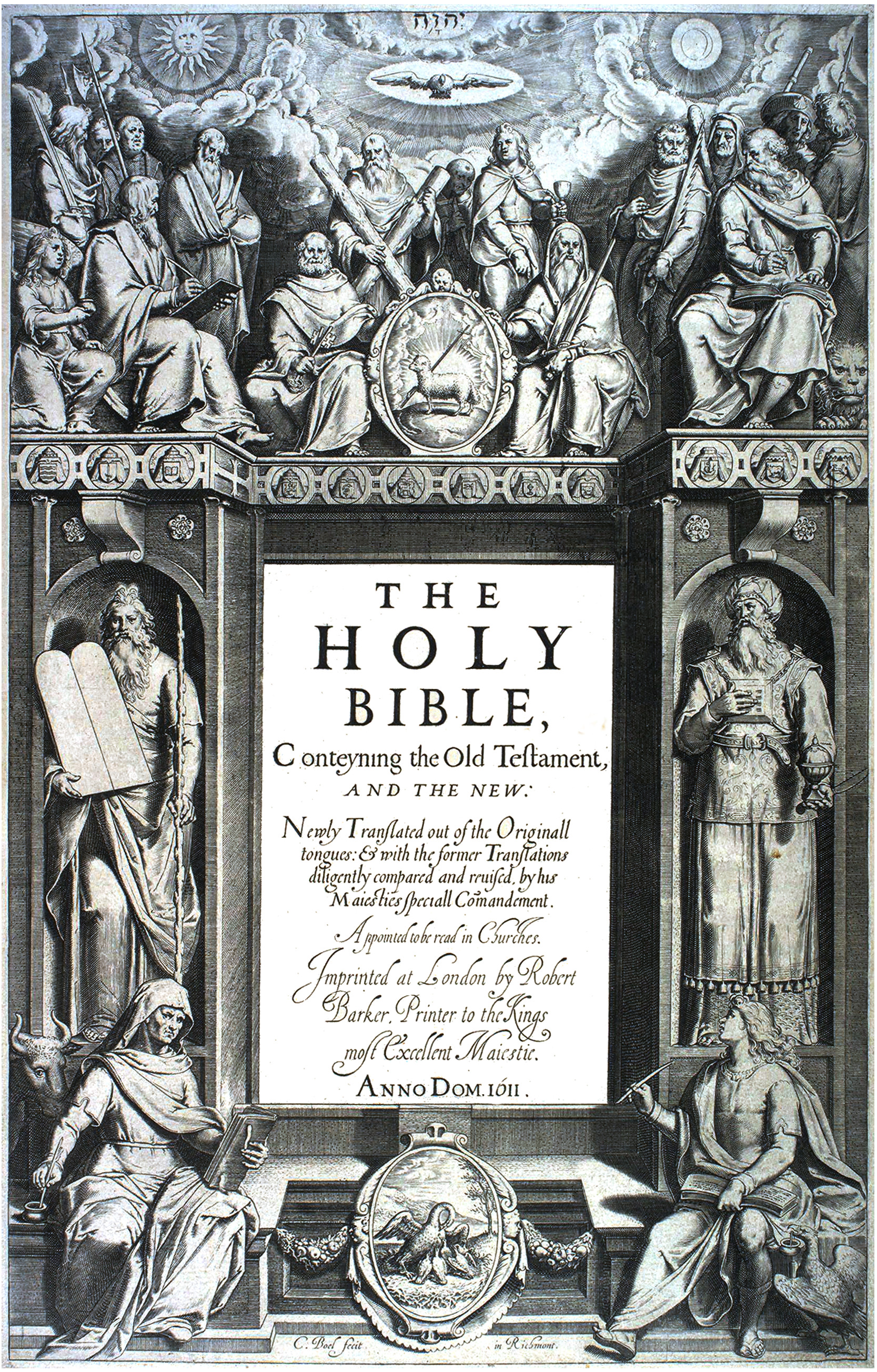
Every account of the NIV's origin begins with Howard Long. The NIV's publisher tells the story this way: "The history of the NIV starts with Howard Long, an engineer from Seattle. Howard was known for his passion for sharing the gospel and his love for the King James Bible. One day, he tried sharing Scripture with a non-Christian only to find that the KJV's 17th-century English didn't connect."1 The same page says that "In 1955, Long embarked on a ten-year quest for a new Bible translation" and that his denomination, the Christian Reformed Church (CRC), and the National Association of Evangelicals (NAE) "embraced his vision."1
An article in The Banner, the magazine of the Christian Reformed Church, written in 2015 by Michael Williams of Calvin Theological Seminary (then a member of the NIV's translation committee) with Jinny De Jong, gives the denominational side. In 1955, it says, "Howard Long, a businessman and member of a Christian Reformed congregation in Seattle, Wash., encouraged his pastor, Peter De Jong, to bring before the consistory the idea of a new English translation of the Bible." The idea then "struggled through, and sometimes against, a classis, a synod, a study committee, an advisory committee, and a couple more synods" before it was "formally commissioned" at Palos Heights in 1965.2 (The Banner's dashes are given here as commas.) The magazine quotes Long's goal: a Bible "both readable in contemporary language and reliable to the original texts."2
The exact years of the CRC synod decisions and the NAE action in the later 1950s are reported differently in secondary accounts. Mark Strauss, a current member of the translation committee, in a history written for Logos in 2023, places the CRC synod's approval of the proposal in 1958, while other summaries give 1957.3 The NIV's own 1978 preface says only that the 1965 meeting came "after several years of exploratory study by committees from the Christian Reformed Church and the National Association of Evangelicals."4 This lesson follows the preface and leaves the exact synod year open.

The other modern versions of the time
Long's request came at a moment when several modern English Bibles already existed or were on the way, and the NIV's founders defined their project partly against them. The Revised Standard Version (RSV), sponsored by the National Council of Churches, had appeared complete in 1952 as the heir of the American Standard Version; its history, and the dispute over its rendering of Isaiah 7:14, are told in lesson 09, and the church background (the split between the mainline denominations of the National Council and the evangelical bodies of the NAE) is told in Module 80, Mainline and Evangelical. The Lockman Foundation's New American Standard Bible, a literal revision of the ASV, published the Gospel of John in 1960 and the New Testament in 1963 (lesson 10). Paraphrases and popular versions, such as J. B. Phillips's letters and Kenneth Taylor's Living Letters, were reaching a wide readership (lesson 14), and the American Bible Society's Good News for Modern Man appeared in 1966 under the translation program that Eugene Nida directed.
The NIV's founders wanted something different from each of these. Unlike the RSV, it would be made by scholars who all affirmed a high view of Scripture. Unlike a revision of the KJV or ASV, it would be a fresh translation. Unlike a paraphrase, it would be the work of a committee checking every book against the Hebrew, Aramaic and Greek. The NIV's publisher puts the decision in these words: "Instead of just updating an existing translation such as the KJV, they chose to start from scratch, using the very best manuscripts available in the original Greek, Hebrew, and Aramaic of the Bible."1
Palos Heights, 1965, and the Committee on Bible Translation
The conference and the Chicago endorsement of 1966
The 1978 preface, revised in 1983 and printed in NIV Bibles of the 1984 text, gives the founding in two sentences: the NIV "had its beginning in 1965 when, after several years of exploratory study by committees from the Christian Reformed Church and the National Association of Evangelicals, a group of scholars met at Palos Heights, Illinois, and concurred in the need for a new translation of the Bible in contemporary English. This group, though not made up of official church representatives, was transdenominational."4 The preface adds that "Its conclusion was endorsed by a large number of leaders from the many denominations who met in Chicago in 1966."4 The publisher's history puts the number at "a gathering of 80 evangelical ministry leaders and scholars."1
The committee's constitution gives the exact dates of the founding meeting. Its first article says that the Committee was "called into being by the Palos Heights Bible Translation Conference (August 26 and 27, 1965)" and was to be "a self-perpetuating body, independent of all ecclesiastical organizations, educational institutions, committees, and other associations."5 The host was Trinity Christian College in Palos Heights, a suburb south of Chicago.2
The charter: what the constitution says
The Committee on Bible Translation (CBT) still works under that constitution. Its text was published by the International Bible Society on its website and is reproduced, with the original membership list, on Michael Marlowe's Bible Research site.5 Several of its articles explain how the NIV has been governed ever since:
- Purpose (Article II). "The purpose of the Committee shall be to prepare a contemporary English translation of the Bible as a collegiate endeavor of evangelical scholars, and to pursue matters related thereto."5
- Size (Article III, section 2). "The size of the Committee shall be limited to fifteen members."5
- Doctrinal test (Article III, section 3). Members must affirm that "The Bible alone, and the Bible in its entirety, is the Word of God written, and is therefore inerrant in the autographs," or subscribe to the statements on Scripture in the Westminster Confession, the Belgic Confession, the New Hampshire Confession, the creedal basis of the NAE, "or some other comparable statement." Article VII requires the same of every translator and editor the Committee engages.5
- Membership by invitation (Article III, section 4). "Admission to membership on the Committee shall be by invitation of the Committee only."5
- Revision (Article VII, section 4). The Committee "shall for a reasonable time provide for a periodic review and revision of the projected translation with a view to improving its renderings, embodying the fruits of future biblical scholarship, and keeping its idiom current." Section 5 applies the article to "any revision(s) of the projected version (NIV) under whatever name such revision(s) may be published."5
- Fixed articles (Article VIII). The purpose, the membership list and limit, the doctrinal affirmation and the translators' article of faith cannot be amended.5
Two features of this charter shaped everything that followed. The committee owns its text in the sense that "No outside group, no publisher or commercial entity, can decide how the NIV is translated," as the publisher's site now puts it (the site's dashes given as commas).6 And the charter required revision from the start, which is why the NIV has gone through several editions while the KJV text has been fixed since 1769.
The first members and Edwin Palmer
The constitution names the members at the time it was adopted: "E. Leslie Carlson, Earl S. Kalland, Francis R. Steele, Edmund P. Clowney, Kenneth S. Kantzer, John H. Stek, Ralph Earle, Charles F. Pfeiffer, J. C. Wenger, Burton L. Goddard, Stephen W. Paine, Marten H. Woudstra, R. Laird Harris, Charles C. Ryrie."5 That is fourteen names for a committee of fifteen. John H. Stek of Calvin Theological Seminary, a member from the start and later chairman, explained the gap in his history of the committee in The Challenge of Bible Translation (Zondervan, 2003): in 1967 "the committee had a vacancy to fill due to the resignation of Robert Mounce," and Youngve Kindberg of the New York Bible Society joined to fill it.5 Stek's chapter records the later changes: Robert Preus and Larry Walker in 1968, Richard Longenecker in 1969, William J. Martin in 1971, Kenneth L. Barker of Dallas Seminary from 1974, Ronald Youngblood in 1979, Bruce Waltke in 1980, and Donald Wiseman of the University of London in 1983.5
The members came from many churches. The 1978 preface lists "Anglican, Assemblies of God, Baptist, Brethren, Christian Reformed, Church of Christ, Evangelical Free, Lutheran, Mennonite, Methodist, Nazarene, Presbyterian, Wesleyan and other churches," and says this breadth "helped to safeguard the translation from sectarian bias."4 The translators came from "the United States, Great Britain, Canada, Australia and New Zealand," which, in the preface's words, "gave the project its international scope" and gave the version its name.4
The administrative center of the work was the committee's executive secretary, Edwin H. Palmer, a minister of the Christian Reformed Church. The list of the NIV's translators and editors reproduced by Marlowe names him as "Executive Secretary, NIV Committee on Bible Translation. Christian Reformed," and Marlowe's bibliography of the first editions lists them under "Edwin H. Palmer et al." (New Testament, Zondervan, 1973; Bible, Zondervan, 1978).57 Palmer coordinated the translation teams and the editorial committees; the published sources used for this lesson do not give the dates of his appointment, which are listed as unverified.
The New York Bible Society, Zondervan and Hodder and Stoughton
A translation by more than a hundred scholars needed a sponsor. The 1978 preface says that "In 1967 the New York Bible Society (now the International Bible Society) generously undertook the financial sponsorship of the project."4 The publisher's present-day history gives the year as 1968 and adds detail: Biblica, "then the New York Bible Society," came on board "mortgaging its office space in Manhattan and New Jersey."1 The two sources differ by a year; the 1978 preface is the earlier and the committee's own statement, and Stek's history, as quoted above, already has a New York Bible Society officer joining the committee in 1967.5
The cost nearly broke the society. The publisher's history says that by 1975 it "had reduced its staff, drained its endowment, taken out loans and put its beautiful New York building up for sale." It then turned to Pat Zondervan, head of Zondervan Publishers in Grand Rapids, Michigan, which already published the NIV New Testament. "Zondervan's answer was yes. The publisher already had exclusive rights in the United States and would advance the society in royalties to finish the work."1 Strauss's 2023 history likewise says the society nearly went bankrupt over the project.3
The arrangement that resulted has lasted: the Bible society (renamed the International Bible Society, and later Biblica) holds the copyright and sponsors the committee; Zondervan, now part of HarperCollins Christian Publishing, publishes the NIV in North America; and Hodder and Stoughton publishes it in the United Kingdom. Stek's history notes that Donald Wiseman, who joined the committee in 1983, "had for many years chaired the committee that Anglicized the text of the NIV for the Commonwealth edition published by Hodder & Stoughton."5 The 1978 preface explains the reason for a separate edition: the translators "sought to avoid obvious Americanisms on the one hand and obvious Anglicisms on the other. A British edition reflects the comparatively few differences of significant idiom and spelling."4 The CBT's 2009 announcement of the 2011 revision was made by Biblica, whose chief executive Keith Danby was then reported as head of "Biblica (formerly the International Bible Society and Send The Light, or IBS-STL)."8

How the 1978 NIV was made
Teams, editorial committees and three revisions
The NIV's prefaces describe the process with unusual care, because the committee believed the process itself was the guarantee of accuracy. The 1978 preface says:
The translation of each book was assigned to a group of scholars. Next, one of the Intermediate Editorial Committees revised the initial translation, with constant reference to the Hebrew, Aramaic or Greek. Their work then went to one of the General Editorial Committees, which checked it in detail and made another thorough revision. This revision in turn was carefully reviewed by the Committee on Bible Translation, which made further changes and then released the final version for publication. In this way the entire Bible underwent three revisions, during each of which the translation was examined for its faithfulness to the original languages and for its English style.4
The publisher's present history gives the size of each team: a translation team of "Two lead translators," "Two translation consultants" and "One English style consultant (if necessary)"; then "another team of five Bible scholars"; then "a general committee of 8 to 12 scholars."1 The preface adds that "a number of stylistic consultants" were used, two of whom "read every book of both Old and New Testaments twice," and that samples "were tested for clarity and ease of reading by various kinds of people, young and old, highly educated and less well educated, ministers and laymen" (the preface's dashes given as commas).4 The preface opens by calling the result "a completely new translation of the Holy Bible made by over a hundred scholars working directly from the best available Hebrew, Aramaic and Greek texts."4
The texts behind the NIV
A translation is only as close to the original as the Hebrew and Greek text it starts from, and the NIV's prefaces state their base texts plainly.
Old Testament. The 1978 preface says: "For the Old Testament the standard Hebrew text, the Masoretic Text as published in the latest editions of Biblia Hebraica, was used throughout." It then lists the other witnesses the translators consulted: the Dead Sea Scrolls, the Samaritan Pentateuch, "the ancient scribal traditions relating to textual changes," and the early versions, among them the Septuagint, the later Greek translations of Aquila, Symmachus and Theodotion, the Latin Vulgate, the Syriac Peshitta and the Aramaic Targums. "Readings from these versions were occasionally followed where the Masoretic Text seemed doubtful," and "Such instances are footnoted."4 The 2011 preface keeps this policy and adds that "In rare cases, the committee has emended the Hebrew text where it appears to have become corrupted at an even earlier stage of its transmission," with footnotes to say so.9 The Masoretic Text and the witnesses named here are described in lesson 01, and the vowel points the preface mentions are taught in Module 101, Vowel Points, Shewa and Dagesh.
New Testament. The 1978 preface says: "The Greek text used in translating the New Testament was an eclectic one." Where manuscripts differ, "the translators made their choice of readings according to accepted principles of New Testament textual criticism. Footnotes call attention to places where there was uncertainty about what the original text was. The best current printed texts of the Greek New Testament were used."4 The 2011 preface names the base: "an eclectic one, based on the latest editions of the Nestle-Aland/United Bible Societies' Greek New Testament."9 In practice this means the NIV, like the RSV, NASB and ESV, follows the critical text rather than the Textus Receptus behind the KJV and NKJV. The difference, and the arguments on both sides, are the subject of lesson 08; the NKJV's different choice is described in lesson 11.
The 2011 preface also explains how the NIV now prints verses that appear in the KJV but not in the critical text: "verse numbers that marked off portions of the traditional English text not supported by the best Greek manuscripts now appear in brackets, with a footnote indicating the text that has been omitted (see, for example, Matthew 17:[21])."9 At Matthew 17:21 the NIV footnote reads: "Some manuscripts include here words similar to Mark 9:29."10 Of the two longest passages in question, Mark 16:9 to 20 and John 7:53 to 8:11, the 2011 preface says that they, "although long accorded virtually equal status with the rest of the Gospels in which they stand, have a very questionable, and confused, standing in the textual history of the New Testament," and that "A different typeface has been chosen for these passages to indicate even more clearly their uncertain status" (the preface's dashes given as commas).9 Whether that judgment is right is argued in lessons 08 and 13; this lesson reports only what the NIV does.
Choices the preface explains
The 1978 preface gives the reasons for several features that readers coming from the KJV notice at once:
- No "thou" for God. The translators "judged that to use these archaisms (along with old verb forms such as 'doest,' 'wouldest' and 'hadst') would violate accuracy in translation. Neither Hebrew, Aramaic nor Greek uses special pronouns for the persons of the Godhead."4
- The divine name. YHWH is printed "LORD" in capitals, as in most English versions; where Adonai and YHWH stand together the NIV prints "Sovereign LORD."4
- "LORD Almighty" for "LORD of hosts." "Because for most readers today the phrase 'the LORD of hosts' and 'God of hosts' have little meaning, this version renders them 'the LORD Almighty' and 'God Almighty.'" The preface admits a cost: a reader without Hebrew cannot see the difference between Sabaoth ("hosts") and Shaddai, which can also be translated "Almighty"; Shaddai, it says, "occurs infrequently and is always footnoted."4 This is a small example of the whole method: a phrase whose words are clear but whose meaning is lost on modern readers is replaced by a phrase that carries the meaning.
- Supplied words and pronouns. "To achieve clarity the translators sometimes supplied words not in the original texts but required by the context. If there was uncertainty about such material, it is enclosed in brackets." Nouns are sometimes put for pronouns "and vice-versa," and shifts of person in Hebrew are often made uniform "without the use of footnotes."4 Unlike the KJV and NASB, the NIV does not put supplied words in italics.
- Headings. The section headings "are not to be regarded as part of the NIV text, are not for oral reading, and are not intended to dictate the interpretation of the sections they head."4
- Footnotes. Notes beginning "Or" give alternative translations, and "Footnotes introduced by 'Or' do not have uniform significance": sometimes the two renderings were judged about equal, sometimes the note records a possible interpretation the translators did not prefer. New Testament notes about the text begin "Some manuscripts."4
The editions: 1973 to 2011
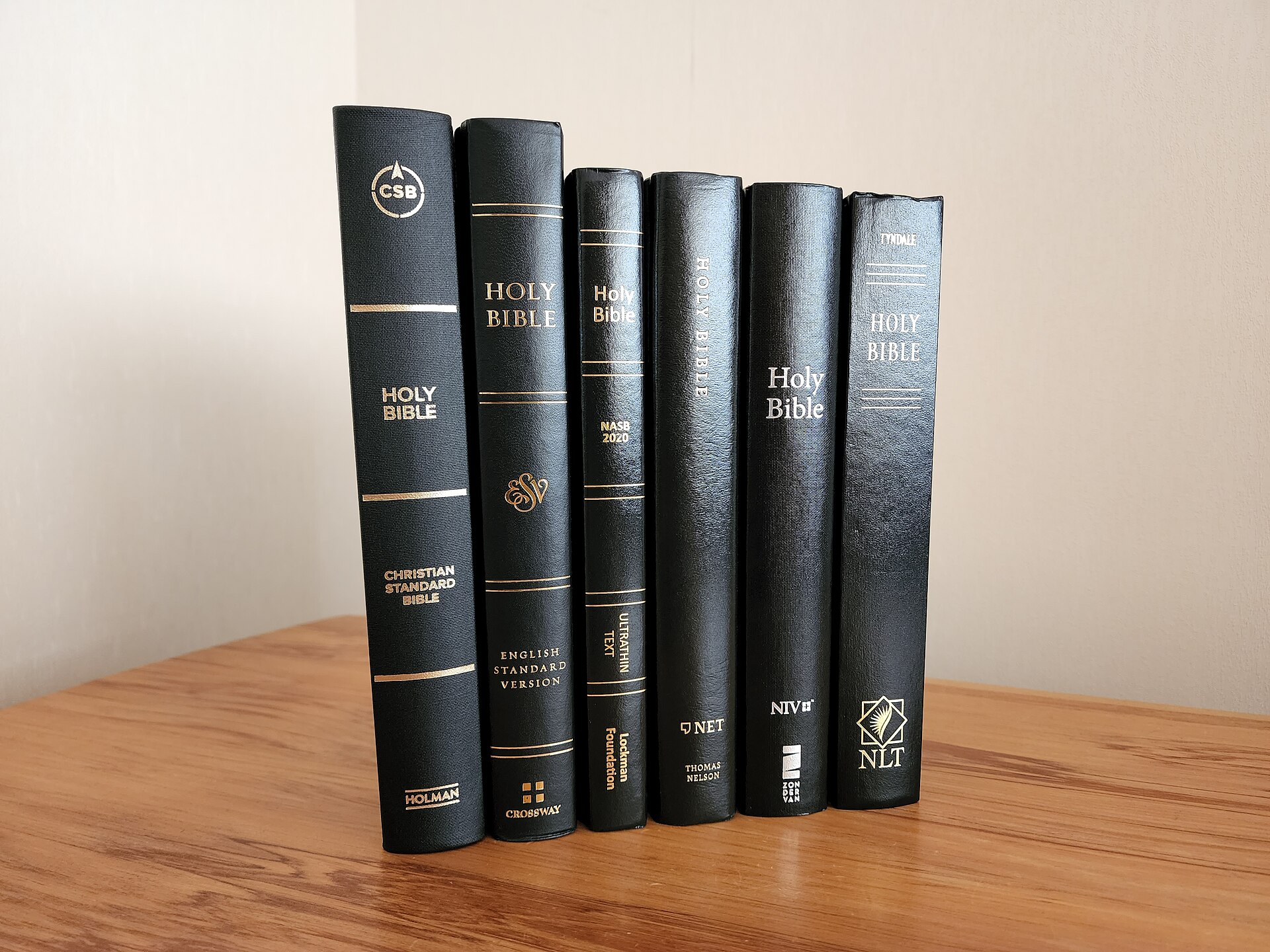
The name "NIV" covers several different texts. A reader comparing an NIV quotation in a book from 1990 with an NIV Bible bought today may find different wording, because the committee's charter requires revision and the committee has used it. The editions are these.
The New Testament (1973) and the complete Bible (1978)
The 1978 preface records the first two stages: "In 1973 the New Testament in the New International Version was published. Since then, suggestions for corrections and revisions have been received from various sources. The Committee on Bible Translation carefully considered the suggestions and adopted a number of them. These were incorporated in the first printing of the entire Bible in 1978."4 The preface itself is dated June 1978.4 The publisher's history says that the first printing of the whole Bible, "over a million copies," sold out "before they were even done printing," and that "Dozens of evangelical denominations, churches, and seminaries embraced the NIV as their official Bible translation."1
The 1984 revision
The same preface, in its revised form, adds: "Additional revisions were made by the Committee on Bible Translation in 1983 and appear in printings after that date." It is signed "June 1978 (Revised August 1983)."4 Printings from 1984 onward carry this text, and it is the edition most English-speaking evangelicals knew as "the NIV" for a generation. The CBT's 2010 notes call it simply "the 1984 text" and say that "In 1984, various corrections and revisions to the NIV text were made."11 For about twenty-five years it was the best-selling modern English Bible; when the committee revised it again, Christianity Today observed that "most translations have not been on top of the best-seller list for a quarter century."8
The Inclusive Language Edition (1996) and the New International Reader's Version
In the 1990s the committee began to render some generic masculine terms (for example "man" meaning any person) with words that include women. Hodder and Stoughton published The Holy Bible: New International Version, Inclusive Language Edition in London in 1996, for the British market only.7 It was never published in the United States. After criticism in America, the International Bible Society announced in 1997 that it was setting aside plans for an updated NIV. Biblica's chief executive Keith Danby recalled in 2009: "In 1997, IBS announced that it was forgoing all plans to publish an updated NIV following criticism of the NIV inclusive language edition (NIVi) published in the United Kingdom."8 The guidelines and resolutions that came out of that dispute, beginning with the Colorado Springs Guidelines of 1997, are part of the case made in lesson 13 and of the history of gender-neutral versions in lesson 14.
A separate, simplified edition for children and new readers, the New International Reader's Version (NIrV), was edited by Ronald Youngblood; its New Testament appeared in 1995 and both Marlowe and Christianity Today date the full version to 1996.78 The NIrV is a different text from the NIV, written at a lower reading level, and its own history lies outside this lesson.
Today's New International Version (2002 and 2005)
The committee kept working under its charter. The 2011 preface summarizes: "A more thorough revision process was completed in 2005, resulting in the separately published TNIV."9 Today's New International Version appeared as a New Testament in 2002 (Christianity Today calls it "the 2002 revision") and as a complete Bible in 2005, while the 1984 NIV stayed in print alongside it.8 The TNIV used inclusive language for people more widely than the 1984 NIV, and the dispute over it was sharp. The committee later said that most of its changes had nothing to do with gender: in matters unrelated to gender language, "which account for about 75 percent of the changes made from the 1984 NIV to the TNIV," its work was carried forward into the 2011 edition.11 Strauss writes that the TNIV never reached more than about 1 percent of the English Bible market in its ten years.3
The announcement of September 1, 2009
On September 1, 2009, Biblica, Zondervan and the committee announced that the NIV would be revised for 2011 and that the TNIV would be dropped. Christianity Today's report (by Ted Olsen) quoted the three parties. Danby said: "The first mistake was the NIVi. The second was freezing the NIV. The third was the process of handling the TNIV."8 Zondervan's president Moe Girkins said: "Whatever its strengths were, the TNIV divided the evangelical Christian community. So as we launch this new NIV, we will discontinue putting out new products with the TNIV."8 Douglas Moo of Wheaton College, then chairman of the committee, predicted: "I can predict that this is going to look 90 percent or more what the 1984 NIV looks like and 95 percent what the TNIV looks like." Christianity Today added that the committee had made "1200 changes to the text in its database since the TNIV's most recent 2005 revision."8 The committee's 2010 notes add that "every single change introduced into the committee's last major revision (the TNIV) relating to inclusive language for humanity was reconsidered. Some were preserved, some were abolished in favor of the 1984 rendering and many were reworded in a third, still different way."11
The 2011 NIV
The updated NIV was released in 2011, replacing both the 1984 NIV and the TNIV in new printings. Its preface is signed "The Committee on Bible Translation, September 2010."9 The committee's notes, dated August 2010, give the scale of the change: "about 95% of the text of the updated NIV is exactly the same as the 1984 text it replaces. The majority of what has changed involves comparatively minor matters of vocabulary, sentence structure and punctuation: changes that move the NIV from the English of 1984 to the English of 2011."11 The notes sort the reasons for change into three kinds: "Changes in English," "Progress in Scholarship" and "Concern for Clarity."11
On gender language the committee commissioned a study of the Collins Bank of English, which its publisher describes as "a database of more than 4.4 billion words, taken from publications and spoken-word recordings spanning two decades."6 The 2011 preface gives the result in two examples. "The original NIV (1978) was published in a time when 'a man' would naturally be understood, in many contexts, to be referring to a person, whether male or female." So the NIV (1984) wording of 1 Corinthians 8:3, "But the man who loves God is known by God" (NIV 1984, copyright Biblica, Inc.), "becomes in this edition 'But whoever loves God is known by God'" (NIV 2011, copyright Biblica, Inc.).9 The KJV of the same verse reads: "But if any man love God, the same is known of him."12 And on pronouns, the preface explains that "The reader will frequently encounter a 'they,' 'their,' or 'them' to express a generic singular idea," citing Mark 8:36: "What good is it for someone to gain the whole world, yet forfeit their soul?" (NIV 2011, copyright Biblica, Inc.).910 The preface also says the committee kept "man" and "mankind" where they denote the human race, and that "Nowhere in the updated NIV (nor in the TNIV, nor in any of the committee discussions leading up to either version) is there even the remotest hint of any inclusive language for God," in the words of the committee's notes.11
The committee today works under the same charter. Its publisher says that "a change must receive the support of at least 70 percent of the translation team," and the 2010 notes say the threshold is 70 percent "of the committee members present at the time of the voting."611 The notes describe the committee as of August 2010 as "twelve American scholars, two British scholars and one Indian scholar," thirteen men and two women, from "Baptist, Presbyterian or Reformed, Anglican, Pentecostal, and independent denominations and churches."11 The publisher's list of members in 2026 names Simon Gathercole of the University of Cambridge as chair and Jeannine K. Brown of Bethel Seminary as vice-chair, with members from Canada, Britain, Kenya, Australia and India as well as the United States; Douglas Moo, the chair at the time of the 2011 revision, is still listed as a member.13
Eugene Nida and dynamic equivalence
Who Eugene Nida was
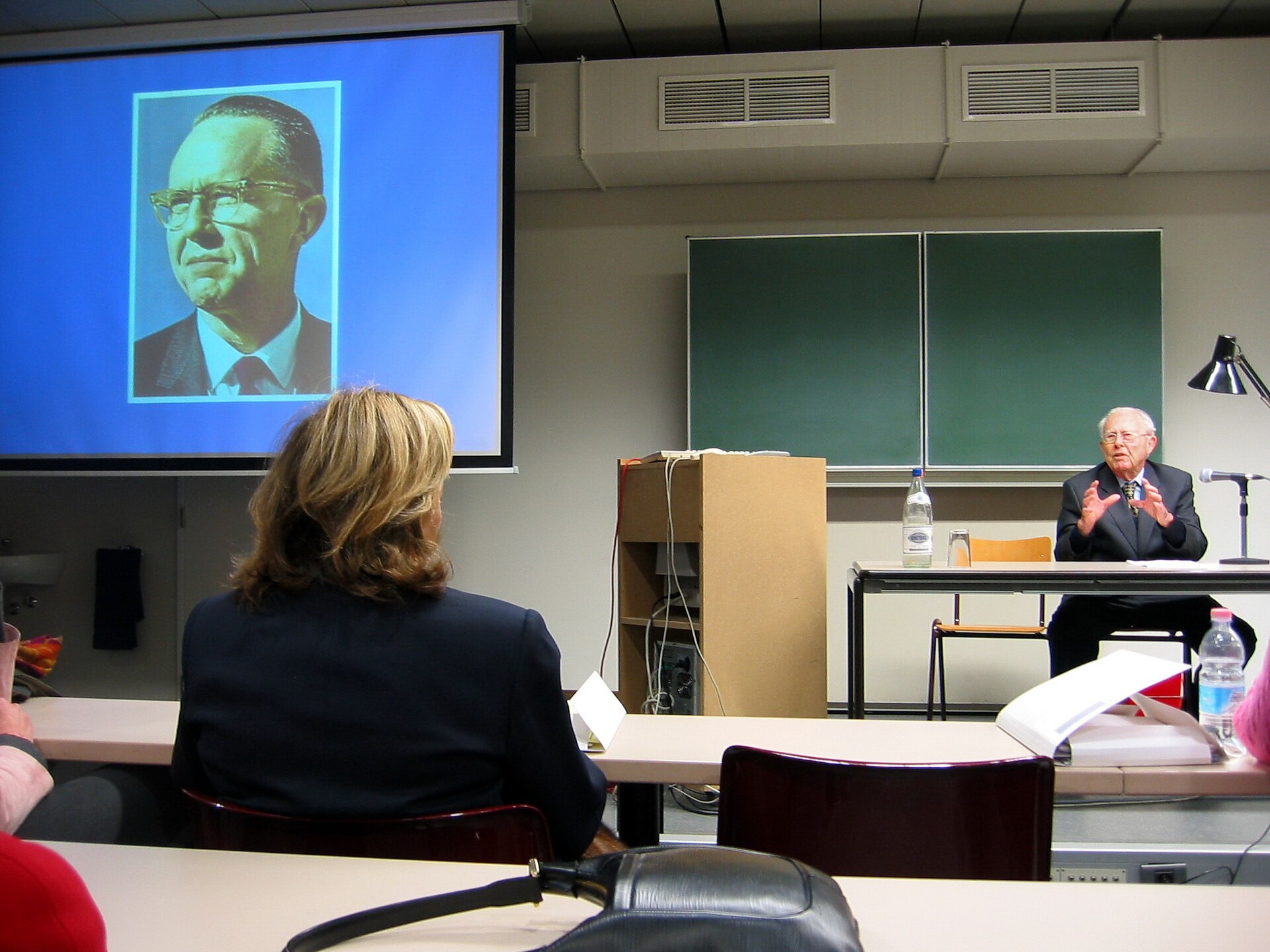
The vocabulary in which the NIV is usually discussed ("formal equivalence," "dynamic equivalence," "functional equivalence") comes from one man, the American linguist Eugene A. Nida. The linguist D. Terence Langendoen's memorial of him for the journal Language (2013) gives the outline of his life. Nida was born in Oklahoma City on November 11, 1914, studied classics at the University of California, Los Angeles (graduating in 1936), trained with the Summer Institute of Linguistics, earned a master's degree in New Testament Greek at the University of Southern California in 1939 and a doctorate in linguistics at the University of Michigan in 1943. In 1943 he was ordained in the Northern Baptist Convention and joined the staff of the American Bible Society, where he served as Associate Secretary for Versions until 1946 and then as Executive Secretary for Translations until he retired in 1984. He was a delegate to the conference that founded the United Bible Societies in 1946, and in 1967 he helped to make the agreement between the United Bible Societies and the Vatican for joint translation projects. He died in Madrid on August 25, 2011, at the age of 96.14
Nida was not a member of the NIV's committee, and the NIV is not one of the versions he directed. His importance for this lesson is that his books gave every later translator, and every critic, the terms for describing what translators do. Strauss, writing for the NIV's side in 2023, traces the NIV's meaning-based approach in part to the linguistic work of Nida and his colleagues; critics of the NIV use the same terms to describe what they object to.3

Formal and dynamic equivalence in Nida's own words
Nida introduced the pair of terms in chapter 8 of Toward a Science of Translating (Leiden: E. J. Brill, 1964), in a section headed "Two Basic Orientations in Translating." Because no two languages have exact equivalents, he wrote, a translator must look for the closest possible equivalent, and there are "two different types of equivalence: one which may be called formal and another which is primarily dynamic."15
Of the first he wrote: "Formal equivalence focuses attention on the message itself, in both form and content. In such a translation one is concerned with such correspondences as poetry to poetry, sentence to sentence, and concept to concept." The extreme form is "a 'gloss translation,' in which the translator attempts to reproduce as literally and meaningfully as possible the form and content of the original," a kind of translation that "would require numerous footnotes in order to make the text fully comprehensible."15
Of the second: a translation of dynamic equivalence "is based upon 'the principle of equivalent effect'". In it "one is not so concerned with matching the receptor-language message with the source-language message, but with the dynamic relationship ..., that the relationship between receptor and message should be substantially the same as that which existed between the original receptors and the message." It "aims at complete naturalness of expression, and tries to relate the receptor to modes of behavior relevant within the context of his own culture."15
Nida's own example was a verse every reader can check. "For example, a phrase such as 'holy kiss' (Romans 16:16) in a gloss translation would be rendered literally, and would probably be supplemented with a footnote explaining that this was a customary method of greeting in New Testament times." By contrast, J. B. Phillips's New Testament, which "perhaps more than any other, seeks for equivalent effect," renders "greet one another with a holy kiss" as "give one another a hearty handshake all around."15 Nida treated the two as ends of a scale, not as two boxes: "Between the two poles of translating (i.e. between strict formal equivalence and complete dynamic equivalence) there are a number of intervening grades, representing various acceptable standards of literary translating."15
A few pages later Nida gave his best-known definition. A dynamic-equivalence translation is "one concerning which a bilingual and bicultural person can justifiably say, 'That is just the way we would say it.'" And: "One way of defining a D-E translation is to describe it as 'the closest natural equivalent to the source-language message.' This type of definition contains three essential terms: (1) equivalent, which points toward the source-language message, (2) natural, which points toward the receptor language, and (3) closest, which binds the two orientations together on the basis of the highest degree of approximation."15 He insisted that such a version is still a translation: it "is not merely another message which is more or less similar to that of the source. It is a translation, and as such must clearly reflect the meaning and intent of the source."15
Nida also named the limits of the method. He divided the vocabulary of a text into three levels: words with ready parallels ("river, tree, stone, knife"), words for objects that differ in form but have a similar function (a "book," which in New Testament times meant a scroll), and "terms which identify cultural specialties, e.g. synagogue, homer, ephah, cherubim, and jubilee." Of the last he wrote: "No translation that attempts to bridge a wide cultural gap can hope to eliminate all traces of the foreign setting. For example, in Bible translating it is quite impossible to remove such foreign 'objects' as Pharisees, Sadducees, Solomon's temple, cities of refuge, or such Biblical themes as anointing, adulterous generation, living sacrifice, and Lamb of God, for these expressions are deeply imbedded in the very thought structure of the message."15 The passages quoted here are from pages 159 to 160 and 166 to 168 of Nida's book, as transcribed by Michael Marlowe, a critic of the method, who adds his own objections to Nida's use of earlier writers.15
Nida and Taber (1969) and "functional equivalence" (1986)
Nida developed the method for working translators in The Theory and Practice of Translation, written with Charles R. Taber (Leiden: Brill, 1969). Langendoen's memorial says that "The theory of dynamic equivalence was first expounded in Nida and Taber (1969), and later (as 'functional equivalence') in Nida and de Waard (1986)," the second book being Jan de Waard and Eugene A. Nida, From One Language to Another: Functional Equivalence in Bible Translating (Nashville: Nelson, 1986).14 (The term itself first appeared in the 1964 book quoted above; the 1969 book set out the full working method.) The 1969 book opens with a definition of translating as reproducing in the receptor language the closest natural equivalent of the source-language message, first in meaning and second in style; that summary is given here as a paraphrase, because the 1969 text could not be opened for this lesson. The change of name in 1986 to "functional equivalence" is why the NIV's method is described today as "functional" or "meaning-based" more often than "dynamic."
Where the NIV places itself
The NIV has never called itself a dynamic-equivalence translation. Its committees have described their method as a balance, and their own words have changed a little over forty years.
- 1978 preface. "The first concern of the translators has been the accuracy of the translation and its fidelity to the thought of the Biblical writers. They have weighed the significance of the lexical and grammatical details of the Hebrew, Aramaic, and Greek texts. At the same time, they have striven for more than a word-for-word translation. Because thought patterns and syntax differ from language to language, faithful communication of the meaning of the writers of the Bible demands frequent modifications in sentence structure and constant regard for the contextual meaning of words."4 The same preface asks for English that is "idiomatic but not idiosyncratic, contemporary but not dated."4
- 2011 preface. "Out of these deep convictions, we have sought to recreate as far as possible the experience of the original audience, blending transparency to the original text with accessibility for the millions of English speakers around the world" (the preface's dash given as a comma). The translators' first concern "has moved the translators to go beyond a formal word-for-word rendering of the original texts."9 The edition aims "to articulate God's unchanging Word in the way the original authors might have said it had they been speaking in English to the global English-speaking audience today."9
- 2010 Translators' Notes. The committee places the NIV between two other kinds of translation: some "place a particularly high priority on hearing God's Word the way it was written," others "on understanding God's Word the way it was meant." The NIV, it says, aims at "the best possible blend of transparency to the original documents and comprehension of the original meaning in every verse," and holds "that neither one of these two criteria be prioritized above the other."11
- The publisher today. "Even the best literal translation can't follow the original form all the time. And even the best meaning-based translation can't capture every detail of meaning found in the original." The NIV's approach is described as "balancing transparency to the original with clarity of meaning," and its reading level as "8th-grade."616
Nida's own example shows where the NIV stops. Romans 16:16 in the 2011 NIV reads "Greet one another with a holy kiss" (NIV 2011, copyright Biblica, Inc.), close to the KJV's "Salute one another with an holy kiss," and nowhere near Phillips's handshake.1012 In Nida's terms, the NIV keeps many forms that a fully dynamic version would replace, and replaces others (idioms, Hebrew word order, long Greek sentences, some technical terms) where its translators judged that the form would mislead or say nothing to a modern reader.
The method at work: verses side by side
The fairest way to see what a translation method does is to set the same verse in several versions and read the differences slowly. The verses below were chosen because the NIV's own committee discussed them, or because they show a typical choice. The KJV is quoted from the standard 1769 text as printed at Bible Gateway; the NASB 1995 and the NIV 2011 from Bible Gateway; the NIV 1984 from the CBT's own 2010 notes where it quotes the 1984 text, and otherwise from an online text of the 1984 NIV (Bible-Centre's "New International Version (en)"), which this lesson identifies as the 1984 text because its wording matches the 1984 readings the committee itself quotes.12171018 Copyrighted versions are quoted at most two verses at a time, as allowed for comparison.
Romans 8:4 to 5: "flesh" and "sinful nature"
Paul's Greek word sarx means "flesh." In Paul it sometimes means the body and often means human nature under the power of sin. Formal translations keep "flesh" every time and leave the reader to decide which sense is meant. The original NIV chose to translate the second sense directly.
That the righteousness of the law might be fulfilled in us, who walk not after the flesh, but after the Spirit. For they that are after the flesh do mind the things of the flesh; but they that are after the Spirit the things of the Spirit. (Romans 8:4 to 5, KJV)12
so that the requirement of the Law might be fulfilled in us, who do not walk according to the flesh but according to the Spirit. For those who are according to the flesh set their minds on the things of the flesh, but those who are according to the Spirit, the things of the Spirit. (Romans 8:4 to 5, NASB 1995, copyright The Lockman Foundation)17
in order that the righteous requirements of the law might be fully met in us, who do not live according to the sinful nature but according to the Spirit. Those who live according to the sinful nature have their minds set on what that nature desires; but those who live in accordance with the Spirit have their minds set on what the Spirit desires. (Romans 8:4 to 5, NIV 1984, copyright Biblica, Inc.)18
in order that the righteous requirement of the law might be fully met in us, who do not live according to the flesh but according to the Spirit. Those who live according to the flesh have their minds set on what the flesh desires; but those who live in accordance with the Spirit have their minds set on what the Spirit desires. (Romans 8:4 to 5, NIV 2011, copyright Biblica, Inc.)10
Four things show here. First, the 1984 NIV put an interpretation ("sinful nature") where the Greek has a single noun ("flesh"); its footnote at verse 3 gave "Or the flesh."18 Second, both NIV editions turn the Greek's compact phrases into fuller English ("have their minds set on what the flesh desires" for the KJV's "do mind the things of the flesh"), which is the "modifications in sentence structure" the preface describes. Third, "walk" (Greek peripateo, a Hebrew-style picture of living) becomes "live" in both NIV editions, while the KJV and NASB keep the picture. Fourth, the 2011 NIV went back to "flesh" and moved the explanation into a footnote: "In contexts like this, the Greek word for flesh (sarx) refers to the sinful state of human beings, often presented as a power in opposition to the Spirit; also in verses 4-13."10
The committee explained the reversal in its 2010 notes: "Most occurrences of 'sinful nature' have become 'flesh.' Especially in Paul, sarx can mean either part or all of the human body or the human being under the power of sin. In an effort to capture this latter sense of the word, the original NIV often rendered sarx as 'sinful nature.' But this expression can mislead readers into thinking the human person is made up of various compartments, one of which is sarx." The updated NIV, it says, "uses 'flesh' as the translation in many places where it is important for readers to decide for themselves from the context whether one or both of these uses of sarx is present."11 The same move appears in 1 John 2:16, where the committee replaced the 1984 phrases "the cravings of sinful man, the lust of his eyes and the boasting of what he has and does" with the KJV's own three phrases, "the lust of the flesh, the lust of the eyes, and the pride of life," and asked: "Has anyone really improved on the KJV rendering of these three expressions, to which the updated NIV returns?"11 Lesson 13 takes up how far the 1984 rendering went and what critics made of it.
Psalm 1:1: "the man" and "the one"
Blessed is the man that walketh not in the counsel of the ungodly, nor standeth in the way of sinners, nor sitteth in the seat of the scornful. (Psalm 1:1, KJV)12
How blessed is the man who does not walk in the counsel of the wicked, Nor stand in the path of sinners, Nor sit in the seat of scoffers! (Psalm 1:1, NASB 1995, copyright The Lockman Foundation; its footnote gives "Or way" for "path")17
Blessed is the man who does not walk in the counsel of the wicked or stand in the way of sinners or sit in the seat of mockers. (Psalm 1:1, NIV 1984, copyright Biblica, Inc.)18
Blessed is the one who does not walk in step with the wicked or stand in the way that sinners take or sit in the company of mockers, (Psalm 1:1, NIV 2011, copyright Biblica, Inc.)10
Here the 1984 NIV was nearly as literal as the NASB: "walk," "counsel," "way" and "seat" are all kept. The 2011 NIV changed two kinds of thing. It replaced "the man" (Hebrew ha'ish, "the man") with "the one," following the preface's rule that where "the original text intends to refer generically to men and women equally" the edition "substitutes other expressions."9 And it turned two of the psalm's pictures into their meaning: "counsel" became "walk in step with," and "seat" became "company." The NASB note "Or way" shows that even the most literal versions sometimes choose between near-synonyms. Whether the Psalm's "man" is generic is itself a question of interpretation, discussed in lesson 13.
Hebrews 2:6: "What is man"
But one in a certain place testified, saying, What is man, that thou art mindful of him? or the son of man that thou visitest him? (Hebrews 2:6, KJV)12
But one has testified somewhere, saying, "What is man, that You remember him? Or the son of man, that You are concerned about him? (Hebrews 2:6, NASB 1995, copyright The Lockman Foundation)17
But there is a place where someone has testified: "What is man that you are mindful of him, the son of man that you care for him? (Hebrews 2:6, NIV 1984, copyright Biblica, Inc., as quoted by the Committee on Bible Translation)11
But there is a place where someone has testified: "What is mankind that you are mindful of them, a son of man that you care for him? (Hebrews 2:6, NIV 2011, copyright Biblica, Inc.)10
This verse quotes Psalm 8:4, and it is one of the most discussed changes in the 2011 NIV. The committee's notes state the problem in its own terms: "Hebrews is quoting Psalm 8:4-6, in which the Psalmist marvels at God's creation and that God should care for puny, mortal humanity," but "because, centuries later, Jesus would use 'Son of man' as a title for himself," the author of Hebrews sees Jesus fulfilling what the psalm says of mankind. The committee asked: "How does one preserve all of these possible allusions and interconnections, foreclosing on no major interpretive option, while still avoiding exclusively masculine language for both genders if possible?" Its answer was "to use 'mankind' for 'man,' to delete the definite article from before 'Son of man' (it's not in either the Greek or the Hebrew), to retain the language, 'son of man that you care for him,' but to make the remaining pronouns plural so that it is clear they refer to all people, including Jesus."11 The notes add that "Footnotes in verses 7-8 also give the options of preserving the masculine singular pronouns."11 The NIV 2011 footnote at verse 7 reads "Or them for a little while."10 Those who think the change obscures a reference to Christ make their case in lesson 13.
Idioms: 1 Samuel 24:3 and Amos 4:6
The clearest cases of meaning-based translation are idioms, where the words of the original are plain but their sense is not. In both of the following, even the NASB 1995, which aims at a word-for-word rendering (lesson 10), chooses meaning over form in one of the two.
And he came to the sheepcotes by the way, where was a cave; and Saul went in to cover his feet: and David and his men remained in the sides of the cave. (1 Samuel 24:3, KJV)12
He came to the sheepfolds on the way, where there was a cave; and Saul went in to relieve himself. Now David and his men were sitting in the inner recesses of the cave. (1 Samuel 24:3, NASB 1995, copyright The Lockman Foundation; its footnote reads "Lit cover his feet")17
He came to the sheep pens along the way; a cave was there, and Saul went in to relieve himself. David and his men were far back in the cave. (1 Samuel 24:3, NIV 2011, copyright Biblica, Inc.)10
"To cover his feet" is a Hebrew euphemism. The KJV keeps it; the NASB 1995 gives the meaning in its text and the literal words in its footnote; the NIV gives the meaning without a note. In Amos 4:6, by contrast, the NASB keeps the idiom and the NIV does not: the KJV reads "I also have given you cleanness of teeth in all your cities, and want of bread in all your places"; the NASB 1995 reads "I gave you also cleanness of teeth in all your cities" (NASB 1995, copyright The Lockman Foundation); and the NIV reads "I gave you empty stomachs in every city and lack of bread in every town" (NIV 2011, copyright Biblica, Inc.).121710 The diagram above sets out what each choice gives and asks of the reader. The difference between "literal" and "meaning-based" versions is a difference of how often, not of whether: every version in this lesson departs from the form somewhere.
Other 2011 changes the committee explained
The CBT's notes give many smaller examples of its reasoning, sorted under "Changes in English," "Progress in Scholarship" and "Concern for Clarity." Among them:
- Luke 2:7. "We are more certain than we were forty years ago that the Greek word kataluma used in Luke 2:7 means 'guest room,' not 'inn.'"11 The 2011 text reads "because there was no guest room available for them" (NIV 2011, copyright Biblica, Inc.), where the KJV has "because there was no room for them in the inn."1012
- Mark 15:27. The men crucified with Jesus, "called lēstai," were "'rebels' rather than 'robbers.'"11
- Philippians 4:13. The 1984 NIV's "I can do everything through him who gives me strength" (NIV 1984, copyright Biblica, Inc.) became "I can do all this through him who gives me strength" (NIV 2011, copyright Biblica, Inc.), so that, in the committee's words, "one shouldn't be as easily able to misapply" the verse; the context is contentment "whether in riches or in poverty."11 The KJV reads "I can do all things through Christ which strengtheneth me."12
- "Alien." "Who would have guessed in the 1970s that, within a few decades, an 'alien' would mean, thanks to the influence of ET and other movies and TV shows, an 'extraterrestrial being'?" The 2011 NIV uses "foreigner" instead.11
- "Saints." "'Saints' often becomes 'God's people,' 'the Lord's people,' 'the Lord's holy people' and the like," because "Most people today think of a particularly good person when they hear the word 'saint.'"11
- "Christ" and "Messiah." "Certain uses of 'Christ' are now 'Messiah,'" especially in the Gospels and Acts, where the word "seemed to retain its titular sense."11
- Romans 1:17 and "works of the law." "Translations that leave open important scholarly options have often been chosen. Thus, for instance, 'righteousness from God' in Romans 1:17 and related passages has been changed to 'righteousness of God,' and 'observing the law' (erga nomou) has been changed to 'works of the law.'"11
Several of these 2011 changes moved the NIV closer to the older, more literal wording ("flesh," "the lust of the flesh," "righteousness of God," "works of the law"), while others moved it further from it ("mankind ... them," "guest room," "rebels," "God's people"). That mixed record is why both defenders and critics of the NIV can cite the 2011 edition for their side.
| Verse | KJV (1769 text) | NASB 1995 | NIV 1984 | NIV 2011 |
|---|---|---|---|---|
| Romans 8:4 to 5 (sarx) | "flesh" | "flesh" | "sinful nature" (note: "Or the flesh") | "flesh" (note explains sarx) |
| Romans 8:4 (peripateo) | "walk" | "walk" | "live" | "live" |
| Psalm 1:1 (ha'ish) | "the man" | "the man" | "the man" | "the one" |
| Psalm 1:1 (picture words) | "counsel," "seat" | "counsel," "seat" | "counsel," "seat" | "walk in step with," "company" |
| Hebrews 2:6 | "man ... him" | "man ... him" | "man ... him" | "mankind ... them" |
| 1 Samuel 24:3 (idiom) | "to cover his feet" | "to relieve himself" (note: literal) | meaning given | "to relieve himself" |
| Amos 4:6 (idiom) | "cleanness of teeth" | "cleanness of teeth" | "empty stomachs" (note: "Hebrew you cleanness of teeth") | "empty stomachs" |
| Romans 16:16 | "an holy kiss" | not quoted here | not quoted here | "a holy kiss" |
One cell in the NIV 1984 column says only "meaning given": the 1984 wording of 1 Samuel 24:3 was not checked for this lesson. At Amos 4:6 the 1984 NIV printed "empty stomachs" with the footnote "Hebrew you cleanness of teeth" (NIV 1984, copyright Biblica, Inc.); the 2011 text at Bible Gateway shows no note at that verse.1810 Each NIV and NASB phrase in the table is copyright of its publisher (NIV, copyright Biblica, Inc.; NASB 1995, copyright The Lockman Foundation) and is quoted for comparison.
The KJV also translated by meaning in places
Meaning-based renderings did not begin with Nida. Paul's Greek exclamation me genoito means, word for word, "may it not be." The KJV translators rendered it with an English idiom that has no word for God in the Greek: "God forbid. How shall we, that are dead to sin, live any longer therein?" (Romans 6:2, KJV).12 The NASB 1995 keeps closer to the Greek form: "May it never be! How shall we who died to sin still live in it?" (Romans 6:2, NASB 1995, copyright The Lockman Foundation).17 The KJV also prints in italics the words its translators supplied to make sense in English, a practice the NASB continues and the NIV does not. The difference between the KJV tradition and the NIV is therefore one of degree and of stated aim: the KJV and its literal heirs depart from the form when English requires it, while the NIV's prefaces make meaning, in clear contemporary English, the stated first concern.
How to read an NIV page
Because the NIV changes forms more often than a literal version does, its footnotes matter more. The prefaces explain the system, and a reader who knows it can recover much of what the text alone does not show:
- Which edition? The copyright page of a 2011 NIV lists the dates 1973, 1978, 1984 and 2011; a 1984 NIV lists 1973, 1978 and 1984. A quick test is Romans 8:5 ("sinful nature" in 1984, "flesh" in 2011) or Philippians 4:13 ("everything" in 1984, "all this" in 2011).181011
- "Or" notes. These give other possible translations. The 1978 preface warns that they "do not have uniform significance."4
- "Some manuscripts" notes and bracketed verse numbers. These mark places where Greek manuscripts differ, including verses found in the KJV but not printed in the NIV's text, such as Matthew 17:[21].910 The manuscripts behind them are described in lesson 02 and lesson 08.
- "See Septuagint" notes. "The New Testament authors, writing in Greek, often quote the Old Testament from its ancient Greek version, the Septuagint," so the 2011 NIV marks such quotations "(see Septuagint)."9
- Notes on Hebrew readings. In the Old Testament, the 1978 preface says, "evidence for the reading chosen is given first, and evidence for the alternative is added after a semicolon," and "the term 'Hebrew' refers to the Masoretic text."4
- Explanatory notes on key words. The 2011 edition adds notes such as the one on sarx at Romans 8:3 and, at many places, a note that "the Greek word for 'brothers and sisters' (adelphoi) refers to believers, both men and women, as part of God's family."1011
- Different typeface. Mark 16:9 to 20 and John 7:53 to 8:11 are set off with notes and printed in a different typeface in the 2011 edition.9
Readers who want to see the Greek or Hebrew word behind an English rendering can use the interlinear and lexicon tools taught in lesson 15 and in the language modules: Module 78, Using a Lexicon and Reading Aids (Greek), and Module 101, Using a Lexicon and Reading Aids (Hebrew).
Sales and reach
Every count of NIV copies comes from the NIV's sponsors or supporters, none is audited, and the counts mix "sold," "distributed," "in print" and "read." With that caution, the published figures, each with its source and date, are these:
- "Thirty years after its first publication there are more than four hundred million NIV Bibles in print" (Committee on Bible Translation, notes dated August 2010).11
- "read today by more than 450 million English-speaking Christians around the world" (The Banner, 2015).2
- More than 500 million copies sold worldwide, with a market share that at one point reached about 40 percent of English Bible sales (Mark Strauss, Logos, 2023, paraphrased).3
- "With more than 680 million copies distributed worldwide, the New International Version (NIV) is the most widely read Bible translation in contemporary English" (thenivbible.com, the publisher's site, as retrieved October 28, 2026).16
The publisher also says that "the NIV remains the most frequently used translation in churches across the US."1 These are claims by an interested party; no independent survey was checked for this lesson. What the record does show without dispute is that the NIV became, within a decade of 1978, the standard Bible of a large part of English-speaking evangelicalism, and that the TNIV, by contrast, never found a wide market.38

What the record shows and what it does not
- Documented fact. The Committee on Bible Translation was called into being at Palos Heights, Illinois, on August 26 and 27, 1965; its charter limits it to fifteen members, makes it self-perpetuating and independent, requires a statement of faith in an inerrant Bible, and requires periodic revision. The NIV New Testament appeared in 1973, the Bible in 1978, a revised text in 1984, the TNIV in 2002 and 2005, and the current NIV in 2011. The Old Testament is translated from the Masoretic Text of Biblia Hebraica with other witnesses consulted; the New Testament from an eclectic Greek text based on Nestle-Aland and the United Bible Societies' edition. The wording quoted in this lesson was checked against the sources cited.
- The committee's own claim. That the NIV "blends" transparency to the original with clarity; that its process makes it uniquely thorough ("It may well be that no other translation has been made by a more thorough process of review and revision"); that its 70 percent rule protects it "from agendas, bias, and outside influence."46 These are statements of aim and self-assessment, not findings by outside reviewers.
- Scholarly reading. That the NIV is a moderate meaning-based version, placed between formal versions (KJV, NASB) and freer ones (Good News, Living Bible), is the usual description; even Michael Marlowe, a critic, speaks of its "moderate use of the so-called dynamic equivalence method."7 How well it keeps that balance verse by verse is the subject of lesson 13.
- Open question. The exact years of the CRC and NAE decisions of the late 1950s; the year the New York Bible Society took up sponsorship (1967 in the preface, 1968 on the publisher's site); and every sales figure, which comes from interested parties.
Claims checked
The claims below are common in sermons, websites, booksellers' descriptions and online debates about the NIV. Claims about the NIV's doctrine and its omitted verses (for example "the NIV removed 64,000 words," "the NIV denies the virgin birth" and "the NIV removes the deity of Christ") are checked verse by verse in lesson 13.
"The NIV is a paraphrase, not a translation."
Rating: Partly supported. The NIV is a committee translation made from the Hebrew, Aramaic and Greek, with each book revised three times against the original languages, and its prefaces say so.4 In that sense it is not a paraphrase like the Living Bible, which Kenneth Taylor made from an English version (lesson 14). But in many places it states the meaning of a phrase instead of its words (Amos 4:6 "empty stomachs," 1 Samuel 24:3 "relieve himself," the 1984 "sinful nature"), and its prefaces say it aims at "more than a word-for-word translation."4 Whether those renderings amount to paraphrase is a matter of definition, and lesson 13 argues that they often do.
"The NIV is a dynamic-equivalence translation built on Nida's theory."
Rating: Partly supported. The NIV's committees never used Nida's label for their own work, and Nida had no role in the NIV. The committee describes its method as a "balance" or "blend" of "transparency to the original" and clarity.116 Yet its stated aim (to reproduce the meaning of the biblical writers in natural modern English, with "frequent modifications in sentence structure") fits within Nida's scale between "strict formal equivalence and complete dynamic equivalence," nearer the middle than the dynamic pole.415 Strauss, a committee member, describes the method as meaning-based and traces it in part to Nida's linguistics.3
"The NIV was made by scholars who do not believe the Bible."
Rating: Refuted. The committee's charter requires every member, and every translator and editor it engages, to affirm that "The Bible alone, and the Bible in its entirety, is the Word of God written, and is therefore inerrant in the autographs," or an equivalent confession; that article cannot be amended.5 The 1978 preface says the translators "were united in their commitment to the authority and infallibility of the Bible as God's Word in written form."4 Critics who object to the NIV's renderings are disputing method and judgment, not the translators' stated faith.
"The NIV is a Christian Reformed (or a Baptist) Bible."
Rating: Refuted. The project began in the Christian Reformed Church and the NAE, and Calvin Theological Seminary professors served on it, but the founding conference was "transdenominational" and the translators came from more than a dozen named traditions in five countries.42 The current committee lists members from Baptist, Presbyterian, Anglican, Alliance and other churches.13
"Zondervan (or HarperCollins) decides what the NIV says."
Rating: Refuted as to the text; supported as to money. By charter the committee is "independent of all ecclesiastical organizations, educational institutions, committees, and other associations," and the 2011 preface says it "has sole responsibility for the NIV text."59 The publisher's own site says "No publisher, ministry, or other group can tell this committee how to translate God's Word."16 At the same time the record shows the money side plainly: Zondervan advanced royalties to finish the 1978 Bible, and Zondervan's president joined Biblica in announcing in 2009 that the TNIV would be dropped.18
"The 2011 NIV is just the TNIV under the old name."
Rating: Partly supported. The 2011 preface says the new edition "builds on both the original NIV and the TNIV."9 The committee says it reconsidered every TNIV change involving inclusive language for people: "Some were preserved, some were abolished in favor of the 1984 rendering and many were reworded in a third, still different way."11 Hebrews 2:6, where 2011 uses "mankind ... them" but keeps "a son of man that you care for him," is an example of the third way.11 The 2011 NIV is closer to the TNIV than to the 1984 NIV on gender language and is a distinct text from both.
"The 2011 NIV uses gender-neutral language for God."
Rating: Refuted. The committee's notes: "Nowhere in the updated NIV (nor in the TNIV, nor in any of the committee discussions leading up to either version) is there even the remotest hint of any inclusive language for God. The revisions solely surround inclusive language for mankind."11 The pronouns for God in the 2011 text remain "he" and "him." Whether its inclusive language for people is accurate is a separate question, argued in lesson 13.
"Most of what changed in 2011 was about gender."
Rating: Refuted. The committee reports that "about 95% of the text of the updated NIV is exactly the same as the 1984 text" and that most changes concern "comparatively minor matters of vocabulary, sentence structure and punctuation."11 Of the changes from the 1984 NIV to the TNIV, the committee says about 75 percent were unrelated to gender language.11 Gender language was the most debated category, not the largest.
"The NIV is the best-selling English Bible."
Rating: Unresolved. The NIV's sponsors give figures from "more than four hundred million" in print (2010) to "more than 680 million copies distributed" (2026), and Christianity Today wrote in 2009 that it had been "on top of the best-seller list for a quarter century."11168 These figures come from the publisher or from a trade list the lesson did not examine, they use different measures, and the KJV, in print since 1611 and free of copyright in the United States, cannot be counted the same way. The NIV's place as the leading modern evangelical Bible from the 1980s onward is well attested; a single "best-selling" title for all English Bibles is not.
Hard questions and answers
A King James reader asks: if the KJV also turned idioms into English, what is the real difference?
The KJV does render some idioms by their sense ("God forbid" for me genoito in Romans 6:2) and supplies words in italics.12 The difference is in stated aim and in how often the form gives way. The KJV and its literal heirs keep the form unless English forbids it, and they mark supplied words; the NIV's prefaces make "the meaning of the writers" in natural English the first concern and say this "demands frequent modifications in sentence structure and constant regard for the contextual meaning of words."4 Two versions can both translate "God forbid"-type idioms by sense and still differ greatly in how many other places they do so. Lesson 13 counts some of those places.
A skeptic asks: if the NIV changed so much between 1984 and 2011, why trust any version?
By the committee's own count about 95 percent of the 2011 text is identical to the 1984 text, and much of the rest is updated English (for example "alien" to "foreigner").11 All the major English versions have been revised: the KJV's text was revised several times before Benjamin Blayney's Oxford edition of 1769 (lesson 07), the NASB in 1977, 1995 and 2020 (lesson 10). What a revision cannot change is the Hebrew and Greek behind it, which a reader can check with the tools in lesson 15. The more serious question is whether a given change is better or worse, and that is answered verse by verse, not by the fact of revision.
A Catholic or mainline reader asks: is a committee that requires a confession of inerrancy less objective than an ecumenical one?
Every translation committee works from convictions; the NIV's are written into its charter, which makes them easy to see.5 The NIV answers the charge of party bias by pointing to the range of Protestant traditions on the committee and its 70 percent voting rule.46 The range is real but limited: the committee has been evangelical Protestant from the start, with no Catholic or Orthodox members, which is why Catholic critics have questioned some renderings (for example how the Greek word paradosis, "tradition," is translated where Paul commends traditions).7 The RSV and NRSV, made under the National Council of Churches, had different convictions and drew different criticisms (lesson 09). The fair test in each case is the same: compare the rendering with the Hebrew or Greek.
A textual critic asks: does the NIV simply print the Nestle-Aland Greek text in English?
Not exactly. The 2011 preface calls its Greek text "an eclectic one, based on the latest editions of the Nestle-Aland/United Bible Societies' Greek New Testament," and says that "The committee has made its choices among the variant readings in accordance with widely accepted principles of New Testament textual criticism."9 So the committee may choose a reading other than the one printed in Nestle-Aland, and its "Some manuscripts" footnotes record major alternatives. In the great majority of places the NIV agrees with the Nestle-Aland text; the places where it agrees with the critical text against the Textus Receptus are the ones listed in lesson 08.
A student asks: a book quotes "the NIV" and the wording does not match my Bible. Which is right?
Probably both. Books printed before 2011 usually quote the 1984 text (or occasionally the 1973 New Testament or the 1978 Bible), and books from 2002 to 2011 sometimes quote the TNIV. The copyright notice in the book should name the edition; Bible Gateway's current NIV is the 2011 text, with the copyright line "1973, 1978, 1984, 2011 by Biblica, Inc."10 When citing the NIV, give the edition year, as this lesson does.
A careful reader asks: why does the NIV not mark the words it supplies?
The 1978 preface says the translators "sometimes supplied words not in the original texts but required by the context," and that "If there was uncertainty about such material, it is enclosed in brackets."4 The NIV does not use the KJV and NASB system of italics, so a reader cannot see from the page alone which English words stand for Hebrew or Greek words. This is one of the practical reasons readers who study the original languages often keep a literal version or an interlinear beside the NIV, a method set out in lesson 15.
Where to go next
- Lesson 13: Why the NIV and Similar Versions Fall Short, Verse by Verse (with the Counter View), the case against the NIV and the committee's answer.
- Lesson 14: The Modern Rewrites, on the paraphrases and gender-neutral editions that the NIV is often compared with.
- Lesson 15: How to Choose a Bible, for reading prefaces and checking a verse in Hebrew or Greek.
- Lesson 08: The Textual Debate, for the Greek text behind the NIV's footnotes.
- Module 80, Mainline and Evangelical, for the church history behind the RSV and the NIV.
- Module 77, The Jesus People and Costa Mesa, for the readers of the modern paraphrases in the years when the NIV was being made.
- Module 78, Intro to Classical Greek, and Module 101, Intro to Classical Hebrew, to read the words the translators were translating.
Learn more
- Committee on Bible Translation, Translators' Notes (2010): The committee's own explanation of the 2011 changes, with before-and-after wording of many verses.
- NIV Preface, 2011 text: The full preface: method, base texts, gender language and footnote system.
- Eugene Nida, "Two Basic Orientations in Translating" (1964), transcribed with a critic's comments: Nida's own definitions of formal and dynamic equivalence, with Michael Marlowe's critique.
- NIV Translation Philosophy (publisher): How the NIV's publisher and committee describe the method today, with links to papers by Douglas Moo and William Mounce.
- Michael Marlowe, The New International Version: A History and Evaluation: A critical history with a bibliography of every edition; read with lesson 13.
Still being checked (10 items)
These points could not be confirmed against a primary source when this lesson was written and fact checked in October 2026. The text above states each one as uncertain.
- The exact years of the Christian Reformed Church synod decisions and the NAE action in the late 1950s: secondary accounts differ (1957 in some summaries, 1958 in Mark Strauss's 2023 history); the lesson follows the 1978 preface's "several years of exploratory study."
- The year the New York Bible Society took up sponsorship: 1967 in the 1978 preface, 1968 on the publisher's present site.
- The dates of Edwin H. Palmer's appointment and service as executive secretary were not found in the sources opened.
- Nida and Taber's 1969 definition of translating is given as a paraphrase; the 1969 book could not be opened. Nida's 1964 wording is quoted from Michael Marlowe's transcription, not from a scan of the book.
- The CBT constitution is quoted from Marlowe's reproduction of the text formerly published at biblica.com/niv; Biblica's own site refused automated access.
- Mark Strauss's 2023 Logos article (sales over 500 million, about 40 percent market share at one point, the TNIV under 1 percent, the New York Bible Society near bankruptcy) was read only through a web summary tool; it is paraphrased, not quoted.
- All NIV sales and distribution figures (400 million in 2010, 450 million in 2015, 500 million in 2023, 680 million in 2026) come from the publisher, the committee or its members; none is independently audited.
- The TNIV New Testament is dated 2002 here (Christianity Today, 2009); one secondary summary gives 2001.
- The Eugene Nida photograph is described only as taken at a conference in Ghent; its date is not stated on the Commons page.
- The NIV 1984 wording of Romans 8:3 to 5, Psalm 1:1, Amos 4:6 and Philippians 4:13 was re-checked by the fact checker on Bible-Centre's reproduction of the 1984 text (bible-center.fr and bible-center.com, one source that does not label the edition year; it matches the 1984 readings the CBT itself quotes). The NIV 1984 wording of 1 Samuel 24:3 was not checked (the site's page for that verse could not be found).
Notes
- "NIV History," thenivbible.com (site copyright HarperCollins Publishers, 2026), the NIV publisher's official site (retrieved Oct. 28, 2026). Read it online. ↩
- Michael Williams and Jinny De Jong (Calvin Theological Seminary), "Continuing Connection Between the CRC and the NIV," The Banner (Christian Reformed Church in North America), August 13, 2015 (September 2015 issue) (retrieved Oct. 28, 2026). Read it online. ↩
- Mark L. Strauss, "The World's Most Popular Bible: A History of the New International Version (NIV)," Logos (Faithlife), March 21, 2023. The page could be read only through a web summary tool, so it is cited here for facts and paraphrase, not for direct quotation (retrieved Oct. 28, 2026). Read it online. ↩
- Committee on Bible Translation, "Preface," The Holy Bible, New International Version, dated June 1978, revised August 1983 (the preface printed with the 1984 text), as reproduced by Michael Marlowe, Bible Research (retrieved Oct. 28, 2026). Read it online. ↩
- "Committee on Bible Translation Constitution" (text as published by the International Bible Society at biblica.com/niv) and lists of NIV translators and editors, with quotations from John H. Stek, "The New International Version: How It Came to Be," chapter 10 in The Challenge of Bible Translation (Grand Rapids: Zondervan, 2003), pp. 245 to 261, all as reproduced in Michael Marlowe, "NIV Translators and Editors," Bible Research (retrieved Oct. 28, 2026). Read it online. ↩
- "NIV Translation Philosophy," thenivbible.com (HarperCollins Publishers, 2026) (retrieved Oct. 28, 2026). Read it online. ↩
- Michael Marlowe, "The New International Version (NIV): A History and Evaluation," Bible Research, October 2011, including its bibliography of editions (New Testament 1973 and Bible 1978 under "Edwin H. Palmer et al.," Zondervan; NIrV New Testament 1995; Inclusive Language Edition, London: Hodder and Stoughton, 1996). Marlowe writes as a critic of the NIV (retrieved Oct. 28, 2026). Read it online. ↩
- Ted Olsen, "Correcting the 'Mistakes' of TNIV and Inclusive NIV, Translators Will Revise NIV in 2011," Christianity Today, September 2009 (report of the September 1, 2009, announcement by Biblica, Zondervan and the Committee on Bible Translation) (retrieved Oct. 28, 2026). Read it online. ↩
- Committee on Bible Translation, "Preface," The Holy Bible, New International Version (2011 text), signed September 2010, as reproduced by Michael Marlowe, Bible Research (retrieved Oct. 28, 2026). Read it online. ↩
- New International Version, copyright 1973, 1978, 1984, 2011 by Biblica, Inc. (the 2011 text), at Bible Gateway (version NIV): Romans 8:4 to 5 with the note at 8:3, Psalm 1:1, Hebrews 2:6 with the note at 2:7, 1 Samuel 24:3, Amos 4:6, 1 Corinthians 8:3, Mark 8:36, Romans 16:16, Luke 2:7, Philippians 4:13, and the note at Matthew 17:21; quoted for comparison (retrieved Oct. 28, 2026). Read it online. ↩
- Committee on Bible Translation, "Updating the New International Version of the Bible: Notes from the Committee on Bible Translation" (the Translators' Notes), dated August 2010, 11 pages, PDF hosted by Bible Gateway; quotes the 1984 and 2011 wording of Hebrews 2:6 to 8, 1 John 2:16, Philippians 4:13 and other verses (retrieved Oct. 28, 2026). Read it online. ↩
- King James Version, standard text derived from the Oxford edition of 1769 (public domain in the United States), at Bible Gateway: Romans 8:4 to 5, Romans 6:2, Romans 16:16, Psalm 1:1, Hebrews 2:6, 1 Samuel 24:3, Amos 4:6, 1 Corinthians 8:3, Philippians 4:13, Luke 2:7, 1 John 2:16 (retrieved Oct. 28, 2026). Read it online. ↩
- "Meet the NIV Translators," thenivbible.com (HarperCollins Publishers, 2026), list of the members of the Committee on Bible Translation (retrieved Oct. 28, 2026). Read it online. ↩
- D. Terence Langendoen, "Eugene Albert Nida," memorial article written for Language (Linguistic Society of America), to appear March 2013; author's submitted version, University of Arizona, including note 7 on Nida and Taber (1969) and de Waard and Nida (1986) (retrieved Oct. 28, 2026). Read it online. ↩
- Eugene A. Nida, Toward a Science of Translating (Leiden: E. J. Brill, 1964), chapter 8, pp. 159 to 160 ("Two Basic Orientations in Translating") and pp. 166 to 168, as transcribed in Michael Marlowe, "Dynamic Equivalence Defined" (July 2009), Bible Research. Marlowe is a critic of the method and adds his own comments, which are not quoted here (retrieved Oct. 28, 2026). Read it online. ↩
- "About the NIV," thenivbible.com (HarperCollins Publishers, 2026) (retrieved Oct. 28, 2026). Read it online. ↩
- New American Standard Bible 1995, copyright The Lockman Foundation, at Bible Gateway (version NASB1995): Romans 8:4 to 5, Romans 6:2, Psalm 1:1 (with note "Or way"), Hebrews 2:6, 1 Samuel 24:3 (with note "Lit cover his feet"), Amos 4:6; quoted for comparison (retrieved Oct. 28, 2026). Read it online. ↩
- New International Version, 1984 text, copyright Biblica, Inc., as given at Bible-Centre (bible-center.fr), "New International Version (en)": Romans 8:3 to 5 with notes, Psalm 1:1, Amos 4:6 with note. The site does not state the edition year; the text is identified as the 1984 NIV because it reads "sinful nature" in Romans 8 and "the man" in Psalm 1:1, the 1984 wording that the Committee on Bible Translation itself describes and quotes; quoted for comparison (retrieved Oct. 28, 2026). Read it online. ↩
Check yourself
1. Where and when was the Committee on Bible Translation called into being, according to its constitution?
Article I of the CBT constitution says the Committee was "called into being by the Palos Heights Bible Translation Conference (August 26 and 27, 1965)."
2. How large may the Committee on Bible Translation be under its charter?
Article III, section 2: "The size of the Committee shall be limited to fifteen members." The more than one hundred scholars worked under the committee as translators and editors.
3. Which Greek text does the 2011 NIV preface say the New Testament translates?
The 2011 preface calls it "an eclectic one, based on the latest editions of the Nestle-Aland/United Bible Societies' Greek New Testament," with the committee choosing among variants.
4. In Nida's 1964 definition, a dynamic-equivalence translation aims to be what?
Nida, Toward a Science of Translating (1964), p. 166: "the closest natural equivalent to the source-language message," with the three terms equivalent, natural and closest.
5. How did the 2011 NIV change the 1984 NIV's rendering of Paul's word sarx in Romans 8?
The committee's notes: "Most occurrences of 'sinful nature' have become 'flesh,'" so that readers can decide from context which sense of sarx is meant; a footnote at Romans 8:3 explains the word.
6. About how much of the 2011 NIV text does the committee say is exactly the same as the 1984 text?
The 2010 Translators' Notes: "about 95% of the text of the updated NIV is exactly the same as the 1984 text it replaces."
7. What example did Nida give of a dynamic rendering of Romans 16:16, and how does the 2011 NIV render the verse?
Nida cited J. B. Phillips's "give one another a hearty handshake all around"; the 2011 NIV reads "Greet one another with a holy kiss," close to the KJV.
8. What vote does the committee require to change the NIV text?
The 2010 notes: a change is made "only if at least 70 percent of the committee members present at the time of the voting agree to it."
Terms in this lesson
- Committee on Bible Translation (CBT)
- The self-perpetuating body of fifteen evangelical scholars, founded at Palos Heights in 1965, that has sole responsibility for the NIV text and must review and revise it.
- Palos Heights conference
- The meeting of evangelical scholars at Trinity Christian College, Palos Heights, Illinois, on August 26 and 27, 1965, that decided on a new translation and created the CBT.
- New York Bible Society / International Bible Society / Biblica
- The Bible society that sponsored the NIV from 1967 (1968 by its own present account) and holds its copyright; renamed the International Bible Society and later Biblica.
- Formal equivalence
- In Nida's words, translation that "focuses attention on the message itself, in both form and content"; it keeps the source's words and structures where possible.
- Dynamic equivalence
- Nida's term (1964) for translation aimed at "the closest natural equivalent to the source-language message," judged by the response of the reader rather than by matching form.
- Functional equivalence
- The later name Nida and Jan de Waard used for dynamic equivalence in From One Language to Another (1986); also called meaning-based translation.
- Gloss translation
- Nida's name for the most literal kind of formal translation, which reproduces form and content as closely as possible and needs many footnotes.
- Eclectic text
- A Greek text built by choosing, at each place where manuscripts differ, the reading judged original; the NIV's New Testament is based on the Nestle-Aland/UBS eclectic text.
- Sarx
- Greek for "flesh"; in Paul it can mean the body or human nature under the power of sin. The 1984 NIV often rendered it "sinful nature," the 2011 NIV mostly "flesh."
- TNIV
- Today's New International Version, a revision of the NIV by the CBT published as a New Testament in 2002 and a Bible in 2005, with wider inclusive language for people; discontinued after 2011.
- NIVI
- The New International Version Inclusive Language Edition, published in Britain by Hodder and Stoughton in 1996 and never published in the United States.
- Idiom
- A phrase whose meaning is not the sum of its words, such as the Hebrew "cleanness of teeth" (famine) in Amos 4:6 or "cover his feet" in 1 Samuel 24:3.
Sources
- NIV Preface (June 1978, revised August 1983), reproduced at Bible Research (1978, rev. 1983) checked 2026-10
- NIV Preface (2011 text, September 2010), reproduced at Bible Research (2010) checked 2026-10
- Committee on Bible Translation, Updating the New International Version of the Bible: Notes from the Committee on Bible Translation (August 2010) checked 2026-10
- NIV History (thenivbible.com) (2026) checked 2026-10
- About the NIV (thenivbible.com) (2026) checked 2026-10
- NIV Translation Philosophy (thenivbible.com) (2026) checked 2026-10
- Meet the NIV Translators (thenivbible.com) (2026) checked 2026-10
- NIV Translators and Editors, with the Committee on Bible Translation Constitution (Bible Research) (2001 to 2011) checked 2026-10
- Michael Williams and Jinny De Jong, Continuing Connection Between the CRC and the NIV, The Banner (2015-08-13) checked 2026-10
- Mark L. Strauss, The World's Most Popular Bible: A History of the New International Version (Logos) (2023-03-21) checked 2026-10
- Eugene A. Nida, Toward a Science of Translating (1964), pp. 159 to 168, transcribed in Michael Marlowe, Dynamic Equivalence Defined (1964 (transcription 2009)) checked 2026-10
- D. Terence Langendoen, Eugene Albert Nida (memorial for Language) (2013) checked 2026-10
- Ted Olsen, Correcting the 'Mistakes' of TNIV and Inclusive NIV, Translators Will Revise NIV in 2011, Christianity Today (2009-09) checked 2026-10
- Michael Marlowe, The New International Version (NIV): A History and Evaluation (Bible Research) (2011-10) checked 2026-10
- King James Version at Bible Gateway (Romans 8:4 to 5) (1769 text) checked 2026-10
- New American Standard Bible 1995 at Bible Gateway (1995) checked 2026-10
- New International Version (2011 text) at Bible Gateway (2011) checked 2026-10
- New International Version (1984 text) at Bible-Centre (1984) checked 2026-10