Lesson 15 of 16 · about 55 minutes · Updated October 28, 2026
How to Choose a Bible: Reading Prefaces, Comparing Passages and Using Interlinear Tools
You'll be able to
- Read a Bible's preface and answer seven questions about its translators, base texts, method, signals and edition.
- Compare a verse across public domain and copyrighted versions and sort each difference into textual or translational.
- Use free tools (Blue Letter Bible, Bible Hub, STEPBible, the Open Scriptures Hebrew Bible, the Codex Sinaiticus Project, DigiVatLib and the NTVMR) and say what each can and cannot show.
- Use Strong's concordance and the Thayer and BDB lexicons for a careful word study, aware of their age and limits.
- Decode footnote labels such as Or, Lit, Some manuscripts, NU, M, TR and BYZ.
- Trace John 1:18 from the English versions to the printed Greek editions and the manuscripts behind them.
Start here: the short version
The earlier lessons of this module told the story of how the Bible was copied, gathered, printed and translated. This lesson turns that history into a method a reader can use at a kitchen table with a laptop and two or three printed Bibles. It has five steps. First, read the preface of any version before trusting it, because the preface tells who made the translation, from which Hebrew and Greek text, by what method, and what its italics, brackets and footnotes mean. Second, compare one passage in several versions and sort the differences into two kinds: differences in the underlying text and differences in translation. Third, look at the Hebrew or Greek words behind the English with free tools such as the Blue Letter Bible, Bible Hub, STEPBible (from Tyndale House, Cambridge) and the Open Scriptures Hebrew Bible, and look at the manuscripts themselves through the Codex Sinaiticus Project, the Vatican Library's digital Codex Vaticanus and the New Testament Virtual Manuscript Room of the Institute for New Testament Textual Research in Munster. Fourth, use a concordance (James Strong's of 1890 is in the public domain) and the older lexicons (Thayer for Greek, Brown, Driver and Briggs for Hebrew) with a clear sense of what they can and cannot tell. Fifth, read the footnotes on textual variants and learn their code words.
The lesson then works one verse from start to finish: John 1:18, where the King James Version reads "the only begotten Son" and most modern versions read "God" in some form. It shows each step on that verse, names the manuscripts on each side, quotes what the committee behind the standard critical Greek text said, and shows how a reader can see the evidence for himself. A short Hebrew example (the word almah in Isaiah 7:14) follows. This lesson does not rank the versions. The case for formal equivalence in the NASB and NKJV is told in lesson 10 and lesson 11, and the case against the NIV and similar versions is made in lesson 13.
Why a method and not a ranking
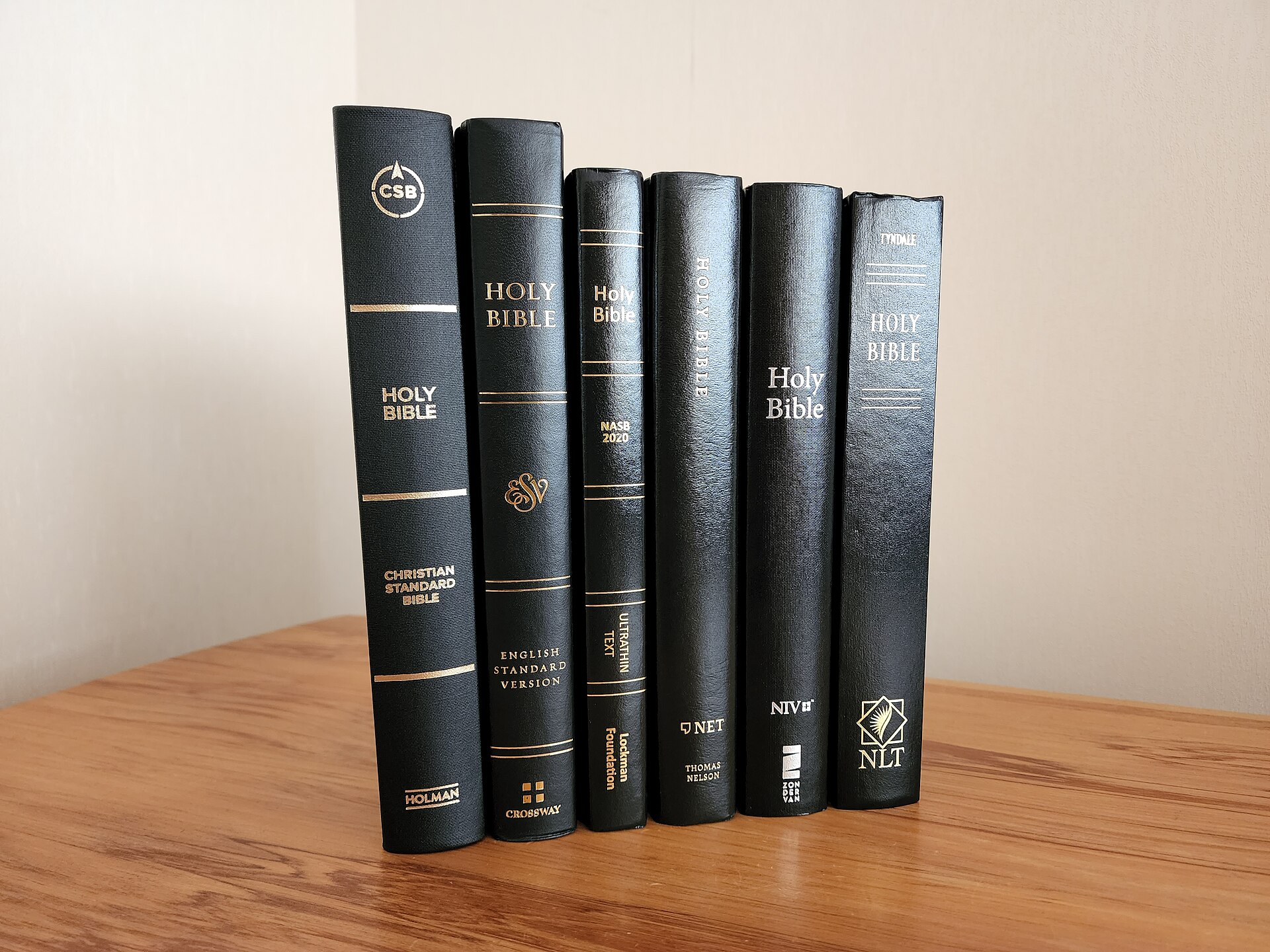
A reader who walks into a bookstore or opens a Bible app meets dozens of English versions. Bible Gateway, one of the largest free Bible websites, lists in its English menu the King James Version, the American Standard Version, the New American Standard Bible in its 1995 and 2020 forms, the New King James Version, the English Standard Version, the New International Version, the Christian Standard Bible, the Revised Standard Version, Young's Literal Translation, the World English Bible, The Message, the Living Bible and many more.1 Each claims to be faithful. They do not all say the same thing in the same words, and in a few hundred places they do not even translate the same Hebrew or Greek text.
The earlier lessons of this module explain why. Lesson 01 and lesson 02 describe the manuscripts. Lesson 05 tells how the printed Greek text called the Textus Receptus came to be, and lesson 08 sets out the debate between that text, the Majority Text and the modern critical text. Lesson 12 explains formal and dynamic equivalence, and lesson 14 separates translation from paraphrase. Those lessons give the history. A reader still has to decide what to read on Sunday morning and what to study on Tuesday night, and needs a way to test a claim when a preacher, a website or a study Bible says "the Greek really means" something.
A ranking would give an answer that holds only as long as the reader trusts the person who made it. A method lets the reader check the answer. The steps below rely on two kinds of evidence that anyone can read: what each translation committee says it did, in its own words, and what the Hebrew and Greek texts and manuscripts show. Where scholars disagree, the lesson says so and names them.

Step 1: Read the preface and the translation notes
What a preface is and why it comes first
Almost every serious translation of the Bible opens with a statement from the translators or publisher: a preface, an introduction, a "to the reader" or, on a website, an "about" page. Many readers skip it. It is the single most useful page in the book, because it is where the translators say, in their own words, what they set out to do. Everything else in this lesson is a way of checking whether they did it.
The custom is old. The translators of the King James Version of 1611 wrote a long preface, "The Translators to the Reader," usually credited to Miles Smith (the story of that preface is in lesson 07). It is still worth reading as a guide to how translators think. They said they had never set out to make a new translation from nothing: "we never thought from the beginning, that we should need to make a new Translation, nor yet to make of a bad one a good one ... but to make a good one better, or out of many good ones, one principal good one, not justly to be excepted against."2 They defended the practice of comparing translations: "as S. Augustine saith, that variety of Translations is profitable for the finding out of the sense of the Scriptures." And they defended printing alternative renderings in the margin where the meaning was uncertain, saying such notes "must needs do good, yea, is necessary, as we are persuaded."2
The same preface warned readers not to expect one English word for every Hebrew or Greek word: "we have not tied ourselves to an uniformity of phrasing, or to an identity of words, as some peradventure would wish that we had done."2 That sentence matters for step 4 below. A concordance shows that one Greek word may stand behind several English words in the King James Version, and the 1611 preface explains that the translators did this on purpose.
The quotations above come from the modernized-spelling text of the preface published at bible-researcher.com. The 1611 printing used older spelling, and a reader who wants the original can find facsimiles of the 1611 edition in libraries and online.
Seven questions to ask any preface
A preface can be read with a short list of questions in hand. The infographic below sets them out, and the paragraphs after it show how real prefaces answer them.
- Who translated it? One person, a committee, or a committee working for a publisher? Of what church background? A one-man version (such as Young's Literal Translation or the Living Bible) is a different kind of book from a committee version.
- From which Hebrew text? Most English Old Testaments follow the Masoretic text, usually in the printed edition called Biblia Hebraica Stuttgartensia (BHS), which is based on the Leningrad Codex. The preface should say when and why the translators departed from it (for a reading in the Dead Sea Scrolls or the Septuagint, for example).
- From which Greek text? The Textus Receptus (as in the KJV and NKJV), the Majority or Byzantine text (as in the World English Bible's New Testament), or the critical text of the Nestle-Aland and United Bible Societies editions (as in the NASB, ESV, NIV and most modern versions)?
- By what method? Formal equivalence ("word for word," "essentially literal," "complete equivalence") or dynamic or functional equivalence ("thought for thought"), or paraphrase? What words does the preface itself use?
- What do the signals mean? Italics, brackets, small capitals, capitalized pronouns for God, the form of the divine name (LORD, Jehovah, Yahweh), and the code words in the footnotes.
- How does it handle disputed passages? Are passages such as Mark 16:9 to 20 and John 7:53 to 8:11 printed in the text, in brackets, or moved to a note? (The evidence for each is in lesson 08.)
- Which edition is this, and who owns it? Many versions have been revised several times under the same name. The copyright page gives the dates of each revision and the owner, which also tells a reader how much may be quoted.
How real prefaces answer the questions
The American Standard Version (1901). The American revisers wrote a preface that explains each change they made from the English Revised Version, which makes it a model of disclosure. On the divine name they were blunt. They replaced "LORD" and "GOD" with "Jehovah" because, they wrote, they had come to "the unanimous conviction that a Jewish superstition, which regarded the Divine Name as too sacred to be uttered, ought no longer to dominate in the English or any other version of the Old Testament."3 On the margin they said they had dropped most of the English revisers' references to ancient versions and "retained a little more than one-sixth" of them.3 A reader of the ASV therefore knows two things from the preface: why "Jehovah" appears on almost every page of its Old Testament, and that its marginal notes on the Hebrew text are selective. (The story of the Revised Version and the ASV is in lesson 09.)
The New American Standard Bible (1995). The NASB preface opens with the Lockman Foundation's "Fourfold Aim," which says in part that its publications "shall be true to the original Hebrew, Aramaic, and Greek," "shall be grammatically correct," and "shall be understandable."4 It then explains its signals precisely: "Personal Pronouns are capitalized when pertaining to Deity. Italics are used in the text to indicate words that are not found in the original Hebrew, Aramaic, or Greek but are implied by it." Small capitals in the New Testament "are used in the text to indicate Old Testament quotations or obvious references to Old Testament texts." For the Greek text the 1995 preface says: "In most instances the 26th edition of Eberhard Nestle's Novum Testamentum Graece was followed."4 A reader who sees an italic word in the NASB is being told by the translators that the word was supplied in English. The worked example below shows that signal at work in John 1:18. (The NASB is the subject of lesson 10.)
The New King James Version (1982). The NKJV preface names its method "complete equivalence" and defines it: "This principle of complete equivalence seeks to preserve all of the information in the text, while presenting it in good literary form." It contrasts this with dynamic equivalence, which, it says, "commonly results in paraphrasing where a more literal rendering is needed to reflect a specific and vital sense."5 On the Greek text the preface explains that the editors "decided to retain the traditional text in the body of the New Testament and to indicate major Critical and Majority Text variant readings in the footnotes," and it adds that "fully eighty-five percent of the New Testament text is the same in the Textus Receptus, the Alexandrian Text, and the Majority Text."5 The NKJV's footnote system is described in step 5 below and in lesson 11.
The English Standard Version. The ESV preface calls the version "an 'essentially literal' translation that seeks as far as possible to reproduce the precise wording of the original text and the personal style of each Bible writer." It names its texts: "the Masoretic text of the Hebrew Bible as found in Biblia Hebraica Stuttgartensia (5th ed., 1997)" and the Greek text "in the 2014 editions of the Greek New Testament (5th corrected ed.), published by the United Bible Societies (UBS), and Novum Testamentum Graece (28th ed., 2012)." It also tells the reader how to treat its footnotes: they are "an integral part of the ESV translation, informing the reader of textual variations and difficulties."6 And it states a choice that a reader would otherwise have to guess at: "It has seemed best not to capitalize deity pronouns in the ESV," in part because "there is nothing in the original Hebrew and Greek manuscripts that corresponds to such capitalization."6 The NASB and the ESV thus make opposite choices on capital letters for "He" and "Him," and each preface says so.
The New International Version. The NIV's publisher describes its method on its website: "The NIV translators take great care to balance accuracy, readability, and clarity using global English as it is spoken today," and says the NIV "is translated by an independent, self-governing team of Bible scholars using the oldest and most reliable Bible manuscripts available today."7 The phrase "oldest and most reliable" is itself a position in the textual debate described in lesson 08, and a careful reader notes it as such. The NIV's own preface, its committee and its method are described in lesson 12, and the argument against its choices is made in lesson 13.
The Berean Standard Bible. The BSB is a recent version whose text, its publisher says, was "officially placed into the public domain as of April 30, 2023."8 Because it is in the public domain it can be quoted in full, which is why this lesson uses it beside the King James Version. Its publisher lists the abbreviations used in its footnotes, among them NA (Nestle-Aland), SBL (the Society of Biblical Literature Greek New Testament), ECM (the Editio Critica Maior), WH (Westcott and Hort), BYZ (the Byzantine Textform), TR (Scrivener's Textus Receptus and Stephanus's), MT (the Masoretic text in the Westminster Leningrad Codex and in Biblia Hebraica Stuttgartensia), DSS (the Dead Sea Scrolls) and LXX (the Septuagint).9 A reader of the BSB footnotes can therefore tell exactly which printed edition supports each alternative.
The World English Bible. The WEB is a public domain update of the ASV. Its website says it "is based on the American Standard Version of the Holy Bible first published in 1901," on the BHS Old Testament, and on "a combination of the original ASV source text choices and the Greek Majority Text New Testament."10 That makes it one of the few modern English versions whose New Testament leans on the Majority Text, which is why it so often agrees with the King James Version on disputed readings while using modern English.
Young's Literal Translation. Bible Gateway's note on its YLT text says it "is from the 1898 Young's Literal Translation by Robert Young who also compiled Young's Analytical Concordance," and calls it "an extremely literal translation that attempts to preserve the tense and word usage as found in the original Greek and Hebrew writings."11 It is the work of one man, and its literalness sometimes produces English that no one speaks, as the comparison below shows. That is its value for study: it lets an English reader see the order and tense of the original more nearly.
The signals on the page
Once the preface has been read, the page itself becomes easier to read. The most common signals are these:
- Italics. In the KJV, the NKJV and the NASB, italic words were supplied by the translators to make sense in English. The NASB preface says so in the sentence quoted above.4 Many readers take italics for emphasis, which is the opposite of what they mean in these Bibles. A word in italics is the translators' word, printed so that the reader can see it.
- Brackets. Several modern versions put brackets or a line around passages whose place in the original text the editors doubt. How each version marks Mark 16:9 to 20 and John 7:53 to 8:11 is shown in lesson 08.
- Capitals for the divine name. "LORD" in small capitals stands for the Hebrew name YHWH in most English versions. The ASV printed "Jehovah," for the reason its preface gives.3
- Capitalized pronouns. The NASB capitalizes pronouns referring to God; the ESV does not. Neither practice comes from the manuscripts, as the ESV preface points out.6 A capital "He" is an interpretation by the translators of who is meant.
- Footnote code words. "Or" introduces another possible translation of the same text. "Lit" or "Greek" gives a more literal rendering. "Some manuscripts," "NU," "M," "TR," "BYZ" and similar words point to a different underlying text. Step 5 decodes them.
Step 2: Compare one passage across versions
Choosing a test passage
Reading a preface tells a reader what a committee intended. Comparing a passage shows what it did. The best test passages are short, well known and known to differ: a verse where the Greek or Hebrew text is disputed, a verse with a hard word, or a verse that carries doctrinal weight. A good habit is to choose three or four such verses and read them in every version under consideration, side by side.
The public domain versions can be quoted and compared in full without limit: the King James Version, the American Standard Version (1901), Young's Literal Translation, the World English Bible and the Berean Standard Bible (dedicated to the public domain in 2023). Copyrighted versions (the NASB, NKJV, ESV, NIV and others) can be read freely on their publishers' sites and on Bible Gateway, and a verse or two can be quoted for comparison with credit, which is what this lesson does.
John 1:18 in ten versions
John 1:18 is the last verse of the prologue of John's Gospel. Here it is in ten English versions, copied word for word from Bible Gateway and Bible Hub. The footnote attached to the verse in each version is given after it.
| Version | John 1:18 | The version's own footnote on the verse |
|---|---|---|
| King James Version (1769 Oxford text) | No man hath seen God at any time, the only begotten Son, which is in the bosom of the Father, he hath declared him.12 | None |
| American Standard Version (1901) | No man hath seen God at any time; the only begotten Son, who is in the bosom of the Father, he hath declared him.13 | "Many very ancient authorities read God only begotten." |
| Young's Literal Translation (1898) | God no one hath ever seen; the only begotten Son, who is on the bosom of the Father -- he did declare.14 | None |
| World English Bible | No one has seen God at any time. The only born Son, who is in the bosom of the Father, has declared him.15 | On "only born": "The phrase 'only born' is from the Greek word 'μονογενη', which is sometimes translated 'only begotten' or 'one and only'." On "Son": "NU reads 'God'." |
| Berean Standard Bible | No one has ever seen God, but the one and only Son, who is Himself God and is at the Father's side, has made Him known.16 | "Or but the only begotten God, who; BYZ and TR but the only begotten Son, who" and "Greek in the Father's bosom" |
| New King James Version | No one has seen God at any time. The only begotten Son, who is in the bosom of the Father, He has declared Him. (NKJV, copyright Thomas Nelson)17 | "NU God" |
| New American Standard Bible 1995 | No one has seen God at any time; the only begotten God who is in the bosom of the Father, He has explained Him. (NASB 1995, copyright The Lockman Foundation)18 | No textual note shown on Bible Gateway (cross references only) |
| New American Standard Bible 2020 | No one has seen God at any time; God the only Son, who is in the arms of the Father, He has explained Him. (NASB 2020, copyright The Lockman Foundation)19 | On "arms": "Lit chest; or possibly lap." On "explained": "I.e., given a detailed account of" |
| English Standard Version | No one has ever seen God; God the only Son, who is at the Father's side, he has made him known. (ESV, copyright Crossway)20 | "Or seen God; the only God who; some manuscripts seen God; the only Son, who (see verse 14)" and "Greek in the bosom of the Father" |
| New International Version 2011 | No one has ever seen God, but the one and only Son, who is himself God and is in closest relationship with the Father, has made him known. (NIV 2011, copyright Biblica, Inc.)21 | "Some manuscripts but the only Son, who" |
Two cautions about the table. The ESV text shown is the one Bible Gateway labels "ESV Text Edition: 2025"; earlier printings of the ESV may differ, which is one more reason to check the edition on the copyright page (question 7 of the checklist).20 And the KJV text on Bible Gateway and most websites is the Oxford text of 1769 with modern spelling, not the spelling of the 1611 printing (lesson 07).
The reader who lines up these ten renderings can see three different things going on.
First, a difference in the underlying Greek text. The KJV, YLT, WEB and NKJV say "Son." The NASB 1995 says "God." The NIV 2011, the BSB, the current ESV text and the NASB 2020 say both "Son" and "God," and the ESV's footnote shows that "the only God" is another way to translate the reading it follows. The footnotes tell the reader why: the ASV's note says "Many very ancient authorities read God only begotten," the NKJV's says "NU God" (that is, the Nestle-Aland and United Bible Societies text reads "God"), the WEB's says "NU reads 'God'," and the BSB's says that "BYZ and TR" (the Byzantine text and the Textus Receptus) read "Son." So there are two Greek readings here, and the versions follow different ones.
Second, a difference in how the same Greek word is translated. The Greek word behind "only begotten" is monogenes. The KJV, ASV, YLT, NKJV and NASB 1995 render it "only begotten," the WEB "only born," the BSB and NIV "one and only," the ESV and NASB 2020 "only." The WEB's footnote names the word and gives the three common renderings. This is a question of translation and lexicon, not of manuscripts. Step 4 shows how to look it up.
Third, a difference in how much the translators add. The NIV 2011 and BSB read "who is himself God," and the NIV reads "is in closest relationship with the Father" where the KJV reads "is in the bosom of the Father." The NASB 2020 prints "Son" in italics, which by its own rule means the word is supplied and not in the Greek it follows.4 The NASB 1995 prints "Him" in italics at the end for the same reason. The BSB and ESV footnotes add "Greek in the Father's bosom" or "Greek in the bosom of the Father," which tells the reader that their text has turned a Greek figure of speech into plainer English. These are the choices that formal and dynamic equivalence describe (lesson 12).
A comparison like this does not by itself say which version is right. It tells the reader exactly what to check next: which Greek reading is better supported (step 3 and step 5), and what monogenes means (step 4).
Two kinds of difference, and why sorting them comes first
Nearly every difference between two careful translations belongs to one of two kinds. A textual difference means the translators were working from different Hebrew or Greek words, because the manuscripts differ at that point and the editions behind the versions chose differently. A translational difference means the translators had the same Hebrew or Greek words in front of them and chose different English to represent them.
The NKJV preface makes a strong claim about which kind matters more: "Bible readers may be assured that the most important differences in English New Testaments of today are due, not to manuscript divergence, but to the way in which translators view the task of translation."5 Whether or not a reader accepts that judgment, the two kinds call for different tools. A textual difference sends the reader to the editions and manuscripts. A translational difference sends the reader to the grammar, the lexicon and the concordance. The footnotes usually tell which kind is in play: "Or" and "Lit" signal translation, while "some manuscripts," "NU," "M," "TR" and "BYZ" signal text.
Step 3: Check the Hebrew and Greek with free tools
A generation ago, looking at the Greek or Hebrew behind an English verse required a shelf of expensive books. Today several free websites put the original text, word-by-word glosses, grammatical tags, dictionary entries and even photographs of ancient manuscripts within reach of anyone with a browser. Each tool described below was opened and tested for this lesson in October 2026, and each description says what the tool actually showed. Websites change, so a reader should expect some menus and addresses to move.
Blue Letter Bible
The Blue Letter Bible (blueletterbible.org) is a free study site best known for tying the King James Version to Strong's numbers. Its page for John 1:18 in the KJV prints the verse and, in its chapter view, places a Strong's number after each English word (for example "Son G5207"), and offers tabs for each verse that open interlinear Bibles, cross-references, commentaries, dictionaries and other tools.22 A click on a Greek word leads to a lexicon page. The page for monogenes (Strong's G3439) gives the Greek word, its transliteration and pronunciation, a count of how the KJV translates it ("only begotten (6x), only (2x), only child (1x)"), Strong's own short definition, and the full entry from Thayer's Greek-English Lexicon.23 The same site has Hebrew lexicon pages keyed to the Westminster Leningrad Codex. The addresses of these lexicon pages themselves show which text they follow: the Greek page used here ends in "kjv/tr" (the Textus Receptus) and the Hebrew page in "kjv/wlc" (the Westminster Leningrad Codex).23
What it is good for: finding every place a Hebrew or Greek word occurs, seeing how the KJV rendered it each time, and reading the older public domain lexicons. What to watch: the default Greek text behind the KJV pages is the Textus Receptus, so a reader comparing a modern version must remember that a word may be missing or different in the text that version translated.
Bible Hub: the interlinear and the parallel Greek and Hebrew texts
Bible Hub (biblehub.com) offers two pages that are especially useful for this method. Its interlinear page for John 1:18 sets out each Greek word with its Strong's number, its transliteration, an English gloss and a grammatical code. For the key words of this verse it shows: "3439 monogenēs μονογενὴς [the] only-begotten Adj-NMS" followed by "2316 Theos Θεὸς , God N-NMS."24 In other words, the Greek line of this interlinear follows the reading "God" (monogenes theos), the reading of the critical text. A reader who opened only this page could come away thinking that the Greek simply says "only begotten God," without knowing that the Greek printed behind the KJV says something else.
The cure is Bible Hub's second page, "Parallel Greek Texts" (biblehub.com/texts/john/1-18.htm). It prints the verse in nine printed editions of the Greek New Testament, one under another. For John 1:18 it shows that the SBL Greek New Testament (2010), Nestle's 1904 text and Westcott and Hort (1881) read μονογενὴς θεὸς (monogenes theos, "only begotten God" or "the only God"), while the Robinson-Pierpont Byzantine Majority Text (2005), the Greek Orthodox Church's text of 1904, Tischendorf's eighth edition, Scrivener's Textus Receptus (1894) and Stephanus's Textus Receptus (1550) read ὁ μονογενὴς υἱός (ho monogenes huios, "the only begotten Son").25 The same site has a matching page of parallel Hebrew texts, which for Isaiah 7:14 prints the Westminster Leningrad Codex with vowels and accents, the same text in consonants only, and the Aleppo Codex.26
What it is good for: seeing at a glance whether the printed Greek editions agree at a given verse. If all nine editions agree, any difference among English versions is a matter of translation. If they disagree, the difference is textual, and the reader knows which editions stand on each side.


STEPBible from Tyndale House, Cambridge
STEPBible (stepbible.org; the letters stand for Scripture Tools for Every Person) is a free study site. Its own user guide says it is "created and supported by Bible scholars at Tyndale House, Cambridge," the biblical research library in Cambridge, England, with help from volunteers and partner organizations.27 The guide lists among its features original-language text shown "as Hebrew/Greek, transliteration, with grammar or English glosses," several interlinear displays, and vocabulary that can be viewed for a verse by hovering over the verse number. It describes its Greek dictionary as an enhanced Liddell-Scott-Jones based on the ninth edition, and its Hebrew dictionary as an abridged Brown-Driver-Briggs with a fuller version in preparation.27 When opened for this lesson the site loaded with Genesis 1 in the ESV as its default.
What it is good for: reading an English version and the original side by side, with each word linked to a dictionary entry, without leaving the page. What to watch: the default English text is a copyrighted modern version, and a reader should check which Greek or Hebrew text the chosen display follows before drawing conclusions about a disputed verse.
The Open Scriptures Hebrew Bible
For the Old Testament the most open resource is the Open Scriptures Hebrew Bible (hb.openscriptures.org, with its data at github.com/openscriptures/morphhb). Its home page describes the aim of joining four things: "the text of the Hebrew Bible," a lexicon, morphology (the grammatical analysis of every word) and cantillation (the Masoretic accent marks). It states its licensing plainly: "Lemma and morphology data are licensed under a Creative Commons Attribution 4.0 International license," and "The text of the WLC remains in the Public Domain."28 WLC is the Westminster Leningrad Codex, a digital text of the Leningrad Codex of about 1008, the oldest complete Hebrew Bible, whose history is told in lesson 01. Because the text is public domain and the analysis is openly licensed, much of the Hebrew data in other free Bible software traces back to this project.
What it is good for: seeing each Hebrew word divided into its prefix, root and suffix, with its grammatical parsing and the accent marks that show how the Masoretes divided the verse. A reader who has worked through the vowel points in Hebrew lesson 02 can follow the pointed text directly.
Seeing the manuscripts themselves
Printed editions and interlinears report what the manuscripts say. Several libraries and research centers now let anyone look at the manuscripts directly.
- The Codex Sinaiticus Project (codexsinaiticus.org). Codex Sinaiticus (siglum א, aleph) is a fourth-century Greek Bible whose surviving leaves are divided among four places: London, Leipzig, St Petersburg and St Catherine's Monastery at Sinai. The project describes itself as "an international collaboration to reunite the entire manuscript in digital form." Its pages explain that every leaf was photographed in standard light and also under raking light to show the physical surface, and that the text was transcribed by the Institute for Textual Scholarship and Electronic Editing at the University of Birmingham, "a uniquely detailed digital transcription of a Biblical codex."29 The manuscript viewer uses a dynamic page that some automated tools cannot load, so a reader should open it in an ordinary browser. The story of the codex is in lesson 02.
- Codex Vaticanus at the Vatican Library (digi.vatlib.it, shelfmark Vat.gr.1209). The Vatican Apostolic Library's digital library serves page images of Codex Vaticanus (siglum B), the fourth-century codex that is one of the two chief witnesses of the critical text. The page for the manuscript loaded when tested for this lesson.30
- The New Testament Virtual Manuscript Room (ntvmr.uni-muenster.de). Run by the Institute for New Testament Textual Research (INTF) at the University of Munster, which keeps the official register (the "Liste") of Greek New Testament manuscripts, the NTVMR describes itself in one sentence: "This site is devoted to the study of Greek New Testament manuscripts." It offers manuscript images, transcriptions and catalog data, and it invites registered users to help index and transcribe manuscripts.31 It is the place to look up a manuscript by its Gregory-Aland number (P66, 01, 03 and so on) and see what pages survive.
- The Center for New Testament Textual Studies (CNTTS). The H. Milton Haggard Center for New Testament Textual Studies at New Orleans Baptist Theological Seminary, founded in 1998, has built a large database of manuscript variants called the CNTTS New Testament Critical Apparatus.32 This lesson's check found that the apparatus is not a free website. The center's page says it "is available on all major Bible software platforms," naming BibleWorks and Accordance modules.32 A reader who already owns one of those programs can use it; a reader without one should start with the free resources above.
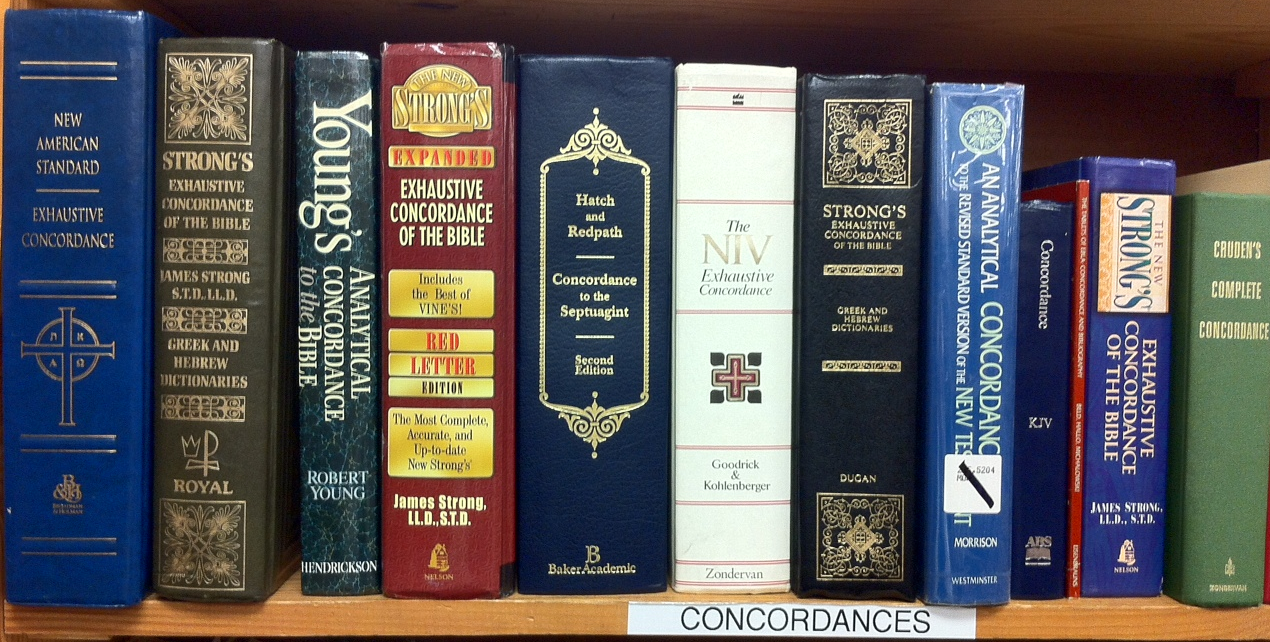
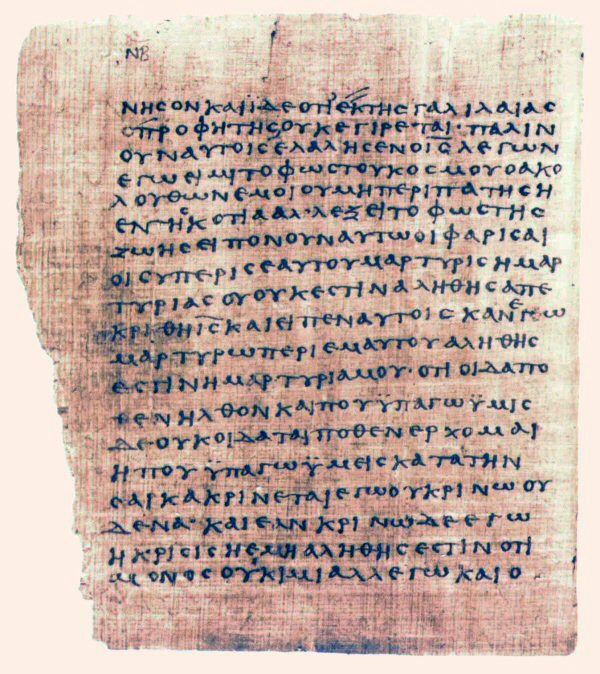
Two cautions apply to all of these. First, reading a manuscript takes practice: the great codices are written in capital letters without spaces between words, and they abbreviate sacred names such as "God," "Lord," "Jesus" and "Son" with two letters and a line above them (these abbreviations are called the nomina sacra). Greek lesson 01 introduces the letter forms. Second, a single manuscript shows what one scribe wrote, not what the original said. The weight of a reading depends on how many independent witnesses support it, how early they are, and how well the reading explains the others, which is the subject of lesson 08.
What an interlinear can and cannot do
An interlinear is a powerful tool and an easy one to misuse. It can show which Greek or Hebrew word stands behind an English word, in what form (case, tense, person, number), and in what order the words come. It cannot tell a reader what a sentence means, because meaning in any language depends on grammar and context, not on stringing glosses together. The YLT rendering of John 1:18, "God no one hath ever seen," shows what happens when Greek word order is carried straight into English: the sentence is accurate but awkward, and a reader has to rearrange it in his head.14 The glosses under the words are also choices made by the interlinear's editor. Bible Hub's gloss for monogenes is "[the] only-begotten," with the bracket showing a supplied article; another interlinear could gloss the same word "only" or "unique."24 An interlinear is therefore best used to answer narrow questions ("Which Greek word is this? Is it the same word as in verse 14?") and not as a translation in its own right.
Step 4: Use a concordance and the lexicons
What a concordance does
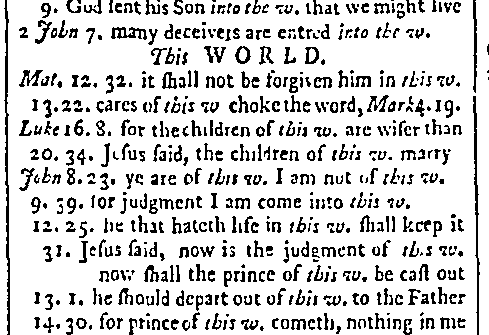
A concordance is an alphabetical index of the words of a book, listing every place each word occurs. For Bible readers it answers the question every word study begins with: where else is this word used, and how is it translated there? Before computers, concordances were the heaviest books on a pastor's shelf.
The best known English Bible concordance before Strong's was Alexander Cruden's A Complete Concordance to the Holy Scriptures of the Old and New Testament, keyed to the King James Version. The Internet Archive holds a copy whose title page is dated 1738 and a copy of "The third edition, with some improvement," dated 1769.33 Robert Young, the translator of Young's Literal Translation, also compiled an Analytical Concordance, as Bible Gateway's note on the YLT mentions.11

Strong's Exhaustive Concordance (1890)
James Strong (1822 to 1894) was a Methodist layman who served as Professor of Exegetical Theology at Drew Theological Seminary from 1868 to 1893 and was a member of the Anglo-American Bible Revision Committee behind the Revised Version (lesson 09), according to the Drew University Library's guide to his papers.34 He published The Exhaustive Concordance of the Bible in 1890. The title page of the first edition, as catalogued by the Internet Archive, describes the book as "showing every word of the text of the common English version of the canonical books, and every occurrence of each word in regular order; together with A comparative concordance of the authorized and revised versions, including the American variations; also brief dictionaries of the Hebrew and Greek words of the original, with references to English words," and gives the publishers as Hunt and Eaton of New York and Cranston and Curts of Cincinnati.35 The "common English version" is the King James Version. The book is in the public domain.
Strong's lasting invention was a numbering system. Each Hebrew word in his Hebrew dictionary and each Greek word in his Greek dictionary received a number, and each line of the concordance carried the number of the original word behind the English. That is why free websites still tag words with "G3439" or "H5959": the "G" and "H" stand for Strong's Greek and Hebrew dictionaries, and the number is his. A reader who does not know Greek can use the number to find every verse where the same Greek word stands, even when the KJV translators rendered it with different English words, which, as their preface said, they often did on purpose.2
Strong's dictionary entries are brief, and they show their purpose. The entry for G3439 reads, as reproduced on the Blue Letter Bible: "μονογενής monogenḗs, mon-og-en-ace'; from G3441 and G1096; only-born, i.e. sole," and then, after a dash that marks the list of KJV renderings, "only (begotten, child)."23 The entry tells the reader where Strong thought the word came from (monos, "only," and the verb ginomai, G1096, "to become" or "to be born"), gives a short meaning, and then lists how the KJV translated it. A Strong's entry is an index to the King James Version, not a full lexicon. The James Strong portrait below dates from his years as a professor.


The public domain lexicons: Thayer and Brown-Driver-Briggs
A lexicon is a dictionary of a language that gives the range of meanings of each word with examples. Two older lexicons are in the public domain and appear on almost every free Bible site.
Thayer's Greek-English Lexicon. Joseph Henry Thayer (1828 to 1901) translated, revised and enlarged the Latin New Testament lexicon of Carl Ludwig Wilibald Grimm, itself a revision of Christian Gottlob Wilke's Clavis Novi Testamenti. The Internet Archive holds Harper and Brothers printings dated 1887 and American Book Company printings dated 1889 under the title A Greek-English Lexicon of the New Testament, being Grimm's Wilke's Clavis Novi Testamenti.36 Its entry for monogenes begins: "single of its kind, only, [A. V. only-begotten]; used of only sons or daughters (viewed in relation to their parents)," and it cites Greek writers from Hesiod and Herodotus to Josephus before turning to the New Testament, where its first example is Hebrews 11:17.23 (A. V. means the Authorized Version, the KJV.)
Brown, Driver and Briggs. A Hebrew and English Lexicon of the Old Testament by Francis Brown, S. R. Driver and Charles A. Briggs, based on the lexicon of Wilhelm Gesenius as translated by Edward Robinson, was published in 1906 by Houghton Mifflin in Boston and the Clarendon Press in Oxford, according to the Internet Archive's records of its copies.37 It is usually called BDB. Its entries are arranged by Hebrew root, which makes it hard for a beginner to use without help, and the free websites solve that by linking each word to its entry.
Both lexicons are more than a century old. Thayer worked before the great finds of Greek papyri from Egypt changed scholars' knowledge of everyday Greek, and BDB before the discovery of the Ugaritic texts and the Dead Sea Scrolls. Their entries remain useful, but a reader should treat them as a careful first opinion and not as the last word. The current standard lexicons (for Greek, the Bauer-Danker lexicon known as BDAG; for Hebrew, the lexicon of Koehler and Baumgartner known as HALOT) are copyrighted and sold, and are not needed for the method in this lesson. The Hebrew and Greek modules on this site each have a lesson on reading a lexicon entry: Greek lesson 20 and Hebrew lesson 20.
Doing a word study carefully
A word study done well follows the evidence of usage. Take monogenes. The Blue Letter Bible's count shows the word nine times in the Greek text behind the KJV, translated "only begotten" six times, "only" twice and "only child" once.23 Thayer's first New Testament example is Hebrews 11:17, which the KJV renders: "By faith Abraham, when he was tried, offered up Isaac: and he that had received the promises offered up his only begotten son."12 The BSB renders the same clause "He who had received the promises was ready to offer his one and only son."38 Genesis records that Abraham had another son, Ishmael, so in Hebrews 11:17 the word cannot mean simply "the only child born to this father." Thayer's gloss, "single of its kind," fits that use: Isaac was the unique son of the promise.
That one example shows why the versions differ in John 1:18. Translators who stress the word's derivation from "only" and "born" keep "only begotten," a rendering the NKJV preface defends as part of its policy of considering "the history of usage and etymology of words in their contexts."5 Translators who stress usage, as in Hebrews 11:17, render "one and only" or "only" or "unique." Both sides appeal to evidence; a reader who has looked up the word can see what the evidence is and weigh it. The same word study shows the limit of the tools. Strong's and Thayer report meanings and uses; they do not settle the theological question of what "begotten" means when said of the Son, which belongs to the creeds and to doctrine, and which Church History lesson 04 on Nicaea treats.
Three rules keep a word study honest. First, meaning comes from use in context, not from the parts of a word, just as an English "butterfly" is neither butter nor a fly. Second, a word does not carry all of its possible meanings into every sentence; the context selects one. Third, when a lexicon gives a meaning, check its examples, and when a preacher gives a meaning, ask for the lexicon.

Step 5: Read the footnotes on textual variants
Decoding the footnotes
The footnotes of a modern Bible are short, and they use code. Once the code is known, they become a summary of the textual evidence printed at the foot of the page. The table below collects the code words found in the footnotes quoted in this lesson and the meanings the versions themselves give them.
| Footnote wording | Where it appears | What it means |
|---|---|---|
| "Or ..." | ESV, ASV, NASB, BSB and most versions | Another possible translation of the same Hebrew or Greek. A translational note, not a textual one. |
| "Lit ..." or "Greek ..." | NASB ("Lit chest"), ESV and BSB ("Greek in the bosom of the Father") | A more literal rendering of words the text has put in plainer English. |
| "Some manuscripts ..." | NIV, ESV | A different reading found in some manuscripts. The note does not say which manuscripts, how many or how old. |
| "Many very ancient authorities read ..." | ASV (1901), following the Revised Version | A reading the revisers judged early and well supported but did not put in the text. |
| "NU" or "NU-Text" | NKJV, WEB | The critical text of the Nestle-Aland (N) and United Bible Societies (U) editions. The NKJV preface defines it as the reading "found in the Critical Text published in the twenty-sixth edition of the Nestle-Aland Greek New Testament (N) and in the United Bible Societies' third edition (U)."5 |
| "M" or "M-Text" | NKJV | The Majority Text. The NKJV preface says "M stands for whatever reading is printed in the published Greek New Testament According to the Majority Text."5 |
| "TR," "BYZ," "NA," "SBL," "WH," "ECM" | BSB | The printed editions named in the BSB's list of abbreviations: Textus Receptus, Byzantine Textform, Nestle-Aland, SBL Greek New Testament, Westcott and Hort, Editio Critica Maior.9 |
| "MT," "DSS," "LXX," "SP" | BSB and other versions in the Old Testament | Masoretic text, Dead Sea Scrolls, Septuagint, Samaritan Pentateuch: the Old Testament witnesses described in lesson 01. |
Two things stand out. First, the notes differ in how much they say. "Some manuscripts" tells the reader that a variant exists but not whether it stands in two late copies or in the great majority. "NU" and "M" name the printed editions, which a reader can then look up. Second, the notes are not all neutral. The NKJV preface criticizes notes that grade the evidence: its own notes, it says, "make no evaluation of readings" and avoid "such tendentious remarks as 'the best manuscripts omit' or 'the most reliable manuscripts read.' Such notes are value judgments that differ according to varying viewpoints on the text."5 A reader does not have to agree with the NKJV's choice of base text to see the point: a footnote that says "the earliest and most reliable manuscripts" is already making an argument, and a footnote that says "NU" is reporting a source.
What footnotes cannot tell
Footnotes are selective. Every version prints only the variants its editors judged significant; the thousands of small differences in spelling and word order that fill a full critical apparatus are left out, as the NKJV preface explains of variations in spelling and word order: "These ordinarily do not show up in translation and do not affect the sense of the text in any way."5 Footnotes also vary between editions of the same version. The NASB 1995 page for John 1:18 on Bible Gateway shows no textual note at all, while the 2020 text shows only translation notes.1819 A reader who wants the full evidence has to go behind the footnote to the editions and manuscripts, which is what the worked example does.
Worked example: John 1:18 from start to finish
This section takes one verse through all five steps, in the order a reader at home would take them. The verse was chosen because the King James Version and most modern versions differ in it, and because the evidence on both sides can be seen with the free tools above.
Step 1 on John 1:18: what the prefaces lead a reader to expect
Before opening the verse, the prefaces already predict what will be found. The KJV and NKJV translate the Textus Receptus; the NKJV promises to footnote "major Critical and Majority Text variant readings."5 The NASB 1995 follows, "in most instances," the 26th edition of Nestle-Aland,4 and the ESV the 28th edition of Nestle-Aland and the fifth edition of the UBS text.6 The WEB's New Testament leans on the Majority Text.10 So if the printed Greek editions disagree at John 1:18, the reader should expect the KJV, NKJV and WEB on one side and the NASB and ESV on the other. That is exactly what the comparison in step 2 showed.
Step 2 on John 1:18: the comparison
The table in step 2 above showed two Greek readings ("Son" and "God") and several ways of rendering monogenes. It also showed three versions (NIV 2011, BSB, NASB 2020) and the current ESV text that combine "Son" and "God" in one phrase. Of these, the NASB 2020 is the most open about what it has done: it prints "Son" in italics, which by the Lockman Foundation's rule marks a word "not found in the original ... but ... implied by it."419 The NIV 2011 and BSB give no such signal in the text, though their footnotes show the alternative readings.1621
Step 3 on John 1:18: the Greek, edition by edition
Bible Hub's parallel Greek page answers the first question at once. The two readings are:
μονογενὴς θεὸς (monogenes theos), "only begotten God" or "the only God," printed by Westcott and Hort (1881), Nestle (1904) and the SBL Greek New Testament (2010).
ὁ μονογενὴς υἱός (ho monogenes huios), "the only begotten Son," printed by Stephanus (1550), Scrivener's Textus Receptus (1894), Tischendorf's eighth edition, the Greek Orthodox Church's text (1904) and the Robinson-Pierpont Byzantine Majority Text (2005).25
Two details are worth noticing. The two readings differ by one word and by the article ὁ ("the"): the "God" reading has no article. And Tischendorf, the discoverer of Codex Sinaiticus, printed "Son" in his eighth edition even though, as the apparatus evidence below shows, the first hand of his own codex reads "God." Editors who follow the same method can still weigh a passage differently.
A reader who has learned the Greek article in Greek lesson 07 can follow the next part of the argument, which turns on that missing article.
The manuscripts behind each reading
Printed editions are built from manuscripts. The standard way to report which manuscripts support which reading is a critical apparatus, which uses sigla: P plus a number for papyri, Hebrew aleph (א) for Codex Sinaiticus, capital letters for the other early parchment codices, numbers for later minuscules, and an asterisk for a manuscript's first hand before a later corrector changed it. The apparatus for John 1:18 can be read in summary on websites from both sides of the textual debate. A summary published at uasvbible.org, the website of the Updated American Standard Version, which favors the critical text, lists the evidence this way:39
- μονογενὴς θεὸς ("only begotten God," no article): P66, the first hand of Sinaiticus (א*), Codex Vaticanus (B), the first hand of Codex Ephraemi Rescriptus (C*), Codex Regius (L), the Syriac Peshitta and the Harclean margin, and some citations of Origen and Didymus.
- ὁ μονογενης θεος ("the only begotten God," with the article): P75, a corrector of Sinaiticus, minuscule 33, the Bohairic Coptic, and some citations of Clement of Alexandria and Origen.
- ὁ μονογενὴς υἱὸς ("the only begotten Son"): Codex Alexandrinus (A), a later corrector of C, W, K, Γ, Δ, Θ, Ψ, the minuscule families 1 and 13 and many other minuscules, the Byzantine majority, the Latin tradition, the Curetonian and Harclean Syriac, and some citations of Clement and others.
A website that defends the Textus Receptus, textus-receptus.com, agrees on the main alignment: it states that "P66 and P75 both read θεός," and it lists θεος for "a*, B, C*, L" and υιος for "a2, A, C3, W, Δ, Θ, Ψ" and the great majority of later manuscripts, together with the Old Latin, the Latin Vulgate and the Curetonian Syriac.40 The two summaries differ on small points (for example, on which corrector of Sinaiticus is meant), but on the main facts the two sides agree: the oldest Greek copies of this verse read "God," and the great majority of all Greek copies, with the Latin, read "Son."
The manuscripts on the "God" side include the two oldest Greek copies of John 1. P75, a papyrus codex of Luke and John formerly kept at the Bibliotheca Bodmeriana in Cologny, Switzerland, was given to the Vatican Apostolic Library in January 2007; the library describes it as "Copied in the early third century A.D."41 P66 is Papyrus Bodmer II, a papyrus codex of John. Their dates have been questioned: Brent Nongbri has argued in two articles ("The Limits of Palaeographic Dating of Literary Papyri: Some Observations on the Date and Provenance of P. Bodmer II (P66)," Museum Helveticum 71, 2014, and "Reconsidering the Place of Papyrus Bodmer XIV-XV (P75) in the Textual Criticism of the New Testament," Journal of Biblical Literature 135, 2016) that both could be as late as the fourth century, which would make them about as old as Sinaiticus and Vaticanus rather than older.42 On any of these dates the two papyri are among the earliest witnesses to the verse.

How the editors weighed the evidence, in their own words
Bruce Metzger's A Textual Commentary on the Greek New Testament explains why the committee of the United Bible Societies' Greek New Testament printed "God." The note on John 1:18 in the 1971 edition, as reproduced at bible-researcher.com, gives the reading a "{B}" rating (the committee's grade of its confidence) and says: "With the acquisition of P66 and P75, both of which read θεός, the external support of this reading has been notably strengthened. A majority of the Committee regarded the reading μονογενὴς υἱός, which undoubtedly is easier than μονογενὴς θεός, to be the result of scribal assimilation to Jn 3.16, 18; 1 Jn 4.9."43 The argument has two parts. The external part is the age of the witnesses. The internal part is that a scribe who knew John 3:16 ("For God so loved the world, that he gave his only begotten Son," KJV) would be more likely to change the unusual "only begotten God" to the familiar "only begotten Son" than the other way round.12 This is the canon "prefer the harder reading" described in lesson 08.
The committee was not unanimous. The same note ends with a bracketed dissent signed "A.W." (Allen Wikgren, a member of the committee): "It is doubtful that the author would have written μονογενὴς θεός, which may be a primitive, transcriptional error in the Alexandrian tradition (Υς/Θς). At least a {D} decision would be preferable."43 The letters Υς and Θς are the abbreviated nomina sacra for "Son" and "God." In a manuscript written in capitals, they differ by a single letter, so a scribe's slip from one to the other is easy to imagine in either direction. Defenders of the Textus Receptus make the same point and add the weight of numbers and of the Latin and Syriac evidence. They argue that the "God" reading belongs to a small group of related Egyptian manuscripts and should not outweigh the agreement of the church's copies across the centuries, the position described in lesson 08 and argued in lesson 13.
A reader working through this does not have to settle the question to learn something solid. Both readings call Jesus the monogenes. Both are in the same verse that ends with his making the Father known. The "God" reading makes the verse a direct statement of Christ's deity, parallel to John 1:1; the "Son" reading uses the title that John uses in 3:16 and 3:18. The choice is a real textual question, with evidence and serious scholars on both sides, and a reader who knows the evidence can follow any version's choice with open eyes.
Steps 4 and 5 on John 1:18: the word and the footnotes
Step 4 has already been taken in the word study above: monogenes, Strong's G3439, means "only-born, i.e. sole" in Strong's short definition and "single of its kind, only" in Thayer, and Hebrews 11:17 shows the word used of Isaac, who was not Abraham's only son.23 That explains the spread from "only begotten" to "one and only" in the English versions, and it is a separate question from the "Son" or "God" reading.
Step 5 completes the picture. The NKJV note "NU God" tells the reader that the Nestle-Aland and UBS text reads "God."17 The NIV note "Some manuscripts but the only Son, who" tells the reader that "Son" without "God" is found in some manuscripts, though it does not say that those manuscripts are the great majority.21 The BSB note names the editions on the other side, "BYZ and TR."16 The ESV note gives both a translational alternative ("the only God who") and a textual one ("some manuscripts ... the only Son").20 The ASV note, more than a century old, says "Many very ancient authorities read God only begotten," which was written when Sinaiticus, Vaticanus and C were known but before P66 and P75 had been found.1343 Read together, the notes say what the apparatus says. Read alone, any one of them leaves something out.
What the reader now knows
At the end of the five steps the reader knows, from the sources themselves, that John 1:18 has two main Greek readings; which manuscripts, editions and versions follow each; why the critical-text committee chose "God" and why one of its own members dissented; why defenders of the traditional text choose "Son"; that the word monogenes is translated in several ways for reasons of meaning, not of manuscripts; and how each version's footnote reports, or under-reports, the evidence. None of this required a seminary library. Every source used was free and open in a browser.
A Hebrew example: almah in Isaiah 7:14
The same method works in the Old Testament, where the difference is usually translational, because nearly all English versions follow the same Masoretic text. Isaiah 7:14 is a well-known test case. Here the Hebrew text is not in dispute: Bible Hub's parallel Hebrew page shows the same consonants in the Westminster Leningrad Codex and the Aleppo Codex, with the key phrase הנה העלמה הרה וילדת בן (hinneh ha-almah harah ve-yoledet ben), "behold, the almah [is or will be] with child and bearing a son."26 The question is what almah means and how to render it.
The comparison
- King James Version: "Therefore the Lord himself shall give you a sign; Behold, a virgin shall conceive, and bear a son, and shall call his name Immanuel."12
- American Standard Version (1901): "Therefore the Lord himself will give you a sign: behold, a virgin shall conceive, and bear a son, and shall call his name Immanuel." Its marginal notes give "Or, the" for "a," "Or, maiden" for "virgin," and "Or, is with child, and beareth" for "shall conceive." 44
- Young's Literal Translation: "Therefore the Lord Himself giveth to you a sign, Lo, the Virgin is conceiving, And is bringing forth a son, And hath called his name Immanuel,"44 the sentence running on into verse 15.
- World English Bible: "Therefore the Lord himself will give you a sign. Behold, the virgin will conceive, and bear a son, and shall call his name Immanuel."44
- Berean Standard Bible: "Therefore the Lord Himself will give you a sign: Behold, the virgin will be with child and give birth to a son, and will call Him Immanuel."38
- Revised Standard Version (1952): "Behold, a young woman shall conceive and bear a son," with the footnote "Or virgin." (RSV, copyright National Council of the Churches of Christ in the USA)45
The comparison shows a translational difference on one word, and the ASV and YLT also show that the Hebrew has the article ("the almah"), which the KJV and RSV render "a." The ASV margin, "Or, maiden," shows that the revisers of 1901 already saw the question that made the RSV's "young woman" a public controversy half a century later (lesson 09). The RSV, in turn, put "Or virgin" in its own footnote.
The tools on almah
The concordance and lexicons show why translators differ. Strong's dictionary, as reproduced on the Blue Letter Bible, gives H5959 as "a lass (as veiled or private)" and lists the KJV renderings; the site's count shows the word seven times in the Hebrew Old Testament, rendered "virgin (4x), maid (2x), damsels (1x)" in the KJV.46 Brown, Driver and Briggs, as reproduced on Bible Hub, defines it as "young woman (ripe sexually; maid or newly married)" and lists its uses, beginning with Genesis 24:43, Exodus 2:8, Proverbs 30:19 and Isaiah 7:14.47 A twentieth-century evangelical reference, the Theological Wordbook of the Old Testament (R. Laird Harris and others), is quoted on the Blue Letter Bible page: "There is no instance where it can be proved that 'almâ designates a young woman who is not a virgin."46
So the lexicons do not speak with one voice, and the reader can see exactly where they differ. A reader can then check each listed verse in context, as the method requires: Genesis 24:43 is said of Rebekah before her marriage to Isaac, and Exodus 2:8 of Moses's sister. The New Testament adds a further witness. Matthew 1:23 quotes Isaiah 7:14 with the Greek word parthenos, the word used in the Septuagint, a point treated in lesson 01. Nothing in this example required more than a free website and patience, and the reader ends with the evidence on the table and not a slogan.
The Hebrew tools also reward a little grammar. The form הָעַלְמָה breaks into the article ha- ("the") and almah, and the next word, הָרָה (harah), is tagged on Bible Hub's interlinear as a feminine singular adjective ("Adj-fs," Strong's H2030) describing a woman with child, which is why the ASV margin offers "is with child" and YLT "is conceiving."48 Reading such forms is the subject of Hebrew lesson 06 and Hebrew lesson 07.
The method as a decision flowchart
The five steps can be run as a set of questions. The flowchart below starts with a verse that reads differently in two versions and ends with a written note of what the evidence shows.
From tools to the languages
The tools in this lesson let a reader look over a translator's shoulder. They do not make the reader a translator. Sooner or later a reader who uses interlinears and lexicons regularly runs into questions only grammar can answer: why the missing article in John 1:18 matters, what a participle such as Hebrew yoledet ("bearing") implies about time, why one Greek tense is rendered "has seen" and another "declared." Two modules on this site teach enough of each language to read with a lexicon:
- Greek. Introduction to Classical Greek begins with the alphabet and handwriting (which helps with reading manuscript images), covers the article and agreement (the grammar behind the John 1:18 argument) and the aorist and the perfect (the two tenses in John 1:18), and ends with using a lexicon and reading aids and readings.
- Hebrew. Introduction to Classical Hebrew begins with the alphabet and the vowel points that the Masoretes added, explains roots and the verb stems (the key to using BDB, which is arranged by root), and ends with using a lexicon and reading aids and readings.
Even a few weeks in either module change how the free tools read. A grammatical tag such as "V-AIM-3S" on Bible Hub (the code it gives for exegesato, "has made known," in John 1:18) stops being noise and starts being information.24
Putting it together: choosing a Bible with the method
A reader choosing a Bible for regular use can apply the method in an afternoon. Pick two or three candidate versions. Read each preface with the seven questions. Choose four test passages that matter to the reader: one disputed passage (John 1:18, Mark 16:9 to 20 or 1 John 5:7 to 8 from lesson 08), one passage with a hard word (Isaiah 7:14 or Romans 8:4, where "flesh" and "sinful nature" are compared in lesson 12), one well-loved passage for English style (Psalm 23 or 1 Corinthians 13), and one passage on a doctrine the reader cares about. Read each in every candidate version, sort the differences into textual and translational, and use the tools to check two or three of them. Write down what was found.
Many readers end up with more than one Bible: a formal-equivalence version for study, perhaps another for reading aloud, and the free tools for checking both. The translators of 1611 recommended the same habit when they wrote that "variety of Translations is profitable for the finding out of the sense of the Scriptures."2 For a reader who wants guidance on particular versions, lesson 10 describes the NASB's formal equivalence, lesson 11 the NKJV's preservation of the KJV's wording and Greek text, and lesson 13 makes the case against the NIV and similar versions verse by verse, with the counter view. Lesson 16 reviews the whole module.
What the record shows and what it does not
- Documented fact: Every major English version states its base text and method in a preface or publisher statement, and those statements differ (Textus Receptus for the KJV and NKJV, Majority Text for the WEB's New Testament, Nestle-Aland and UBS for the NASB, ESV and NIV). The prefaces quoted in this lesson say so in their own words.
- Documented fact: At John 1:18 the printed Greek editions divide between "God" (Westcott and Hort, Nestle, SBL) and "Son" (Stephanus, Scrivener, Tischendorf 8, Robinson-Pierpont), and the apparatus summaries from both sides of the textual debate agree that P66, P75, Sinaiticus (first hand) and Vaticanus read "God" while Alexandrinus, the later majority and the Latin read "Son."
- Documented fact: Strong's concordance (1890), Thayer's lexicon (1880s) and BDB (1906) are in the public domain and are reproduced on free websites; the CNTTS critical apparatus is sold as a software module and is not a free website.
- A committee's judgment: The UBS committee's choice of "God" at John 1:18, graded {B} in Metzger's commentary, and the dissent of one of its own members, are judgments about evidence, stated by the scholars who made them.
- A publisher's claim: Phrases such as "the oldest and most reliable Bible manuscripts" (NIV) and "complete equivalence" (NKJV) are the publishers' descriptions of their own work, to be tested by comparison.
- Open question: The dates of P66 and P75 (about AD 200, or later as Brent Nongbri has argued), and whether age or number of witnesses should weigh more in a case like John 1:18, remain matters of scholarly debate.
Claims checked
"An interlinear Bible shows exactly what the original says."
Rating: Partly supported. An interlinear shows the words of one printed edition with an editor's gloss under each. Bible Hub's interlinear for John 1:18 prints monogenes Theos and glosses it "[the] only-begotten ... God," while its own parallel texts page shows that five of the nine printed editions it lists read "Son" instead.2425 An interlinear shows what one edition says, not what "the original" says where editions differ, and its glosses are translations.
"Strong's numbers tell you what a word really means."
Rating: Partly supported. Strong's numbers identify the word reliably, which is their great value. Strong's definitions are short and are tied to the King James Version: the entry for G3439 gives a derivation, a short meaning ("only-born, i.e. sole") and the list of KJV renderings.23 A word's meaning in a given verse comes from its use in context, which requires a full lexicon and reading the verses, as the monogenes example in Hebrews 11:17 shows.
"The King James translators held that only one English translation should be used."
Rating: Refuted. Their own preface says they aimed "to make a good one better, or out of many good ones, one principal good one," and quotes Augustine that "variety of Translations is profitable for the finding out of the sense of the Scriptures."2 Whatever a reader concludes about later versions, the 1611 translators did not make this claim for their own work.
"Every footnote in a modern Bible marks something that was removed."
Rating: Unsupported. Most footnotes are translational ("Or," "Lit," "Greek"), as the John 1:18 notes in the ESV, NASB 2020 and BSB show.161920 Textual notes do mark places where versions follow different readings, and some of those concern whole verses (lesson 08); others, as at John 1:18, concern a single word, and in the NKJV they mark readings the NKJV did not adopt.
"Modern versions remove the deity of Christ" (tested at John 1:18).
Rating: Refuted for this verse. At John 1:18 the critical-text versions read "God": the NASB 1995 "the only begotten God," the NIV 2011 "the one and only Son, who is himself God," the ESV "God the only Son."182021 Whatever the merits of that reading as a matter of text, it does not lower the verse's statement about Christ. Other verses where the claim is made are treated in lesson 13, which keeps to the claims that survive a check.
"The oldest manuscripts are the best manuscripts."
Rating: Unresolved. At John 1:18 the oldest Greek witnesses (P66, P75, Sinaiticus, Vaticanus) agree on "God," and the UBS committee counted their age heavily: "With the acquisition of P66 and P75 ... the external support of this reading has been notably strengthened."43 A member of the same committee thought the reading might be "a primitive, transcriptional error in the Alexandrian tradition."43 Defenders of the Majority Text and the Textus Receptus argue that the agreement of many later copies preserves an early text as well. Age is evidence; whether it outweighs number in a given place is the core of the debate in lesson 08.
"Free online Bible tools are not scholarly enough to use."
Rating: Partly supported. The free sites reproduce older public domain reference works (Strong, Thayer, BDB) whose scholarship is a century or more old, and their own glosses and summaries vary in quality. But some free resources come from scholarly institutions: STEPBible from Tyndale House, Cambridge; the NTVMR from the INTF at Munster; the Codex Sinaiticus Project with a transcription made at the University of Birmingham; and the Vatican Library's own images of Codex Vaticanus.27293031 The tools are only as good as the care with which they are used.
"Strong's Concordance was made for the King James Version."
Rating: Supported. Its title page describes it as "showing every word of the text of the common English version," with a comparative concordance of the Authorized and Revised Versions added.35 Its numbers are now attached to many other versions by software, but the concordance itself indexes the KJV.
Hard questions and answers
A King James reader asks: why use tools that print the critical text at all?
Because the tools also print the Textus Receptus, and they show the reader exactly where the two differ. Bible Hub's parallel page sets Scrivener's 1894 Textus Receptus and Stephanus's 1550 text beside Westcott and Hort and the SBL text.25 The Blue Letter Bible keys its KJV lexicon pages to the Textus Receptus.23 A reader convinced that the traditional text is right will find the evidence for it laid out in the same place as the evidence against it, which is a stronger position than relying on a summary written by either side. The NKJV's editors made a similar choice in print, keeping the traditional text and footnoting the others so that, in their words, the version "benefits readers of all textual persuasions."5
A skeptic asks: if the experts disagree even on John 1:18, how can anyone trust the text?
The disagreement is real and narrow. At John 1:18 the question is whether one word is "Son" or "God," and every reading still says that the monogenes, who is in the bosom of the Father, has made him known. The NKJV preface, written by editors who favor the traditional text, states that "fully eighty-five percent of the New Testament text is the same in the Textus Receptus, the Alexandrian Text, and the Majority Text," and that many of the remaining differences are in spelling and word order.5 The method in this lesson lets a reader see the size of each disagreement instead of guessing at it.
A Catholic reader asks: do these tools and versions serve a Catholic Bible?
Partly. The versions compared here are Protestant in origin and print the shorter Old Testament canon, though the King James Version of 1611 included the Apocrypha between the testaments (lesson 03). The World English Bible publishes a companion Deuterocanon and Apocrypha, which its website says is derived from the Revised Version Apocrypha and Brenton's translation of the Septuagint.10 The Douay-Rheims, translated from the Latin Vulgate (translated about 382 to 405 at the request of Pope Damasus I), is public domain and on Bible Gateway's list.1 The method itself (preface, comparison, original text, lexicon, footnotes) applies to any version, Catholic or Protestant, and a Catholic reader can ask the same seven questions of a Catholic edition's preface.
A new reader asks: is it necessary to learn Greek and Hebrew to choose a Bible?
No. Steps 1, 2 and 5 require no language at all: reading a preface, comparing a verse and reading the footnotes can be done in English. Steps 3 and 4 need only the ability to recognize a word and follow a Strong's number. Learning the languages, even a little, makes the tools far more useful and guards against the commonest mistakes of word study, which is why the Greek and Hebrew modules are linked above. The translators of 1611 themselves wrote that "Translation it is that openeth the window, to let in the light," for readers who could not read the originals.2
A critical-text scholar asks: isn't it irresponsible to send readers to Thayer and BDB?
It would be if they were presented as the last word. They are presented here as free, public domain first opinions whose age is stated. Thayer predates the papyrus discoveries that reshaped the study of everyday Greek, and BDB predates the Ugaritic texts and the Dead Sea Scrolls. Their value for a lay reader is that they cite their evidence, so a reader can check the examples, as was done with monogenes and almah above. STEPBible's use of a Liddell-Scott-Jones-based dictionary for Greek gives a reader a broader classical base at no cost.27
A reader asks: after all this, which Bible should I buy?
This lesson does not answer that, on purpose. It gives the questions and the tools, and the earlier lessons give the history and the arguments: the case for the NASB in lesson 10, for the NKJV in lesson 11, and against the NIV and similar versions in lesson 13. A reader who runs the four test passages through two or three candidates, with the preface checklist in hand, will know more about those versions than most of the advertisements for them say.
Learn more
- Bible Hub Parallel Greek Texts (change the verse in the address): The fastest free way to see whether the printed Greek editions differ at a verse.
- STEPBible: Free original-language study from Tyndale House, Cambridge, with interlinear displays and linked dictionaries.
- Open Scriptures Hebrew Bible: Public domain Westminster Leningrad Codex with openly licensed word-by-word analysis.
- New Testament Virtual Manuscript Room (INTF): Images, transcriptions and catalog data for Greek New Testament manuscripts.
- Codex Sinaiticus Project: Every surviving leaf of Codex Sinaiticus with a detailed transcription; open it in an ordinary browser.
- The Translators to the Reader (1611): The KJV translators' own account of how and why they translated, still the best short essay on the task.
- Introduction to Classical Greek, lesson 20: Using a Lexicon and Reading Aids: How to read a Greek lexicon entry.
- Introduction to Classical Hebrew, lesson 20: Using a Lexicon and Reading Aids: How to find a Hebrew word by its root in BDB and similar lexicons.
Still being checked (9 items)
These points could not be confirmed against a primary source when this lesson was written and fact checked in October 2026. The text above states each one as uncertain.
- The Codex Sinaiticus Project manuscript viewer could not be loaded by the automated tools used for this lesson (robots exclusion and timeouts); its features are described from the project's own home and project pages, and readers are told to open it in an ordinary browser.
- The NTVMR home page was read through a web fetch; its manuscript viewer was not exercised page by page.
- Brent Nongbri's 2014 and 2016 articles on P66 and P75 were not opened; their titles, journals and conclusions are taken from a blog summary (note 42).
- The manuscript lists for John 1:18 come from two apparatus summaries on websites from opposite sides of the textual debate (notes 39 and 40), which agree on the main alignment but differ on which corrector of Sinaiticus is meant; the Nestle-Aland 28 apparatus itself was not consulted.
- The identification of "A.W." in Metzger's note as Allen Wikgren, a member of the UBS committee, is not stated on the page quoted; it rests on the known membership of the committee.
- P66 is described as Papyrus Bodmer II on the basis of Nongbri's article title; its present location (the Bibliotheca Bodmeriana, Cologny) was not separately confirmed for this lesson.
- The first edition date of Cruden's concordance is given as the date on the title page of the Internet Archive copy (1738); the often-cited 1737 publication date was not confirmed.
- The ESV text of John 1:18 quoted is Bible Gateway's ESV Text Edition: 2025; earlier ESV printings were not checked.
- The NIV preface itself (as opposed to the publisher's About the NIV page) could not be opened (biblica.com returned 403); NIV method quotations come from thenivbible.com.
Notes
- Bible Gateway, version information page for the New International Version, including the site's menu of available English versions (KJV, ASV, AMP, CSB, Douay-Rheims 1899 American Edition, ESV, Geneva 1599, YLT, WEB, NASB, NASB1995, NKJV, NIV, RSV, The Message, Living Bible and others) (retrieved Oct. 28, 2026). Read it online. ↩
- Miles Smith and the translators, "The Translators to the Reader," preface to the King James Version (London: Robert Barker, 1611), modernized-spelling text published by Michael Marlowe at bible-researcher.com (retrieved Oct. 28, 2026). Public domain. Read it online. ↩
- Preface to the American Standard Version (New York: Thomas Nelson and Sons, 1901), text at bible-researcher.com (retrieved Oct. 28, 2026). Public domain. Read it online. ↩
- The Lockman Foundation, Foreword, "The Fourfold Aim of The Lockman Foundation" and Preface to the New American Standard Bible (1995 edition), sections "Principles of Translation," "Greek Text" and "Explanation of General Format," as published on the Blue Letter Bible (retrieved Oct. 28, 2026). Short quotations. Read it online. ↩
- Preface to the New King James Version (Nashville: Thomas Nelson, 1982), sections "Complete Equivalence in Translation," "The New Testament Text" and "New King James Footnotes," as reproduced at bible-researcher.com (with the note "Copyright 1997, Thomas Nelson, Inc.") (retrieved Oct. 28, 2026). Short quotations. Read it online. ↩
- Crossway, "Preface to the English Standard Version," sections "Translation Philosophy," "The Translation of Specialized Terms," "Textual Basis and Resources" and "Textual Footnotes," esv.org (retrieved Oct. 28, 2026). Short quotations. Read it online. ↩
- Biblica and Zondervan, "About the NIV," thenivbible.com (retrieved Oct. 28, 2026). Short quotations. Read it online. ↩
- Berean Bible, "Free Licensing" page, berean.bible: "The Berean Bible and Majority Bible texts are officially placed into the public domain as of April 30, 2023" (retrieved Oct. 28, 2026). Read it online. ↩
- Berean Bibles, "Greek, Hebrew, and Aramaic Sources" (list of footnote abbreviations for the BSB), bereanbibles.com (retrieved Oct. 28, 2026). Read it online. ↩
- "About the World English Bible," worldenglish.bible (states that the WEB is public domain and is based on the ASV of 1901, the BHS Old Testament and the Greek Majority Text New Testament, with a companion Deuterocanon/Apocrypha from the Revised Version Apocrypha and Brenton's Septuagint) (retrieved Oct. 28, 2026). Read it online. ↩
- Bible Gateway, version information for Young's Literal Translation (YLT): text from the 1898 edition by Robert Young (retrieved Oct. 28, 2026). Read it online. ↩
- King James Version (Oxford 1769 text, public domain), John 1:18, John 3:16, Hebrews 11:17 and Isaiah 7:14, at Bible Gateway (retrieved Oct. 28, 2026). Read it online. ↩
- American Standard Version (1901, public domain), John 1:18 with its footnote, at Bible Gateway (retrieved Oct. 28, 2026). Read it online. ↩
- Young's Literal Translation (1898, public domain), John 1:18, at Bible Gateway (retrieved Oct. 28, 2026). Read it online. ↩
- World English Bible (public domain), John 1:18 with its two footnotes, at Bible Gateway (retrieved Oct. 28, 2026). Read it online. ↩
- Berean Standard Bible (public domain since 2023), John 1 with footnotes d and e on verse 18, at Bible Hub (retrieved Oct. 28, 2026). Read it online. ↩
- New King James Version, John 1:18 with footnote "NU God," copyright 1982 by Thomas Nelson, at Bible Gateway (retrieved Oct. 28, 2026). Quoted for comparison. Read it online. ↩
- New American Standard Bible 1995, John 1:18, copyright 1960, 1971, 1977, 1995 by The Lockman Foundation, at Bible Gateway (retrieved Oct. 28, 2026). Quoted for comparison. Read it online. ↩
- New American Standard Bible (2020), John 1:18 with footnotes ("Lit chest; or possibly lap"; "I.e., given a detailed account of"); the word "Son" is printed in italics in the page source; copyright The Lockman Foundation, at Bible Gateway (retrieved Oct. 28, 2026). Quoted for comparison. Read it online. ↩
- English Standard Version (ESV Text Edition: 2025), John 1:18 with footnotes a and b, copyright 2001 by Crossway, at Bible Gateway (retrieved Oct. 28, 2026). Quoted for comparison. Read it online. ↩
- New International Version (2011), John 1:18 with footnote, copyright 1973, 1978, 1984, 2011 by Biblica, Inc., at Bible Gateway (retrieved Oct. 28, 2026). Quoted for comparison. Read it online. ↩
- Blue Letter Bible, John 1 (KJV), verse 18, with Strong's numbers and verse tools (retrieved Oct. 28, 2026). Read it online. ↩
- Blue Letter Bible, lexicon page for G3439 (monogenes): KJV translation count, Strong's Definitions and Thayer's Greek Lexicon entry (Textus Receptus) (retrieved Oct. 28, 2026). Read it online. ↩
- Bible Hub, Interlinear, John 1:18 (Greek words with Strong's numbers, transliteration, gloss and parsing) (retrieved Oct. 28, 2026). Read it online. ↩
- Bible Hub, "John 1:18 Parallel Greek Texts" (SBL 2010, Nestle 1904, Westcott and Hort 1881, Robinson-Pierpont 2005, Greek Orthodox Church 1904, Tischendorf 8th ed., Scrivener 1894, Stephanus 1550) (retrieved Oct. 28, 2026). Read it online. ↩
- Bible Hub, "Isaiah 7:14 Parallel Hebrew Texts" (Westminster Leningrad Codex, consonants-only WLC, Aleppo Codex) (retrieved Oct. 28, 2026). Read it online. ↩
- STEPBible user guide, "About STEP Bible" (Tyndale House, Cambridge), stepweb.atlassian.net (retrieved Oct. 28, 2026). Read it online. ↩
- Open Scriptures Hebrew Bible, home page (aims, licensing: lemma and morphology CC BY 4.0, WLC text public domain) (retrieved Oct. 28, 2026). Read it online. ↩
- Codex Sinaiticus Project, "The Project" and home page, codexsinaiticus.org (retrieved Oct. 28, 2026). Read it online. ↩
- Vatican Apostolic Library, DigiVatLib, Vat.gr.1209 (Codex Vaticanus) (retrieved Oct. 28, 2026). Read it online. ↩
- Institut fur Neutestamentliche Textforschung (INTF), University of Munster, New Testament Virtual Manuscript Room, home page (retrieved Oct. 28, 2026). Read it online. ↩
- New Orleans Baptist Theological Seminary, H. Milton Haggard Center for New Testament Textual Studies, home page and "CNTTS Critical Apparatus" page (retrieved Oct. 28, 2026). Read it online. ↩
- Alexander Cruden, A Complete Concordance to the Holy Scriptures of the Old and New Testament (London; title page dated 1738; third edition 1769), Internet Archive records bim_eighteenth-century_a-complete-concordance-t_cruden-alexander_1738 and ..._1769 (retrieved Oct. 28, 2026). Read it online. ↩
- Drew University Library, "James Strong Papers" (Strong was Professor of Exegetical Theology at Drew Theological Seminary 1868 to 1893, a layman, and a member of the Anglo-American Bible Revision Committee) (retrieved Oct. 29, 2026). Read it online. ↩
- James Strong, The Exhaustive Concordance of the Bible (New York: Hunt and Eaton; Cincinnati: Cranston and Curts, 1890), Internet Archive record exhaustiveconcor1890stro (retrieved Oct. 28, 2026). Public domain. Read it online. ↩
- Joseph Henry Thayer, A Greek-English Lexicon of the New Testament, being Grimm's Wilke's Clavis Novi Testamenti, translated, revised and enlarged (New York: Harper and Brothers, 1887; New York: American Book Company, 1889), Internet Archive records greekenglishlex00grimuoft (Harper, 1887) and greekenglishlexi00grimuoft (American Book Co., 1889) (retrieved Oct. 29, 2026). Public domain. Read it online. ↩
- Francis Brown, S. R. Driver and Charles A. Briggs, A Hebrew and English Lexicon of the Old Testament, based on the lexicon of William Gesenius as translated by Edward Robinson (Boston and New York: Houghton Mifflin; Oxford: Clarendon Press, 1906), Internet Archive records hebrewenglishlex00browuoft (Clarendon Press) and ahebrewandengli00briggoog (Houghton Mifflin) (retrieved Oct. 29, 2026). Public domain. Read it online. ↩
- Berean Standard Bible (public domain), Hebrews 11:17 and Isaiah 7:14, at Bible Hub (retrieved Oct. 28, 2026). Read it online. ↩
- "NTTC John 1:18: 'Only Begotten God' or 'Only Begotten Son'," Updated American Standard Version website, May 9, 2022 (apparatus summary for John 1:18; the site favors the critical text) (retrieved Oct. 28, 2026). Read it online. ↩
- "John 1:18," textus-receptus.com (a site that defends the Textus Receptus; apparatus summary and its argument for the reading "Son") (retrieved Oct. 28, 2026). Read it online. ↩
- Vatican Apostolic Library, "The Hanna Papyrus 1 (Mater Verbi)" (P75; copied in the early third century; donated January 2007; formerly at the Bibliotheca Bodmeriana, Cologny) (retrieved Oct. 28, 2026). Read it online. ↩
- Brent Nongbri, "The Limits of Palaeographic Dating of Literary Papyri: Some Observations on the Date and Provenance of P. Bodmer II (P66)," Museum Helveticum 71 (2014): 1 to 35; and "Reconsidering the Place of Papyrus Bodmer XIV-XV (P75) in the Textual Criticism of the New Testament," Journal of Biblical Literature 135, no. 2 (2016): 405 to 437; as cited and summarized in "P75, P66 and the useful life of papyrus," The Textual Mechanic blog, June 6, 2016 (retrieved Oct. 28, 2026). The articles themselves were not opened for this lesson. Read it online. ↩
- Bruce M. Metzger, A Textual Commentary on the Greek New Testament (London and New York: United Bible Societies, 1971), p. 198, note on John 1:18, including the bracketed dissent signed A.W.; as reproduced by Michael Marlowe, "Metzger on John 1:18," bible-researcher.com (retrieved Oct. 28, 2026). Short quotations. Read it online. ↩
- American Standard Version, Young's Literal Translation and World English Bible (all public domain), Isaiah 7:14 with footnotes, at Bible Gateway (retrieved Oct. 28, 2026). Read it online. ↩
- Revised Standard Version, Isaiah 7:14 with footnotes, copyright National Council of the Churches of Christ in the USA, at Bible Gateway (retrieved Oct. 28, 2026). Quoted for comparison. Read it online. ↩
- Blue Letter Bible, lexicon page for H5959 (almah): Strong's Definitions, KJV translation count and a quotation from R. Laird Harris et al., Theological Wordbook of the Old Testament, p. 672 (retrieved Oct. 28, 2026). Read it online. ↩
- Bible Hub, Strong's Hebrew 5959, with the Brown-Driver-Briggs entry (retrieved Oct. 28, 2026). Read it online. ↩
- Bible Hub, Interlinear, Isaiah 7:14 (parsing of ha-almah, harah, ve-yoledet) (retrieved Oct. 28, 2026). Read it online. ↩
Check yourself
1. What does italic type mean in the KJV, NKJV and NASB?
The NASB preface says italics indicate words not found in the original Hebrew, Aramaic or Greek but implied by it. The KJV and NKJV use italics the same way.
2. In the NKJV footnotes, what does "NU" stand for?
The NKJV preface defines NU-Text as the reading in the critical text of the Nestle-Aland (N) and United Bible Societies (U) editions.
3. At John 1:18, which printed Greek editions read "the only begotten Son"?
Bible Hub's Parallel Greek Texts page shows Stephanus, Scrivener, Tischendorf 8, the Greek Orthodox text and Robinson-Pierpont reading huios (Son), while Westcott and Hort, Nestle 1904 and SBL read theos (God).
4. Which two early papyri read "God" at John 1:18, according to Metzger's Textual Commentary?
Metzger wrote that with the acquisition of P66 and P75, both of which read theos, the external support for that reading was notably strengthened.
5. What was James Strong's lasting contribution in his Exhaustive Concordance of 1890?
Strong numbered each word in his Hebrew and Greek dictionaries and keyed the KJV's words to them; free websites still use "G" and "H" Strong's numbers.
6. Hebrews 11:17 uses monogenes of Isaac. Why does that matter for word study?
Because Abraham had another son, the use in Hebrews 11:17 fits Thayer's gloss "single of its kind," which explains why some versions render the word "one and only" or "unique."
7. Which statement about the CNTTS critical apparatus is accurate, as of October 2026?
The center's page says the apparatus is available on major Bible software platforms, naming BibleWorks and Accordance; it is not a free website.
8. Which footnote word signals a translational (not textual) difference?
"Or" introduces another possible translation of the same Hebrew or Greek; the others point to different manuscripts or printed editions.
Terms in this lesson
- Preface
- The translators' or publisher's opening statement in a Bible, giving the base text, method and the meaning of its signals; the first thing to read when judging a version.
- Interlinear
- A printing of the Hebrew or Greek text with an English gloss under each word. It follows one printed edition and its glosses are the editor's translations.
- Concordance
- An alphabetical index listing every place each word occurs in the Bible. Strong's (1890) and Cruden's (first issued in the 1730s) index the King James Version.
- Strong's number
- The number James Strong gave each Hebrew (H) and Greek (G) word in the dictionaries of his 1890 concordance, used by free websites to tag words, for example G3439 for monogenes.
- Lexicon
- A dictionary of a language giving the range of meanings of each word with examples. Thayer (Greek, 1880s) and Brown-Driver-Briggs (Hebrew, 1906) are in the public domain.
- Critical apparatus
- The notes in a critical edition that list variant readings and the manuscripts, versions and early writers that support each, using sigla such as P66, a (aleph) and B.
- Siglum (plural sigla)
- The short symbol for a manuscript in an apparatus: P plus a number for papyri, Hebrew aleph for Sinaiticus, A for Alexandrinus, B for Vaticanus; an asterisk marks a manuscript's first hand.
- NU-Text and M-Text
- The NKJV's footnote labels for readings of the Nestle-Aland and UBS critical text (NU) and of the Majority Text (M) where they differ from the Textus Receptus.
- Textual difference
- A difference between versions caused by different Hebrew or Greek wording in the manuscripts and printed editions they follow.
- Translational difference
- A difference between versions that translate the same Hebrew or Greek words with different English, as with "only begotten" and "one and only" for monogenes.
- Monogenes
- The Greek word (Strong's G3439) behind "only begotten" in John 1:18 and 3:16; Strong gives "only-born, i.e. sole," Thayer "single of its kind, only."
- Nomina sacra
- The abbreviations scribes used for sacred names such as God, Lord, Jesus and Son, usually the first and last letters with a line above; in John 1:18 the abbreviations for Son and God differ by one letter.
- Almah
- The Hebrew word (Strong's H5959) in Isaiah 7:14, rendered "virgin" in the KJV, ASV, WEB and BSB and "young woman" in the RSV, whose lexicons differ on its range of meaning.
Sources
- The Translators to the Reader (KJV preface, 1611), modernized text (1611) checked 2026-10
- Preface to the American Standard Version (1901) (1901) checked 2026-10
- Preface to the New American Standard Bible (1995) (1995) checked 2026-10
- Preface to the New King James Version (1982) (1982) checked 2026-10
- Preface to the English Standard Version (2001 to 2025) checked 2026-10
- About the NIV (2026) checked 2026-10
- Berean Bible: Free Licensing (public domain dedication) (2023) checked 2026-10
- Berean Bibles: Greek, Hebrew, and Aramaic Sources (2026) checked 2026-10
- About the World English Bible (2026) checked 2026-10
- Bible Gateway: Young's Literal Translation version information (2026) checked 2026-10
- Bible Gateway: John 1:18 in KJV, ASV, YLT, WEB, NKJV, NASB1995, NASB, ESV, NIV (2026) checked 2026-10
- Bible Gateway: Isaiah 7:14 in KJV, ASV, YLT, WEB, RSV (2026) checked 2026-10
- Berean Standard Bible, John 1 (Bible Hub) (2016 to 2025) checked 2026-10
- Berean Standard Bible, Hebrews 11 and Isaiah 7 (Bible Hub) (2016 to 2025) checked 2026-10
- Blue Letter Bible: John 1:18 (KJV) (2026) checked 2026-10
- Blue Letter Bible: G3439 monogenes (Strong's, Thayer) (2026) checked 2026-10
- Blue Letter Bible: H5959 almah (2026) checked 2026-10
- Bible Hub: John 1:18 Interlinear (2026) checked 2026-10
- Bible Hub: John 1:18 Parallel Greek Texts (2026) checked 2026-10
- Bible Hub: Isaiah 7:14 Parallel Hebrew Texts (2026) checked 2026-10
- Bible Hub: Isaiah 7:14 Interlinear (2026) checked 2026-10
- Bible Hub: Strong's Hebrew 5959 with Brown-Driver-Briggs (2026) checked 2026-10
- About STEP Bible (Tyndale House, Cambridge) (2026) checked 2026-10
- Open Scriptures Hebrew Bible (2019 to 2026) checked 2026-10
- Codex Sinaiticus Project: The Project (2026) checked 2026-10
- DigiVatLib: Vat.gr.1209 (Codex Vaticanus) (4th century (manuscript)) checked 2026-10
- INTF New Testament Virtual Manuscript Room (2026) checked 2026-10
- CNTTS Critical Apparatus (NOBTS) (2026) checked 2026-10
- Vatican Apostolic Library: The Hanna Papyrus 1 (Mater Verbi), P75 (2026) checked 2026-10
- James Strong, The Exhaustive Concordance of the Bible (1890) (1890) checked 2026-10
- Drew University Library: James Strong Papers (2026) checked 2026-10
- Alexander Cruden, A Complete Concordance to the Holy Scriptures (1738 printing) (1738) checked 2026-10
- Joseph Henry Thayer, A Greek-English Lexicon of the New Testament (1889) (1889) checked 2026-10
- Brown, Driver and Briggs, A Hebrew and English Lexicon of the Old Testament (1906) (1906) checked 2026-10
- Metzger on John 1:18 (Textual Commentary, 1971, p. 198), at bible-researcher.com (1971) checked 2026-10
- NTTC John 1:18 (Updated American Standard Version site) (2022-05-09) checked 2026-10
- John 1:18 (textus-receptus.com) (2026) checked 2026-10
- The Textual Mechanic: P75, P66 and the useful life of papyrus (summary of Nongbri's articles) (2016-06-06) checked 2026-10