Lesson 4 of 16 · about 50 minutes · Updated October 28, 2026
The Latin Vulgate, the Bible in Old English, and Wycliffe
You'll be able to
- Explain what the Old Latin was and why Augustine complained that the Latin translators were "out of all number."
- Describe how the Latin Vulgate was made in stages, which parts came from the Hebrew and which from the Greek or the Old Latin, and how it became the standard Bible of the West.
- Tell the story of the Codex Amiatinus and name the official Vulgate editions of 1590, 1592 and 1979 and the Trent decree of 1546.
- Identify the main Old English renderings of Scripture (Caedmon, Bede, the Vespasian Psalter, Alfred, the Lindisfarne gloss, the West Saxon Gospels, Aelfric) and say what kind of rendering each was.
- Describe the two versions of the Wycliffite Bible, what is known of their translators, and why they were made from the Latin.
- State what Arundel's Constitutions of 1407 to 1409 actually forbade and weigh the evidence of the roughly 250 surviving manuscripts.
Start here: the short version
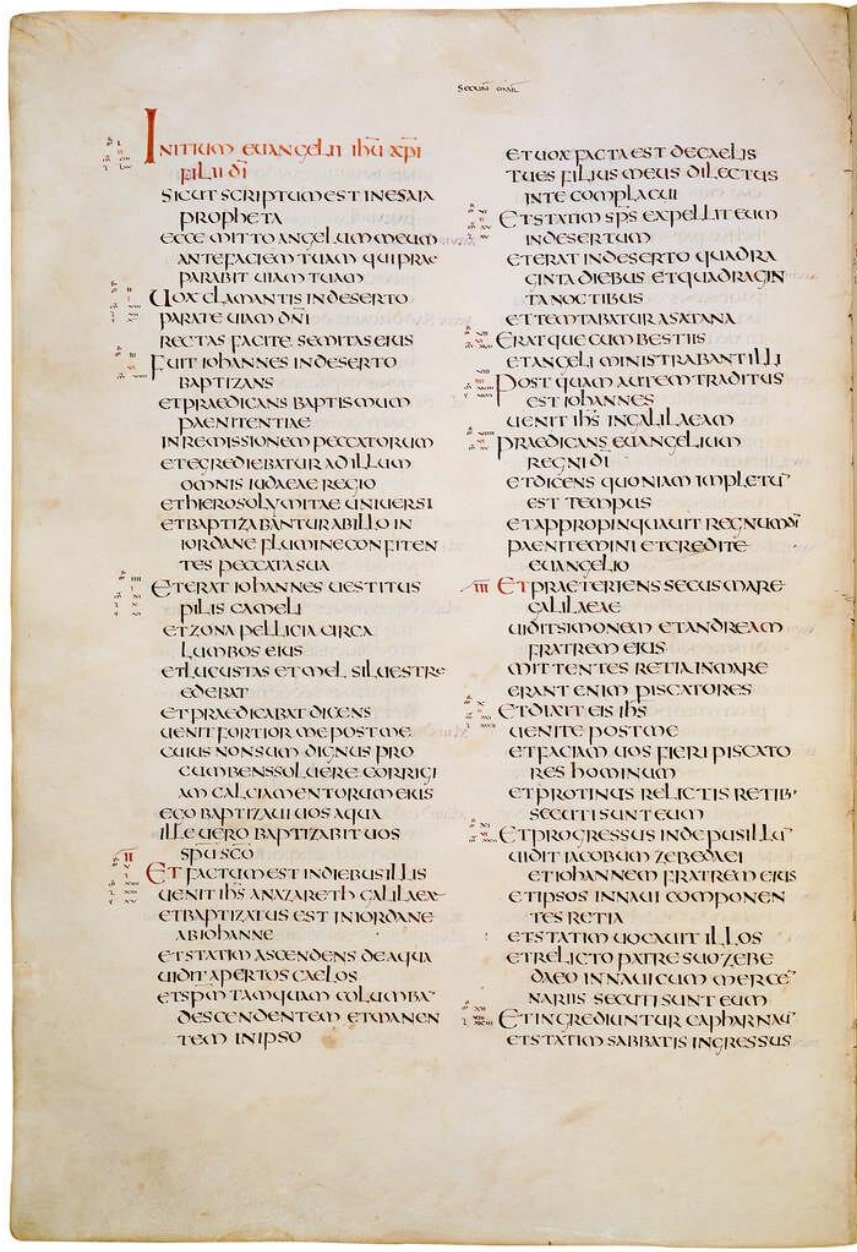
For more than a thousand years, most Christians in western Europe met the Bible in Latin. The first Latin translations, now called the Old Latin (Vetus Latina), were made piecemeal from the Greek by many hands from the second century on, and by the late fourth century their wording varied so widely that Augustine of Hippo complained the Latin translators were "out of all number."1 The Latin Vulgate (translated about 382 to 405 at the request of Pope Damasus I) revised the Gospels against Greek manuscripts and translated most of the Old Testament from the Hebrew. It slowly displaced the Old Latin, was copied in great monastic Bibles such as the Codex Amiatinus (made at Wearmouth-Jarrow in northern England shortly before 716 and now in Florence, the oldest surviving complete Latin Bible), was declared "authentic" for public use by the Council of Trent in 1546, and was issued in official papal editions in 1590 and 1592. Its modern successor, the Nova Vulgata, was promulgated in 1979.
English speakers first met parts of the Bible through that Latin text. Caedmon turned Bible stories into Old English verse in the late seventh century. Bede was translating the Gospel of John into English when he died in 735. In the ninth and tenth centuries scribes wrote English words between the lines of Latin Psalters and Gospel books (the Vespasian Psalter, and Aldred's gloss in the Lindisfarne Gospels), King Alfred set the Ten Commandments at the head of his laws, and about the year 1000 the West Saxon Gospels and Aelfric's Old Testament translations gave English readers continuous prose. The first complete Bible in English came only in the 1380s, from John Wycliffe and his circle, translated from the Latin Vulgate, and its circulation was restricted by Archbishop Arundel's Constitutions of 1407 to 1409. About 250 manuscripts of it survive. In 1455 the first great book printed with movable metal type in Europe, the Gutenberg Bible, was a Latin Vulgate. This lesson traces that path, names the manuscripts, and checks the claims often made about it.
Why the Latin and early English Bibles matter
The earlier lessons of this module followed the Hebrew and Greek texts: how the Old Testament was copied (lesson 01), how the Greek New Testament survives (lesson 02), and how the books were recognized as Scripture (lesson 03). For most of the Middle Ages, however, very few people in western Europe read Hebrew or Greek. The Bible that was read in church, sung in the monastic offices, quoted in law and argued over in the universities was a Latin Bible. When the first English versions were made, they were made from that Latin.
This has two consequences that run through the rest of the module. First, the Latin Bible is itself a witness to the text. Because the Old Latin and the Latin Vulgate were translated from Greek manuscripts older than most that survive, their readings are cited in every critical edition of the Greek New Testament, and the debates in lesson 05 (Erasmus) and lesson 08 (the verses in question) keep returning to "what the Latin has." Second, the early English Bibles were translations of a translation. When William Tyndale went back to the Greek and Hebrew in the 1520s (lesson 06), he was doing something no English translator before him had done for a whole Testament.
The story also touches church history that other modules on this site tell in full. Wycliffe's life and the Lollard movement as a reform movement are covered in Church History, Part A, lesson 10, and the medieval church as an institution in lesson 09 of that module. The exhumation and burning of Wycliffe's bones and the deaths of Lollards are told in Martyrs Briefs, lesson 05. This lesson stays with the books themselves: who made them, from what text, and what survives.
The Old Latin Bible (Vetus Latina)
Greek first, then Latin
The New Testament was written in Greek, and the first Christians in Rome itself wrote and worshiped largely in Greek. The Old Testament most of them used was the Greek Septuagint (described in lesson 01). Latin became the language of the western church first in the Roman provinces of North Africa and the western cities where Greek was less common. No one recorded the first Latin translation of any biblical book, and no single translator or committee made the Old Latin. It is a family of translations made over a long period, in different places, by different people.
The earliest dated scene that shows Latin-speaking Christians with biblical books comes from Carthage. The Passion of the Scillitan Martyrs, a short court record in Latin, is dated by the names of the consuls to July 17 of a year that corresponds to AD 180. When the proconsul Saturninus asked the accused what was in their chest, "Speratus said: Books and epistles of Paul, a just man."2 The record does not say in what language those books were written. Scholars have long read the scene as a sign that some Latin translation of Paul existed in Africa by then, but that is an inference, not a statement in the text.
The Catholic Encyclopedia's article on versions of the Bible (Anthony Maas, 1912) summarizes the older scholarly consensus. It says that "long before the end of the second century, Latin translations, though rude and defective," of a few Old Testament books were in use, and that by the close of that century "there existed at least one version of the whole Bible, based on the Septuagint and on Greek manuscripts of the New Testament." It adds that whether there was one original version or several is "involved in much uncertainty."3 Because the Old Latin Old Testament was translated from the Greek Septuagint, it included the books found in the Septuagint codices, among them the books Protestants later called the Apocrypha. That fact matters for the history of the canon told in lesson 03.
Augustine on the many Latin translators
The clearest description of the Old Latin's condition comes from Augustine, bishop of Hippo in North Africa, in his handbook On Christian Doctrine. Explaining why a serious reader of Scripture needs Hebrew and Greek, he wrote (in J. F. Shaw's translation in the Nicene and Post-Nicene Fathers):
For the translations of the Scriptures from Hebrew into Greek can be counted, but the Latin translators are out of all number. For in the early days of the faith every man who happened to get his hands upon a Greek manuscript, and who thought he had any knowledge, were it ever so little, of the two languages, ventured upon the work of translation.1
Augustine did not reject the Latin versions. In the same book he names one he preferred: "Now among translations themselves the Italian (Itala) is to be preferred to the others, for it keeps closer to the words without prejudice to clearness of expression." He also laid down the rule that later textual critics would repeat in other words. The Latin texts of the Old Testament were "to be corrected if necessary by the authority of the Greeks," and for the New Testament, "if any perplexity arises from the diversities of the Latin texts, we must of course yield to the Greek."1 No one today knows exactly which Latin text Augustine meant by the "Itala," and scholars still argue over it. The name Itala, and the older name "Old Latin," are now used loosely for all the Latin translations made before the Vulgate.
What survives of the Old Latin
The Old Latin survives in two ways. Some manuscripts preserve it directly. Maas wrote in 1912 that its New Testament is preserved "complete in some thirty-eight manuscripts, but its Old-Testament text has survived only in parts."3 (That count is a century old. The Vetus Latina Institute at Beuron in Germany has been gathering every surviving Old Latin manuscript and quotation for a full edition, and modern counts are larger.) The second kind of evidence is quotation: Latin church writers such as Tertullian, Cyprian and Augustine quoted the Bible in the Latin they knew, so their works show which wording was read in a given place and time.
For the text of the Greek New Testament, the Old Latin is an important early witness because it was translated from Greek manuscripts of the second to fourth centuries. When a Greek reading appears in the Old Latin, it shows that the reading existed in a Greek copy at least as early as the translation. That is why the editions described in lesson 08 list the Old Latin manuscripts in their notes beside the Greek ones.
The Latin Vulgate
The request of Pope Damasus I
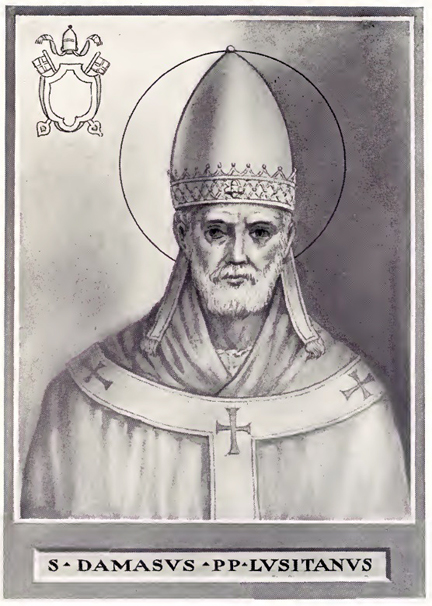
Damasus I was bishop of Rome from 366 until his death on December 11, 384. The Catholic Encyclopedia's article on him (Thomas Shahan, 1908) records his election in October 366 amid a violent dispute with a rival claimant, his synods against heresy, his building and restoration of churches and martyrs' tombs, and his role in the revision of the Latin Bible.4 According to Maas, because the Latin text "was found to have variant readings in different parts of the Church," Damasus requested its revision. The revised Gospels, corrected against "old Greek manuscripts," were put forth at Rome about 383.3 This module follows a site rule and does not name the translator. The work is called here, as it is throughout the module, the Latin Vulgate (translated about 382 to 405 at the request of Pope Damasus I).

How the Vulgate was made
The Latin Vulgate was put together in stages, and not all of it was translated fresh. Maas's account, which reflects the scholarship of the early twentieth century and still stands in its main lines, describes the parts this way:3
- The Gospels were a revision of the Old Latin, corrected against Greek manuscripts, issued at Rome about 383. The rest of the New Testament was "probably" revised by the same method, though how much revision the Acts, the Epistles and Revelation received has long been debated.
- The Psalms were revised twice from the Greek. A first light revision was used in Rome, and a second, made about 388 "using the Hexaplar text as a basis," became known as the Gallican Psalter "from becoming current in Gaul." It is the Gallican Psalter, a revision from the Greek Septuagint and not a translation from the Hebrew, that stands in the Vulgate Bible.
- Most of the Old Testament was translated directly from the Hebrew, a task begun about 390 and completed in 405, together with Tobit and Judith from Aramaic.
- Some books were left in their Old Latin form, including several of the deuterocanonical books (Wisdom, Sirach, Baruch and 1 and 2 Maccabees are the usual examples), which entered the Vulgate Bible "just as they existed in the Itala."
So the book later called "the Vulgate" is a composite: part fresh translation from Hebrew, part revision of older Latin against Greek, part untouched Old Latin. The Wycliffite translators noticed one result centuries later. Their General Prologue complains that the Psalter "of alle oure bokis discordith most fro Ebru," because, it explains, the church did not read the Psalter in the Latin translation made from the Hebrew but in "another translacioun of othere men" (the Gallican Psalter, revised from the Greek).5
Slow acceptance and the name "Vulgate"
The new translation was not welcomed everywhere. Maas notes that "at first it met with little favour," that some thought it inferior to the Septuagint, and that others feared it would cause dissension. It spread over centuries: "adopted by several writers in the fifth century, it came into more general use in the sixth," was used by Spanish churches in the seventh, and by the ninth century "was found in practically the whole Roman Church."3 In the meantime manuscripts often mixed the two traditions, copying Old Latin readings into Vulgate texts.
The name came later still. Vulgata means "common" or "in general circulation." Maas states that the title "Vulgate," "indicating its common use, and belonging to the Old Latin until the seventh century, was firmly established in the thirteenth."3 In other words, for several centuries the "common edition" meant the older Latin, and the newer translation earned the name only as it became the common text.
Corruption and revision in the Middle Ages
A text copied by hand for a thousand years drifts. Maas lists the main medieval attempts to correct the Vulgate: "In the eighth century Alcuin undertook and completed (A.D. 801) a revision with the aid of the best manuscripts then current. Another was made about the same time by Theodulph, Bishop of Orleans." Later recensions were made by Lanfranc (died 1089), Stephen Harding, abbot of Citeaux (died 1134), and others, and the universities and religious orders compiled Correctoria biblica, lists of variant readings with judgments on them.3 Alcuin, an English scholar from York working at the court of Charlemagne, is a reminder that the English were not only receivers of the Latin Bible. They were among its best editors.
The Latin Bible in medieval schools and churches was therefore never one fixed text. There were good copies and bad ones, regional families, and corrected and uncorrected manuscripts. That variety is the background to the Council of Trent's call, in 1546, for an edition "printed in the most correct manner possible," described below.
The Codex Amiatinus: an English Vulgate in Florence
Three great Bibles at Wearmouth-Jarrow
The oldest surviving complete Latin Bible was made in England. Its story is told by Bede, the monk of Jarrow, in his Lives of the Abbots of the twin monasteries of Wearmouth and Jarrow in Northumbria. Benedict Biscop, the founder, had brought books back from his journeys to Rome. His successor, Abbot Ceolfrith, enlarged the library. In J. A. Giles's translation of Bede:
For he added three Pandects of a new translation to that of the old translation which he had brought from Rome; one of them, returning to Rome in his old age, he took with him as a gift; the other two he left to the two monasteries.6
A pandect is a single volume holding the whole Bible. The "new translation" is the Vulgate, and the "old translation" the Old Latin. Bede's sentence therefore records two things at once: that a Northumbrian monastery around the year 700 owned both Latin traditions, and that it produced three complete Vulgate Bibles of its own.
Ceolfrith resigned as abbot and set out for Rome with the gift Bible. He never arrived. Bede reports that he died at Langres in Burgundy (the city of the Lingones) on September 25, having traveled 114 days since leaving on June 4, and that his English company numbered about eighty. Giles's nineteenth century translation prints the year of his death as 715, but the same passage says he died on a Friday, and September 25 fell on a Friday in 716 (in 715 it fell on a Wednesday).6 Modern accounts, including the reporting on the British Library's 2018 loan of the codex, date the departure and the making of the book to 716.7 The weekday Bede gives therefore supports 716.
How the codex was identified
For centuries no one knew what had happened to the gift Bible. A great Latin Bible had been kept at the monastery of San Salvatore on Monte Amiata in Tuscany, from which it takes its name, Amiatinus, and it later passed to the Biblioteca Medicea Laurenziana in Florence, where it remains (shelfmark MS Amiatinus 1). Sixteenth century scholars thought it a fine Italian manuscript, and it was used by the papal revisers who produced the Sixtine Vulgate of 1590. Cardinal Francis Aidan Gasquet, who led the Benedictine commission for a critical revision of the Vulgate, described in 1912 how its origin was discovered. The dedication page said the book was given to the monastery by "a certain abbot, Peter the Lombard." The Italian archaeologist Giovanni Battista de Rossi noticed that this name had been written over an erasure, and that the original name was "a name like 'Ceolfridas.'" The Cambridge scholar F. J. A. Hort then showed that the dedication verses, with the changed words restored, were the very lines quoted in the anonymous early life of the abbots of Wearmouth and Jarrow as written in the Bible taken to the pope.8
Gasquet gave the size of each page as "nineteen and one-half by thirteen and one-half inches," written "in the most regular uncial hand in two columns to the page."8 Writing for Smithsonian in 2017, Brigit Katz reported that more than 1,000 animal skins were needed for its parchment, that it weighs about 75 pounds, and that it was "the earliest complete Latin Bible that survives to the present-day." It returned to England for the first time in about 1,300 years for the British Library's exhibition on the Anglo-Saxon kingdoms, which opened in October 2018.7 Of the two sister Bibles left in England, only fragments survive. Gasquet described a leaf that Canon William Greenwell of Durham found in the binding of an old account book and that the British Museum acquired.8
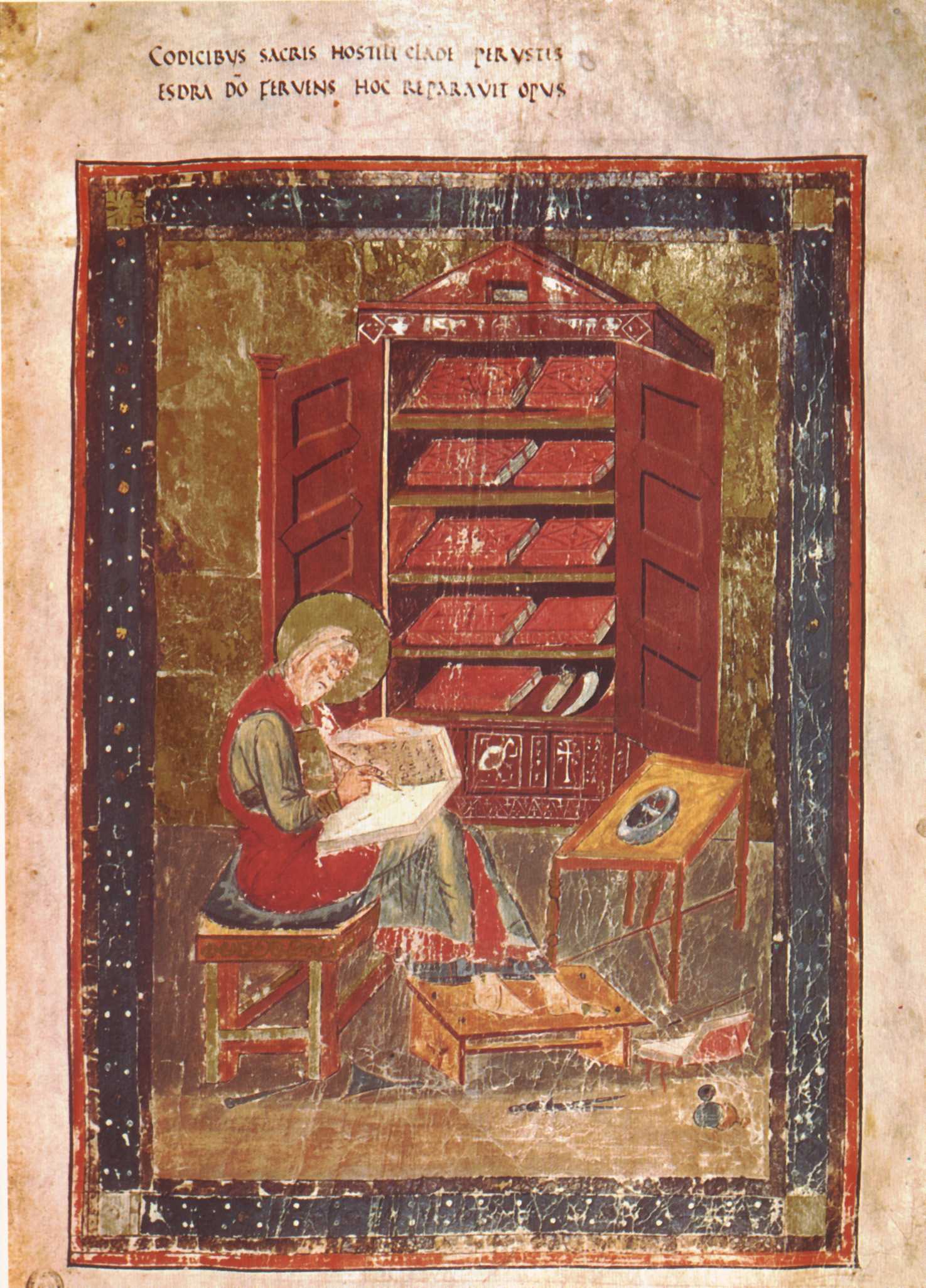

The codex is important for two reasons. It is an English achievement, made by Northumbrian scribes from Italian exemplars and so faithful to them in style that it was taken for Italian work for a thousand years. And it is one of the best witnesses to the Vulgate text. Gasquet's commission, charged by the pope to determine the original Vulgate text "as accurately as possible," photographed the whole codex, and Gasquet expected it to prove "among the most important manuscripts for the Vulgate text." Modern critical editions of the Vulgate rank it among their chief witnesses.8

Trent, the Sixtine and Clementine editions, and the Nova Vulgata
The Council of Trent, April 8, 1546
By the sixteenth century the Vulgate had been printed many times, other Latin translations from the Hebrew and Greek were appearing, and the Reformers were translating from the original languages into German, French and English. At its fourth session, on April 8, 1546, the Council of Trent issued two decrees on Scripture. The first listed the canonical books (see lesson 03) and said they were to be received "as they are contained in the old Latin vulgate edition." The second, the "Decree concerning the edition, and the use, of the sacred books," said this, in J. Waterworth's translation of 1848:
...the said old and vulgate edition, which, by the lengthened usage of so many years, has been approved of in the Church, be, in public lectures, disputations, sermons and expositions, held as authentic; and that no one is to dare, or presume to reject it under any pretext whatever.9
The same decree ordered that "the sacred Scripture, and especially the said old and vulgate edition, be printed in the most correct manner possible," and forbade printing or selling books on sacred matters without the author's name and the approval of the bishop.9 What the decree meant by "authentic" has been argued ever since. Maas, writing as a Catholic scholar in 1912, held that the council, "without depreciating the Hebrew or the Septuagint or any other version then in circulation and without forbidding the original texts," approved the Vulgate for public and official use "as a text free from error in doctrine and morals."3 Protestant writers of the period read the decree as setting a translation above the originals. The text of the decree speaks of choosing among "all the Latin editions, now in circulation," which supports the narrower reading.
The Sixtine Vulgate (1590) and the Clementine Vulgate (1592)
The corrected edition Trent asked for took more than forty years. The Museum of the Bible's catalog entry for its copy of the second Clementine printing summarizes the result: "After decades of study and debate, Pope Sixtus V issued an authorized edition in 1590. In 1592, however, Pope Clement VIII and Cardinal Robert Bellarmine, later named a Doctor of the Church, updated the text, in part, due to typographical errors." The copy itself was printed in 1593 by the Vatican press, and the museum notes that the Clementine text "remained the church's standard Bible until 1979."10 Sixtus V died on August 27, 1590, and the Catholic Encyclopedia's article on him (Michael Ott, 1912) says his edition, "printed shortly before his death, was withdrawn from circulation on account of its many errors, corrected, and reissued in 1592."11 Maas adds that the revised text kept the title page naming Sixtus, and that Clement VIII's name "has appeared in the title since 1641."3 The reasons for the withdrawal of the Sixtine edition, and how many errors it really contained, are still debated by historians.
The Clementine Vulgate is the Latin text behind the Catholic English Bible of Rheims and Douai (1582 and 1609 to 1610), in its later revisions, described in lesson 06. It is also the Latin text quoted in this lesson, from the edition on the Douay-Rheims and Clementine Vulgate site (drbo.org).
The Nova Vulgata (1979)
The Second Vatican Council asked for the Latin Psalter to be revised for the Liturgy of the Hours. On November 29, 1965, before the council closed, Pope Paul VI set up a commission to revise all the books of the Latin Bible. On April 25, 1979, Pope John Paul II's apostolic constitution Scripturarum Thesaurus promulgated the result. The constitution explains that the revisers kept the old Vulgate text word for word where it accurately rendered the original texts as modern critical editions give them, and corrected it "prudently" where it departed from them. The revised text had appeared in separate volumes from 1969 to 1977. The constitution's operative sentence reads: "Nos harum Litterarum vi Novam Vulgatam Bibliorum Sacrorum editionem 'typicam' declaramus et promulgamus, praesertim in sacra Liturgia utendam", that is, "by the force of this letter We declare and promulgate the New Vulgate edition of the Holy Bible as the 'typical' edition, to be used especially in the sacred Liturgy."12 (The English rendering is this lesson's.) The constitution also says that in past times the church judged the old Vulgate sufficient for giving the word of God to Christian people, and that the Nova Vulgata will now do so better.12
Unlike the medieval Vulgate, the Nova Vulgata is a deliberate revision toward the Hebrew and Greek. It stands at the end of a line that began with the Old Latin, but its method belongs to the modern critical era described in lessons 08 to 10.
The Bible in Old English
Old English (also called Anglo-Saxon) is the form of English spoken and written from the settlement of the Angles, Saxons and Jutes in Britain until some generations after the Norman Conquest of 1066. It had several dialects: Northumbrian, Mercian, Kentish and West Saxon. A modern reader cannot read it without study, as the samples below show. The Bible reached the English in Latin, carried by missionaries from Rome in the south (from 597) and from Ireland and Iona in the north. Latin was the language of the liturgy and of learning, and English renderings of Scripture began as aids to understanding the Latin, in verse, in interlinear glosses, and in partial translations. No complete Bible in Old English was ever made, as far as the surviving record shows.
Caedmon, the cowherd who sang Scripture
The first English rendering of biblical matter that history records was in verse. Bede tells the story in his Ecclesiastical History of the English People (finished 731), book 4, chapter 24. In the monastery of the abbess Hild at Whitby there was a lay brother who looked after the cattle and could not sing. When the harp was passed around at a feast, he left. One night in the stable he dreamed that someone called him by name and said, "Caedmon, sing me something," and when he protested, told him, "Sing the beginning of creation." He sang verses he had never heard, which Bede renders in Latin. In A. M. Sellar's translation (1907):
"Now must we praise the Maker of the heavenly kingdom, the power of the Creator and His counsel, the deeds of the Father of glory. How He, being the eternal God, became the Author of all wondrous works, Who being the Almighty Guardian of the human race, first created heaven for the sons of men to be the covering of their dwelling place, and next the earth." This is the sense but not the order of the words as he sang them in his sleep; for verses, though never so well composed, cannot be literally translated out of one language into another without loss of their beauty and loftiness.13
Bede's comment is one of the earliest recorded remarks on translation in English history, and it runs in the opposite direction from what follows in this lesson: he is apologizing for translating English verse into Latin prose. Old English texts of the hymn were also preserved, and Albert S. Cook's verse translation of them begins: "Now must we hymn the Master of heaven, / The might of the Maker, the deeds of the Father."14
Bede then describes how Caedmon worked. The learned men of the monastery "expounded to him a passage of sacred history or doctrine," and he came back the next morning with it "rendered in most excellent verse." Hild had him made a monk and ordered that he be taught "the whole course of sacred history." Bede continues:
So he, giving ear to all that he could learn, and bearing it in mind, and as it were ruminating, like a clean animal, turned it into most harmonious verse... He sang the creation of the world, the origin of man, and all the history of Genesis, the departure of the children of Israel out of Egypt, their entrance into the promised land, and many other histories from Holy Scripture; the Incarnation, Passion, Resurrection of our Lord, and His Ascension into heaven; the coming of the Holy Ghost, and the teaching of the Apostles...13
Caedmon's work was oral paraphrase, made by a man who could not read Latin from passages explained to him. Sellar's edition puts the chapter under the year 680. Later scholars ascribed various surviving Old English religious poems to him. Anna C. Paues, writing the article "Bible, English" for the 1911 Encyclopaedia Britannica, judged that "it is, however, doubtful whether any of the poetry which has been ascribed to him can claim to be regarded as his genuine work."15 Apart from the nine lines of the hymn, nothing that Caedmon composed can be identified with confidence.
Bede and the Gospel of John (735)
Bede himself is the first person known to have translated part of a biblical book into English prose. The evidence is a single letter. Cuthbert, a pupil of Bede who later became abbot of Wearmouth and Jarrow, wrote to a fellow student named Cuthwin describing his master's last weeks in the spring of 735. A. M. Sellar's edition of Bede prints the letter in translation. Cuthbert says that, besides his daily lessons and the singing of the Psalms, Bede was working on two books:
...to wit, his translation of the Gospel of St. John, from the beginning, as far as the words, 'But what are they among so many?' into our own tongue, for the benefit of the Church of God; and some selections from the books of Bishop Isidore, saying, 'I would not have my boys read a lie, nor labour herein without profit after my death.'16
The words "But what are they among so many?" come from the feeding of the five thousand, John 6:9, which the King James Version renders, "There is a lad here, which hath five barley loaves, and two small fishes: but what are they among so many?"17 Bede's English John therefore reached at least the sixth chapter. Cuthbert's letter goes on to describe the last day, the Wednesday before Ascension Day: a boy named Wilbert told him, "Dear master, there is yet one sentence not written," Bede answered, "It is well, write it," and after it was written he died chanting the Gloria Patri on the floor of his cell.16 Sellar's introduction explains that Bede died on a Wednesday evening, the eve of Ascension Day, which fell on May 26 in 735.16 Paues summarized the matter in 1911: Bede "translated the first portion (chs. i-vi.9) of the Gospel of St John into the vernacular, but no part of this rendering is extant."15 Nothing of it survives. The fact rests on Cuthbert's eyewitness letter.
The same letter preserves five lines of Old English verse that Bede recited on his deathbed, the poem now called "Bede's Death Song," beginning "Fore then neidfaerae / naenig uiuurthit", which Sellar renders: "Before the inevitable journey hence, no man is wiser than is needful that he may consider, ere the soul departs, what good or evil it hath done and how it shall be judged after its departure."16 Bede was, in Cuthbert's words, "learned in our native poetry."
The Psalter glosses: the Vespasian Psalter
The oldest surviving English rendering of a whole biblical book is a gloss. A gloss is a word-for-word translation written between the lines of a Latin manuscript, each English word above the Latin word it translates. It is a tool for understanding the Latin, not a text meant to be read on its own. The Psalms were glossed first, because the Psalter was the book every monk and nun had to learn.
The oldest of these is the Vespasian Psalter (London, British Library, Cotton MS Vespasian A I), a Latin Psalter of the Roman type with an English gloss written between its lines. Paues described it as "written in Mercia in the first half of the 9th century" and as "in all probability the original" of the later glossed Psalters. She counted twelve glossed Psalter manuscripts in two groups, according to whether the Latin was the Roman or the Gallican Psalter.15 Albert S. Cook, in Biblical Quotations in Old English Prose Writers (1898), cited Henry Sweet's dating of the gloss to the first half of the ninth century, recorded the long argument over whether its dialect was Kentish or Mercian (Eduard Sievers identified it as Mercian in 1882, and Sweet came to agree), and stressed that "this version is not a translation, in the ordinary sense of that word, but a mere interlinear gloss."18
Paues printed Psalm 100:1 to 2 (Psalm 99:2 in the Latin numbering) from the Vespasian gloss beside the Latin, which shows how a gloss follows its original word by word:
Latin (Roman Psalter): Jubilate Deo, omnis terra; servite Domino in laetitia; intrate in conspectu eius in exultatione.
Mercian gloss (Vespasian Psalter): Wynsumiað gode, all eorðe ðiowiað Dryhtne in blisse; ingað in gesihðe his in wynsumnisse.15
For comparison, the King James Version translates the Hebrew of the same verses: "Make a joyful noise unto the LORD, all ye lands. Serve the LORD with gladness: come before his presence with singing."17 The gloss renders servite Domino in laetitia as ðiowiað Dryhtne in blisse, "serve the Lord in bliss."
A Latin-only manuscript became an English one in stages, and later scribes copied the glosses into other Psalters. Toward the end of the ninth century or early in the tenth, the Paris Psalter (Paris, Bibliotheque nationale de France, MS lat. 8824) went further: its first fifty Psalms are an English prose translation, not a gloss. Paues noted that some scholars attributed it to King Alfred, on the strength of William of Malmesbury's statement that Alfred began to translate the Psalter and died when barely the first part was done, while others denied it.15
King Alfred: the law of Moses and the duty to translate
Alfred the Great, king of the West Saxons from 871 until his death about the year 900, did more than any other early English ruler to bring Latin learning into English. Two parts of his program touch the Bible directly.
First, his law code begins with Scripture. F. L. Attenborough's edition of The Laws of the Earliest English Kings (1922) explains that Alfred's laws "are preceded by a long introduction (cap. 1-48) which contains translations of the Ten Commandments, and many other passages from the book of Exodus (cap. 20-23)," followed by an account of the apostolic council of Acts 15 and of the growth of church law. Only after that does Alfred turn to the English laws of his predecessors, Ine of Wessex, Offa of Mercia and Aethelberht of Kent.19 An English king thus put a translated portion of Exodus at the head of the law of his kingdom.
Second, Alfred explained why translation was needed. In the preface to his English version of Pope Gregory the Great's Pastoral Care, a letter sent with copies to his bishops, he lamented how Latin learning had decayed in England and gave a short history of Bible translation as a reason to act. In Henry Sweet's translation (1871):
Then I remembered how the law was first known in Hebrew, and again, when the Greeks had learnt it, they translated the whole of it into their own language, and all other books besides. And again the Romans, when they had learnt it, they translated the whole of it through learned interpreters into their own language. And also all other Christian nations translated a part of them into their own language. Therefore it seems better to me, if ye think so, for us also to translate some books which are most needful for all men to know into the language which we can all understand...20
Alfred says he translated the Pastoral Care "sometimes word by word and sometimes according to the sense," as he had learned it from Archbishop Plegmund, Bishop Asser and the priests Grimbold and John.20 The distinction he draws, word for word or sense for sense, is the same one that divides modern Bible translations into formal and dynamic equivalence, the subject of lesson 12.
The Lindisfarne Gospels and Aldred's gloss
The Lindisfarne Gospels (London, British Library, Cotton MS Nero D IV) is a Latin Gospel book written and painted on the island monastery of Lindisfarne, off the coast of Northumbria, in the decades around 700. Its Latin text is a Vulgate text. About two and a half centuries after it was made, a priest named Aldred wrote an English word above nearly every Latin word of all four Gospels, in the Northumbrian dialect. Paues dated the gloss to about 950 and placed it first in date among the tenth century English versions of the Gospels; she gave the dates of Eadfrith, bishop of Lindisfarne, as 698 to 721.15 Cook, writing in 1898, also dated Aldred's work "about A.D. 950, or perhaps somewhat" later.18
Aldred also added a colophon at the end of the book (folio 259r) recording who made it. A modern English rendering published by the Art of the Middle Ages site, which notes that it simplifies some passages, reads in part: "Eadfrith, bishop of the Lindisfarne church, first copied out this book for God and for St. Cuthbert," "And Æthelwald, bishop of the islanders of Lindisfarne, bound it on the outside," "And the anchorite Billfrith forged the ornaments that are on the outside," and "And Aldred, an unworthy and most pitiable priest, glossed it in English with the help of God and of St. Cuthbert."21 Cook printed E. M. Thompson's freer version of Aldred's own entry, in which Aldred says he "got for himself a home [in the monastery] by his work on the three parts," Matthew, Mark and Luke, "paying also eight oras of silver on his admission," while "St. John he glossed for himself."18 The colophon was written about 250 years after the events it describes, so its account of Eadfrith, Aethelwald and Billfrith is a tradition recorded by Aldred, accepted by most scholars but not an eyewitness record.
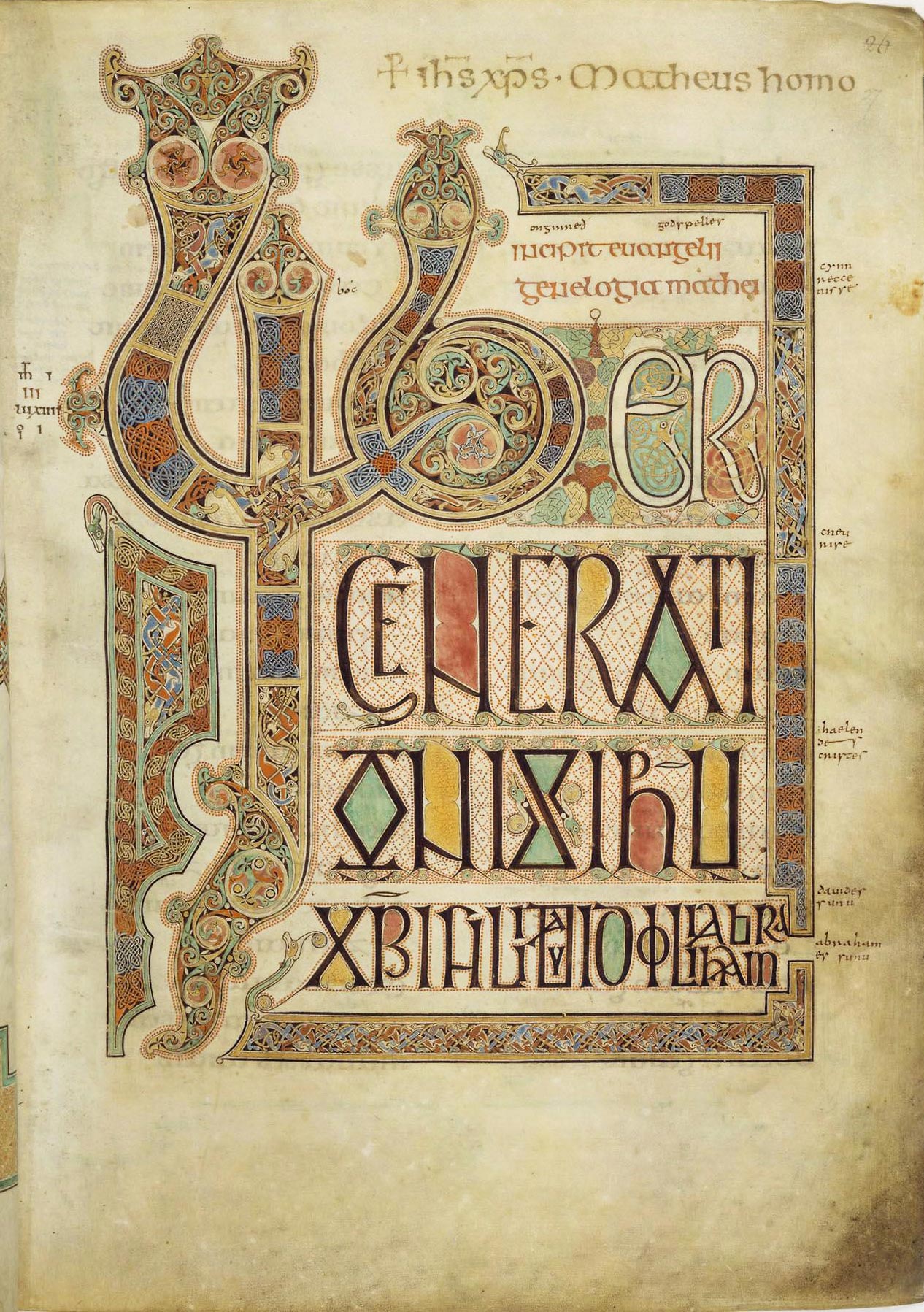

Here is how Aldred's gloss renders the opening of the Lord's Prayer, Matthew 6:9 to 11, as Paues printed it. The sign ⁊ is the scribe's abbreviation for "and." Where Aldred offers two possible English words he links them, here shown with a plus sign as Paues printed it:
fader urer ðu arð ðu bist in heofnum + in heofnas; sie gehalgad noma ðin; to-cymeð ric ðin. sie willo ðin suae is in heofne ⁊ in eorðo. hlaf userne oferwistlic sel us to dæg.15
The word oferwistlic ("super-substantial") renders the Latin supersubstantialem, the Vulgate's word in Matthew 6:11 for the bread the prayer asks for. A reader of the gloss was being taught the Latin; the English follows it even where English idiom would choose another word. Paues also described the Rushworth Gospels (Oxford, Bodleian Library, MS Auct. D. 2. 19; Paues printed the shelfmark as "Auct. D. ii. 9"), a somewhat later book in which a priest named Faerman of Harewood made an independent Mercian translation of Matthew and glossed the opening of Mark and a few verses of John, while a second man, Owun, copied the rest from the Lindisfarne gloss.15
The West Saxon Gospels (about 1000)
The first translation of the four Gospels into continuous English prose, meant to be read without the Latin beside it, was made in the south of England near the end of the tenth century. Paues wrote that "at the close of the century, probably about the year 1000, the Gospels were rendered anew for the first time in the south of England," and that "not less than seven manuscripts have come down to us." One of them, Cambridge, Corpus Christi College MS 140, has a Latin note saying that a scribe named Aelfric wrote the book at Bath and gave it to Brihtwold the provost. This is not known to be the famous Aelfric discussed below, and "of this Aelfric and his superior nothing further is known."15 Paues printed the Lord's Prayer from that manuscript. Its opening (Matthew 6:9 to 11, with one stray mark of punctuation omitted) reads:
Fæder ure þu þe eart on heofonum; si þin nama gehalgod to-becume þin rice; gewurþe ðin willa on eorðan swa swa on heofonum. urne gedæghwamlican hlaf syle us to dæg,15
Two differences from the Lindisfarne gloss stand out. The West Saxon word order is English, not Latin ("si þin nama gehalgod," "be thy name hallowed"), and the bread is gedæghwamlican, "daily," the word the Vulgate itself uses in Luke's form of the prayer (Luke 11:3, quotidianum), in place of the word-for-word "super-substantial." The letters þ (thorn) and ð (eth) both stand for the sound "th."
Aelfric and the Old English Old Testament
Aelfric, whom Paues called "the most eminent scholar in the close of the 10th and the opening decades of the 11th century," translated or paraphrased large parts of the Old Testament, and he wrote frankly about the danger he saw in doing it. Paues reports that in his treatise on the Old and New Testaments (about 1010) he said he had translated the Pentateuch, Joshua, Judges, Kings, Job, Esther, Judith and the Maccabees, though many of these were "mere homilies epitomized from the corresponding Old Testament books."15
His preface to Genesis, addressed to the ealdorman Aethelweard about 997, is the first essay on Bible translation written in English. Cook translated it in 1898:
When you desired me, honoured friend, to translate the Book of Genesis from Latin into English, I was loth to grant your request; upon which you assured me that I should need to translate only so far as the account of Isaac, Abraham's son, seeing that some other person had rendered it for you from that point to the end. Now, I am concerned lest the work should be dangerous for me or any one else to undertake, because I fear that, if some foolish man should read this book or hear it read, he would imagine that he could live now, under the new dispensation, just as the patriarchs lived before the old law was established, or as men lived under the law of Moses.18
He gave an example: a priest who had been his teacher, who "had some knowledge of Latin," had said that "the patriarch Jacob had four wives," without understanding "what a difference there is between the old dispensation and the new." Aelfric then stated his own rule of translation: "We dare write no more in English than the Latin has, nor change the order except so far as English idiom demands." He also asked future copyists to follow his text exactly, "since I cannot help it if an inaccurate scribe introduces corruptions."18 In practice he shortened freely. Cook summarized the German scholar Dietrich's finding that Aelfric left out nearly all the lists of names, the hardest poetic passages (such as Jacob's blessing in Genesis 49 and the Song of Deborah in Judges 5), and most of the detailed laws of Leviticus and Numbers.18
The Old English "Heptateuch" (the first seven books, Genesis to Judges, partly by Aelfric and partly by other hands) survives in several manuscripts. Cook names Oxford, Bodleian Library, MS Laud Misc. 509 as the base of the first printed edition (Edward Thwaites, Oxford, 1698) and London, British Library, Cotton MS Claudius B IV, which contains the Pentateuch and Joshua.18
After the Norman Conquest: French, Latin and the English Psalters
The Norman Conquest of 1066 brought a French-speaking ruling class to England. Paues described the following centuries bluntly: "The 13th century, from the point of view of Biblical renderings into the vernacular, is an absolute blank." There were translations of the Bible in England in the twelfth to fourteenth centuries, "but they were all in French," the language of the court, the schools and the upper classes, and before the middle of the fourteenth century "the entire Old Testament and the greater part of the New Testament had been translated into the Anglo-Norman dialect."15 West Saxon Gospel manuscripts were still copied in the twelfth century, in a later form of English. In the fourteenth century English Psalters reappeared, among them the commentary on the Psalms by the hermit Richard Rolle of Hampole (died 1349), which, Paues wrote, "spread in numerous copies throughout the country."22 These were orthodox works made for devout readers. Paues stressed that "these early versions from Anglo-Saxon times onwards were perfectly orthodox, executed by and for good and faithful sons of the church."22
| Work | Date | Kind | Where it survives |
|---|---|---|---|
| Caedmon's hymn and songs | about 680 | Oral verse paraphrase; only the hymn survives | Bede, Ecclesiastical History 4.24, and Old English copies of the hymn |
| Bede's Gospel of John (to 6:9) | 735 | Prose translation | Lost; known only from Cuthbert's letter |
| Vespasian Psalter gloss | first half of 9th century | Mercian interlinear gloss on the Roman Psalter | British Library, Cotton MS Vespasian A I |
| Alfred's laws, introduction | late 9th century | Translation of Exodus 20 to 23 and Acts 15 in a law code | Edited by Attenborough (1922) |
| Paris Psalter (Psalms 1 to 50) | late 9th or early 10th century | Prose translation; Alfred's authorship disputed | Paris, BnF MS lat. 8824 |
| Lindisfarne Gospels gloss (Aldred) | about 950 | Northumbrian interlinear gloss on the four Gospels | British Library, Cotton MS Nero D IV |
| Rushworth Gospels (Faerman and Owun) | later 10th century | Mercian translation of Matthew and Northumbrian gloss of the rest | Oxford, Bodleian, MS Auct. D. 2. 19 |
| Aelfric's Genesis and other Old Testament books | about 997 to 1010 | Prose translation, often abridged | Bodleian MS Laud Misc. 509; BL Cotton MS Claudius B IV and others |
| West Saxon Gospels | about 1000 | Prose translation of the four Gospels | At least seven manuscripts, including Cambridge, Corpus Christi College MS 140 |
Sources for the table: Bede and Cuthbert in Sellar's edition; Paues (1911); Cook (1898); Attenborough (1922).15 No complete Bible, and no complete New Testament, in Old English is known to have existed.
Wycliffe and the Wycliffite Bible
John Wycliffe and the Bible
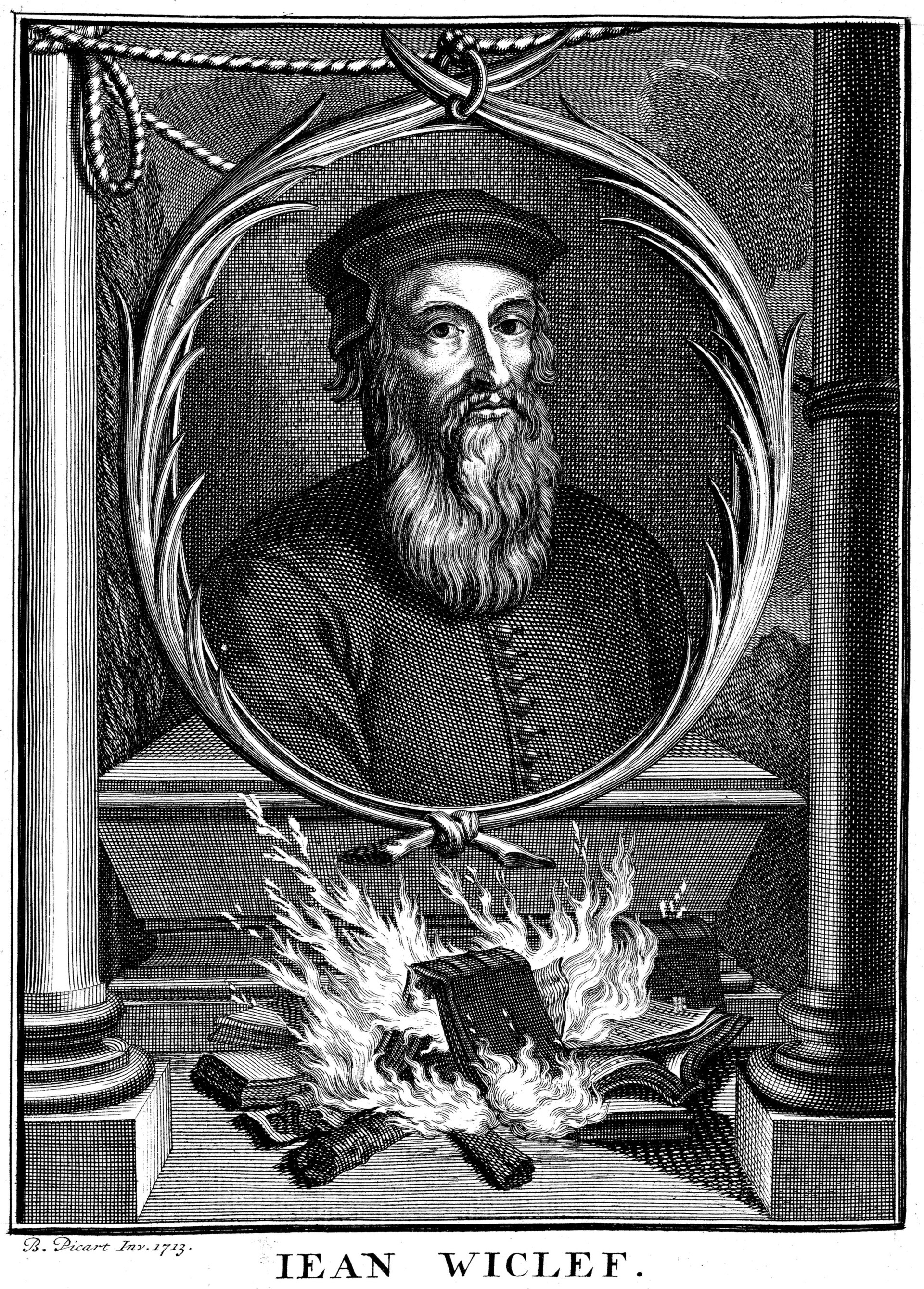
John Wycliffe (about 1328 to December 31, 1384) was an Oxford philosopher and theologian whose attacks on the wealth and power of the clergy, on the papacy and on the doctrine of transubstantiation made him the most controversial churchman in England in the 1370s and 1380s. His life, his teaching and the movement of his followers, called Lollards, are the subject of Church History, Part A, lesson 10. What matters here is his conviction about Scripture. Paues summarized it in 1911: "Wycliffe proclaimed the Bible, not the Church or Catholic tradition, as a man's supreme spiritual authority, and... he sought in consequence by every means in his power to spread the knowledge of it among the people."22 The two English translations associated with his name, she wrote, "are the earliest complete renderings that we possess of the Holy Scriptures into English."22

Two versions: the Early Version and the Later Version
The manuscripts of the Wycliffite Bible fall into two groups. Walter W. Skeat, introducing the Clarendon Press reprint of the New Testament in 1879, explained the division made by Josiah Forshall and Frederic Madden, whose four-volume edition of 1850 was "the result of twenty-two years of labour." The editors "examined no less than 170" manuscripts and found that they separate into "one in which the version is given in a close, literal, and sometimes rather unpolished form, and another in which the version, if a little less literal, is more smooth and flowing, and expressed in more idiomatic and less laboured English."23 The rougher version is the earlier. Skeat gave the dates as they were then accepted: "the date of the earlier version appears to be about 1382 or 1383, and that of the later version about 1388," with the New Testament of the Early Version first made about 1380. Wycliffe died on December 31, 1384.23 Anne Hudson, writing later, puts it more broadly: the translation was "completed within the last twenty years of the fourteenth century."24
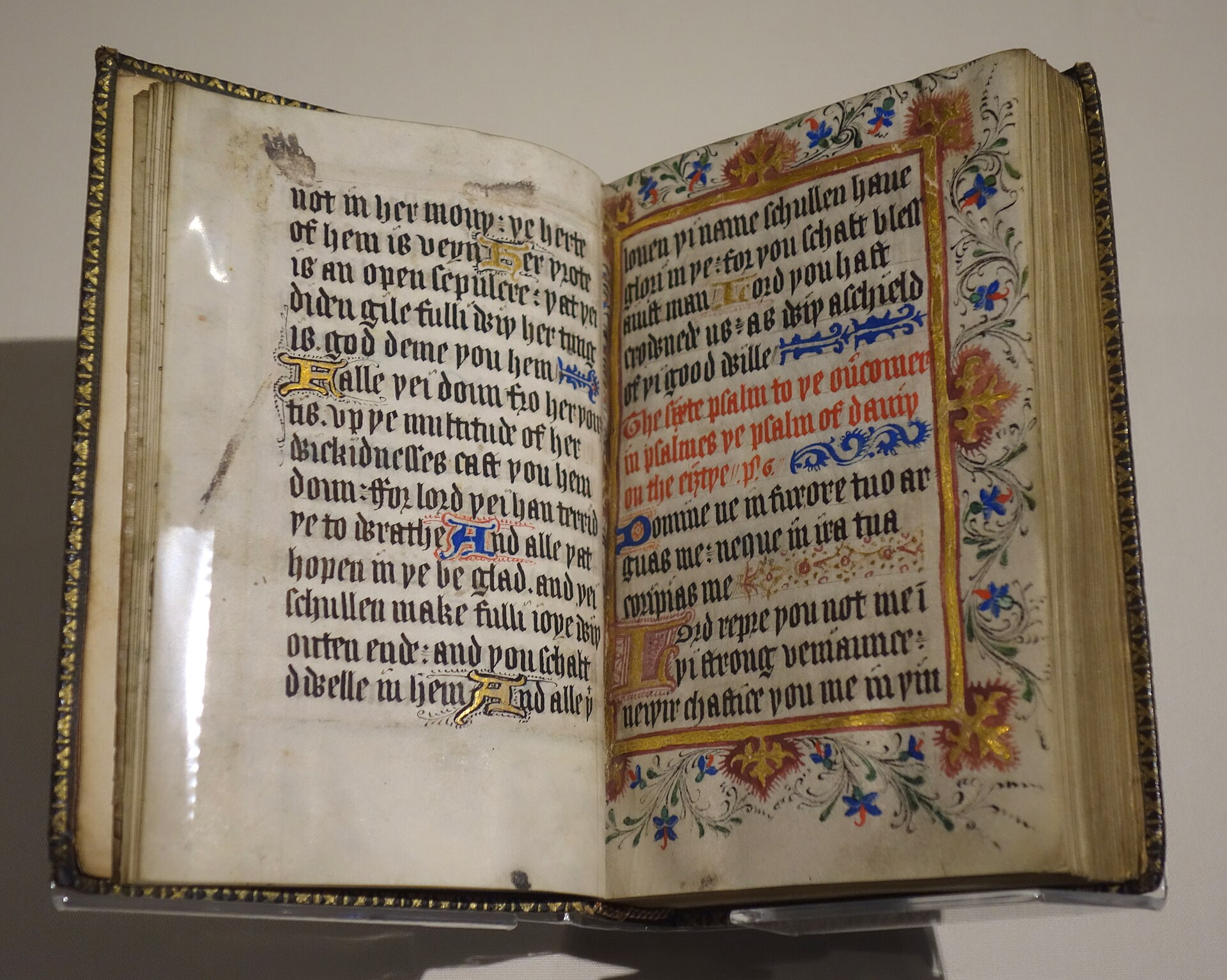
Paues showed how much more readable the revision was by setting the two side by side. Psalm 1:1 in the Early Version reads: "Blisful the man, that that went not awei in the counseil of vnpitouse, and in the wei off sinful stod not; and in the chayer of pestilence sat not." In the Later Version: "Blessid is the man, that gede not in the councel of wickid men; and stood not in the weie of synneris, and sat not in the chaier of pestilence."22 The Early Version keeps the Latin word order (Beatus vir qui non abiit in consilio impiorum) almost exactly. The Later Version turns it into English.
Who translated it
No manuscript names Wycliffe as the translator, and his personal share in the work is uncertain. The evidence as scholars hold it runs as follows.
- Nicholas Hereford and the Early Version Old Testament. Two Bodleian manuscripts of the Early Version (MS Bodley 959 and MS Douce 369) break off abruptly in the book of Baruch, chapter 3, and one of them has a note at that point: "Explicit translacionem Nicholay de herford" ("here ends the translation of Nicholas Hereford"). Paues judged that there is "but little doubt that Nicholas de Herford took part in the translation of the Old Testament, though it is uncertain to what extent," and that other hands were probably involved.22 Paues called Hereford "one of Wycliffe's coadjutors."22
- Wycliffe and the Early Version New Testament. Forshall and Madden thought the Early Version New Testament "might probably be the work of Wycliffe himself." Paues disputed the reasoning behind that view and concluded that "it is therefore at present impossible to say what part of the Early Version of the New Testament was translated by Wycliffe."22
- John Purvey and the Later Version. Forshall and Madden attributed the Later Version mainly to John Purvey, one of Wycliffe's followers, and Skeat repeated that attribution in 1879.23 Later scholars were more cautious. Paues wrote that Purvey "is generally assumed to have taken a prominent part in the work, but the evidence of this is extremely slight."22 Anne Hudson, the leading modern authority on Lollard writings, put it more strongly: "there is no medieval evidence to link Purvey's name with the work of translation."24
The safest summary is the one most historians now use: the Wycliffite Bible was the work of a group of Oxford scholars in Wycliffe's circle, begun in his lifetime and revised after his death, with Hereford's part in the Early Version Old Testament the best documented single contribution.
Translated from the Latin: the General Prologue
Both versions were translated from the Latin Vulgate. Forshall and Madden's title says so: The Holy Bible... in the Earliest English Versions Made from the Latin Vulgate by John Wycliffe and His Followers. Hudson states it plainly as well: the translation was made from the Vulgate, "the standard biblical text of the middle ages."24
The Later Version circulated with a long General Prologue whose fifteenth chapter describes how the revision was made. Forshall and Madden printed it in volume 1 of their edition, in Middle English. Its author calls himself only "a symple creature" and describes four stages of work:
First, this symple creature hadde myche trauaile, with diuerse felawis and helperis, to gedere manie elde biblis, and othere doctouris, and comune glosis, and to make oo Latyn bible sumdel trewe; and thanne to studie it of the newe, the text with the glose, and othere doctouris, as he miȝte gete, and speciali Lire on the elde testament, that helpide ful myche in this werk; the thridde tyme to counseile with elde gramariens, and elde dyuynis, of harde wordis, and harde sentencis, hou tho miȝten best be vndurstonden and translatid; the iiij. tyme to translate as cleerli as he coude to the sentence, and to haue manie gode felawis and kunnynge at the correcting of the translacioun.5
In modern terms: first, gather many old Latin Bibles and commentaries and establish a reasonably correct Latin text; second, study that text with the standard gloss and the commentators, especially Nicholas of Lyra on the Old Testament; third, consult grammarians and theologians on hard words and sentences; fourth, translate "as clearly as he could to the sense" and have the translation checked by others. The first step is textual criticism, applied to the Latin. The author knew the Latin manuscripts disagreed and tried to correct them before translating.
The same chapter states a rule of translation very close to Alfred's: "to translate aftir the sentence, and not oneli aftir the wordis, so that the sentence be as opin, either openere, in English as in Latyn, and go not fer fro the lettre." ("Sentence" here means "meaning.") And it appeals to English history. If worldly clerks would look in their chronicles, it says, they would find "that Bede translatide the bible, and expounide myche in Saxon, that was English, either comoun langage of this lond, in his tyme; and not oneli Bede, but also king Alured, that foundide Oxenford, translatide in hise laste daies the bigynning of the Sauter into Saxon, and wolde more, if he hadde lyued lengere."5 That claim about Bede is larger than the evidence (see the claims checked below), and the statement that Alfred founded Oxford is a medieval legend. But the appeal shows the translators presenting themselves as continuing an old English practice, not starting a new one.
The Lord's Prayer from Latin to English
The Later Version renders Matthew 6:9 to 11 this way, in Forshall and Madden's text as reprinted in 1879: "Oure fadir that art in heuenes, halewid be thi name; thi kyngdoom come to; be thi wille don in erthe as in heuene; ȝyue to vs this dai oure breed ouer othir substaunce."23 The letter ȝ (yogh) stood for a "y" or guttural sound, and "u" and "v" were not yet separate letters. The phrase "oure breed ouer othir substaunce" translates the Vulgate's panem nostrum supersubstantialem word for word, just as Aldred's oferwistlic had four centuries earlier.25 The chart below sets the five texts side by side.
The comparison also shows what changed when English translators went back to the Greek. The Greek word in Matthew 6:11, epiousios, is rare and its meaning is debated. The Vulgate translated it supersubstantialem in Matthew but quotidianum ("daily") in Luke 11:3.25 Translators working from the Latin followed the Latin in each place; the King James translators, working from the Greek, chose "daily" in both places ("Give us day by day our daily bread," Luke 11:3).17 The King James text of Matthew 6:13 also ends with the doxology "For thine is the kingdom, and the power, and the glory, for ever. Amen," which the Vulgate and the Wycliffite Bible do not have, because it is absent from the Latin and from some of the oldest Greek manuscripts.17 That textual question belongs to lesson 08.
Arundel's Constitutions: the restriction of 1407 to 1409
After Wycliffe's death, Paues wrote, "the Lollards came gradually to be looked upon as enemies of order and disturbers of society."22 The English Bible became bound up with the Lollard cause. Thomas Arundel, archbishop of Canterbury, responded with a set of thirteen Constitutions against the Lollards. Hudson describes them as "drafted in 1407 and promulgated in 1409."24 The text is dated January 14, 1408. In the English reckoning of the time the new year began on March 25, so January 1408 in that reckoning is January 1409 by the modern calendar, which is why both years appear in the literature.26
The seventh constitution deals with translation. Paues quoted it in 1911 as enacting:
"that no man hereafter by his own authority translate any text of the Scripture into English or any other tongue, by way of a book, booklet, or tract; and that no man read any such book, booklet, or tract, now lately composed in the time of John Wycliffe or since, or hereafter to be set forth in part or in whole, publicly or privately, upon pain of greater excommunication, until the said translation be approved by the ordinary of the place, or, if the case so require, by the council provincial. He that shall do contrary to this shall likewise be punished as a favourer of heresy and error."22
John Johnson's eighteenth century translation of the same clause, as revised by Michael Marlowe (2012) against the Latin in David Wilkins's Concilia, adds a preface to the prohibition: "The translation of the text of Holy Scripture out of one tongue into another is a dangerous thing," because "it is not easy to make the sense in all respects the same."26 The sixth constitution separately forbade any book or treatise by Wycliffe or written in his time to be read in the schools until approved by the University of Oxford or Cambridge and by the archbishop.26
Read as written, the seventh constitution did not forbid all English Scripture. It forbade unlicensed new translations and the reading of translations made since Wycliffe's time without a bishop's approval. Hudson herself describes the Constitutions as containing "a formal prohibition of the translation of the Bible into English," with existing copies to be confiscated unless both text and owner had been approved as orthodox by the local bishop.24 In practice, Hudson writes, "possession of English scriptures became regarded as serious evidence of heresy," and "over and over again ownership is mentioned in investigations of Lollards between the 1380s and 1530s"; at a suspect's recantation or burning "the offending books were routinely confiscated and destroyed." Arundel himself licensed an English devotional work, the Carthusian Nicholas Love's life of Christ, which Hudson describes as offered "declaredly as a substitute for the banned vernacular Bible."24 No new English translation of the Bible was made in England until the sixteenth century. Paues, writing as a historian of the English Bible, judged that the enactment "was not without justification," since the Lollards had inserted controversial matter into some copies of Rolle's orthodox Psalter commentary and the Later Version's General Prologue "was interlarded with controversial matter." She also recorded the other side of the evidence: "manuscripts of Purvey's Revision were copied and re-copied during this century, the text itself being evidently approved by the ecclesiastical authorities, when in the hands of the right people and if unaccompanied by controversial matter."22 The prosecutions of Lollards, and the later burning of Wycliffe's bones after the Council of Constance condemned him, are told in Martyrs Briefs, lesson 05.
How many copies survive
The number of surviving manuscripts is the strongest evidence that the Wycliffite Bible was widely read despite the restrictions. Counts have grown as more copies were identified:
- Forshall and Madden examined 170 manuscripts for their 1850 edition, according to Skeat (1879).23
- Paues wrote in 1911 that "over 150 copies" of the Later Version remained.22
- Anne Hudson, in "The First Complete English Bible," wrote: "Some 250 manuscript copies of the whole or parts of this translation survive."24
- The University of Oxford's Faculty of English, describing Elizabeth Solopova's catalogue of the 64 Wycliffite Bible manuscripts in Oxford collections, also gives the total as about 250.27
The copies hold "the whole or parts" of the translation. Hudson notes that "the majority of copies were professionally produced to a high standard, with regular running headings, clear division into chapters," and that "many are accompanied by a list of festivals and a lectionary," so that a reader could find the readings for the church year. "Orthodox owners are known," she adds: one copy "belonged to Henry VI, and was given by him to the London Carthusian house." She calls the total "the largest number of any medieval English work."24 That fits Paues's observation that the text was tolerated when it came without the Lollard prologue.

When the Wycliffite Bible was finally printed
The Wycliffite Bible was never printed in the age of manuscripts and early printing. By the time printing reached England, its English was old-fashioned and its use still restricted. Skeat lists the first printed editions of the Later Version New Testament: a folio "in 1731, by the Rev. John Lewis, of Margate," a reprint edited by Henry Baber in 1810, and a text in Bagster's English Hexapla of 1841. The whole Bible in both versions waited for Forshall and Madden's four volumes from Oxford in 1850.23 The Catholic Encyclopedia notes how late England was compared with the continent: "No part of the English Bible was printed before 1525, no complete Bible before 1535, and none in England before 1538."3 Those dates belong to Tyndale and Coverdale, in lesson 06.
A Vulgate reading in English: 1 John 5:7
Because the Wycliffite Bible follows the late medieval Vulgate, it contains readings found in the Latin but in few or no early Greek manuscripts. The best known is the passage on the three heavenly witnesses, the Comma Johanneum. The Later Version reads: "For thre ben, that ȝyuen witnessing in heuene, the Fadir, the Sone, and the Hooli Goost; and these thre ben oon. And thre ben, that ȝyuen witnessing in erthe, the spirit, water, and blood; and these thre ben oon."23 The Clementine Vulgate has the passage in Latin, though where it reads Verbum ("Word") the Wycliffite text has "Sone": "Quoniam tres sunt, qui testimonium dant in caelo: Pater, Verbum, et Spiritus Sanctus: et hi tres unum sunt."25 The King James Version prints the verse as "For there are three that bear record in heaven, the Father, the Word, and the Holy Ghost: and these three are one."17 How the verse entered the printed Greek New Testament is told in lesson 05, and the manuscript evidence for and against it in lesson 08.
The Gutenberg Bible: the Vulgate in print
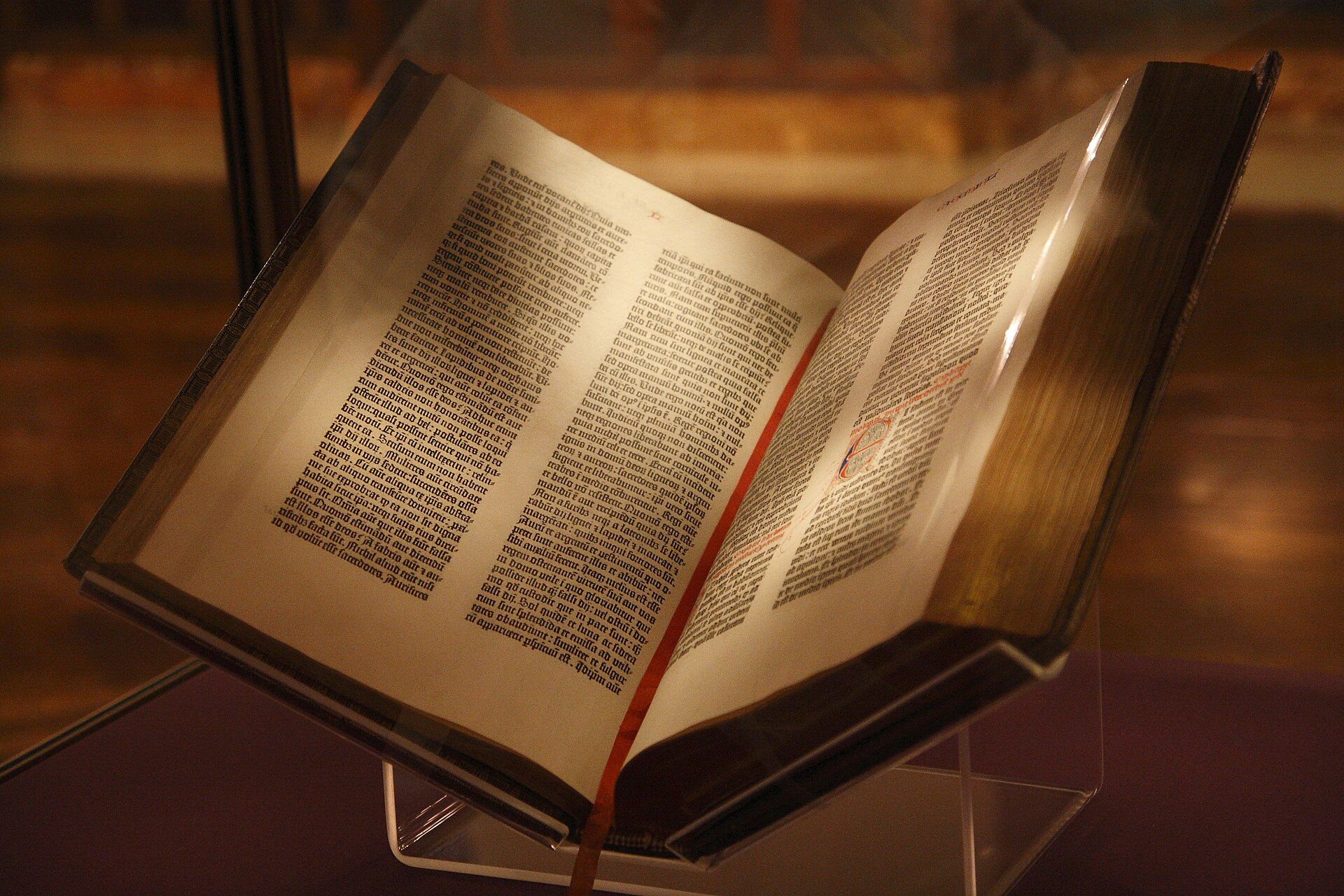
The Latin Vulgate was also the first great book printed in Europe. The Library of Congress, which owns one of the finest copies, describes the Gutenberg Bible as "the first great book printed in Western Europe from movable metal type." The library states that "the printing of the Bible was probably completed late in 1455 at Mainz, Germany," and that Johann Gutenberg (about 1400 to about 1468) "is generally credited for inventing the process of making uniform and interchangeable metal types." Its text is the Vulgate, "printed throughout in double columns, for the most part, with forty-two lines to a page," with capitals and headings added by hand in color.28
Some copies were printed on paper and some on vellum. The Library of Congress copy "is printed entirely on vellum" and "is one of only three perfect vellum copies known to exist," the others being in the Bibliotheque nationale in Paris and the British Library. It belonged for nearly five centuries to Benedictine monks in Austria, and Congress bought it with the Otto Vollbehr collection of fifteenth century books by an act of 1930.28 Printing made it possible to produce identical copies of the Bible for the first time, and so to fix a text, correct it in a new edition, and argue about readings across a continent. The first printed Greek New Testament followed in 1516 (lesson 05), and the first printed English New Testament in 1526 (lesson 06).

What the record shows and what it does not
- Documented fact: Latin translations of the Bible existed by the late second century and varied widely by the fourth (Augustine). The Latin Vulgate (translated about 382 to 405 at the request of Pope Damasus I) combined revision and fresh translation. The Codex Amiatinus was made at Wearmouth-Jarrow and is in Florence. Trent declared the "old and vulgate edition" authentic for public use on April 8, 1546. The Sixtine (1590), Clementine (1592) and Nova Vulgata (1979) editions followed. Bede was translating John into English when he died in 735 (Cuthbert's letter). The Vespasian Psalter and Lindisfarne glosses, the West Saxon Gospels and Aelfric's Old Testament survive in named manuscripts. The Wycliffite Bible exists in two versions translated from the Latin, in about 250 manuscripts. Arundel's seventh constitution forbade unlicensed translation and the reading of translations made since Wycliffe's time without episcopal approval. The Gutenberg Bible is a printed Latin Vulgate, probably completed in 1455.
- Tradition or a book's own claim: Aldred's colophon naming Eadfrith, Aethelwald and Billfrith as makers of the Lindisfarne Gospels, written about 250 years after the fact. The General Prologue's statements that Bede "translatide the bible" and that Alfred founded Oxford.
- Scholarly reading: the dates of the Wycliffite versions (about 1382 and about 1388, from Forshall and Madden), the role of Nicholas Hereford (strong evidence) and of John Purvey (weak evidence), the date of the Vespasian gloss (first half of the ninth century), the date of the Lindisfarne Gospels (about 700 in Gasquet, Cook and Paues; some later scholars place it as late as about 720).
- Open questions: who made the first Old Latin translations and whether there was one version or several; what Augustine meant by the "Itala"; how far the rest of the New Testament beyond the Gospels was revised for the Vulgate; how much of the Early Version New Testament, if any, Wycliffe translated himself; the exact wording of Bede's Latin on the year of Ceolfrith's departure (the weekday he gives points to 716).
Claims checked
"Before Wycliffe there was no Bible in English."
Partly supported. There was no complete Bible in English before the Wycliffite Bible of the 1380s, which Paues called "the earliest complete renderings that we possess of the Holy Scriptures into English."22 But large parts of the Bible had been rendered into English centuries earlier: the Psalter glosses of the ninth century, Aldred's gloss of all four Gospels about 950, the West Saxon Gospels about 1000 (at least seven manuscripts), and Aelfric's Old Testament books, besides Bede's lost John.15 The claim is true of a whole Bible and false of English Scripture in general.
"Wycliffe translated the Bible from the original Hebrew and Greek."
Refuted. Both Wycliffite versions were made from the Latin Vulgate, as Forshall and Madden's title, Skeat, Paues and Hudson all state, and as the General Prologue's own account of gathering "manie elde biblis" to make "oo Latyn bible sumdel trewe" shows.5 Readings such as "breed ouer othir substaunce" in Matthew 6:11 and the heavenly witnesses in 1 John 5:7 come straight from the Latin.23 The first English New Testament from the Greek was Tyndale's (1526).
"John Wycliffe personally translated the Bible into English."
Unresolved. No manuscript names him as translator. Forshall and Madden thought the Early Version New Testament "might probably be the work of Wycliffe himself," while Paues concluded it was "impossible to say what part" he translated.22 The best documented individual contribution is Nicholas Hereford's to the Early Version Old Testament. The Bible is properly called "Wycliffite," the work of his circle, and it is fair to credit Wycliffe with inspiring it.
"The medieval church forbade the Bible in English entirely."
Partly supported. Before Wycliffe there was no general prohibition, and the Old English and fourteenth century versions were made by and for churchmen; Paues called them "perfectly orthodox."22 Arundel's seventh constitution (1407 to 1409) forbade unlicensed translation and the reading of any translation made since Wycliffe's time without a bishop's approval, on pain of the greater excommunication.22 In practice ownership of English Scripture "became regarded as serious evidence of heresy," and copies were confiscated and destroyed when Lollards were tried, as Hudson documents; yet orthodox owners, including King Henry VI, kept copies, and about 250 manuscripts survive.24 The restriction was real and severe in effect, but it was a licensing rule in its wording, not an absolute ban on all English Scripture.
"Bede translated the whole Bible into English."
Unsupported. The Wycliffite General Prologue says "Bede translatide the bible."5 The only contemporary evidence, Cuthbert's letter, says he translated the Gospel of John "from the beginning, as far as the words, 'But what are they among so many?'" (John 6:9), and none of that translation survives.16
"The Vespasian Psalter is the Psalter Pope Gregory sent to Augustine of Canterbury, translated by Aldhelm and Guthlac."
Refuted. Cook quoted an American handbook of 1890 that called the Vespasian Psalter "the identical copy sent by Pope Gregory to Augustine, a.d. 596" with a translation by Aldhelm and Guthlac. He answered that the supposed versions by Aldhelm and Guthlac were "both mythical" and that the manuscript "is not a translation, but a mere gloss," its English added in the ninth century.18
"The Codex Amiatinus is an Italian Bible of the sixth century."
Refuted. It was long believed to be Italian, but De Rossi's discovery of the erased dedication and Hort's identification of the dedication verses showed it to be the Bible Ceolfrith of Wearmouth-Jarrow took toward Rome, "copied in the north of England about the year 700."8
"The Latin Vulgate was the Bible of the western church for a thousand years."
Supported, with a qualification. The Vulgate came into general use only gradually between the fifth and ninth centuries, and the Old Latin continued alongside it and mixed into it.3 From about the ninth century to the Reformation, and in the Catholic Church in its Clementine form until 1979, it was the standard Latin Bible of the West.10
"The Council of Trent declared the Vulgate superior to the Hebrew and Greek."
Partly supported. The decree chose the Vulgate from among "all the Latin editions, now in circulation" and declared it "authentic" for "public lectures, disputations, sermons and expositions."9 It said nothing explicit about the Hebrew and Greek, and Catholic scholars such as Maas held that it did so "without depreciating the Hebrew or the Septuagint."3 Protestant writers read the practical effect differently. The words of the decree support the narrower reading.
"The Gutenberg Bible was the first book ever printed."
Partly supported. The Library of Congress describes it, in carefully limited words, as "the first great book printed in Western Europe from movable metal type."28 That limited claim is accepted. Printing as such is older, above all in East Asia, so "first book ever printed" goes beyond what even the library claims.
"Caedmon translated Genesis into English."
Partly supported. Bede says Caedmon sang "the creation of the world, the origin of man, and all the history of Genesis" and much else, turning into verse what was "expounded to him."13 That was oral paraphrase in poetry, not translation of a written text, and apart from the short hymn none of it can be securely identified today.15
Hard questions and answers
A Catholic reader asks: was Arundel's restriction a defense of the Bible or a suppression of it?
The text of the seventh constitution gives the archbishop's stated reason: translation "is a dangerous thing," because "it is not easy to make the sense in all respects the same," and new translations needed a bishop's approval.26 Paues, no partisan of the Lollards, thought the measure "not without justification" given the controversial prologue and Lollard additions to orthodox works.22 Hudson's evidence shows the effect: for a century and a half, owning English Scripture was treated as evidence of heresy, and Arundel licensed Nicholas Love's devotional life of Christ "as a substitute for the banned vernacular Bible."24 The record supports both descriptions: the stated aim was protection against error, and the practical result was that ordinary readers had no lawful new English Bible until the 1530s.
A King James reader asks: if the Wycliffite Bible came from the Latin, is it a lesser Bible than the KJV?
As a translation it stands one step further from the originals, and the Lord's Prayer chart shows a concrete result: "breed ouer othir substaunce" follows the Latin supersubstantialem, while the King James Version, translated from the Greek, says "daily." But the Latin also preserved readings that the King James Version shares, among them the heavenly witnesses of 1 John 5:7, which entered the printed Greek largely through Latin influence (lesson 05). The fair judgment is that the Wycliffite Bible is a faithful rendering of the late medieval Latin text, valuable as English history and as a witness to that text, and that the move back to the Hebrew and Greek in the sixteenth century was a real gain in accuracy.
A skeptic asks: how can anyone say Bede translated John if not one word of it survives?
The evidence is a single letter by an eyewitness, Cuthbert, who was present at Bede's death, wrote to a fellow student, and gave precise details: the stopping point at John 6:9, the boy Wilbert, the last sentence written on the day of death.16 A single eyewitness account is good evidence by the ordinary standards of history, though it is not a manuscript. What cannot be known is the wording, whether the work was finished beyond chapter 6, or whether any later English Gospel drew on it.
A textual scholar asks: why should anyone studying the Greek New Testament care about the Latin?
Because the Old Latin and the Vulgate were translated from Greek manuscripts older than most that survive, they show which readings existed in Greek at an early date and where. Gasquet described the Vulgate's translator as having access "to Greek and other manuscripts, even at that time considered ancient, which are not now known to exist."8 Augustine had already laid down the rule that, where Latin copies disagree, "we must of course yield to the Greek."1 The Latin evidence therefore appears in every critical apparatus, and it is central to several of the passages discussed in lesson 08.
An Orthodox or Protestant reader asks: was the Vulgate Old Testament translated from the Hebrew or from the Septuagint?
Both, in different parts. Most of the Old Testament was translated from the Hebrew between about 390 and 405, but the Psalter in the Vulgate Bible is the Gallican Psalter, a revision made from the Greek, and several deuterocanonical books were left in their Old Latin form, which was itself translated from the Greek.3 The Wycliffite translators noticed the result and complained that the Psalter "of alle oure bokis discordith most fro Ebru."5 The Septuagint and its relation to the Hebrew are covered in lesson 01.
A visitor asks: why is the oldest complete Latin Bible, made in England, in Florence?
Because it was a gift that never reached its destination. Ceolfrith carried it toward Rome for the pope, died at Langres on the way, and the book ended up at the monastery of San Salvatore on Monte Amiata in Tuscany, where its dedication was altered to name a Lombard abbot.68 It later passed to the Laurentian Library in Florence. It left Italy again only on loan, for the British Library's exhibition in 2018.7
Continue with lesson 05, Erasmus and the Textus Receptus, where the first printed Greek New Testament replaces the Latin as the base of translation, and lesson 06, where Tyndale makes the first English New Testament from the Greek. Readers who want to see the original languages for themselves can begin with the Introduction to Classical Greek and the Introduction to Classical Hebrew. The full timeline of the module is in lesson 16.
Learn more
- Bede, Ecclesiastical History of England (Sellar, CCEL): The full history, with Cuthbert's letter on Bede's death in the introduction; the source for Caedmon and much early English church history.
- The New Testament in English, Wycliffe and Purvey (1879): A readable reprint of the Wycliffite Later Version New Testament with Skeat's introduction and glossary.
- Anne Hudson, The First Complete English Bible: A short, authoritative account of the Wycliffite Bible, its manuscripts, its owners and its suppression.
- Cook, Biblical Quotations in Old English Prose Writers (1898): The classic survey of Old English Bible versions, with Aelfric's preface to Genesis in translation.
- Library of Congress Bible Collection: Images and description of the Library's vellum Gutenberg Bible and the Giant Bible of Mainz.
- Church History, Part A, lesson 10: Reform before Luther: Wycliffe and the Lollards as a reform movement.
Still being checked (11 items)
These points could not be confirmed against a primary source when this lesson was written and fact checked in October 2026. The text above states each one as uncertain.
- The year Ceolfrith left for Rome: Giles's translation prints 715, but the weekday Bede gives (Friday, September 25) fits 716, the year modern accounts use; Bede's Latin text itself was not opened.
- The date of the Lindisfarne Gospels (given as about 700 to 720): Paues (1911) dates the Latin text to the close of the seventh century; the British Library's dating of about 715 to 720 is reported only secondhand, because its collection pages were offline after a cyber-attack.
- The Later Version date is given as about 1388 (Forshall and Madden, Skeat); Hudson says only that the translation was completed within the last twenty years of the fourteenth century. A more exact modern date was not checked.
- The statement that Alfred's founding of Oxford is a medieval legend is not tied to a cited source in this lesson.
- The explanation that January 1408 in the old English reckoning (year beginning March 25) is January 1409 by modern reckoning is standard but not tied to a cited source here.
- The remark that printing is older in East Asia than the Gutenberg Bible is not tied to a cited source in this lesson.
- The English wording of Aldred's colophon comes from the Art of the Middle Ages site, which says it simplifies some passages, and from E. M. Thompson's free version quoted by Cook (1898).
- In the West Saxon Lord's Prayer as printed by Paues, one stray stop after "þe" was omitted; the Tironian sign printed as "J" on the transcription was rendered as ⁊.
- The journal issue and year of Anne Hudson's article "The First Complete English Bible" are not shown on the tyndale.org page (the URL suggests Tyndale Society Journal no. 2).
- Maas (1912) counts 38 Old Latin New Testament manuscripts; modern counts by the Vetus Latina Institute are larger but were not checked.
- The University of Oxford Faculty of English page on Solopova's catalogue (64 Oxford manuscripts, about 250 in all) loaded through a reader tool but returned 'page not found' to a direct request on Oct. 29, 2026; the link may be unstable.
Notes
- Augustine of Hippo, On Christian Doctrine, book 2, chapters 11 and 15 (sections 16 and 22), trans. James Shaw, Nicene and Post-Nicene Fathers, first series, vol. 2, ed. Philip Schaff (Buffalo, NY: Christian Literature Publishing Co., 1887), revised for New Advent by Kevin Knight (retrieved Oct. 28, 2026). Read it online. ↩
- The Passion of the Scillitan Martyrs, in Ante-Nicene Fathers, vol. 9, ed. Allan Menzies (public domain translation), Wikisource (retrieved Oct. 28, 2026). Read it online. ↩
- Anthony Maas, "Versions of the Bible," The Catholic Encyclopedia, vol. 15 (New York: Robert Appleton Company, 1912), sections on the Old Latin, the Vulgate and the English versions, New Advent (retrieved Oct. 28, 2026). Read it online. ↩
- Thomas Shahan, "Pope St. Damasus I," The Catholic Encyclopedia, vol. 4 (New York: Robert Appleton Company, 1908), New Advent (retrieved Oct. 28, 2026). Read it online. ↩
- General Prologue to the Wycliffite Bible (Later Version), chapter 15, Middle English text as printed in Josiah Forshall and Frederic Madden, eds., The Holy Bible... in the Earliest English Versions Made from the Latin Vulgate by John Wycliffe and His Followers (Oxford: Oxford University Press, 1850), vol. 1; reproduced on Michael Marlowe's Bible Research site (retrieved Oct. 28, 2026). Read it online. ↩
- Bede, Lives of the Holy Abbots of Wearmouth and Jarrow, trans. J. A. Giles, Internet Medieval Sourcebook, Fordham University (retrieved Oct. 28, 2026). Bede dates the death to Friday, September 25; that date fell on a Friday in 716. Read it online. ↩
- Brigit Katz, "After 1300 Years Abroad, the Earliest Complete Latin Bible Returns to England," Smithsonian Magazine, December 5, 2017 (retrieved Oct. 28, 2026). Read it online. ↩
- Francis Aidan Gasquet, "Revision of Vulgate," The Catholic Encyclopedia, vol. 15 (New York: Robert Appleton Company, 1912), New Advent (retrieved Oct. 28, 2026). Gasquet states the commission's aim (to determine the text "as accurately as possible") and calls the Amiatinus possibly "among the most important manuscripts for the Vulgate text." Read it online. ↩
- Council of Trent, Fourth Session (April 8, 1546): Decree concerning the Canonical Scriptures and Decree concerning the Edition, and the Use, of the Sacred Books, in The Canons and Decrees of the Sacred and Oecumenical Council of Trent, trans. J. Waterworth (London: Dolman, 1848), 17 to 21, Hanover Historical Texts Project (retrieved Oct. 28, 2026). Read it online. ↩
- Museum of the Bible, "Clementine Vulgate, Second Edition" (Rome: Typographia Apostolica Vaticana, 1593), collections catalog entry (retrieved Oct. 28, 2026). Read it online. ↩
- Michael Ott, "Pope Sixtus V," The Catholic Encyclopedia, vol. 14 (New York: Robert Appleton Company, 1912), New Advent (retrieved Oct. 28, 2026). Read it online. ↩
- John Paul II, Apostolic Constitution Scripturarum Thesaurus, April 25, 1979, Latin text, vatican.va; English renderings in this lesson are the lesson's own (retrieved Oct. 28, 2026). Read it online. ↩
- Bede, Ecclesiastical History of the English People, book 4, chapter 24, in Bede's Ecclesiastical History of England, a revised translation by A. M. Sellar (London: George Bell and Sons, 1907), Christian Classics Ethereal Library (retrieved Oct. 28, 2026). Read it online. ↩
- "Caedmon (fl. c. 657-684): Hymn," verse translation by Albert S. Cook, with introduction, Internet Medieval Sourcebook, Fordham University (retrieved Oct. 28, 2026). Read it online. ↩
- Anna C. Paues, "Bible, English," Encyclopaedia Britannica, 11th ed. (1911), section on the Old English versions, as excerpted on the Bible Research site (retrieved Oct. 28, 2026). The Rushworth Gospels shelfmark, MS. Auct. D. 2. 19, is confirmed in the Bodleian Libraries' Medieval Manuscripts catalogue (medieval.bodleian.ox.ac.uk/catalog/manuscript_431). Read it online. ↩
- Cuthbert, Letter to Cuthwin on the death of Bede, with Sellar's introduction on Bede's life, in Bede's Ecclesiastical History of England, trans. A. M. Sellar (London: George Bell and Sons, 1907), Christian Classics Ethereal Library (retrieved Oct. 28, 2026). Read it online. ↩
- King James Version (1769 Oxford text): Matthew 6:9 to 13, John 6:9, Psalm 100:1 to 2, Luke 11:3, 1 John 5:7, Bible Gateway (public domain) (retrieved Oct. 28, 2026). Read it online. ↩
- Albert S. Cook, Biblical Quotations in Old English Prose Writers (London: Macmillan, 1898), introduction (on the Vespasian Psalter gloss, the Lindisfarne entries, and Aelfric's preface to Genesis, pp. xlv and lxx to lxxii), Internet Archive (retrieved Oct. 28, 2026). Read it online. ↩
- F. L. Attenborough, ed. and trans., The Laws of the Earliest English Kings (Cambridge: Cambridge University Press, 1922), introduction and notes on the laws of Alfred, Internet Archive (retrieved Oct. 28, 2026). Read it online. ↩
- King Alfred's West-Saxon Version of Gregory's Pastoral Care, ed. and trans. Henry Sweet, Early English Text Society (London, 1871), Alfred's preface, Internet Archive (retrieved Oct. 28, 2026). Read it online. ↩
- "The Lindisfarne Gospels colophons" (British Library, Cotton MS Nero D IV, fol. 259r), English rendering with simplifications noted by the site, Art of the Middle Ages (retrieved Oct. 28, 2026). Read it online. ↩
- Anna C. Paues, "Bible, English," Encyclopaedia Britannica, 11th ed. (1911), sections on the fourteenth century versions and the Wycliffite versions, as excerpted on the Bible Research site (retrieved Oct. 28, 2026). Read it online. ↩
- Walter W. Skeat, introduction, and the Later Version text of Matthew 6 and 1 John 5, in The New Testament in English according to the Version by John Wycliffe about A.D. 1380 and Revised by John Purvey about A.D. 1388, formerly edited by Josiah Forshall and Frederic Madden (Oxford: Clarendon Press, 1879), Internet Archive (retrieved Oct. 28, 2026). Read it online. ↩
- Anne Hudson, "The First Complete English Bible," Tyndale Society Journal, online at tyndale.org (retrieved Oct. 28, 2026). Read it online. ↩
- Biblia Sacra Vulgata, Clementine text: Matthew 6, Luke 11 and 1 John 5, Douay-Rheims and Clementine Vulgate site, drbo.org (retrieved Oct. 28, 2026). Read it online. ↩
- Archbishop Thomas Arundel, Constitutions against the Lollards (dated January 14, 1408), English translation by John Johnson as revised by Michael Marlowe (2012) against the Latin in David Wilkins, Concilia Magnae Britanniae et Hiberniae, vol. 3 (London, 1737), 314 to 319, Bible Research (retrieved Oct. 28, 2026). Read it online. ↩
- University of Oxford, Faculty of English, "Manuscripts of the Wycliffite Bible in the Bodleian and Oxford College Libraries" (Elizabeth Solopova) (retrieved Oct. 28, 2026). The online copy cited earlier returned page not found when checked on Oct. 28, 2026. ↩
- Library of Congress, "The Gutenberg Bible," in the exhibition Library of Congress Bible Collection (retrieved Oct. 28, 2026). Read it online. ↩
Check yourself
1. What did Augustine say about the Latin translators of the Bible in his day?
In On Christian Doctrine 2.11 Augustine wrote that the Latin translators "are out of all number," because in the early days of the faith anyone who got a Greek manuscript and knew a little of both languages ventured to translate.
2. Which part of the Latin Vulgate Bible is a revision from the Greek rather than a translation from the Hebrew?
The Psalter printed in the Vulgate Bible is the Gallican Psalter, a revision made from the Greek (Hexaplar) text, as Maas describes; most other Old Testament books were translated from the Hebrew.
3. Where was the Codex Amiatinus, the oldest surviving complete Latin Bible, made?
Bede records that Abbot Ceolfrith had three pandects made; De Rossi and Hort showed that the Amiatinus, long thought Italian, is the one Ceolfrith took toward Rome.
4. What did the Council of Trent decree about the Vulgate on April 8, 1546?
The Decree concerning the Edition and Use of the Sacred Books chose the Vulgate from among the Latin editions in circulation and declared it authentic for public use.
5. What does Cuthbert's letter say Bede was translating into English when he died in 735?
Cuthbert's letter to Cuthwin names the Gospel of John up to John 6:9; no part of the translation survives.
6. What is Aldred's contribution to the Lindisfarne Gospels?
Aldred glossed the Latin text word by word in Northumbrian English about 950 and wrote the colophon naming Eadfrith, Aethelwald and Billfrith.
7. From what text was the Wycliffite Bible translated?
Both the Early and Later Versions were made from the Latin Vulgate, as Forshall and Madden, Skeat, Paues and Hudson state; Erasmus's Greek did not appear until 1516.
8. What did the seventh of Archbishop Arundel's Constitutions forbid?
Constitution 7 forbade unlicensed translation and the reading of such translations until approved by the diocesan bishop or a provincial council, under pain of the greater excommunication.
Terms in this lesson
- Old Latin (Vetus Latina)
- The Latin translations of the Bible made from the Greek, by many unknown translators, from the second century until they were displaced by the Vulgate. Augustine called one form of them the Itala.
- Latin Vulgate
- The Latin Bible translated about 382 to 405 at the request of Pope Damasus I: the Gospels revised against Greek manuscripts, most of the Old Testament translated from the Hebrew, the Psalter revised from the Greek, and some books left in Old Latin form. Vulgata means "common."
- Gallican Psalter
- The revision of the Latin Psalms made about 388 from the Greek Hexaplar text, so named because it became current in Gaul; it is the Psalter printed in the Vulgate Bible.
- Pandect
- A single volume containing the whole Bible. Bede says Abbot Ceolfrith had three Vulgate pandects made at Wearmouth-Jarrow.
- Codex Amiatinus
- The oldest surviving complete Latin Bible, made at Wearmouth-Jarrow for Abbot Ceolfrith shortly before 716 and now in the Biblioteca Medicea Laurenziana, Florence (MS Amiatinus 1).
- Clementine Vulgate
- The official Vulgate edition issued under Pope Clement VIII in 1592 after the withdrawn Sixtine edition of 1590; the standard Latin Bible of the Catholic Church until 1979.
- Nova Vulgata
- The revised Latin Bible promulgated as the typical edition by John Paul II's constitution Scripturarum Thesaurus on April 25, 1979, corrected toward the Hebrew and Greek.
- Gloss (interlinear)
- A word-for-word translation written between the lines of a manuscript, each word above the word it translates, as in the Vespasian Psalter and Aldred's Lindisfarne gloss.
- Colophon
- A note at the end of a manuscript about who made it, when or where. Aldred's colophon in the Lindisfarne Gospels names Eadfrith, Aethelwald, Billfrith and himself.
- West Saxon Gospels
- The first translation of the four Gospels into continuous Old English prose, made in southern England about the year 1000 and surviving in at least seven manuscripts.
- Wycliffite Bible
- The first complete Bible in English, made from the Latin Vulgate by John Wycliffe's circle: the literal Early Version (about 1382) and the more idiomatic Later Version (about 1388). About 250 manuscripts survive.
- General Prologue
- The long preface that circulated with the Wycliffite Later Version; its chapter 15 describes how the translators established a Latin text, studied commentaries, consulted scholars and translated "to the sentence" (the meaning).
- Lollards
- The followers of John Wycliffe in England in the late fourteenth and fifteenth centuries, associated with the English Bible and prosecuted as heretics.
- Arundel's Constitutions
- Thirteen constitutions against the Lollards issued by Archbishop Thomas Arundel, drafted in 1407 and dated January 1408 (1409 by modern reckoning); the seventh forbade unlicensed translation of Scripture into English.
Sources
- Augustine, On Christian Doctrine, book 2 (NPNF I.2) (about 397 to 426; trans. 1887) checked 2026-10
- The Passion of the Scillitan Martyrs (ANF 9) (AD 180; trans. 1896) checked 2026-10
- Catholic Encyclopedia: Versions of the Bible (Maas) (1912) checked 2026-10
- Catholic Encyclopedia: Pope St. Damasus I (Shahan) (1908) checked 2026-10
- Catholic Encyclopedia: Revision of Vulgate (Gasquet) (1912) checked 2026-10
- Catholic Encyclopedia: Pope Sixtus V (Ott) (1912) checked 2026-10
- Wycliffite General Prologue, chapter 15 (Forshall and Madden text) (about 1390s; ed. 1850) checked 2026-10
- Bede, Lives of the Abbots of Wearmouth and Jarrow (Giles) (after 716; trans. 19th century) checked 2026-10
- Smithsonian: the earliest complete Latin Bible returns to England (Katz) (2017-12-05) checked 2026-10
- Council of Trent, Fourth Session (Waterworth) (1546-04-08; trans. 1848) checked 2026-10
- Museum of the Bible: Clementine Vulgate, Second Edition (1593 (object)) checked 2026-10
- John Paul II, Scripturarum Thesaurus (1979-04-25) checked 2026-10
- Bede, Ecclesiastical History 4.24 (Sellar) (731; trans. 1907) checked 2026-10
- Cuthbert's letter on the death of Bede (Sellar) (735; trans. 1907) checked 2026-10
- Caedmon's Hymn, trans. A. S. Cook (Internet Medieval Sourcebook) (7th century; trans. early 20th century) checked 2026-10
- Paues, Bible, English: Old English versions (EB 1911) (1911) checked 2026-10
- Paues, Bible, English: Wycliffite versions (EB 1911) (1911) checked 2026-10
- Cook, Biblical Quotations in Old English Prose Writers (1898) checked 2026-10
- The Lindisfarne Gospels colophons (Art of the Middle Ages) (about 950 (colophon)) checked 2026-10
- Sweet, King Alfred's West-Saxon Version of Gregory's Pastoral Care (late 9th century; ed. 1871) checked 2026-10
- Attenborough, The Laws of the Earliest English Kings (1922) checked 2026-10
- The New Testament in English, Wycliffe and Purvey (Clarendon Press reprint, Skeat introduction) (1879) checked 2026-10
- Anne Hudson, The First Complete English Bible (Tyndale Society Journal (date not shown)) checked 2026-10
- Oxford Faculty of English: Manuscripts of the Wycliffite Bible (Solopova) (accessed 2026) checked 2026-10
- Arundel's Constitutions (Johnson, rev. Marlowe) (1408 (1409 n.s.); trans. rev. 2012) checked 2026-10
- Clementine Vulgate, Matthew 6 (drbo.org) (1592 text) checked 2026-10
- King James Version passages (Bible Gateway) (1611; 1769 text) checked 2026-10
- Library of Congress: The Gutenberg Bible (exhibition page) checked 2026-10