Lesson 5 of 16 · about 55 minutes · Updated October 28, 2026
Erasmus, the Textus Receptus and the First Printed Greek New Testaments
You'll be able to
- Explain why the Complutensian Polyglot was the first Greek New Testament printed but Erasmus's the first published, with the dates for each.
- Name the manuscripts Erasmus used in 1516, where they are now, and how he used them, including his single incomplete manuscript of Revelation.
- Identify the places where the Textus Receptus took Greek wording from the Latin, such as Revelation 22:19 and Acts 9:5 to 6, and check them in the KJV and ASV.
- Tell the history of 1 John 5:7 in the printed Greek text and evaluate the 'promise' story in light of H. J. de Jonge's 1980 study.
- Trace the line from Erasmus through Stephanus, Beza and the Elzevirs to the King James Version and Scrivener's 1881 text, and say where the name 'Textus Receptus' came from.
- Describe how the critical editions from Mill (1707) to Lachmann (1831) branched off from the received text.
Start here: the short version
For about sixty years after Gutenberg, the New Testament circulated in Western Europe in print only in Latin. The first complete Greek New Testament ever printed was the fifth volume of a Spanish multilingual Bible, the Complutensian Polyglot, finished at Alcala on January 10, 1514, but it was not released for sale until about 1522. In the meantime the Basel printer Johann Froben hired the Dutch scholar Desiderius Erasmus to produce a Greek New Testament in a hurry, and their book, the Novum Instrumentum omne, came off the press in February and March 1516. It was the first Greek New Testament published and sold.
Erasmus worked from a handful of late medieval manuscripts that happened to be in Basel, used one of them as the printer's copy, and had a single manuscript of Revelation that lacked its last verses, which he supplied by translating the Latin Vulgate back into Greek. He revised the book four times (1519, 1522, 1527, 1535). In the third edition he added 1 John 5:7 (the Comma Johanneum) from a single Greek manuscript produced in England, now Codex Montfortianus in Trinity College Dublin. The well known story that he had "promised" to add the verse if one Greek manuscript were found was examined by H. J. de Jonge in 1980, who found no such promise in Erasmus's writings.
Later printers built on Erasmus: Robert Estienne (Stephanus) at Paris, whose 1550 folio carried the first printed collection of variant readings and whose 1551 edition introduced the verse numbers still used; Theodore Beza at Geneva (1565 to 1598); and the Elzevir brothers of Leiden, whose 1633 preface told the reader, in Latin, that he now held "the text received by all." That phrase gave the family of editions its name, the Textus Receptus. The King James translators of 1611 worked mainly from Beza's and Stephanus's editions. In 1881 F. H. A. Scrivener reconstructed, for Cambridge University Press, the Greek text the King James translators followed. This lesson traces that chain edition by edition, names the manuscripts behind it, quotes the editors in their own words, and checks the stories told about them.
Why the Greek New Testament was printed late
Printing with movable type spread across Europe from Mainz in the 1450s. The first great book from the press was a Latin Bible (see lesson 04 on the Gutenberg Bible). Hebrew Bibles followed within a generation, printed by and for Jewish communities. The Greek New Testament, by contrast, waited more than half a century. Samuel Prideaux Tregelles, a nineteenth century English textual scholar who wrote a full history of the printed Greek text (1854), gave several reasons. Jewish communities had the skill, money and demand to print Hebrew. Greek-speaking Christians did not: the fall of Constantinople to the Ottoman sultan in 1453 came "almost synchronous with the invention of printing," and many Greek exiles in the West earned their living by copying manuscripts by hand, so that "they had a positive interest in not using the newly-invented art of printing."1 Early Greek type was clumsy, and scholars used to the ligatures and contractions of Greek handwriting disliked it.
The main reason Tregelles gave was the place of the Latin Bible in the Western church. "In Western Europe, the Latin Vulgate was the form in which Holy Scripture was known and received," he wrote, "so that even on the part of theologians there was no desire for the original text."1 The Latin Vulgate (translated about 382 to 405 at the request of Pope Damasus I) had been the Bible of the Latin church for a thousand years, and any departure from it looked to many like a dangerous novelty. That attitude explains much of the opposition Erasmus later met.
Small pieces of the Greek New Testament did reach print before 1514. Tregelles, quoting Samuel Davidson, listed the hymns of Mary and Zechariah from Luke 1 appended to a Greek Psalter printed in 1486, the first six chapters of John printed by Aldus Manutius at Venice in 1504, and the first fourteen verses of John printed at Tubingen in 1514.1 None of these was a New Testament. The first complete one came from Spain.
The Complutensian Polyglot
Cardinal Ximenes and Alcala
Francisco Ximenes de Cisneros (in modern Spanish spelling, Jimenez), a Franciscan who became Archbishop of Toledo, primate of Spain and regent of Castile, planned the first printed multilingual Bible in 1502. According to F. H. A. Scrivener, the Cambridge textual scholar whose Plain Introduction to the Criticism of the New Testament went through four editions (the fourth edited by Edward Miller in 1894), the cardinal meant the work "to celebrate the birth of him who afterwards became the Emperor Charles V," and gathered at his new University of Alcala de Henares (in Latin, Complutum, which gives the Polyglot its name) "as many manuscripts as he could procure."2 The New Testament team included Diego Lopez de Zuniga (Stunica in Latin), Antonio de Nebrija, Demetrius Ducas of Crete and Fernando Nunez (Pintianus). Tregelles judged that Zuniga "seems to have been the person who undertook the responsibility of preparing the Greek text."1
The Polyglot ran to six volumes. The Old Testament set the Hebrew, the Latin Vulgate and the Greek Septuagint side by side, with the Latin in the middle column. The New Testament, printed first as volume 5, set Greek and Latin in parallel columns. Its colophon dates its completion to January 10, 1514, and names the printer as Arnao Guillen de Brocar. Volume 6, a lexicon and indexes, is dated March 17, 1515, and the fourth Old Testament volume July 10, 1517. Scrivener reported that the outlay "is stated to have exceeded 50,000 ducats," and that "not more than six hundred copies were printed."2
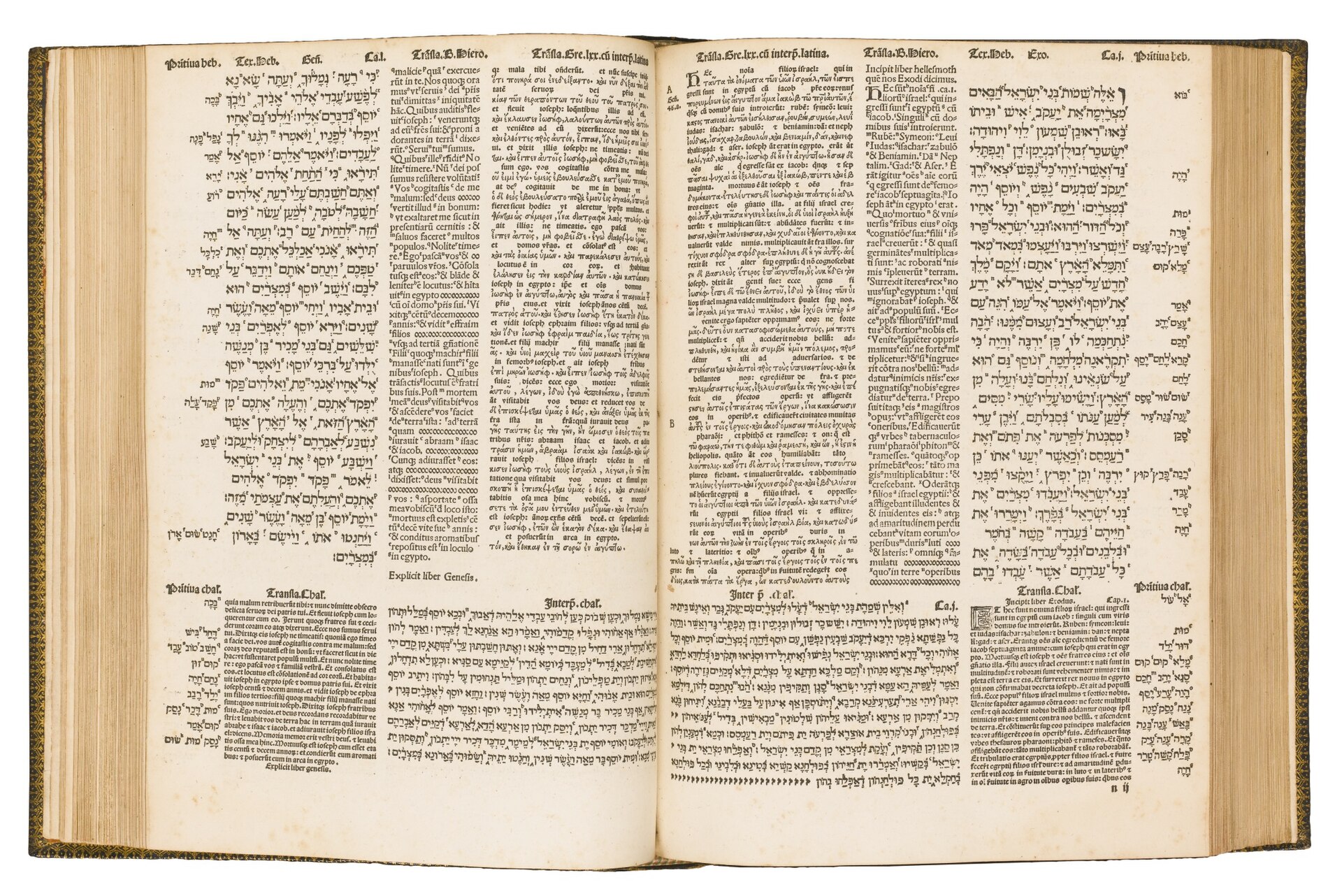

What manuscripts the Spanish editors used
The editors did not list their manuscripts, which, Tregelles noted, "was not then customary." Their preface claimed that "ordinary copies were not the archetypes for this impression, but very ancient and correct ones," sent "from the apostolical library" by Pope Leo X (Tregelles's translation of the Latin preface).1 Scrivener doubted that the claim could cover the New Testament. Leo X "was not elected Pope till March 11, 1513, and the N. T. was completed Jan. 10 of the very next year," and the Vatican librarian Carlo Vercellone found records of only two manuscripts sent to the cardinal in Leo's first year, neither containing any part of the New Testament. The surviving Alcala collection, catalogued at Madrid in 1846, held Latin and Hebrew books and only two Greek manuscripts of the Septuagint.2 Scrivener's conclusion was that the Complutensian Greek "does not widely differ from that of most codices written from the tenth century downwards," with no sign that Codex Vaticanus or any manuscript like it had been used.2
The Spanish editors generally printed their Greek as they found it, even where it disagreed with the Latin beside it. Scrivener's own collation counted 849 places where the Latin column disagreed with the Greek, which he took as evidence that the Greek had not been made over to match the Latin. The great exception was 1 John 5:7 to 8. Scrivener wrote, "We need not deny that 1 John v. 7, 8 was interpolated, and probably translated from the Vulgate."2 Tregelles was blunter: "the Complutensian editors translated it from the modern Latin."3 That verse returns below.
Printed in 1514, published about 1522
The finished New Testament sat in storage for years. The cardinal died on November 8, 1517. Pope Leo X's authorization for publication is dated March 22, 1520, and, in Tregelles's words, "the work did not get into general circulation before the year 1522."1 By then Erasmus's Greek New Testament had been on sale for six years and was in its third edition. Scrivener put it this way: Erasmus's New Testament "was by six years the earlier published, though it was printed two years later than the Complutensian."2 The distinction between printed and published decides the answer to the popular question of which Greek New Testament came first (see Claims checked below). Only a few later editions followed the Complutensian text closely, chiefly Christophe Plantin's Antwerp Polyglot of 1569 to 1572, but its readings entered the Textus Receptus through Erasmus's fourth edition and through Stephanus.2
Both Tregelles and Scrivener repeated a story that when the old cardinal was shown Erasmus's rival edition and Zuniga tried to belittle it, he answered, in Scrivener's rendering, "would God that all the Lord's people were prophets! produce better, if thou canst; condemn not the industry of another."4 Scrivener's footnote gives Tregelles as his source. The anecdote is attractive but rests on later report, and this lesson treats it as tradition.
Erasmus and Froben
Who Erasmus was
Desiderius Erasmus was born at Rotterdam in the later 1460s (the year is disputed; Scrivener wrote "in 1465, or, perhaps, a year or two later"), the illegitimate son of, in Scrivener's words, "reputable and (but for that sin) of virtuous parents." Orphaned young, he was pressed into religious life, was ordained a priest in 1492, and then spent his life as a traveling scholar, living on patrons, printers and pupils. Scrivener summed him up as "now learning Greek at Oxford" (largely self-taught, he added), "now teaching it at Cambridge (1510)."4 By 1515 he was famous across Europe as a Latin writer (Froben's preface to the 1516 edition, as Scrivener described it, took pride in the friendship of "the first of living authors"), a critic of clerical corruption and of the scholastic theology of the universities, and a champion of a return to the sources: the Greek New Testament and the early church writers. For the wider movement of reform in which he moved, see Module 79, lesson 10 and lesson 11.
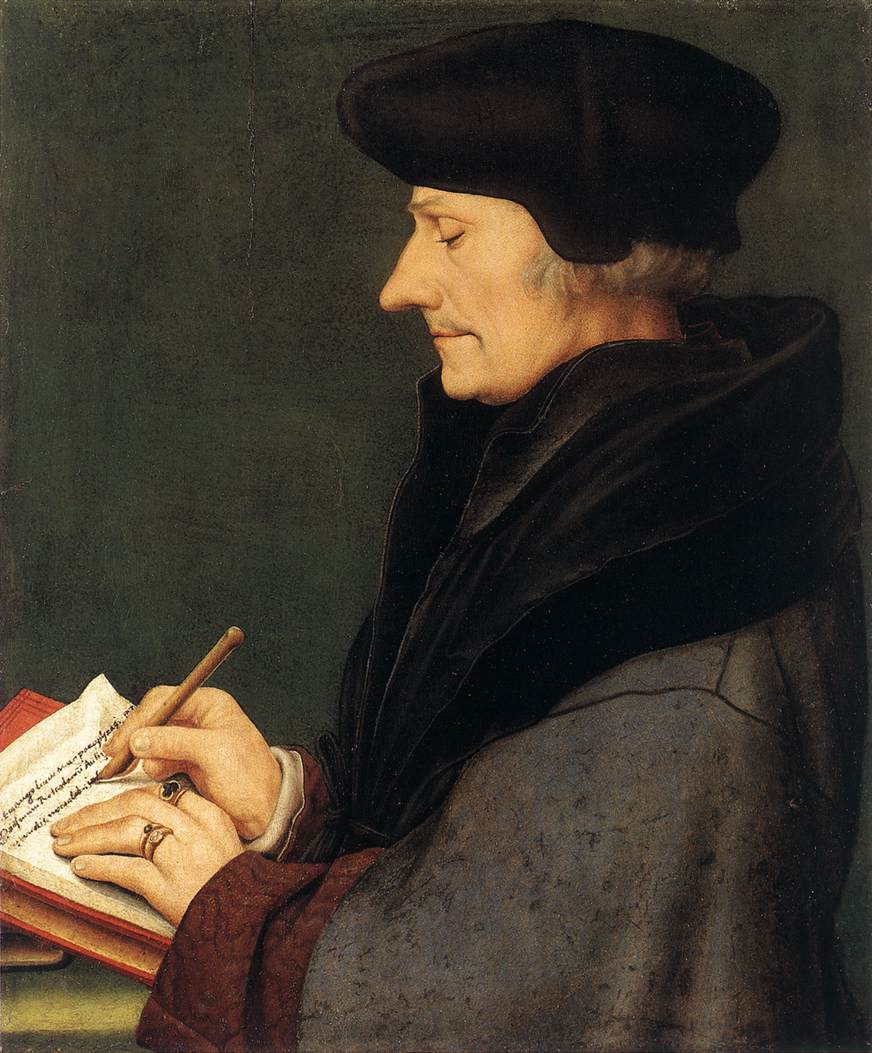

A race with Spain
Erasmus had been working for years on a new Latin translation of the New Testament with notes defending it. The Greek text was meant to support the Latin. What turned the project into a Greek New Testament was a printer's business sense. Scrivener tells it this way: Johann Froben of Basel, "moved by the report of the forthcoming Spanish Bible and eager to forestall it," applied to Erasmus through a friend "to undertake immediately an edition of the N. T." The proposal was sent on April 17, 1515.4 Erasmus was then in England. He reached Basel in the summer of 1515. On September 11 it was still undecided whether his Latin version should stand in a column beside the Greek or be printed separately.5
The book was printed in a few months. Tregelles wrote that "In less than six months from the commencement of the printing, the whole volume was completed," and he recorded the dates printed in it: the back of the title page reads "Sexto Calendas Martias, anno M.D.XVI" (February 24, 1516), the dedication to Pope Leo X is dated "Calendis Februariis" (February 1), the colophon at the end reads "Mense Februario, anno M.D.XVI" (February 1516), and the end of the annotations reads "Kalendis Martij" (March 1).5 Scrivener describes the result as "a large folio of 1,027 pages in all."4 So the honest answer to "when was it published" is late February or early March 1516. The book went on sale at once: Tregelles notes that Erasmus's letters mention copies being sent to various people besides the Pope.5
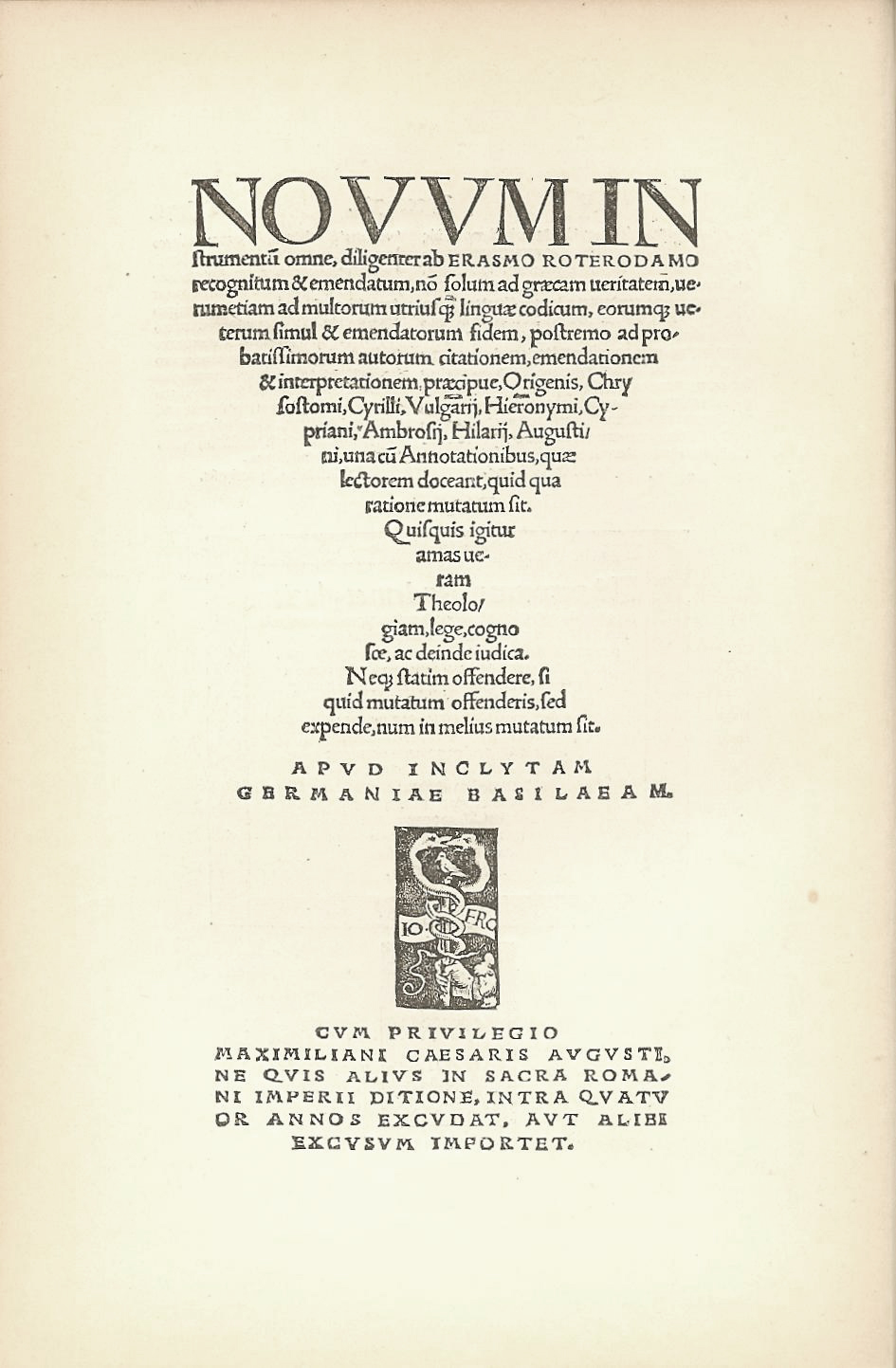

The long title promised much: Novum Instrumentum omne, diligenter ab Erasmo Roterodamo recognitum et emendatum, non solum ad Graecam veritatem, verum etiam ad multorum utriusque linguae codicum, eorumque veterum simul et emendatorum fidem, that is, "The whole New Instrument, diligently revised and corrected by Erasmus of Rotterdam, not only according to the Greek truth but also according to the reliability of many manuscripts of both languages, both old and corrected." It closed with an invitation: "Quisquis igitur amas veram theologiam, lege, cognosce, ac deinde judica," "whoever you are who love true theology, read, learn, and then judge."4 Erasmus's dedication to Leo X said the same: "Novum ut vocant testamentum universum ad Graecae originis fidem recognovimus, idque non temere neque levi opera, sed adhibitis in consilium compluribus utriusque linguae codicibus, nec iis sane quibuslibet, sed vetustissimis simul et emendatissimis," roughly, "We have revised the whole of what they call the New Testament to agree with the Greek original, and not rashly or with little effort, but taking into counsel a number of manuscripts in both languages, and not just any, but the oldest and most correct."4
The reality was humbler, and Erasmus later admitted it. In a letter to Willibald Pirckheimer he called the book "praecipitatum fuit verius quam editum," "rushed out rather than edited" (Scrivener's citation).4 Scrivener, who admired Erasmus, was sharp about the gap between the dedication and the facts: "it is almost painful to be obliged to remember that a portion of ten months at the utmost could have been devoted to his task by Erasmus."4 The proofreader was Johannes Oecolampadius, later a reformer at Basel, but "Froben's hot haste gave him little leisure to do his part." Scrivener's verdict on the typesetting was that the first edition "is in that respect the most faulty book I know," with 501 itacisms (vowel misspellings) carried over from the manuscripts into print.4 Even the title page carried a blunder: it listed among the authorities a writer "Vulgarius," a name Erasmus had formed by mistake from Bulgaria, the see of the commentator Theophylact. Erasmus had found out the blunder by 1528, when he gave the commentator his right name.4
The manuscripts Erasmus used
The Basel manuscripts
Erasmus did not search Europe for the oldest copies. He used what was in Basel, most of it in the library of the Dominican house, to which, Heide notes, Cardinal John of Ragusa had bequeathed his Greek manuscripts. Martin Heide, a professor at Marburg, summarizes current scholarship in a 2023 article: eight manuscripts "written between the 10th and 15th centuries," six lent by the Basel Dominicans and two borrowed from the German Hebrew scholar Johann Reuchlin.6 Most are still in the University Library of Basel under the same shelf marks. Scholars now refer to them by Gregory-Aland numbers, the standard numbering kept by the Institute for New Testament Textual Research (INTF) at Munster. Older books such as Scrivener's use an older system, in which, for example, the Basel Acts and Epistles manuscript is "Act. Paul. 2"; the table gives the current numbers as Heide lists them.
| Gregory-Aland number | Contents | Date | Where held now | How Erasmus used it |
|---|---|---|---|---|
| 2 | Four Gospels | 12th century (Heide); "xv or earlier" (Scrivener) | Basel, University Library, A. N. IV. 1 | Main text of the Gospels; marked up and sent to the typesetters |
| 2815 | Acts and Epistles | 12th century | Basel, A. N. IV. 4 | Main text of Acts and the Epistles |
| 2817 | Pauline Epistles | 10th to 11th century | Basel, A. N. III. 11 | Used for Paul |
| 1 | Gospels, Acts, Epistles | 12th century | Basel, A. N. IV. 2 | Consulted occasionally; Erasmus thought it unreliable |
| 2816 | Acts and Epistles | 15th century | Basel, A. N. IV. 5 | Consulted occasionally |
| 817 | Gospels with Theophylact's commentary | 15th century | Basel, A. N. III. 15 | Consulted |
| 2814 | Revelation with the commentary of Andrew of Caesarea | 12th century | Augsburg, University Library, I.1.4 1 | The only manuscript of Revelation; lent by Reuchlin |
| 2105 | Pauline Epistles with Theophylact's commentary | 12th century | Oxford, Bodleian Library | Used mainly for the annotations |
Sources: Heide (2023) for numbers, dates and shelf marks; Scrivener (1894) and Tregelles (1854) for how each was used.647
Scrivener's account matches Heide's in substance: "the only manuscripts he can be imagined to have constantly used are Codd. Evan. 2, Act. Paul. 2 and Paul. 7, with occasional reference to Evan. Act. Paul. 1 and Act. Paul. 4 (all still at Basle) for the remainder of the New Testament, to which add Apoc. 1, now happily recovered, alone for the Apocalypse." He added that all of these, "excepting Evan. Act. Paul. 1, were neither ancient nor particularly valuable."4 The irony, which both Tregelles and Scrivener noticed, is that manuscript 1, the one Erasmus valued least, is the one modern critics rate highest. Tregelles wrote that Erasmus "thought it to be of but little value, from its readings being so different from the common Greek copies."7 Scrivener nonetheless listed about twenty places where Erasmus "could have followed none other than Cod. 1."4
Manuscripts used as printer's copy
To save time, Erasmus did not have a clean copy written out. He corrected the Basel manuscripts by hand and sent them to the compositors. Tregelles reported that the Gospels manuscript (GA 2) "still has the marks of Erasmus's corrections, and the printer's notices of the beginnings of the folios."7 Scrivener's note says the same: "to save time and trouble, he used them as copy for the press."4 His catalog entry for GA 2 calls it "the inferior manuscript chiefly used by Erasmus for his first edition of the N. T. (1516), with press corrections by his hand, and barbarously scored with red chalk to suit his pages," and adds that the Basel monks "had bought it for two Rhenish florins."8 In practice, then, the Greek text of the Gospels in 1516 is, with Erasmus's corrections, the text of one twelfth century Byzantine manuscript, and the Greek of Acts and the Epistles mostly that of another.
One manuscript of Revelation
For Revelation Erasmus had a single manuscript, borrowed from Reuchlin: GA 2814, a twelfth century copy in which the Greek text is broken up by the commentary of Andrew of Caesarea. It was lost to scholars for centuries and identified again in the nineteenth century (Scrivener calls it "now happily recovered"); it is now in the University Library at Augsburg.46 Tregelles described the problem plainly: "For the Apocalypse he had but one mutilated MS., borrowed from Reuchlin, in which the text and commentary were intermixed almost unintelligibly. And thus he used here and there the Latin Vulgate for his guide, retranslating into Greek as well as he could. This was the case with regard to the last six verses, which from the mutilated condition of his MS. were wholly wanting."5 The last leaf of the manuscript was gone. Heide reports that its text "ends abruptly with Revelation 22:16."6
Erasmus did not hide what he had done. His annotation reads: "quanquam in calce hujus libri, nonnulla verba reperi apud nostros, quae aberant in Graecis exemplaribus, ea tamen ex latinis adjecimus," that is, "although at the end of this book I found some words in our copies [the Latin] which were missing in the Greek copies, we nevertheless added them from the Latin."4 The result was a Greek text of Revelation 22:16 to 21 made in Basel in 1515 or 1516 from the Latin. Some of its wording survived into every later edition of the Textus Receptus. Scrivener listed the individual Greek forms involved and stated that "some portions of his self-made version, which are found (however some editors may speak vaguely) in no one known Greek manuscript whatever, still cleave to our received text."4
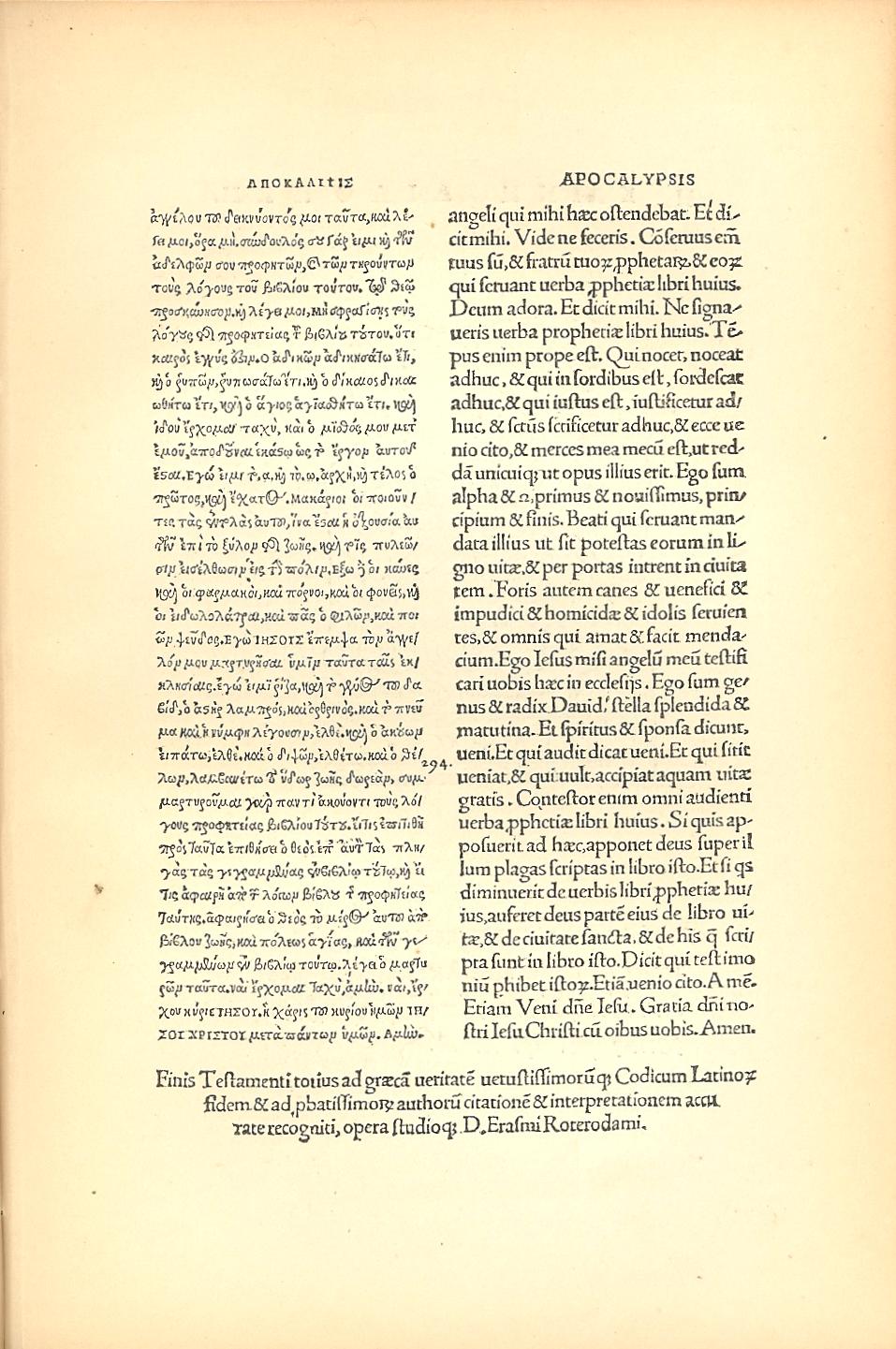

The best known example is Revelation 22:19. Erasmus's Greek, following the Latin copies he had, reads "book of life" (βίβλου τῆς ζωῆς), and the King James Version, made from the Textus Receptus, follows it: "God shall take away his part out of the book of life, and out of the holy city" (Revelation 22:19, KJV).9 The Greek manuscripts of Revelation read "tree of life" (ξύλου τῆς ζωῆς), and so do the Revised Version and the American Standard Version: "God shall take away his part from the tree of life, and out of the holy city" (Revelation 22:19, ASV 1901).10 Scrivener included βίβλου in verse 19 in his list of Erasmus's self-made readings.4 Heide explains the Latin side: the KJV's "book of life" comes from a confusion in Latin copies between ligno ("tree") and libro ("book").6 Defenders of the Textus Receptus have pointed to a few Greek manuscripts that read "book"; textual scholars answer that those are late copies influenced by the printed editions. That debate belongs to lesson 08.
Scrivener also showed that the problem was not confined to the last six verses. Because text and commentary in the Reuchlin manuscript were "so mixed up as to be undistinguishable in parts," Erasmus at times "was sometimes tempted to translate into his own Greek from the Latin Vulgate such words or clauses as he judged to have been wrongly passed over by his sole authority," and he gave a list of places through the book (for example Revelation 2:2, 2:17, 3:5, 5:14 and 22:11).4 Many of these were corrected in 1527 from the Complutensian Polyglot, as described below. Some were not.
Other places filled from the Latin
Erasmus's habit of supplying from the Latin what he thought his Greek copies had lost showed up outside Revelation as well. Two places from Acts became part of the King James Version.
Acts 9:5 to 6. Erasmus's own annotation admits that the words "it is hard for thee to kick against the pricks" are not in the Greek manuscripts at this point: "In graecis codicibus id non additur hoc loco, cum mox sequatur, Surge; sed aliquanto inferius, cum narratur haec res," that is, "In the Greek manuscripts this is not added at this place, since 'Arise' follows directly, but somewhat further on, where this event is narrated" (Acts 26:14). Yet his printed text carried the full Latin wording.5 The KJV reads: "it is hard for thee to kick against the pricks. And he trembling and astonished said, Lord, what wilt thou have me to do?" (Acts 9:5 to 6, KJV).9 Scrivener agreed that "in Acts ix. 5, 6, the words from σκληρόν to πρὸς αὐτόν are interpolated from the Vulgate, partly by the help of Acts xxvi."4
Acts 8:37. Here Erasmus's note says he had not found the verse in the Greek manuscript he was using but had found it written in the margin of one: "non reperi in Graeco codice, quanquam arbitror omissum librariorum incuria. Nam et haec in quodam codice graeco asscripta reperi sed in margine," "I did not find it in the Greek manuscript, though I think it was left out by the carelessness of scribes. For I found these words written in a certain Greek manuscript, but in the margin."5 He printed the verse, and it passed into the KJV: "And Philip said, If thou believest with all thine heart, thou mayest. And he answered and said, I believe that Jesus Christ is the Son of God" (Acts 8:37, KJV).9 Tregelles, a critical-text scholar, judged that the verse has little "claim to be considered part of Holy Scripture."5 Defenders of the verse point to early Latin writers who quote it; lesson 08 sets out the evidence on both sides.
Erasmus could also correct a familiar reading when he had early testimony. In Acts 13:33 he printed "the first psalm" for "the second psalm," explaining in his note that early Latin testimony showed the psalm cited in Acts had been counted as the first in older copies (the expanded note of 1522 adds Hilary and Augustine): "Proinde nos his autoribus germanam restituimus scripturam," "therefore, on the authority of these writers, we have restored the genuine reading." Tregelles, who quoted the note, observed that the later received text did not follow Erasmus here.7 The point matters for judging him: he did weigh ancient evidence when he had it. In 1516 he had very little.
The Latin translation and the notes
To Erasmus and his first readers, the new Latin translation and the annotations were the heart of the book, and they drew the fire. Tregelles wrote that "his own revised Latin version was regarded as such an innovation, that every variation from what had been commonly read, was regarded as presumption or even as heresy."5 In the second edition (1519) Erasmus changed the first words of John's Gospel in his Latin from In principio erat Verbum to In principio erat Sermo, following, Tregelles says, "the phraseology of the early Latin fathers," and "This was deemed almost, if not quite, a heresy."3 Tregelles retells Erasmus's own report of a bishop who denounced the new translation from the outdoor pulpit at St. Paul's Cross in London and called on the Lord Mayor and citizens not to "suffer such new translations, which subvert the authority of Holy Scripture, to obtain farther currency."3
Erasmus's prefaces also argued that Scripture should be read by ordinary people in their own languages. Tregelles summarized them: Erasmus "had spoken of the importance of Holy Scripture to all Christians; and had expressed a wish that it might be so translated and used, as not to be in the hands of the learned merely, but also of the common people, such (he specifies) as the Scots and Irish."3 Within a decade William Tyndale, working from Erasmus's Greek, would put that wish into English (see lesson 06).
Five editions, 1516 to 1535
Erasmus lived to see five editions of his New Testament, all printed at Basel by Froben's firm, and he died at Basel in 1536.4 The chart below sets out what each one changed. The counts of changes come from John Mill's prolegomena of 1707 as Scrivener and Tregelles reported them; Scrivener warned that "his statements respecting their divergences are much below the truth."4
The second edition, 1519
The second edition, with the title changed to Novum Testamentum, appeared in March 1519. Scrivener notes that its title page claimed to be "multo quam antehac diligentius ab Er. Rot. recognitum" ("revised by Erasmus of Rotterdam much more carefully than before"), and that the claim was fair: "a large portion of the misprints, and not a few readings of the first edition, are herein corrected, the latter chiefly on the authority of a fresh codex, Evan. Act. Paul. 3."4 (That manuscript is GA 3, the Codex Corsendonckensis, a twelfth century copy of the Gospels, Acts and Epistles from a convent at Corsendonck near Turnhout, now in Vienna; Scrivener notes that it "was lent to Erasmus for his second edition in 1519, as he testifies on the first leaf.")8 It was prefaced by a letter of thanks from Pope Leo X.3 Mill counted about four hundred changes, by his reckoning 330 for the better and seventy for the worse.4
Erasmus himself gave the size of the first two printings. Tregelles wrote, "we are, however, informed in one place by Erasmus, that the numbers unitedly of his first two editions amounted to three thousand three hundred," and that they were sold out by 1522, a sign that "the demand for the Greek New Testament was considerable."3 The 1519 text had an influence far beyond its sales. Martin Luther, hidden at the Wartburg castle, obtained "a copy of Erasmus of Rotterdam's newly published and more accurate Greek New Testament," in the words of a 2022 account by Ken Sundet Jones, and spent his last eleven weeks there translating it into German; the result, the "September Testament," was published in September 1522.11 Which Erasmus edition Luther used is usually given as the second (1519); the source opened for this lesson does not name the edition. For Luther's Bible see Module 79, lesson 11.
In 1518, between the first and second editions, the Aldine press at Venice printed a Greek Bible whose New Testament, according to Mill as Scrivener reports him, follows Erasmus's first edition "so closely in the New as to reproduce his very errors of the press."4 Erasmus later treated readings from this Aldine reprint as if they were independent evidence, apparently not realizing the Venetian text was his own. Tregelles quoted him: before the second edition he wrote to his friends at Basel asking them to restore the concluding verses of Revelation from the Aldine edition ("ex editione Aldina restituerent eum locum").7
The third edition, 1522
The third edition is remembered for one verse, 1 John 5:7, treated in the next section. It also, by Mill's count, changed the text of the second edition in 118 places, several of them taken, Tregelles says, from silent corrections in the Aldine reprint.3 Scrivener noted that "The first complete printed English N. T. (Tyndale 1526) followed Erasmus' third edition rather than his second," citing Romans 8:20 to 21 and 1 John 5:7 to 8.4
The fourth edition, 1527
Erasmus finally saw the Complutensian Polyglot in 1522, after his third edition was out. For the fourth edition (March 1527) he used it to repair Revelation, where, in Scrivener's words, "he amended from it at least ninety readings."4 Tregelles added a dry comment: more could have been corrected, "but Erasmus seems to have forgotten what all the places were which he had himself turned into Greek, ten years before," and he asked why such readings had then "for three hundred years" been "repeated in the common editions, although their origin has been a matter of common knowledge."3 The fourth edition printed three columns: the Greek, the Latin Vulgate, and Erasmus's own Latin. Tregelles thought the Vulgate was added so that the severe censures of the new translation "might be shown to be undeserved."7
The fifth edition, 1535
The fifth edition, published the year before Erasmus died, dropped the Vulgate again and changed the Greek very little; Mill noticed only four differences from 1527, though Scrivener found that many in the Epistle of James alone. Tregelles drew the conclusion that matters for the rest of this lesson: "as the fifth edition of Erasmus is the substantial basis of the text which has commonly been used, and as that edition scarcely varies from the fourth, we may look on the edition of 1527 as containing really that revision of the text, which has obtained a kind of permanency."7
The Comma Johanneum and the "promise"
The verse in question
The words in dispute are the reference to three heavenly witnesses in 1 John 5:7 to 8, called the Comma Johanneum ("the Johannine clause"). In the King James Version, which prints them, the passage reads: "For there are three that bear record in heaven, the Father, the Word, and the Holy Ghost: and these three are one. And there are three that bear witness in earth, the Spirit, and the water, and the blood: and these three agree in one" (1 John 5:7 to 8, KJV).9 Without the added words, the Greek manuscripts known to Erasmus read only that there are three that bear witness, the Spirit, the water and the blood, and the three agree in one. The American Standard Version of 1901, which omits the clause, renumbers the verses, so that its verse 8 reads: "For there are three who bear witness, the Spirit, and the water, and the blood: and the three agree in one" (1 John 5:8, ASV 1901).10 The words were present in many later manuscripts of the Latin Vulgate. They were not in the Greek copies Erasmus had, so he did not print them in 1516 or 1519.
Edward Lee and Diego Lopez de Zuniga
The omission brought attacks from two directions. Edward Lee, an English cleric who later became Archbishop of York, and Diego Lopez de Zuniga, the Complutensian editor, both charged Erasmus with dropping a key text for the doctrine of the Trinity. Tregelles described Erasmus's defense: "it was in vain for Erasmus to answer that this was a case not of omission, but simply of non-addition. He showed that even some Latin copies did not contain the verse; and that Cyril of Alexandria, in his 'Thesaurus,' so cited the context of the passage as to show that he knew nothing of the words in question."5 Erasmus also asked his friend Paolo Bombasio in Rome to check Codex Vaticanus, and in a letter dated June 18, 1521, Bombasio sent him a transcript of the opening verses of 1 John 4 and 5 from it, without the clause. Tregelles calls this the first time "the authority of the Codex Vaticanus was appealed to" in a question of criticism.5
The "Codex Britannicus"
Between the second and third editions a Greek manuscript containing the clause was reported in England. Erasmus inserted the words in his third edition of 1522 and explained himself in his annotation. Tregelles printed the note. It begins "Verumtamen ne quid dissimulem, repertus est apud Anglos Graecus codex unus in quo habetur quod in Vulgatis deest," "But so as to hide nothing, a single Greek manuscript has been found among the English in which is found what is missing in the [Greek] common copies," quotes the manuscript's wording, and ends: "Ex hoc igitur codice Britannico reposuimus, quod in nostris dicebatur deesse: ne cui sit ansa calumniandi. Tametsi suspicor codicem illum ad nostros esse correctum." In English: "From this British codex, therefore, we have restored what was said to be missing in ours, so that no one would have a handle for slander. Even so, I suspect that codex was corrected to agree with ours" (Latin spelling normalized from the OCR of Tregelles's 1854 print).3
The manuscript Erasmus called the Codex Britannicus is generally identified with the manuscript now numbered 61, the Codex Montfortianus, in the library of Trinity College Dublin (catalogued today as MS 30). The French manuscript database Pinakes, kept by the Institut de recherche et d'histoire des textes, dates it to the early sixteenth century, "ante 1522," and lists it as a paper manuscript of the whole Greek New Testament.12 Scrivener's description adds details: it is the work of "three or four successive scribes," on paper, "only one of them, that on which 1 John v. 7 stands, being glazed, as if to protect it from harm." Its earliest known owner was a Franciscan friar named Froy (or Roy); it passed through the hands of Thomas Clement, William Chark and Thomas Montfort of Cambridge (from whom it takes its name) to Archbishop James Ussher, who gave it to Trinity College.8 Heide states that the codex was written around 1520 "most likely to provide Erasmus with the missing 'evidence.'"6 That is an inference from its date and its owner's circumstances; no document records who commissioned it.
Tregelles also pointed out how un-Greek the manuscript's wording was. It lacked the Greek articles that the grammar requires, and Erasmus's printed form differed from it slightly. "In his subsequent editions, he inserted the articles," and later editors smoothed the wording further, so that "the verse assumed, in the common editions, the form which it has retained." His conclusion: "Its origin, however, is clear: the Complutensian editors translated it from the modern Latin, and so did the writer of the Dublin MS."3
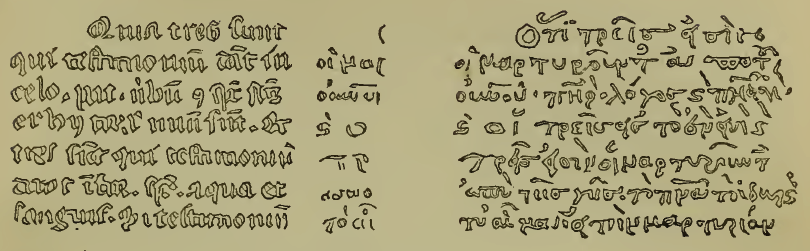

How many Greek manuscripts contain the clause at all? In 1854 Tregelles listed four: the Codex Montfortianus; the Codex Ravianus at Berlin, which he called "a transcript from the Complutensian Polyglot, imitating its very misprints"; a manuscript at Naples "where a recent hand has added it in the margin"; and the Codex Ottobonianus 298 in the Vatican, a fifteenth century Greek and Latin manuscript "in which the Greek is a mere accompaniment of the Latin."13 Later discoveries have added a handful of late manuscripts and marginal notes. Lesson 08 gives the modern count, the Latin evidence (including the fourth century Spanish writer Priscillian) and the arguments of the verse's defenders.
Did Erasmus promise?
For two centuries the episode has usually been told as a wager. Tregelles in 1854: "At length Erasmus promised that if a Greek MS. were produced which contained the words, he would insert them," and in 1522 he inserted the verse "in fulfilment of his promise."53 Scrivener's catalog says Erasmus "had publicly declared, in answer to objectors, that if any Greek manuscript could be found containing the passage, he would insert it in his revision of the text; a promise which he fulfilled in 1522."8 Bruce Metzger repeated the story in The Text of the New Testament, and it is told in countless sermons and websites, often with the added claim that the Codex Montfortianus was forged to win the bet.
In 1980 the Dutch scholar Henk Jan de Jonge, whom Metzger and Ehrman later called "a specialist in Erasmian studies," examined what Erasmus actually wrote, in "Erasmus and the Comma Johanneum," Ephemerides Theologicae Lovanienses 56 (1980), pages 381 to 389.14 The passage usually cited is in Erasmus's reply to Lee, the Responsio ad annotationes Eduardi Lei of 1520: "Si mihi contigisset unum exemplar in quo fuisset quod nos legimus, nimirum illinc adiecissem quod in caeteris aberat," roughly, "If it had fallen to me to have a single copy in which stood what we read, I would certainly have added from it what was missing in the others." De Jonge's reading: the sentence looks back to what Erasmus had done in 1516 and 1519. "This is not a promise, but a justification after the event of what had happened, cast in the unfulfilled conditional."14 He concluded that the promise story "has no foundation in Erasmus' works," that the earliest reference he could find was by the English writer Thomas Hartwell Horne in 1818, and that it most likely grew out of a misreading of the reply to Lee. On Erasmus's motive in 1522, de Jonge took Erasmus at his word, "ne cui sit ansa calumniandi": Lee had linked the omission to Arianism, and Erasmus was protecting his reputation and his book. De Jonge also found that it "cannot be shown from Erasmus' writings" that Erasmus thought the Codex Britannicus had been made specially to force his hand.14
The standard handbook adjusted, partly. In the fourth edition of The Text of the New Testament (2005), Metzger and Bart Ehrman softened the sentence to "In an unguarded moment, Erasmus may have promised that he would insert the Comma Johanneum," and added a note that de Jonge "could find no explicit evidence that supports this frequently made assertion concerning a specific promise made by Erasmus." The textual scholar Peter Gurry, who quoted both on the Evangelical Textual Criticism blog in 2019, called the footnote, in a reply to a reader, "a bit of an odd admission given what they write in the main text."15 The verdict on the story appears in Claims checked below.
Erasmus and Codex Vaticanus
A common charge against Erasmus is that he knew of Codex Vaticanus (B), the great fourth century manuscript in the Vatican Library, and ignored it. The record is more mixed. Besides Bombasio's 1521 transcript of 1 John, Erasmus received in 1533 a letter from the Spanish scholar Juan Gines de Sepulveda describing "Graecum exemplar antiquissimum in Bibliotheca Vaticana," "a very old Greek copy in the Vatican Library," written in capital letters, containing both Testaments, "longe diversum a vulgatis exemplaribus," "very different from the common copies." Scrivener records that Sepulveda "furnishes Erasmus with 365 readings" from it, and that in his notes on Acts published in 1535 Erasmus cited the spelling Kauda in Acts 27:16 "from a Greek codex in the Pontifical Library," a reading for which, Scrivener noted, Codex Vaticanus was the only known Greek witness apart from a corrector of Codex Sinaiticus.16 Sepulveda praised the manuscript for agreeing with the Latin. Erasmus, who had suggested during the Comma dispute that Greek manuscripts agreeing with the Latin might have been altered to match it after the Council of Florence in the fifteenth century,5 did not rebuild his text on it. By then the text was in its fourth edition and the outline of the received text was set. For the codex itself see lesson 02.
After Erasmus: Colinaeus and Stephanus
Simon de Colines, 1534
Once Erasmus's text was in print, other printers copied it. One early edition stands apart. Simon de Colines (Colinaeus), a Paris printer, issued a Greek New Testament in 1534 that mixed the Complutensian and Erasmian texts and, according to Mill as Scrivener reports him, departed from both in about 150 places, usually with manuscript support. Tregelles judged it "not, however, by any means a critical edition," noted that Colinaeus did not print 1 John 5:7, and concluded that "This edition seems to have had no influence whatever on those which succeeded."134
Robert Estienne and the royal press
Robert Estienne (1503 to 1559), known in Latin as Stephanus and in older English books as Robert Stephens or Stephen, worked under the patronage of King Francis I of France and his son Henry II and printed his Greek New Testaments at the royal press. Scrivener called him "This eminent and resolute man," "whose Biblical work taken altogether had perhaps more influence than that of any other single man in the sixteenth century" (quoting another writer).17 He printed four editions of the Greek New Testament.
1546 and 1549. Two small, elegant editions printed at Paris with royal Greek type, known to collectors by the first words of their preface, O mirificam ("O wonderful generosity of our King"). In the preface Estienne claimed to have used manuscripts in the King's Library "almost to be adored for the very look of their age," and boldly added that he had edited the text "ita ... ut nullam omnino literam secus esse pateremur quam plures, iique meliores libri, tanquam testes, comprobarent," "so that we allowed not a single letter to stand otherwise than the greater number, and the better, books approved, as witnesses."17 Tregelles found that these two editions "had contained a text blended from the Complutensian and Erasmian."13
1550, the Editio Regia. The royal folio of 1550 was the first Greek New Testament printed with a collection of variant readings in its margin. The text itself, Tregelles wrote, followed Erasmus "almost exclusively," apparently his fifth edition, while "The various readings in the margin are from the Complutensian printed edition, and from fifteen MSS."13 Estienne's preface lists sixteen authorities by Greek numerals: alpha was the Complutensian, and beta a manuscript collated in Italy that scholars have identified as Codex Bezae (D), now at Cambridge. Most of the others came from the King's Library in Paris. The collating was done by Robert's son Henri, who in 1546 was only eighteen years old.17 The work was uneven. Scrivener tested it against the one witness anyone could check, the printed Complutensian, and found that out of more than 2,300 differences it was cited correctly 554 times and wrongly 56 times. Of the apparatus as a whole he wrote, "the text is perpetually at variance with the majority of them, and in 119 places with them all."17
The margin still mattered. It showed readers for the first time that the manuscripts disagreed, and how. It also caused trouble. The theologians of the Sorbonne objected to the edition; when Estienne explained that the notes were variant readings, Tregelles records, "they then desired him to produce the MS. copy from which the variations were taken; they had again to be informed that the MSS. were many, not one merely."13 At 1 John 5:7 a misplaced semicircle in the 1550 margin seemed to say that seven manuscripts lacked only the words "in heaven." Beza and others later argued from this that the verse stood in seven Greek manuscripts. Tregelles answered that the sign belonged after the words "in earth" in verse 8, so that the seven manuscripts omitted the whole clause, and that identification of some of the manuscripts "has proved this to be a fact."13 Scrivener added that in England the 1550 text itself came to be "by many regarded as the received or standard text."17
The verse numbers of 1551
Under pressure from the Sorbonne, Estienne left Paris for Geneva, where, Scrivener says, he settled for good in 1552 and "made public profession of the Protestant opinions which had long been gathering strength in his mind." In 1551 he printed at Geneva a small Greek New Testament with two Latin versions, the Vulgate and Erasmus's, on either side of the Greek, and with the text divided into numbered verses for the first time.1317 Chapters already existed (they came from the medieval Latin Bible); the verse numbers in every modern Bible's New Testament come from this edition. His son Henri later wrote, in the preface to his father's Concordance, that Robert had done the work on a journey from Paris to Lyon, "inter equitandum," which Scrivener translated cautiously as "while resting at the inns on the road." Scrivener complained that "a very little care would have spared us many of the disadvantages" of the divisions, and traced their spread: from the 1551 Greek New Testament into the English Geneva New Testament of 1557, into Beza's Greek of 1565, "and thence into subsequent editions."18 Whether "inter equitandum" means on horseback or at stops along the way is still argued; the Latin can be read either way.
Theodore Beza
Theodore Beza (Theodore de Beze, 1519 to 1605), a French scholar of noble birth, became, in Scrivener's words, the holder of "the chief place among the French Reformed on the death of their teacher Calvin in 1564" (see Module 79, lesson 12). He published his own Latin translation of the New Testament in 1556 and then, according to the list Scrivener's editor took from Isaac H. Hall, ten editions of the Greek New Testament with Latin and notes: four in folio (1565, 1582, 1588 and 1598) and six smaller ones (1565, 1567, 1580, 1591, 1604 and 1611).17 Tregelles's 1854 list of five (1565, 1576, 1582, 1589 and 1598) shows how the counting of Beza's editions has varied.13
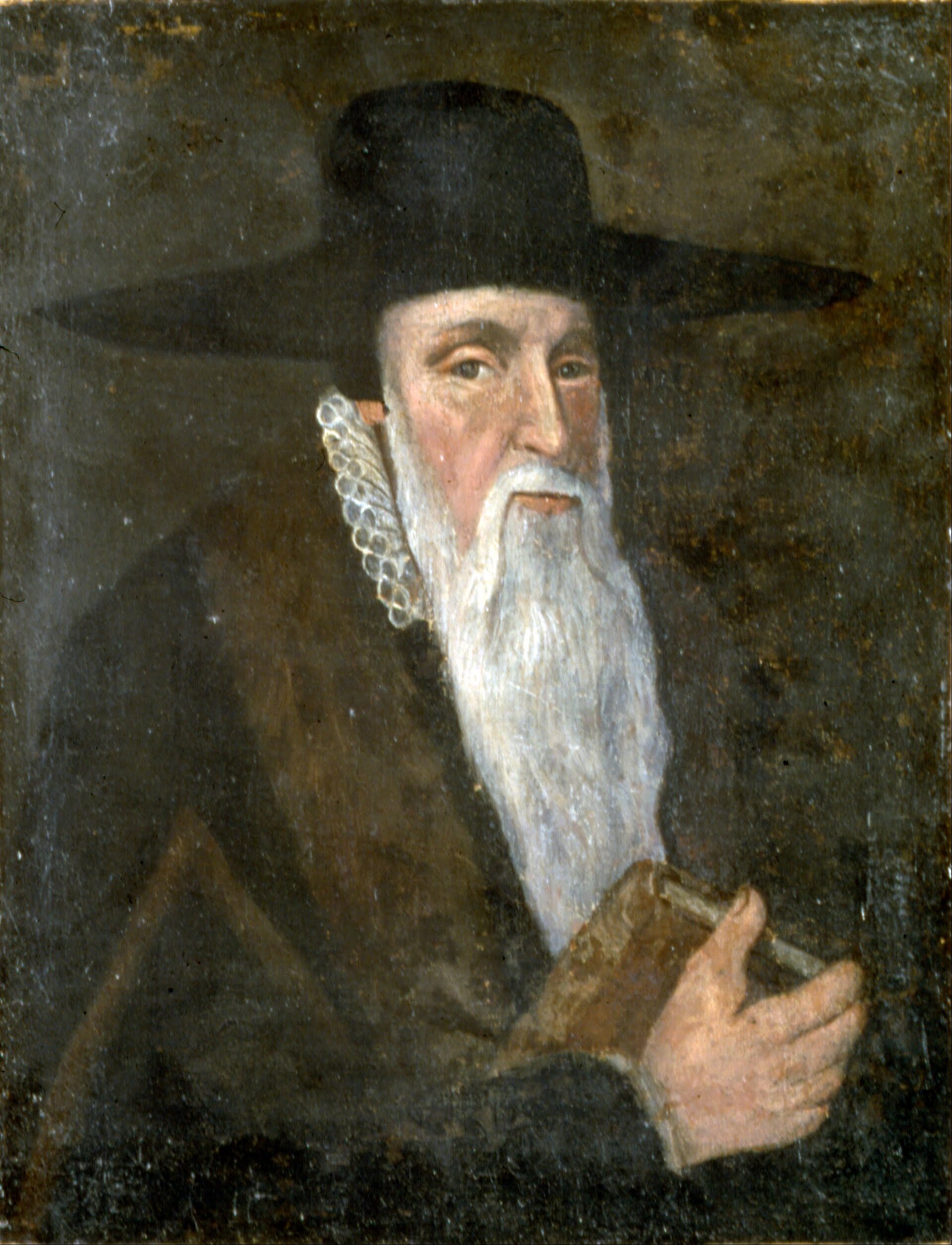

Beza owned two of the most important manuscripts of the New Testament: the Codex Bezae (D) of the Gospels and Acts in Greek and Latin, which he gave to the University of Cambridge, and the Codex Claromontanus of Paul's letters, now in Paris. He also had Henri Estienne's collations. He made little use of any of them. Scrivener: Beza "neither sought very anxiously after fresh materials for correcting the text, nor made any great use of what were ready at hand," and "All his editions vary somewhat from Stephen and from each other, yet there is no material difference between any of them."17 Scrivener's editor reported the count of Eduard Reuss that Beza's 1565 edition departed from Estienne's 1551 text only about twenty-five times.17
Both Tregelles and Scrivener faulted Beza for choosing readings by theological preference. Scrivener's example is Luke 2:22, where Beza adopted from the Complutensian "her purification" (τοῦ καθαρισμοῦ αὐτῆς), "for which he could have known of no manuscript authority whatever," and noted that "our Authorized English version condescends to follow his judgement."17 The KJV reads: "And when the days of her purification according to the law of Moses were accomplished, they brought him to Jerusalem" (Luke 2:22, KJV).9 The ASV, following the Greek manuscripts, reads: "And when the days of their purification according to the law of Moses were fulfilled, they brought him up to Jerusalem" (Luke 2:22, ASV 1901).10
Yet Beza could also weigh ancient evidence against the received text. On the story of the woman taken in adultery (John 7:53 to 8:11), after noting how many ancient writers did not know it and how much the manuscripts varied, he wrote (in Tregelles's translation): "As far as I am concerned, I do not conceal that I justly regard as suspected what the ancients with such consent either rejected or did not know of."13 He kept the passage in his text. Tregelles's judgment of his influence was that "Beza's text was during his life in very general use amongst Protestants; they seemed to feel that enough had been done to establish it."13
The Elzevirs and the name "Textus Receptus"
Bonaventure and Abraham Elzevir (Scrivener calls them brothers; other accounts make Abraham the nephew of Bonaventure) ran a printing house at Leiden in the Dutch Republic, famous for small, neat, well-printed books. In 1624 they issued a pocket Greek New Testament. Its title page said only that it was printed "Ex Regiis aliisque optimis editionibus cum cura expressum," "printed with care from the royal and other best editions," meaning Estienne's (especially the royal folio of 1550) and Beza's; it had no preface, and its editor is unknown.1317 Scrivener's editor reported Reuss's finding that out of a thousand test readings the 1624 Elzevir differed from Beza's small 1565 edition in only eight.17
The second Elzevir edition, of 1633, broke the text into separate verses and added a preface. That preface contains the sentence that named the whole tradition:
"Textum ergo habes, nunc ab omnibus receptum: in quo nihil immutatum aut corruptum damus."
Tregelles translated it: "Thou hast the text now received by all, in which we give nothing altered or corrupted."13 In plain modern English: "So you have the text, now received by everyone, in which we offer nothing changed or corrupted." Scrivener remarked that the editor spoke "with a confidence which no doubt helped on its own accomplishment."17 From the words textum ... receptum came the Latin label Textus Receptus, "received text," first applied to the Elzevir text and then to the whole family of printed editions descending from Erasmus. Tregelles noted that in England the standard text was in practice Estienne's 1550, reprinted by John Mill in 1707, while "in foreign countries the Elzevir edition has been regarded as 'the received text.'"13 The term therefore never named one fixed edition. Scrivener's editor recorded that Scrivener's own list of differences between Estienne's 1550 text and the Elzevir text ran to 287 items, most of them small.17
The Greek behind the King James Version
The King James translators finished their work in 1611, twenty-two years before the Elzevir preface coined the phrase "received text." They did not work from a single printed Greek edition, and they left no list of the editions they used. The best evidence comes from comparing their English with the printed Greek texts available to them. Scrivener did this for his 1884 study The Authorized Edition of the English Bible (1611) and concluded: "Doubtless they rested mainly on the later editions of Beza's Greek Testament, whereof his fourth (1589) was somewhat more highly esteemed than his fifth (1598), the production of his extreme old age. But besides these, the Complutensian Polyglott, together with the several editions of Erasmus, and Stephen's of 1550, were constantly resorted to." In the 252 places he examined where those printed texts differ enough to affect the English, "our Translators abide with Beza against Stephen in 113 places, with Stephen against Beza in 59, with the Complutensian, Erasmus, or the Vulgate against both Stephen and Beza in 80."19 Scrivener judged that "On certain occasions, it may be, the Translators yielded too much to Beza's somewhat arbitrary decisions; but they lived at a time when his name was the very highest among Reformed theologians."19 The translators' own account of their work, and the six companies who did it, are in lesson 07.
Scrivener's figure of 80 places where the KJV follows the Complutensian, Erasmus or the Latin against both Estienne and Beza means that the KJV's Greek text, read verse by verse, matches no single printed edition. That is the problem Scrivener solved for Cambridge University Press in 1881.
Scrivener's reconstruction, 1881 and 1894
When the Revised Version New Testament appeared in May 1881 (see lesson 09), the revisers sent their list of Greek readings to the Oxford and Cambridge presses. The Cambridge edition, prepared by Scrivener, was designed to show both the Greek the KJV translators had followed and the changes the revisers had adopted. The book was The New Testament in the Original Greek, according to the Text followed in the Authorised Version, together with the Variations adopted in the Revised Version (Cambridge, 1881). Its preface states the aim: "to place clearly before the reader the variations from the Greek text represented by the Authorised Version of the New Testament which have been embodied in the Revised Version." Scrivener took Beza's edition of 1598 as his base, because it agreed with the KJV more closely than any other, and replaced Beza's reading wherever the KJV clearly followed a different printed reading; the replacements are marked with an asterisk and number "about 190." The readings the revisers changed are printed "in a thicker type," with their replacements at the foot of the page.20
Scrivener's text was reprinted with corrections in 1894 and has been reprinted many times since. It is the Greek text usually meant today when a publisher or teacher speaks of "the Textus Receptus" as the Greek behind the King James Version. It is, by its own description, a modern reconstruction: a Greek text assembled in 1881 to match an English translation made in 1611, not an edition that any sixteenth century printer issued.20
The critical editions branch off
While the received text held its place in churches and schools, scholars kept collecting the variant readings that Estienne's margin had first displayed. The chart below traces both lines.
John Mill (1707). Mill, an Oxford scholar, spent about thirty years on a Greek New Testament that printed Estienne's 1550 text unchanged with a vast collection of variants in its notes. He died in 1707, a fortnight after it was published.21 His apparatus was later said to contain about thirty thousand variant readings, and the number frightened some readers. The classical scholar Richard Bentley answered in 1713, in words Scrivener quoted with approval: "The real text of the sacred writers does not now (since the originals have been so long lost) lie in any MS. or edition, but is dispersed in them all. 'Tis competently exact indeed in the worst MS. now extant; nor is one article of faith or moral precept either perverted or lost in them." And: "Make your 30,000 [variations] as many more, if numbers of copies can ever reach that sum: all the better to a knowing and a serious reader, who is thereby more richly furnished to select what he sees genuine."22
Bengel, Wettstein and Griesbach. Johann Albrecht Bengel published his Greek New Testament at Tubingen in 1734; Johann Jakob Wettstein his, with an enormous apparatus, at Amsterdam in 1751 and 1752; and Johann Jakob Griesbach his first edition at Halle in 1774 and 1775.21 Each moved further from the printed text toward a text chosen by grouping manuscripts into families and weighing them.
Karl Lachmann (1831). The decisive break came from a classical scholar. In 1831 Karl Lachmann published at Berlin a small edition "containing only the text of the New Testament, with a list of the readings wherein he differs from that of Elzevir," in Scrivener's description.21 Lachmann did not correct the received text; he built a text from the oldest witnesses and measured the received text against it. From there the line runs through Tregelles, Constantin von Tischendorf, and Westcott and Hort (1881) to the Nestle-Aland and United Bible Societies editions behind most modern translations. That story, and the defenders of the received text who answered it, are in lesson 08. Readers who want to look at the Greek of these editions can start with Module 78, Intro to Classical Greek, and its lessons on using a lexicon and reading aids.
Judging Erasmus's work
Erasmus's edition has been judged harshly by later critics and defended warmly by supporters of the received text, and both sides can quote the record. What the sources opened for this lesson agree on is this. The 1516 book was made fast, from a few late manuscripts available in one city, with one incomplete copy of Revelation, by an editor whose chief interest was his Latin translation and notes. Its errors in Revelation and in a few places in Acts came from the Latin. Its later editions improved it, especially in Revelation in 1527. Erasmus was open about what he had done, said where he had supplied words from the Latin, and printed 1 John 5:7 in 1522 with a note saying he suspected the manuscript behind it.
Tregelles, who spent his life replacing the received text, still wrote: "let us make whatever deductions are needful, still Erasmus is entitled to our thanks for the labour which he undertook and accomplished, in spite of so many hindrances." He also observed that "had he possessed the materials since brought to light, no one would have valued more than he those ancient MSS. and versions."37 His complaint was with those who came after: "The Greek New Testament, however, soon became, as it were, stereotyped in men's minds; so that the readings originally edited on most insufficient MS. authority, were supposed to possess some prescriptive right, just as if (to use Dr. Bentley's phrase) an apostle had been the compositor."7
Defenders of the received text read the same history differently. In their view, set out by Edward F. Hills (The King James Version Defended, 1956) and others and examined in lesson 08, the manuscripts Erasmus used represent the text the Greek church read for a thousand years, and the acceptance of the printed text by the Protestant churches was itself part of God's providential care of Scripture. The facts about which manuscripts Erasmus had, and what he took from the Latin, are not in dispute between the two positions; the weight to give them is.
Timeline, 1502 to 1894
What the record shows and what it does not
- Documented fact. The Complutensian New Testament was printed by January 10, 1514, licensed by Leo X on March 22, 1520, and in circulation about 1522. Erasmus's first edition is dated February and March 1516 in the book itself. Erasmus's five editions appeared in 1516, 1519, 1522, 1527 and 1535. Most of his Basel manuscripts survive and show printer's marks. His only manuscript of Revelation (GA 2814) lacks the end, and his own note says he supplied words from the Latin. He printed 1 John 5:7 first in 1522, with a note naming a single English manuscript and saying he suspected it had been corrected to the Latin. Estienne's 1550 folio was the first printed edition with variant readings; his 1551 edition first printed verse numbers. The Elzevir preface of 1633 contains the words "textum ergo habes, nunc ab omnibus receptum."
- Editors' own claims. The Complutensian preface's claim that its Greek came from very ancient manuscripts sent from the Vatican; Erasmus's dedication's claim to have used "the oldest and most correct" manuscripts; Estienne's claim that every letter was approved by the better manuscripts; the Elzevir claim that the text was "received by all." Each was written by the editor or printer about his own work, and later study qualified each one.
- Scholarly reading. That Codex Montfortianus was made for the purpose of supplying the verse (Heide and others infer it; no document says so). That Erasmus never made a "promise" (de Jonge's reading of the reply to Lee, accepted in a note by Metzger and Ehrman). That the KJV translators relied mainly on Beza's 1589 and 1598 editions (Scrivener's 1884 comparison).
- Open questions. Which Erasmus edition Luther used for his 1522 translation (usually given as the second); who commissioned or wrote the Codex Montfortianus; exactly how many Greek manuscripts Erasmus consulted for his notes beyond the core Basel set; what Henri Estienne meant by "inter equitandum."
Claims checked
"Erasmus promised to add 1 John 5:7 if a single Greek manuscript had it."
Refuted as usually told. The story appears in Tregelles (1854) and Scrivener (1894) and was repeated by Metzger. H. J. de Jonge (1980) found that the passage in Erasmus's 1520 reply to Lee looks back on what he had done, in an unreal conditional, and that the promise story "has no foundation in Erasmus' works"; the earliest instance he found was T. H. Horne in 1818.14 Metzger and Ehrman's fourth edition (2005) keeps "may have promised" in the text but notes de Jonge's finding.15 What is documented is that Erasmus inserted the words in 1522 from a single English manuscript, giving as his reason "ne cui sit ansa calumniandi," and voicing suspicion of the manuscript.3
"Erasmus's edition was the first printed Greek New Testament."
Partly supported. It was the first published. The Complutensian New Testament was printed first, by January 10, 1514, but was not licensed until 1520 or circulated until about 1522. Tregelles called the Complutensian "the first printed Greek New Testament (although not the first published)."1
"Erasmus translated the end of Revelation from Latin into Greek."
Supported. His one manuscript (GA 2814) lacked the end of the book, and his own annotation says "ea tamen ex latinis adjecimus." Scrivener lists readings in Revelation 22:16 to 21, including "book" in 22:19, that are found in no known Greek manuscript before Erasmus. Erasmus corrected many Revelation readings from the Complutensian in 1527, but not all of the final verses.43
"Codex Montfortianus was forged to force Erasmus to print the verse."
Unresolved. The manuscript is real, is in Trinity College Dublin, and is dated before 1522; Heide states it was "most likely" written about 1520 to supply the missing evidence.126 No document names who ordered it or why. De Jonge found nothing in Erasmus's writings showing that Erasmus himself believed it had been made to trap him; Erasmus said only that he suspected it had been corrected to the Latin.14
"The King James Version was translated from the Textus Receptus of 1633."
Refuted. The Elzevir edition that coined the phrase appeared twenty-two years after the KJV. The translators worked mainly from Beza's editions of 1588 to 1589 and 1598 and Estienne's 1550, with the Complutensian, Erasmus and the Vulgate also consulted, by Scrivener's analysis.19 In the loose modern sense, in which "Textus Receptus" means the whole family of printed editions from Erasmus to the Elzevirs, it is true that the KJV New Testament was made from that family.
"The Textus Receptus is a single fixed text."
Refuted. The editions differ among themselves. Scrivener listed 287 differences between Estienne 1550 and the Elzevir text, and Beza's ten editions varied from one another.17 In England the 1550 Estienne text served as the standard; on the Continent the Elzevir text did.13 Scrivener's 1881 text, the one most often reprinted today, is a reconstruction made to match the KJV's choices.20
"The Textus Receptus is the same as the majority of Greek manuscripts."
Partly supported. Erasmus's manuscripts were late Byzantine copies, and the Textus Receptus stands close to the text found in most medieval Greek manuscripts. But it departs from that majority wherever Erasmus supplied words from the Latin (Revelation 22:16 to 21, Acts 9:5 to 6) or followed a single late witness (1 John 5:7 from one manuscript; Acts 8:37 from a margin).45 The printed Majority Text editions of Hodges and Farstad (1982) and Robinson and Pierpont, which do differ from the Textus Receptus in such places, are treated in lesson 08.
"Erasmus knew Codex Vaticanus and deliberately ignored it."
Partly supported. He had a transcript of 1 John 4 and 5 from it in 1521 and 365 readings from Sepulveda in 1533, and he cited at least one Vaticanus reading in 1535.516 He never had the manuscript itself, and by 1533 his text had gone through four editions. He chose not to rebuild it on the strength of a list of readings, partly because he thought Greek copies that agreed with the Latin had been brought into line with it.
"Stephanus divided the New Testament into verses while riding on horseback."
Partly supported. His son wrote that Robert did the work on a journey from Paris to Lyon, "inter equitandum." Scrivener read the phrase as "while resting at the inns on the road." The verse numbers themselves appear first in the Geneva edition of 1551.18
Hard questions and answers
If Erasmus used only a few late manuscripts, does that make the King James New Testament unreliable?
The question has two parts. On the text: in most of the New Testament, Erasmus's late Byzantine manuscripts read the same as the early manuscripts discovered since, and where they differ, the differences that change the sense are a limited, well catalogued set (the passages in lesson 08). Bentley's point of 1713, quoted above, still describes the situation: even the worst manuscript leaves no "article of faith or moral precept either perverted or lost."22 On the edition: the specific places where Erasmus supplied Greek from the Latin (the end of Revelation, Acts 9:5 to 6) or followed one late witness (1 John 5:7) are known and can be checked by any reader, as this lesson has done. Defenders of the received text and its critics weigh those places differently, but they agree on what the places are.
Why did Protestant churches build on a text made by a Catholic priest who never left Rome's communion?
Because it was the Greek text in print. Erasmus remained a Catholic priest, dedicated his New Testament to Pope Leo X, and printed Leo's letter of thanks in the second edition.3 The Reformers valued it because it let them read the apostles in the language the apostles wrote. Tregelles, writing as a Protestant, remarked that "Little did the Pope think that in encouraging the publication of Holy Scripture, he was sharpening that weapon" that Reformers would use against Rome.3 Later Protestant editors (Estienne and Beza at Geneva) made their own editions on Erasmus's foundation, and the Catholic Complutensian supplied readings to them. The early printed Greek text was a shared project of Catholic and Protestant scholars and printers.
Does the history of 1 John 5:7 settle whether it belongs in the Bible?
Not by itself. The printing history shows how the clause entered the printed Greek text: from the Latin, by way of the Complutensian editors and of Erasmus's 1522 edition from one sixteenth century manuscript. It does not by itself answer the question of whether the words go back to the apostle. That depends on the full evidence: the Greek manuscripts, the Latin manuscripts and writers, and the internal arguments, which lesson 08 sets out with the arguments of the verse's defenders. For the Latin side of the story, the Vulgate and its editions, see lesson 04.
If the Elzevir printers were advertising, why does "received text" still carry authority?
The phrase began as a printer's claim in a pocket edition. It acquired authority because it described something true about the seventeenth century: Protestant churches across Europe did read, preach and translate from these editions, and the King James Version and the great Reformation translations rest on them. Tregelles saw this as "a kind of traditional submission" by Protestants to texts no more critically grounded than the Vulgate they rejected.13 Defenders of the received text answer that the churches' long use of a text is itself evidence of its standing. Both readings agree on the history; they differ over what long use proves.
Doesn't this history show that printers and their deadlines, not God or the apostles, decided the text of the Bible?
It shows that one printed edition of the Greek New Testament was shaped by a printer's deadline, and that its accidents were copied for three centuries. It also shows that the accidents were documented: Erasmus wrote down what he had taken from the Latin, Estienne printed variant readings in his margin, and scholars from Mill to Scrivener catalogued every difference. The manuscripts themselves, thousands of them, were copied long before any printer existed and are now photographed and published (see lesson 02). The printing history explains particular readings in particular editions. It does not make the manuscript evidence disappear.
What should an ordinary reader do with this?
Three practical things. First, when a Bible's footnote says "some manuscripts add" or "the TR reads," the reader now knows what the TR is and where its readings came from. Second, the places where Erasmus's edition differs from the Greek manuscripts are short and specific; a reader can look them up in a parallel Bible, as this lesson did with Revelation 22:19, Luke 2:22 and 1 John 5:7 to 8 in the KJV and ASV. Third, both the King James Version and the modern versions say in their prefaces which Greek text they follow; lesson 15 shows how to read those prefaces and check the Greek with free tools.
Learn more
- Tregelles, An Account of the Printed Text of the Greek New Testament (1854): The first full history of the printed Greek text, with the Latin of Erasmus's notes and the Elzevir preface; written by a critical-text scholar.
- Scrivener, A Plain Introduction, vol. 2, ch. 7 (Project Gutenberg): The most detailed public domain account of the Complutensian, Erasmus, Stephanus, Beza and the Elzevirs, by the editor of the KJV's Greek text.
- De Jonge, "Erasmus and the Comma Johanneum" (1980): The short study that examined the 'promise' story against Erasmus's own words.
- Heide, "Erasmus and the Search for the Original Text" (2023): A current summary of the manuscripts Erasmus used, with Gregory-Aland numbers and shelf marks.
- Gurry, "Putting to Rest an Old Canard about Erasmus" (2019): Shows how Metzger's handbook changed its wording on the promise between editions.
- Scrivener, The Authorized Edition of the English Bible (1884): Scrivener's comparison of the KJV with the Greek editions of Beza, Stephanus, Erasmus and the Complutensian.
Still being checked (15 items)
These points could not be confirmed against a primary source when this lesson was written and fact checked in October 2026. The text above states each one as uncertain.
- Which edition of Erasmus Luther used for his 1522 German New Testament: usually given as the second (1519), but the source opened for this lesson (1517.org, 2022) does not name the edition.
- The exact publication day of Erasmus's first edition: the book carries dates of February 1, February 24, 'Mense Februario' and March 1, 1516; no single release date is documented in the sources opened.
- The date of GA 2: Heide (2023) gives the 12th century, Scrivener (1894) '[xv or earlier]'.
- Whether Bonaventure and Abraham Elzevir were brothers (Scrivener) or uncle and nephew (as other accounts say) was not settled from a primary source.
- Beza's editions are counted differently: Scrivener's editor (from Isaac H. Hall) lists ten, Tregelles (1854) five with partly different dates.
- Who made or commissioned the Codex Montfortianus, and whether it was made to supply 1 John 5:7, is not documented; Heide's 'most likely' is an inference.
- The modern count of Greek manuscripts containing the Comma Johanneum is left to lesson 08 and was not checked for this lesson; Tregelles's 1854 count of four is reported as his.
- The Commons dating of the Codex Ottobonianus image (14th century) conflicts with Tregelles (15th century); the Gregory-Aland number of that manuscript was not checked.
- Erasmus's annotation on Acts 13:33 is quoted from Tregelles's transcription; the expanded 1522 note's mention of Hilary and Augustine is from Tregelles's footnote.
- Latin quotations from Tregelles's 1854 book were read from an OCR scan; spelling (ae ligatures) was normalized where the OCR dropped letters.
- The summary of Edward F. Hills's position (The King James Version Defended, 1956) is a description, not a quotation, and was not checked against the book in this task.
- The Commons record for the Beza portrait gives 'British school, inscribed 1605' without a holding museum; the Complutensian photograph's volume and page were not identified.
- The Ximenes anecdote ('produce better, if thou canst') rests on later report cited by Tregelles and Scrivener and is treated as tradition.
- The Pinakes record for Codex Montfortianus (footnote 12) could not be reloaded on Oct. 29, 2026 (the server did not respond); its dating 'ante 1522' was not rechecked by the fact checker.
- Codex Vaticanus's support for Kauda in Acts 27:16 is given as Scrivener (1894) reported it; modern apparatus adds other witnesses and was not checked.
Notes
- S. P. Tregelles, An Account of the Printed Text of the Greek New Testament (London: Samuel Bagster and Sons, 1854), section 1, "The Complutensian Edition," pp. 1 to 4 (early Greek printing, the Polyglot's editors, the dates January 10, 1514 and March 22, 1520, the preface's claim about Vatican manuscripts, circulation about 1522). Internet Archive scan (retrieved Oct. 28, 2026). Read it online. ↩
- F. H. A. Scrivener, A Plain Introduction to the Criticism of the New Testament, 4th ed., ed. Edward Miller (London: George Bell and Sons, 1894), vol. 2, ch. 7, "Printed Editions and Critical Editions," section 1 (the Complutensian Polyglot: plan of 1502, editors, colophon dates, cost, 600 copies, Vercellone's findings, 849 Latin-Greek differences, 1 John 5:7 to 8). Project Gutenberg text (retrieved Oct. 28, 2026). Read it online. ↩
- S. P. Tregelles, An Account of the Printed Text of the Greek New Testament (London: Samuel Bagster and Sons, 1854), section 2, pp. 23 to 27 (Erasmus's thanks and limits, the 1519 edition and Leo X's letter, the 3,300 copies, "Sermo" in John 1:1, the bishop at Paul's Cross, the third edition and Erasmus's 1522 note on the Codex Britannicus, the fourth edition and the Complutensian). Internet Archive scan (retrieved Oct. 28, 2026). Read it online. ↩
- F. H. A. Scrivener, A Plain Introduction to the Criticism of the New Testament, 4th ed., ed. Edward Miller (London: George Bell and Sons, 1894), vol. 2, ch. 7, section 2, and notes 160 to 166 (Erasmus's life, Froben's proposal of April 17, 1515, the dates in the 1516 volume, the title and dedication, the manuscripts used, Revelation, the editions of 1519 to 1535 and Mill's counts, the Aldine edition of 1518; note 162 quotes Erasmus's annotation on the end of Revelation; note 165 on Tyndale). Project Gutenberg text (retrieved Oct. 28, 2026). Read it online. ↩
- S. P. Tregelles, An Account of the Printed Text of the Greek New Testament (London: Samuel Bagster and Sons, 1854), section 2, "The Editions of Erasmus," pp. 19 to 23 (Froben and the race with Alcala, the printing in under six months, Revelation from Reuchlin's manuscript, the attacks of Lee and Stunica, Bombasius's letter of June 18, 1521, Erasmus's annotations on Acts 9:5 to 6 and Acts 8:37). Internet Archive scan (retrieved Oct. 28, 2026). Read it online. ↩
- Martin Heide, "Erasmus and the Search for the Original Text of the New Testament," Text and Canon Institute, February 7, 2023 (table of Erasmus's manuscripts with Gregory-Aland numbers, dates and shelf marks; GA 2814 ending at Revelation 22:16; Codex Montfortianus; "book of life" in Revelation 22:19) (retrieved Oct. 28, 2026). Read it online. ↩
- S. P. Tregelles, An Account of the Printed Text of the Greek New Testament (London: Samuel Bagster and Sons, 1854), section 2, pp. 27 to 29 (Erasmus's request to restore Revelation from the Aldine edition, the fourth and fifth editions, manuscript 1 and the Gospels manuscript used as printer's copy, Acts 13:33, the text "stereotyped in men's minds"). Internet Archive scan (retrieved Oct. 28, 2026). Read it online. ↩
- F. H. A. Scrivener, A Plain Introduction to the Criticism of the New Testament, 4th ed., ed. Edward Miller (London: George Bell and Sons, 1894), vol. 1, ch. 7, "Cursive Manuscripts of the Gospels, Part I," entries for Evan. 2 (Basel A. N. IV. 1), Evan. 3 (Codex Corsendonckensis, Vienna) and Evan. 61 (Codex Montfortianus, Trinity College Dublin), with note 232. Project Gutenberg text (retrieved Oct. 28, 2026). Read it online. ↩
- King James Version (Oxford 1769 standard text, public domain), 1 John 5:7 to 8; Revelation 22:16 to 21; Acts 9:5 to 6; Acts 8:37; Luke 2:22, at Bible Gateway (retrieved Oct. 28, 2026). Read it online. ↩
- American Standard Version (1901, public domain), Luke 2:22; Revelation 22:19; 1 John 5:7 to 8, at Bible Gateway (retrieved Oct. 28, 2026). Read it online. ↩
- Ken Sundet Jones, "Luther's September Testament," 1517.org, September 21, 2022 (Luther's request for Erasmus's Greek New Testament, eleven weeks of translation at the Wartburg, publication in September 1522) (retrieved Oct. 28, 2026). Read it online. ↩
- Pinakes database of Greek manuscripts, Institut de recherche et d'histoire des textes (CNRS), record for Dublin, Trinity College, MS 30 (Gregory-Aland 61, Codex Montfortianus, "aliquando Britannicus dictus"; dated early 16th century, before 1522; paper, whole New Testament) (retrieved Oct. 28, 2026). Read it online. ↩
- S. P. Tregelles, An Account of the Printed Text of the Greek New Testament (London: Samuel Bagster and Sons, 1854), section 3, "The Editions of Stephens, Beza, and the Elzevirs," pp. 30 to 36, with the note on the Greek manuscripts containing 1 John 5:7 (p. 32) and the Latin of the Elzevir preface (p. 35). Internet Archive scan (retrieved Oct. 28, 2026). Read it online. ↩
- Henk Jan de Jonge, "Erasmus and the Comma Johanneum," Ephemerides Theologicae Lovanienses 56, no. 4 (1980): 381 to 389, as reproduced online (quotations of Erasmus's Responsio ad annotationes Eduardi Lei, 1520, and of the Annotations of 1522) (retrieved Oct. 28, 2026). Read it online. ↩
- Peter Gurry, "Putting to Rest an Old Canard about Erasmus," Evangelical Textual Criticism blog, July 31, 2019, with Gurry's reply comment of August 1, 2019, quoting Bruce M. Metzger and Bart D. Ehrman, The Text of the New Testament, 4th ed. (Oxford University Press, 2005), p. 146 and note, and Metzger's 3rd ed. (1992), p. 291 (retrieved Oct. 28, 2026). Read it online. ↩
- F. H. A. Scrivener, A Plain Introduction to the Criticism of the New Testament, 4th ed., ed. Edward Miller (London: George Bell and Sons, 1894), vol. 1, ch. 4, "The Larger Uncial Manuscripts," on Codex Vaticanus (Sepulveda's letter of 1533, the 365 readings, Kauda in Acts 27:16). Project Gutenberg text (retrieved Oct. 28, 2026). Read it online. ↩
- F. H. A. Scrivener, A Plain Introduction to the Criticism of the New Testament, 4th ed., ed. Edward Miller (London: George Bell and Sons, 1894), vol. 2, ch. 7, sections 4 to 6 and notes 174 to 187 (Robert Estienne's editions of 1546, 1549, 1550 and 1551; Henri Estienne's collations; Beza's editions as listed by Isaac H. Hall and Reuss's counts; the Elzevir editions of 1624 and 1633 and their preface; Luke 2:22). Project Gutenberg text (retrieved Oct. 28, 2026). Read it online. ↩
- F. H. A. Scrivener, A Plain Introduction to the Criticism of the New Testament, 4th ed., ed. Edward Miller (London: George Bell and Sons, 1894), vol. 1, ch. 3, "Divisions of the Text," on Robert Estienne's verse divisions (Henri Estienne's report "inter equitandum"; the 1551 Geneva edition; the Geneva New Testament of 1557; Beza 1565). Project Gutenberg text (retrieved Oct. 28, 2026). Read it online. ↩
- F. H. A. Scrivener, The Authorized Edition of the English Bible (1611), Its Subsequent Reprints and Modern Representatives (Cambridge: Cambridge University Press, 1884), section 2, pp. 59 to 60 (the Greek texts used by the King James translators; 113, 59 and 80 of 252 passages) and Appendix E. Internet Archive scan (retrieved Oct. 28, 2026). Read it online. ↩
- F. H. A. Scrivener, ed., The New Testament in the Original Greek, according to the Text followed in the Authorised Version, together with the Variations adopted in the Revised Version (Cambridge: Cambridge University Press, 1881; reprinted 1894), preface, as reproduced at Baptist Search, June 2021; the 1894 printing is scanned at the Internet Archive (archive.org/details/newtestamentinor00scri) (retrieved Oct. 28, 2026). Read it online. ↩
- F. H. A. Scrivener, A Plain Introduction to the Criticism of the New Testament, 4th ed., ed. Edward Miller (London: George Bell and Sons, 1894), vol. 2, ch. 7, sections on Mill (1707), Bengel (1734), Wettstein (1751 to 1752), Griesbach (1774 to 1775) and Lachmann (1831). Project Gutenberg text (retrieved Oct. 28, 2026). Read it online. ↩
- F. H. A. Scrivener, A Plain Introduction to the Criticism of the New Testament, 4th ed., ed. Edward Miller (London: George Bell and Sons, 1894), vol. 1, ch. 1, "Preliminary Considerations," quoting Richard Bentley, Remarks upon a Late Discourse of Free-Thinking by "Phileleutherus Lipsiensis" (1713), on Mill's 30,000 variants. Project Gutenberg text (retrieved Oct. 28, 2026). Read it online. ↩
Check yourself
1. Which was the first complete Greek New Testament to be printed, and which the first to be published and sold?
The Complutensian New Testament volume was finished January 10, 1514, but was licensed only in 1520 and circulated about 1522. Erasmus's edition was on sale in early 1516.
2. Why does the Textus Receptus read 'book of life' in Revelation 22:19?
GA 2814, Reuchlin's manuscript, ended at Revelation 22:16. Erasmus supplied the rest from Latin copies, which read libro ('book'); his annotation says 'ex latinis adjecimus.'
3. What did H. J. de Jonge conclude in 1980 about Erasmus's supposed promise to print 1 John 5:7 if one Greek manuscript had it?
De Jonge read the 1520 reply to Lee as an unfulfilled conditional about what Erasmus had already done, and traced the promise story to T. H. Horne in 1818.
4. Which manuscript is generally identified as Erasmus's 'Codex Britannicus'?
The Codex Montfortianus, an early sixteenth century paper manuscript now Trinity College Dublin MS 30, contains the clause and is identified with the manuscript Erasmus cited in 1522.
5. Which edition first printed a collection of variant readings from Greek manuscripts in its margin?
Estienne's 1550 folio gave readings from the Complutensian and fifteen manuscripts, collated mainly by his son Henri.
6. Where does the phrase 'Textus Receptus' come from?
The 1633 Leiden preface told the reader he had 'the text now received by all,' and the label stuck to the whole family of editions.
7. According to Scrivener's 1884 study, which printed Greek editions did the King James translators mainly rely on?
In 252 test passages Scrivener found the KJV with Beza against Stephanus 113 times, with Stephanus against Beza 59 times, and with other sources against both 80 times.
8. What did F. H. A. Scrivener's Cambridge Greek New Testament of 1881 do?
Its preface states the aim of showing the Greek behind the Authorised Version and the Revised Version's changes; the departures from Beza 1598 are marked and number about 190.
Terms in this lesson
- Textus Receptus
- Latin for 'received text': the family of printed Greek New Testaments from Erasmus (1516) through Stephanus, Beza and the Elzevirs, named from the 1633 Elzevir preface. Today often used of Scrivener's 1881 reconstruction of the KJV's Greek.
- Complutensian Polyglot
- The six-volume multilingual Bible made at Alcala de Henares (Latin Complutum) under Cardinal Ximenes; its New Testament volume was printed in 1514 and issued about 1522.
- Novum Instrumentum omne
- The title of Erasmus's first edition (Basel, Johann Froben, 1516), with Greek text, a new Latin translation and annotations.
- Comma Johanneum
- The clause about three heavenly witnesses in 1 John 5:7 to 8, absent from Erasmus's first two editions and added in his third (1522) from a single Greek manuscript.
- Codex Montfortianus (61)
- An early sixteenth century Greek New Testament on paper, now Trinity College Dublin MS 30, identified with the 'Codex Britannicus' from which Erasmus printed 1 John 5:7.
- GA 2814
- The twelfth century manuscript of Revelation with Andrew of Caesarea's commentary, lent to Erasmus by Johann Reuchlin, lacking the end of the book; now in Augsburg.
- Gregory-Aland number
- The standard identifying number for a Greek New Testament manuscript, kept by the Institute for New Testament Textual Research at Munster (papyri P1, majuscules 01, minuscules 1, lectionaries l1).
- Printer's copy
- The exemplar given to the typesetters. Erasmus corrected Basel manuscripts by hand and sent them to the press, so GA 2 still bears his corrections and the printer's marks.
- Editio Regia
- Robert Estienne's royal folio Greek New Testament (Paris, 1550), the first printed with variant readings in the margin.
- Critical apparatus
- A collection of variant readings, with the manuscripts that support them, printed beside or below a text.
- Retroversion
- Translating a text back into its supposed original language from a translation, as Erasmus did when he turned the Latin of Revelation 22:16 to 21 into Greek.
- Scrivener's text
- The Greek New Testament F. H. A. Scrivener prepared for Cambridge University Press in 1881 (reprinted 1894) to show the Greek followed by the King James translators, based on Beza's 1598 edition.
- Critical text
- A Greek text built by weighing all the manuscript evidence rather than reprinting an earlier edition, beginning in print with Lachmann (1831) and leading to Westcott and Hort and Nestle-Aland.
Sources
- S. P. Tregelles, An Account of the Printed Text of the Greek New Testament (London, 1854) (1854) checked 2026-10
- F. H. A. Scrivener, A Plain Introduction to the Criticism of the New Testament, 4th ed. (1894), vol. 1 (Project Gutenberg 36548) (1894) checked 2026-10
- F. H. A. Scrivener, A Plain Introduction to the Criticism of the New Testament, 4th ed. (1894), vol. 2 (Project Gutenberg 36549) (1894) checked 2026-10
- F. H. A. Scrivener, The Authorized Edition of the English Bible (1611) (Cambridge, 1884) (1884) checked 2026-10
- F. H. A. Scrivener, ed., The New Testament in the Original Greek according to the Text followed in the Authorised Version (Cambridge, 1881; 1894 printing) (1881, 1894) checked 2026-10
- Scrivener's preface to the 1881 Cambridge Greek New Testament, as reproduced at Baptist Search (1881 (posted June 2021)) checked 2026-10
- Henk Jan de Jonge, "Erasmus and the Comma Johanneum," Ephemerides Theologicae Lovanienses 56 (1980): 381 to 389 (1980) checked 2026-10
- Peter Gurry, "Putting to Rest an Old Canard about Erasmus," Evangelical Textual Criticism blog (2019-07-31) checked 2026-10
- Martin Heide, "Erasmus and the Search for the Original Text of the New Testament," Text and Canon Institute (2023-02-07) checked 2026-10
- Pinakes (IRHT, CNRS): Dublin, Trinity College, MS 30 (Codex Montfortianus, GA 61) (database record) checked 2026-10
- Ken Sundet Jones, "Luther's September Testament," 1517.org (2022-09-21) checked 2026-10
- King James Version (1769 text): 1 John 5:7 to 8; Revelation 22:16 to 21; Acts 9:5 to 6; Acts 8:37; Luke 2:22 (Bible Gateway) (1611, 1769) checked 2026-10
- American Standard Version (1901): Luke 2:22; Revelation 22:19; 1 John 5:7 to 8 (Bible Gateway) (1901) checked 2026-10
- Wikimedia Commons: Holbein, Erasmus writing (1523) (1523) checked 2026-10
- Wikimedia Commons: Erasmus's Novum Instrumentum, title page and last page (1516) (1516) checked 2026-10
- Wikimedia Commons: Complutensian Polyglot, open volume (1514 to 1517) checked 2026-10
- Wikimedia Commons: Theodore Beza, British school, inscribed 1605 (1605) checked 2026-10
- Wikimedia Commons: Codex Ottobonianus, 1 John 5:7 to 8 (14th or 15th century) checked 2026-10