Lesson 10 of 16 · about 50 minutes · Updated October 28, 2026
The New American Standard Bible: Lockman, Formal Equivalence and the 1995 and 2020 Texts
You'll be able to
- Tell the history of the NASB from the Lockman Foundation's founding in 1942 through the 1960, 1963, 1971, 1977, 1995 and 2020 texts and the Legacy Standard Bible of 2021.
- State the Lockman Foundation's Fourfold Aim and its description of formal equivalence in its own words, and explain how the 1995 wording of the aim differs from 1963.
- Read an NASB page: italics for supplied words, small capitals for LORD and for Old Testament quotations, the asterisk for historical presents, capitalized pronouns for Deity and brackets for doubtful words.
- Name the Greek and Hebrew editions behind each NASB text and explain why the 1995 text brackets and the 2020 text footnotes verses such as Matthew 17:21 and Acts 8:37.
- Describe the 2020 edition's gender-accurate changes, such as italic 'and sisters,' and the reasons and limits the Foundation gives for them.
- Rate common claims about the NASB, such as that it is the most literal Bible or a gender-neutral one, against the evidence.
Start here: the short version
The New American Standard Bible (NASB) is a revision of the American Standard Version of 1901, made by The Lockman Foundation of La Habra, California, a nonprofit founded in 1942 by Dewey and Minna Lockman. Work began in 1959. The Gospel of John appeared in 1960, the four Gospels in 1962, the New Testament in 1963 and the complete Bible in 1971, dedicated on August 28, 1971, at First Baptist Church of Anaheim. The Foundation revised it in 1977, 1995 and 2020, and in 2021 scholars of The Master's Seminary and University completed the Legacy Standard Bible (LSB), a further revision of the 1995 text published under Lockman's copyright.
The NASB describes its own method as "formal equivalence," a "word-for-word" approach, and it signals its choices on the page: italic type for words supplied in English, small capitals for the divine name and for Old Testament quotations in the New, an asterisk for Greek historical presents put into the English past tense, and capital letters on pronouns that refer to God. Its New Testament follows the critical text (Nestle's 23rd edition in 1963, the 26th in 1995, Nestle-Aland 28 and the Editio Critica Maior in 2020), so the verses that most later Greek manuscripts and the King James Version contain appear in brackets in the 1995 text and mostly in footnotes in the 2020 text. The 2020 edition also adopted what the Foundation calls "gender-accurate" language, such as "brothers and sisters" with the added words in italics. This lesson tells that history in the Foundation's own words first, then checks it against the record, compares sample verses with the KJV and ASV, and rates the common claims about the NASB.
The Lockman Foundation
Dewey and Minna Lockman and the citrus ranch
The NASB was made by a small California charity, not by a church body or a commercial publisher. The Foundation's own history begins on a specific date: "On December 3, 1942, Dewey & Minna Lockman donated their large citrus ranch, located in La Habra, California, to form The Lockman Foundation." Its stated purpose was "promoting Christian evangelism, education, and benevolence."1 The Legacy Standard Bible's own history page gives a more exact figure: the Lockmans "donated 75% of their 385 acre citrus ranch."2 The Foundation's "Who We Are" page names the founder in full as F. Dewey Lockman and says its headquarters "are still located on Dewey and Minna Lockman's homestead in La Habra, California."3
Bible translation was not the Foundation's first work. During the Second World War it ran a Bible study program for servicemen at the El Toro Marine base. According to the Foundation, "over the course of 35 months the Foundation provided free soft drinks, tracts, and Bibles reaching over half a million military men." From 1944 to 1946 students from the Bible Institute of Los Angeles (now Biola University) held summer Bible schools for children, and the Foundation financed a released-time program that let grade school children leave class one period a week for religious instruction; the Foundation says it eventually reached "over 20,000 children." In 1945 it bought a printing press to print tracts.1 These figures are the Foundation's own and have not been checked against outside records for this lesson.
The Amplified Bible came first
The Foundation's first translation was the Amplified Bible, a very different kind of book from the NASB. Its history says that "in 1954 work began on a translation that would use synonyms and definitions to both explain and expand the meaning of the Biblical words by placing 'amplifications' in parentheses and brackets." The Amplified Gospel of John was printed in 1954, the New Testament in 1958, the two-volume Old Testament was finished in 1964, and the complete Amplified Bible followed in 1965.1 The Amplified Bible belongs to the family of expanded and explanatory versions discussed in lesson 14. It matters here for one reason: it shows that the same small foundation published, within a few years, both one of the most expansive English versions and one of the most literal.
Lockman's "Who We Are" page explains what came next: "Following the success of the Amplified Bible, Dewey Lockman saw the need for a translation of the Bible that would be clearly readable in current English without sacrificing any accuracy in the translation from Hebrew, Greek, and Aramaic. In 1959, he sought to organize a group of scholars and pastors to work on a new translation." Its model was to be "the strong scholarship and accuracy of the 1901 American Standard Version."3 The Foundation's history adds that the project "was fast-tracked in 1960" and that in that year "Dewey Lockman tithed the remainder of his family's holdings to the Foundation."1

Why revise the American Standard Version
The reasons given in the 1963 preface
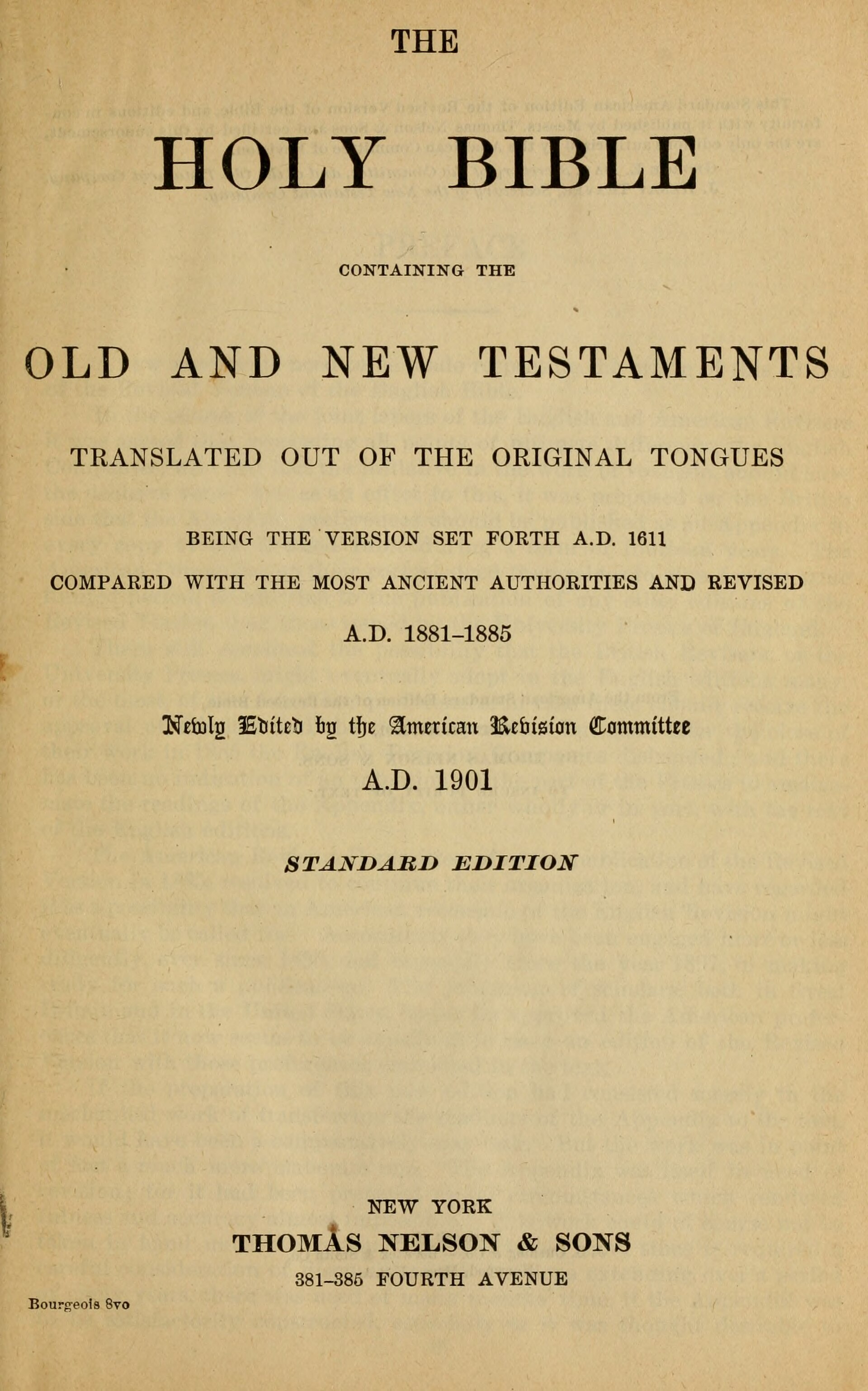
The American Standard Version of 1901 was the American edition of the English Revised Version, and its story is told in lesson 09. By the 1950s it had a rival heir. The Revised Standard Version, sponsored by the National Council of Churches, appeared as a New Testament in 1946 and a complete Bible in 1952, and many theologically conservative churches would not use it (see lesson 09 and, for the church history behind it, Module 80, lesson 11). Michael D. Marlowe, whose Bible Research site collects the prefaces of English versions, describes the NASB as the work of "a company of conservative scholars who wished to provide a literal and conservative revision of the ASV, as an alternative to the Revised Standard Version (1952), which had proven to be unacceptable to conservative churches."4 That is Marlowe's reading. The NASB's own first preface does not mention the RSV at all.
What the 1963 preface does give is a list of reasons for preserving the ASV. It says that "the recognized value of the version of 1901 which deserves and demands perpetuation" was "the chief inducement," and it lists six "observations," among them that the ASV "has been in a very real sense the standard for many translations," that it "is a monumental product of applied scholarship, assiduous labor and thorough procedure," and that, "Unlike many modern translations of the Scriptures, the American Standard Version retains its acceptability for pulpit reading and for personal memorization."5
The preface then names what it calls "the most weighty impetus": "a disturbing awareness that the American Standard Version of 1901 was fast disappearing from the scene." Borrowing the language of Exodus 1:8, it says, "As a generation which knew not Joseph was born, even so a generation unacquainted with this great and important work has come into being." The Foundation, it says, "felt an urgency to rescue this noble achievement from an inevitable demise, to preserve it as a heritage for coming generations."5
Revision or new translation?
The NASB has always described itself in two ways at once. The 1963 foreword says the purpose was "to present to the modern reader a revision of the American Standard Version in clear and contemporary language."5 The 1995 preface says that "in 1959 a new translation project was launched, based on the time-honored principles of translation of the ASV and KJV," and Lockman's present NASB page calls it "This new and original translation project."67 Both descriptions fit the record. The ASV supplied the base wording and the general method, and the editors worked through the Hebrew and Greek afresh, with newer Greek and Hebrew editions and the Dead Sea Scrolls, which had not been found when the ASV was made.
The NASB's own account of English Bible history sets it in a single line of descent. In 1604, its NASB page says, "a revision of the Bishops' Bible of 1568 was commissioned. This revision, first printed in 1611, came to be known as the King James Version." The KJV "itself became the basis for the English Revised Version, completed in 1885, with its American counterpart, the American Standard Version, being published in 1901."7 That line, from the Bishops' Bible to the KJV, the RV and the ASV, is the subject of lessons 07 and 09. The family tree below carries it forward to the NASB and its offshoots.
The Fourfold Aim
The aim as first printed
Every NASB edition has opened with a short statement the Foundation calls its Fourfold Aim. In the New Testament of 1963 it read:
1. These publications shall be true to the original Greek. 2. They shall be grammatically correct. 3. They shall be understandable to the masses. 4. They shall give the Lord Jesus Christ His proper place, the place which the Word gives Him, and no work will ever be personalized.5
The 1995 edition changed three points of wording. The first line became "true to the original Hebrew, Aramaic, and Greek," since the volume now held the whole Bible; the third became simply "They shall be understandable," and Marlowe's annotated copy of the preface notes that "previous editions read 'understandable to the masses'"; and the fourth was joined by "therefore": "the place which the Word gives Him; therefore, no work will ever be personalized."6 The Foundation's present website prints the same four points and adds a sentence in parentheses after the fourth: "(Our work is a symphony, not a solo, because many have had a part.)"3
"No work will ever be personalized": the unnamed translators
The last clause of the fourth aim explains a feature of the NASB that puzzled readers for decades: the translators were not named. Marlowe writes that "For many years the names of the NASB translators and editors were withheld by the publisher. But in 1995 this information was finally disclosed."4 The policy fits the Foundation's stated aim that "no work will ever be personalized." It also left the version open to suspicion from readers who wanted to know who had chosen its wording, a point taken up in the Claims checked section below.
The Foundation's NASB page now lists the names. Under "1977 NASB Translators" it gives 42 names, among them Gleason Archer, Kenneth Lee Barker, Charles Lee Feinberg, Edward F. Harrison, William L. Lane, J. Barton Payne, Robert L. Thomas, Merrill C. Tenney, Bruce Waltke and Kenneth Wuest. It lists 19 for the 1995 edition (among them Buist M. Fanning, W. Hall Harris, Harold Hoehner and Don Wilkins), with four "Critical Consultants," and 12 for the 2020 edition, with further consultants.7 Marlowe's list of "Original NASB translators," copied from the publisher's website in 2002, has 39 names; the current Lockman list for 1977 adds a few (George Blankenbaker, Frank G. Carver and Robert Saucy) who appear in the 1995 list as well.47 The two lists therefore do not match exactly, and neither says which person worked on which book.
The Foundation also describes the translators' belief about the text: "Underlying the New American Standard Bible is the evangelical commitment of the translators, all of whom believe that the original writing of the Bible is the inspired and inerrant Word of God."7 Its doctrinal statement begins, "We believe that the entire Bible is the inspired and inerrant word of God; the only infallible rule of faith and practice," and affirms that Jesus Christ was "conceived by the Holy Spirit and born of the Virgin Mary."3 A reader who wants to know where a committee stood theologically has, for the NASB, a published answer.
From John (1960) to the whole Bible (1971)
The NASB appeared in stages. Marlowe records that "The publication of the New American Standard Bible began with the Gospel of John in 1960, followed by the four Gospels in 1962, the New Testament in 1963, and the entire Bible in 1971."4 The copyright line the Foundation uses today confirms the first date: "New American Standard Bible, Copyright 1960, 1971, 1977, 1995, 2020 by The Lockman Foundation."8 His bibliography gives the New Testament of 1963 as a "Pilot ed." produced by the Lockman Foundation and printed by its Foundation Press, with Reuben A. Olson named first among the editors in the catalog entry.4
The Foundation's history describes the completion: "on August 28, 1971, the NASB was dedicated at a public service held at Dewey Lockman's home church, First Baptist Church of Anaheim, California."1 It says the team "worked for more than ten years to produce the New American Standard Bible."7 Six years later, according to the Foundation, "in 1977 the Christian Booksellers' Association recorded the NASB as the number one selling Bible in America."1 That ranking is reported here as the Foundation reports it; the CBA's own list for 1977 was not found for this lesson, and best-seller rankings of that period depended on how a list counted editions.
In 1981 the Foundation published the New American Standard Exhaustive Concordance, which, it says, "took over 11 years to complete and contained over 400,000 entries listing every word in the NASB."1 A concordance tied to one English version, with each English word keyed to the Hebrew or Greek word behind it, made the NASB a working tool for students in the way Strong's concordance had made the KJV one (Strong's is discussed in lesson 15). The Foundation also produced translations in other languages on the same principles, including La Biblia de las Americas (completed 1986) and the Nueva Biblia de las Americas (2005).3
Formal equivalence in the NASB's own words
What the Foundation says it does
The NASB's identity rests on its method. The Foundation's page on the version says: "Since its completion in 1971, the New American Standard Bible, NASB Bible, has been widely embraced as a literal and accurate English translation because it consistently uses the formal equivalence translation philosophy. This method translates word-for-word from the original languages as much as possible. At the same time, it recognizes the need for the translation to be readable."7
The same page sets the NASB against interpretive translation: "The New American Standard Bible (NASB) does not attempt to interpret Scripture through translation. Instead, the NASB Bible adheres to the principles of a formal equivalence translation. This is the most exacting and demanding method of translation, striving for the most readable word-for-word translation that is both accurate and clear." It adds that the method "more closely follows the word and sentence patterns of the biblical authors in order to enable the reader to study Scripture in its most literal format," and that "Instead of the translation choices telling the reader what to think, the NASB simply provides the most precise English translation it can."7 The Foundation's page for the 1995 text describes the philosophy as "often described as 'formal equivalence,' or a word-for-word approach," one that "seeks to represent as closely as possible the wording, grammar, and structure of the original Hebrew, Aramaic, and Greek texts while expressing their meaning clearly in English."9
The terms "formal equivalence" and "dynamic equivalence" come from the work of the linguist and Bible Society translation consultant Eugene Nida, whose Toward a Science of Translating (1964) set the two approaches side by side; his theory and its use in the NIV are explained in lesson 12. A short and fair statement of the trade-off comes from another committee, the one behind the English Standard Version: "Every translation is at many points a trade-off between literal precision and readability, between 'formal equivalence' in expression and 'functional equivalence' in communication."10 The NASB places itself at the formal end of that trade-off and says so plainly.
What the prefaces allow
The NASB's prefaces have never claimed that every word is rendered one for one. The 1963 preface said: "When it was felt that the word-for-word literalness of the ASV was unacceptable to the modern reader, a change was made in the direction of a more current English idiom. In the instances where this has been done, the more literal rendering has been indicated in the margin."5 The 1995 preface repeats the principle and names specific exceptions: "frequently 'And' is not translated at the beginning of sentences because of differences in style between ancient and modern writing," the Hebrew idiom "answered and said" is sometimes reduced to "answered" or "said," and "the idiom 'it came about that' has not been translated in the New Testament except when a major transition is needed."6
The prefaces also explain how the NASB handles Greek verb tenses, a matter where a literal version can either reproduce the original or confuse an English reader. The editors made "a careful distinction" between the Greek aorist (usually "He did") and the imperfect ("He was doing," or "He began to do," or "He used to do"). "'Began' is italicized if it renders an imperfect tense, in order to distinguish it from the Greek verb for 'begin.'" In questions introduced by the Greek particle me, "which always expects the answer, 'No,'" the wording was changed "from a mere, 'Will he not do this?' to a more accurate, 'He will not do this, will he?'" And in sequence of tenses the translators "took care to follow English rules rather than Greek."56 These notes show the kind of literalism the NASB practices: close attention to the grammar of the original, signaled to the reader, inside English sentence rules.
A critic's test: is the NASB more literal than the ASV?
The NASB's claim has been tested by readers who share its aim. Marlowe, who values literal translation, argues that "the NASB is often less literal than the old American Standard Version of 1901." His first example is Isaiah 1:4, where "the ASV translated ... 'they are estranged and gone backward,' but the NASB has the rather weak and paraphrastic rendering 'they have turned away from him.'"4 His second is Jeremiah 23:5 to 6 and 33:15 to 16, two passages that share Hebrew phrases. The ASV rendered both "Jehovah our righteousness," while the NASB (1971) has "The Lord our righteousness" in 23:6 and "The Lord is our righteousness" in 33:16. Marlowe concludes that "In the ASV all the renderings were concordant; it seems that the NASB revisers have deliberately made them different," and he suggests that the RSV influenced some New Testament choices, such as "coming for baptism" in Matthew 3:7 where the ASV had "coming to his baptism."4
He also tested the publisher's language. He quotes an older Lockman statement that "the NASB is a literal word-for-word translation from the original languages" and that other versions "stress either a loose, personalized paraphrase, or a free-style, thought-for-thought translation," and he replies: "The claim made here is somewhat overstated. The NASB is not really in a class by itself, because the New King James Version is about equally literal."4 His criticism is a scholarly reading by one informed reader, not a ruling, and it cuts in a direction many NASB readers do not expect: the strongest complaints against the NASB from his side are that it is sometimes not literal enough.
How to read an NASB page
The NASB is built to show a reader where the English departs from the original. Its prefaces explain each device, and the explanations have changed a little from edition to edition.
Italics for supplied words
The 1995 preface says: "ITALICS are used in the text to indicate words which are not found in the original Hebrew, Aramaic, or Greek but implied by it."6 The practice goes back to the Geneva Bible and the KJV, which printed supplied words in a different type (see lesson 07), and the ASV continued it. In Romans 12:1 the 1995 text reads "which is your spiritual service of worship," with "which is" in italics because Greek needs no verb there (NASB 1995, copyright The Lockman Foundation).11 The 2020 edition uses the same device for its best-known change, "brothers and sisters," discussed below.
Small capitals: LORD, GOD and Old Testament quotations
In the Old Testament, the NASB follows the KJV custom of printing the divine name YHWH as "LORD" in small capitals. The 1995 preface explains: "There is yet another name which is particularly assigned to God as His special or proper name, that is, the four letters YHWH (Exodus 3:14 and Isaiah 42:8). This name has not been pronounced by the Jews because of reverence for the great sacredness of the divine name. Therefore, it has been consistently translated LORD. The only exception to this translation of YHWH is when it occurs in immediate proximity to the word Lord, that is, Adonai. In that case it is regularly translated GOD in order to avoid confusion." It adds that "for many years YHWH has been transliterated as Yahweh, however no complete certainty attaches to this pronunciation."6
Here the NASB departed from its parent. The ASV of 1901 printed the name as "Jehovah," so its Psalm 23:1 reads "Jehovah is my shepherd; I shall not want" (ASV).12 The NASB returned to the KJV's practice, and its 1995 text of the same verse reads "The LORD is my shepherd, I shall not want" (NASB 1995, copyright The Lockman Foundation).12 The Legacy Standard Bible of 2021 went the other way and prints "Yahweh is my shepherd, I shall not want" (LSB, copyright The Lockman Foundation).12
In the New Testament, small capitals mark quotations from the Old. The 1963 preface said simply that "SMALL CAPS are used in the text to indicate Old Testament quotes." The 1995 preface widened this to "Old Testament quotations or obvious references to Old Testament texts," and added a caution: "modern rules for the indication of direct quotation were not used in biblical times; thus, the ancient writer would use exact quotations or references to quotation without specific indication of such."56
The asterisk: historical presents
Greek narrative often switches into the present tense to tell a past event vividly, the "historical present." The NASB board decided to put these into the English past tense but to mark them. The 1963 preface explains: "Greek authors frequently used the present tense for the sake of heightened vividness, thereby transporting their readers in imagination to the actual scene at the time of occurrence. However, the Board felt that it would be wise to change these historical presents into English past tenses. Therefore verbs marked with an asterisk (*) represent historical presents in the Greek." Its own example was John 1:38, where "'Jesus ... beheld ... and says' has been changed to 'Jesus ... beheld ... and *said.'"5
The three versions side by side show the device at work. The KJV keeps the present tense: "Then Jesus turned, and saw them following, and saith unto them, What seek ye?" (John 1:38, KJV). So does the ASV: "And Jesus turned, and beheld them following, and saith unto them, What seek ye?" (ASV). The NASB uses the past tense and the star: "And Jesus turned and saw them following, and *said to them, 'What do you seek?'" (John 1:38, NASB 1995, copyright The Lockman Foundation). The 2020 text keeps the asterisk and changes the question to "What are you seeking?" (NASB 2020, copyright The Lockman Foundation).13 A reader who sees the star knows that the Greek says "says."
Capitalized pronouns for God
The 1963 and 1995 prefaces both state: "PERSONAL PRONOUNS are capitalized when pertaining to Deity."56 Neither the KJV nor the ASV did this. The practice is an interpretive aid, since Hebrew and Greek have no capital letters, and in a few passages it requires the translators to decide whether a pronoun refers to God, to the Messiah or to a human king. In Jeremiah 23:5 to 6, for example, the NASB's "He will reign as king" and "In His days" print the coming Branch as a divine figure, in line with the Christian reading Marlowe describes.4
"Thou" in prayer: kept in 1963 to 1977, dropped in 1995
The 1963 New Testament changed "thou," "thy" and "thee" to "you" "except in the language of prayer when addressing Deity."5 The 1995 preface records the end of that exception: "'THOU,' 'THEE' AND 'THY' are not used in this edition and have been rendered as 'YOU' and 'YOUR.'"6 The Foundation's page for the 1977 text says that edition "uses a very traditional style of old English that includes vocabulary, such as 'thee,' 'thy,' and 'thou,'" and that it "is not widely available since it has been replaced."14
Brackets
The 1995 preface ends its list of devices with one line: "[ ] = In text, brackets indicate words probably not in the original writings."6 That single symbol carries the NASB's position on the textual debate of lesson 08, and it is the clearest place where the 1995 and 2020 editions differ. The next sections take it up.
The Hebrew and Greek texts behind the NASB
The Greek: Nestle's 23rd edition, then the 26th, then NA28
A translation is only as close to the original as the text it translates from. The NASB has always used the critical Greek text, the edition built by comparing the manuscripts with the methods described in lesson 08, not the Textus Receptus behind the KJV (lesson 05) or the Majority Text. The 1963 preface states: "In revising the ASV, consideration was given to the latest available manuscripts with a view to determining the best Greek text. In most instances the 23rd edition of the Nestle Greek New Testament was followed."5 The 1995 preface kept the sentence and changed the number: "In most instances the 26th edition of Eberhard Nestle's NOVUM TESTAMENTUM GRAECE was followed," with Marlowe's note that "previous editions read, '23rd edition.'"6
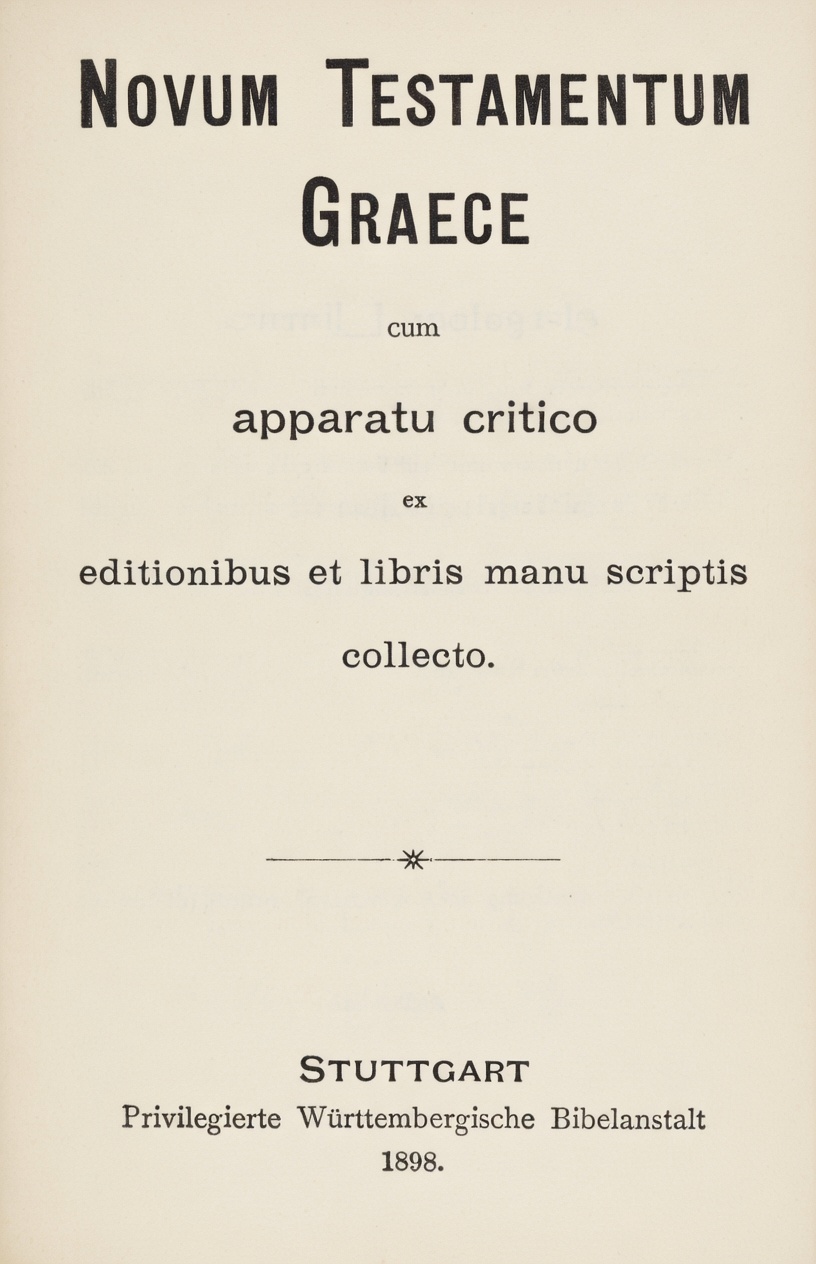
Eberhard Nestle published his Novum Testamentum Graece at Stuttgart in 1898. Marlowe's bibliography explains how he built it: he compared the editions of Tischendorf (1869), Westcott and Hort (1881) and Weymouth (1892) and placed "in his text whichever reading was followed by two of the three"; from the third edition (1901) Weiss replaced Weymouth. After Nestle's death in 1913 his son Erwin edited it, and the 23rd edition appeared in 1957. According to the same bibliography, "the text remained the same from the 17th through the 25th edition (1963)," and that text "was the basis of the Revised Standard Version and the New American Standard Bible." Kurt Aland, who succeeded Erwin Nestle as executive editor, "replaced the Nestle text with the UBS text he had helped to create" in the 26th edition of 1979.15 The NASB's move from the 23rd to the 26th edition in 1995 was therefore a move from the older Nestle text, which it shared with the RSV, to the Nestle-Aland and United Bible Societies text that most modern translations share. The 2020 edition went further.

The Foundation's statement on the 2020 text gives its textual basis in a few lines: "For the Old Testament: Biblia Hebraica Stuttgartensia (BHS) and Biblia Hebraica Quinta (BHQ) for the books available. Also the LXX, DSS, the Targums, and other ancient versions when pertinent. For the New Testament: NA28 supplemented by the new textual criticism system that uses all the available Gr mss. known as the ECM2."16 NA28 is the 28th edition of Nestle-Aland (2012). The ECM is the Editio Critica Maior, the large critical edition produced at the Institute for New Testament Textual Research (INTF) in Munster, which is being published book by book (its volumes on the Catholic Letters and on Acts were among the first). The Foundation also names newer reference works: "a new and more [complete] Hebrew and Aramaic lexicon (known as HALOT), a major revision to the standard Greek lexicon (BDAG), and the use of UC Irvine's Thesaurus Linguae Graecae to research especially difficult Greek words and constructions."16 (The bracketed word replaces one adjective in the Foundation's sentence.)
The Hebrew: Kittel, then Stuttgart and Quinta
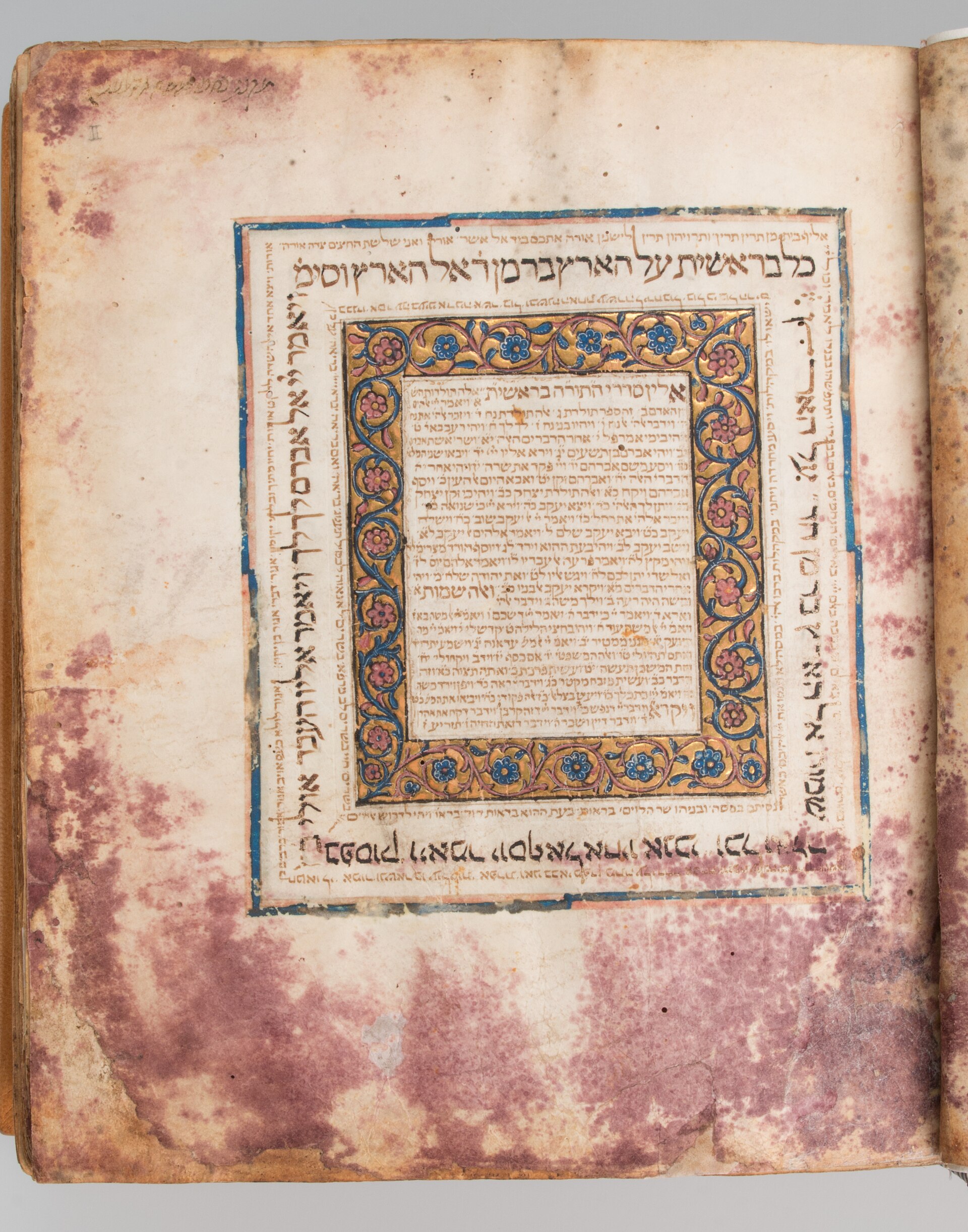
For the Old Testament the 1995 preface says: "In the present translation the latest edition of Rudolf Kittel's BIBLIA HEBRAICA has been employed together with the most recent light from lexicography, cognate languages, and the Dead Sea Scrolls."6 Kittel's third Biblia Hebraica, finished in 1937 after his death, replaced the text of the Rabbinic Bible of 1524 to 1525 with that of the Leningrad Codex; known as BHK, it was, in Marlowe's words, "the standard text used by scholars for forty years, from 1937 to 1977," when a thoroughly revised edition appeared as the Biblia Hebraica Stuttgartensia (BHS), based on the same manuscript.17 (The Leningrad Codex and its dating are covered in lesson 01.) The 1995 preface's wording does not make clear whether "the latest edition of Rudolf Kittel's BIBLIA HEBRAICA" means BHK itself or BHS, which carries Kittel's name in its tradition. Marlowe notes that the original NASB editors "used Kittel's edition of the Hebrew text," and that its layout explains why the NASB prints Jeremiah 23:5 to 6 as poetry and 33:15 to 16 as prose.4 For 2020 the Foundation names BHS and, where published, BHQ (Biblia Hebraica Quinta), with the Septuagint, the Dead Sea Scrolls and the Targums consulted "when pertinent."16
The Foundation's history adds that from the beginning the NASB "incorporated new information taken from the Dead Sea Scrolls which had recently been discovered."1 The scrolls had been found from 1947 to 1956, after the ASV was made and while the NASB was being planned, and the NASB was among the first major English versions whose Old Testament translators could use them.

How the NASB prints the disputed passages
Brackets in the 1995 text
Because the NASB follows the critical text, it treats the verses discussed in lesson 08 as the critical editions do. Through the 1995 edition, however, it kept most of them in the text inside square brackets with a footnote, so that readers used to the KJV would still find them where they expected. Matthew 17:21 shows the method. In the KJV it reads: "Howbeit this kind goeth not out but by prayer and fasting" (KJV). The ASV of 1901 had already taken the verse out of the text and put it in a footnote: "Many authorities, some ancient, insert verse 21 But this kind goeth not out save by prayer and fasting." (ASV note).18 The NASB of 1995 put it back, in brackets: "[But this kind does not go out except by prayer and fasting.]" with the note "Early mss do not contain this v" (NASB 1995, copyright The Lockman Foundation).18
Acts 8:37, the eunuch's confession, received the same treatment. The KJV reads: "And Philip said, If thou believest with all thine heart, thou mayest. And he answered and said, I believe that Jesus Christ is the Son of God" (KJV). The NASB 1995 prints the verse in brackets, beginning "[And Philip said, 'If you believe with all your heart, you may.'" with the note "Early mss do not contain this v" (NASB 1995, copyright The Lockman Foundation).19 Lesson 08 sets out the manuscripts on each side, including the allusion in Irenaeus.
Footnotes in the 2020 text
The 2020 edition changed course. The Foundation explains: "In the NASB 2020 New Testament, most of the bracketed verses have been moved to footnotes." It lists them: "Matthew 6:13b; Matthew 17:21; Matthew 18:11; Matthew 23:14; Mark 7:16; Mark 9:44; Mark 9:46; Mark 15:28; Luke 9:55; Luke 9:56; John 5:3b-4; Acts 8:37; Acts 15:34; Acts 24:6b-8; Acts 28:29; Romans 16:24." Its reason is stated without hedging: "All of these verses are represented by dashes in the Greek NA28 because they are not found in any early manuscripts. There is no reasonable doubt that they were added to the text by later copyists."16
It explains why earlier editions had kept them: "In past editions these verses were retained in the text for the traditional versification and their familiarity to readers of the King James Version, but since the manuscript evidence has clearly established that they are not part of the original scripture, the NASB 2020 does not continue to retain them in the text because it would be misleading to the reader."16 On the page, Matthew 17:20 now ends with a note: "Late mss add (traditionally v 21): But this kind does not go out except by prayer and fasting" (NASB 2020, copyright The Lockman Foundation).18 The note on Acts 8:36 reads "Late mss add as v 37" and gives the verse in italics (NASB 2020, copyright The Lockman Foundation).19 The word in the 1995 notes was "Early mss do not contain"; the word in the 2020 notes is "Late mss add." Both describe the same evidence from opposite ends.
The Foundation kept some bracketed passages in the text: "There are, however, a few exceptions for some bracketed verses and parts of verses whose weak support is somewhat mitigated by other factors, including contextual arguments or possible explanations for omission by early manuscripts. Those instances are part of Judges 16:13; Matthew 12:47; Mark 11:26; Mark 16:9-16:20; Luke 17:36; Luke 22:43; Luke 23:17; part of Luke 23:34; John 7:53-8:11."16
Mark 16:9 to 20 and John 7:53 to 8:11
The two longest passages in question stay in the NASB text in every edition, marked as doubtful. In the 1995 text Mark 16:9 opens with a bracket, "[Now after He had risen early on the first day of the week," and carries the note "Later mss add vv 9-20" (NASB 1995, copyright The Lockman Foundation). The 2020 text prints the same note and opens the passage with double brackets, "[[Now after He had risen" (NASB 2020, copyright The Lockman Foundation).20 The story of the woman taken in adultery is handled the same way: John 7:53 begins with brackets in both editions, with the note "Later mss add the story of the adulterous woman, numbering it as John 7:53-8:11."21 The double bracket is the convention of the Nestle-Aland and UBS editions for passages their editors regard as later additions that are nonetheless old and important. The evidence for and against both passages, with the manuscripts named, is in lesson 08.

1 John 5:7
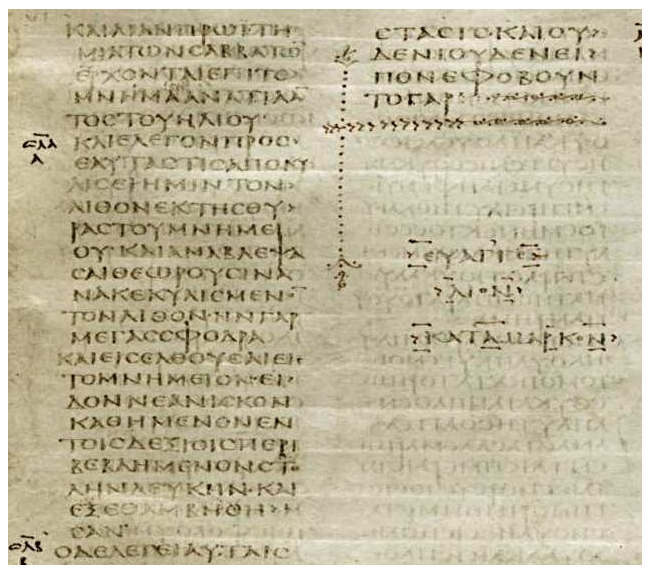
The Johannine Comma, the Trinitarian words of 1 John 5:7 in the KJV, does not appear in any NASB edition, even in brackets. The KJV reads: "For there are three that bear record in heaven, the Father, the Word, and the Holy Ghost: and these three are one" (KJV). The NASB 1995 and 2020 both read only "For there are three that testify:" (NASB 1995 and NASB 2020, copyright The Lockman Foundation).22 On this verse the NASB agrees with the ASV and with every critical edition; how the words entered the printed Greek text through Erasmus's third edition of 1522 is told in lesson 05.
John 1:18: one verse, three renderings
John 1:18 shows that the NASB's text and its English can change separately. The KJV, following the Textus Receptus, reads: "No man hath seen God at any time, the only begotten Son, which is in the bosom of the Father, he hath declared him" (KJV). The ASV kept "the only begotten Son" in the text, with a margin note: "Many very ancient authorities read God only begotten" (ASV).23 The NASB followed those ancient authorities (among them the papyri P66 and P75, discussed in lesson 02) and put "God" in the text: "No one has seen God at any time; the only begotten God who is in the bosom of the Father, He has explained Him" (John 1:18, NASB 1995, copyright The Lockman Foundation). The 2020 edition kept "God" and changed the phrase: "God the only Son, who is in the arms of the Father," with "Son" in italics as a supplied word (NASB 2020, copyright The Lockman Foundation). The LSB keeps the 1995 wording, "the only begotten God" (LSB, copyright The Lockman Foundation).23
This verse is used in two opposite arguments. Some defenders of the KJV say that modern versions weaken the deity of Christ; on John 1:18 the NASB's text calls the Son "God" outright, where the KJV calls Him "Son." The case for and against the critical text on other verses, such as 1 Timothy 3:16, is made in lesson 13.
Isaiah 7:14
The NASB's translators also made a choice the RSV did not. The RSV of 1952 rendered Isaiah 7:14 "a young woman shall conceive," which drew strong protest (lesson 09). The ASV had read "behold, a virgin shall conceive, and bear a son," with "maiden" in the margin (ASV), and the NASB kept "virgin": "Behold, a virgin will be with child and bear a son," with the note "Or maiden" (Isaiah 7:14, NASB 1995, copyright The Lockman Foundation).24 Marlowe's remark that "the NASB deliberately interprets the Old Testament from a Christian standpoint, in harmony with the New Testament" refers to choices of this kind.4
The 1977 and 1995 editions
The 1977 edition
The NASB of 1977 was a light revision of the 1971 text by the standing Editorial Board. The 1995 preface says that "The Editorial Board has continued to function since publication of the complete Bible in 1971."6 The Foundation's present description of the 1977 text is short: "The NASB 1977 is the original version preceding the NASB 1995 and NASB 2020 updates. It uses a very traditional style of old English that includes vocabulary, such as 'thee,' 'thy,' and 'thou.'" It adds: "Some of the English used in the NASB 1977 is no longer understood by the average modern-day reader and therefore it can be misunderstood or incorrectly interpreted."14 The 1977 text kept the 1963 rule that "thou" forms be used in prayer addressed to God. Detailed lists of the changes made between 1971 and 1977 were not found for this lesson.
The 1995 update
The 1995 edition was a larger revision. Marlowe records that "In 1992 the Lockman Foundation commissioned a limited revision of the NASB which was intended to improve its English style by allowing a somewhat less literal approach. The revision was published as the 'NASB Updated Edition' in 1995."4 The 1995 preface itself says the edition "represents revisions and refinements recommended over the last several years as well as thorough research based on modern English usage," and Marlowe's note on that sentence records that earlier editions had said "minor revisions."6
The Foundation's NASB page names the main change: "A major change from the 1977 edition is the removal of archaic English, such as 'thy' and 'thou', that are no longer used or familiar to many people." It also says the 1995 text "increases clarity and readability as well as updates vocabulary, grammar, and sentence structure so that the text is more easily understood."7 The preface's new exceptions for "And" at the start of sentences and for "it came about that" belong to this revision as well.6
The 1995 text kept older English where the Foundation judged it still understood. In Romans 12:1 it reads "I urge you, brethren, by the mercies of God" (NASB 1995, copyright The Lockman Foundation), keeping the KJV's "brethren."11 Marlowe's judgment is that "Although the Updated Edition is slightly less literal than the original, The NASB continues to be one of the most literal versions commonly used in churches today."4 The Foundation now describes the 1995 text as one "especially appreciated by readers who value its more traditional and literary expression of biblical English," whose "familiar cadence and established wording reflect a style that many readers associate with longstanding patterns of Bible reading, teaching, and Scripture memorization."9 It remains in print alongside the 2020 text.
The 2020 edition
What the Foundation says it changed
The Foundation's statement on Bible Gateway describes the 2020 text this way: "This brand new update of the widely respected NASB 1995 builds upon its strengths by further improving accuracy, modernizing language, and improving readability. The NASB 2020 is an important update because it utilizes advances in biblical scholarship over the past 25 years and it incorporates changes necessary to keep pace with the ever evolving English language." It adds that "The long-established translation standard for the NASB remains the same as it always has been, that is to accurately translate the inspired Word of God from the Hebrew, Aramaic, and Greek texts into modern English that is clearly understandable today."8
Besides the new textual basis and the moving of bracketed verses to the notes, described above, the Foundation names several kinds of change: gender language, "he who" phrases, "let us," and a general modernizing of vocabulary.1625
"Gender-accurate," not "gender-neutral"
The Foundation published a long explanation titled "Gender-Accurate Language in the NASB 2020." It opens: "The NASB 2020 is gender-accurate, meaning the reader will no longer have to try to determine which genders the biblical authors have in mind." It then draws a line: "The NASB 2020 is not gender-neutral because when the original context calls for a specific masculine or feminine term, it does not use a gender-neutral term instead. Likewise, changes such as the addition of italic 'and sisters' following 'brothers' are made only when it is accurate to the way both the language and context would have been naturally understood by the original audiences."25
Its reason is a claim about English, not about Greek or Hebrew: "Many gender-specific words that were once traditionally understood as referring to both men and women have begun to lose their inclusive meaning. Additionally, some archaic words, such as 'brethren', are no longer used in everyday conversation at all." The Foundation says it must ensure the text "is accurately understood by everyone, including those who, by accident or design, have never been taught about the historic gender inclusivity of masculine pronouns."25 (In the original the words "by accident or design" are set off by dashes; commas replace them here.)
"Brothers and sisters"
The most visible change is the treatment of the Greek adelphoi, "brothers." The Foundation argues that "In the NT the Greek term 'brother' is used affectionately for fellow Christians, both male and female," and that "adding 'and sisters' in italics to represent women in the Christian community is preferable, but only if the clarification is accurate." It explains why the added words are in italics: "Since the Greek word for 'sister' does exist, the option of using 'brothers and sisters' in all-roman type is not adequate because it would indicate that all three Greek words had been used in the original text instead of just the one."25
Romans 12:1 shows the result. The KJV reads: "I beseech you therefore, brethren, by the mercies of God, that ye present your bodies a living sacrifice, holy, acceptable unto God, which is your reasonable service" (KJV). The ASV reads "I beseech you therefore, brethren" (ASV). The NASB 1995 reads "I urge you, brethren," and the NASB 2020 reads: "Therefore I urge you, brothers and sisters, by the mercies of God, to present your bodies as a living and holy sacrifice, acceptable to God, which is your spiritual service of worship" (NASB 2020, copyright The Lockman Foundation).11
The same change appears with "sons." Galatians 3:26 in the KJV reads "For ye are all the children of God by faith in Christ Jesus" (KJV), and in the ASV "For ye are all sons of God, through faith, in Christ Jesus" (ASV). The NASB 1995 has "For you are all sons of God through faith in Christ Jesus," and the NASB 2020 has "For you are all sons and daughters of God through faith in Christ Jesus" (NASB 1995 and NASB 2020, copyright The Lockman Foundation).26
"Men, brothers": changes that narrow
The Foundation points out that not every gender change widens the text. Acts uses the phrase andres adelphoi, literally "men, brothers," as a form of address. The Foundation writes: "We do, however, find the term 'men brothers' (ἄνδρες ἀδελφοί, ándres adelphoí) used as a term of address thirteen times in Acts to exclusively address men within a group. In these verses we believe it is best to translate the term strictly as 'brothers,' without any indication that women are also being addressed since the text is specifically singling out men."25 In Acts 1:16 the KJV reads "Men and brethren, this scripture must needs have been fulfilled" (KJV); the NASB 1995 begins "Brethren, the Scripture had to be fulfilled" (NASB 1995, copyright The Lockman Foundation); the NASB 2020 has "Brothers" with the footnote "Lit Men, brothers" (NASB 2020, copyright The Lockman Foundation).27 So in Acts 1:16 the KJV is the more literal of the three, and the NASB 2020 restores the literal form only in its note.
"Man" and "person," "he who" and "the one who"
For the Greek anthropos and the Hebrew adam, enosh and ish, the Foundation says "more occurrences of 'people' or 'person' have replaced 'men' or 'man' (in the NT) where ἄνθρωπος (ánthrōpos) is found," while "masculine terms have been retained in occurrences where the context makes it clear that the Greek word is, in fact, referring explicitly to males." The words that mean a male specifically, Greek aner and Hebrew geber, are, it says, never translated to include women.25 The Foundation also notes that a practice of earlier editions was reversed: where Hebrew or Greek has an adjective or participle referring to a person, "In earlier editions, including NASB 1995, the word 'man' or 'men' was often added," while "in the NASB 2020 this practice has been changed to translate these cases as 'person' or 'people.'"25
Micah 6:8 is an example readers noticed. The KJV reads: "He hath shewed thee, O man, what is good; and what doth the LORD require of thee, but to do justly, and to love mercy, and to walk humbly with thy God?" (KJV).28 The NASB 2020 begins "He has told you, mortal one, what is good" (NASB 2020, copyright The Lockman Foundation).28 The Hebrew word there is adam.
The Foundation kept the singular "he" for a person of either sex: "English does not have a universally accepted third-person singular pronoun that refers to both males and females, so the NASB 2020 maintains the practice of using 'he' or 'him' when referring to a singular, non-gender specific antecedent such as 'person'." It calls changing singular to plural throughout the Bible "in direct conflict with the second principle of our longstanding Fourfold Aim and, therefore, ... a red line to us."25 For the phrase "he who," it says that "the one who" is "not only gender-accurate, but also closer to the original sentence structure because it directly translates the Greek and Hebrew articles." Its example is Matthew 13:9, which now reads "The one who has ears, let him hear" (NASB 2020, copyright The Lockman Foundation), where the KJV has "Who hath ears to hear, let him hear" (KJV).2529
"Let's" and other changes
The Foundation explains a change some readers found jarring: "In most places in the New American Standard Bible, NASB 2020 Bible the phrase 'let us' has been replaced with 'let's' when a proposal is being made by one or more persons within a group to engage in an action." Its reason is that "It is common today for readers to understand 'let us' to mean 'allow us,' so in effect, 'let us' has become unintentionally misleading to most readers." It adds that "in some situations 'Let Us' is retained for intimate discourse within the Godhead, as in Gen 1:26."16
Other wording changed throughout. Psalm 23:1 in the NASB 1995 reads "The LORD is my shepherd, I shall not want"; in the NASB 2020 it reads "The LORD is my shepherd, I will not be in need" (NASB 1995 and NASB 2020, copyright The Lockman Foundation).12 A 2021 review in Truth Magazine by Samuel Stinson listed further examples in word pairs (1995 first, 2020 second), among them "forsaking" and "abandoning" in Hebrews 10:25, "makes" and "lets" in Psalm 23:2, "hosts" and "armies" in Jeremiah 15:16, "countenance" and "face" in Numbers 6:26, and "immorality" and "sexual immorality" in Matthew 19:9.30
The reaction
The Foundation anticipated resistance. Its gender article says: "We know that longtime readers of the NASB 1995 love their version of the Bible, and it can be difficult to have something you love change. We are happy that there are readers who will keep using the NASB 1995 as their preferred version, and 1995 editions will continue to be available in both digital and print formats."25 That promise has been kept: the Foundation still sells and licenses both texts, and Bible Gateway carries both.8
Stinson's review gives one reader's measured verdict from within the NASB's own audience. He judged that "On the spectrum of Bible translations, the NASB 2020 update is still a mostly literal translation, though it is located marginally closer to the dynamic equivalence side," and he noted that "the Lockman Foundation website includes an article arguing that their approach should be instead called gender accurate." He reported a poll in an NASB readers' group on Facebook in which "The 1995 version received 116 votes, the 2020 version 65 votes, and the 1977 version was represented with 27 votes," and he called the 2020 text "a reasonable compromise, providing more formally equivalent, gender inclusive translation options without the more dynamically equivalent, gender neutral phrasing of translations such as the TNIV."30 A self-selected online poll is not a measure of readers at large, and it is reported here only as Stinson reported it. The wider debate over gender language in translation, including the 1997 Colorado Springs Guidelines and the TNIV, belongs to lessons 13 and 14.
The most consequential reaction was a new edition. In 2021 a team from The Master's Seminary and University finished a revision of the 1995 text, under Lockman's copyright, that did not adopt the added "and sisters" and that set out to be more consistent than the NASB in rendering each Hebrew and Greek word. In Romans 12:1 it reads "I exhort you, brothers, by the mercies of God" (LSB, copyright The Lockman Foundation).11
The Legacy Standard Bible (2021)
Origin
The Legacy Standard Bible's own history says that in 2020 "Leaders from The Lockman Foundation, Three Sixteen Publishing, and The John MacArthur Charitable Trust met to explore the idea of an update to the NASB '95." The vision, it says, "was twofold, update some of the language of the NASB, while preserving the accuracy and trustworthiness of the translation for generations to come." It records that "The Legacy Standard Bible was completed by a team of scholars from The Master's Seminary and University," that "The LSB New Testament with Psalms and Proverbs was released first," and that the complete LSB was "released in October 2021."2 The Lockman Foundation lists the LSB among its own translations and states that it "is managed in partnership with Three Sixteen Publishing, Inc."; the copyright line on the LSB site reads "THE LEGACY STANDARD BIBLE (LSB), COPYRIGHT BY THE LOCKMAN FOUNDATION."3132 The charitable trust bears the name of the pastor and author John MacArthur, whom the LSB site lists first among the "Expository preachers and Bible teachers" who "have used the NASB because of its faithfulness to what the Author originally intended."2
A revision of the 1995 text
The Foundation describes the LSB as "a direct update of the NASB 1995 edition." It says: "The translators went back to the original Hebrew, Aramaic, and Greek of every verse in order to double check its accuracy. Any changes made revolved around translating words as consistently as possible in English style and within their various nuances considering context and grammatical structure. Sometimes these changes will incorporate what was found in the earlier NASB 1977 edition. However, if no update was needed, then the text was left as originally translated by the NASB 1995. Thus, as opposed to a brand-new translation, the LSB is truly designed to be a legacy edition."31 The LSB's origin page adds that the text "was reviewed by a team of 70+ scholars, pastors, and every-day NASB readers from around the world."2
Three distinctives
The LSB's own answer to the question "How is the LSB different from the NASB '95?" names three things: "The recovery of God's name, Yahweh in the OT, and slave for the Greek term doulos in the NT"; "The change of certain words and phrases in order to ensure that English words consistently matched their original language counterparts"; and "The usage of weights, measurements, and currency as they're found in the original writing," with modern equivalents in the notes.32
On the divine name, the LSB explains: "In the LSB, God's covenant name is rendered as Yahweh, as opposed to LORD," and it says that "Yahweh appears in the OT over 6,800 times." It also prints the short form "Yah," which it says is "predominantly found in poetry and praise."33 This reverses the decision the NASB made in 1963, when it dropped the ASV's "Jehovah" for the KJV's "LORD." The 1995 NASB preface had given its reason for "LORD": the name "has not been pronounced by the Jews because of reverence for the great sacredness of the divine name," and "no complete certainty attaches to" the pronunciation Yahweh.6 The LSB and the NASB thus give opposite answers to the same question, and each states its reason in print. The ASV (Jehovah), the NASB (LORD) and the LSB (Yahweh) are three members of one family that render Psalm 23:1 three different ways.12
Verses compared: KJV, ASV, NASB 1995 and NASB 2020
The table gathers the verses quoted in this lesson so that the changes can be read across. The KJV (Oxford 1769 text as printed by Bible Gateway) and the ASV (1901) are in the public domain. The NASB wording is quoted briefly for comparison under the Foundation's terms, with italics as the NASB prints them.
| Verse | KJV | ASV 1901 | NASB 1995 | NASB 2020 | What changed |
|---|---|---|---|---|---|
| John 1:38 | "and saith unto them, What seek ye?" | "and saith unto them, What seek ye?" | "and *said to them, 'What do you seek?'" | "and *said to them, 'What are you seeking?'" | Historical present put in the past tense and marked with a star; question modernized in 2020.13 |
| Psalm 23:1 | "The LORD is my shepherd; I shall not want." | "Jehovah is my shepherd; I shall not want." | "The LORD is my shepherd, I shall not want." | "The LORD is my shepherd, I will not be in need." | Divine name; "want" replaced in 2020. LSB: "Yahweh is my shepherd."12 |
| Romans 12:1 | "I beseech you therefore, brethren" | "I beseech you therefore, brethren" | "I urge you, brethren" | "I urge you, brothers and sisters" | Added words in italics. LSB: "I exhort you, brothers."11 |
| Galatians 3:26 | "ye are all the children of God" | "ye are all sons of God" | "you are all sons of God" | "you are all sons and daughters of God" | Added words in italics.26 |
| Acts 1:16 | "Men and brethren" | (not quoted) | "Brethren" | "Brothers" (note: "Lit Men, brothers") | Literal form kept only in the note.27 |
| Matthew 17:21 | "Howbeit this kind goeth not out but by prayer and fasting." | In a footnote only | In the text, in brackets | In a footnote only | Treatment of a verse absent from early manuscripts.18 |
| John 1:18 | "the only begotten Son" | "the only begotten Son" (margin: "God only begotten") | "the only begotten God" | "God the only Son" | Greek reading and English phrasing.23 |
| 1 John 5:7 | "three that bear record in heaven, the Father, the Word, and the Holy Ghost" | (not quoted) | "three that testify:" | "three that testify:" | The Johannine Comma absent from every NASB.22 |
Copyright notice for the NASB quotations in this lesson, in the form the Foundation requires for web pages: Scripture quotations taken from the (NASB) New American Standard Bible, Copyright 1960, 1971, 1977, 1995, 2020 by The Lockman Foundation. Used by permission. All rights reserved. www.Lockman.org. Quotations from the Legacy Standard Bible: The Legacy Standard Bible (LSB), copyright by The Lockman Foundation. Used by permission. All rights reserved. Managed in partnership with Three Sixteen Publishing, Inc.3432
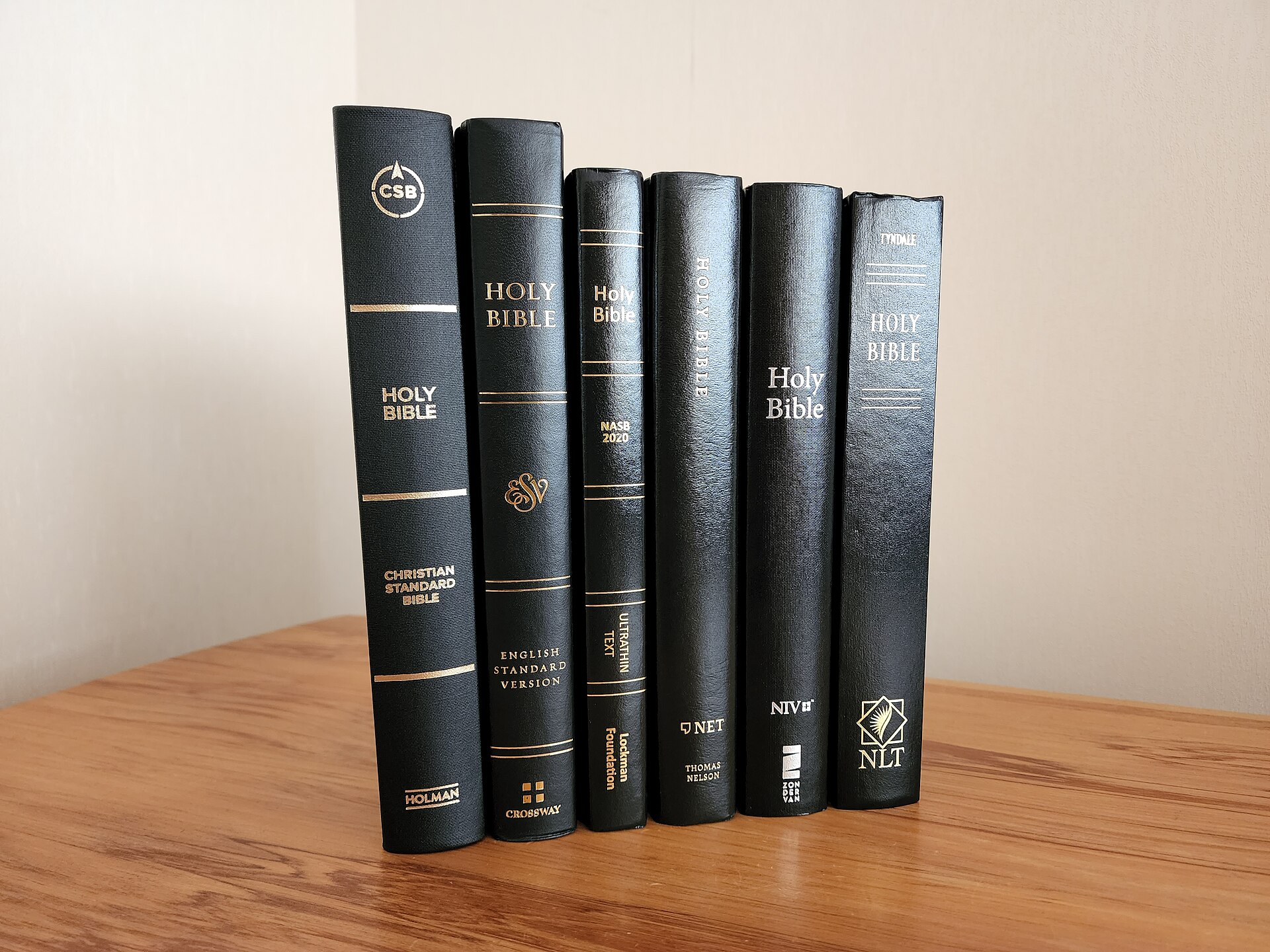

How literal? The versions as their publishers describe them
Charts that line up Bible versions from "word for word" to "paraphrase" are common in Bible shops and on publishers' websites. Most of them are drawn by a publisher or a reviewer, and the placements are judgments. The chart below places each version only by the words its own publisher uses to describe its method, quoted under it, so that a reader can see what is being claimed. It is not a measurement, and lessons 12, 13 and 14 test some of these claims verse by verse.
- NASB (The Lockman Foundation): "the formal equivalence translation philosophy. This method translates word-for-word from the original languages as much as possible."7
- LSB (Lockman and The Master's Seminary): it "seeks to be a window into the original Hebrew, Aramaic, and Greek" by "translating individual words as consistently as possible."31
- ESV (Crossway): "an 'essentially literal' translation that seeks, as far as possible, to reproduce the precise wording of the original text."10
- CSB (Holman): "Optimal Equivalence, a translation philosophy that balances linguistic precision to the original languages and readability in contemporary English."35
- NIV (Biblica): "providing the best possible blend of transparency to the original documents and comprehension of the original meaning in every verse."36
- NLT (Tyndale House): "translating entire thoughts (rather than just words) into natural, everyday English."37
- The Message (NavPress): Eugene Peterson "decided to strive for the spirit of the original manuscripts."38
What the record shows and what it does not
- Documented fact: The Lockman Foundation was formed in La Habra, California, on December 3, 1942; NASB work began in 1959; John appeared in 1960, the New Testament in 1963, the whole Bible in 1971 (dedicated August 28, 1971); revisions followed in 1977, 1995 and 2020; the LSB was completed in 2021. The 1963 NASB followed the 23rd Nestle edition, the 1995 the 26th, and the 2020 NA28 with the ECM. The prefaces define italics, small capitals, the asterisk and capitalized pronouns for Deity. The 2020 text moved sixteen bracketed verses or parts of verses to footnotes and added italic "and sisters" in contexts it judged mixed.
- The Foundation's own claims: that the NASB is "the most exacting and demanding method of translation," that it "does not attempt to interpret Scripture through translation," that it was the best-selling Bible in America in 1977 by the Christian Booksellers' Association's record, and that the 2020 text is "gender-accurate" and "not gender-neutral."
- Scholarly and reviewers' readings: Marlowe's judgment that the NASB was meant as a conservative alternative to the RSV, that it is sometimes less literal and less concordant than the ASV, and that the NKJV is about equally literal; Stinson's judgment that the 2020 text sits "marginally closer to the dynamic equivalence side."
- Open questions: exactly which translators worked on which books; how many changes each revision made (no complete published list was found); whether "the latest edition of Rudolf Kittel's BIBLIA HEBRAICA" in the 1995 preface means BHK or BHS; and how readers at large, as opposed to self-selected groups, have divided between the 1995 and 2020 texts.
Claims checked
"The NASB is the most literal English translation."
Partly supported. The Foundation describes its method as formal equivalence and "the most exacting and demanding method of translation," and reviewers of many schools place the NASB near the literal end of the range.7 But the claim of first place does not hold without qualification. Marlowe, himself a defender of literal translation, shows passages where the NASB is less literal than the ASV of 1901 (Isaiah 1:4) and judges the NKJV "about equally literal."4 Acts 1:16 above is a case where the KJV's "Men and brethren" is closer to the Greek than either NASB edition, which give the literal form only in a note.27 The LSB was produced partly to be more consistent than the NASB 1995. Older word-for-word versions such as Young's Literal Translation are far more literal than any of these, at a large cost in readability. "One of the most literal versions in common church use" is the claim the record supports.
"The NASB is just a conservative edition of the RSV."
Refuted, with a qualification. The NASB's prefaces describe it as a revision of the ASV of 1901, not of the RSV, and its Greek base in 1963 (Nestle 23) was the same older Nestle text the RSV had used, according to Marlowe's bibliography, which is a shared source, not a dependence.515 The qualification is Marlowe's observation that "the NASB revisers were influenced by the RSV's interpretation in many places," with examples such as Matthew 3:7.4 On Isaiah 7:14 the NASB kept "virgin" where the RSV had "young woman."24
"The NASB is translated from the same Greek as the King James Version."
Refuted. Every NASB preface names the Nestle critical text, never the Textus Receptus: the 23rd edition in 1963, the 26th in 1995, and NA28 with the Editio Critica Maior in 2020.5616 That is why the NASB lacks 1 John 5:7's Trinitarian clause and brackets or footnotes Matthew 17:21 and Acts 8:37. The modern version whose New Testament follows the Textus Receptus is the NKJV, described in lesson 11.
"The NASB 2020 removed verses from the Bible."
Partly supported. The 2020 edition moved sixteen verses or parts of verses from the text to the footnotes, where the note gives the full wording and says "Late mss add."1618 A reader of the 2020 text will not find Matthew 17:21 between verses 20 and 22, so in the sense of the printed text the claim is true. The words are not gone from the book, and the 1995 text printed them in brackets as words "probably not in the original writings."6 The ASV of 1901 had already put Matthew 17:21 in a footnote.18 Whether the verses belong in the text at all is the question of lesson 08, and the case against moving them is made in lesson 13.
"The NASB 2020 is a gender-neutral Bible like the TNIV."
Partly supported. The Foundation says plainly that the 2020 text "is not gender-neutral," keeps singular "he," keeps "man" where the Hebrew or Greek word means a male, and marks its additions in italics.25 On those points it differs from versions that change singular to plural or remove "brothers." The text does change "man" to "person" or "mortal one" in many places, add "and sisters" and "and daughters," and drop the inclusive use of "men" that the 1995 text had.2628 Stinson's description, "gender inclusive translation options without the more dynamically equivalent, gender neutral phrasing of translations such as the TNIV," is closer to the record than either "gender-neutral" or "unchanged."30
"The NASB translators hid their names because they had something to hide."
Unsupported. The names were withheld until 1995, as Marlowe records, and the Foundation's own explanation is the fourth point of its Fourfold Aim: "no work will ever be personalized," which its website glosses as "a symphony, not a solo."43 The lists published since then name scholars from evangelical seminaries and colleges, among them Gleason Archer, Merrill C. Tenney, Charles Lee Feinberg and Bruce Waltke, and the Foundation states that all the translators held the Bible to be "the inspired and inerrant Word of God."7 No evidence was found for any hidden motive.
"The Legacy Standard Bible is a brand-new translation."
Refuted by its own publisher. The Foundation says the LSB is "a direct update of the NASB 1995 edition" and that "as opposed to a brand-new translation, the LSB is truly designed to be a legacy edition"; where no change was needed, "the text was left as originally translated by the NASB 1995."31 Its most visible departures from the NASB, "Yahweh" and "slave," are departures of rendering, not of base text.32
"The NASB was once the best-selling Bible in America."
Partly supported. The Foundation states that in 1977 "the Christian Booksellers' Association recorded the NASB as the number one selling Bible in America," and the LSB's history repeats it.12 The CBA's own report for that year was not found for this lesson, so the claim rests on the Foundation's account. Sales rankings of that period also depended on whether all editions of a version, including the KJV in its many printings, were counted together.
"The NASB was the first Bible to use the Dead Sea Scrolls."
Unsupported as stated. The Foundation says the NASB "incorporated new information taken from the Dead Sea Scrolls which had recently been discovered," and its 1995 preface mentions "the most recent light from ... the Dead Sea Scrolls."16 Neither statement claims priority. The Revised Standard Version's Old Testament appeared in 1952, after the first Isaiah scroll from Qumran had been published. Its preface names "the Dead Sea texts of Isaiah and Habakkuk" as the exceptions to the rule that only late Hebrew manuscripts survive, and its notes follow the Isaiah scroll against the Masoretic text in places, for example Isaiah 21:8, where the note reads "One ancient Ms: Heb a lion" (RSV, copyright the National Council of the Churches of Christ in the U.S.A.).39 (The scroll is described in lesson 01.) The NASB was therefore among the early versions to use the scrolls, not the first.
Hard questions and answers
A King James reader asks: if the NASB is so literal, why does it leave out verses the KJV has?
Because literal translation and choice of text are separate questions. A version can render its Greek text word for word and still differ from the KJV because its Greek text is different. The NASB translates the Nestle critical text, which omits Matthew 17:21, Acts 8:37 and the Trinitarian clause of 1 John 5:7 on the testimony of the earliest manuscripts; the KJV translates the Textus Receptus, which has them.1622 On John 1:18 the same choice of text gives the NASB the reading "God" where the KJV has "Son."23 Which text is closer to the originals is argued in lesson 08, and the case against the critical-text versions is set out in lesson 13. The NASB's literalness describes how it translates, not what it translates.
A critical-text scholar asks: if the bracketed verses are not original, why did the NASB keep them in the text until 2020?
The Foundation answers in its 2020 statement: "In past editions these verses were retained in the text for the traditional versification and their familiarity to readers of the King James Version." It decided in 2020 that keeping them "would be misleading to the reader."16 The 1995 brackets were a compromise between textual judgment and readers' habits, and the same compromise is still visible in the 2020 text for Mark 16:9 to 20, John 7:53 to 8:11 and several other passages whose "weak support is somewhat mitigated by other factors." A scholar may think the line was drawn in the wrong place; the Foundation published the list, so a reader can see exactly where it was drawn.
A Catholic or Orthodox reader asks: does the NASB include the deuterocanonical books?
No edition of the NASB includes the books that Catholic and Orthodox churches receive as part of the Old Testament and Protestants call the Apocrypha. None of the Foundation's pages on the NASB lists them, and its prefaces describe the Old Testament as translated from the Hebrew Bible edited by Kittel and its successors, which contains the books of the Jewish canon only.616 The Foundation's doctrinal statement is that of an evangelical Protestant body.3 How the canons differ is explained in lesson 03. Readers who want a formal translation with those books have other choices, which lesson 15 discusses.
A skeptic asks: if the "same" Bible keeps changing, in 1977, 1995 and 2020, how can readers trust any edition?
The changes are of three kinds, and each can be checked. Most are changes of English (thou to you, "brethren" to "brothers," "let us" to "let's"), which do not change what the underlying text says. Some are changes of text, such as the treatment of Matthew 17:21, and those follow the published Greek editions, which in turn print their evidence. A few are changes of interpretation, such as "God the only Son" in John 1:18, where the italics tell the reader a word was supplied. The prefaces and the Foundation's notes list the rules for all three.61625 A reader who distrusts any one edition can compare it with the public domain ASV and KJV, as this lesson's table does, or with the Hebrew and Greek using the free tools described in lesson 15.
A longtime NASB reader asks: which NASB should be used, 1995, 2020 or the LSB?
The Foundation itself declines to choose. It says the "NASB 1995, NASB 2020, and LSB Bibles are all accurate, clear, and readable translations that complement each other," and that "Each can be read with equal confidence because they follow the formal equivalence translation approach."7 The record shows real differences a reader can weigh: the 2020 text puts doubtful verses in the notes and adds italic "and sisters"; the 1995 text keeps those verses in brackets and "brethren"; the LSB keeps the 1995 base and adds "Yahweh," "slave" for doulos and a stricter consistency of wording.162532 Which of those matters most depends on the reader's purpose, and lesson 15 sets out a method for deciding.
A reader of lesson 09 asks: is the NASB or the RSV the "true" heir of the ASV?
Both claim descent, in different senses. The RSV, as lesson 09 explains, was made under the body that held the ASV copyright and presented itself as a revision of the ASV, as its 1952 preface states;39 the NASB's founders said they wished "to rescue this noble achievement from an inevitable demise" and kept the ASV's literal method more closely.5 The NASB also abandoned two ASV features: "Jehovah" (for "LORD") and the ASV's practice of leaving some doubtful verses only in the margin (Matthew 17:21 returned to the NASB text in brackets).1218 The family tree near the top of this lesson shows both lines; lesson 09 tells the RSV side.
Related lessons and modules
- The American Standard Version and its parent, the Revised Version: lesson 09.
- The Greek texts and the verses in question: lesson 08; the printed Greek New Testament from Erasmus on: lesson 05; the manuscripts: lesson 02.
- The other close heir of the KJV tradition: lesson 11, the NKJV. The NIV and dynamic equivalence: lesson 12; the case against it: lesson 13; paraphrases and gender-neutral editions: lesson 14; choosing a version: lesson 15.
- The church divisions behind the RSV and the evangelical versions: Module 80, lesson 11.
- To read the NASB's Greek for oneself: Introduction to Classical Greek, lesson 20; for the Hebrew and the divine name YHWH: Introduction to Classical Hebrew, lesson 02 and lesson 20.
Learn more
- NASB 1995 preface with notes on changes from earlier editions: The full explanation of the NASB's principles and page conventions, with Marlowe's marks showing what changed since 1963 and 1977.
- Gender-Accurate Language in the NASB 2020: The Foundation's own long defense and description of its 2020 gender changes, word by word.
- More Information about NASB 2020: The textual basis of the 2020 text and the full list of bracketed verses moved to footnotes.
- Michael D. Marlowe, The New American Standard Bible: A literal-translation advocate's critique of where the NASB is less literal and less consistent than the ASV.
- The Origin of the LSB: The Legacy Standard Bible's own account of how and why it revised the NASB 1995.
Still being checked (8 items)
These points could not be confirmed against a primary source when this lesson was written and fact checked in October 2026. The text above states each one as uncertain.
- The Christian Booksellers' Association ranking of the NASB as the best-selling Bible in America in 1977 rests on the Lockman Foundation's own account; the CBA list itself was not found.
- The Foundation's figures for its early ministries (over half a million servicemen reached, over 20,000 children) were not checked against outside records.
- No complete published list of the changes made in the 1977 revision was found; the lesson says only what the Foundation and the prefaces state.
- Whether 'the latest edition of Rudolf Kittel's BIBLIA HEBRAICA' in the 1995 preface means BHK or BHS is unclear from the preface's wording.
- The statement that double brackets in the Nestle-Aland and UBS editions mark passages regarded as later but old and important additions is given from general knowledge of those editions, not from a quoted introduction.
- The Editio Critica Maior volumes are described only generally (Catholic Letters and Acts among the first); the current list of published volumes was not checked.
- The two NASB translator lists (Marlowe's 2002 copy with 39 names and Lockman's current list of 42 for 1977) differ; neither says who worked on which book.
- The Facebook poll reported by Stinson (116, 65 and 27 votes) is self-selected and is reported only as he reported it.
Notes
- The Lockman Foundation, "The Lockman Foundation History," lockman.org (retrieved Oct. 28, 2026). Read it online. ↩
- Legacy Standard Bible, "The Origin of the LSB," lsbible.org (retrieved Oct. 28, 2026). Read it online. ↩
- The Lockman Foundation, "Who We Are" (mission statement, Fourfold Aim, doctrinal statement, "How It All Began"), lockman.org (retrieved Oct. 28, 2026). Read it online. ↩
- Michael D. Marlowe, "The New American Standard Bible," Bible Research (bible-researcher.com), with bibliography of the 1963, 1971 and 1995 editions, translator lists as posted by the publisher in 2002, and his critique of NASB renderings (retrieved Oct. 28, 2026). Read it online. ↩
- The Lockman Foundation, Foreword, Fourfold Aim and Preface to the New American Standard Bible New Testament (1963), with "Notes on the Translation of Greek Tenses" and "Explanation of General Format," as transcribed by Michael D. Marlowe, Bible Research (retrieved Oct. 28, 2026). Read it online. ↩
- The Lockman Foundation, Foreword and Preface to the New American Standard Bible, 1995 edition (Principles of Translation; Explanation of General Format), as transcribed with notes on changes from earlier editions by Michael D. Marlowe, Bible Research (retrieved Oct. 28, 2026). Read it online. ↩
- The Lockman Foundation, "New American Standard Bible (NASB)" (formal equivalence, history, and lists of 1977, 1995 and 2020 NASB translators and consultants), lockman.org (retrieved Oct. 28, 2026). Read it online. ↩
- Bible Gateway, "New American Standard Bible (NASB): Version Information" (publisher's statement on the NASB 2020 update and copyright notice, "Copyright 1960, 1971, 1977, 1995, 2020 by The Lockman Foundation") (retrieved Oct. 28, 2026). Read it online. ↩
- The Lockman Foundation, "Buy the NASB 1995 Bible" (description of the 1995 text and its translation philosophy), lockman.org (retrieved Oct. 28, 2026). Read it online. ↩
- Bible Gateway, "English Standard Version (ESV): Version Information" (publisher's statement, Crossway) (retrieved Oct. 28, 2026). Read it online. ↩
- Romans 12:1 in the KJV, ASV, NASB 1995, NASB 2020 and LSB, Bible Gateway (retrieved Oct. 28, 2026). Read it online. ↩
- Psalm 23:1 in the KJV, ASV, NASB 1995, NASB 2020 and LSB, Bible Gateway (retrieved Oct. 28, 2026). Read it online. ↩
- John 1:38 in the KJV, ASV, NASB 1995 and NASB 2020, Bible Gateway (retrieved Oct. 28, 2026). Read it online. ↩
- The Lockman Foundation, "Buy the NASB 1977 Bible" (description of the 1977 text), lockman.org (retrieved Oct. 28, 2026). Read it online. ↩
- Michael D. Marlowe, "Bibliography of Greek New Testament editions: N" (entries Nestle 1898, Nestle 1927, Aland), Bible Research (retrieved Oct. 28, 2026). Read it online. ↩
- The Lockman Foundation, "More Information about NASB 2020" (Gender Accuracy; Use of "Let's"; Textual Basis; Bracketed Text), lockman.org (retrieved Oct. 28, 2026). Read it online. ↩
- Michael D. Marlowe, "Old Testament Bibliography" (entries on Kittel's Biblia Hebraica, 1937, and the Biblia Hebraica Stuttgartensia), Bible Research (retrieved Oct. 28, 2026). Read it online. ↩
- Matthew 17:20 to 21 in the KJV, ASV (note on verse 21), NASB 1995 (verse 21 in brackets) and NASB 2020 (note on verse 20), Bible Gateway (retrieved Oct. 28, 2026). Read it online. ↩
- Acts 8:36 to 37 in the KJV, NASB 1995 (verse 37 in brackets) and NASB 2020 (note on verse 36), Bible Gateway (retrieved Oct. 28, 2026). Read it online. ↩
- Mark 16:8 to 9 in the NASB 1995 and NASB 2020, with the note "Later mss add vv 9-20," Bible Gateway (retrieved Oct. 28, 2026). Read it online. ↩
- John 7:53 in the NASB 1995 and NASB 2020, with the note on John 7:53 to 8:11, Bible Gateway (retrieved Oct. 28, 2026). Read it online. ↩
- 1 John 5:7 in the KJV, NASB 1995 and NASB 2020, Bible Gateway (retrieved Oct. 28, 2026). Read it online. ↩
- John 1:18 in the KJV, ASV (with margin note), NASB 1995, NASB 2020 and LSB, Bible Gateway (NASB copyright The Lockman Foundation; LSB copyright The Lockman Foundation) (retrieved Oct. 28, 2026). NASB 1995 shown; change version= to NASB, KJV, ASV or LSB for the others. Read it online. ↩
- Isaiah 7:14 in the ASV and NASB 1995, Bible Gateway (retrieved Oct. 28, 2026). Read it online. ↩
- The Lockman Foundation, "Gender-Accurate Language in the NASB 2020," lockman.org (retrieved Oct. 28, 2026). Read it online. ↩
- Galatians 3:26 in the KJV, ASV, NASB 1995 and NASB 2020, Bible Gateway (retrieved Oct. 28, 2026). Read it online. ↩
- Acts 1:16 in the KJV, NASB 1995 and NASB 2020 (with note "Lit Men, brothers"), Bible Gateway (retrieved Oct. 28, 2026). Read it online. ↩
- Micah 6:8 in the KJV and NASB 2020, Bible Gateway (retrieved Oct. 28, 2026). Read it online. ↩
- Matthew 13:9 in the KJV and NASB 2020, Bible Gateway (retrieved Oct. 28, 2026). Read it online. ↩
- Samuel Stinson, "OPEN ISSUE: Review of the New American Standard Bible, 2020 Update," Truth Magazine, March 2021 (retrieved Oct. 28, 2026). Read it online. ↩
- The Lockman Foundation, "Legacy Standard Bible (LSB)," lockman.org (retrieved Oct. 28, 2026). Read it online. ↩
- Legacy Standard Bible, "How is the LSB different from the NASB '95?" (FAQ posted Feb. 23, 2021), lsbible.org, with the site's copyright notice (retrieved Oct. 28, 2026). Read it online. ↩
- Legacy Standard Bible, "Why does the LSB use Yahweh instead of LORD?" (FAQ posted Feb. 25, 2021), lsbible.org (retrieved Oct. 28, 2026). Read it online. ↩
- The Lockman Foundation, "Permission to Quote, Copyright and Trademark Information" (NASB and LSB quotation limits and required notices), lockman.org (retrieved Oct. 28, 2026). Read it online. ↩
- Bible Gateway, "Christian Standard Bible (CSB): Version Information" (publisher's statement, Holman Bible Publishers) (retrieved Oct. 28, 2026). Read it online. ↩
- Bible Gateway, "New International Version (NIV): Version Information" (publisher's statement, Biblica) (retrieved Oct. 28, 2026). Read it online. ↩
- Bible Gateway, "New Living Translation (NLT): Version Information" (publisher's statement, Tyndale House) (retrieved Oct. 28, 2026). Read it online. ↩
- Bible Gateway, "The Message (MSG): Version Information" (publisher's statement, NavPress) (retrieved Oct. 28, 2026). Read it online. ↩
- Revised Standard Version, Preface to the Bible (1952), on the copyright of the ASV acquired in 1928 by the International Council of Religious Education and on "the Dead Sea texts of Isaiah and Habakkuk," transcription at BibleVersion.org; and Isaiah 21:8 in the RSV with its note "One ancient Ms: Heb a lion," Bible Gateway (RSV copyright 1946, 1952 and 1971 the Division of Christian Education of the National Council of the Churches of Christ in the U.S.A.) (retrieved Oct. 29, 2026). Read it online. ↩
Check yourself
1. Which earlier English version was the NASB created to revise?
The 1963 foreword describes the purpose as 'a revision of the American Standard Version in clear and contemporary language.'
2. Which NASB book was published first, in 1960?
Marlowe records that publication 'began with the Gospel of John in 1960,' and the NASB copyright line begins with 1960.
3. What does an asterisk before a verb (as in John 1:38, '*said') mean in the NASB?
The prefaces explain that verbs marked with an asterisk 'represent historical presents in the Greek' put into the English past tense.
4. Which Greek text did the 1963 NASB New Testament follow 'in most instances'?
The 1963 preface names Nestle's 23rd edition; the 1995 text used the 26th and the 2020 text NA28 with the ECM.
5. How does the NASB 2020 treat Matthew 17:21 ('But this kind does not go out except by prayer and fasting')?
The Foundation lists Matthew 17:21 among the bracketed verses 'moved to footnotes' in 2020; the note reads 'Late mss add (traditionally v 21).'
6. Why does the NASB 2020 print 'and sisters' in italics in Romans 12:1?
The Foundation explains that all-roman 'brothers and sisters' would 'indicate that all three Greek words had been used' when only one was.
7. How does the Legacy Standard Bible render the divine name YHWH in Psalm 23:1?
The LSB reads 'Yahweh is my shepherd'; the ASV had 'Jehovah' and the NASB 'LORD.'
8. Which statement about the NASB translators is supported by the record?
Marlowe records that the names were 'withheld by the publisher' until 1995; the Fourfold Aim says 'no work will ever be personalized.'
Terms in this lesson
- The Lockman Foundation
- A nonprofit Christian ministry in La Habra, California, formed on December 3, 1942, by Dewey and Minna Lockman; publisher of the NASB, the Amplified Bible and the LSB.
- Fourfold Aim
- The Lockman Foundation's four principles printed in every NASB: true to the original languages, grammatically correct, understandable, and giving Jesus Christ His proper place, with 'no work ever personalized.'
- Formal equivalence
- A translation method that follows the words, grammar and sentence patterns of the original as closely as English allows; the NASB's own description of its method.
- Functional (dynamic) equivalence
- A method that aims to reproduce the meaning and effect of the original in natural English, even where that departs from the original wording; explained in lesson 12.
- Italics (supplied words)
- In the NASB, words printed in italic type are not in the Hebrew, Aramaic or Greek but are implied by it, such as 'which is' in Romans 12:1 or 'and sisters' in the 2020 text.
- Historical present
- A Greek present-tense verb used to tell a past event vividly; the NASB puts it in the English past tense and marks it with an asterisk.
- LORD in small capitals
- The NASB's rendering of the divine name YHWH, following the KJV; GOD in small capitals renders YHWH where it stands next to Adonai.
- Nestle-Aland (NA)
- The hand edition of the critical Greek New Testament begun by Eberhard Nestle in 1898; the NASB used its 23rd (1963), 26th (1995) and 28th (2020) editions.
- Editio Critica Maior (ECM)
- The large critical edition of the Greek New Testament produced at the Institute for New Testament Textual Research in Munster; consulted for the NASB 2020.
- BHS and BHQ
- Biblia Hebraica Stuttgartensia and Biblia Hebraica Quinta, printed critical editions of the Hebrew Bible based on the Leningrad Codex; the base of the NASB 2020 Old Testament.
- Gender-accurate
- The Lockman Foundation's term for the 2020 NASB's handling of gender: adding italic 'and sisters' or using 'person' where it judges both sexes are meant, while keeping singular 'he' and male terms where the original means males.
- Legacy Standard Bible (LSB)
- A 2021 revision of the NASB 1995 by scholars of The Master's Seminary and University, under Lockman copyright, using 'Yahweh' and 'slave' for doulos.
- Brackets
- In the NASB text, square brackets mark 'words probably not in the original writings'; double brackets mark the longer ending of Mark and John 7:53 to 8:11 in the 2020 text.
Sources
- The Lockman Foundation History (accessed 2026-10-28) checked 2026-10
- The Lockman Foundation, Who We Are (accessed 2026-10-28) checked 2026-10
- NASB New Testament Foreword and Preface, 1963 (Bible Research transcription) (1963) checked 2026-10
- NASB Foreword and Preface, 1995 edition (Bible Research transcription with notes) (1995) checked 2026-10
- Michael D. Marlowe, The New American Standard Bible (Bible Research) (accessed 2026-10-28) checked 2026-10
- Lockman Foundation, New American Standard Bible (NASB) (accessed 2026-10-28) checked 2026-10
- Lockman Foundation, NASB 1977 page (accessed 2026-10-28) checked 2026-10
- Lockman Foundation, NASB 1995 page (accessed 2026-10-28) checked 2026-10
- Lockman Foundation, NASB 2020 page (accessed 2026-10-28) checked 2026-10
- Lockman Foundation, More Information about NASB 2020 (accessed 2026-10-28) checked 2026-10
- Lockman Foundation, Gender-Accurate Language in the NASB 2020 (accessed 2026-10-28) checked 2026-10
- Lockman Foundation, Legacy Standard Bible (LSB) (accessed 2026-10-28) checked 2026-10
- Lockman Foundation, Permission to Quote, Copyright and Trademark Information (accessed 2026-10-28) checked 2026-10
- LSB FAQ: How is the LSB different from the NASB '95? (2021-02-23) checked 2026-10
- LSB FAQ: Why does the LSB use Yahweh instead of LORD? (2021-02-25) checked 2026-10
- The Origin of the LSB (accessed 2026-10-28) checked 2026-10
- Bible Gateway, NASB version information and copyright (accessed 2026-10-28) checked 2026-10
- Bible Gateway passages (KJV, ASV, NASB 1995, NASB 2020, LSB) for John 1:18, John 1:38, Romans 12:1, Psalm 23:1, Matthew 17:20 to 21, Acts 1:16, Mark 16:9, John 7:53, 1 John 5:7, Acts 8:36 to 37, Isaiah 7:14, Galatians 3:26, Micah 6:8, Matthew 13:9 (accessed 2026-10-28) checked 2026-10
- Samuel Stinson, Review of the New American Standard Bible, 2020 Update, Truth Magazine (2021-03) checked 2026-10
- Bible Gateway version information pages: ESV, CSB, NIV, NLT, The Message (accessed 2026-10-28) checked 2026-10
- Michael D. Marlowe, Bibliography of Greek New Testament editions (N) (accessed 2026-10-28) checked 2026-10
- Michael D. Marlowe, Old Testament Bibliography (accessed 2026-10-28) checked 2026-10
- Revised Standard Version, Preface to the Bible (1952), transcription at BibleVersion.org (1952) checked 2026-10
- Isaiah 21:8 in the Revised Standard Version, Bible Gateway (1952) checked 2026-10