Lesson 17 of 18 · about 14 minutes
The Postmodern Turn: Lyotard, Foucault, Derrida
You'll be able to
- Define Lyotard's 'incredulity toward metanarratives' in his own terms
- Describe Foucault's argument about power, knowledge and the panopticon
- Explain what deconstruction claims and why the 'outside the text' remark is read in different ways
- See how Schaeffer described the same pattern in 1968, before the label postmodern was common
- Say what the Founders' framework answers to each thinker
On November 3, 1966, the New York Review of Books ran a review by Steven Marcus of Columbia University under the title "In Praise of Folly." It dealt with Madness and Civilization by a French philosopher named Michel Foucault. Marcus described the present moment as one "coming to think of itself as post-everything, post-modern, post-history."1 Two years later Francis Schaeffer quoted the review in Escape from Reason, in a chapter section called "Madness."21 The word that would later name a whole era was already in print, and Schaeffer was quoting it in 1968.
Lyotard and the Doubt About Grand Stories
Jean-Francois Lyotard was born in Vincennes on August 10, 1924, and died in Paris in April 1998. In 1979 he published La condition postmoderne with Editions de Minuit. It began as a report on the state of knowledge, written at the request of the university council of Quebec, and the English translation by Geoff Bennington and Brian Massumi appeared in 1984.3 The book gave the label its definition. "Simplifying to the extreme," he wrote, "I define postmodern as incredulity toward metanarratives."4
A metanarrative is a large story that says what history is for and so justifies what we claim to know. Lyotard's examples were the Enlightenment story of progress through reason and the Marxist story of liberation.4 His point was that such stories no longer persuade. Science, he argued, then faces a crisis of legitimation, because it has to rely on narratives outside itself to claim authority over other kinds of knowledge.5 What remains are many language games, each with its own rules, such as science, law and art, and no master rule above them. In a later book, The Differend (1983), he put the problem as a conflict between parties that cannot be settled because no shared rule of judgment applies to both.5
He tied the change to technology as well. He linked the decline of grand stories to advances in communication, mass media and computer science, which were making symbolic and linguistic production central to the postindustrial economy.4
Foucault and the Question of Power
Michel Foucault (1926 to 1984) wrote a history of madness in 1961, became famous with The Order of Things in 1966, and published Discipline and Punish in 1975.6 Discipline and Punish opens with the public execution of Robert-Francois Damiens, who had tried to kill the king, and then jumps to the daily schedule of a nineteenth-century prison. Foucault asks what happened between the two scenes. His answer is that punishment moved from a spectacle of the sovereign's power to a steady discipline of bodies and habits.7
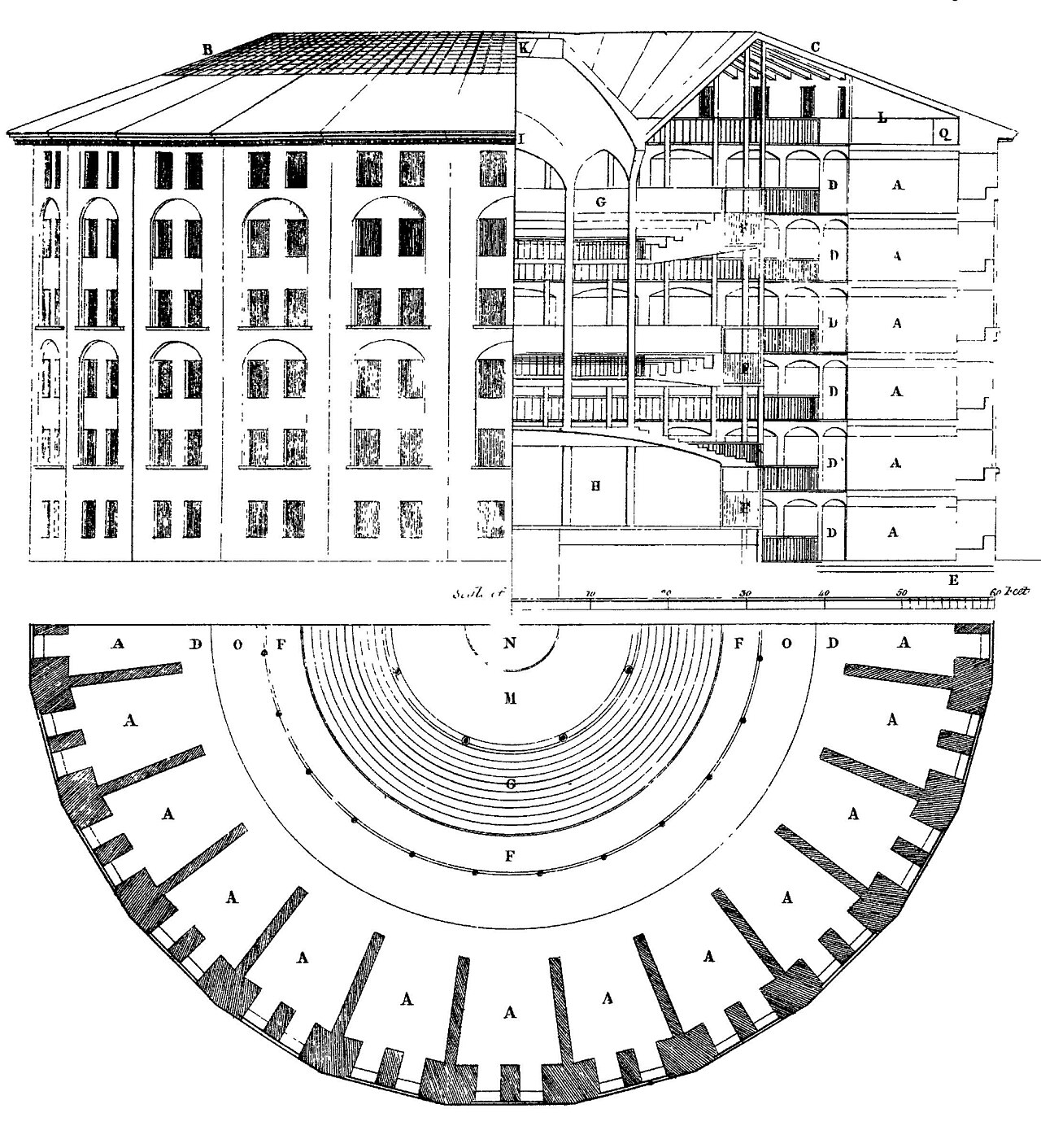
His model is the panopticon. Jeremy Bentham described it as a "new mode of obtaining power of mind over mind, in a quantity hitherto without example."8 A guard at the center can see every cell, and the prisoners cannot tell when they are being watched, so they come to watch themselves.9 His brother Samuel had come up with the central inspection principle while working in Russia for Prince Potemkin, and Jeremy commissioned the architect Willey Reveley to draw the plans. No prison was ever built to match the detailed drawings.87 Foucault used the design as a picture of how modern institutions shape conduct without needing force. Of the reformers who wanted to replace the scaffold he wrote that their aim was "to punish less, perhaps; but certainly to punish better."9
Two of his ideas have traveled far. One is that power and knowledge support each other, so that those who know a population can control it and those who control it come to know it.6 The other is that power is not only repressive but productive. It makes the categories in which people understand themselves.6 He called his method genealogy, borrowed in part from Nietzsche, and it traces how practices came about by accident and interest and not by inevitable progress.6
A citizen can use the warning without accepting everything Foucault concluded. Any system that records, scores and sorts people, whether a school, a credit bureau, a camera network or a government database, carries power that does not look like power. It deserves the questions a free people have always asked of governments. Who sees the records? Who answers for mistakes? Who can say stop?
Derrida and the Slippery Text
Jacques Derrida was born on July 15, 1930, and died on October 8, 2004. In 1967 he published three books, among them Of Grammatology, which Gayatri Spivak translated in 1976.1011 His method became known as deconstruction. In the first of three definitions the Stanford Encyclopedia gives, it has two phases: reverse a Platonic hierarchy, then re-inscribe the lower term.10 He changed the spelling of the key word to différance to mark its altered status, and used it for an undecidable resource that metaphysics had to cut into to make its founding decision.10
The remark most quoted is the French sentence il n'y a pas de hors-texte, from De la grammatologie (1967), often translated "there is nothing outside the text."12 Read as a claim that nothing exists except words, it sounds like the end of truth. The literary theorist Timothy Morton reads it more narrowly. Derrida is discussing Rousseau, and on Morton's reading the sentence says that given the closed system of textuality Rousseau prescribes, there is no outside-text. The trouble, in his account, lies in the closed system and not in the absence of a world beyond texts.13 Readers differ about the sentence, and a student is wise to treat it as a puzzle to read in context and not as a slogan.
The late Derrida wrote about justice. The Stanford entry quotes his view that "Justice remains an event yet to come."10 Even the great doubter of fixed meanings kept a place for a standard that no existing law fully reaches.
Reading Them Fairly
Lyotard's book began as a report, and its job was to describe the state of knowledge, not to cheer for its collapse.3 Foucault did not say that nothing could be known. He said that what a society counts as knowledge has a history and a link to power, and he made the case through histories of the asylum and the prison.6 Derrida's late essays turn deconstruction toward law and justice, and the Stanford entry closes by saying that what deconstruction values is survival.10
The three are often used as labels for everything that went wrong in the universities. The labels do little work. A student who reads the originals finds careful, sometimes obscure, sometimes brilliant arguments, and a few of them touch the same problems Schaeffer named, such as the limits of reason and the fate of shared standards.
What Schaeffer Saw Coming
Schaeffer died on May 15, 1984, the year Lyotard's book reached English readers and the year Foucault died.1436 He had described the pattern in 1968, before the names were fixed. In the "Madness" section he quoted Marcus's judgment that what Foucault was finally against was "the authority of reason."1 He tied the theme to Rousseau: carried to its conclusion, he wrote, the ultimate in autonomous freedom is being crazy. The reviewer's phrase "post-modern" served as his evidence of the mood.1
His account of how thought had changed supports the same reading. He described thinking by antithesis, the idea that if a thing is true its opposite is not, and if a thing is right its opposite is wrong. He added that a man cannot totally reject that method, however far his system leads him from it.15 After Hegel, he wrote, "truth as truth is gone," and a both-and synthesis took its place.16 He also noted that the Theatre of the Absurd deliberately used abnormal syntax and a devaluation of words.17 Lyotard's incredulity, Foucault's suspicion and Derrida's play with language can be read as later steps in that sequence. It is fair to say that Schaeffer drew the map before the names of the towns were agreed on.
The thinkers also help the other side of the argument. Foucault is a good guide to how power operates in institutions, and Derrida's late work on justice reminds readers that people still ask for more than law gives them. Lyotard is honest about what follows when every grand story is doubted. Schaeffer's line of questioning leads to a practical one: what can a society say to a ruler if it has lost every standard above the state? The three Frenchmen supply plenty of material for asking it.
The Founders' Answer
The Declaration states that "all men are created equal" and that governments are instituted "to secure these rights."18 It does not offer a grand story of progress, and it does not ground rights in a culture's language games. It grounds them in what it calls self-evident truths and in a Creator. That is why the Founders could build a government that fears power as Foucault does. The separate branches, the elections and the written Constitution all reflect an assumption that power needs watching, and they put the watching in the hands of the governed. A citizen can borrow Foucault's suspicion and keep the Founders' standard, which gives the suspicion a purpose.
| Thinker | Key work | Main claim | Use for a citizen |
|---|---|---|---|
| Lyotard (1924 to 1998) | The Postmodern Condition, 1979 | Grand stories have lost credibility | Ask what story justifies a claim of authority |
| Foucault (1926 to 1984) | Discipline and Punish, 1975 | Power and knowledge support each other | Watch who keeps the records |
| Derrida (1930 to 2004) | Of Grammatology, 1967 | Meaning depends on what it excludes | Read texts and statutes closely |
- 1966 Foucault publishes The Order of Things; Marcus's review of his madness book appears November 3.61
- 1967 Derrida publishes three books, including Of Grammatology.10
- 1968 Schaeffer's Escape from Reason quotes the review.1
- 1975 Discipline and Punish appears in French.7
- 1979 Lyotard publishes La condition postmoderne.3
- 1984 The English translation appears; Foucault dies; Schaeffer dies on May 15.3614
Learn more
- Stanford Encyclopedia of Philosophy, Foucault: a careful overview of his major books.
- Stanford Encyclopedia of Philosophy, Lyotard: explains language games and the differend.
- Stanford Encyclopedia of Philosophy, Derrida: covers deconstruction and his late political work.
- Bentham Project, The Panopticon: the design as Bentham described it.
- Morton, There Is Nothing Outside of the What?: one reading of Derrida's best-known sentence.
- Wikipedia, Discipline and Punish: the structure of Foucault's 1975 book.
Notes
- Francis A. Schaeffer, Escape from Reason (London: InterVarsity Press, 1968), chapter 6, section "Madness," on Michel Foucault's Madness and Civilization and the review that Schaeffer's index lists as by "Stephen Marcus" (the review's byline reads Steven Marcus), quoting the phrases "post-everything, post-modern, post-history" and "What Foucault is finally against, however, is the authority of reason"; Steven Marcus, "In Praise of Folly," New York Review of Books, November 3, 1966 (reprinted November 17, 1966, with passages restored to order). Read the review. ↩
- Francis A. Schaeffer, The Francis A. Schaeffer Trilogy (Wheaton, Ill.: Crossway), table of contents of Escape from Reason, chapter 6, "Madness." Schaeffer's remark that the ultimate in autonomous freedom is being crazy appears in the same book, in the discussion of Rousseau. Read it online. ↩
- "Jean-Francois Lyotard," Stanford Encyclopedia of Philosophy: born August 10, 1924, in Vincennes; died April 1998 in Paris; La condition postmoderne (Paris: Editions de Minuit, 1979), English translation by Geoff Bennington and Brian Massumi (1984); written for the Conseil des universites of Quebec; language games; The Differend (1983). Read it online. ↩
- "The Postmodern Condition," Wikipedia, and the Stanford Encyclopedia entry on Lyotard (which gives "incredulity toward metanarratives"; printings differ between "toward" and "towards"): "Simplifying to the extreme, I define postmodern as incredulity toward metanarratives"; the Enlightenment and Marxism as examples of teleological views of history; computerization and the report for the Conseil des universites du Quebec. Read it online. ↩
- "Jean-Francois Lyotard," Stanford Encyclopedia of Philosophy, on the crisis of legitimation in the sciences, which must rely on extra-scientific narratives to claim authority, and on the differend as a conflict that no shared rule of judgment can settle. Read it online. ↩
- "Michel Foucault," Stanford Encyclopedia of Philosophy: 1926 to 1984; the history of madness of 1961; The Order of Things (1966); Discipline and Punish (1975); the link between power and knowledge; genealogy; The History of Sexuality, volume 1, and the claim that power is productive. Read it online. ↩
- "Discipline and Punish," Wikipedia: Surveiller et punir (Paris: Gallimard, 1975), English translation by Alan Sheridan (New York: Pantheon, 1977); the contrast between the public torture of Damiens and a regimented prison schedule; four parts on torture, punishment, discipline and prison; the panopticon as a model. Read it online. ↩
- "The Panopticon," Bentham Project, University College London: Bentham's description of the design as a "new mode of obtaining power of mind over mind, in a quantity hitherto without example"; the drawings by the architect Willey Reveley; Samuel Bentham's central inspection principle, developed in Russia while he worked for Prince Potemkin; no existing prison matches the detailed drawings. Read it online. ↩
- "Michel Foucault," Stanford Encyclopedia of Philosophy, quoting Foucault (Discipline and Punish, English translation 1977, p. 82) on the aims of the reformers, "to punish less, perhaps; but certainly to punish better," and describing the panopticon as a design in which inmates cannot tell when they are watched and so regulate themselves. Read it online. ↩
- "Jacques Derrida," Stanford Encyclopedia of Philosophy: born July 15, 1930; died October 8, 2004; three books in 1967, including Of Grammatology; deconstruction as a reversal of hierarchies such as appearance over essence; differance; the remark that "Justice remains an event yet to come" (discussing "Force of Law"); the closing line "Thus what deconstruction values is survival." Read it online. ↩
- "Of Grammatology," Wikipedia: Derrida's 1967 book, translated by Gayatri Chakravorty Spivak (Johns Hopkins University Press, 1976; the Stanford entry's bibliography lists 1974). Read it online. ↩
- Jacques Derrida, De la grammatologie (Paris: Minuit, 1967), p. 227: "Il n'y a pas de hors-texte." The sentence is discussed in the Stanford Humanities Center essay cited below. Excerpt with the citation. ↩
- Timothy Morton, "There Is Nothing Outside of the What?," Arcade, Stanford Humanities Center, August 27, 2010, which quotes the sentence as "il n'y a pas d'hors-texte" from Of Grammatology and reads it as a claim about the closed system of textuality that Rousseau prescribes. Read it online. ↩
- Francis Schaeffer, Wikipedia: died May 15, 1984, in Rochester, Minnesota. Read it online. ↩
- Schaeffer, Escape from Reason, in the passages on thinking by antithesis: if a thing is true, the opposite is not true; and a man cannot totally reject the methodology of antithesis, however much his system leads him to (text searched in The Francis A. Schaeffer Trilogy, Internet Archive). ↩
- Schaeffer, Escape from Reason, the discussions of Hegel in The God Who Is There and Escape from Reason, where he describes modern man's approach to truth as one in which "truth as truth is gone" and synthesis, the both-and, takes its place. ↩
- Schaeffer, Escape from Reason, chapter 5, section "The Theatre of the Absurd," on the deliberate use of abnormal syntax and a devaluation of words. ↩
- Declaration of Independence, 1776, National Archives transcript: "We hold these truths to be self-evident, that all men are created equal," and "That to secure these rights, Governments are instituted among Men." Read it online. ↩
Terms in this lesson
- Metanarrative
- A grand story that claims to explain history and justify knowledge, such as progress through reason or liberation of the working class.
- Language game
- Lyotard's name for a type of speech with its own rules, such as science, law or art.
- Power/knowledge
- Foucault's claim that systems of knowledge and systems of power support each other.
- Panopticon
- Jeremy Bentham's prison design in which a central guard can see every cell, and prisoners cannot tell when they are watched.
- Genealogy
- Foucault's method of tracing how a practice or idea arose from contingent events and not from inevitable progress.
- Deconstruction
- Derrida's way of reading that shows how a text's key oppositions, such as speech and writing, depend on each other and on what they exclude.
- Postmodern
- A label for thought that doubts grand stories, universal reason and fixed meaning.
Sources
- Stanford Encyclopedia of Philosophy, Michel Foucault checked 2026-10
- Stanford Encyclopedia of Philosophy, Jean-Francois Lyotard checked 2026-10
- Stanford Encyclopedia of Philosophy, Jacques Derrida checked 2026-10
- Bentham Project, UCL, The Panopticon checked 2026-10
- Wikipedia, Discipline and Punish checked 2026-10
- Crossway, Francis A. Schaeffer Trilogy table of contents checked 2026-10
- Steven Marcus, In Praise of Folly, New York Review of Books, November 3, 1966 checked 2026-10