Lesson 8 of 18 · about 15 minutes
Darwin and the New Story of Origins
You'll be able to
- Say what Darwin actually claimed in 1859 and 1871, using his own words
- Explain the difference Schaeffer drew between modern science and a closed system of cause and effect
- Describe how Christian thinkers of Darwin's day answered him, and that they did not answer alike
- Trace how the language of fitness moved from biology into social policy
- Explain why the Declaration of Independence grounds rights in a Creator and not in measured fitness
The book went on sale on Thursday, 24 November 1859, at fifteen shillings. The printer had made 1,250 copies, and on 22 November the booksellers had taken every copy available.1 Darwin's closing paragraph holds the best-known sentence in the book.
"There is grandeur in this view of life, with its several powers, having been originally breathed into a few forms or into one;"
Charles Darwin, On the Origin of Species, 1859, closing paragraph. 2
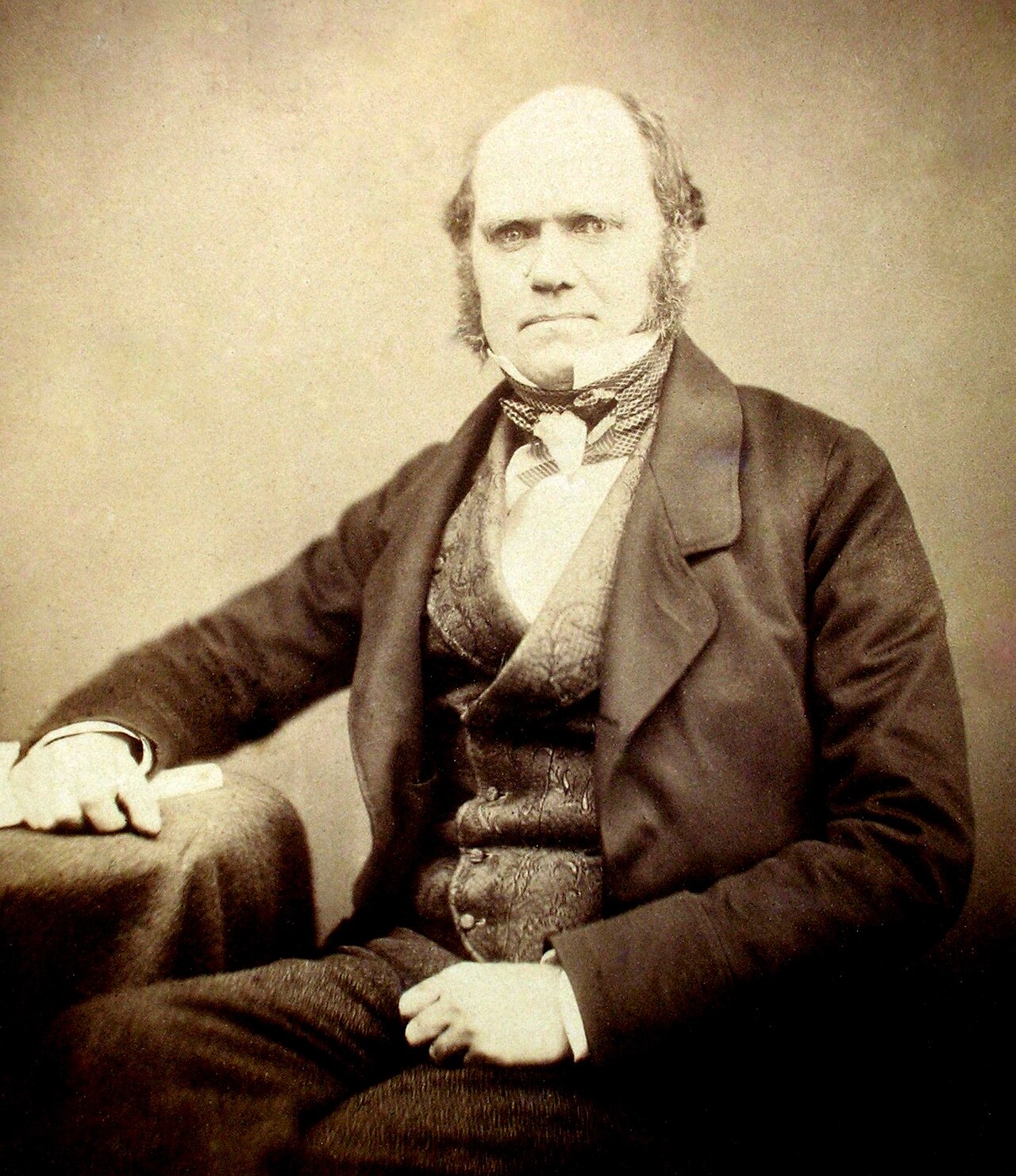
The World Darwin Entered
Darwin did not walk into an empty room. In Britain, William Paley's Natural Theology had taught a generation to see the fit between an eye and its work as evidence of a designer. All the naturalists at Oxford and Cambridge were Church of England clergymen, and science was understood as a search for the laws a Creator had set in motion.3 Darwin's theory landed in a culture that already took design for granted, and the first fight was over whether natural selection could do the work design had done. The fight over what a human being is came afterward.
What the Origin Said
The argument of the book is plain enough. Living things vary. Some variations are inherited. More young are born than can survive, so those with helpful variations leave more offspring, and over very long periods this sorting changes species and produces new ones. Darwin called the process natural selection. The book supplied a mass of evidence from pigeon breeding, geology, and geography and made the case that all living forms share ancestors.
The text holds two surprises. On people the book says almost nothing. It closes its list of future research with one sentence: "Light will be thrown on the origin of man and his history."4 Darwin published his full treatment in The Descent of Man in 1871. And the paragraph above changed in the second edition, which appeared on 7 January 1860. Darwin added "by the Creator," so that life was "originally breathed by the Creator into a few forms or into one," and that wording stood through the sixth edition of 1872.5 Darwin's own explanation came three years later. Writing to his friend Joseph Hooker on 29 March 1863, he said he had long regretted that he had "truckled to public opinion" by using the biblical word "creation" for what he meant as "appeared" by some unknown process.6 Yet the first edition had already spoken of "the laws impressed on matter by the Creator" in its concluding pages, so the 1860 change added a word to the last sentence and did not introduce a new idea.6 The second edition also quoted a letter from a clergyman, later identified as Charles Kingsley, who had written that it was "just as noble a conception of the Deity" to believe God created a few original forms capable of self-development as to believe He needed a fresh act of creation to fill each gap.7
Myth: The Origin of Species argued that men come from apes
The 1859 book says nothing of the kind in so many words. Its one sentence on the subject promises future research, and Darwin held his full treatment of human descent for the Descent of Man, twelve years later.4
- 1859 Origin of Species published on 24 November.
- 1860 Second edition (7 January) adds "by the Creator."
- 1864 Herbert Spencer coins "survival of the fittest."
- 1869 Fifth edition of the Origin adopts the phrase.
- 1871 The Descent of Man.
- 1874 Charles Hodge publishes What Is Darwinism?
- 1927 Buck v. Bell upholds compulsory sterilization in Virginia.
Darwin on the Weak
The Descent is the book to read for yourself. Darwin writes plainly about a problem he saw. "With savages," he says, "the weak in body or mind are soon eliminated." "We civilised men, on the other hand, do our utmost to check the process of elimination; we build asylums for the imbecile, the maimed, and the sick; we institute poor-laws." He thought this likely to harm the race, and he compared it to a breeder who allows his worst animals to breed.8
Then he turns, and the turn is the part most quoted by nobody. We could not check our sympathy "even at the urging of hard reason, without deterioration in the noblest part of our nature." To neglect the weak on purpose, he says, could only be for a contingent benefit "with an overwhelming present evil."8 Darwin saw the cold arithmetic and refused it. He traced the impulse to help the helpless to the instinct of sympathy, one of the social instincts, and held that stifling it would damage us.
It is a decent position. Darwin's reason is that overriding sympathy would harm the noblest part of our nature. That is a claim about what a person is, and the sections below ask what such a claim can rest on.
How Churchmen Answered
American Protestants did not give one answer. At Princeton Theological Seminary, Charles Hodge published What Is Darwinism? in 1874 and concluded that Darwinism was atheistic because it excluded design from nature. He added that this did not mean Darwin himself was an atheist.9 At the college, which was a separate institution, the new president, the Scottish philosopher James McCosh, who had arrived in 1868, argued that much of Darwinism could be sound and should be read as evidence of design, the prearrangement and purpose of a Creator working through law.10 Two Presbyterians, one town, two verdicts. Both men supported scientific inquiry and resisted its reach into philosophy and religion.10
Christians who held the same creed read the same book and reached different conclusions about its science. Schaeffer came to the question a century later and asked something else.
Schaeffer and the Closed System
In the summaries of his work, Schaeffer's concern is a way of thinking about nature and man. In How Should We Then Live? (1976), chapter 7 is "The Rise of Modern Science" and chapter 8 is "The Breakdown in Philosophy and Science."11 The first chapter makes a point that is easy to skip over: modern science grew up on Christian ground. In Schaeffer's telling, early scientists believed a rational God had designed a world that human reason could investigate. They held that nature runs on uniform causes in an open system, where God, and to a degree man, can act freely on the chain of cause and effect.12
The later turn, on his account, was to keep the uniform causes and drop the openness. Nature became a closed system, a machine with no outside. As the Themelios reviewer William Dyrness puts it, summarizing Schaeffer, this was "a closed system of cause and effect in which man himself came to be seen as part of the world machine."13 Schaeffer's claim is that nobody can live inside that picture. A person who is only a part of the machine still loves, blames, and promises. So he looks for meaning in non-reason, which is the upper-floor leap you met in the lesson on Kierkegaard.12
This lets a reader handle Darwin without taking sides in every quarrel about biology. A scientist can accept or question an account of species and still ask a further question that science as a method cannot answer: whether the account is the whole story about what a person is. Darwin himself closed his book with "grandeur" and a Creator. Many who used his name later dropped both.
Schaeffer was no enemy of science. The same summary of his work notes that he held all truth to be God's truth, and that the pursuit of the arts and sciences reflects the creative image of God in man.12 The trouble he saw lay in the move from a method to a metaphysics. A biologist who studies how populations change has done science. A claim that nothing exists but matter and energy shaped by chance has gone beyond what any experiment can show, and it carries consequences for ethics and law that the experiment never tested. Learn to name that boundary between method and philosophy, politely, in a school board meeting or a living room.
From Biology to Policy
The phrase "survival of the fittest" did not come from Darwin. Herbert Spencer coined it in 1864, and Darwin adopted it in the fifth edition of the Origin in 1869.14 Spencer's own evolutionary ideas were worked out before the Origin, which is why the biologist Ernst Mayr preferred the name "social Spencerism" to "social Darwinism," and why scholars still debate how far the movement reflected Darwin's views.15 The record shows a gap between what Darwin wrote and what others did with it. Darwin's cousin Francis Galton advanced eugenic ideas in 1865 and 1869, and the passage from the Descent quoted above proposes no law of any kind.15
The laws came later. On 2 May 1927, in Buck v. Bell, the United States Supreme Court upheld Virginia's compulsory sterilization statute. Justice Oliver Wendell Holmes wrote for the Court: "Three generations of imbeciles are enough."16 Holmes's opinion spoke of preventing "those who are manifestly unfit from continuing their kind," which is the vocabulary of fitness.
The fair summary: Darwin did not write the sterilization laws, and he warned against the neglect of the weak. Those who did write them used the language of fitness, and found nothing in the language to stop them.
Why the Founders Wrote "Creator"
The Declaration of Independence says that "all men are created equal; that they are endowed by their Creator with certain unalienable rights."17 The sentence places equality in an act of creation, before any government and before any measurement of strength, health, or talent. That is why the rights can be called unalienable. A right that comes from fitness can be withdrawn from the unfit, since fitness varies and somebody has to do the measuring.
A natural-law reader would add that human beings can know something of what they owe each other by looking at what a person is. If the account of what a person is says only "a product of selection," the knowledge has nothing to stand on, and the sympathy Darwin trusted becomes a taste that some have and some do not. Schaeffer saw that connection and spent the later part of his career on it, with Whatever Happened to the Human Race? in 1979, a book and film series.18 The lesson on the 1970s takes that up.
A community can hold every view on descent, from theistic evolution to six-day creation, and still agree that the person next door holds rights from a source above the vote. The Declaration's phrase asks for that agreement and nothing more on the question of origins. It leaves the science to the scientists and the exegesis to the churches.
None of this requires a citizen to settle the age of the earth or the details of descent. It requires him to ask, when a policy is defended by an account of human nature, what that account says a person is worth and who gave it the right to say so.
Learn more
- The Origin of Species, first edition: Darwin's own text, with the first closing paragraph.
- The Descent of Man (second edition, 1874): Chapter 5 holds his remarks on the weak and on sympathy.
- Dyrness on How Should We Then Live?: A review that summarizes Schaeffer's thesis on science and the closed system.
- How Should We Then Live? (EBSCO Research Starters): A plain-language summary of the whole book.
- Buck v. Bell: The 1927 opinion, short enough to read in full.
- Declaration of Independence: Read the second paragraph slowly.
Notes
- Wikipedia, "On the Origin of Species," section on publication: first published Thursday 24 November 1859, offered to booksellers on 22 November, first printing of 1,250 copies of which about 1,170 were on sale; second edition of 3,000 copies on 7 January 1860. Read it online. ↩
- Charles Darwin, On the Origin of Species by Means of Natural Selection (London: John Murray, 1859), final chapter, last paragraph. Project Gutenberg ebook 1228, first edition. Read it online. ↩
- Wikipedia, "On the Origin of Species," section on background: Paley's Natural Theology saw adaptation as "design" by the Creator acting through natural laws, and all naturalists at Oxford and Cambridge were Church of England clergymen. Read it online. ↩
- Darwin, On the Origin of Species (1859), final chapter: "Light will be thrown on the origin of man and his history." Project Gutenberg ebook 1228. Read it online. ↩
- Darwin, On the Origin of Species, sixth edition (London: John Murray, 1872), final paragraph, which reads "having been originally breathed by the Creator into a few forms or into one." Project Gutenberg ebook 2009. Read it online. ↩
- Charles Darwin to J. D. Hooker, [29 March 1863], letter 4065, Darwin Correspondence Project, University of Cambridge: "I have long regretted that I truckled to public opinion & used Pentateuchal term of creation, by which I really meant 'appeared' by some wholly unknown process." For the first edition's "laws impressed on matter by the Creator," see Darwin, Origin (1859), final chapter, Project Gutenberg ebook 1228. Read it online. ↩
- Darwin, On the Origin of Species, sixth edition (1872), concluding chapter, quoting "a celebrated author and divine" (the passage was added in the second edition of 1860; the Darwin Correspondence Project identifies the writer as Charles Kingsley, letter of 18 November 1859). Project Gutenberg ebook 2009. Read it online. ↩
- Charles Darwin, The Descent of Man, and Selection in Relation to Sex, second edition (London: John Murray, 1874; first edition 1871), chapter 5 (the quotations follow the 1874 text; the first edition words two phrases differently, for example "a certain and great present evil"), "On the Development of the Intellectual and Moral Faculties During Primeval and Civilised Times," section on natural selection as affecting civilised nations. Project Gutenberg ebook 2300. Read it online. ↩
- Charles Hodge, What Is Darwinism? (New York: Scribner, Armstrong and Co., 1874), concluding chapter: "What is Darwinism? It is Atheism. This does not mean ... that Mr. Darwin himself and all who adopt his views are atheists; but it means that his theory is atheistic." Project Gutenberg ebook 19192. Read it online. McCosh's position is summarized in the Wikipedia article "Charles Hodge" and "James McCosh." Read it online. ↩
- Wikipedia, "Charles Hodge" (as above), on the contrast between the Princeton seminary under Hodge and Princeton University under McCosh. Read it online. ↩
- Wikipedia, "How Should We Then Live?", list of the book's thirteen chapters, including chapter 7, "The Rise of Modern Science," and chapter 8, "The Breakdown in Philosophy and Science." Read it online. ↩
- David D. Pettus, "How Should We Then Live? by Francis A. Schaeffer," EBSCO Research Starters (2022), on the rise of modern science, open and closed systems, and man as part of the cosmic machine. Read it online. ↩
- William Dyrness, review of Francis A. Schaeffer, How Should We Then Live?, Themelios 4:2: the Enlightenment produced "a closed system of cause and effect in which man himself came to be seen as part of the world machine." Read it online. ↩
- Wikipedia, "On the Origin of Species": the fifth edition (10 February 1869) first included the phrase "survival of the fittest," coined by Herbert Spencer in Principles of Biology (1864). Read it online. ↩
- Wikipedia, "Social Darwinism": the phrase "survival of the fittest" is credited to Herbert Spencer; Francis Galton, Darwin's cousin, put forward eugenic ideas in 1865 and 1869; Ernst Mayr preferred the name "social Spencerism," citing Spencer's earlier, neo-Lamarckian theories (Mayr, The Growth of Biological Thought, 1982, pp. 385-386). Read it online. ↩
- Buck v. Bell, 274 U.S. 200, 207 (1927), argued 22 April and decided 2 May 1927, opinion of the Court by Justice Holmes, upholding Virginia's sterilization law. Read it online. ↩
- Declaration of Independence, 4 July 1776, second paragraph, Avalon Project, Yale Law School. Read it online. ↩
- Wikipedia, "Francis Schaeffer," list of books: Whatever Happened to the Human Race? (1979), a book and film series. Read it online. ↩
Terms in this lesson
- Natural selection
- Darwin's name for the process by which individuals with helpful inherited variations leave more offspring, so that those variations spread.
- Closed system
- Schaeffer's phrase for a view in which every event, including human thought, is explained by a chain of natural causes with nothing outside it.
- Open system
- The view Schaeffer credited to early modern scientists: nature runs on regular causes, but God and, in a measure, persons act freely within it.
- A label for the use of evolutionary language to defend policies about wealth, race, or the weak. It is tied more to Herbert Spencer than to Darwin.
- Eugenics
- A movement, begun by Darwin's cousin Francis Galton, that sought to improve human stock by controlling who had children.
- Unalienable rights
- Rights the Declaration says come from the Creator, so that no government grants them and none may rightly take them away.
Sources
- Darwin, On the Origin of Species (1859), Project Gutenberg checked 2026-10
- Darwin, On the Origin of Species (sixth edition, 1872), Project Gutenberg checked 2026-10
- Darwin, The Descent of Man (second edition, 1874), Project Gutenberg checked 2026-10
- Wikipedia, On the Origin of Species (publication and editions) checked 2026-10
- Hodge, What Is Darwinism? (1874), Project Gutenberg, with McCosh summarized in Wikipedia, Charles Hodge checked 2026-10
- Darwin to J. D. Hooker, 29 March 1863, Darwin Correspondence Project checked 2026-10
- Wikipedia, Social Darwinism checked 2026-10
- EBSCO Research Starters, How Should We Then Live? (David D. Pettus, 2022) checked 2026-10
- Dyrness, review of How Should We Then Live?, Themelios 4:2 checked 2026-10
- Declaration of Independence, Avalon Project checked 2026-10
- Buck v. Bell, 274 U.S. 200 (1927), Cornell Legal Information Institute checked 2026-10