Lesson 6 of 18 · about 14 minutes
Hegel and the March of History
You'll be able to
- Give the main dates of Hegel's life and works
- Quote Hegel on reason in history and on the progress of the consciousness of freedom
- Explain why thesis, antithesis and synthesis is not Hegel's own formula
- Describe how Schaeffer placed Hegel in the history of modern thought
- Contrast fixed natural rights with rights that unfold in history
Georg Wilhelm Friedrich Hegel was born in Stuttgart on August 27, 1770, and died in Berlin on November 14, 1831.1 In between he became the most influential philosopher in Germany. He studied philosophy and then theology at Tübingen from 1788 to 1793, where he befriended Hölderlin and Schelling. He published the Phenomenology of Spirit in 1807 and the Science of Logic while a headmaster at Nuremberg. The Encyclopaedia of the Philosophical Sciences came out at Heidelberg in 1817. In 1818 he took the chair of philosophy at Berlin, and in 1820 or 1821 he published the Elements of the Philosophy of Right.2
Two works matter most for politics: the preface to the Philosophy of Right and the Introduction to his lectures on the philosophy of history, given at Berlin. Read as a whole, the Phenomenology presents a sequence of shapes of consciousness that, the Stanford Encyclopedia notes, maps onto the history of western European civilization from the Greeks to Hegel's own time.3 Each stage fails in a way that calls for the next. That is the idea that Hegel carried into history.
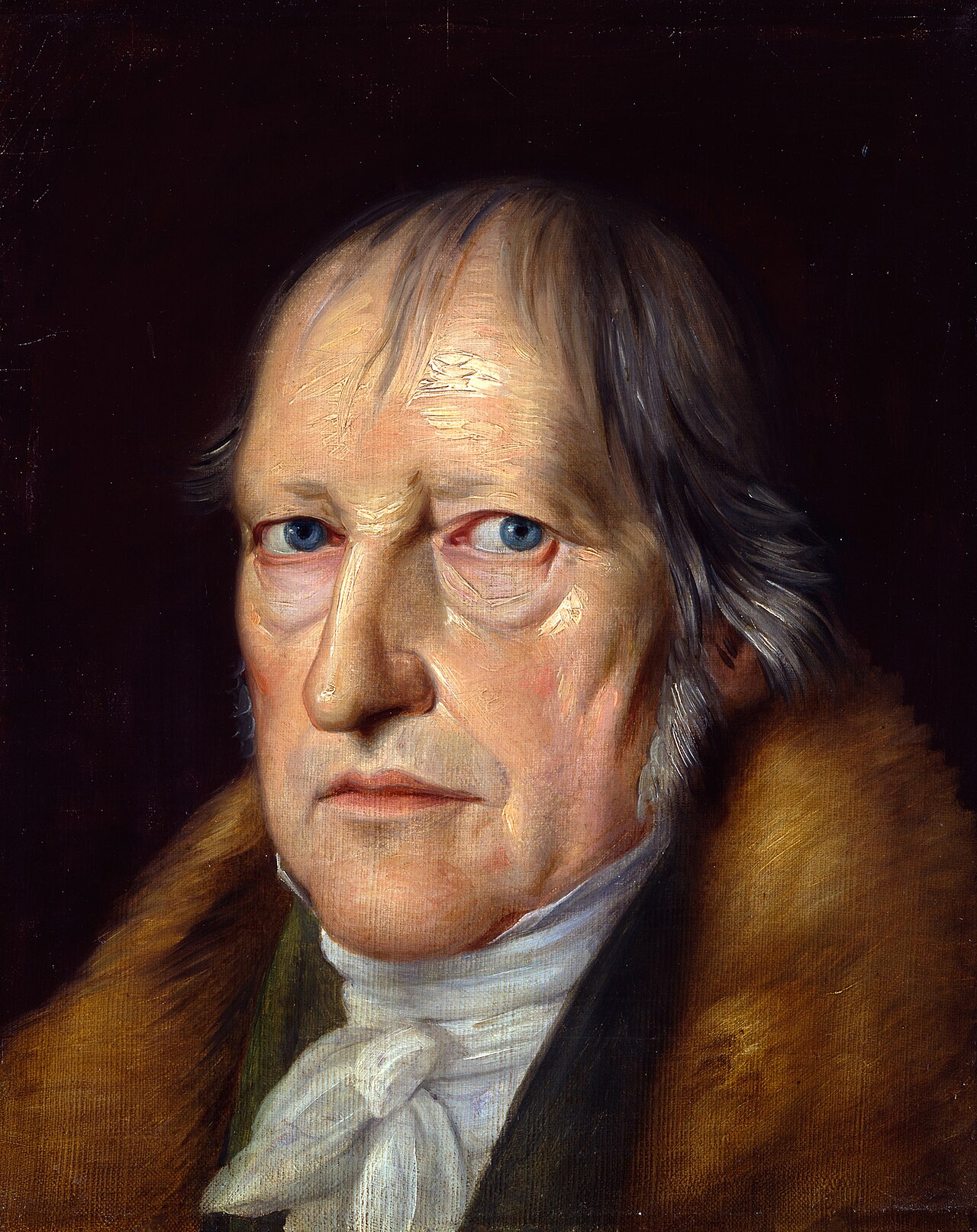
Reason in the Real
In the preface to the Philosophy of Right, Hegel wrote the sentence that has been argued over ever since. In the Dyde translation: "What is rational is real; And what is real is rational."4 He did not mean that whatever exists is good. He meant that reason is at work in the actual world and that the task of philosophy is to see it there. The same preface contains a modest line about the job. Philosophy, he says, "as the thought of the world, does not appear until reality has completed its formative process, and made itself ready." So philosophy "always comes too late" to teach the world what it ought to be. Then comes the line that students remember: "The owl of Minerva, takes its flight only when the shades of night are gathering."5
That is a conservative-sounding preface. Hegel was no friend of reformers who drew up a perfect state on paper. He wanted to understand the institutions that had grown up and to find the reason in them. The Stanford Encyclopedia of Philosophy notes that his political thought moves from abstract right to morality and then to ethical life, which includes the family and civil society, and that he does not begin from a lone individual making a contract.6
Hegel also belongs to a line. Britannica places him after Kant, Fichte and Schelling in the classical German philosophy that his work capped.1 Kant had made freedom a matter of the self giving itself the law, and Hegel took the idea and asked how such freedom becomes real in the world. The Stanford article links his account of freedom as self-determination directly to Kant's.6 Where Kant answered with a moral law inside the reasoning person, Hegel answered with institutions and history. The question of this lesson is whether that move kept what was best in Kant or lost it.
The Story of Freedom
The lectures on history turn that outlook into a single plot. The line most often quoted is this: "The History of the world is none other than the progress of the consciousness of Freedom."7 Hegel's scheme runs in stages. In the ancient East, he says, only one person was known to be free, and that one was a despot. The Greeks and Romans knew that some are free. And "we know that all men absolutely (man as man) are free."8 He gives this last stage a Christian name, speaking of the "Christian principle of self-consciousness" and giving that principle the name Freedom.9
| Stage | Who is known to be free | Hegel's description |
|---|---|---|
| The ancient East | One | Knew "only that one is free"; that one is a despot |
| Greece and Rome | Some | Freedom is known but limited to a class |
| The Christian, modern world | All | "all men absolutely (man as man) are free" |
A Christian can recognize something here and welcome it. Hegel was saying that the worth of every person as a person, which he tied to the Christian principle, was slowly worked out in law and society.
The trouble sits in the machinery. In Hegel's history, reason uses people. "This may be called the cunning of reason," he writes, "that it sets the passions to work for itself, while that which develops its existence through such impulsion pays the penalty and suffers loss."11 Great men, which he calls World-Historical Individuals, carry the next stage, and they have no happy lives. Caesar belongs in that category. "They die early, like Alexander; they are murdered, like Caesar," Hegel says, and when their purpose is served "they fall off like empty hulls from the kernel."12 History is also, he admits, "the slaughter-bench at which the happiness of peoples, the wisdom of States, and the virtue of individuals have been victimised."13 He asks to what final aim these sacrifices were offered, and his answer is the advance of freedom.
That answer carries a cost. If the sacrifices serve a purpose that only the philosopher sees, then they can be explained and, in time, excused.
A Formula Hegel Did Not Write
Most people learn Hegel through three words: thesis, antithesis, synthesis. The formula is a legend. According to a summary in Encyclopedia.pub, Kant's first Critique in 1781 supplied the thesis and antithesis pairs, and Johann Gottlieb Fichte first used all three terms together, in 1794 and 1795. Hegel, on this account, did not use the three terms for his own method. The philosophers Gustav Mueller, in an article of 1958 in the Journal of the History of Ideas, and Walter Kaufmann, in 1966, both argued that the attribution to Hegel is mistaken.14 Marx and Engels adopted the triad later and spread it, notably in Marx's Poverty of Philosophy of 1847.15
Britannica, a standard reference, still describes the Hegelian scheme as a movement "from thesis to antithesis and thence to a synthesis."1 The legend is hard to kill because it is easy to remember and because it roughly fits a real idea in Hegel: positions meet their opposites and are taken up into something larger.
Myth: Hegel taught thesis, antithesis, synthesis
The three terms come mostly from Fichte and later popularizers, and Hegel did not use them as the label for his method. Anyone who wants to criticize or defend Hegel should quote what he wrote, not the slogan.14
Schaeffer at the Door of Despair
Francis Schaeffer gave Hegel a key place. In Escape from Reason, chapter 3 moves from Kant and Rousseau to Hegel, and then to Kierkegaard and the line of despair.16 In David Steele's summary of Schaeffer's argument, Hegel "became the first man to open the door into the line of despair." He proposed that thesis and antithesis resolve into synthesis by reason, and the door then led to Kierkegaard, who concluded that reason cannot reach synthesis and that truth needs a leap of faith.17
When synthesis becomes the habit of thought, truth changes. If every position is a stage that will be absorbed into a later one, then no position is simply true. It is a moment. A moral claim becomes the claim of an age, and right and wrong start to look like products of their time.
Fairness to Hegel requires saying that he did not mean this relativism. He believed reason is real and that history shows it. He would have said that freedom for all is a truth, not a mood. What he did was tie the truth to history, so that it unfolds in time and is known only afterward. The people who came after him kept the history and dropped the reason.
The habit survives in ordinary speech. Anyone who argues that a policy must be right because it is the direction history is moving has borrowed Hegel's move, whether or not he has read a page of him. The argument takes the verdict out of the hands of the citizen, who might weigh the policy against a standing rule, and hands it to a process that no one can examine. A person who holds that rights are fixed can always ask whether a given act violates them. A person who holds that rights unfold has to wait and see.
An Old Principle and a New One
Jefferson wrote in 1825 that the Declaration's purpose was "not to find out new principles, or new arguments, never before thought of."18 The principle was old, and he said so with some pride. A Hegelian reading of the same year, 1776, would ask a different question: what stage of the consciousness of freedom did the Declaration mark? On that reading its principle is new in a sense, a step in a sequence, and it will be superseded. Nothing in Hegel prevents the next step from setting aside what the last one held.
Fixed Rights or Unfolding Rights
The Declaration says "We hold these truths to be self-evident," and it names the Creator as the source of rights.19 In that view rights are already there, before any government and before any stage of history, and they limit both. A people can fail to honor them. It cannot cancel them.
Hegel's account is different. The Stanford Encyclopedia describes Hegel as taking Kant's idea of freedom as self-determination and placing it inside forms of social life that emerged in history. Property rests on reciprocal recognition between persons, not on the individual alone, and a common will is achieved because of co-existing differences, not in spite of them.6 Rights are real and valuable, but they arrive through institutions and history, and the standard for judging a given stage is the stage that follows. That puts the court of appeal in the future.
The Stanford article records how this divided readers. The traditional reading sees a teleological, necessary course of history, and critics such as Karl Popper held that it underpinned a politics foreshadowing totalitarianism. Marx later turned the scheme upside down into materialism.20 Post-Kantian readers see in Hegel something milder, a history of social forms in which every claim becomes open to rational correction.20 Both readings find support in his pages.
Lesson 7 follows the thinker who refused Hegel's system because no system can say what it is to be this one person, now, who must choose. Lesson 9 follows Marx, who kept the dialectic of history and changed what drove it.
Learn more
- Hegel, Philosophy of Right, Preface: the source of the rational and real passage and the owl of Minerva.
- Hegel, Philosophy of History, Introduction: the freedom passages and the cunning of reason.
- Hegel, Stanford Encyclopedia of Philosophy: a full scholarly guide to his system and politics.
- Hegel, Britannica: a short, dated outline of his life and works.
- Mueller, The Hegel Legend (DOI link): the 1958 article that questioned the famous triad.
- David Steele on the line of despair: a plain-language summary of Schaeffer's placing of Hegel.
Notes
- "Georg Wilhelm Friedrich Hegel," Britannica, giving his birth on August 27, 1770, in Stuttgart, his death on November 14, 1831, in Berlin, and the description of the movement from thesis to antithesis to synthesis. Read it online. ↩
- "Hegel," Stanford Encyclopedia of Philosophy, on his career from Tübingen to Berlin, the Phenomenology (1807), the Encyclopaedia (1817), the Philosophy of Right (1820 or 1821), his account of freedom, ethical life and recognition, and the debate over Popper's reading. Read it online. ↩
- "Hegel," Stanford Encyclopedia of Philosophy, on the Phenomenology's sequence of shapes of consciousness as a map of Western civilization from the Greeks to Hegel's time. Read it online. ↩
- G. W. F. Hegel, Philosophy of Right (1820), Preface, trans. S. W. Dyde (1896), Marxists Internet Archive. Read it online. ↩
- Hegel, Philosophy of Right, Preface, the passages on philosophy always coming too late and on the owl of Minerva. Read it online. ↩
- "Hegel," Stanford Encyclopedia of Philosophy, on freedom as historically and socially realized self-determination, mutual recognition and property, the common will, and the move from abstract right through morality to ethical life. Read it online. ↩
- Hegel, Philosophy of History, Introduction, "The History of the world is none other than the progress of the consciousness of Freedom." Read it online. ↩
- Hegel, Philosophy of History, Introduction, the three grades of the consciousness of freedom, from "one is free" to "some are free" to "all men absolutely (man as man) are free." Read it online. ↩
- Hegel, Philosophy of History, Introduction, on the "Christian principle of self-consciousness" and Freedom. Read it online. ↩
- G. W. F. Hegel, Lectures on the Philosophy of History, Introduction, section III, "Philosophic History," trans. J. Sibree, Marxists Internet Archive, on the progress of the consciousness of freedom, the three stages, the cunning of reason, world-historical individuals and the slaughter-bench. Read it online. ↩
- Hegel, Philosophy of History, Introduction, on the cunning of reason. Read it online. ↩
- Hegel, Philosophy of History, Introduction, on World-Historical Individuals, Caesar and Alexander. Read it online. ↩
- Hegel, Philosophy of History, Introduction, on history as "the slaughter-bench." Read it online. ↩
- "Dialectic," Encyclopedia.pub entry summarizing the history of thesis, antithesis and synthesis in Kant (1781), Fichte (1794 to 1795), Schelling (1795) and Marx (1847), and citing Gustav E. Mueller, "The Hegel Legend of 'Thesis-Antithesis-Synthesis'," Journal of the History of Ideas 19 (1958): 411 to 414, and Walter Kaufmann (1966). Read it online. ↩
- "Dialectic," Encyclopedia.pub, on Marx and Engels adopting the triad, notably in Marx's The Poverty of Philosophy (1847). Read it online. ↩
- Crossway, Francis A. Schaeffer Trilogy, table of contents, Escape from Reason, chapter 3, naming Hegel and "Kierkegaard and the Line of Despair." Read it online. ↩
- David Steele, "Why Francis Schaeffer Matters: The Line of Despair, Part 3," Servants of Grace, April 2, 2018, on Hegel opening the door and Kierkegaard going below the line. Read it online. ↩
- Thomas Jefferson to Henry Lee, May 8, 1825, Founders Online. Read it online. ↩
- Declaration of Independence, July 4, 1776, National Archives transcript. Read it online. ↩
- "Hegel," Stanford Encyclopedia of Philosophy, on the traditional teleological reading, Popper's criticism, Marx's inversion into materialism and the post-Kantian reading. Read it online. ↩
Terms in this lesson
- Dialectic
- A way of reasoning in which a position meets its opposite and both are taken up into a fuller view. Hegel used it to describe thought and history.
- Spirit (Geist)
- Hegel's word for the shared mind of a people and an age as it comes to know itself.
- Cunning of reason
- Hegel's phrase for the way reason in history uses the passions of individuals to reach ends they did not intend.
- World-historical individual
- A person such as Caesar whose aims, in Hegel's account, carry the next stage of history.
- Historicism
- The view that ideas, rights and values belong to their time and develop with it, with no standard that stands outside history.
- Synthesis
- The joining of a position and its opposite into a higher view. In Schaeffer's account, the modern habit of seeking synthesis in place of plain true and false.
Sources
- Hegel, Philosophy of Right, Preface (Dyde translation), Marxists Internet Archive checked 2026-10
- Hegel, Philosophy of History, Introduction (Sibree translation), Marxists Internet Archive checked 2026-10
- Stanford Encyclopedia of Philosophy, Hegel checked 2026-10
- Britannica, Georg Wilhelm Friedrich Hegel checked 2026-10
- Gustav Mueller, The Hegel Legend of Thesis-Antithesis-Synthesis, Journal of the History of Ideas, 1958 checked 2026-10
- Crossway, Schaeffer Trilogy, table of contents checked 2026-10
- David Steele, Why Francis Schaeffer Matters: The Line of Despair checked 2026-10
- National Archives, Declaration of Independence transcript checked 2026-10