Lesson 1 of 12 · about 24 minutes
Art of the Revolution
You'll be able to
- Explain how Paul Revere's 1770 engraving of the Boston Massacre was made from Henry Pelham's design and why it worked as propaganda
- Describe what John Singleton Copley's portrait of Paul Revere and his Watson and the Shark show about art, trade and politics in the 1760s and 1770s
- State what Benjamin West changed with The Death of General Wolfe and why American painters went to his London studio
- Read John Trumbull's Revolutionary paintings as deliberate records that mix fact, memory and invention
Three weeks after British soldiers fired into a crowd on King Street in Boston on March 5, 1770, a silversmith named Paul Revere put an advertisement in the newspapers. He had a print for sale: The Bloody Massacre perpetrated in King Street Boston on March 5th 1770, by a party of the 29th Regt. It showed a neat line of redcoats firing on command into a group of unarmed townsmen while an officer raised his sword to give the order. Above the soldiers' heads, on the front of the Customs House, Revere lettered two words that were never on the real building: "Butcher's Hall."1
Four days after the ad ran, a young artist named Henry Pelham sat down and wrote Revere a furious letter. The picture was his.
"When I heard that you was cutting a plate of the late Murder, I thought it impossible, as I knew you was not capable of doing it unless you coppied it from mine and as I thought I had entrusted it in the hands of a person who had more regard to the dictates of Honour and Justice than to take the undue advantage you have done of the confidence and Trust I reposed in you."
Henry Pelham to Paul Revere, Boston, March 29, 1770.2
Pelham said he had gone to "the great Trouble and Expence of making a design paying for paper, printing &c," only to be robbed "as truly as if you had plundered me on the highway."2 Nobody knows whether he ever mailed the letter. But the famous image of the Boston Massacre, the one in nearly every American history book, began as a copy of another man's work, rushed to market a week before the original.1
That is a good place to start a lesson on the art of the American Revolution, because it is honest about what the art was. Some of it was a weapon. Some of it was a record. A good deal of it was both, and the artists themselves were patriots, Loyalists, businessmen, refugees and men who simply needed to sell pictures.
Revere's Bloody Massacre, 1770
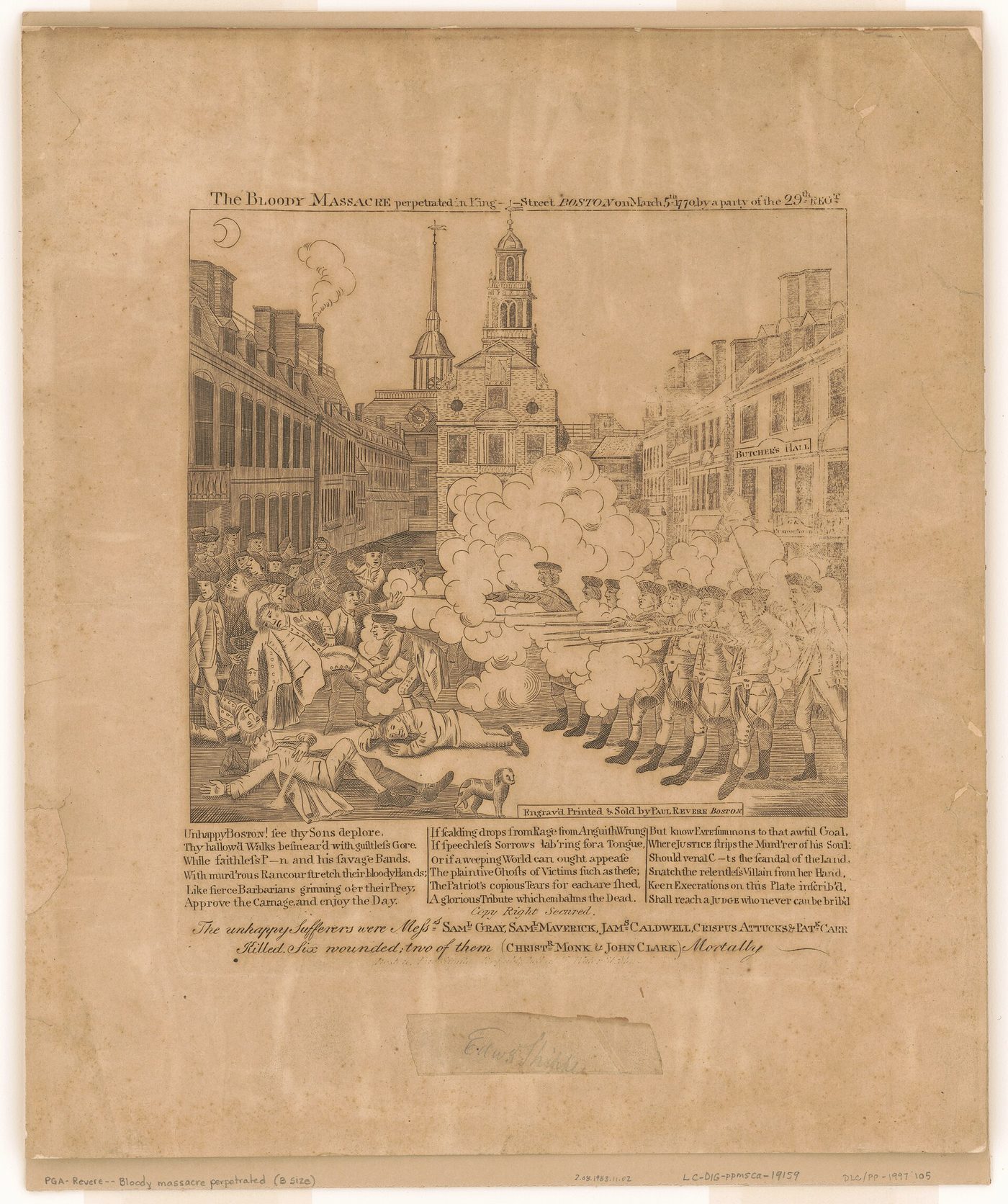
Revere was an engraver, not an inventor of images. The Boston Athenaeum, which owns a hand-colored copy of the print, puts it plainly: he "engraved works whose genesis came from the ideas of others."1 It appears Pelham, the half-brother of the painter John Singleton Copley, made his own plate of the shooting and lent Revere a version of it. Revere copied the scene, added his own title at the top and a verse and the names of the dead at the bottom, and beat Pelham to the street.1
What the print left out
The real night was a mess. A crowd had gathered around a lone sentry at the Custom House, Captain Thomas Preston brought a small squad to relieve him, and the shots came ragged and scattered. The full story, and John Adams's defense of the soldiers that December, is told in the lesson on the road to revolution.3 None of that confusion is in the picture. Both Pelham and Revere show slightly more than twenty orderly citizens shot at close range by seven soldiers under an officer who is plainly giving the command.1
One more thing is missing. Crispus Attucks, a sailor of African and Native American descent, was one of the first men killed. No figure matching him appears in any print made at the time. The earliest known picture of Attucks as a man of color at the massacre is an 1855 drawing by William L. Champney, turned into a color lithograph in 1856.4
So the print is propaganda in the plain sense of the word. It bent the facts toward a cause. It also worked. Copies were cheap, they could be hung in a parlor or a tavern, and they fixed in the colonial mind a picture of British soldiers as murderers before any trial took place. A free people has to be able to look at a picture like this and ask two questions at once: is the cause just, and is the picture true? Those are different questions, and the answer to the first does not settle the second.
Revere's engraving is the most famous American political print of the 1700s, and it is a copy. When you see it, look for Pelham's name in the credit line. If it is missing, the person who made the caption skipped the most interesting part of the story.
Copley's Boston: the silversmith in shirtsleeves
The best painter in colonial America lived a few streets away. John Singleton Copley, born in 1738, was Pelham's older half-brother.1 By the late 1760s he was painting the merchants, ministers and officials of Massachusetts, and their wives, with a hard, clear realism no one else in America could match.
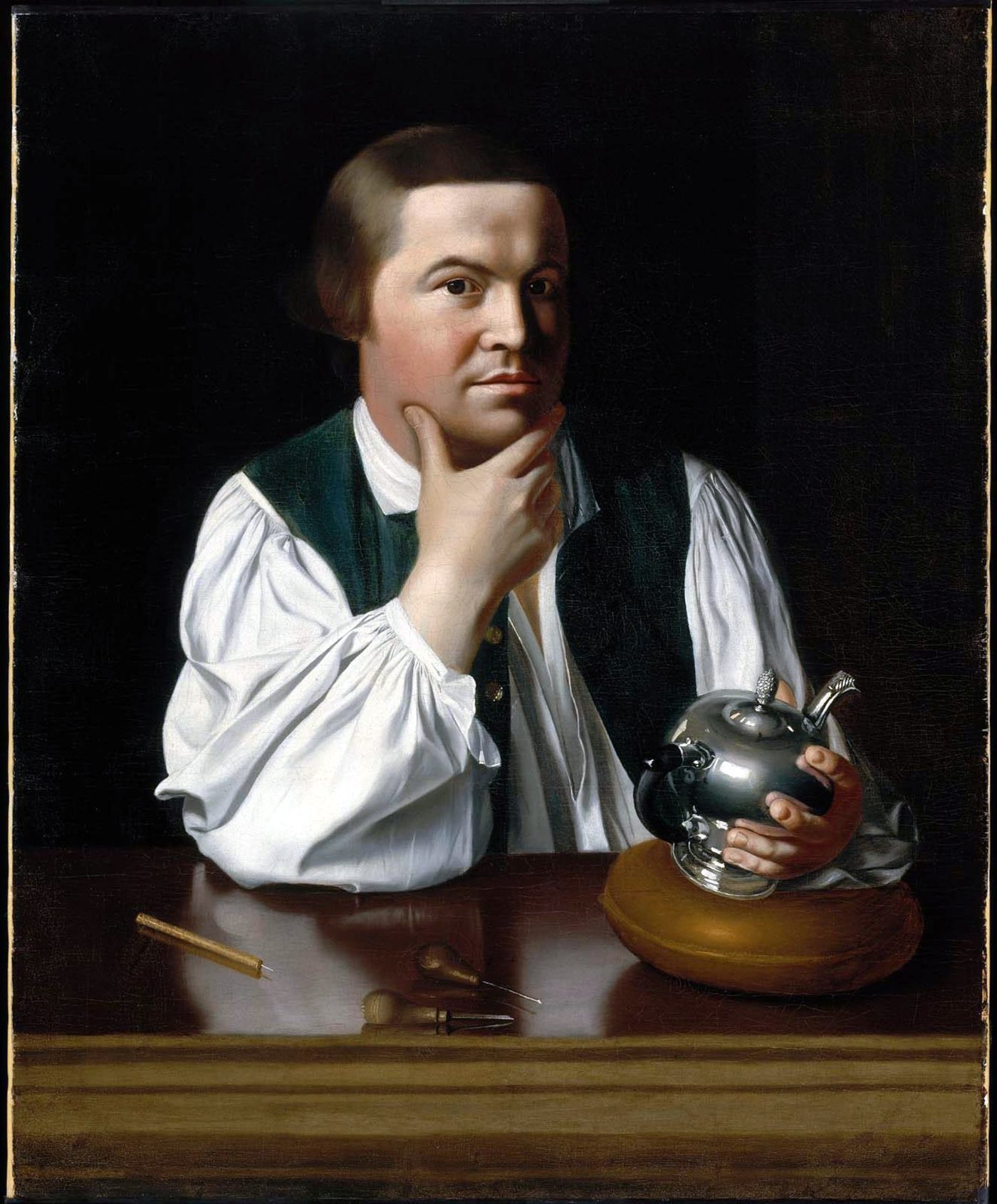
Look at what Copley chose to show in his portrait of Revere. Gentlemen were painted in coats and powdered wigs, with books or columns or a view of their estates. Revere sits at his workbench in shirtsleeves, unpowdered, holding a silver teapot he has made, with his engraving tools on the table.5 It is a portrait of a man who works with his hands and is proud of it. The year was 1768, the year British troops landed in Boston. Revere was already a Son of Liberty. Copley was not, and his politics would soon cost him his home.
A mob at the door, 1774
Copley's wife, Susanna, was a Clarke, and in the spring of 1774 her brother Isaac was staying at Castle William, the harbor fort held by British troops. In April 1774 he spent an evening entertaining Colonel George Watson of Plymouth, one of the new councilors appointed by the Crown.6 Around midnight a crowd came to Copley's house, knocked at the front door, and demanded to know whether Watson was inside. Copley leaned out the window and gave his word he was gone. The men left, came back, and "kept up the Indian Yell for sometime." Copley wrote to his wife's brother, Isaac Winslow Clarke, the next day:
"I must either have given up a friend to the insult of a Mob or had my house pulled down and perhaps my family murthered."
John Singleton Copley to Isaac Winslow Clarke, Boston, April 26, 1774.6
Six weeks later Copley sailed for England. Pelham wrote that November that his brother had embarked at "the begining of last June."7 He never came back. In London he became West's rival, and in 1792 he challenged West for the presidency of the Royal Academy and lost.8 The man who painted Samuel Adams, John Hancock and Paul Revere spent the rest of his life in London.
That story deserves a moment. The cause of American liberty was just, and men like Revere risked everything for it. But a crowd that pulls down houses because a man has the wrong dinner guest is not liberty. Ordered liberty means holding your own side to the law as well as the other side. Copley's letter is a record of what happened when a just cause forgot that.
Watson and the Shark, 1778
In London, Copley set out to beat the English at the kind of picture they honored most: the large painting of a dramatic event. His first great success there came in 1778, and it was a strange subject for a history painting. No king, no battle. A boy, a harbor and a shark.
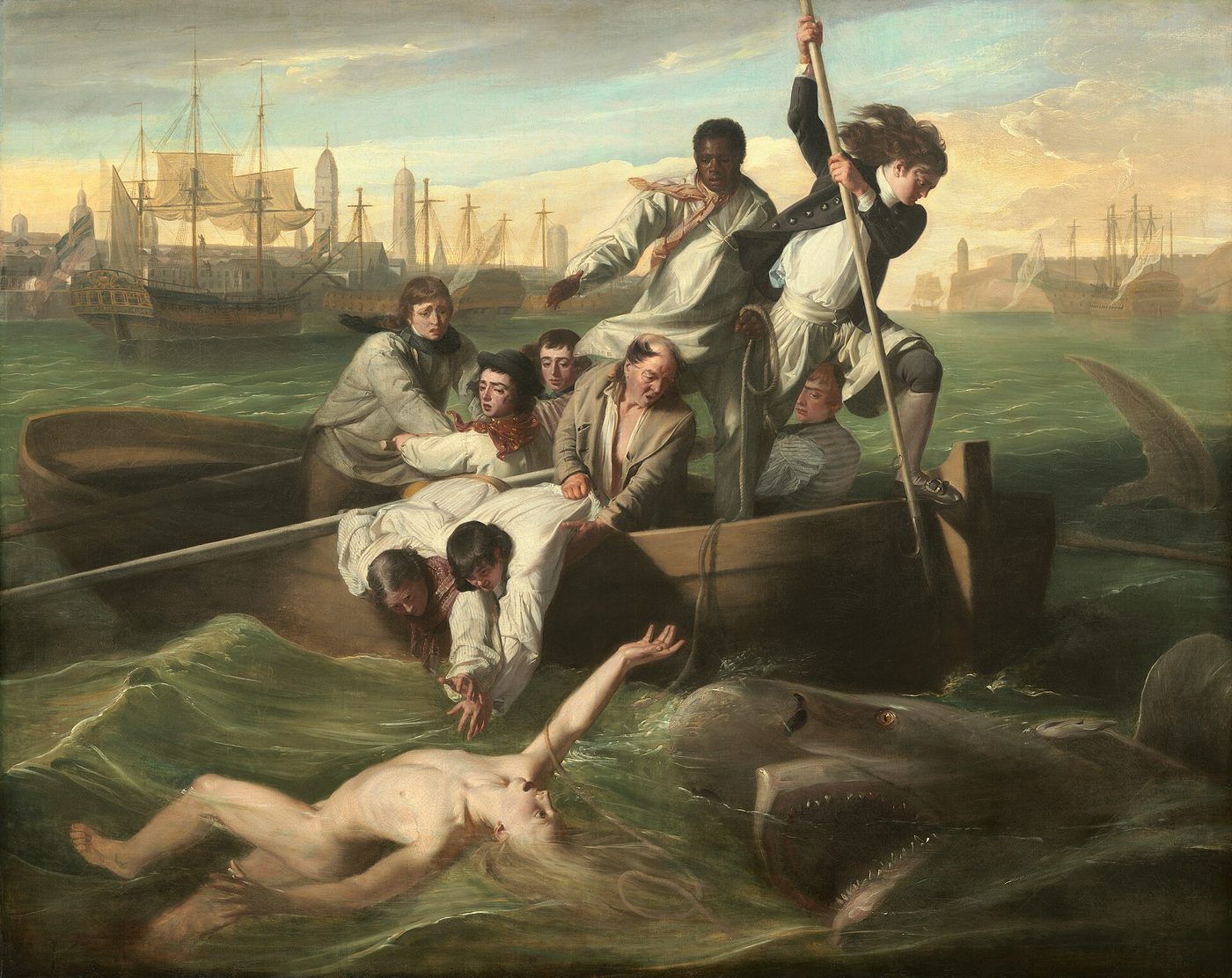
In 1749, a teenager named Brook Watson was swimming in Havana harbor when a shark attacked him and took off his leg. His shipmates pulled him out. Watson survived, went into trade, and rose to become Lord Mayor of London. He later defended the slave trade in the West Indies.9 Copley's large painting of the attack was shown in London in 1778. Copley made a smaller version that now hangs in the Metropolitan Museum of Art, and later versions are in Detroit and Boston.9
Copley treated a private rescue with the seriousness painters gave to the death of a hero. The harpooner is posed like Saint Michael with his spear. The naked boy in the water recalls paintings of the dead Christ. And the year Copley showed it, his own country was at war with the country he was living in. A picture about a helpless person in deep water, saved at the last instant by a crew of ordinary men, could hardly have been more pointed in 1778, whether or not Copley meant it that way. How much politics he put into it is a matter of reading the picture, and readers differ.
Benjamin West and The Death of General Wolfe
Copley went to London to compete with the most successful American artist of the age, a man who had never fought in a war or signed a petition. Benjamin West was born near Springfield, Pennsylvania, on October 10, 1738, in a Quaker community outside Philadelphia. Patrons in Philadelphia paid for him to study in Italy in 1760. In 1763 he moved to London and stayed there for the rest of his life.10 He became history painter to King George III, a founding member of the Royal Academy, and in 1792 its president, after Sir Joshua Reynolds.10
A modern hero in a modern coat
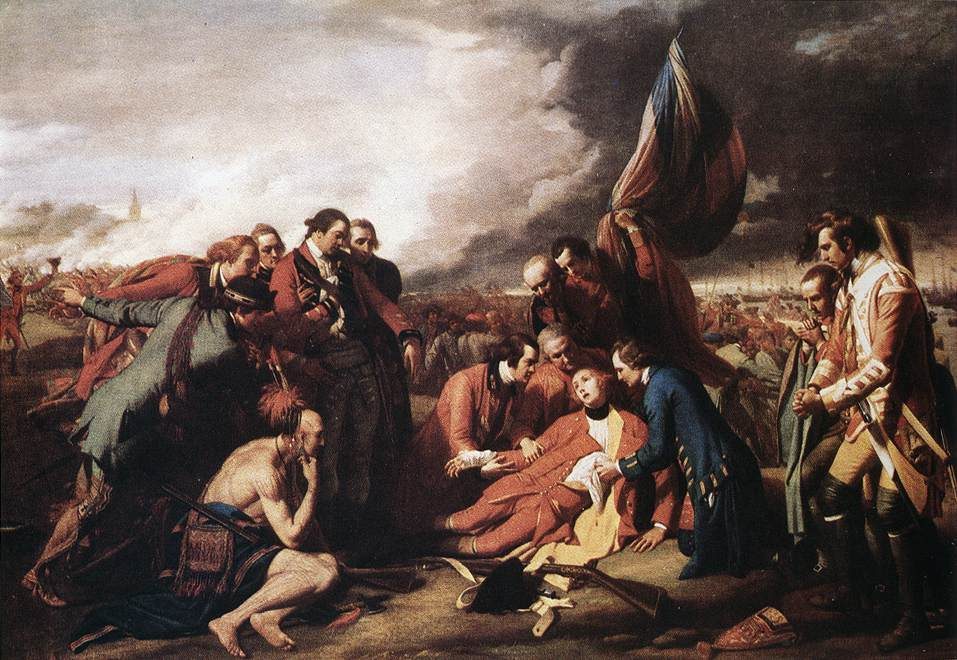
West's most famous picture shows General James Wolfe dying at the moment of victory outside Quebec in September 1759, the battle that won Canada for Britain. West showed it at the Royal Academy in 1771.11 The grand rules of the day said heroes should be painted in Greek or Roman dress, which never went out of fashion. West put his soldiers in their real uniforms.
West liked to tell a story about it. Reynolds, he said, warned the King not to buy a picture with modern clothes in it, then admitted the idea had "taken." The historian C. P. Stacey, writing for the National Gallery of Canada in 1966, was blunt: the story "has long been exploded." Other painters, George Romney and Edward Penny among them, had already painted Wolfe's death in contemporary dress.11 West did not invent the idea. He made it famous.
He also made things up. Of the thirteen men in West's main group, Stacey found only one identifiable figure, Lieutenant Henry Browne, who "actually seems to have been there." Robert Monckton had been wounded and carried to a ship. Isaac Barré was badly wounded in the face. Others were miles away.11 West was painting what the death meant, not who stood nearby. The canvas itself stayed in English hands until the Second Duke of Westminster gave it to Canada, through Lord Beaverbrook, as a tribute to Canada's part in the First World War.12 That choice, real coats with an invented cast, set the pattern for every American painter who wanted to put the Revolution on canvas.
The American school in London
West was generous to young Americans. His wife's cousin Matthew Pratt became the first of many American pupils, and Pratt painted West teaching them in The American School in 1765.10 Charles Willson Peale studied in London from 1767 to 1769.13 Gilbert Stuart arrived poor in the 1770s, worked for about five years as West's assistant, and made his name at the Royal Academy with The Skater in 1782.14 John Trumbull came in July 1780, while the war was still going on.15 The King's own history painter trained the men who would paint the faces of the rebellion. It was a small world, and a forgiving one, in a way the politics of the time were not.
Charles Willson Peale, painter and soldier
Peale went home. After two years of study and practice in London, from 1767 to 1769, he came back to make a living painting portraits.13 In 1772 he traveled to Mount Vernon and painted George Washington as a colonel of the Virginia regiment, the only likeness of Washington made before the Revolution.13
When the war came, Peale picked up a musket. He commanded a company of Philadelphia militia, served for three years, and saw action at Trenton, Princeton and Germantown.13 He painted officers in camp between duties. In 1779 the Supreme Executive Council of Pennsylvania commissioned a full-length portrait of Washington after the Battle of Princeton for its council chamber in the State House, now Independence Hall.13 Peale had seven chances to paint Washington from life, more than any other artist.13 His story continues in the lesson on the arts of the early republic, where his portrait gallery turns into America's first great museum.
John Trumbull paints the Revolution
John Trumbull of Connecticut was a soldier before he was a painter. He enlisted as an adjutant in General Joseph Spencer's regiment in 1775, and on June 17 he watched the Battle of Bunker's Hill from across the water.15 After the war he went back to West in London and set himself a project: a series of paintings of the great moments of the Revolution, with the real faces of the men who were there.
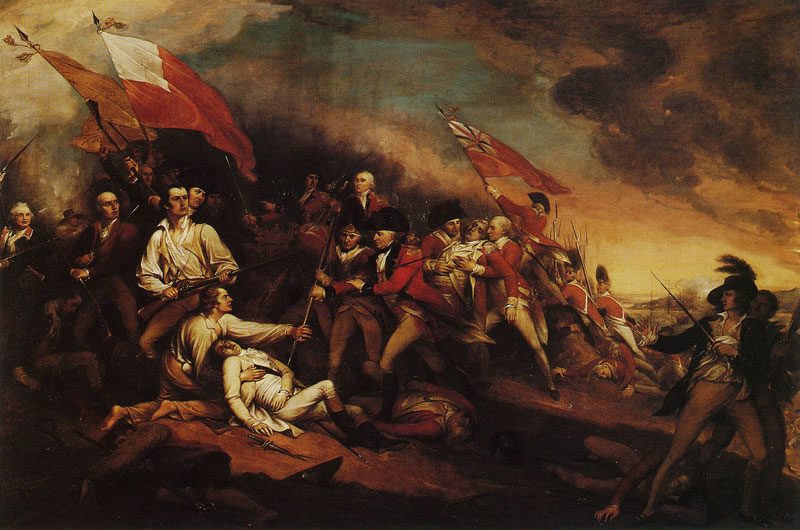
Bunker's Hill, 1786
Trumbull painted The Death of General Warren at the Battle of Bunker's Hill in West's studio in 1786. It follows West's formula exactly: a dying hero at the center, real uniforms, real people, a moment arranged for meaning. Trumbull later said the grenadier trying to bayonet the fallen Warren was "a pictorial liberty," a kind of poetic license, added "to afford an opportunity to do honor" to the British officer who stops him.15
That is worth sitting with. An American officer, painting the death of an American hero at the hands of the British, went out of his way to honor a British officer. Trumbull knew the war had decent men on both sides. He put that knowledge in the middle of the picture.
The Declaration in the Rotunda
Trumbull's most famous painting is the one almost every American has seen and almost no one reads correctly. He began a small version of Declaration of Independence in the 1780s and spent years collecting portraits of the delegates from life. In 1817 Congress commissioned four large Revolutionary scenes from him for the new Capitol Rotunda. He painted the Declaration at twelve by eighteen feet between August 1817 and September 1818, showed it in New York that October, and saw it installed in the Rotunda in 1826 with the other three.16
Myth: Trumbull painted the signing of the Declaration
The painting shows the moment on June 28, 1776, when the drafting committee presented its draft to Congress. Jefferson hands the paper to John Hancock, with John Adams, Roger Sherman, Robert Livingston and Benjamin Franklin around him. Congress adopted the Declaration on July 4, and most delegates signed it on August 2. Trumbull painted 47 men: 42 of the 56 signers and five others. He put in some delegates who were not there that day, left out signers he had no likeness of, and got the room wrong, working from a faulty sketch by Jefferson.16 It is the moment the country's founding statement was handed over for debate and amendment, which is a better subject than a signing anyway.
Trumbull did something no one else did: he went to the men themselves, or their families, and drew their faces. When Americans picture the Continental Congress, they picture Trumbull's faces. In 1831, short of money as he had been most of his life, he deeded many of his paintings to Yale College in return for an annuity of $1,000 a year, and so founded the first college art gallery in America.17 That is the power of art as record, and its danger too. A painting can fix a false detail in a nation's memory as firmly as a true one.
Art that argued, art that remembered
The pictures in this lesson fall along a line. At one end is Revere's massacre print, made in three weeks to sell and to inflame. At the other end is Trumbull's Rotunda, made over forty years to remember. Most of the work sits in between. West's Wolfe is a record of a real death and an invented crowd. Copley's Revere is a faithful likeness that makes an argument about the dignity of work. Peale's Washington portraits are records made by a man who had marched with his subject.
- 1768 Copley paints Paul Revere in shirtsleeves with a silver teapot.
- 1770 March 26: Revere advertises The Bloody Massacre, copied from Henry Pelham's design. Pelham protests on March 29.
- 1771 West shows The Death of General Wolfe at the Royal Academy.
- 1772 Peale paints Washington at Mount Vernon, the only portrait of him before the war.
- 1774 April: a crowd comes to Copley's door at midnight. June: Copley sails for England for good.
- 1778 Copley's Watson and the Shark is shown in London.
- 1779 Pennsylvania commissions Peale's full-length Washington after Princeton.
- 1786 Trumbull paints The Death of General Warren at the Battle of Bunker's Hill in West's studio.
- 1817 Congress commissions four Revolutionary paintings from Trumbull.
- 1826 Trumbull's four paintings are installed in the Capitol Rotunda.
Citizens need both kinds of art. A free people needs pictures that stir them to defend their rights, and Revere's print did that at a moment when it mattered. They also need pictures that try hard to get it right, so the next generation knows what actually happened and who actually paid for it. The trouble starts when we forget which kind we are looking at. Revere's print is still reproduced as if it were a photograph. It is an argument, and a good one, made by a man who borrowed another man's drawing to make it.
The music of the same years made the same kind of argument in a form anyone could carry. That is the subject of the next lesson.
Learn more
- The Bloody Massacre (Boston Athenaeum): a short, clear account of Revere, Pelham and the print, from a library that owns a hand-colored copy.
- Letters and Papers of John Singleton Copley and Henry Pelham, 1739-1776: the family letters, including Pelham's complaint to Revere and Copley's account of the mob at his door.
- Watson and the Shark (The Met): Copley's smaller version, with notes on Brook Watson and the other versions.
- C. P. Stacey, Benjamin West and The Death of Wolfe: a military historian checks who was really at Wolfe's side. Very few were.
- Benjamin West biography (Worcester Art Museum): West's life from Quaker Pennsylvania to the Royal Academy, with his American pupils.
- Charles Willson Peale's Washington (U.S. Senate): Peale's war service and his portraits of Washington from life.
- Declaration of Independence (Architect of the Capitol): what Trumbull's Rotunda painting shows, who is in it and what he got wrong.
- Questioning the Accuracy of War Images (Yale-New Haven Teachers Institute): a teacher's study of Trumbull's battle paintings and their liberties with fact.
Notes
- Boston Athenaeum, "The Bloody Massacre," news article on Paul Revere, The Bloody Massacre perpetrated in King Street Boston on March 5th 1770, by a party of the 29th Regt., 1770, hand-colored engraving, gift of Mr. and Mrs. Robert Saltonstall, 1972. Read it online. ↩
- Henry Pelham to Paul Revere, Boston, March 29, 1770, in Letters and Papers of John Singleton Copley and Henry Pelham, 1739-1776, Collections of the Massachusetts Historical Society, vol. 71 (Boston: Massachusetts Historical Society, 1914), 83. Read it online. ↩
- The events of March 5, 1770, and the trial are covered in this course's lesson on the road to revolution; for the defense, see John Adams, "Adams' Argument for the Defense," December 3-4, 1770, Legal Papers of John Adams, Founders Online, National Archives. Read it online. ↩
- Boston Athenaeum, "The Bloody Massacre," on the absence of Crispus Attucks from contemporary prints and William L. Champney's drawing, published as a chromolithograph by Henry Q. Smith, Boston, 1856. Read it online. ↩
- John Singleton Copley, Paul Revere, 1768, oil on canvas, Museum of Fine Arts, Boston. Museum record. ↩
- John Singleton Copley to Isaac Winslow Clarke, Boston, April 26, 1774, in Letters and Papers of John Singleton Copley and Henry Pelham, 217-219; the editors identify the guest as "Colonel George Watson, of Plymouth, a mandamus counsellor," 218n. Read it online. ↩
- Henry Pelham to Charles Pelham, November 1774, in Letters and Papers of John Singleton Copley and Henry Pelham, 271-272. Read it online. ↩
- Worcester Art Museum, "Benjamin West," on West's presidency of the Royal Academy, 1792 to 1805 and again from 1807, and Copley's challenge in 1792, citing Jules David Prown, John Singleton Copley (1966), 2:337-339. Read it online. ↩
- The Metropolitan Museum of Art, John Singleton Copley, Watson and the Shark, ca. 1778, oil on canvas, 42.71.1, catalogue entry and audio guide. Read it online. ↩
- Worcester Art Museum, "Benjamin West" (biography), Early American Art collection. Read it online. ↩
- C. P. Stacey, "Benjamin West and 'The Death of Wolfe,'" National Gallery of Canada Bulletin 7 (1966). Read it online. ↩
- Stacey, "Benjamin West and 'The Death of Wolfe,'" on the gift of the painting by the Second Duke of Westminster. Read it online. ↩
- United States Senate, "George Washington" by Charles Willson Peale, Senate Collection, catalogue entry. Read it online. ↩
- White House Historical Association, "Gilbert Stuart." Read it online. ↩
- Yale-New Haven Teachers Institute, "Questioning the Accuracy of War Images: John Trumbull's Paintings of the American Revolution and Photographs from the American Civil War," curriculum unit 12.01.10 (2012), quoting Trumbull on the grenadier and Major Small. Read it online. ↩
- Architect of the Capitol, "Declaration of Independence," John Trumbull, oil on canvas, 12 by 18 feet, U.S. Capitol Rotunda. Read it online. ↩
- Yale-New Haven Teachers Institute, "Questioning the Accuracy of War Images," on Trumbull's 1831 agreement with Yale and the Trumbull Gallery. Read it online. ↩
Terms in this lesson
- Engraving
- A print made by cutting lines into a metal plate, inking it and pressing paper onto it. One plate could make hundreds of copies.
- History painting
- A large picture of an important event from history, scripture or legend, meant to teach a moral lesson. In the 1700s it was ranked the highest kind of painting.
- Propaganda
- Words or pictures made to push people toward a belief or an action, often by leaving out or bending facts.
- Mandamus counselor
- A member of the Massachusetts governor's council appointed by the Crown under the 1774 Massachusetts Government Act, instead of being elected by the legislature.
- Royal Academy
- The Royal Academy of Arts in London, founded in 1768, which held the most important yearly exhibition of new paintings in Britain.
- Broadside
- A single large sheet printed on one side and sold or posted in public. Used for news, songs, notices and pictures.
Sources
- Letters and Papers of John Singleton Copley and Henry Pelham, 1739-1776 (Massachusetts Historical Society, 1914), Internet Archive checked 2026-10
- The Bloody Massacre (Boston Athenaeum) checked 2026-10
- Watson and the Shark, ca. 1778 (The Metropolitan Museum of Art) checked 2026-10
- C. P. Stacey, Benjamin West and The Death of Wolfe (National Gallery of Canada Bulletin 7, 1966) checked 2026-10
- Benjamin West biography (Worcester Art Museum) checked 2026-10
- George Washington by Charles Willson Peale (U.S. Senate) checked 2026-10
- Declaration of Independence by John Trumbull (Architect of the Capitol) checked 2026-10
- Questioning the Accuracy of War Images: John Trumbull's Paintings (Yale-New Haven Teachers Institute) checked 2026-10
- Gilbert Stuart (White House Historical Association) checked 2026-10