Lesson 2 of 9 · about 26 minutes
The Road to Revolution, 1763-1775
You'll be able to
- Trace the sequence of British measures from the Sugar Act of 1764 to the Coercive Acts of 1774 and the colonial answer to each
- State the constitutional argument in the Stamp Act Congress resolutions and the Declaratory Act, and why the two could not both stand
- Describe what happened on King Street in March 1770 and why John Adams defended the soldiers
- Explain the difference between the petitions, boycotts and committees that colonial leaders used and the acts of destruction at the Gaspee and the Tea Party
The sentence sits near the top of an act of Parliament. "It is just and necessary," it says, "that a revenue be raised, in your Majesty's said dominions in America, for defraying the expences of defending, protecting, and securing the same." The year was 1764. The act was the Sugar Act.1 Parliament had regulated colonial trade with duties for a long time. With this act it sought, for the first time, to tax the colonies for the specific purpose of raising revenue.2
That small shift of purpose started a quarrel that ran for twelve years and ended with muskets. The colonists, who had held the purse in their own assemblies for generations, said they alone could tax themselves. Parliament said it could tax them too, and make their laws in every other matter besides. The documents below show each side saying so in its own words, one step at a time.
The bill for the war, 1763-1764
The Treaty of Paris of February 10, 1763, ended the French and Indian War, and France ceded its Canadian possessions and its claim to the land east of the Mississippi to Britain.34 It also left a bill. Britain's national debt had nearly doubled during the war, from about 72 million pounds in 1755 to almost 130 million by 1764. The ministry also decided to keep ten thousand regular soldiers in America, at a cost of about 225,000 pounds a year.5 Ministers looked across the Atlantic at colonies that had been defended at British expense and decided they could carry part of the cost.
The first move, though, was a limit on the colonists, and no tax. On October 7, 1763, King George III issued a proclamation reserving "for the use of the said Indians" all the lands "lying to the Westward of the Sources of the Rivers which fall into the Sea from the West and North West," and forbidding governors to grant surveys or patents there. It also said the Indians should not be "molested or disturbed in the Possession of such Parts of Our Dominions and Territories as, not having been ceded to or purchased by Us, are reserved to them, or any of them, as their Hunting Grounds."6 The line ran along the Appalachians. Colonial land speculators and families who wanted to move west took it as a wall, and it became one of the first points of friction between Britain and the colonies.7
In 1764 came the Sugar Act, the sentence quoted above. It cut the duty on foreign molasses from six pence a gallon, the rate set in 1733, to three pence.5 Colonial legislatures protested, but the act raised its money through trade-related duties and so stayed clear of the idea of a direct tax.8 Then, in March 1765, Parliament passed the Stamp Act.
The Stamp Act and the Congress that answered it, 1765
The Stamp Act received royal assent on March 22, 1765, and was to take effect on November 1.5 It required that printed materials, from legal documents to newspapers to playing cards, be produced on stamped paper bought from London, and paid for in British money rather than colonial paper.5 Within Britain, stamp duties had worked well and cost little to collect.5 The ministry saw nothing strange in extending them.
The colonists saw a tax on everyone who wrote, printed, sued or sold. And it was a direct tax, laid by a body in which they had no vote. The British answer was the doctrine of virtual representation: members of Parliament were bound to speak for all subjects of the Crown, including the many Britons who could not vote, and colonists were represented in the same way.5 The colonists rejected the idea. Their reason was simple. Nobody in Parliament had ever stood for election in Virginia or Massachusetts, and no one in Virginia or Massachusetts could remove him.
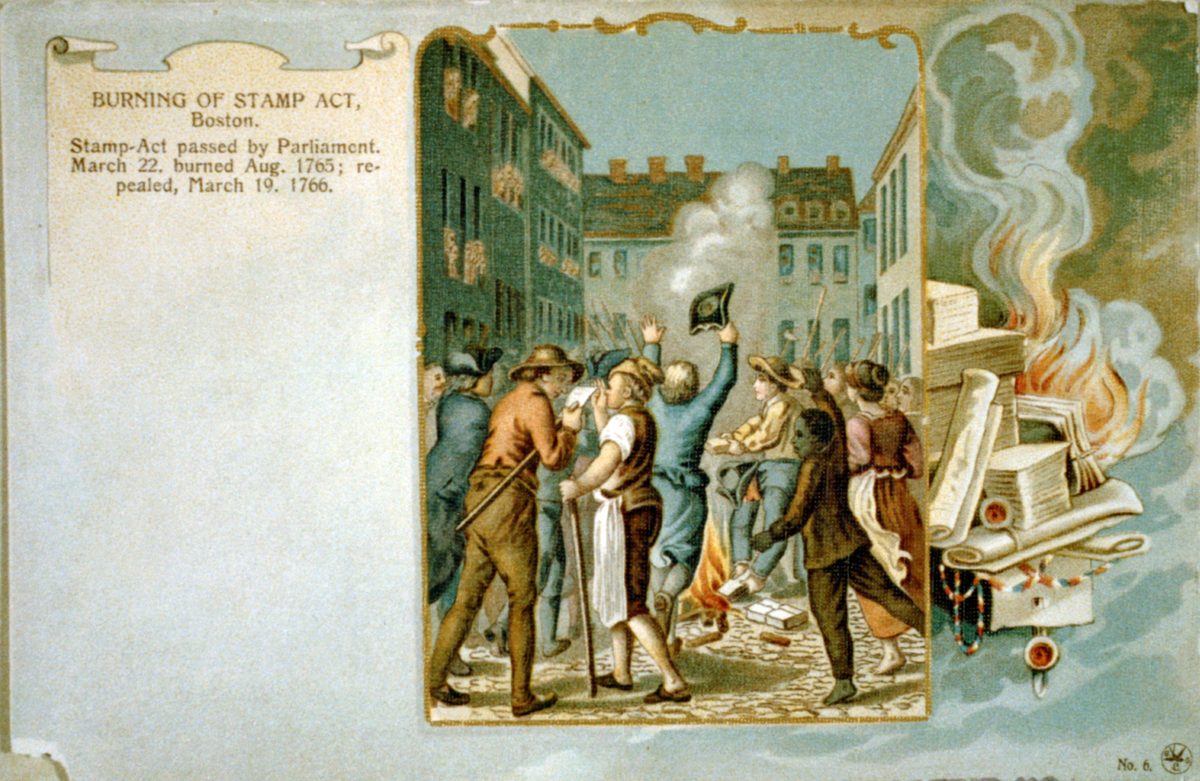
Protests increased, often started by the Sons of Liberty, and some of them were violent.58 A more important response was a meeting. From October 7 to 25, 1765, delegates from nine colonies sat in New York City as the Stamp Act Congress.8 It was the second gathering of elected colonial representatives, after Albany in 1754. A number of royal governors took steps to keep their legislatures from choosing delegates, and four of the thirteen colonies sent none.8
On October 19 the Congress adopted a set of resolutions. Read them closely, because they set down the colonial position that would hold, with few changes, for the next ten years. They open with loyalty. The colonists, the first resolution says, "owe the same allegiance to the Crown of Great-Britain, that is owing from his subjects born within the realm, and all due subordination to that august body the Parliament of Great Britain."9 Then they draw the line.
"That it is inseparably essential to the freedom of a people, and the undoubted right of Englishmen, that no taxes be imposed on them, but with their own consent, given personally, or by their representatives. That the people of these colonies are not, and from their local circumstances cannot be, represented in the House of Commons in Great-Britain. That the only representatives of the people of these colonies, are persons chosen therein by themselves, and that no taxes ever have been, or can be constitutionally imposed on them, but by their respective legislatures."
Resolutions of the Stamp Act Congress, October 19, 1765, resolutions 3 to 5. 9
Notice what the Congress claims and what it leaves alone. It says taxes need consent. It says the colonists cannot be represented in Parliament because of distance and circumstance, and that their own assemblies are therefore the only bodies that can tax them. It does not deny that Parliament is the supreme lawmaker of the empire in other matters, and it states the right to a jury trial as "the inherent and invaluable right of every British subject in these colonies."9 The final resolution commits the colonies to seek relief by "a loyal and dutiful address to his Majesty, and humble applications to both Houses of Parliament."9 These are people who want their rights as Englishmen restored, and who say so with petitions.
The Congress was an extralegal body, and its existence alarmed officials in Britain.8 What did more to change minds in London was money. The colonists stopped importing British goods, and British merchants, whose business suffered, added their own protests.8
Repeal, and the Act that took it back, 1766
Parliament repealed the Stamp Act. The repeal passed on March 18, 1766, and took effect May 1.5 On the same day, Parliament passed the Declaratory Act.810 It is two paragraphs long.
"That the said colonies and plantations in America have been, are, and of right ought to be, subordinate unto, and dependent upon the imperial crown and parliament of Great Britain ... full power and authority to make laws and statutes of sufficient force and validity to bind the colonies and people of America, subjects of the crown of Great Britain, in all cases whatsoever."
The Declaratory Act, March 18, 1766. 10
The second paragraph declared that every colonial resolution denying or questioning that power was "utterly null and void."10
Set the two documents side by side. The Stamp Act Congress said no tax without the consent of the colonists' own legislatures. The Declaratory Act said Parliament could make laws for the colonies "in all cases whatsoever," and it said so on the very day it gave in. Parliament had retreated on one tax and kept the principle that justified all the others. The principle was now written down, and any future minister could point to it.
The Townshend duties and the purse, 1767-1768
The next minister was Charles Townshend, Chancellor of the Exchequer, and he tried a different route. The Townshend Acts of 1767 laid duties on glass, lead, paint, paper and tea imported into the colonies. They were indirect taxes, duties on imports, which Townshend offered as a response to the failure of the Stamp Act's direct tax.2 The preamble says what the money was for. "It is expedient that a revenue should be raised in your Majesty's dominions in America," it says, "for making a more certain and adequate provision for defraying the charge of the administration of justice, and the support of civil government, in such provinces where it shall be found necessary."11
Read the second half of that sentence twice. The money was for paying the officers of government. Lesson 1 described the purse that colonial assemblies held, and this was a way of taking it from the other side: an official paid from London no longer had to answer to the assembly for his salary. Massachusetts leaders saw it exactly that way in 1772, when they objected that the governor's and judges' salaries were to come from the Crown and not the assembly.12 The First Continental Congress would later list among its grievances that "judges, who before held only estates at will in their offices, have been made dependant on the crown alone for their salaries."13
Colonial leaders answered as before, with words first. John Dickinson of Pennsylvania wrote the Letters from a Farmer in Pennsylvania, and the Massachusetts House sent its Circular Letter to the other colonies.2 American port cities refused to import British goods.2 Lord Hillsborough, the newly appointed colonial secretary, ordered governors to dissolve any assembly that answered the Circular Letter, and the first of four British regiments began to land in Boston on October 1, 1768.14
King Street, March 5, 1770
Two of those regiments, the 14th and the 29th, were still in Boston in 1770.14 Tension rose in February, when a customs employee killed a boy of about eleven named Christopher Seider, and Seider's funeral was one of the largest Boston had seen.14
On the night of March 5, a crowd gathered around a sentry at the Custom House. Church bells rang, which usually meant fire, and more people came. Captain Thomas Preston led a corporal and six privates with fixed bayonets to relieve the sentry. The crowd, estimated at between 300 and 400, shouted "Fire!" and threw snowballs and other objects. After a pause, a soldier fired, and then the others did, in a ragged series of shots and with no order from Preston. Three men died on the spot: Samuel Gray, James Caldwell and Crispus Attucks, a mixed-race man who had been enslaved. Eleven were hit in all, and two more died later, making five dead.14
Acting Governor Thomas Hutchinson was summoned to the scene. He began an investigation at once, and Preston and eight soldiers were arrested by the next morning. The selectmen asked him to move the troops out of the city to Castle William on Castle Island, and colonists held a town meeting at Faneuil Hall to discuss the affair.14
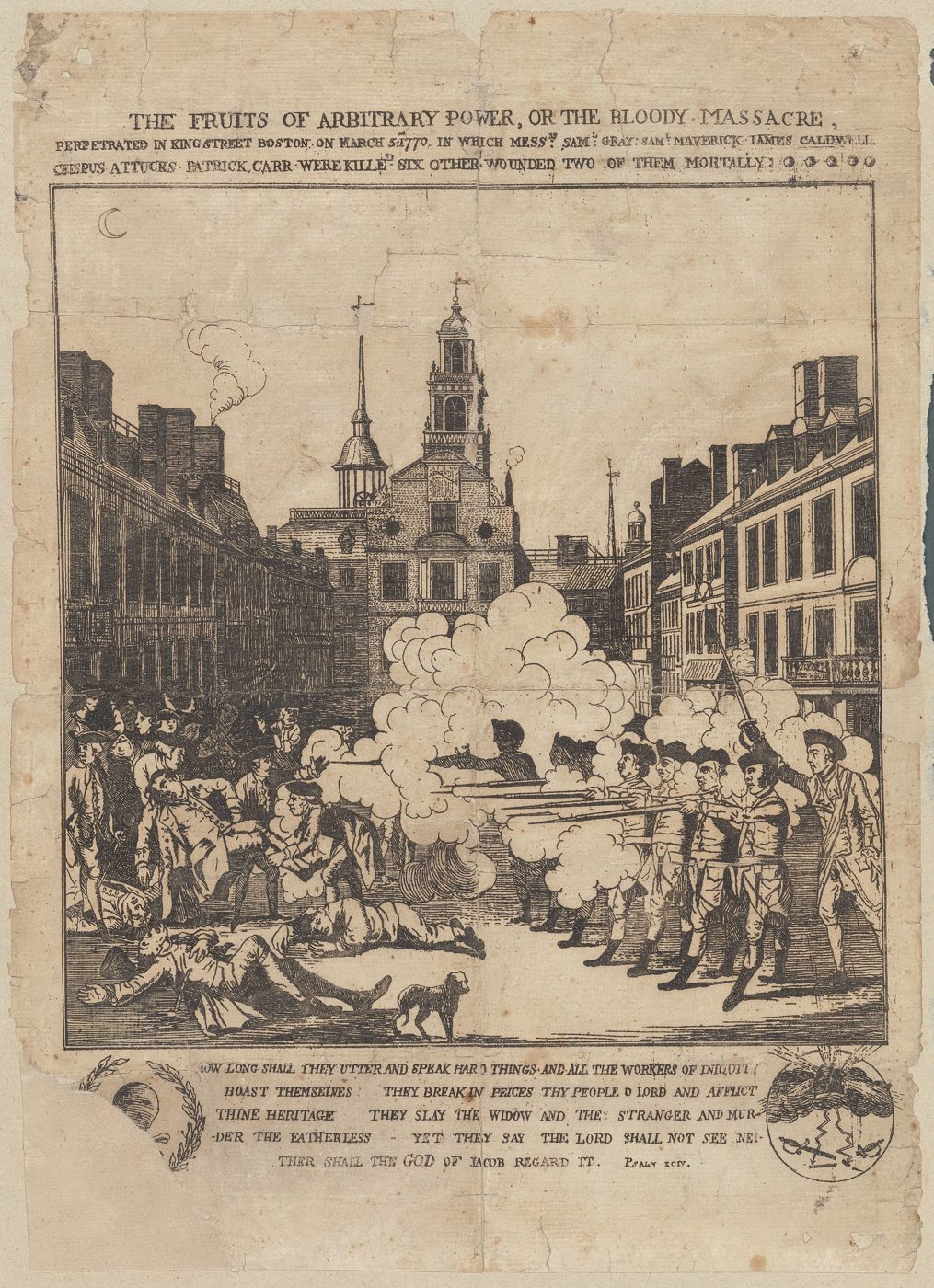
The engraving did what propaganda does. The record says the firing was ragged and that Preston gave no order. The picture shows Preston commanding the volley. The Boston town meeting also published a pamphlet, A Short Narrative of the Horrid Massacre, written chiefly by James Bowdoin, Samuel Pemberton and Joseph Warren, and others wrote very different accounts.14 The word "massacre" belonged to Samuel Adams, Paul Revere and the Patriots from the first.14
John Adams takes the case
Preston had difficulty finding a lawyer among so much anti-British feeling. A Loyalist merchant, James Forrest, asked John Adams, already a leading Patriot and thinking about a run for public office, to take the case. Adams agreed. Josiah Quincy II joined him once the Sons of Liberty promised not to oppose it, and Robert Auchmuty, a Loyalist, joined too.14
Adams wrote about it three years later, on the anniversary of the shootings. "The Part I took in Defence of Cptn. Preston and the Soldiers, procured me Anxiety, and Obloquy enough. It was, however, one of the most gallant, generous, manly and disinterested Actions of my whole Life, and one of the best Pieces of Service I ever rendered my Country."15 He gave his reason in the same entry: a death sentence for the soldiers "would have been as foul a Stain upon this Country as the Executions of the Quakers or Witches, anciently."15
Preston was tried first, in late October 1770, and acquitted after the jury was convinced he had not ordered the troops to fire. The eight soldiers went to trial on November 27.14 Adams's argument for the defense, delivered December 3 and 4, opened its case on the evidence with one of the best-known lines in his writings:
"Facts are stubborn things; and whatever may be our wishes, our inclinations, or the dictates of our passions, they cannot alter the state of facts and evidence."
John Adams, Argument for the Defense, December 3-4, 1770. 16
Then he turned to the law of self-defense. If the soldiers were assaulted "to endanger their lives," Adams said, "the law is clear, they had a right to kill in their own defence." If the assault fell short of that, yet they were "struck and abused" by "snow-balls, oyster-shells, cinders, clubs, or sticks of any kind," then "this was a provocation, for which the law reduces the offence of killing, down to manslaughter."16 He also told the jury that it matters more to the community that innocence be protected than that guilt be punished.16
The jury took two and a half hours. Six soldiers were acquitted. Two were convicted of manslaughter because the evidence showed they had fired directly into the crowd, and they pleaded benefit of clergy, which cut their punishment from death to branding of the thumb. Four civilians accused of firing from the Custom House were tried on December 13 and acquitted.14
Be fair to Adams, and to the record. His argument leaned hard on contempt for the crowd, and he described Attucks in terms the testimony did not support: two witnesses put Attucks twelve to fifteen feet from the soldiers when the firing began, too far to have seized a bayonet.14 A good lawyer's speech is not always a fair historian's account. But the verdicts matter more than the speech. Adams was already a leading Patriot, and he took the case for men his own side wanted punished, because a death sentence on the evidence before the jury would have been a stain on the country.15 Ordered liberty depends on that kind of man. Resistance that claims the protection of the law has to extend it to its enemies.
The Gaspee and the committees, 1772-1773
In June 1772 the revenue schooner HMS Gaspee, which had been stopping and searching ships in Narragansett Bay, chased the packet Hannah and ran aground off Warwick, Rhode Island. On the night of June 9, Providence men led by Abraham Whipple and John Brown, in eighteen boats, rowed out, boarded her about 1 a.m., shot and wounded her commander, Lieutenant William Dudingston, forced the crew off and burned the ship.17
The Crown responded with a Royal Commission of Inquiry. Its job was to find which colonists could be sent to England for trial, since an act of April 1772 said that anyone suspected of burning British ships should be extradited and tried there.17 The commission could not get enough evidence to name anyone.17 Colonial Whigs were alarmed at the prospect of Americans being shipped to England for trial.17
Module 52 sorts forms of resistance by whether they stay lawful, and the Gaspee falls on the wrong side of that line. The raiders burned a naval vessel and shot an officer. Rhode Island officials had questioned whether Dudingston had any right to act in the colony without showing the governor his warrant, and that was a fair question, but the answer to it was a protest, not a fire.17 The act was arson and an armed attack, and a people who want to be governed by law cannot call it anything else. What the colonies did next was another matter.
In November 1772 the Boston town meeting, pushed by Samuel Adams and with Joseph Warren among its members, formed a committee of correspondence in response to the Gaspee affair and to the decision to have the royal governor's and judges' salaries paid by the Crown, not by the assembly, a move that took away the colony's hold on its officials.12 In March 1773 Dabney Carr proposed a permanent committee of correspondence in the Virginia House of Burgesses, and the Burgesses formed an intercolonial committee to consult with the others.1217 Committees of correspondence were a plain tool: men writing letters. But they linked the colonies by routine, and by 1774 they had helped set up the First Continental Congress.12
The Tea Party, December 1773
Parliament passed the Tea Act on May 10, 1773. It let the East India Company sell tea in the colonies without paying any duty but the Townshend tax, and the Sons of Liberty opposed both the Tea Act and the Townshend duties as violations of their rights as Englishmen.18 On the night of December 16, in Boston, men disguised as Indians boarded the ship Dartmouth and threw 340 or 342 chests of tea into the harbor.18
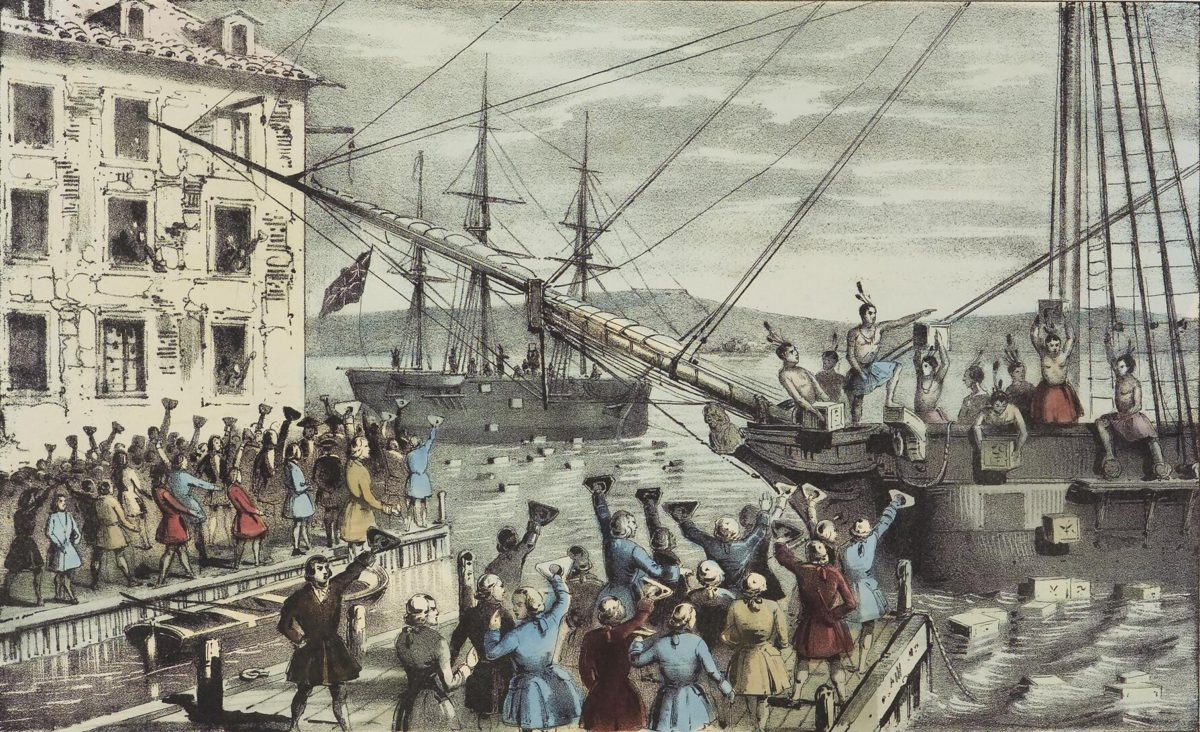
John Adams wrote in his diary the next day. His entry shows a leader who approved of what was done, with open eyes about what it meant.
"This is the most magnificent Movement of all. There is a Dignity, a Majesty, a Sublimity, in this last Effort of the Patriots, that I greatly admire. The People should never rise, without doing something to be remembered."
John Adams, diary, December 17, 1773. 19
Adams went on to say that the destruction was "an Attack upon Property," that another such exertion of popular power "may produce the destruction of Lives," and that the question was whether the destruction of the tea was necessary. He judged it "absolutely and indispensably so." The tea could not be sent back because the governor, the admiral, the collector and the comptroller would not allow it. To let it land, he said, "would be giving up the Principle of Taxation by Parliamentary Authority, against which the Continent have struggled for 10 years."19
That is the ordered-liberty reasoning at its hardest. Adams makes no claim that the act was gentle or lawful. He calls it necessary, because in his judgment every other path was shut. A reader can weigh whether he was right. What matters for the record is that the leaders of the resistance knew what they were doing, and wrote it down.
The Coercive Acts and the First Continental Congress, 1774
Parliament's answer came in the spring of 1774, in four punitive laws: the Boston Port Act, the Massachusetts Government Act, the Impartial Administration of Justice Act and a new Quartering Act. A fifth, the Quebec Act, was unrelated but passed in the same session, and the colonists lumped it in.20 The Port Act's preamble blames "dangerous commotions and insurrections" fomented in Boston. It closed the port to the landing and shipping of goods, and it said the port would stay closed until the East India Company had been repaid for the tea.21 The Massachusetts Government Act of May 20 went further. It made almost all positions in the colonial government appointive and limited town meetings to one a year, unless the governor called another.20
Look at that last provision against what lesson 1 described. The town meeting, which had governed New England towns for generations, could now meet only by permission. For the colonists, this was the point at which a tax quarrel became a quarrel over whether they would keep self-government at all. Outside Massachusetts, people feared that their own governments could be rewritten the same way.20
The Congress met in Philadelphia from September 5 to October 26, 1774, at Carpenters' Hall, with delegates from twelve colonies. Georgia stayed away.22 On October 14 it adopted a declaration of rights. It claimed them, in its own words, "by the immutable laws of nature, the principles of the English constitution, and the several charters or compacts."13 The first resolution reads, "That they are entitled to life, liberty and property: and they have never ceded to any foreign power whatever, a right to dispose of either without their consent."13 The fourth says that the foundation of English liberty, and of all free government, "is a right in the people to participate in their legislative council," and that the colonists, who cannot be represented in Parliament, are therefore "entitled to a free and exclusive power of legislation in their several provincial legislatures." It adds that they consent to acts of Parliament that merely regulate external trade.13 Even now the delegates were offering Parliament a share of authority.
The Congress also adopted the Continental Association on October 20. Its signers promised not to import goods from Britain or Ireland after December 1, and not to buy or use East India tea. Article 2 went further: "We will neither import nor purchase, any slave imported after the first day of December next; after which time, we will wholly discontinue the slave trade."23 The Association set up committees, chosen by those who could vote for the legislature, in every county, city and town. A committee that found a violator was to publish his name in the gazette so that all such foes to the rights of British-America "may be publicly known."23 In Article 14 the signers promised no dealings with any colony that refused to join.23
The Association belongs among the lawful tools of resistance that module 52 describes. It used refusal and no force. It asked every signer to bear a cost, and it worked through committees chosen by the local voters. The slave-trade article was real and it was limited: it ended the signers' own part in the Atlantic trade, left slavery itself in place, and depended on the signers keeping their word. The Declaration of 1776 would show how hard that contradiction would become.
April 1775
By the winter of 1774 and 1775 the committees were supervising the election of provincial conventions, which began the work of a real colonial government.12 On April 19, 1775, fighting at Lexington and Concord launched the eight-year war.1824 The full story of that day is in module 52, lesson 3. What counts here is what the colonists believed they were doing. They believed Parliament had broken the English constitution, and that they stood for it. They had said so in October 1774 when they claimed their rights under "the principles of the English constitution."13 The next lesson follows what happened when that belief ran out.
| Year | Parliament acts | Colonists answer |
|---|---|---|
| 1763 | Proclamation sets a western line; ten thousand troops to stay | Land companies and settlers object |
| 1764 | Sugar Act: first act to state revenue as its purpose | Assemblies protest |
| 1765 | Stamp Act, effective November 1 | Stamp Act Congress (Oct. 7-25), non-importation, riots |
| 1766 | Repeal on March 18, and the Declaratory Act the same day | Celebration; principle left standing |
| 1767-68 | Townshend duties; troops to Boston Oct. 1, 1768 | Dickinson's Letters, Massachusetts Circular Letter, boycotts |
| 1770 | Most Townshend duties repealed; tea duty kept | King Street shootings March 5; trials in the fall |
| 1772-73 | Gaspee inquiry; Tea Act (May 10, 1773) | Committees of correspondence; Tea Party, Dec. 16 |
| 1774 | Coercive Acts | First Continental Congress; Association, Oct. 20 |
Learn more
- Resolutions of the Stamp Act Congress: thirteen short resolutions that state the colonial case in plain terms.
- The Declaratory Act: two paragraphs, and the answer Parliament gave.
- Adams' Argument for the Defense: the speech that saved the soldiers, with its self-defense law and its flaws.
- Adams's diary, December 17, 1773: the morning after the Tea Party, written by a man who had not been there.
- Declaration and Resolves of 1774: what twelve colonies claimed as their rights.
- The Continental Association: a boycott that also ended the slave trade, on paper.
- Lexington and Concord (module 52): the full account of April 19, 1775.
- Forms of Lawful Resistance (module 52): how petition, boycott and refusal fit the ordered-liberty tradition.
Notes
- "The Sugar Act: 1764," preamble, Avalon Project, from The Statutes at Large. Apostrophes added to the possessives. Read it online. ↩
- "Townshend Acts," Wikipedia: the taxes on glass, lead, paints, paper and tea, Dickinson's Letters from a Farmer in Pennsylvania, the Massachusetts Circular Letter, the colonial boycotts and the partial repeal of March 1770. Read it online. ↩
- "Treaty of Paris (1763)," Wikipedia: signed February 10, 1763. Read it online. ↩
- "French and Indian War," Wikipedia, on the Treaty of Paris of 1763. Read it online. ↩
- "Stamp Act 1765," Wikipedia: the growth of the British national debt from 1755 to 1764, the decision to keep ten thousand regulars in America at about 225,000 pounds a year, the act's dates, the molasses duty of 1733 and 1764, and the theory of virtual representation. Read it online. ↩
- "The Royal Proclamation - October 7, 1763," Avalon Project. Read it online. ↩
- "Royal Proclamation of 1763," Wikipedia, on the line drawn along the Appalachians and the discontent of colonial land speculators and settlers. Read it online. ↩
- "Stamp Act Congress," Wikipedia: held October 7-25, 1765, in New York City with delegates from nine colonies, and its extralegal character. Read it online. ↩
- "Resolutions of the Continental Congress [Stamp Act Congress], October 19, 1765," resolutions 1 to 14, Avalon Project. Read it online. ↩
- "The Declaratory Act; March 18, 1766," Avalon Project. Read it online. ↩
- "The Townshend Act, November 20, 1767," preamble, Avalon Project. Read it online. ↩
- "Committee of correspondence," Wikipedia: the Boston committee of November 1772 and the Virginia committee proposed in March 1773. Read it online. ↩
- "Declaration and Resolves of the First Continental Congress, October 14, 1774," Avalon Project. Read it online. ↩
- "Boston Massacre," Wikipedia, which draws on the trial records, the depositions and the engravings. Used here for the events of March 5, 1770, the arrests, the town meeting, the trial dates and verdicts, and the Pelham and Revere engravings. Read it online. ↩
- John Adams, diary entry for March 5, 1773, as quoted in the Wikipedia article "Boston Massacre," section on the trials. Read it online. ↩
- John Adams, "Adams' Argument for the Defense," December 3-4, 1770, in Legal Papers of John Adams, Founders Online (National Archives). Read it online. ↩
- "Gaspee affair," Wikipedia: the grounding on June 9, 1772, the boarding at about 1 a.m. on June 10 led by Abraham Whipple and John Brown, the burning, and the royal commission of inquiry. Read it online. ↩
- "Boston Tea Party," Wikipedia: the Tea Act of May 10, 1773, and the destruction of 340 or 342 chests on December 16, 1773. Read it online. ↩
- John Adams, diary entry of December 17, 1773, Diary and Autobiography of John Adams, vol. 2, p. 86, Adams Papers Digital Edition, Massachusetts Historical Society. Read it online. ↩
- "Intolerable Acts," Wikipedia: the four acts of 1774 and the Quebec Act, and the provisions of the Massachusetts Government Act of May 20, 1774, including its limit on town meetings. Read it online. ↩
- "The Boston Port Act: March 31, 1774," Avalon Project. Read it online. ↩
- "First Continental Congress," Wikipedia: held September 5 to October 26, 1774, at Carpenters' Hall, with twelve colonies represented and Georgia absent. Read it online. ↩
- "The Continental Association, October 20, 1774," articles 1, 2, 11 and 14, Avalon Project. Read it online. ↩
- See lesson 3 of module 52, "Lexington and Concord," for the full account. For the date and the war that followed, see "Boston Tea Party," Wikipedia, introduction. Lexington and Concord. ↩
Terms in this lesson
- Virtual representation
- The British argument that every member of Parliament spoke for all subjects of the Crown, including those who had never voted for him, such as the colonists.
- Declaratory Act
- The act of March 18, 1766, passed the day the Stamp Act was repealed, which asserted Parliament's power to bind the colonies 'in all cases whatsoever.'
- Non-importation
- An agreement among colonists not to buy goods from Britain, used as an economic weapon against Parliament's taxes.
- Committee of correspondence
- A standing committee that shared news and coordinated resistance between towns and colonies by letter.
- Coercive Acts
- The four punitive laws Parliament passed in 1774 after the Boston Tea Party, which the colonists called the Intolerable Acts.
- Continental Association
- The boycott agreement adopted by the First Continental Congress on October 20, 1774, enforced by local committees.
- Sons of Liberty
- Groups formed in the colonies during the Stamp Act crisis to organize protests, often with public demonstrations.
Sources
- The Sugar Act, 1764 (Avalon Project) checked 2026-10
- The Royal Proclamation, October 7, 1763 (Avalon Project) checked 2026-10
- Resolutions of the Stamp Act Congress, October 19, 1765 (Avalon Project) checked 2026-10
- The Declaratory Act, March 18, 1766 (Avalon Project) checked 2026-10
- The Townshend Act, November 20, 1767 (Avalon Project) checked 2026-10
- Adams' Argument for the Defense, 3-4 December 1770 (Founders Online) checked 2026-10
- Diary of John Adams, December 17, 1773 (Massachusetts Historical Society) checked 2026-10
- The Boston Port Act, 1774 (Avalon Project) checked 2026-10
- Declaration and Resolves of the First Continental Congress, October 14, 1774 (Avalon Project) checked 2026-10
- The Continental Association, October 20, 1774 (Avalon Project) checked 2026-10