Lesson 3 of 12 · about 26 minutes
Writings of the Revolution
You'll be able to
- Explain why the Stamp Act of 1765 struck printers first and how they answered it
- Describe what Dickinson's Letters from a Farmer in Pennsylvania argued and why it reached so many readers
- State what is known and what is disputed about how many copies of Paine's Common Sense were sold, and why the dispute matters
- Describe the work of Phillis Wheatley and Mercy Otis Warren and how their contemporaries received it
- Read the Declaration of Independence as a piece of writing built for persuasion
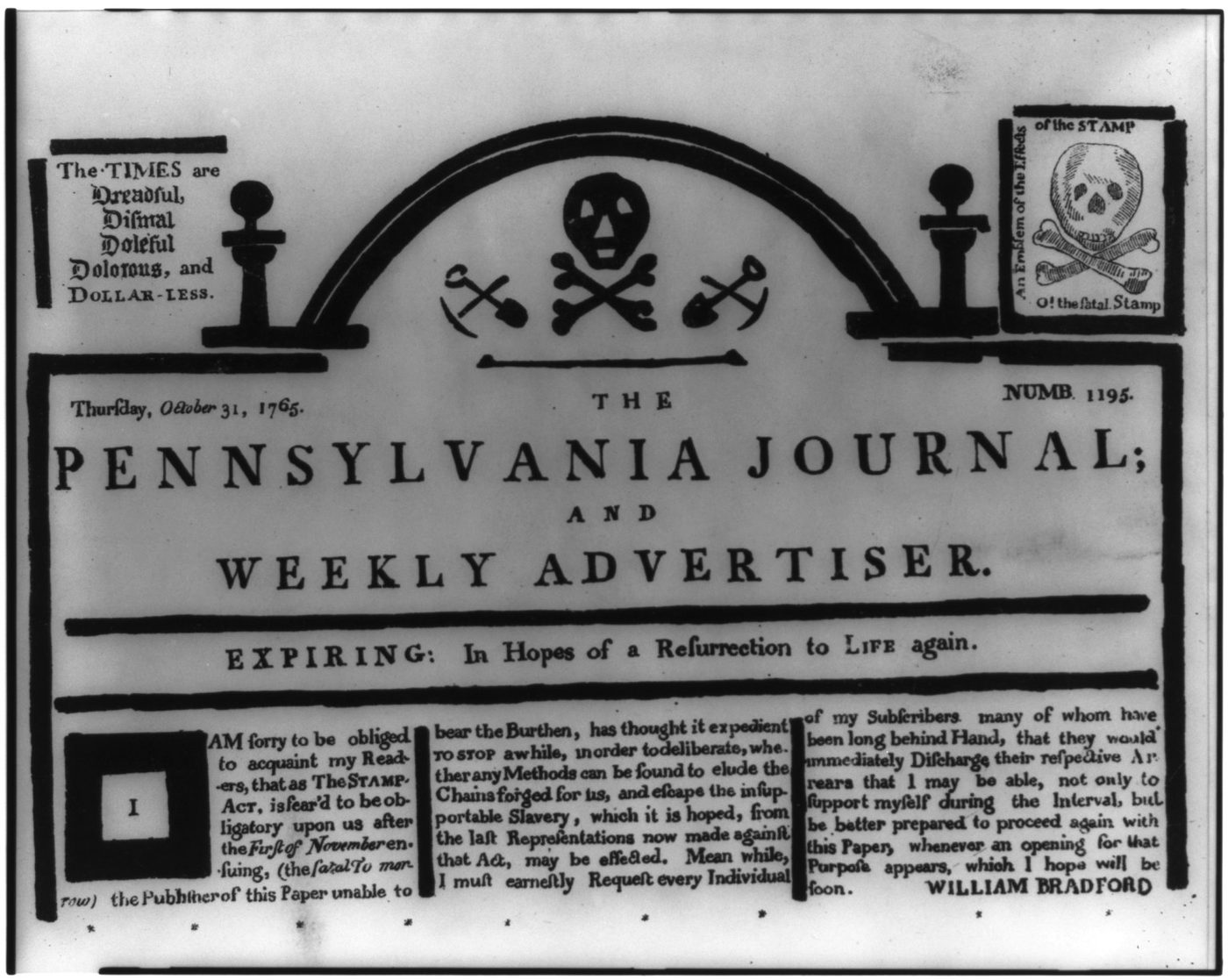
On Thursday, October 31, 1765, readers of the Pennsylvania Journal in Philadelphia picked up a paper that looked like a gravestone. Heavy black borders ran down the columns. Where the title usually sat, the printer William Bradford had set the words "EXPIRING: In Hopes of a Resurrection to Life again." On the last page was a coffin, with an epitaph underneath: "The last Remains of The PENNSYLVANIA JOURNAL, Which departed this Life, the 31st. of October, 1765. Of a STAMP in her Vitals, Aged 23 Years."1
The Stamp Act took effect the next morning. Bradford did not actually stop printing. He was back on November 7 and kept going, without stamps.1 The funeral was theater, aimed at readers who could see exactly what Parliament had done. It had put a tax on the very paper they were holding.
The Stamp Act and the printers
Parliament passed the Stamp Act in 1765, in its own words to help defray "the expences of defending, protecting, and securing" the colonies.2 It required that a long list of papers be printed on stamped paper bought from royal distributors: court documents, licenses, deeds, almanacs, playing cards, and "every news paper, containing publick news, intelligence, or occurrences." A newspaper on half a sheet paid a halfpenny a copy. A full sheet paid a penny. Every advertisement in a paper paid two shillings.2 From November 1, 1765, anyone who sold an unstamped newspaper could be fined forty shillings.2
Think about who that tax hit. Lawyers, merchants and printers were the most articulate people in every colonial town, and the act fell on all three. Printers in particular had every reason to fight and every means to do it, since they owned the presses. Parliament had picked a quarrel with the men who controlled what Americans read. Parliament repealed the act the next year, but the printers had learned how strong they were together.
A Farmer in Pennsylvania
Two years later Parliament tried again with the Townshend Acts, which laid duties on glass, lead, paint, oil and tea, among other goods.3 The answer came in the Pennsylvania Chronicle of November 30 to December 3, 1767: the first of twelve weekly "Letters from a Farmer in Pennsylvania, to the Inhabitants of the British Colonies." They were reprinted in newspapers up and down the coast.3
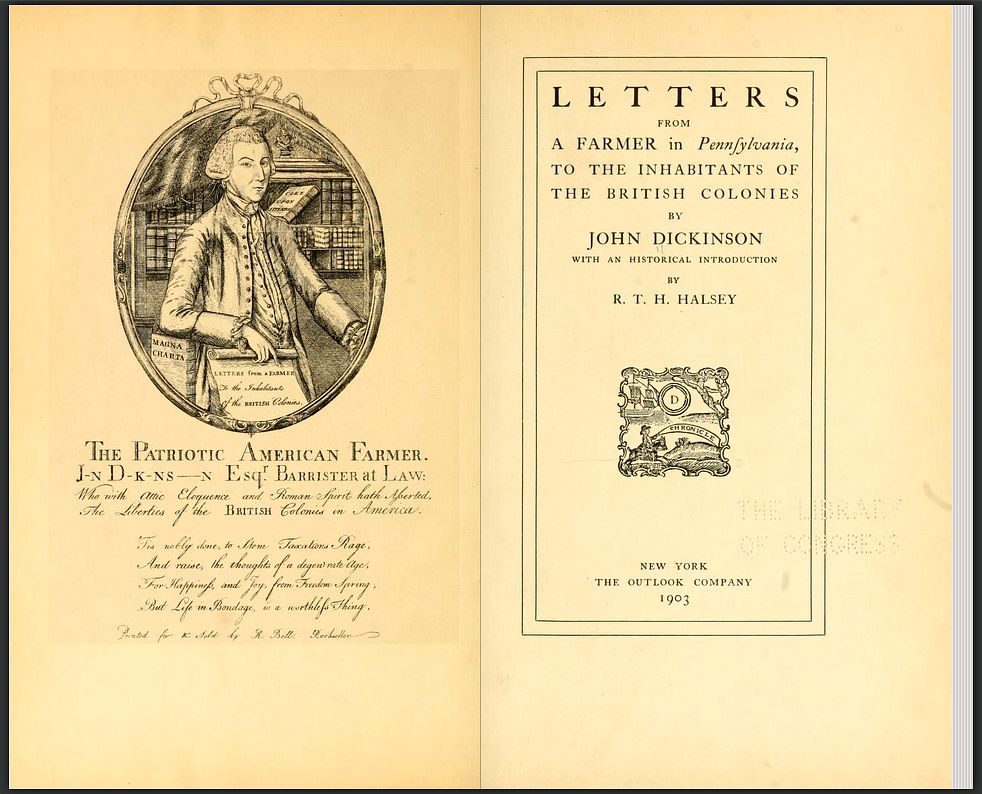
The first letter opens with a self-portrait:
"I am a farmer, settled after a variety of fortunes, near the banks, of the river Delaware, in the province of Pennsylvania. I received a liberal education, and have been engaged in the busy scenes of life: But am now convinced, that a man may be as happy without bustle, as with it. My farm is small, my servants are few, and good; I have a little money at interest; I wish for no more."
John Dickinson, Letters from a Farmer in Pennsylvania, Letter I, 1767.4
The voice is calm on purpose. Dickinson was writing for readers who were angry and wanted to stay loyal to the King. He gave them a modest man with nothing to gain, reasoning step by step. The argument was legal and narrow: Parliament could regulate trade, but duties laid "for the sole purposes of raising money" were taxes, and only the colonists' own assemblies could tax them. Near the end of the last letter he gathered it into one chain:
"Let these truths be indelibly impressed on our minds ... that we cannot be happy without being free ... that we cannot be free without being secure in our property ... that we cannot be secure in our property, if, without our consent, others may, as by right, take it away ... that taxes imposed on us by parliament, do thus take it away."
Dickinson, Letters from a Farmer, Letter XII.5
The same chain ends with a line about union: opposition "can never be effectual, unless it is the united effort of these provinces."5 That was the practical lesson. One colony could be punished. Thirteen acting together could not easily be.
The letters crossed the ocean. A London edition appeared in June 1768. Benjamin Franklin, then in London, wrote his son that Lord Hillsborough, the minister for the colonies, had read the "Farmer's Letters," thought them "well written," and "censured the doctrines as extremely wild."6 Dickinson followed his prose with a song, the Liberty Song you met in the last lesson. He knew that argument and music reach different people.
Common Sense, 1776
On January 10, 1776, the Philadelphia printer Robert Bell published a pamphlet called Common Sense, with no author's name on it. Bell printed 1,000 copies at two shillings each, and they sold out in a week or two.7 The author was Thomas Paine, a recent immigrant from England.
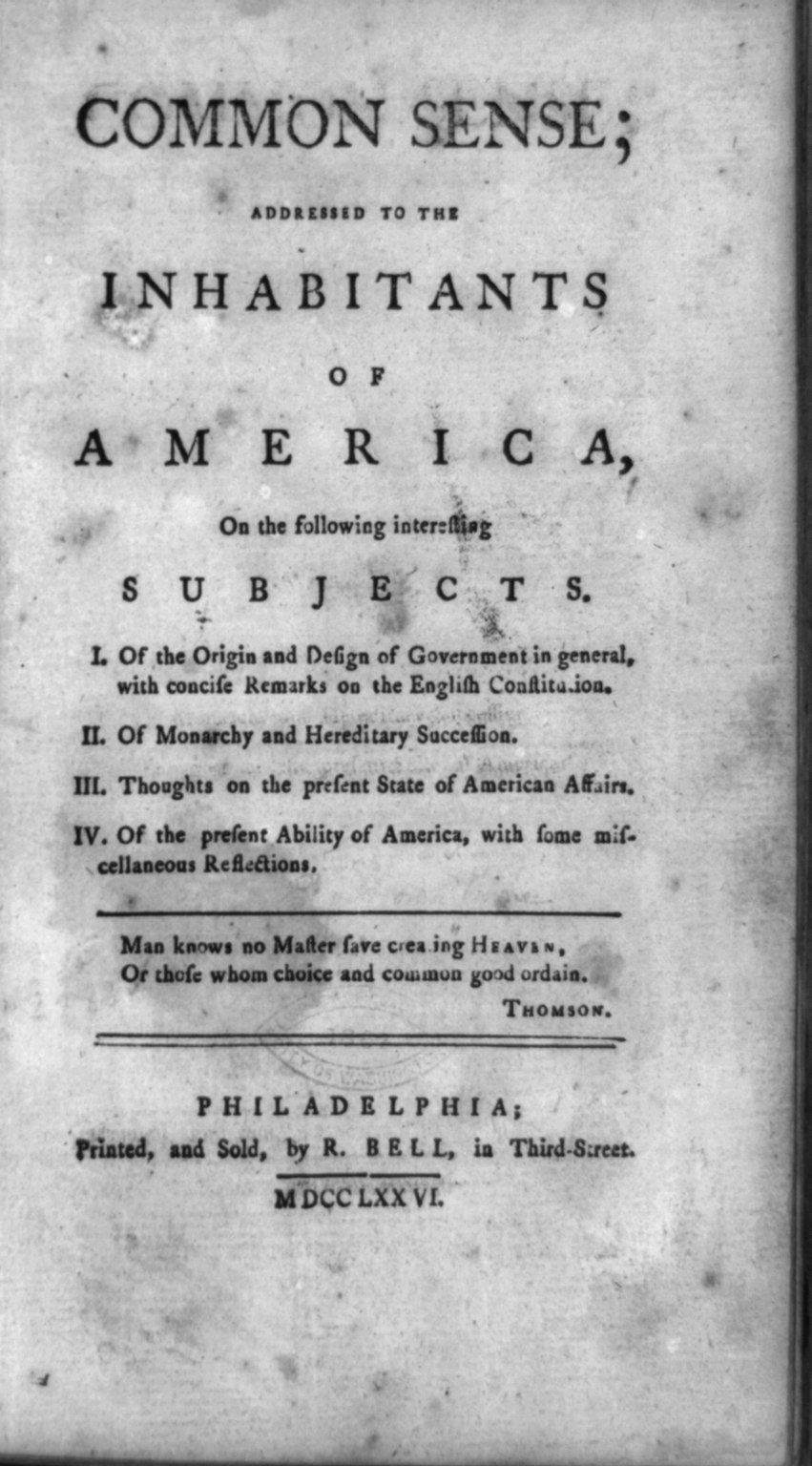
Dickinson had written as a lawyer to Englishmen. Paine wrote as a preacher to Americans, and he went straight at the King. Monarchy itself, he argued, was a fraud with no warrant in Scripture or reason. An island could not rule a continent. And the hope of reconciliation was a delusion that would cost lives. He wanted Americans to write their own charter "placed on the divine law, the word of God," and crown it, so "that so far as we approve of monarchy, that in America the law is king."8 He ended with a call that still raises the hair on your neck:
"O ye that love mankind! Ye that dare oppose, not only the tyranny, but the tyrant, stand forth! Every spot of the old world is overrun with oppression. Freedom hath been hunted round the globe ... O! receive the fugitive, and prepare in time an asylum for mankind."
Thomas Paine, Common Sense, 1776.8
Paine fell out with Bell almost at once. Bell printed a second edition without waiting for Paine's revisions, so Paine took an enlarged edition to William and Thomas Bradford, adding an appendix aimed at the Quakers who opposed rebellion. The two sides denounced each other in the newspapers, which only sold more copies.7
How many copies? The numbers dispute
Ask how many copies Common Sense sold and you will hear 100,000, 120,000, 150,000 or even 500,000. Every one of those numbers has a source, and none of them is a sales record. None survive.9
The first three come from Paine. He used 120,000 in the spring of 1776. On January 14, 1779, writing to Henry Laurens, he said he believed "the number of copies printed and sold in America was not short of 150,000," and called it "the greatest sale that any performance ever had since the use of letters." In a footnote to Rights of Man in 1791 he said the demand "ran to not less than one hundred thousand copies."9 The half million came from Paine's biographer Moncure Conway in 1892, who guessed that "in the end probably half a million copies were sold." Textbooks picked it up.9
The historian Trish Loughran, in The Republic in Print (Columbia University Press, 2007), went back to the printing record. She found twenty-five known printings in 1776, sixteen of them in Philadelphia, most of the rest along the northeastern coast, and only one press south of Pennsylvania. At a generous 3,000 copies a printing, that puts a far upper limit of 75,000, and she thinks the real number was much smaller.9 Ray Raphael, who had used the 100,000 figure himself, reviewed her work in 2013 and agreed the old numbers fail against the population, the presses and the roads. Five hundred thousand copies would mean one for every free household in the rebelling colonies.9
But Raphael also warned against swinging too far. Twenty-five printings beat the seven printings of Dickinson's Farmer letters, and dwarf the single run of 500 copies of The Federalist. And pamphlets were read aloud in taverns and passed hand to hand, so readers outnumbered buyers.9 The fair conclusion: Common Sense was the most widely printed pamphlet of the Revolution and changed the debate, and nobody knows how many copies were sold. Be suspicious of anyone who gives you a precise number.
Paine received no royalties and broke with his first printer within weeks. He had no way of knowing how many copies were sold, and every reason to say a lot. The numbers in your textbook may be propaganda that outlived the war.
The American Crisis
By December 1776 the cause looked lost. Washington's army had been chased out of New York and across New Jersey, and enlistments were running out at the end of the year. Paine, who had marched on the retreat as an aide to General Nathanael Greene, went to Philadelphia and wrote. The first number of The American Crisis came out as a pamphlet on December 19, 1776.10
"THESE are the times that try men's souls. The summer soldier and the sunshine patriot will, in this crisis, shrink from the service of their country; but he that stands it now, deserves the love and thanks of man and woman. Tyranny, like hell, is not easily conquered; yet we have this consolation with us, that the harder the conflict, the more glorious the triumph."
Thomas Paine, The American Crisis, No. 1, December 1776.11
Myth: Washington had The Crisis read to his troops before they crossed the Delaware
It is in many biographies, and it may be true, but no one has found evidence. Jett Conner, writing in the Journal of the American Revolution in 2015, traced the story to James Cheetham, a hostile biographer of Paine, who wrote soon after Paine's death in 1809 that the pamphlet "was read in the camp to every corporal's guard." Cheetham was not there and gave no source. Washington's general orders and letters say nothing about it, and Paine never claimed it. Later writers, from Moncure Conway to modern biographers, repeated Cheetham or each other.10 It is reasonable that copies reached the camp. A reasonable assumption is not evidence.
Phillis Wheatley's Poems, 1773
In 1761 a ship from West Africa landed in Boston, and John and Susanna Wheatley bought a small girl from it. She was about seven or eight. They named her Phillis.12 Her master later wrote that "in sixteen Months Time from her Arrival," she had learned English well enough "to read any, the most difficult Parts of the Sacred Writings, to the great Astonishment of all who heard her." By 1765 she was writing letters, and she was learning Latin.13
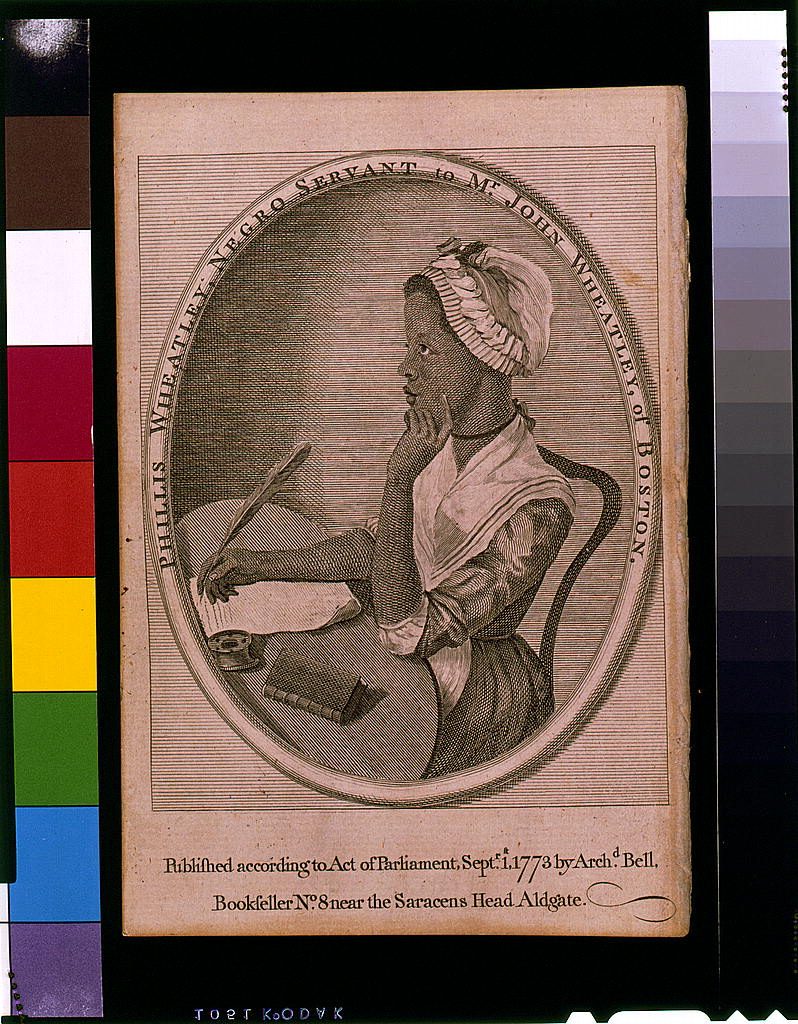
No Boston printer would publish her poems. With the Wheatleys' help she went to London, where Selina Hastings, the Countess of Huntingdon, became her patron, and in 1773 Poems on Various Subjects, Religious and Moral appeared, the first book of poetry published by an enslaved Black woman.12 It opened with something no white poet's book needed: a signed statement that she had really written it. Eighteen of Boston's leading men signed, among them Governor Thomas Hutchinson, Lieutenant Governor Andrew Oliver, John Hancock and a row of ministers. They assured the world that the poems were written "by Phillis, a young Negro Girl, who was but a few Years since, brought an uncultivated Barbarian from Africa, and has ever since been, and now is, under the Disadvantage of serving as a Slave in a Family in this Town."13
What she wrote
Most of the poems are elegies and religious verse in the polished style of Alexander Pope. Her best-known poem is eight lines long:
"'Twas mercy brought me from my Pagan land,
Phillis Wheatley, "On being brought from Africa to America," 1773.14
Taught my benighted soul to understand
That there's a God, that there's a Saviour too:
Once I redemption neither sought nor knew,
Some view our sable race with scornful eye,
"Their colour is a diabolic die."
Remember, Christians, Negroes, black as Cain,
May be refin'd, and join th' angelic train."
Readers today sometimes stop at the first line and hear only gratitude. Read the last two lines. She turns and speaks directly to "Christians," and the word "Remember" is a command. She uses their own faith to rebuke their contempt. In her poem to the Earl of Dartmouth, also in the book, she was plainer about her own enslavement:
"I, young in life, by seeming cruel fate
Wheatley, "To the Right Honourable William, Earl of Dartmouth," 1773.15
Was snatch'd from Afric's fancy'd happy seat ...
Such, such my case. And can I then but pray
Others may never feel tyrannic sway?"
A colonist who complained of "tyrannic sway" from Parliament could not read that without feeling it. The Wheatleys freed her soon after she came back from London.12 In October 1775 she sent a poem to George Washington, newly in command at Cambridge. He answered on February 28, 1776, apologizing for the delay and saying that "the style and manner exhibit a striking proof of your great poetical Talents." He invited her to visit his headquarters.16
Jefferson's verdict
Thomas Jefferson saw it differently. In Notes on the State of Virginia, written in 1781 and 1782, he argued at length that Black people were inferior in reason and imagination, and he took up Wheatley by name:
"Religion indeed has produced a Phyllis Whately; but it could not produce a poet. The compositions published under her name are below the dignity of criticism."
Thomas Jefferson, Notes on the State of Virginia, Query XIV.17
That sentence is worth facing squarely, because the same man wrote "all men are created equal." Jefferson needed Wheatley to be no poet, because if she was one, his case for slavery's natural basis fell apart. Washington, a slaveholder too, at least read what was in front of him. Wheatley married John Peters, a free Black grocer, in 1778, struggled with poverty while he was jailed for debt, could not find a publisher for a second book, and died on December 5, 1784, at about thirty-one.12 Her poems outlived Jefferson's judgment of them.
Mercy Otis Warren: plays and a history
Mercy Otis was born in Barnstable, Massachusetts, on September 14, 1728, the third of thirteen children. She had no college. She was taught by her uncle, the Reverend Jonathan Russell, and sat in on the lessons her brother James Otis Jr. took to prepare for Harvard, and he kept sending her books after he left. In 1754 she married James Warren, later a leader of the Massachusetts legislature, and their house in Plymouth became a meeting place for John and Samuel Adams and other opponents of British policy.18
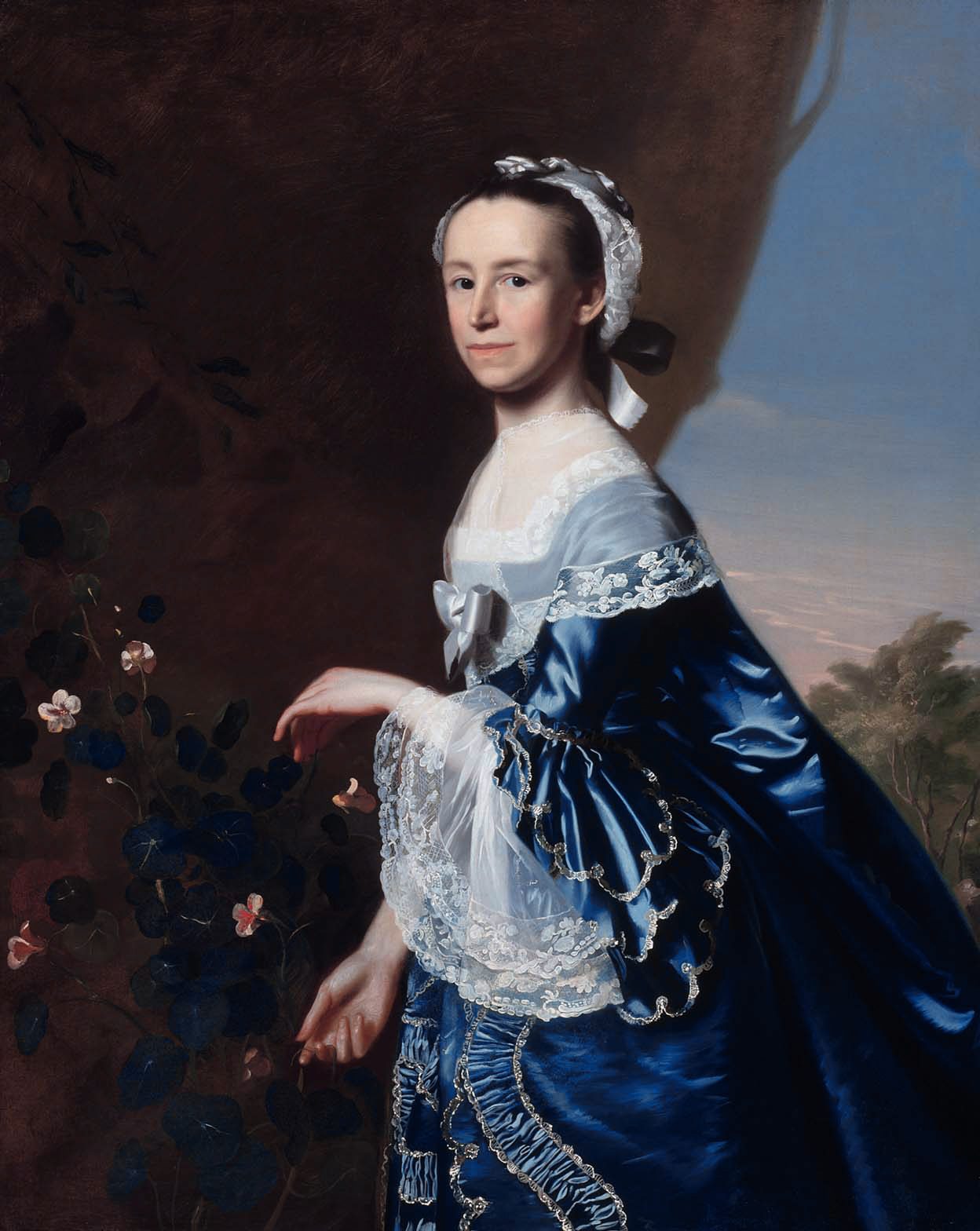
Her weapon was ridicule. Her first play, The Adulateur, appeared in a Boston newspaper in 1772 and cast Governor Hutchinson as a villain named Rapatio. The Defeat followed in 1773 and The Group in 1775.18 In 1788 she wrote Observations on the New Constitution against ratification, signed "A Columbian Patriot."18
Her largest work was a history. She began it in the late 1770s and published it in 1805 in three volumes: History of the Rise, Progress and Termination of the American Revolution.18 In the opening address she explained why a woman would attempt such a thing. The war, she wrote, had "stimulated to observation a mind that had not yielded to the assertion, that all political attentions lay out of the road of female life." She did not deny that men had their own duties in war, but she reasoned that "every domestic enjoyment depends on the unimpaired possession of civil and religious liberty."19 If liberty touched every home, then a woman had every right to write its history.
The History was not neutral, and she said she meant it to be truthful rather than neutral. She accused her old friend John Adams of forgetting "the principles of the American revolution." Adams answered with a stream of angry letters in 1807, and the two did not make peace until 1812.18 She died in Plymouth on October 19, 1814.18
The Declaration as literature
The most read piece of American writing from the Revolution was written by a committee and edited by a Congress. Jefferson drafted it in June 1776. Congress debated it for two days and cut it hard. In his autobiography Jefferson remembered that the clause attacking the King for the slave trade "was struck out in complaisance to South Carolina and Georgia," and that northern delegates "felt a little tender under those censures" too, since their merchants had carried slaves for others.20
Almost fifty years later, Jefferson explained what he had been trying to do. He was not, he said, "aiming at originality of principle or sentiment." The paper "was intended to be an expression of the american mind."21 That is a writer's goal, and it shows in every line. Look at how the second paragraph is built:
"We hold these truths to be self-evident, that all men are created equal, that they are endowed by their Creator with certain unalienable Rights, that among these are Life, Liberty and the pursuit of Happiness."
The Declaration of Independence, July 4, 1776.22
Each clause starts with "that," like steps in a proof. The rights come from the Creator, not from Parliament or Congress, so no government can claim to have given them. Then comes a long list of charges against the King, each starting "He has," hammered one after another like counts in an indictment. And it ends in a vow, a sentence that binds the signers to each other before God: "with a firm reliance on the protection of divine Providence, we mutually pledge to each other our Lives, our Fortunes and our sacred Honor."22
Pamphlets like Dickinson's and Paine's argued. The Declaration does something different. It assumes the argument is won and states the conclusion in words meant to be read aloud in town squares. That is why it worked as literature, and why people who were left out of it, Wheatley among them, could quote it back to the nation for the next two centuries.
A press that argued a nation into being
| Work | Year | Form | Author's mask | Main audience |
|---|---|---|---|---|
| Pennsylvania Journal "tombstone" issue | 1765 | Newspaper | The printer, William Bradford | Philadelphia readers |
| Letters from a Farmer in Pennsylvania | 1767 to 1768 | Newspaper letters, then pamphlet | "A Farmer" | Colonial assemblies, merchants, British readers |
| The Adulateur | 1772 | Satirical play in a newspaper | Anonymous | Boston readers |
| Poems on Various Subjects | 1773 | Book of poems | None: her name and portrait, with an attestation | London and Boston readers |
| Common Sense | 1776 | Pamphlet | Anonymous | Ordinary colonists |
| The American Crisis, No. 1 | 1776 | Pamphlet, then newspaper | "Common Sense" | Soldiers and wavering citizens |
| Declaration of Independence | 1776 | Broadside and newspaper | The Congress | Americans and the world |
| History of the Rise, Progress and Termination of the American Revolution | 1805 | Three-volume history | Her own name | The next generation |
Look down the "mask" column. Most of the Revolution's writers hid their names, and the argument had to carry itself. The last two in the table, Wheatley at the start of the war and Warren after it, put their names on their work, and both were women who had been told that public life was not theirs. The press of the Revolution made room for them anyway. The young republic's painters, builders and songwriters, in the next lesson, set out to give that new nation a look and a sound of its own.
Learn more
- The Tombstone Edition (Journal of the American Revolution): high-resolution images of all four pages of Bradford's protest issue.
- Dickinson, Letters from a Farmer in Pennsylvania: the full twelve letters, with an introduction on how they spread.
- Paine, Common Sense: short enough to read in an evening, and worth reading whole.
- Ray Raphael, Thomas Paine's Inflated Numbers: where every sales figure for Common Sense came from, and why none holds up.
- Going Viral in 1776 (Clements Library): Bell's first edition, the quarrel with Paine and the Bradford edition, with images.
- Jett Conner, The American Crisis Before Crossing the Delaware?: a careful hunt for the source of a famous story.
- Wheatley, Poems on Various Subjects, Religious and Moral: the whole 1773 book, attestation included.
- Phillis Wheatley (National Park Service): a short, clear life.
- Mercy Otis Warren Papers (Massachusetts Historical Society): her life and the collection of her letters.
- The Declaration of Independence (National Archives): read it aloud, as it was meant to be.
Notes
- Editors, "The Tombstone Edition: Pennsylvania Journal, October 31, 1765," Journal of the American Revolution, June 2015. Read it online. ↩
- Stamp Act, 5 George III, c. 12 (1765), duties on pamphlets, newspapers and advertisements, and section XXXII on penalties after November 1, 1765, Avalon Project, Yale Law School. Read it online. ↩
- R. T. H. Halsey, Introduction to John Dickinson, Letters from a Farmer in Pennsylvania (New York: The Outlook Company, 1903), xvii. Read it online. ↩
- Dickinson, Letters from a Farmer in Pennsylvania, Letter I. Read it online. ↩
- Dickinson, Letters from a Farmer in Pennsylvania, Letter XII. Read it online. ↩
- Benjamin Franklin to William Franklin, London, March 13, 1768, quoted in Halsey, Introduction to Letters from a Farmer. Read it online. ↩
- William L. Clements Library, University of Michigan, "Going Viral in 1776," in the exhibition Revolutionary Paine. Read it online. ↩
- Thomas Paine, Common Sense (Philadelphia, 1776), "Thoughts on the Present State of American Affairs." Read it online. ↩
- Ray Raphael, "Thomas Paine's Inflated Numbers," Journal of the American Revolution, March 20, 2013, quoting Paine to Henry Laurens, January 14, 1779, and Rights of Man (1791), and summarizing Trish Loughran, The Republic in Print: Print Culture in the Age of U.S. Nation Building, 1770-1870 (New York: Columbia University Press, 2007), 40-58, 253-261, and Moncure Daniel Conway, The Life of Thomas Paine (New York: Putnam, 1892), 1:69. Read it online. ↩
- Jett Conner, "The American Crisis Before Crossing the Delaware?," Journal of the American Revolution, February 2015, including note 1 on first publication as a pamphlet on December 19, 1776. Read it online. ↩
- Thomas Paine, The American Crisis, No. 1 (December 1776), in The Writings of Thomas Paine, vol. 1, ed. Moncure Daniel Conway. Read it online. ↩
- National Park Service, "Phillis Wheatley," last updated January 17, 2023, citing Jared Ross Hardesty, Unfreedom: Slavery and Dependence in Eighteenth-Century Boston (New York University Press, 2016). Read it online. ↩
- John Wheatley, letter to the publisher, Boston, November 14, 1772, and "To the Public" with the attestation, in Phillis Wheatley, Poems on Various Subjects, Religious and Moral (London: Archibald Bell, 1773). Read it online. ↩
- Wheatley, "On being brought from Africa to America," Poems on Various Subjects. Read it online. ↩
- Wheatley, "To the Right Honourable William, Earl of Dartmouth, His Majesty's Principal Secretary of State for North-America," Poems on Various Subjects. Read it online. ↩
- George Washington to Phillis Wheatley, Cambridge, February 28, 1776, Papers of George Washington, Revolutionary War Series, vol. 3, Founders Online, National Archives. Read it online. ↩
- Thomas Jefferson, Notes on the State of Virginia, Query XIV, Avalon Project, Yale Law School. Read it online. ↩
- Massachusetts Historical Society, "Mercy Otis Warren Papers," collection guide, biographical sketch, drawing on Notable American Women, 1607-1950 (Harvard University Press, 1971). Read it online. ↩
- Mercy Otis Warren, "An Address to the Inhabitants of the United States of America," History of the Rise, Progress and Termination of the American Revolution, vol. 1 (Boston: Manning and Loring, 1805), transcription at Seltzer Books. Read it online. ↩
- Thomas Jefferson, Autobiography (1821), Avalon Project, Yale Law School. Read it online. ↩
- Thomas Jefferson to Henry Lee, May 8, 1825, Founders Online, National Archives. Read it online. ↩
- "Declaration of Independence: A Transcription," National Archives. Read it online. ↩
Terms in this lesson
- Pamphlet
- A short unbound booklet, usually a few sheets folded and stitched, sold cheaply. The main form of political argument in the 1700s.
- Stamp duty
- A tax collected by requiring that paper be bought already stamped by the government. The 1765 Stamp Act put it on newspapers, pamphlets, legal papers, licenses and playing cards.
- Printing (edition)
- One run of copies from set type. A pamphlet could go through many printings in many towns, each by a different printer.
- Attestation
- A signed statement by witnesses vouching that something is genuine. Wheatley's book opened with one signed by eighteen Boston men.
- Pseudonym
- A false name used by a writer. Dickinson wrote as 'A Farmer,' Mercy Otis Warren as 'A Columbian Patriot,' and Paine signed Common Sense 'an Englishman.'
- Satire
- Writing that attacks people or ideas by making them look ridiculous. Warren's plays satirized the royal officials of Massachusetts.
Sources
- The Stamp Act, 1765 (Avalon Project) checked 2026-10
- The Tombstone Edition: Pennsylvania Journal, October 31, 1765 (Journal of the American Revolution) checked 2026-10
- John Dickinson, Letters from a Farmer in Pennsylvania (Project Gutenberg) checked 2026-10
- Thomas Paine, Common Sense (Project Gutenberg) checked 2026-10
- Ray Raphael, Thomas Paine's Inflated Numbers (Journal of the American Revolution, 2013) checked 2026-10
- Going Viral in 1776 (William L. Clements Library, University of Michigan) checked 2026-10
- Jett Conner, The American Crisis Before Crossing the Delaware? (Journal of the American Revolution, 2015) checked 2026-10
- Phillis Wheatley, Poems on Various Subjects, Religious and Moral (Project Gutenberg) checked 2026-10
- Phillis Wheatley (National Park Service) checked 2026-10
- Mercy Otis Warren Papers, collection guide (Massachusetts Historical Society) checked 2026-10
- Jefferson, Notes on the State of Virginia (Avalon Project) checked 2026-10
- Declaration of Independence: A Transcription (National Archives) checked 2026-10