Lesson 5 of 12 · about 25 minutes
Painters of the American Wilderness
You'll be able to
- Explain what Thomas Cole argued in his 1836 Essay on American Scenery and how The Oxbow puts that argument in paint
- Describe the five paintings of The Course of Empire and what they say about the rise and fall of republics
- Describe how Durand, Church and Bierstadt carried Cole's approach forward and how the public received their work
- Read Bingham's election paintings as a record of self-government with its virtues and its faults
In 1825, a few small paintings of the Catskill Mountains sat in the window of a New York shop. They were by a young immigrant almost nobody knew. Three established artists walked past, stopped, and looked. One of them was the engraver Asher B. Durand. Within a short time the painter, Thomas Cole, had commissions, admirers and a career.1 Before the century was half over, Americans would think of their wild country the way Cole taught them to see it.
Cole was born in 1801 in Bolton, Lancashire, in the mill country of northwest England, and his family brought him to the United States in 1818. He worked as a traveling portrait painter in Philadelphia, Ohio and Pittsburgh before he found what he was looking for in the Catskills.2 He had grown up among smokestacks. He knew what the Hudson Valley could turn into, and that knowledge runs through everything he painted.
Thomas Cole and American scenery
In January 1836 Cole published an essay in the American Monthly Magazine that served as a manifesto for the painters who followed him. He answered the old complaint that America was a raw country without the ruins and storied places of Europe. He turned the complaint around:
"the most distinctive, and perhaps the most impressive, characteristic of American scenery is its wildness. It is the most distinctive, because in civilized Europe the primitive features of scenery have long since been destroyed or modified."
Thomas Cole, "Essay on American Scenery," 1836.3
Europe had castles and temples. America had what God had made before anyone built on it. And where Americans had settled, Cole saw a different kind of history. "American associations are not so much of the past as of the present and the future," he wrote. He asked the reader to picture a valley of farms and a village spire: "You see no ruined tower to tell of outrage," no "gorgeous temple to speak of ostentation," but "freedom's offspring" of "peace, security, and happiness."3 For Cole the farms of a free people were a kind of monument.
He was not naive about progress. Near the end of the essay he mourned that "the ravages of the axe are daily increasing," and that "another generation will behold spots, now rife with beauty, desecrated by what is called improvement."3 He called the railroad builders of the Catskills "copper-hearted barbarians."2 He thought a people that cared only for profit would lose something it could not get back.
Cole's convictions were religious. After his return from Europe he was baptized and confirmed in the Episcopal Church and joined St. Luke's in Catskill, where he later designed a new church building for his friend and biographer, the Reverend Louis Legrand Noble.2 He believed the artist's "mission" was "a great and serious one," and that a painting "ought not to be a dead imitation of things without the power to impress a sentiment, or enforce a truth."4 When he painted wilderness he was painting creation.
The Oxbow, 1836
In 1836 Cole was months behind on a huge series for his patron Luman Reed and worried about money. He set it aside to paint something that would sell at the National Academy of Design's annual show. He wrote to Reed: "Fancy pictures seldom sell & they generally take more time than views so I have determined to paint one of the latter. I have already commenced a view from Mt. Holyoke."5
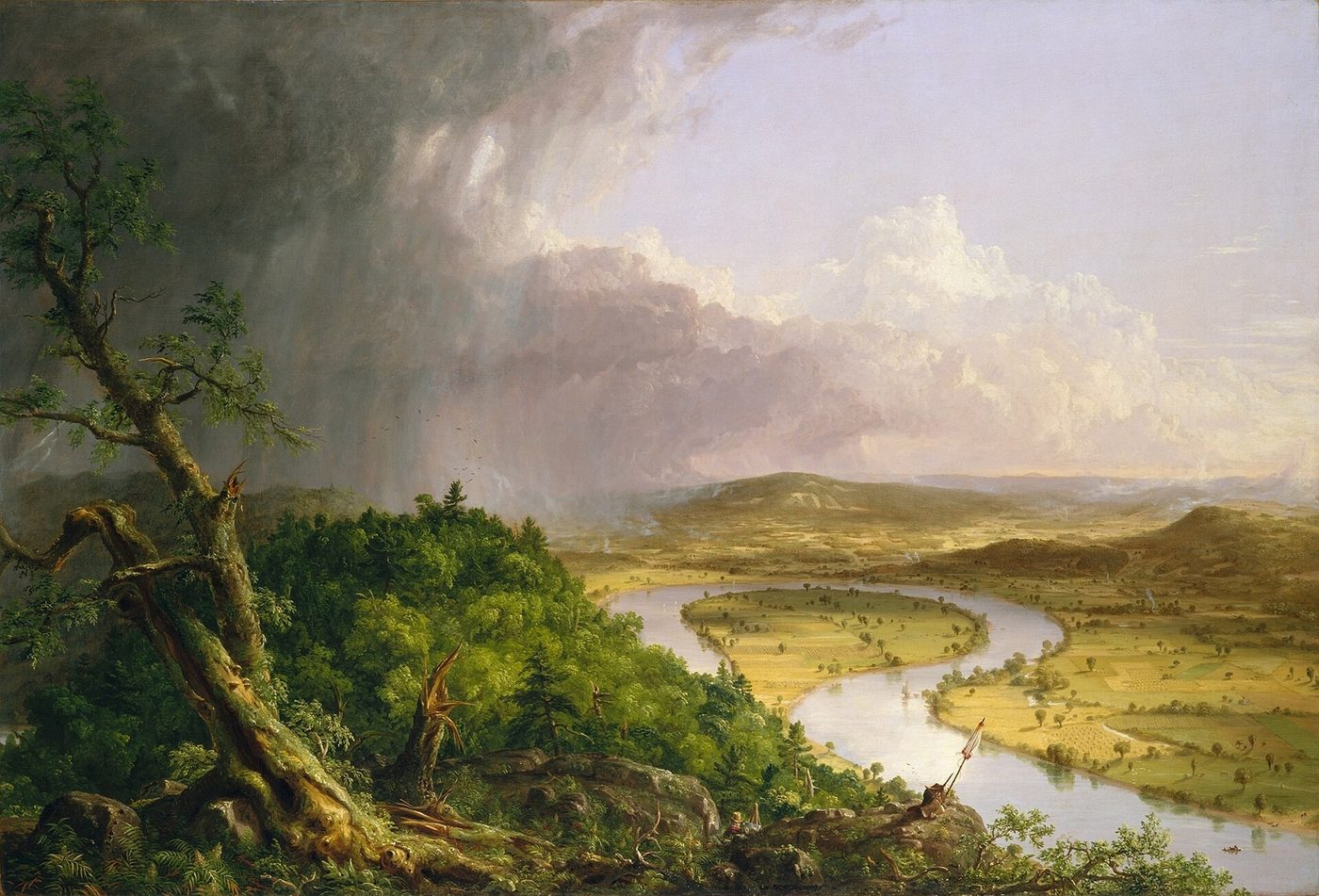
The Oxbow is the place where the Connecticut River makes a great loop near Northampton, Massachusetts, a popular view for tourists then. Cole set the storm and the wild forest on one side and the farms on the other, joined by the river. At the bottom he painted himself sketching on the mountaintop, his umbrella reaching across the divide.5 Some historians read the cleared patches on the far hillside as Hebrew letters spelling "Noah," or, upside down, "Shaddai," the Almighty. If they are right, Cole wrote the name of God on the land itself.5 The painting got mixed reviews, but to Cole's surprise Charles N. Talbot bought it for $500.5
Which side is Cole on? People have argued it both ways. The storm is moving off, which may mean the wild is passing. The farms are lovely, and the essay praised exactly such valleys. Cole seems to hold both at once: civilization is good, and it costs something. A citizen can feel both.
The Course of Empire, 1833 to 1836
The series Cole set aside was the most ambitious American painting project of its time. On September 18, 1833, he wrote to Reed from Catskill describing a plan he had been "cherishing for several years":6
"A series of pictures might be painted that should illustrate the History of a natural scene, as well as be an Epitome of Man ... in his progress from Barbarism to Civilization, to Luxury, the Vicious state or state of destruction and to the state of Ruin & Desolation."
Thomas Cole to Luman Reed, Catskill, September 18, 1833.7
Reed agreed, and Cole spent three years on five canvases for Reed's picture gallery on Greenwich Street in New York. All five show the same harbor under the same distinctive rock, at different hours and in different weather. In The Savage State, hunters chase deer at dawn. In The Arcadian or Pastoral State, shepherds tend flocks by a simple temple in the morning. The Consummation of Empire fills the harbor at noon with marble palaces and a triumphal procession. Destruction brings storm, fire and invading soldiers. In Desolation, moonlight falls on ruins overgrown with vines, and no people are left at all.7
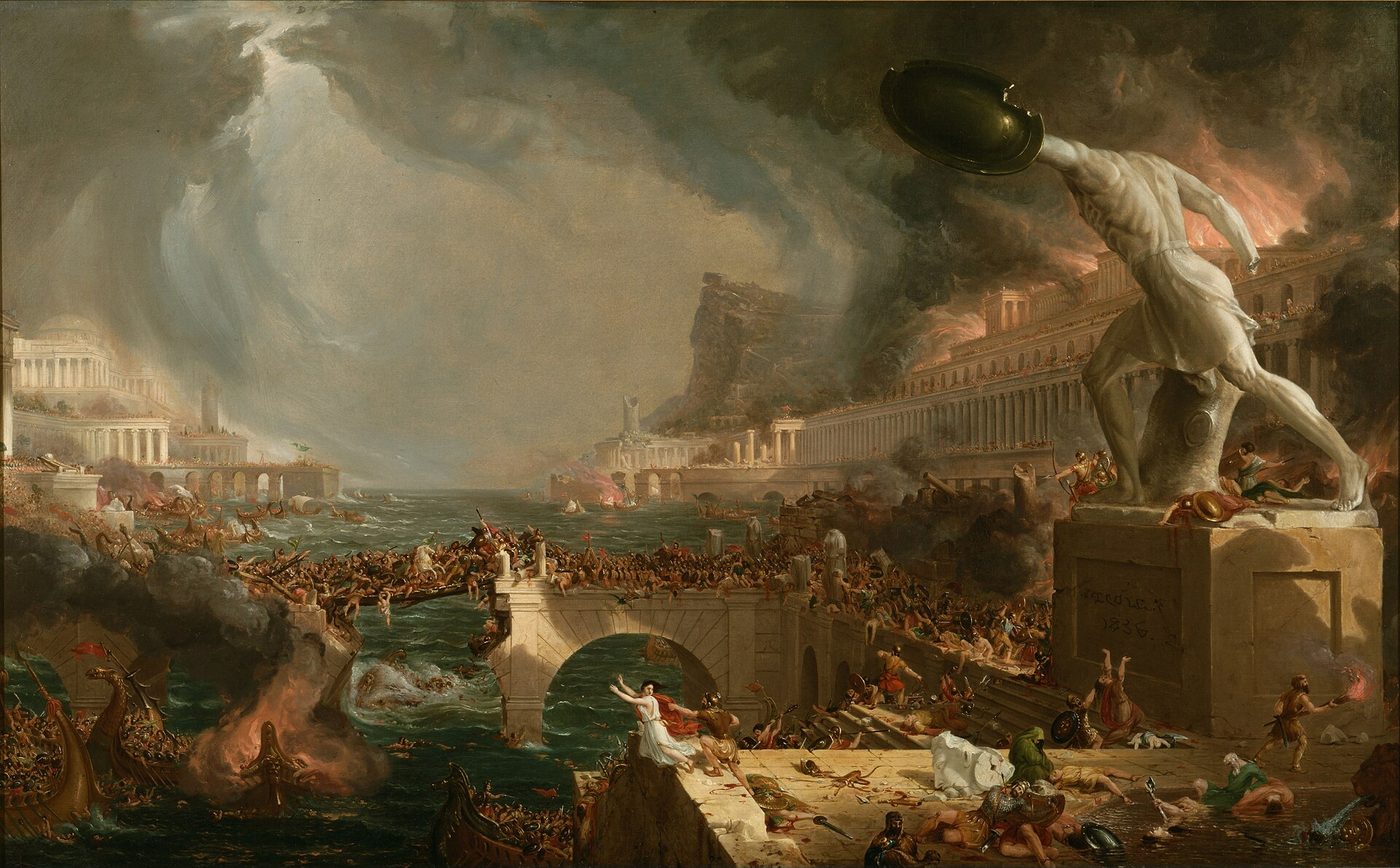
Cole took the title from a poem by Bishop George Berkeley and connected the series to lines from Byron's Childe Harold's Pilgrimage: "There is the moral of all human tales; / 'Tis but the same rehearsal of the past." The next line names the sequence the paintings follow, beginning "First Freedom and then Glory," and ending in "barbarism at last."7
An argument about republics
Cole was painting Rome. He was also painting the United States, and his audience knew it. Many historians read the conquering hero in Consummation, carried through the city in triumph, as a dig at President Andrew Jackson, the general in the White House.8 Cole's private writings make his fears plain. Once, hearing a company of Jacksonians celebrate an election, he asked why they rejoiced: "because of the triumph of good principles of the cause of virtue & morality? No! but because their party was victorious!"8 And elsewhere:
"It is with sorrow that I anticipate the downfall of this republican government; its destruction will be a death blow to Freedom, for if the Free government of the U States cannot exist a century where shall we turn?"
Thomas Cole, private writings, quoted by Explore Thomas Cole (Thomas Cole National Historic Site).8
Not everyone agreed with him. Some Democrats of the day saw the course of empire as a line rising forever, with no fall for America at all.8 But the founders would have understood Cole. They had read the same Roman histories and believed the same thing: republics die when citizens trade virtue for luxury and loyalty to the common good for loyalty to a faction. The Course of Empire puts that warning on a wall. James Fenimore Cooper wrote in 1849 that he considered it "the work of the highest genius this country has ever produced."9
Cole's warning was about people, not paintings or politicians. The harbor, the rock and the sky stay the same in all five canvases. Only what people do changes. A republic's fate is in its citizens' habits.
Kindred Spirits, 1849
When Cole sailed for Europe in 1829, his friend the poet William Cullen Bryant wrote him a sonnet. "Thine eyes shall see the light of distant skies," it begins, and it warns that Europe's scenes, lovely as they are, bear "everywhere the trace of men." It ends with a charge: "Gaze on them, till the tears shall dim thy sight, / But keep that earlier, wilder image bright."10
Cole died at his home in Catskill on February 11, 1848, after an attack of pleurisy. He was not yet fifty.2 The New York merchant Jonathan Sturges commissioned Durand to paint a memorial, and in 1849 he gave it to Bryant.11
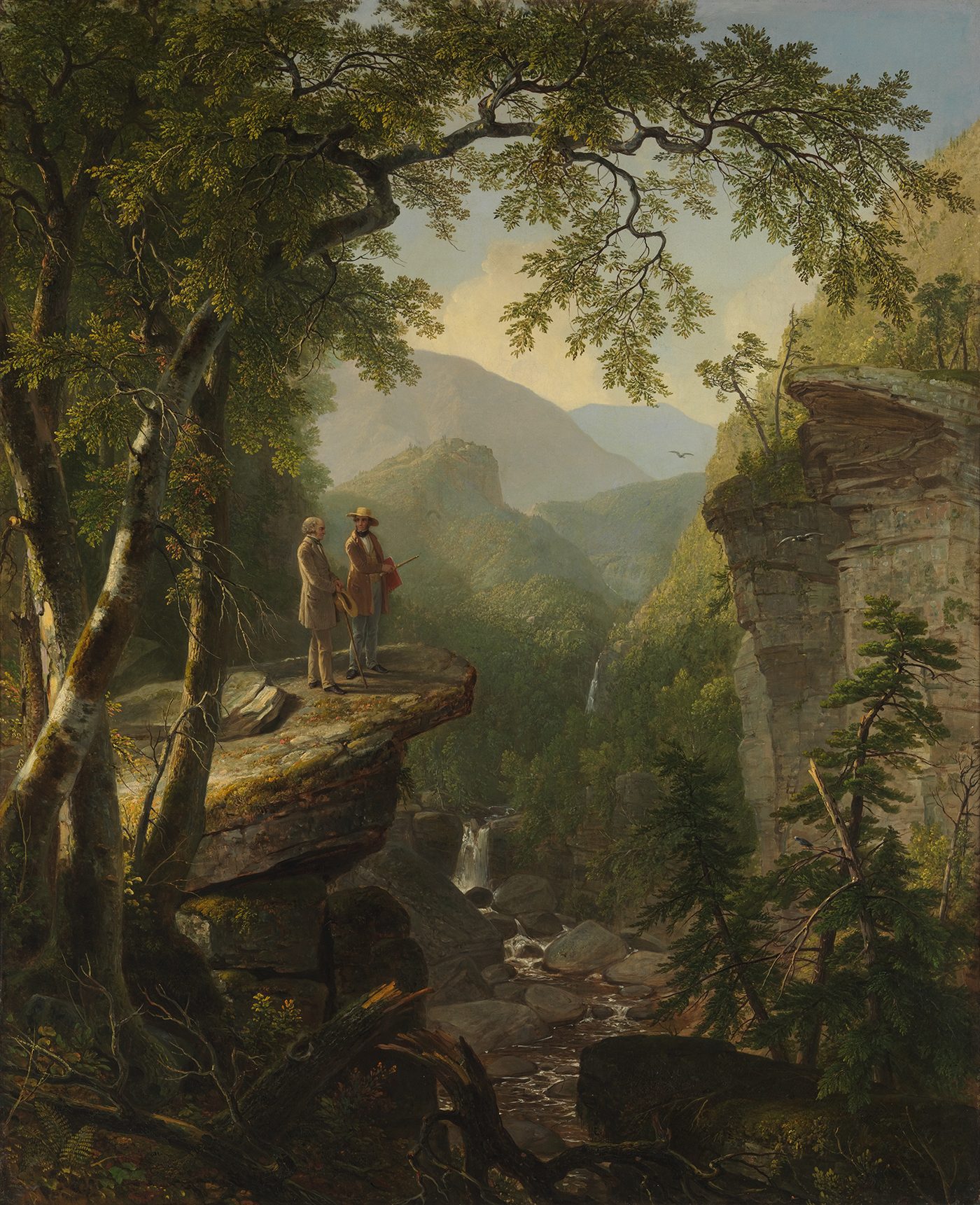
Durand put the painter and the poet together in the place they both loved, as if Cole were still alive. Bryant's famous poem "Thanatopsis" had told readers to "Go forth, under the open sky, and list / To Nature's teachings."12 Durand showed two friends doing exactly that. The picture is a portrait of a friendship and of an idea, that a nation's art and poetry could grow out of its own ground. The painting stayed with Bryant's family until his daughter gave it to the New York Public Library in 1904. The library sold it at auction in 2005, and it went to Crystal Bridges in Arkansas.11
Frederic Church: Niagara and the Andes
Cole took only one real student, Frederic Edwin Church, who studied with him from 1844 to 1846.1 Church combined Cole's sense of meaning with a scientist's eye for detail, and he made paintings that the public lined up and paid to see.
Niagara, 1857
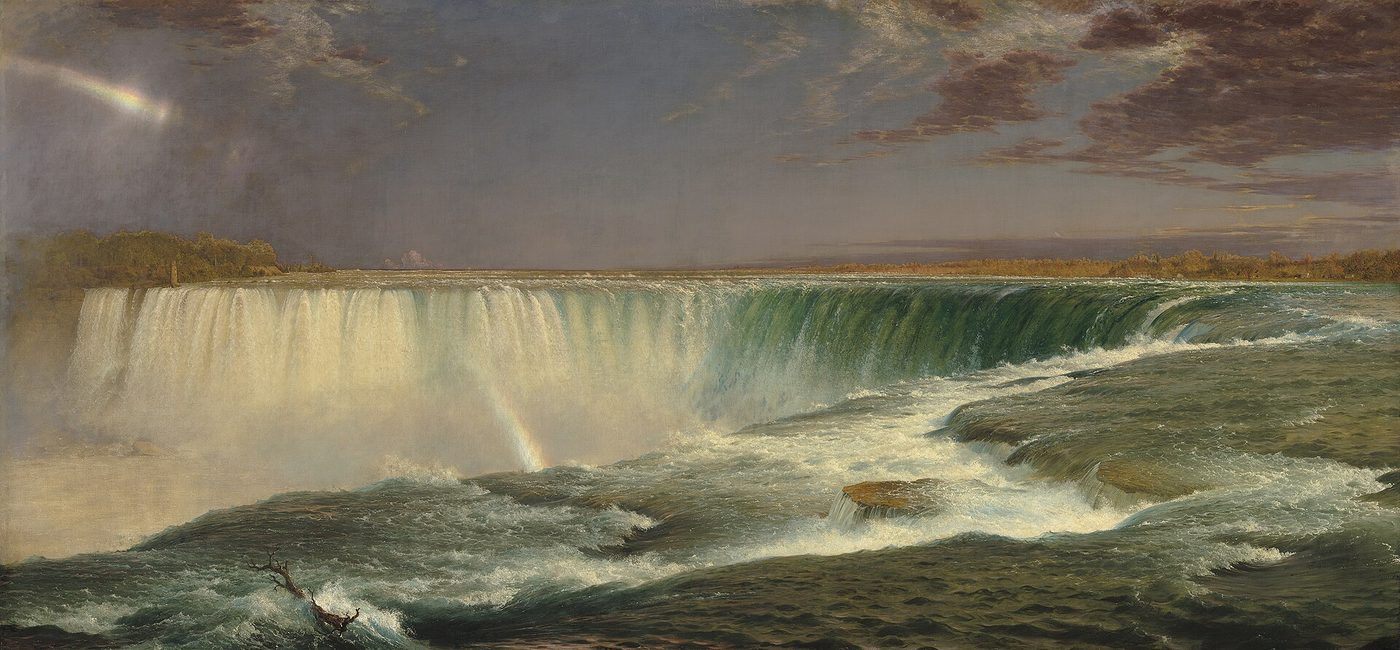
Niagara Falls had been painted many times. Church painted it seven feet wide and from a viewpoint no one could actually stand on. The New York dealers Williams, Stevens & Williams bought the painting and its copyright for $4,500, and on May 1, 1857, they opened it as a single-picture show. Admission was 25 cents. Tens of thousands came in about three weeks, and visitors could order a color print of it on the way out.13 The painting toured Britain in 1858. In 1876 the Corcoran Gallery in Washington bought it for $12,500.13
Heart of the Andes, 1859
Church then followed the German naturalist Alexander von Humboldt to South America and came back with Heart of the Andes, roughly ten feet wide. He showed it from April 29 to May 23, 1859, at the Tenth Street Studio Building in New York, the city's first building designed for artists. More than 12,000 people paid a quarter to see it, an unheard-of crowd for a single painting in America.14
Albert Bierstadt and the West
Albert Bierstadt was born in Germany, trained at the Düsseldorf Academy, and turned the Hudson River approach westward.1 In 1859 he joined a government survey party led by Frederick W. Lander and reached the Wind River Range in what is now Wyoming. Back in New York he painted The Rocky Mountains, Lander's Peak in 1863, with a Shoshone encampment in the foreground under snowy peaks.15 At the 1864 Metropolitan Fair in New York, it hung opposite Church's Heart of the Andes.1
The Metropolitan Museum, which owns the painting, notes what it did: it advertised the West as a frontier for white settlers and treated the Native people in it as part of the scenery, "with dire consequences."15 That is a fair criticism. Bierstadt's mountains were real, but his West was a promise made to one people at another people's expense. Cole had worried about the axe in the Catskills. In the West the cost of "improvement" fell first on the people who already lived there.
Bingham's election paintings
Not every painter of the period looked at mountains. George Caleb Bingham of Missouri looked at voters. He was a painter and a politician. In 1846 he ran for the Missouri legislature as a Whig, won by three votes, and lost the seat when the result was contested and given to his Democratic opponent, Erasmus Darwin Sappington.16 He drew on that experience for three large paintings he called his election series.17
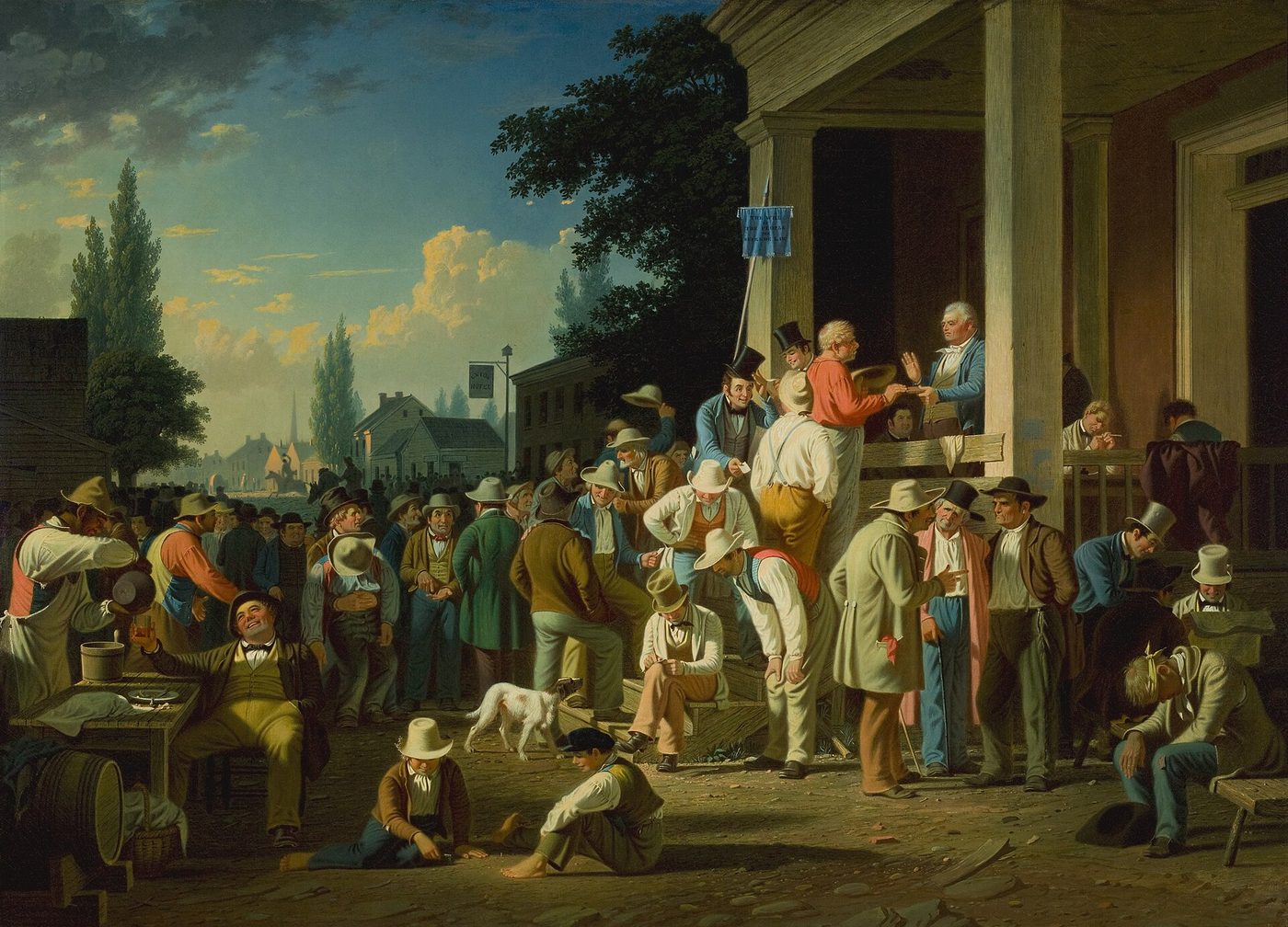
The County Election, 1852
Bingham fills a courthouse porch with every kind of voter. Merchants in top hats argue with laborers in shirtsleeves. Party men press their tickets on passersby. An Irish immigrant takes an oath that he has not voted elsewhere, while a Revolutionary veteran, a "76-er," walks down the steps. A man too drunk to stand is carried up to cast his vote, and another sits nursing a head hurt in a fight.16
Stump Speaking and The Verdict of the People
Stump Speaking, painted in 1853 and 1854, shows a candidate leaning forward to make his points to a crowd of farmers while his opponent sits behind him taking notes for his turn. The speaker is Sappington, the man who took Bingham's seat.18 The Verdict of the People, finished in 1855, shows the crowd at the courthouse as the results are read. One man waves his handkerchief in joy. Another lies drunk on the ground. Women watch from a balcony, temperance reformers who could not vote, and an African American in the foreground stands for the enslaved, who had no voice at all.17 Bingham hoped Congress would buy the series. It did not. He exhibited all three in 1860 in Washington, Philadelphia and St. Louis.17
Bingham was no cynic. He showed the drunks and the deal-makers because they were there, and he showed the oath, the debate and the counting because those were there too. Self-government is noisy and imperfect, and it is still the best thing a free people has. His paintings make the same case Cole's do, from the other side. Cole warned that republics fall when citizens lose virtue. Bingham showed what citizens actually look like on the day they choose, with all their faults on display, and asked you to keep faith with them anyway.
Painting a nation's identity
| Painting | Year | Painter | What it says about America |
|---|---|---|---|
| The Oxbow | 1836 | Thomas Cole | The wild and the settled meet, and both have worth. |
| The Course of Empire (five canvases) | 1833 to 1836 | Thomas Cole | Republics rise and fall by the virtue of their people. |
| Kindred Spirits | 1849 | Asher B. Durand | American art and poetry grow from American ground. |
| The County Election | 1852 | George Caleb Bingham | Self-government is messy and worth it. |
| Niagara | 1857 | Frederic Edwin Church | The continent's power can overwhelm a viewer. |
| Heart of the Andes | 1859 | Frederic Edwin Church | The whole hemisphere is creation to be studied. |
| The Rocky Mountains, Lander's Peak | 1863 | Albert Bierstadt | The West is a promise, made at others' expense. |
The name "Hudson River School" came late. Critics first used it in the 1870s, and they did not mean it as praise. By then taste had turned toward France, and these painters looked old-fashioned. The label stuck anyway.1 It is a little unfair to them, since they painted far beyond the Hudson. But it keeps them tied to the river where Cole first saw what America could be: a country whose history was "not so much of the past as of the present and the future."3
The writers of the same decades, from Emerson to Whitman, made the same claim in words. Their story is told in the next lesson.
Learn more
- Kevin J. Avery, The Hudson River School (The Met): a concise history of the group, from Cole to the 1870s.
- Cole, Essay on American Scenery (National Humanities Center): the 1836 essay in full. Short and worth it.
- Thomas Cole National Historic Site: Cole's life at Cedar Grove in Catskill, his faith and his death.
- The Oxbow (Explore Thomas Cole): an interactive guide to the details of the painting, including the self-portrait and the hillside letters.
- The Course of Empire Series (Explore Thomas Cole): all five paintings with Cole's own descriptions.
- Louis L. Noble, The Course of Empire, Voyage of Life, and Other Pictures of Thomas Cole (1853): the first biography, by Cole's pastor and friend, with his letters.
- Kindred Spirits (Crystal Bridges): the painting's history from Sturges to Bentonville.
- 19th-Century Blockbuster (National Gallery of Art): how Church's Niagara was shown, sold and seen.
- The Rocky Mountains, Lander's Peak (The Met): Bierstadt's journey west and the painting's message.
- The County Election (Saint Louis Art Museum): Bingham's election series, with notes on who is who.
Notes
- Kevin J. Avery, "The Hudson River School," in Heilbrunn Timeline of Art History (New York: The Metropolitan Museum of Art, October 2004). Read it online. ↩
- Thomas Cole National Historic Site, "Thomas Cole (1801-1848)." Read it online. ↩
- Thomas Cole, "Essay on American Scenery," American Monthly Magazine, new series 1 (January 1836): 1-12, as reproduced by the National Humanities Center. Read it online. ↩
- Thomas Cole, quoted in "The Course of Empire Series," Explore Thomas Cole, Thomas Cole National Historic Site. Read it online. ↩
- "View from Mount Holyoke, Northampton, Massachusetts, After a Thunderstorm (The Oxbow)," Explore Thomas Cole, Thomas Cole National Historic Site, quoting Cole to Luman Reed, 1836. Read it online. ↩
- Thomas Cole to Luman Reed, Catskill, September 18, 1833, in Louis Legrand Noble, The Course of Empire, Voyage of Life, and Other Pictures of Thomas Cole, N.A. (New York: Cornish, Lamport, 1853). Read it online. ↩
- "The Course of Empire Series," Explore Thomas Cole, quoting Cole's letter to Reed and the lines from Byron's Childe Harold's Pilgrimage, canto 4. Read it online. ↩
- "The Consummation of Empire," Explore Thomas Cole, Thomas Cole National Historic Site, with Cole's own words on the Jacksonians and the republic. On Democratic responses, see Lawrence Kohl, The Politics of Individualism: Parties and the American Character in the Jacksonian Era (New York: Oxford University Press, 1989). Read it online. ↩
- James Fenimore Cooper, 1849, printed in Noble, The Course of Empire, Voyage of Life, and Other Pictures of Thomas Cole, "Cooper's Opinion of Cole and His Pictures," and quoted in "The Course of Empire Series," Explore Thomas Cole. Read it online. ↩
- William Cullen Bryant, "To Cole, the Painter, Departing for Europe," in Poems by William Cullen Bryant (New York: D. Appleton, 1854 edition). Read it online. ↩
- Crystal Bridges Museum of American Art, Asher B. Durand, Kindred Spirits, 1849, 2010.106, catalogue entry and provenance. Read it online. ↩
- William Cullen Bryant, "Thanatopsis," in Poems by William Cullen Bryant. Read it online. ↩
- National Gallery of Art, "19th-Century Blockbuster: Frederic Edwin Church's Niagara," NGA Stories. Read it online. ↩
- Kevin J. Avery, "The Heart of the Andes Exhibited: Frederic E. Church's Window on the Equatorial World," American Art Journal 18, no. 1 (1986): 52-72, as summarized in the article "The Heart of the Andes," Wikipedia. Read it online. ↩
- The Metropolitan Museum of Art, Albert Bierstadt, The Rocky Mountains, Lander's Peak, 1863, Rogers Fund, 1907, 07.123. Read it online. ↩
- Saint Louis Art Museum, George Caleb Bingham, The County Election, 1852, and Stump Speaking, 1853-1854, catalogue entries. Read it online. ↩
- Saint Louis Art Museum, George Caleb Bingham, The Verdict of the People, 1854-1855, catalogue entry and provenance, drawing on E. Maurice Bloch, The Paintings of George Caleb Bingham (Columbia: University of Missouri Press, 1986). Read it online. ↩
- Saint Louis Art Museum, George Caleb Bingham, Stump Speaking, 1853-1854, catalogue entry. Read it online. ↩
Terms in this lesson
- Hudson River School
- A name given in the 1870s, not kindly, to a group of New York painters of wild American scenery from about 1825 to 1875, beginning with Thomas Cole.
- Sublime
- In the art and writing of the 1700s and 1800s, the feeling of awe, even fear, that vast or wild things such as storms, cliffs and waterfalls produce.
- Allegory
- A picture or story in which the people and things stand for ideas. Cole's Course of Empire is an allegory of the life of a nation.
- Panorama
- A very wide view, or a painting made to show one, often taken from a high place.
- Plein air
- Painting or sketching outdoors, in front of the subject, rather than in the studio.
- Genre painting
- Painting of scenes from everyday life, such as Bingham's pictures of Missouri voters, boatmen and townspeople.
Sources
- Kevin J. Avery, The Hudson River School (The Metropolitan Museum of Art, 2004) checked 2026-10
- Thomas Cole, Essay on American Scenery, 1836 (National Humanities Center) checked 2026-10
- Thomas Cole (Thomas Cole National Historic Site) checked 2026-10
- View from Mount Holyoke after a Thunderstorm (The Oxbow) (Explore Thomas Cole) checked 2026-10
- The Course of Empire Series (Explore Thomas Cole) checked 2026-10
- Louis Legrand Noble, The Course of Empire, Voyage of Life, and Other Pictures of Thomas Cole (1853), Internet Archive checked 2026-10
- Asher B. Durand, Kindred Spirits (Crystal Bridges Museum of American Art) checked 2026-10
- 19th-Century Blockbuster: Frederic Edwin Church's Niagara (National Gallery of Art) checked 2026-10
- The Rocky Mountains, Lander's Peak (The Metropolitan Museum of Art) checked 2026-10
- George Caleb Bingham, The County Election (Saint Louis Art Museum) checked 2026-10
- William Cullen Bryant, Poems (Project Gutenberg) checked 2026-10