Lesson 2 of 12 · about 24 minutes
Songs of the Revolution
You'll be able to
- Trace how Yankee Doodle went from a British tune mocking New Englanders to an American marching song, and say what the evidence does and does not show
- Explain why John Dickinson wrote the Liberty Song in 1768 and how Loyalists and Patriots answered each other in song
- Describe what William Billings did in The New-England Psalm-Singer (1770) and The Singing Master's Assistant (1778), and why Chester mattered
- Describe the jobs of fifers and drummers in the Continental Army and how churches changed their hymnbooks after independence
On September 29, 1768, a British fleet dropped anchor near Castle William in Boston harbor, carrying the troops that would occupy the town. That evening people rowing past heard sky rockets and celebration on board. A correspondent sent the news to the New York Journal, which printed it on October 13: the "Yankey Doodle Song was the Capital Piece in their Band of Music."1
The soldiers were playing it to mock the people they had come to police. "Yankee" was what they called New Englanders, and the tune was a sneer. Seven years later it would be played by the rebels as their enemies marched out to surrender. How that happened is the story of Revolutionary music in miniature. Americans took what was at hand, a tune, a hymn, a drinking song, and made it carry their argument.
Yankee Doodle: a joke that changed sides
Nobody knows where the tune came from. In 1909 the Library of Congress asked its music chief, Oscar Sonneck, to sort out the origins of the country's national songs. He spent dozens of pages on "Yankee Doodle" and threw out one popular theory after another, Dutch harvest songs, English nursery rhymes, a mocking ditty about Oliver Cromwell, for lack of evidence.2 What he could prove was narrower and more useful.
What the record shows
The earliest printed use Sonneck found was in Andrew Barton's comic opera The Disappointment, printed in New York in 1767, which calls for an air named "Yankee Doodle." So the tune was common property, and known south of New England, at least nine years before independence.3 The oldest surviving printing of the music itself is in James Aird's Selection of Scotch, English, Irish and Foreign Airs, published in Glasgow, which Sonneck dated to 1782.4
Then come the war reports. When news of the fighting at Lexington reached Boston on April 19, 1775, Lord Percy marched a relief brigade out of town. The Reverend William Gordon wrote a week later that "The brigade marched out playing, by way of contempt, Yankee Doodle."5 The joke did not survive the day. Percy's men came back under fire the whole way.
By 1777 the Americans owned the song. Thomas Anburey, a British officer taken prisoner with General Burgoyne's army after Saratoga, wrote from Cambridge on November 27, 1777:
"The soldiers at Boston used it as a term of reproach, but after the affair at Bunker's Hill, the Americans gloried in it. Yankee Doodle is now their paean, a favorite of favorites, played in their army, esteemed as warlike as the Grenadier's March."
Thomas Anburey, Travels through the Interior Parts of America, letter of November 27, 1777, quoted in Sonneck, Report, 1909.6
Anburey added that it was "not a little mortifying to hear them play this tune, when their army marched down to our surrender."6 A tune made to insult farmers had become the farmers' victory march. Americans have done this ever since with the names their opponents give them. They pick the insult up and wear it.
The verses changed constantly. Soldiers and printers made up new ones for every occasion, which is why there is no single "original" text. Even John Trumbull the poet (cousin of the painter in the last lesson) worked the tune into his satire M'Fingal in 1775, mocking the British for learning "Yanky-doodle" from the people they meant to teach.7
The Liberty Song, 1768
John Dickinson was the most widely read political writer in America in 1768. His Letters from a Farmer in Pennsylvania, the subject of lesson three, had just made the case against the Townshend duties in careful, lawyerly prose. Then he did something unusual for a lawyer. He wrote a song.
On July 4, 1768, he sent it to James Otis in Boston with a short note:
"I enclose you a song for American freedom. I have long since renounced poetry, but as indifferent songs are very powerful on certain occasions, I venture to invoke the deserted muses."
John Dickinson to James Otis, July 4, 1768, as printed in Frank Moore, Songs and Ballads of the American Revolution, 1856.8
He added that his friend Arthur Lee of Virginia had written eight of the lines. Two days later he sent a corrected copy, worried the first had been "rather too bold."8 The song appeared in the Boston Gazette on July 18, 1768.8 It was set to "Hearts of Oak," a British sea song that everyone in the colonies knew. That was the point. Dickinson took Britain's own patriotic song and turned it into an argument about taxes.
"Come, join Hand in Hand, brave Americans all,
"The Liberty Song," as reprinted in the Boston Evening Post, August 22, 1768.9
And rouse your bold Hearts at fair Liberty's Call,
No tyrannous Acts shall suppress your just Claim,
Or stain with dishonor America's Name.
In Freedom we're born, & in Freedom we'll live,
Our Purses are ready,
Steady, Friends, Steady,
Not as Slaves but as Freemen our money we'll give."
Read the chorus again. It does not refuse to pay. "Our Purses are ready." The complaint is about who decides. Free men give their money through their own representatives. That is the whole constitutional case of the 1760s, set to a tune you could whistle. And one line from a later verse outlived the song itself: "By uniting we stand, by dividing we fall."9
It also ends with a toast to the King. The last verse raises a glass to "our Sovereign's Health" and to "Britannia's Glory and Wealth," on one condition: "If She is but just, and if we are but free."9 In 1768 Dickinson still wanted the empire to work. He would vote against the Declaration of Independence eight years later and then march at the head of his militia regiment to fight for it anyway.10
Sung under the Liberty Tree
On August 15, 1768, the Sons of Liberty in Boston marked the anniversary of the 1765 Stamp Act riot under the great elm they called the Liberty Tree. The Boston Evening Post reported that the music began at noon and closed with "the universally admired American Song of Liberty," sung to "a numerous Audience" while cannon fired and women watched from the windows.9 A newspaper writer that month asked other printers to republish it because it was "now much in Vogue" and heard "in almost all Companies in Town."9
The Loyalist answer
Loyalists could sing too. On September 26, 1768, the Boston Gazette printed a parody that it said had come "from a garret at Castle William," where the customs officers had taken refuge.11 It used the same tune and the same shape, line for line:
"Come shake your dull noddles, ye pumpkins, and bawl,
"The Parody," Boston Gazette, September 26, 1768, in Moore, Songs and Ballads.11
And own that you're mad at fair Liberty's call ...
In folly you're born, and in folly you'll live,
To madness still ready,
And stupidly steady.
Not as men, but as monkeys, the tokens you give."
The Patriots answered with "The Parody Parodized," which opens "Come swallow your bumpers, ye tories, and roar, / That the sons of fair Freedom are hamper'd once more." It ran in the St. James's Chronicle in London on November 8, 1768, as well as in America.12 So within four months one tune had carried three songs and two political positions across the Atlantic. This was the social media of 1768: cheap, fast, mocking, and built on a template everyone already knew.
William Billings and the singing schools
The most original American musician of the era was not a soldier or a gentleman. William Billings was born in Boston on October 7, 1746, the son of a shopkeeper. His father died in 1760, which likely ended his schooling, and he was apprenticed to a tanner, a trade he worked at off and on for the rest of his life.13 A later writer described him as having "one arm somewhat withered."14 He taught himself to compose, and he taught others to sing.
New England churches in the 1700s wanted better singing, and singing schools were the answer: evening classes where young people learned to read notes and sing in parts. Billings became a singing master. He taught schools in Weymouth in 1771 and Stoughton in 1774, among other towns.15
The New-England Psalm-Singer, 1770
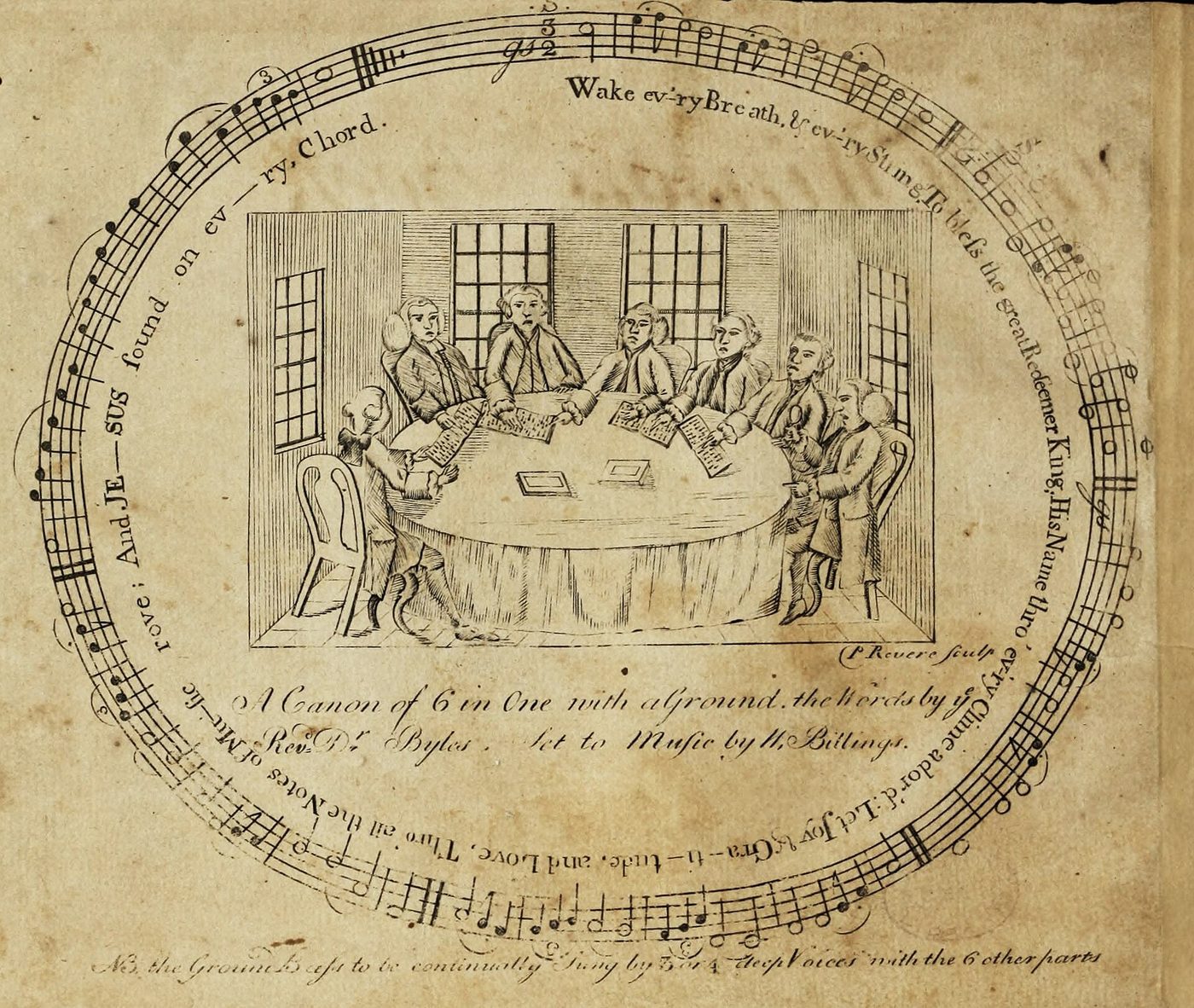
In December 1770 Billings advertised in the Boston Gazette that his book was ready at Edes and Gill's printing office and at "Deacon Elliot's under Liberty-Tree."16 The New-England Psalm-Singer held 127 pieces, all his own. It is recognized as the first American tunebook devoted to the music of one composer and the first made up entirely of American compositions. He was 24, unknown in print, and sold it by subscription after waiting eighteen months for paper.16 Paul Revere engraved the frontispiece, though not the music.17 Billings also petitioned the Massachusetts legislature for copyright protection in 1770 and 1772, the first such request for a musical work in America. The 1772 bill passed, and Governor Thomas Hutchinson refused to sign it.18
His preface is one of the great declarations of independence in American art, written six years before the political one:
"Perhaps it may be expected by some, that I should say something concerning Rules for Composition; to these I answer that Nature is the best Dictator ... for my own Part, as I don't think myself confin'd to any Rules for Composition laid down by any that went before me, neither should I think (were I to pretend to lay down Rules) that any who came after me were any ways obligated to adhere to them ... So in fact, I think it is best for every Composer to be his own Carver."
William Billings, "To all Musical Practitioners," The New-England Psalm-Singer, Boston, 1770.19
Read it fairly. Billings did not throw out skill. In the same passage he wrote that "the more Art is display'd, the more Nature is decorated," and that in a fugue "Art is subservient to Genius, for Fancy goes first, and strikes out the Work roughly, and Art comes after, and polishes it over."19 He wanted freedom with discipline. That is a sound rule for music and for a republic.
Chester
One tune in the 1770 book was named "Chester." In 1778, in the middle of the war, Billings published a new collection, The Singing Master's Assistant, with revised versions of his best tunes. Twenty-two of the 1770 pieces came back, many substantially changed, and the new versions became the standard ones.20 "Chester" now carried words Billings wrote himself:
"Let tyrants shake their iron rod,
William Billings, "Chester," The Singing Master's Assistant, Boston, 1778.21
And Slav'ry clank her galling chains,
We fear them not, we trust in God,
New England's God forever reigns.
Howe and Burgoyne and Clinton too,
With Prescot and Cornwallis join'd,
Together plot our Overthrow ..."
The first verse is a hymn. The second names the British generals one by one. That combination is the heart of it. The singers did not separate their faith from their politics, and they did not think God was a Tory. "Chester" became one of the best-known songs of the Revolution, used as a marching song in the war and sung as a hymn and a patriotic song well into the 1800s.22 It is still sung by choirs across the country, and anyone who hears it once tends to remember the opening line.
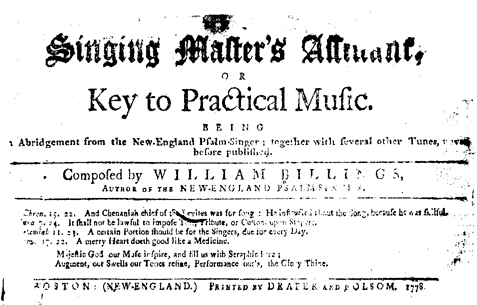
Billings kept writing for twenty more years and had trouble making it pay. Through the 1800s his music fell out of favor with church musicians who wanted European correctness, and his name, as one modern editor put it, became "anathema" to them.23 In the twentieth century scholars and choirs came back to him and decided he had been right all along about being his own carver.
Broadsides and camp ballads
Most Revolutionary songs were not written down in tunebooks. They were printed on single sheets, called broadsides or ballad sheets, with the name of a well-known tune at the top, and sold for pennies in the street. Others lived only in memory. When the New York editor Frank Moore collected them in 1856, he took many from newspapers and "original ballad-sheets and broadsides," and some from "the recollections of a few surviving soldiers, who heard and sang them amid the trials of the camp and field."24
Moore did not oversell what he found. "The poesy of their productions is meagre," he wrote. Nearly every company had its "smart one" or poet who made up verses on the march, and the writers did not write for fame.24 That is exactly why the songs matter. They are the political opinions of ordinary people, in their own rough words, set to tunes they already knew. A tax argument in a pamphlet reached the men who read pamphlets. A tax argument in a ballad reached everyone in the tavern.
Fifes and drums
The music a soldier heard most was not a song at all. It was the drum. Armies of the 1700s used drum and fife calls to give orders, because a voice could not carry over gunfire or across a camp of thousands. The historian Daniel Welch of the American Battlefield Trust describes music in those armies as having several jobs at once: keeping up morale, entertaining in camp, marking the daily routine, and above all controlling men in battle.25
The Continental Army took years to standardize its field music. Baron von Steuben, the Prussian officer who arrived in 1777 and trained the army at Valley Forge, brought it into order. In Washington's camps after Steuben, soldiers woke to "The Reveille," which also ended the sentries' challenges for the night. "The General" was the beat ordering men to strike tents and get ready to march. Calls started at headquarters and were repeated through the camp so every unit heard them.25
The players were often boys. A British military writer of the time recommended young boys as fifers, since their duty was "not very laborious," and many fifers entered the ranks at nine or ten. The Continental Army used more fifers across its units than the British, who allowed them only in grenadier companies.25 Musicians wore distinct uniforms so officers could find them in the smoke.25 A ten-year-old with a fife was a working part of the chain of command.
Myth: The British marched out at Yorktown to "The World Turned Upside Down"
It is a wonderful story, and it is probably not true. Sonneck repeated it in 1909, and the Library of Congress has fielded questions about it since at least 1948. The first time it appears in print is in Alexander Garden's Anecdotes of the American Revolution, second series, published in Charleston in 1828, more than forty years after the surrender. Garden got it secondhand from Major William Jackson of Philadelphia, who said he got it from John Laurens, who had died in 1782.26 No eyewitness account written at the time names the tune. Sonneck himself could not confirm the matching legend that the Americans played "Yankee Doodle" at Yorktown, though he believed a French memoir mentioned it.6
Hymns for a new nation
Every Sunday most Americans sang, and in many Congregational and Presbyterian churches what they sang was Isaac Watts. The English minister's versions of the Psalms were loved for good reason. They also spoke of Great Britain and its king.
After independence that was a problem. In 1785 the General Association of Connecticut, the state's body of Congregational ministers, invited the poet Joel Barlow to revise Watts's Psalms "to remove the allusions to Great Britain and the king" and make them fit for singing in the United States.27 His edition was printed at Hartford that year as Doctor Watts's Imitation of the Psalms of David, corrected and enlarged by Joel Barlow. When the Presbyterian Synod of New York and Philadelphia took up the question of a version "more suitable to our circumstances and taste," Barlow's Watts was allowed in 1787 and printed in special Presbyterian editions well into the 1800s.27
This was done carefully and by church bodies, through their own lawful process. Nobody burned the old hymnals. The churches kept the faith and the poetry and changed the prayers for a king they no longer had. It is the same instinct you can see in the Liberty Song's toast and in Billings's "Chester": keep what is good, refuse what is tyranny, and say why.
A timeline of Revolutionary music
- 1767 Andrew Barton's comic opera The Disappointment, printed in New York, calls for the air "Yankee Doodle," the earliest printed mention Sonneck found.
- 1768 July 4: Dickinson sends the Liberty Song to James Otis. July 18: it appears in the Boston Gazette. August 15: sung at the Liberty Tree. September 26: the Loyalist "Parody." September 29: British bands play "Yankee Doodle" as the troops arrive.
- 1770 December: Billings publishes The New-England Psalm-Singer, with Revere's frontispiece.
- 1772 The Massachusetts legislature passes Billings's copyright bill. Governor Hutchinson does not sign it.
- 1775 April 19: Percy's brigade marches out of Boston playing "Yankee Doodle" in contempt.
- 1777 November 27: the captured British officer Thomas Anburey calls "Yankee Doodle" the Americans' "paean."
- 1778 Billings publishes The Singing Master's Assistant, with "Chester" naming Howe, Burgoyne, Clinton, Prescott and Cornwallis. Steuben's drill reforms spread through the army.
- 1781 October 19: Cornwallis surrenders at Yorktown. Billings publishes The Psalm-Singer's Amusement.
- 1782 Aird's collection in Glasgow prints the oldest surviving music of "Yankee Doodle."
- 1785 Joel Barlow's revision of Watts's Psalms, removing prayers for the king, is printed at Hartford.
- 1828 Alexander Garden first prints the story of "The World Turned Upside Down" at Yorktown.
The songs in this lesson do not have the polish of the paintings in lesson one. That is their strength. Anyone could sing them. A farmer who never read a pamphlet could carry the argument for consent to taxation in his head because it rhymed and fit a tune he had known since childhood. The next lesson turns to the people who did read the pamphlets, and to the pamphlets themselves.
Learn more
- Sonneck, Report on The Star-Spangled Banner, Hail Columbia, America, Yankee Doodle (1909): the Library of Congress study that cleared away the legends about "Yankee Doodle" and laid out the actual evidence.
- Frank Moore, Songs and Ballads of the American Revolution (1856): the Liberty Song, the Loyalist parody and dozens of other songs, with Moore's notes on where he found them.
- Billings's Introduction to The New-England Psalm-Singer: the full preface, "Nature is the best Dictator" and all, from the scholarly edition of his works.
- The Complete Works of William Billings, Introduction: Boston music in 1750 to 1770, Billings's life, and how his first book was made and sold.
- Chester (Song of America): the full text of the 1778 version.
- Music in the 18th-Century Army (American Battlefield Trust): how fifes and drums ran a camp and a battle, and who played them.
- Hamilton Turns the World Upside Down (Library of Congress): a music librarian traces the Yorktown legend to its source.
- Barlow's Revision (1785) (Beinecke Library): the publishing history of the Americanized Watts.
Notes
- New York Journal, October 13, 1768, "Journal of Transactions in Boston," entry for September 29, 1768, quoted in O. G. Sonneck, Report on "The Star-Spangled Banner," "Hail Columbia," "America," "Yankee Doodle" (Washington: Government Printing Office, 1909), 108. Read it online. ↩
- Sonneck, Report, chapter "Yankee Doodle," surveying and rejecting the traditional origin theories. Read it online. ↩
- Sonneck, Report, 110, on Andrew Barton, The Disappointment, or The Force of Credulity (New York, 1767), Air IV, "Yankee Doodle." Read it online. ↩
- Sonneck, Report, on James Aird, A Selection of Scotch, English, Irish and Foreign Airs, vol. 1 (Glasgow), dated 1782. Read it online. ↩
- William Gordon, letter dated Roxbury, April 26, 1775, in his History, quoted in Sonneck, Report, 109. Read it online. ↩
- Thomas Anburey, Travels through the Interior Parts of America, 1st ed., vol. 2, 50, letter dated Cambridge, November 27, 1777, quoted in Sonneck, Report, 109, with Sonneck's comments on the Yorktown legends. Read it online. ↩
- John Trumbull, M'Fingal (Philadelphia, 1775), canto 1, quoted in Sonneck, Report, 110. Read it online. ↩
- John Dickinson to James Otis, July 4 and July 6, 1768, and note on publication in the Boston Gazette, July 18, 1768, in Frank Moore, ed., Songs and Ballads of the American Revolution (New York: D. Appleton, 1856), 36-37. Read it online. ↩
- R. T. H. Halsey, introduction to John Dickinson, Letters from a Farmer in Pennsylvania (New York: The Outlook Company, 1903), reprinting "The Liberty Song" and the account of August 15, 1768, from the Boston Evening Post, August 22, 1768. Read it online. ↩
- Moore, Songs and Ballads, 39-40n, on Dickinson's opposition to the Declaration and his march to Elizabethtown at the head of his regiment. Read it online. ↩
- "The Parody," Boston Gazette, September 26, 1768, in Moore, Songs and Ballads, 41-42. Read it online. ↩
- "The Parody Parodized," St. James's Chronicle (London), November 8, 1768, in Moore, Songs and Ballads, 44-47. Read it online. ↩
- Karl Kroeger, Introduction, The Complete Works of William Billings, vol. 1 (Boston: American Musicological Society and Colonial Society of Massachusetts, 1981), "Music in Boston, 1750-1770" and "The New-England Psalm-Singer: A History and Description." Read it online. ↩
- Complete Works of William Billings, vol. 1, Introduction, note on the engraving of the tunebook, quoting Nathaniel D. Gould's description of Billings. Read it online. ↩
- Complete Works of William Billings, vol. 1, Introduction, on Billings's singing schools after 1770. Read it online. ↩
- Boston Gazette, December 10, 1770, advertisement, and Kroeger's account of the book's contents and publication, in Complete Works of William Billings, vol. 1, Introduction. Read it online. ↩
- Complete Works of William Billings, vol. 1, Introduction, on Revere's frontispiece, its model in William Tans'ur's The Royal Melody Compleat (London, 1755), and the engraving of the music. Read it online. ↩
- Complete Works of William Billings, vol. 1, Introduction, on the copyright petitions of 1770 and 1772. Read it online. ↩
- William Billings, "To all Musical Practitioners," The New-England Psalm-Singer (Boston: Edes and Gill, 1770), in Complete Works of William Billings, vol. 1. Read it online. ↩
- Complete Works of William Billings, vol. 1, Introduction, "The Influence of The New-England Psalm-Singer." Read it online. ↩
- William Billings, "Chester," The Singing Master's Assistant (Boston: Draper and Folsom, 1778), text as given by Song of America. Read it online. ↩
- Complete Works of William Billings, vol. 1, Introduction, on "Chester" as a wartime marching song and its later popularity. Read it online. ↩
- Complete Works of William Billings, vol. 1, Introduction, on Billings's reputation in the nineteenth century. Read it online. ↩
- Moore, Songs and Ballads, Preface, v-vi. Read it online. ↩
- Daniel Welch, "Music in the 18th-Century Army," American Battlefield Trust. Read it online. ↩
- Cait Miller, "Hamilton Turns the World Upside Down," In The Muse: Performing Arts at the Library of Congress, October 26, 2015, citing Alexander Garden, Anecdotes of the American Revolution, 2nd series (Charleston, 1828), 18. Read it online. ↩
- Beinecke Rare Book and Manuscript Library, Yale University, "Barlow's Revision (1785)," quoting Jacob Blanck, Bibliography of American Literature, no. 860, and the history of the Presbyterian editions. Read it online. ↩
Terms in this lesson
- Broadside ballad
- A song printed on one side of a single sheet and sold cheaply in the street, often set to a well-known tune named at the top.
- Contrafactum
- New words written to fit an existing tune. Most Revolutionary songs were made this way, so anyone who knew the tune could sing them at once.
- Tunebook
- An oblong book of psalm and hymn tunes in parts, with a section teaching how to read music, used by singing schools and church choirs.
- Fuging tune
- A psalm tune with a section in which the voices enter one after another with the same melody, overlapping, before coming back together.
- Field music
- The fife and drum calls that gave commands in camp, on the march and in battle, as opposed to a band that played for parades and dinners.
- Singing school
- A course of evening lessons in a town, taught by a traveling singing master, where young people learned to read music and sing in parts.
Sources
- Oscar G. Sonneck, Report on The Star-Spangled Banner, Hail Columbia, America, Yankee Doodle (Library of Congress, 1909), Internet Archive checked 2026-10
- Frank Moore, ed., Songs and Ballads of the American Revolution (1856), Internet Archive checked 2026-10
- John Dickinson, Letters from a Farmer in Pennsylvania, with R. T. H. Halsey's introduction (1903), Project Gutenberg checked 2026-10
- The Complete Works of William Billings, vol. 1, Introduction (Colonial Society of Massachusetts) checked 2026-10
- Billings's Introduction to The New-England Psalm-Singer (Colonial Society of Massachusetts) checked 2026-10
- Chester, by William Billings (Song of America) checked 2026-10
- Daniel Welch, Music in the 18th-Century Army (American Battlefield Trust) checked 2026-10
- Cait Miller, Hamilton Turns the World Upside Down (Library of Congress, In The Muse, 2015) checked 2026-10
- Barlow's Revision (1785) (Beinecke Library, Yale) checked 2026-10