Lesson 15 of 19 · about 40 minutes
Neoconservatism: Ideas, Institutions and Wars, 1965 to 2026
You'll be able to
- Trace the three generations usually grouped as neoconservative, from The Public Interest in 1965 to PNAC in 1997, using their own documents
- State precisely what the 2004 and 2008 Senate Intelligence Committee reports found and did not find
- Distinguish the realist, libertarian, paleoconservative and left critiques of neoconservative foreign policy and state the defenders' strongest case
- Apply Pierson's institutionalism test to the standing authorities and agencies created in 2001 and 2002
Start here: the short version
In the fall of 1965 two writers launching a magazine described how American programs go wrong. By the time anyone learns a program does not fit the problem, they wrote, "an agency has been established, monies appropriated, people and resources committed and the knowledge is not likely to be effectual, or even very welcome." The writers were Daniel Bell and Irving Kristol. The magazine was The Public Interest, the founding journal of neoconservatism. The later generation that carried the label argued for removing Saddam Hussein, and the 2002 Iraq war authorization that followed stayed on the books for twenty-three years. Neoconservatism began in the 1960s as a group of mostly liberal and formerly left-wing writers who doubted that ambitious social programs worked as advertised. Over the next forty years the label passed to a second and third generation more concerned with foreign policy: anti-Soviet Democrats who joined the Reagan administration, then the authors of the 1996 call for "benevolent global hegemony" and the 1997 Project for the New American Century. After September 11, 2001, several people associated with that network held senior posts, and the Bush administration adopted a doctrine of acting against threats "even if uncertainty remains as to the time and place of the enemy's attack." Congress authorized war against Iraq in October 2002. Official investigations later found that most key prewar judgments about Iraqi weapons were wrong, and that some public statements went beyond the intelligence. Both halves of that finding hurt somebody. The same years produced the Department of Homeland Security, now a department of about a quarter million full-time staff. The question here is how a network of writers and officials became a set of standing commitments that outlived the arguments that created them, and whether the founders' own 1965 warning applies to what their heirs left behind.1234
Challenge
If you came in sure the neocons lied the country into Iraq, the Senate Intelligence Committee's unanimous 2004 report found the intelligence agencies got the weapons wrong on their own, with "no evidence" of political pressure, and 81 House Democrats voted for the war authorization. Regime change was already law under Clinton. If you came in sure Iraq was an honest mistake built on bad intelligence, the 2008 report found that statements on al Qaeda ties and on handing weapons to terrorists were "not substantiated" or "contradicted by available intelligence information." Each camp has a finding it would rather skip. Then there is the comfort both camps share, that the label is dead because its magazines are. The Public Interest closed in 2005, and PNAC dissolved in 2006. The 2001 authorization is still in force, and the department built in two years after the attacks employs roughly a quarter of a million people.
The word "neoconservative" is a fight before it is a definition. Irving Kristol, often called the movement's founder, wrote in 2003 that it was "not a 'movement,' as the conspiratorial critics would have it," and preferred the historian Marvin Meyers's word "persuasion," something "that manifests itself over time, but erratically."5 The Brookings historian Justin Vaisse describes it as "at most a network of thinkers sharing an intellectual outlook," with no central authority.6 The label has also been used as an insult, and sometimes as a coded attack on people's religion or ancestry. People are identified here only by what they wrote, signed, voted for or did in office. Signing a statement shows agreement with that statement. Holding an office shows that a person held that office. Neither proves control of anything else.
Origins, 1950 to 1973
The Congress for Cultural Freedom and the CIA
Lesson 13 touched on the anti-Communist intellectual organizations of the early Cold War. The best documented is the Congress for Cultural Freedom, which grew out of a conference of intellectuals in West Berlin in June 1950. A study by the CIA historian Michael Warner, published by the agency's Center for the Study of Intelligence in 1995, opens with a blunt sentence: "The Congress for Cultural Freedom is widely considered one of the CIA's more daring and effective Cold War covert operations." The Congress published journals such as Encounter and hosted dozens of conferences. Its administrative secretary, Michael Josselson, kept it running "for almost two decades until the Agency arranged an amicable separation from the Congress in 1966."7 Warner's account places the planning in the Office of Policy Coordination under Frank Wisner.7
That is a verified fact, and an uncomfortable one for anyone who trusts the Cold War state. A government agency secretly paid for a network of writers to shape opinion abroad. It is just as uncomfortable for anyone who wants a conspiracy, because it does not show that every writer involved knew about the funding, or that later neoconservative journals were intelligence projects. Those would be separate claims requiring separate evidence, and the CIA study does not make them.
The Public Interest, 1965
The domestic project began with a magazine. In the first issue of The Public Interest, in fall 1965, Daniel Bell and Irving Kristol described the typical American policy argument in four steps. Someone says program A will solve problem X. Someone else says it is solving itself. A modified program A is enacted. Then, they wrote, "it is eventually discovered that problem X is really an amalgam of seven other problems," few of which program A will touch. "By this time, however, an agency has been established, monies appropriated, people and resources committed and the knowledge is not likely to be effectual, or even very welcome."1
That sentence reads like a description of institutionalism written forty years before Pierson named it. Bell and Kristol were not attacking government as such. They were saying that once an agency exists, evidence that it does not work arrives too late to matter. They promised "a bias against all such prefabrications," meaning ideologies that "insistently propose prefabricated interpretations of existing social realities," and they called their readers "middle-aged," which they decided was "not such a bad description."1
The name
The label spread in the early 1970s. Vaisse cites a friendly early use in the Wall Street Journal in May 1972 and an unfriendly one in Michael Harrington's essay "The Welfare State and Its Neoconservative Critics," published in Dissent in the fall of 1973.68 Harrington, a socialist, argued that the failures of the welfare state in the 1960s had served as a "stimulus for, and rationale of," the rise of neoconservative thought in the 1970s.8 Whether Harrington was the first to use the word is not settled by the sources reviewed here. He is the best-known early user.
Vaisse's history divides the tendency into three families. The first were "New York-based intellectuals, primarily interested in domestic issues, and they still regarded themselves as liberals." The second were the "Scoop Jackson Democrats of the 1970s and 1980s," named for Senator Henry Jackson of Washington, who broke with their party over detente and arms control and "went to work for the Ronald Reagan administration." The third, the "latter-day neocons," coalesced around The Weekly Standard, launched in 1995, and the American Enterprise Institute.6 Vaisse notes that The Public Interest, "the flagship journal of the original neoconservatives, never dealt with foreign policy."6 The movement most people now associate with the Iraq War began as a magazine that did not cover foreign affairs.
Kristol's own account of the persuasion
Kristol's 2003 essay is the most useful single statement by a participant, because it describes positions that cut against the popular image. On the size of government, he wrote: "Neocons do not feel that kind of alarm or anxiety about the growth of the state in the past century, seeing it as natural, indeed inevitable." They were "impatient with the Hayekian notion that we are on 'the road to serfdom.'"5 On deficits: "Neocons would prefer not to have large budget deficits," but "one sometimes must shoulder budgetary deficits as the cost (temporary, one hopes) of pursuing economic growth."5 He wrote that its twentieth-century heroes "tend to be Theodore Roosevelt, Franklin D. Roosevelt, and Ronald Reagan," and that Coolidge, Hoover, Eisenhower and Goldwater "are politely overlooked."5 He distinguished his camp from "those libertarian conservatives who are conservative in economics but unmindful of the culture."5
On foreign policy he insisted "there is no set of neoconservative beliefs concerning foreign policy, only a set of attitudes derived from historical experience," and listed them as "theses." Patriotism "is a natural and healthy sentiment." World government "is a terrible idea since it can lead to world tyranny." Statesmen "should, above all, have the ability to distinguish friends from enemies." And "for a great power, the 'national interest' is not a geographical term."5 His most quoted line on power was this: "it is a fact that if you have the kind of power we now have, either you will find opportunities to use it or the world will discover them for you."5
In the essay Kristol accepted a large state and accepted deficits. And he described American military superiority as something "planned by no one," which happened "as a result of our bad luck" in a half century of wars, with military spending that "expanded more or less in line with our economic growth."5 Strip it down and it is an argument for keeping a very large standing institution because it already exists and has proved useful. By Pierson's test the first half of that is habit and the second half is performance. Kristol at least made the argument in the open.
The Cold War generation, 1979 to 1989
Kirkpatrick and the double standard
Jeane Kirkpatrick, a Georgetown political scientist and then a Democrat, published "Dictatorships and Double Standards" in Commentary in November 1979. She formally joined the Republican Party in 1985.10 She attacked the Carter administration for undermining allied authoritarian governments in Iran and Nicaragua, only to see them replaced by regimes hostile to the United States and worse for their own people. Her central distinction was between traditional autocracies and revolutionary ones: "Generally speaking, traditional autocrats tolerate social inequities, brutality, and poverty while revolutionary autocracies create them."9
She was skeptical of quick democratization. "No idea holds greater sway in the mind of educated Americans," she wrote, "than the belief that it is possible to democratize governments, anytime, anywhere, under any circumstances." The historical record, she argued, said otherwise: "Decades, if not centuries, are normally required for people to acquire the necessary disciplines and habits."9 Reagan appointed her ambassador to the United Nations. She was appointed January 29, 1981, and served until April 1, 1985.10
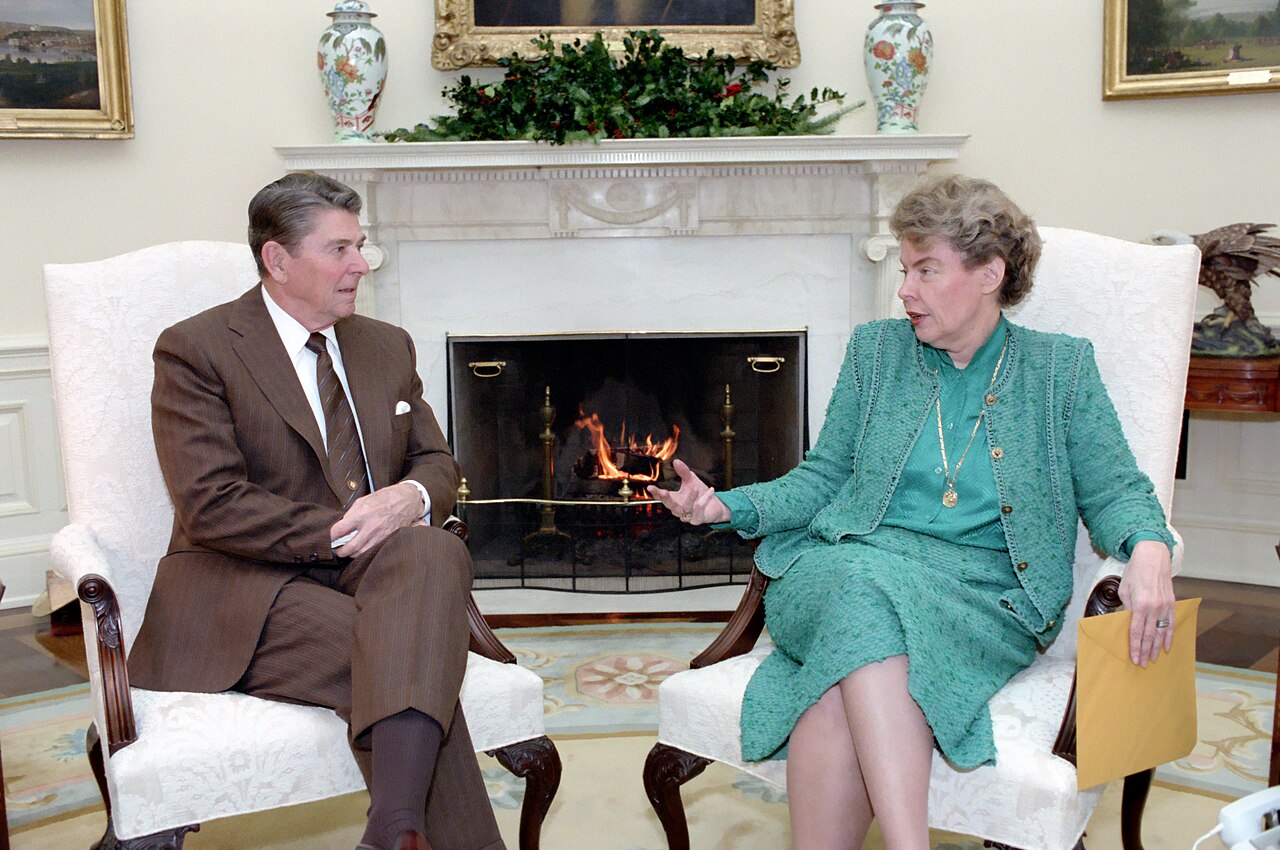

Kirkpatrick's caution sits badly beside what came later. Her essay argued that democracy cannot be installed on demand. A generation later, people associated with the same label argued that removing Saddam Hussein would open the way for a democratic Iraq. Francis Fukuyama, who had worked in that milieu, made a related point in his 2006 break with it: the movement's old skepticism of ambitious social engineering "suggested a cautious approach toward remaking the world."11
Reagan at Westminster
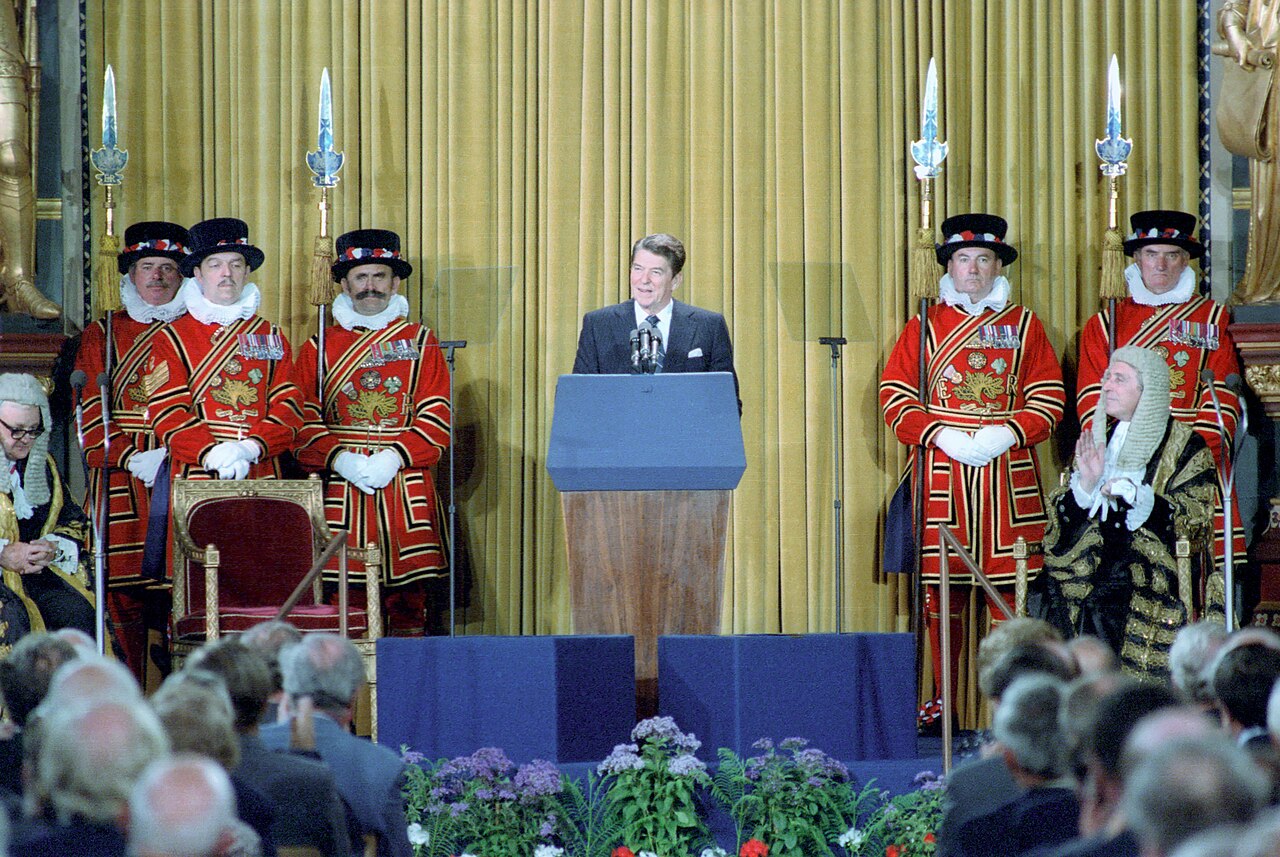
On June 8, 1982, Reagan told the British Parliament that the West should help build "the system of a free press, unions, political parties, universities, which allows a people to choose their own way to develop their own culture." He predicted a "march of freedom and democracy which will leave Marxism-Leninism on the ash-heap of history." In the same passage he called for strengthening NATO while pursuing his "Zero-Option" arms control proposal.12 The speech led to the National Endowment for Democracy, which Vaisse lists among the parts of Reagan's policy that the Jackson Democrats inspired.6 It was a program of political assistance and alliance strength, with no call for invasions.

The paleoconservative objection
Opposition from the right came early. In a Heritage Foundation lecture delivered October 6, 1988, Russell Kirk, author of The Conservative Mind, spoke on "The Neoconservatives: An Endangered Species," a title that matched his view that they had become "a little sect." He credited them with opposing Soviet expansion, but faulted their foreign policy as a "fanciful democratic globalism" in place of the national interest, and warned against treating "Democratic Capitalism" as a kind of quasi-religion. "Ideology, I venture to remind you, is political fanaticism," Kirk said.13 Kristol, fifteen years later, contrasted "the democratic wisdom of Tocqueville" with "the Tory nostalgia of, say, Russell Kirk."5 The two men were describing a real split inside American conservatism, one that reopened in the 1990s and again after 2016.
After the Cold War: hegemony as a program, 1996 to 2000
In the July/August 1996 issue of Foreign Affairs, William Kristol, Irving Kristol's son, and Robert Kagan asked what America's role should be now that the Soviet Union was gone. Their answer was three words: "Benevolent global hegemony." They continued: "The first objective of U.S. foreign policy should be to preserve and enhance that predominance by strengthening America's security, supporting its friends, advancing its interests, and standing up for its principles around the world." They anticipated the objection: "The aspiration to benevolent hegemony might strike some as either hubristic or morally suspect. But a hegemon is nothing more or less than a leader with preponderant influence and authority over all others in its domain."2
The following year the two men founded the Project for the New American Century, which the Clinton Library's finding aid describes as "a Washington conservative foreign policy institute founded by William Kristol and Robert Kagan in 1997."14 Its Statement of Principles, dated June 3, 1997, said "American foreign and defense policy is adrift" and called for four things: increasing defense spending "significantly," strengthening ties to democratic allies and challenging "regimes hostile to our interests and values," promoting "political and economic freedom abroad," and accepting "responsibility for America's unique role in preserving and extending an international order friendly to our security, our prosperity, and our principles." It summed up the program as "a Reaganite policy of military strength and moral clarity."15
The statement had 25 signatories: Elliott Abrams, Gary Bauer, William J. Bennett, Jeb Bush, Dick Cheney, Eliot A. Cohen, Midge Decter, Paula Dobriansky, Steve Forbes, Aaron Friedberg, Francis Fukuyama, Frank Gaffney, Fred C. Ikle, Donald Kagan, Zalmay Khalilzad, I. Lewis Libby, Norman Podhoretz, Dan Quayle, Peter W. Rodman, Stephen P. Rosen, Henry S. Rowen, Donald Rumsfeld, Vin Weber, George Weigel and Paul Wolfowitz.16 Several later held senior posts under George W. Bush: Cheney as Vice President, Rumsfeld as Secretary of Defense, Wolfowitz as Deputy Secretary of Defense, Libby as the Vice President's chief of staff, and Khalilzad as ambassador to Afghanistan and Iraq, among others. The list also includes Fukuyama, who later became one of the movement's sharpest critics. That is the problem with treating a signatory list as a roster of a faction. It records who agreed with one page in 1997.
Regime change becomes law, 1998
On January 26, 1998, PNAC sent President Clinton a letter urging a policy of removing Saddam Hussein.14 Nine months later Congress passed and Clinton signed the Iraq Liberation Act of 1998, approved October 31. Section 3 declared: "It should be the policy of the United States to support efforts to remove the regime headed by Saddam Hussein from power in Iraq and to promote the emergence of a democratic government to replace that regime." Section 8 limited what that meant: "Nothing in this Act shall be construed to authorize or otherwise speak to the use of United States Armed Forces" except for certain assistance.17 So regime change in Iraq was official, bipartisan American policy three years before September 11, signed by a Democratic president. The method was assistance to the Iraqi opposition, and the statute expressly declined to authorize war.
"A new Pearl Harbor"
PNAC's September 2000 report, Rebuilding America's Defenses, is often cited for one phrase. The passage, on printed page 51, discusses the military "transformation" its authors wanted: "the process of transformation, even if it brings revolutionary change, is likely to be a long one, absent some catastrophic and catalyzing event, like a new Pearl Harbor."18 (The report sets off the last phrase with a dash.) Read in context, the sentence is about how slowly the Pentagon changes absent a shock. It is evidence that the authors expected transformation to be slow. It is no evidence of foreknowledge of an attack. Nothing in the report supports that reading, and those who keep quoting the phrase that way are quoting half a sentence. The report lists Donald Kagan and Gary Schmitt as project co-chairmen and Thomas Donnelly as principal author.18
September 11 and the Bush doctrine
The 2001 authorization
Three days after the attacks, on September 14, 2001, the Senate voted 98 to 0 and the House 420 to 1 for a joint resolution authorizing force. The lone House vote against was Representative Barbara Lee of California.1920 Signed September 18, it authorized the President "to use all necessary and appropriate force against those nations, organizations, or persons he determines planned, authorized, committed, or aided the terrorist attacks that occurred on September 11, 2001, or harbored such organizations or persons."21 Idaho's two House members, C. L. "Butch" Otter and Mike Simpson, voted yes, as did Senator Mike Crapo. Senator Larry Craig did not vote.2019 That authorization, sixty words long in its operative clause, has been the legal basis for military operations against groups that did not exist in 2001. It is still in force, a quarter century on.
The National Security Strategy of September 2002
The administration's 2002 National Security Strategy set out the doctrine that came to bear Bush's name. It noted that "international law recognized that nations need not suffer an attack before they can lawfully take action to defend themselves against forces that present an imminent danger of attack," and said, "We must adapt the concept of imminent threat to the capabilities and objectives of today's adversaries." It continued: "The greater the threat, the greater is the risk of inaction," and "the more compelling the case for taking anticipatory action to defend ourselves, even if uncertainty remains as to the time and place of the enemy's attack. To forestall or prevent such hostile acts by our adversaries, the United States will, if necessary, act preemptively."3 It added that the United States "will not use force in all cases to preempt emerging threats, nor should nations use preemption as a pretext for aggression."3
The document used the word "preemptive." Its critics, including Fukuyama, said the policy it described was preventive: acting against a threat that might mature later, rather than one about to strike.11 The difference is large in international law and in practice. A preemptive strike answers visible mobilization. A preventive war rests on a forecast, and forecasts depend on intelligence.
The Iraq authorization, October 2002
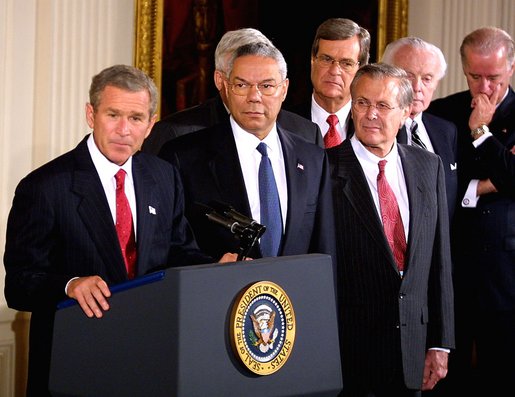
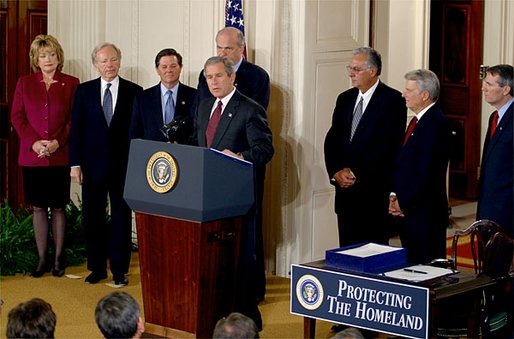
The House passed H.J. Res. 114 on October 10, 2002, by 296 to 133. Republicans voted 215 to 6 in favor; Democrats voted 126 to 81 against.22 The Senate passed it in the early hours of October 11 by 77 to 23.23 Section 3 authorized the President "to use the Armed Forces of the United States as he determines to be necessary and appropriate in order to (1) defend the national security of the United States against the continuing threat posed by Iraq; and (2) enforce all relevant United Nations Security Council resolutions regarding Iraq."24 Bush signed it on October 16.24 Otter and Simpson voted yes in the House, and Craig and Crapo voted yes in the Senate.2223 Those votes show support for the authorization. They say nothing about whether any of the four men belonged to any faction, and no such conclusion is drawn here.

The opposition at the time
The opposition did not come from one side, whatever either side remembers now. On September 26, 2002, the Chronicle of Higher Education reported that 33 international relations scholars had signed a statement, to run as a New York Times advertisement, warning that "war with Iraq will jeopardize the campaign against Al Qaeda." The Chronicle's headline called them realists. John Mearsheimer of the University of Chicago said the signers were limited to security scholars who believe power matters and that the United States must sometimes go to war, a group he described as neither left-wing nor dovish.26 In January 2003 Mearsheimer and Stephen Walt of Harvard published "An Unnecessary War" in Foreign Policy, and on February 2, 2003, they wrote in the New York Times: "The United States faces a clear choice on Iraq: containment or preventive war. President Bush insists that containment has failed and we must prepare for war. In fact, war is not necessary. Containment has worked in the past and can work in the future, even when dealing with Saddam Hussein."2728
On the left, Barack Obama, then an Illinois state senator, told a Chicago rally on October 2, 2002: "I don't oppose all wars." He listed the wars he supported, including the one against those responsible for September 11. "What I am opposed to is a dumb war. What I am opposed to is a rash war."29 In the House, 126 Democrats and 6 Republicans voted against the authorization.22
What the official investigations found
The Iraq Survey Group, with "some 1,750 employees" and visits to "1,200 suspect WMD sites," found no weapons stockpiles. That summary was given by Senator Carl Levin of Michigan at an Armed Services Committee hearing on October 6, 2004, where the group's head, Charles Duelfer, testified. Senator Levin also read from the Duelfer report that "Iraq did not possess a nuclear device, nor had it tried to reconstitute a capability to produce nuclear weapons after 1991," and Duelfer replied, "Sir, I am sure you read it correctly."30 The committee's chairman, Senator John Warner of Virginia, stressed the other half of the findings: the group had "developed a body of fact that shows that Saddam Hussein had: first, the strategic intention to continue to pursue WMD capabilities; and second, created ambiguity about his WMD capabilities."30 Duelfer himself testified that after 1991, Saddam "established as his prime objective" the "termination of U.N. sanctions."30
The 9/11 Commission, reporting in 2004, examined contacts between Iraq and al Qaeda and wrote: "to date we have seen no evidence that these or the earlier contacts ever developed into a collaborative operational relationship. Nor have we seen evidence indicating that Iraq cooperated with al Qaeda in developing or carrying out any attacks against the United States."31
The Senate Intelligence Committee, July 9, 2004
The Senate Select Committee on Intelligence issued the first part of its review, Senate Report 108-301, on July 9, 2004. The committee's Republican minority later referred to it as "the Committee's unanimous Phase I report."32 Its first conclusion reads:
Most of the major key judgments in the Intelligence Community's October 2002 National Intelligence Estimate (NIE), Iraq's Continuing Programs for Weapons of Mass Destruction, either overstated, or were not supported by, the underlying intelligence reporting. A series of failures, particularly in analytic trade craft, led to the mischaracterization of the intelligence.33
The committee found the NIE's statement that Iraq "is reconstituting its nuclear program" was "not supported by the intelligence provided to the Committee." It found the statement that "Baghdad has chemical and biological weapons" "overstated both what was known and what intelligence analysts judged." It also found that "the assessments regarding Iraq's continued development of prohibited ballistic missiles were reasonable."33 Conclusion 3 described "a collective presumption that Iraq had an active and growing weapons of mass destruction (WMD) program," which it called "group think."33
On the question of pressure, the 2004 report was explicit: "The Committee found no evidence that the IC's mischaracterization or exaggeration of the intelligence on Iraq's weapons of mass destruction (WMD) capabilities was the result of political pressure."33 War critics tend to skip that finding. It belongs right beside the findings of error.
The Senate Intelligence Committee, June 5, 2008
The committee's 2008 report asked a different question: whether public statements by officials were supported by the intelligence they had. It was adopted by a majority vote at a meeting on April 1, 2008, and transmitted June 5 with "additional and minority views."34 The committee's press release described the vote as a "bipartisan majority of the Committee (10-5)."35
Its first conclusion is the one most often misquoted in both directions:
Statements by the President, Vice President, Secretary of State and the National Security Advisor regarding a possible Iraqi nuclear weapons program were generally substantiated by intelligence community estimates, but did not convey the substantial disagreements that existed in the intelligence community.34
Other conclusions, as summarized in the committee's release, went further. Statements "suggesting that Iraq and al-Qa'ida had a partnership, or that Iraq had provided al-Qa'ida with weapons training, were not substantiated by the intelligence." Statements by the President and Vice President "indicating that Saddam Hussein was prepared to give weapons of mass destruction to terrorist groups for attacks against the United States were contradicted by available intelligence information." Statements about the postwar situation "did not reflect the concerns and uncertainties expressed in the intelligence products." And "the Intelligence Community did not confirm that Muhammad Atta met an Iraqi intelligence officer in Prague in 2001 as the Vice President repeatedly claimed."35
Chairman John D. Rockefeller IV of West Virginia said: "There is no question we all relied on flawed intelligence. But, there is a fundamental difference between relying on incorrect intelligence and deliberately painting a picture to the American people that you know is not fully accurate."35 The minority, Vice Chairman Christopher Bond of Missouri and Senators Saxby Chambliss, Orrin Hatch and Richard Burr, called the report a "partisan exercise" and argued that "the reports essentially validate what we have been saying all along: that policymakers' statements were substantiated by the intelligence. As the Committee's Phase I report showed, it was the intelligence that was faulty." They noted that "many Democrats in Congress also discussed Iraq's nuclear efforts during the Iraq war debate and in other venues and similarly did not describe disagreements within the intelligence community."32
| Question | 2004 report (S. Rep. 108-301) | 2008 report (S. Rep. 110-345) |
|---|---|---|
| Were the key NIE judgments right? | Most "either overstated, or were not supported by" the reporting; missile assessments reasonable | Not the subject of this report |
| Was there political pressure on analysts? | "No evidence" that mischaracterization resulted from it | Not the subject of this report |
| Did nuclear statements match intelligence? | Not addressed | "Generally substantiated" but omitted "substantial disagreements" |
| Iraq and al Qaeda partnership claims | Not addressed | "Not substantiated by the intelligence" |
| Vote | Unanimous | Majority of 10 to 5, with minority views |
Sources: S. Rep. 108-301; S. Rep. 110-345; committee press release, June 5, 2008.333435
Read together, the two reports support a precise statement. The intelligence community got most of the central weapons judgments wrong, and the committee found no evidence that analysts were pressured into those errors. Some senior officials' public statements, especially on al Qaeda and on handing weapons to terrorists, went beyond or against the intelligence; their statements on the nuclear program tracked the majority estimate but left out the dissents. Neither report found that every advocate of the war lied, and neither found that no one misled. A citizen who says either thing is claiming more than the record shows.
The cost
The best-known academic estimate comes from Neta Crawford of the Costs of War project at Brown University. Her 2023 paper puts the budgetary cost of the wars in Iraq and Syria at about $2.89 trillion through 2050, of which about $1.79 trillion had been spent, with the rest for veterans' care. It estimates that "between 550,000-580,000 people have been killed in Iraq and Syria" since 2003, counting all parties and both countries, with "several times as many" possibly dead from indirect causes.36 Those figures are an estimate by a project that describes its aim as giving "the fullest possible account of the human, economic, political, and environmental costs of U.S. militarism," they include deaths caused by every party to the conflicts, and they include the war against the Islamic State from 2014 on. They are not a count of people killed by American forces, and they should not be quoted as one.
The security bureaucracy
The wars were fought abroad. The institutions they produced at home are still here. The Homeland Security Act of 2002, approved November 25, 2002, established "a Department of Homeland Security, as an executive department of the United States," whose "primary mission" begins with "prevent terrorist attacks within the United States."37 The department describes itself as created by "combining 22 different federal departments and agencies into a unified, integrated Cabinet agency."38 The Intelligence Reform and Terrorism Prevention Act, approved December 17, 2004, created the Office of the Director of National Intelligence, a new layer above the existing intelligence agencies.39

CRS's analysis of the fiscal 2026 request shows the scale. The request funded 256,707 full-time equivalents across DHS, compared with 256,806 in fiscal 2024. Customs and Border Protection was the largest component with 67,964, followed by the Transportation Security Administration at 56,071 and the Coast Guard at 51,892.4 By staff, the department is now led by border enforcement, airport screening and the Coast Guard. Its founding statute put terrorism first.
This is the institutional legacy most Americans meet directly, at an airport checkpoint or a border crossing. It was built in two years. The arguments for it were about a specific threat. The department has lasted on different missions.
The critics, by school
Opposition to neoconservative foreign policy came from at least four directions, and treating them as one camp hides more than it shows.
Realists argued from interests and the balance of power. Mearsheimer and Walt's case in 2003 was that Saddam Hussein "is hardly a reckless aggressor who cannot be contained," that "Iraq has never gone to war in the face of a clear deterrent threat," and that containment was the cheaper and safer course.28 Their objection was strategic and did not rest on moral opposition to the use of force.
Libertarian critics, chiefly at the Cato Institute, added a domestic concern about concentrated state power and the cost of permanent military commitments. In July 2004 Christopher Preble and Justin Logan wrote that "invading and occupying Iraq was never in America's interest," called the democratization agenda "a utopian vision, not a coherent foreign policy framework," and argued that "each problem in the world is not necessarily an American interest."40
Paleoconservatives, in the tradition of Russell Kirk, objected that the project was an ideology wearing conservative clothes, a "democratic globalism" at odds with prudence and national interest.13
Critics on the left attacked the war as an exercise of empire, opposed the doctrine of preventive force, and objected to the domestic security state. In Congress that opposition showed up in the 126 House Democrats who voted against the 2002 authorization and in the single vote against the 2001 authorization.2220
The most influential critique came from inside. In February 2006 Fukuyama, a 1997 PNAC signatory, wrote that "neoconservatism, as both a political symbol and a body of thought, has evolved into something I can no longer support."1116 His argument was that two founding principles had collided: "a belief that American power can be used for moral purposes" and "a view that ambitious social engineering often leads to unexpected consequences and thereby undermines its own ends." The skepticism once aimed at domestic programs "suggested a cautious approach toward remaking the world."11 He concluded that the agenda's problem lay in "the overmilitarized means by which it has sought to accomplish" its ends, and that the Bush administration "did not simply underestimate the difficulty of bringing about congenial political outcomes in places like Iraq; they also misunderstood the way the world would react to the use of American power."11
The defenders' case, in their words
The defense deserves its strongest form, in the defenders' own texts.
American power, the defenders argue, has kept a peace that would not keep itself. Kristol and Kagan answered the old warning against going abroad "in search of monsters to destroy" by writing that the alternative "is to leave monsters on the loose, ravaging and pillaging to their hearts' content, as Americans stand by and watch," and they took the complaint of Russia's and China's leaders about "hegemonism" as something that "should be taken as a compliment."2 PNAC's statement argued that "the history of the 20th century should have taught us that it is important to shape circumstances before crises emerge, and to meet threats before they become dire."15
Totalitarian regimes, they argue, are different in kind. Kirkpatrick's distinction between autocrats who tolerate misery and revolutionaries who create it was an argument against moral equivalence, and against undermining imperfect allies only to empower worse successors.9 Reagan's Westminster speech made the parallel claim that freedom is "the inalienable and universal right of all human beings."12 The Cold War ended on terms the Westminster speech had predicted. Many causes contributed, and no single school can claim it alone, but the defenders' prediction was right.
On Iraq, the defense is that the decision rested on intelligence the whole government believed. The 2008 minority views make this point directly: "it was the intelligence that was faulty," and Democratic members of Congress "similarly did not describe disagreements within the intelligence community."32 The 2004 report found no evidence of political pressure on analysts.33 The Duelfer findings, as Senator Warner summarized them, showed Saddam's "strategic intention to continue to pursue WMD capabilities."30 And regime change had been bipartisan law since 1998.17
And the domestic tradition deserves to be judged on its own. Bell and Kristol's warning that agencies outlive the evidence for them is an argument about performance that a critic of the Iraq War can still accept.1 Failure abroad does not refute an insight about how programs at home behave.
After Iraq, 2008 to 2026
Several of the institutions named in this lesson are gone. Kristol's notice in the Spring 2005 issue of The Public Interest began: "The issue you hold in your hands will be The Public Interest's last."41 The Weekly Standard, founded in 1995, was shut down by its owner in December 2018.42 PNAC dissolved in 2006.14 The people once grouped under the label divided sharply over Donald Trump.
The legal authorities have had a mixed fate. The 2002 Iraq authorization lasted twenty-three years. Senators Todd Young of Indiana and Tim Kaine of Virginia first introduced a bill to repeal it and the 1991 Gulf War authorization in 2019. The House voted for repeal in June 2021 and the Senate in March 2023, but not in the same Congress, so neither repeal took effect.43 Repeal finally came in section 8370 of the National Defense Authorization Act for Fiscal Year 2026, Public Law 119-60, which President Trump signed on December 18, 2025. The section repeals both the 1991 and the 2002 Iraq authorizations.44 The 2001 authorization was not repealed.
The current administration's 2025 National Security Strategy rejects the vocabulary of the 2000s. On the Middle East it says the threat "can and must" be addressed "ideologically and militarily without decades of fruitless 'nation-building' wars," and that "the days in which the Middle East dominated American foreign policy" are over.45 On February 28, 2026, about three months after that strategy was issued, the same administration launched Operation Epic Fury against Iran. The White House listed its objectives: "obliterate Iran's ballistic missile arsenal and production capacity, annihilate its navy, sever its support for terrorist proxies, and ensure the world's leading state sponsor of terrorism will never acquire a nuclear weapon." Vice President Vance said on March 2 that whatever happened to the regime, "it's incidental to the President's primary objective."46 Those are the administration's stated aims. On May 5, 2026, Secretary of State Marco Rubio said the operation had concluded and its objectives were achieved, though the naval blockade of Iranian ports stayed in force. Its results and its legality are not assessed here, and nothing here ties the operation to any intellectual faction. Rejecting the label, the episode shows, has not ended the use of force against regimes the United States regards as threats.
Through Pierson's Framework
Pierson's definition fits this lesson in an unusual way, because the movement's founders wrote a version of it themselves. Bell and Kristol warned in 1965 that by the time anyone learns a program does not work, "an agency has been established, monies appropriated, people and resources committed and the knowledge is not likely to be effectual, or even very welcome."1 Pierson writes that institutionalism is "loyalty to process," that it "assumes continuity equals virtue," and that "the mission is replaced by the machinery, and survival becomes the goal."47 The two descriptions are close. The question is whether the institutions the later movement helped build escaped the trap its founders described.
Apply the name versus function test first. The 2002 strategy called its doctrine "preemptive." What it described, acting "even if uncertainty remains as to the time and place of the enemy's attack," fits the definition of preventive war.3 The 2001 authorization names those who "planned, authorized, committed, or aided the terrorist attacks that occurred on September 11, 2001."21 It has functioned for a quarter century as authority against groups formed later. The Department of Homeland Security's statute lists terrorism first; its largest components today are border enforcement and airport screening.374 Under Pierson's method, each of these is judged by what it does now.
Next, accountability. Pierson's ordered liberty requires that "governments and institutions must operate under law, truth, and justice."48 The record here is better than critics often allow on law and worse than defenders allow on truth. The Iraq war was authorized by a recorded vote of both houses, with the names of every member published.2223 That is accountable government. On truth, the Senate found in 2008 that statements on the al Qaeda link and on weapons transfers to terrorists were "not substantiated" or "contradicted by available intelligence information."35 A citizen asked to support a war is entitled to the uncertainties, and the 2008 report found they were not conveyed. Pierson's Anti-Federalist appendix warns of institutions that "claim moral neutrality while enforcing ideological dogma."49 The 2004 finding of "group think" inside the intelligence community is a case of an institution that failed to test its own assumptions, with no evidence that anyone ordered it to.33
Then the habit test, which carries the most weight here. A policy network is people, journals and arguments. It is not an institution in the legal sense. What turns it into one is the residue it leaves: statutes, departments, standing authorizations and budget lines that continue after the people and journals are gone. The Public Interest closed in 2005.41 The Weekly Standard closed in 2018.42 PNAC dissolved in 2006.14 The 2001 authorization remains in force. The Department of Homeland Security employs roughly a quarter of a million people.4 The 2002 Iraq authorization stayed on the books for twenty-three years after its enactment, until a bipartisan group of senators and representatives finally removed it.4344 Pierson describes institutions that, "once corrupt, do not collapse. They adapt."49 Corruption is not shown by this record. Adaptation is. The authorities and agencies built for one emergency survived by taking on new purposes, and their defense has rested more on the fact of their existence than on a fresh case for each.
The other half of ordered liberty matters too. Pierson's framework is a duty to hold government accountable and a duty to support legitimate government. Nothing in this record makes the officials of 2002 illegitimate, and nothing makes the use of force illegitimate as such. Supporting legitimate government includes taking seriously the defenders' arguments about deterrence, about allies, and about the real danger of the regimes they opposed. Holding government accountable includes asking, of every standing authority and agency left behind, what it does today, and whether it would be created now on the evidence now available. Pierson's test is that institutions "exist to serve liberty, not to redefine it."49 The citizen's role, in his phrase, is to be "the moral auditor of government."50
Hard Questions and Answers
Isn't "neoconservative" just a smear, and too often a coded one? Why use it at all?
Often it has been one, and the complaint is fair. But the people at the center of this lesson used the word themselves. Irving Kristol wrote an essay titled "The Neoconservative Persuasion" in 2003, described himself as "frequently referred to as the 'godfather' of all those neocons," and denied it was a "movement."5 Fukuyama wrote "After Neoconservatism" as a former participant.11 Vaisse, a careful historian, uses it with defined generations.6 It is used here in that historical sense, every claim about a person is tied to a document or a public act, and nobody is classified by religion or ancestry. Where the label gets slapped on anyone who supported the Iraq War or supports Israel, it is not followed here. The 2002 House vote alone included 81 Democrats in favor, and nobody calls them a faction.22
Bush lied the country into Iraq, and the Senate proved it. Why hedge?
Because the Senate did not say that. The 2004 report, adopted unanimously, found the intelligence itself was wrong on most key judgments and found "no evidence" that political pressure caused the errors.33 The 2008 report found the nuclear statements "generally substantiated by intelligence community estimates," though they omitted the "substantial disagreements" inside the community. It also found that other statements, on al Qaeda ties and on handing weapons to terrorists, were "not substantiated" or were "contradicted by available intelligence information."3435 The chairman drew a line between "relying on incorrect intelligence and deliberately painting a picture" known to be inaccurate, and said the administration did the second. The minority disputed that and called the report partisan.3532 The record supports the statement that some officials' public case went beyond the intelligence on specific points. On those points the critics are right, and defenders who wave the whole thing off as bad intelligence are skipping the 2008 findings. It does not establish intent for every official, and a report adopted 10 to 5 is not a judicial finding.
PNAC demanded Saddam's removal in 1998 and wrote about "a new Pearl Harbor" in 2000. Then its signers held the top two posts at the Pentagon. How is that not a plan?
PNAC argued for regime change before September 11, in its January 1998 letter to Clinton.14 So did Congress: the Iraq Liberation Act of 1998 made regime change official policy, passed with bipartisan support, and was signed by a Democratic president.17 The difference is method. The 1998 act expressly declined to authorize the use of armed forces.17 PNAC was an advocacy group with a chairman, a few directors and an executive director.18 Several signers of its 1997 statement later held high office, and Fukuyama, another signer, became a leading critic.1611 Advocacy plus later office-holding shows influence, and the influence was real. It does not show that a think tank planned or directed a war, and the "new Pearl Harbor" sentence in the 2000 report, read in context, concerns the pace of military modernization.18
The neoconservatives called the Cold War right, and the Soviet Union collapsed. Why isn't that the end of the argument?
It vindicates parts of their argument, and that should be said plainly. Kirkpatrick's distinction between authoritarian and totalitarian regimes, Reagan's support for democratic institutions abroad, and the defense buildup of the 1980s were all positions associated with the second generation, and the Soviet Union did collapse.9126 Many other causes contributed, including Soviet economic failure, allied policy, the Polish and Baltic movements and decisions in Moscow, and no single school can claim sole credit. But the Cold War record is an argument about the second generation. The Iraq decision belongs to the third. Kirkpatrick's own warning that democracy normally takes "decades, if not centuries" to build is closer to the realist critics of 2003 than to the advocates of a democratic Iraq.9 Credit for the Cold War does not carry over to Iraq.
Blaming DHS on a few magazine writers is absurd. The whole country wanted it after September 11. Isn't this guilt by association?
On the founding, largely yes. The 2001 authorization passed 98 to 0 and 420 to 1, and the Homeland Security Act reflected a broad consensus after the attacks.192037 It would be wrong to attribute DHS to a small group of writers. The link drawn here is of a different kind. The neoconservative network supplied the most developed argument of the period for a large, permanent, forward-leaning national security establishment, and Kristol defended American military predominance as a fact to be accepted and used.5 The institutional point does not depend on who deserves credit or blame. It is that the authorities and agencies created in 2001 and 2002 have outlasted the circumstances that produced them, and that their continuation now rests more on habit than on a renewed vote. The repeal of the 2002 Iraq authorization in December 2025 shows that Congress can revisit such commitments when it chooses to.44
The administration swore off nation-building wars, then struck Iran about three months later. Isn't the anti-neocon talk just a change of costume?
Too soon to say, and the record is too new to support the claim. The 2025 strategy rejects "decades of fruitless 'nation-building' wars," and the administration's stated objectives for the Iran operation are military targets and a nuclear goal, with the Vice President calling the regime's fate "incidental."4546 That is a different stated aim from the 2003 goal of a democratic Iraq. It is also a large use of force against a hostile regime on the basis of a threat assessment. The operational record, legal analysis and casualty data needed to judge it are not in hand here. Supporters who call it a clean break from the Bush years are outrunning the record just as far. What can be said is narrower. Rejecting a label is not the same as abandoning the instruments the label's advocates built, and the 2001 authorization, the national security bureaucracy and the habit of acting on contested intelligence all remain available to any administration.
Learn more
- Senate Report 108-301 (2004): the Intelligence Committee's review of the prewar estimates; the overall conclusions begin on page 14.
- Senate Report 110-345 (2008): whether officials' public statements matched the intelligence, with minority views.
- Public Law 107-243: the 2002 Iraq authorization as enacted.
- National Security Strategy, September 2002: the preemption doctrine in full.
- Irving Kristol, "The Neoconservative Persuasion" (2003): the founder's own three-page account.
- Bell and Kristol, "What Is the Public Interest?" (1965): the domestic project's founding editorial.
- CIA, Origins of the Congress for Cultural Freedom: the agency's own history of its covert cultural program.
- Justin Vaisse, Why Neoconservatism Still Matters (Brookings, 2010): a historian's account of the three generations.
- Francis Fukuyama, "After Neoconservatism" (2006): the critique from a former participant.
- Module 72: The Political Matrix: placing movements by their relationship to institutional power.
Notes
- Daniel Bell and Irving Kristol, "What Is the Public Interest?" (editorial), The Public Interest, no. 1 (Fall 1965), pp. 3 to 5. Read it online. ↩
- William Kristol and Robert Kagan, "Toward a Neo-Reaganite Foreign Policy," Foreign Affairs 75, no. 4 (July/August 1996), reproduced by the Carnegie Endowment. Read it online. ↩
- The White House, The National Security Strategy of the United States of America, September 2002, section V. Read it online. ↩
- Congressional Research Service, Understanding the FY2026 DHS Budget Request, Report R48704 (September 5, 2025), "DHS Staffing," Tables 6 and 7. Read it online. Mirror at EveryCRSReport. ↩
- Irving Kristol, "The Neoconservative Persuasion," AEI On the Issues, September 2003 (a version appeared in The Weekly Standard, August 25, 2003). Read it online. ↩
- Justin Vaisse, Why Neoconservatism Still Matters, Brookings Foreign Policy Paper No. 20 (May 2010), pp. 1 to 3 and note 1. Read it online. ↩
- Michael Warner, "Origins of the Congress for Cultural Freedom, 1949-50," Studies in Intelligence (CIA Center for the Study of Intelligence, 1995), web summary and full PDF. Read it online. ↩
- Michael Harrington, "The Welfare State and Its Neoconservative Critics," Dissent, Fall 1973 (opening paragraphs available without subscription). Read it online. ↩
- Jeane J. Kirkpatrick, "Dictatorships and Double Standards," Commentary, November 1979 (text reproduced by Ruhr-Universitat Bochum source collection). Read it online. ↩
- U.S. Department of State, Office of the Historian, "Jeane Jordan Kirkpatrick (1926-2006)," Principal Officers and Chiefs of Mission. Read it online. Her Georgetown professorship and her formal move to the Republican Party in 1985: Encyclopaedia Britannica, "Jeane Kirkpatrick." Read it online. ↩
- Francis Fukuyama, "After Neoconservatism," New York Times Magazine, February 19, 2006 (reproduction at California State University, Bakersfield). Read it online. ↩
- Ronald Reagan, "Address to Members of the British Parliament," June 8, 1982, Ronald Reagan Presidential Library. Read it online. ↩
- Russell Kirk, "The Neoconservatives: An Endangered Species," lecture delivered October 6, 1988, Heritage Foundation, published December 15, 1988. Read it online. ↩
- William J. Clinton Presidential Library, finding aid, "Project for a New American Century (PNAC)," FOIA 2015-0653-F. Read it online. ↩
- Project for the New American Century, "Statement of Principles," June 3, 1997, reproduced in the University of Leeds Phil Taylor papers. Read it online. ↩
- Project for the New American Century, "Statement of Principles," June 3, 1997, copy with signatory list (rrojasdatabank.info). The signatory list could not be retrieved from an archived copy of PNAC's own site; it matches the list reported in secondary sources. Read it online. ↩
- Iraq Liberation Act of 1998, Pub. L. 105-338, 112 Stat. 3178 (Oct. 31, 1998), sections 3 and 8. Read it online. ↩
- Project for the New American Century, Rebuilding America's Defenses: Strategy, Forces and Resources for a New Century (September 2000), front matter and p. 51. Read it online. ↩
- U.S. Senate, Roll Call Vote 281, 107th Congress, 1st Session, S.J. Res. 23, September 14, 2001. Read it online. ↩
- Office of the Clerk, U.S. House of Representatives, Roll Call 342, H.J. Res. 64, September 14, 2001. Read it online. ↩
- Authorization for Use of Military Force, Pub. L. 107-40, 115 Stat. 224 (Sept. 18, 2001), section 2. Read it online. ↩
- Office of the Clerk, U.S. House of Representatives, Roll Call 455, H.J. Res. 114, October 10, 2002. Read it online. ↩
- U.S. Senate, Roll Call Vote 237, 107th Congress, 2nd Session, H.J. Res. 114, October 11, 2002. Read it online. ↩
- Authorization for Use of Military Force Against Iraq Resolution of 2002, Pub. L. 107-243, 116 Stat. 1498 (Oct. 16, 2002), section 3. Read it online. ↩
- White House photo by Paul Morse, "President George W. Bush signs H.J. Resolution 114," October 16, 2002, Wikimedia Commons file page. Read it online. ↩
- "Realist Foreign-Policy Scholars Denounce Push to Attack Iraq," Chronicle of Higher Education, September 26, 2002. Read it online. ↩
- John J. Mearsheimer and Stephen M. Walt, "An Unnecessary War," Foreign Policy, no. 134 (January-February 2003), pp. 51 to 59, citation at Harvard Kennedy School. Read it online. ↩
- John J. Mearsheimer and Stephen M. Walt, "Keeping Saddam Hussein in a Box," New York Times, February 2, 2003, sec. 4, p. 15 (copy on Mearsheimer's site). Read it online. ↩
- Barack Obama, speech against the Iraq war, Chicago, October 2, 2002, transcript published by NPR. Read it online. ↩
- Senate Committee on Armed Services, The Report of the Special Advisor to the Director of Central Intelligence for Strategy Regarding Iraqi Weapons of Mass Destruction Programs, S. Hrg. 108-855, hearing of October 6, 2004. Read it online. ↩
- National Commission on Terrorist Attacks Upon the United States, The 9/11 Commission Report (2004), chapter 2, p. 66. Read it online. ↩
- S. Rep. No. 110-345 (2008), Minority Views of Vice Chairman Bond and Senators Chambliss, Hatch and Burr. Read it online. ↩
- Senate Select Committee on Intelligence, Report on the U.S. Intelligence Community's Prewar Intelligence Assessments on Iraq, S. Rep. No. 108-301 (July 9, 2004), Overall Conclusions 1 to 3, pp. 14 to 18. Read it online. ↩
- Senate Select Committee on Intelligence, Report on Whether Public Statements Regarding Iraq by U.S. Government Officials Were Substantiated by Intelligence Information, S. Rep. No. 110-345 (June 5, 2008), transmittal letter and Conclusion 1. Read it online. ↩
- Senate Select Committee on Intelligence, "Senate Intelligence Committee Unveils Final Phase II Reports on Prewar Iraq Intelligence," press release, June 5, 2008. Read it online. ↩
- Neta C. Crawford, "Blood and Treasure: United States Budgetary Costs and Human Costs of 20 Years of War in Iraq and Syria, 2003-2023," Costs of War, Watson Institute, Brown University, March 15, 2023. Read it online. The project's description of its aim is from its About page. Read it online. ↩
- Homeland Security Act of 2002, Pub. L. 107-296, 116 Stat. 2135 (Nov. 25, 2002), section 101. Read it online. ↩
- U.S. Department of Homeland Security, "History" page. Read it online. ↩
- Intelligence Reform and Terrorism Prevention Act of 2004, Pub. L. 108-458, 118 Stat. 3638 (Dec. 17, 2004). Read it online. ↩
- Christopher A. Preble and Justin Logan, "Neocons Forced to Face Reality," Cato Institute commentary, July 26, 2004. Read it online. ↩
- Irving Kristol, "Notice to Our Readers," The Public Interest, Spring 2005 (final issue), National Affairs archive. Read it online. ↩
- Ron Kampeas, "Owners shut down conservative flagship Weekly Standard," Jewish Telegraphic Agency, December 14, 2018. Read it online. ↩
- Office of Senator Todd Young, "Young, Kaine Applaud Inclusion of Bipartisan Legislation to Formally End Iraq Wars in FY26 NDAA," December 9, 2025. Read it online. ↩
- National Defense Authorization Act for Fiscal Year 2026, Pub. L. 119-60 (S. 1071, Dec. 18, 2025), section 8370, "Repeal of Authorizations for Use of Military Force relating to Iraq," 139 Stat. 1906 to 1907. Read it online. See also Office of Representative Chip Roy, "Rep. Roy Celebrates the Repeal of the 1991, 2002 Authorizations for Use of Military Force (AUMFs) in Final NDAA," December 18, 2025. Read it online. ↩
- The White House, National Security Strategy of the United States of America, November 2025 (released December 2025). Read it online. ↩
- The White House, "Operation Epic Fury: Decisive American Power to Crush Iran's Terror Regime," March 12, 2026 (quoting Vice President Vance, March 2, 2026). Read it online. Launch date: U.S. Central Command, "U.S. Forces Launch Operation Epic Fury," February 28, 2026. Read it online. ↩
- Jeff A. Pierson, "The Acacia Illusion: How Institutionalism Mimics Nature's Most Subtle Manipulation," in The Ordered Liberty Papers (2025). Read it online. ↩
- Jeff A. Pierson, Ordered Liberty Reclaimed: A Foundation for Liberty. Read it online. ↩
- Jeff A. Pierson, "The Anti-Federalist Warning: Institutional Power and the Fragility of Liberty," appendix to Ordered Liberty Reclaimed: A Foundation for Liberty. Read it online. ↩
- Jeff A. Pierson, The Ordered Liberty Papers (section on Civic Anti-Authoritarianism). Read it online. ↩
Terms in this lesson
- Neoconservatism
- A contested label for a network of writers and officials, beginning with 1960s liberals skeptical of social programs and later associated with a strong anti-Soviet and then democracy-promoting foreign policy. Irving Kristol called it a persuasion rather than a movement.
- Preemption
- Using force against an enemy that is about to attack. The 2002 National Security Strategy used this word for acting against threats even when the time and place of attack were uncertain.
- Preventive war
- War begun to stop a threat that might develop in the future, rather than one about to strike. Critics argued the 2002 doctrine was in fact preventive.
- AUMF
- Authorization for Use of Military Force, a joint resolution in which Congress authorizes the President to use the armed forces. The 2001 AUMF remains in force; the 2002 Iraq AUMF was repealed in December 2025.
- National Intelligence Estimate
- The intelligence community's coordinated written judgment on a national security question. The October 2002 NIE on Iraqi weapons was the main subject of the 2004 Senate report.
- Benevolent global hegemony
- William Kristol and Robert Kagan's 1996 phrase for the role they argued the United States should take after the Cold War: preserving and enhancing American predominance.
- Realism
- A school of foreign policy thought that judges policy by national interest and the balance of power. Leading realists such as John Mearsheimer and Stephen Walt opposed the Iraq War as unnecessary because Iraq could be contained.
- Paleoconservatism
- A traditionalist strand of American conservatism, associated with Russell Kirk and others, that criticized neoconservatives for ideological globalism.
- Groupthink
- The Senate Intelligence Committee's 2004 description of the intelligence community's shared presumption that Iraq had active and growing weapons programs.
- Congress for Cultural Freedom
- An anti-Communist organization of intellectuals founded in Berlin in 1950 and covertly supported by the CIA until 1966, according to the CIA's own published history.
Sources
- S. Rep. 108-301, Prewar Intelligence Assessments on Iraq (2004) checked 2026-10
- S. Rep. 110-345, Whether Public Statements Were Substantiated (2008) checked 2026-10
- Pub. L. 107-243, Iraq AUMF (2002) checked 2026-10
- Pub. L. 107-40, AUMF (2001) checked 2026-10
- National Security Strategy (2002) checked 2026-10
- Irving Kristol, The Neoconservative Persuasion (2003) checked 2026-10
- Bell and Kristol, What Is the Public Interest? (1965) checked 2026-10
- Kirkpatrick, Dictatorships and Double Standards (1979) checked 2026-10
- Kristol and Kagan, Toward a Neo-Reaganite Foreign Policy (1996) checked 2026-10
- PNAC Statement of Principles (1997) checked 2026-10
- Fukuyama, After Neoconservatism (2006) checked 2026-10
- Warner, Origins of the Congress for Cultural Freedom (CIA) checked 2026-10
- Homeland Security Act of 2002, Pub. L. 107-296 checked 2026-10
- Vaisse, Why Neoconservatism Still Matters (Brookings, 2010) checked 2026-10
- National Defense Authorization Act for Fiscal Year 2026, Pub. L. 119-60, sec. 8370 checked 2026-10
- U.S. Central Command, U.S. Forces Launch Operation Epic Fury (Feb. 28, 2026) checked 2026-10
- Encyclopaedia Britannica, Jeane Kirkpatrick checked 2026-10