Lesson 8 of 19 · about 30 minutes
Legislative Courts, the Bank War and Nullification, 1816 to 1861
You'll be able to
- Describe the 1816 charter of the Second Bank of the United States and the legal grounds of Jackson's 1832 veto and the 1833 removal of deposits
- Explain the Nullification Crisis from Calhoun's 1828 Exposition through the South Carolina Ordinance, Jackson's Proclamation, the Force Bill and the compromise tariff of 1833
- State what Murray's Lessee v. Hoboken Land and Improvement Co. (1856) held about public rights and why the Supreme Court still cites it
- Use federal employment figures to show how the Post Office became the largest federal institution and the engine of patronage before 1861
Start here: the short version
A federal marshal sold a former customs collector's New Jersey land to cover a debt that Treasury auditors had certified and no court had ever tried. The Supreme Court upheld the sale, and the category it used to do it, "public rights," outlasted every loud fight of the era. From 1816 to 1861 the United States built its first large national institutions and then fought over who owned them. Congress chartered a private national bank that held the government's money. Andrew Jackson vetoed its renewal in 1832 and pulled the federal deposits out in 1833, and the Senate censured him for it. South Carolina declared two federal tariffs void, and Jackson answered that a state could not annul a federal law. Quietly, in the same decades, Congress created a Court of Claims that could only recommend payments, and the Post Office grew into a patronage machine that employed most of the civilian government. Several of these forms are still with us. Ask of each one: who built it, on what authority, who did it answer to, and did it later defend itself on habit rather than performance?
Challenge
If you admire Jackson for slaying the money power, his rotation in office turned the Post Office, most of the federal workforce, into a party machine. If you admire the Bank as sound central banking, its president answered a threat to its charter by squeezing credit across the country to save the institution. If states' rights sounds like liberty's natural defense, South Carolina's version opened by barring appeals and making jurors swear to enforce the Ordinance before they could sit. If limited-government language reassures you, Taney wrote some of the best of it in Dred Scott, in an opinion that protected slavery. And if you trust precedent to stay inside the limits its authors drew, Curtis wrote his limit into the same paragraph as his exception in Murray's Lessee. The exception is the half that grew.
The War of 1812 left the government broke. Total public debt rose from $45.2 million on January 1, 1812, to $119.2 million by September 30, 1815, according to the Treasury's own history of the debt.1 State banks had stopped redeeming their notes in coin, and President James Madison, who had fought Hamilton's first national bank in 1791, decided the country needed another one.2 That decision opened a forty-five-year argument over a question the Constitution never answered in plain words: when the national government needs an instrument, may it charter a corporation, hand it public money, and let private shareholders run it?
The answer the period reached was messy. The Bank came and went. Nullification was defeated as law but survived as an idea until it fed secession. And while the loud fights drew the newspapers, Congress and the courts built smaller, quieter forms that outlived all of them: the claims court that only advised Congress, the summary distress warrant upheld under "public rights," and a federal workforce sorted by party loyalty. Those quiet forms matter most to the history of institutionalism, because nobody campaigned on them.
The Second Bank: a corporation holding the public purse
What the 1816 charter built
Madison signed the charter on April 10, 1816. The statute created "a bank of the United States of America" with "a capital of thirty-five millions of dollars, divided into three hundred and fifty thousand shares, of one hundred dollars each share." The United States itself subscribed 70,000 of those shares, or $7 million. The rest went to private buyers.3 The corporation was to exist under the name "The president, directors, and company, of the bank of the United States" until "the third day of March, in the year one thousand eight hundred and thirty-six."3 It had twenty-five directors. The President of the United States appointed five, with Senate confirmation, and the private shareholders elected the other twenty.32
Two clauses carried most of the power. Section 16 required that federal deposits "shall be made in said bank or branches thereof, unless the Secretary of the Treasury shall at any time otherwise order and direct; in which case the Secretary of the Treasury shall immediately lay before Congress" his reasons.3 Section 21 provided that "no other bank shall be established by any future law of the United States during the continuance of the corporation," a promise "for which the faith of the United States is hereby pledged," with an exception for banks in the District of Columbia. Under section 20, in exchange for "the exclusive privileges and benefits conferred by this act," the Bank paid the government a bonus of $1.5 million in three installments.3 That is a charter in the colonial sense covered in lesson 3: a monopoly sold by the sovereign to a private company for a fee and a public service.
The Bank opened in Philadelphia in January 1817 and eventually ran twenty-five branches. It acted as the government's fiscal agent, holding deposits, making payments and helping sell federal debt, and it policed state banks by collecting their notes and presenting them for gold or silver.2 The Federal Reserve's history essay says that by managing its lending and its accounts the Bank could, and did, "alter the supply of money and credit in the economy."2 Its first president, William Jones, a former Navy secretary who had gone bankrupt, extended too much credit and then reversed too quickly. His successor in 1819, Langdon Cheves, cut the Bank's notes in circulation in half and presented state notes for specie, which pushed many state banks into failure during the depression that followed.2 Nicholas Biddle took over in 1823. The essay calls him "an excellent administrator who understood banking," and the same essay records that he "refused to accept any criticism of the Bank's operations" and was "not above allowing the Bank to make loans to his friends while denying loans to those less friendly."2
McCulloch v. Maryland and the power to tax
Maryland tried to tax the Baltimore branch by requiring its notes to be printed on stamped paper bought from the state. The cashier, James McCulloch, refused, and the case reached the Supreme Court in its February Term, 1819.4 Chief Justice John Marshall's opinion settled two questions. On the first, whether Congress could charter a bank at all, he wrote that "we must never forget that it is a constitution we are expounding," and gave the test that still governs implied powers: "Let the end be legitimate, let it be within the scope of the constitution, and all means which are appropriate, which are plainly adapted to that end," and which the Constitution does not forbid and which "consist with the letter and spirit of the constitution, are constitutional."4 On the second, whether Maryland could tax the branch, Marshall held that "the power to tax involves the power to destroy" and that a state could not control the constitutional measures of the national government.4
McCulloch is often read as the birth certificate of a large national government. It is narrower than that. It held that Congress may choose a corporation as a means, and that a state may not tax that means out of existence. It did not hold that Congress must keep the corporation, and it did not bind the President or Congress in deciding whether a bank was still needed. Jackson would lean hard on that gap.
The Bank War, 1829 to 1836
Jackson's opening shot
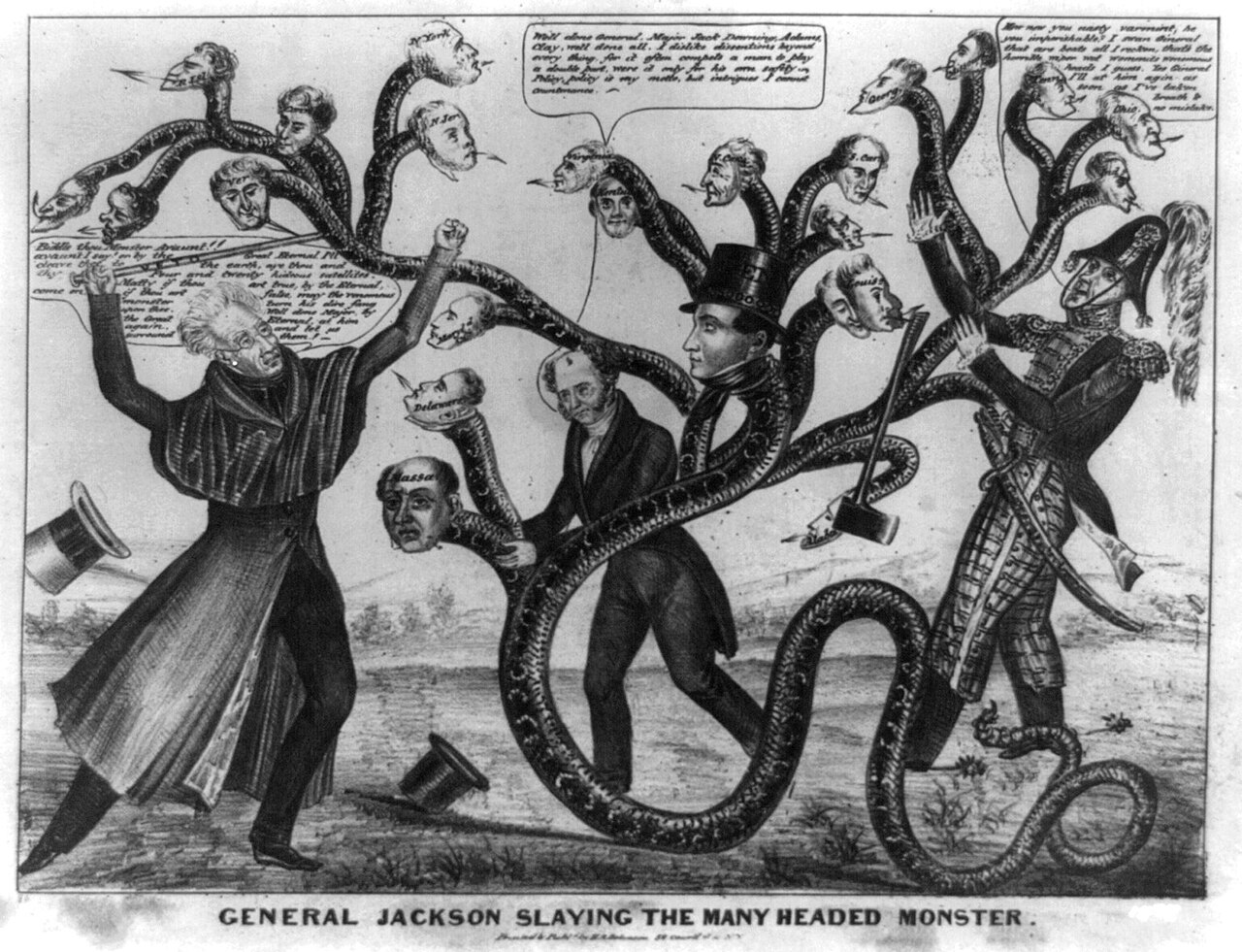
In his first annual message, December 8, 1829, Jackson put the Bank on notice more than six years before its charter expired: "Both the constitutionality and the expediency of the law creating this bank are well questioned by a large portion of our fellow citizens, and it must be admitted by all that it has failed in the great end of establishing an uniform and sound currency."5 The Bank's allies decided to force the issue before the 1832 election. A renewal bill went to Congress in January 1832, four years early, and passed both houses.2
The veto message of July 10, 1832
Jackson's veto is one of the most quoted state papers of the century, and it repays a full reading rather than the two famous lines. Its first argument is about monopoly and price. The Bank, he wrote, "enjoys an exclusive privilege of banking under the authority of the General Government, a monopoly of its favor and support, and, as a necessary consequence, almost a monopoly of the foreign and domestic exchange."6 The original charter, by raising the value of the stock "far above its par value, operated as a gratuity of many millions to the stockholders," and the renewal would hand "another gratuity to the holders of the same stock, and in many cases to the same men, of at least seven millions more."6 Then the line that drew the most fire: "More than eight millions of the stock of this bank are held by foreigners."6
The second argument is about who interprets the Constitution. Jackson conceded nothing to McCulloch: "If the opinion of the Supreme Court covered the whole ground of this act, it ought not to control the coordinate authorities of this Government. The Congress, the Executive, and the Court must each for itself be guided by its own opinion of the Constitution. Each public officer who takes an oath to support the Constitution swears that he will support it as he understands it, and not as it is understood by others."6 Whatever one thinks of the Bank, that passage states a theory of departmental review that every later President has used when it suited him.
The third argument is moral:
It is to be regretted that the rich and powerful too often bend the acts of government to their selfish purposes. Distinctions in society will always exist under every just government. Equality of talents, of education, or of wealth can not be produced by human institutions. In the full enjoyment of the gifts of Heaven and the fruits of superior industry, economy, and virtue, every man is equally entitled to protection by law; but when the laws undertake to add to these natural and just advantages artificial distinctions, to grant titles, gratuities, and exclusive privileges, to make the rich richer and the potent more powerful, the humble members of society-the farmers, mechanics, and laborers-who have neither the time nor the means of securing like favors to themselves, have a right to complain of the injustice of their Government.6
He went on: "There are no necessary evils in government. Its evils exist only in its abuses."6 The supporters of the Bank could not muster two thirds to override.2 Jackson decisively defeated Senator Henry Clay in the 1832 election and read the result as a mandate.72
Removing the deposits and the censure
Section 16 of the charter gave the Secretary of the Treasury, and only the Secretary, the power to stop placing federal money in the Bank, on condition that he report his reasons to Congress. Jackson told Treasury Secretary William J. Duane to do it. Duane refused. On September 23, 1833, Jackson dismissed him and gave a recess appointment to Attorney General Roger Taney, who shared his view of the Bank. Taney moved the federal deposits into a set of state banks and sent his reasons to Congress in December.7 Most of the government's money was out of the Bank by late 1833.2
Biddle's answer was to contract credit, hoping a squeeze would turn the public against Jackson. The Federal Reserve's essay judges that the move "backfired: in the end, it helped to support Jackson's claim that the Bank had been created to serve the interests of the wealthy, not to meet the nation's financial needs."2 In April 1834 the House voted against rechartering the Bank and confirmed that federal deposits should stay in the state banks.2
The Senate, under Clay's anti-administration majority, took the other side. After ten weeks of debate it voted 26 to 20 on March 28, 1834, to adopt a resolution that "the President, in the late executive proceeding in relation to the public revenue, has assumed upon himself authority and power not conferred by the Constitution and laws, but in derogation of both."7 No other President has been censured by the Senate. Jackson sent a long protest. The Senate refused to print it in its journal. Senator Thomas Hart Benton of Missouri spent three years trying to erase the censure, and on January 16, 1837, with Democrats back in the majority, the Secretary of the Senate drew black lines around the resolution in the handwritten journal and wrote across it "Expunged by order of the Senate."8 The expunging resolution, as Benton later printed it, had prescribed the words "Expunged by order of the Senate," followed by the day and year. One Senate Historical Office page renders the endorsement as "Expunged by the order of the Senate." The National Archives, which holds the manuscript journal, transcribes the words actually written as "Expunged by order of the Senate this Sixteenth day of January in the year of our Lord, 1837."337
The charter expired on March 3, 1836, as the statute said it would.3 The Treasury's debt history adds a fact that both sides used: by January 1835, "for the first and only time, all of the government's interest-bearing debt was paid off," and the 1835 surplus of $17.9 million exceeded the government's total spending that year.1 What followed for the state banks that took the deposits, and how far the financial troubles of the late 1830s traced to Jackson's policy, is a question economic historians still argue, and the sources here do not settle it.
Internal improvements and the Maysville Road veto
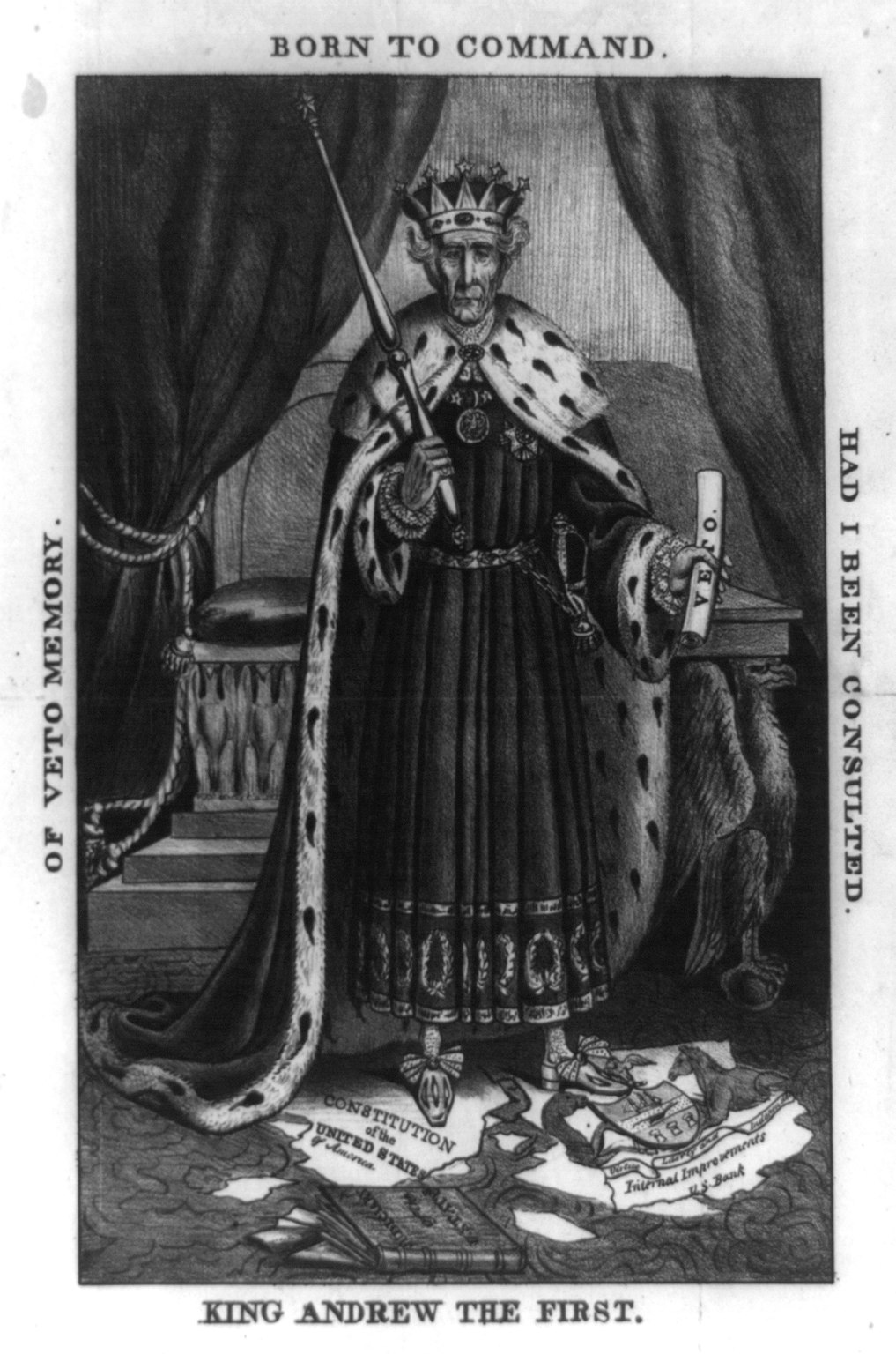
The same quarrel over federal means ran through roads and canals. In May 1830 Congress passed a bill "proposing to authorize 'a subscription of stock in the Maysville, Washington, Paris, and Lexington Turnpike Road Company,'" a Kentucky road. The government would have become a shareholder in a private turnpike company. Jackson vetoed it on May 27, 1830. He could not view the bill "in any other light than as a measure of purely local character; or, if it can be considered national, that no further distinction between the appropriate duties of the General and State Governments need be attempted, for there can be no local interest that may not with equal propriety be denominated national. It has no connection with any established system of improvements; is exclusively within the limits of a State, starting at a point on the Ohio River and running out 60 miles to an interior town."9 Four days later he returned a bill to subscribe for stock in the Washington Turnpike Road Company, referring the Senate to the Maysville message for his objections.10
Remember the form Jackson rejected: the government buying stock in a private company to steer investment. A related form returns in lesson 9 as the Pacific railroad subsidy bonds, a loan of federal credit rather than a purchase of stock, and in lesson 16 as the federal equity stakes of 2025. Jackson's test was territorial and constitutional: is the project national, and does the Constitution reach it? A later age would ask a different question, whether it pays.
Nullification, 1828 to 1833
The Tariff of 1828 and Calhoun's Exposition
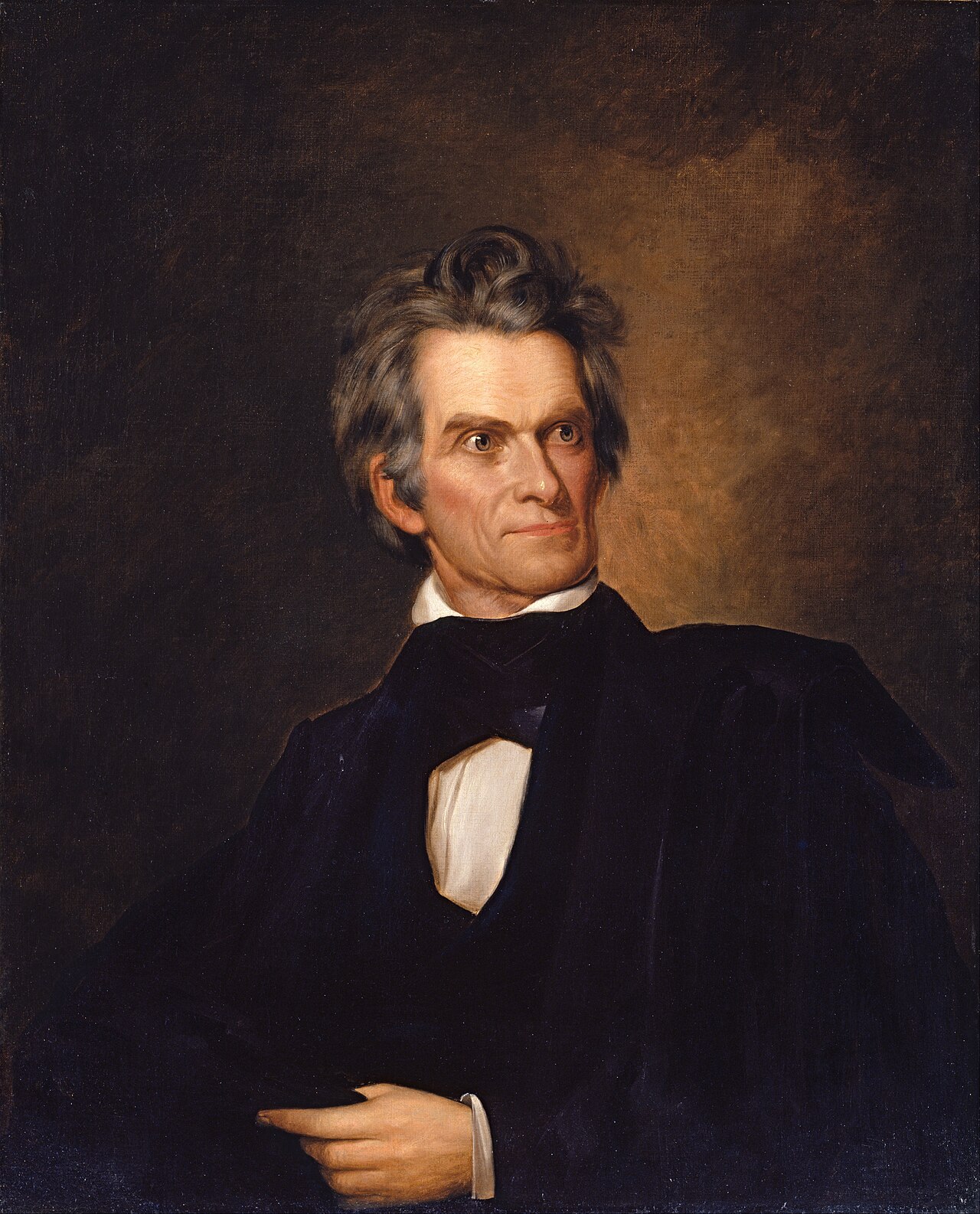
The tariff act of May 19, 1828, raised duties on imported manufactures to protect northern mills.11 South Carolina planters, who sold cotton abroad and bought manufactured goods, called it the Tariff of Abominations. Vice President John C. Calhoun drafted the "South Carolina Exposition and Protest," which a special committee of the South Carolina House reported on December 19, 1828. The legislature resolved "to protest against the unconstitutionality and oppressive operation of the system of protecting duties" and to make "a public exposition of our wrongs and of the remedies within our power."12 Calhoun's own draft, printed from his manuscript in his collected Works in 1855, argued that the framers acted "by leaving to the States an efficient power to protect, by a veto, the minor against the major interests of the community," and that if "the present usurpations" persisted it would be the state's "sacred duty to interpose" and "to arrest the progress of a usurpation."13 The committee adopted the draft "with considerable alterations," in the words of the editor of the Works.13 The version the House ordered printed in 1829 speaks of "granting an efficient power to the latter, to protect by a veto the minor against the major interests of the community," and says it will be the state's "sacred duty to interpose her veto" in order "to arrest the progress of a power, which, if not arrested, must in its consequences, corrupt the public morals, and destroy the liberty of the country."12 Its theory was that each state, as a party to the constitutional compact, could judge for itself whether a federal act exceeded the delegated powers and could interpose to stop it inside its borders.

The Ordinance of November 24, 1832
Congress lowered some duties on July 14, 1832, but kept the protective principle. South Carolina called a convention, which met at Columbia and on November 24, 1832, declared that the 1828 and 1832 tariff acts "are unauthorized by the constitution of the United States, and violate the true meaning and intent thereof and are null, void, and no law, nor binding upon this State, its officers or citizens."14 The legislature was told to prevent enforcement "from and after the first day of February next."14
The Ordinance did more than refuse a tax. It tried to wall off the federal courts. No case involving the Ordinance or the tariffs, decided in a state court, could be appealed to the Supreme Court of the United States, "nor shall any copy of the record be permitted or allowed for that purpose," and anyone who tried an appeal "may be dealt with as for a contempt of the court."14 Every state officer had to swear to enforce it, and "no juror shall be impaneled in any of the courts of this State, in any cause in which shall be in question this ordinance" unless he too had taken that oath.14 A doctrine sold as a protection of liberty began by packing juries and cutting off appeal.
Jackson's Proclamation of December 10, 1832
Jackson's reply is the strongest unionist document before Lincoln. "I consider, then, the power to annul a law of the United States, assumed by one State, incompatible with the existence of the Union, contradicted expressly by the letter of the Constitution, unauthorized by its spirit, inconsistent with every principle on which It was founded, and destructive of the great object for which it was formed."15 On secession he wrote: "To say that any State may at pleasure secede from the Union, is to say that the United States are not a nation."15 And to the people of South Carolina directly: "The laws of the United States must be executed. I have no discretionary power on the subject-my duty is emphatically pronounced in the Constitution." Then, in capitals in the original: "disunion, by armed force, is TREASON."15
The Proclamation also conceded the grievance. Jackson told South Carolinians that the effect of the tariff laws "was confessedly injurious."15 He did not defend the tariff. He defended the Union's power to decide it.
The Force Bill and the compromise of March 2, 1833
Congress passed two bills on the same day. The first, "An Act further to provide for the collection of duties on imports," let the President direct that a customs house "be established and kept in any secure place within some port or harbour of such district, either upon land or on board any vessel," extended federal circuit court jurisdiction over revenue cases, and authorized the President, when federal law was obstructed "by the employment of military force, or by any other unlawful means, too great to be overcome by the ordinary course of judicial proceeding," to issue a proclamation and use force. Its emergency sections were to "be in force until the end of the next session of Congress, and no longer."16 The second, the compromise tariff, provided that wherever a duty exceeded twenty percent of value, one tenth of the excess would come off after December 31 of 1833, 1835, 1837 and 1839, half of what remained after December 31, 1841, and the rest after June 30, 1842.17
South Carolina's convention reassembled. On March 15, 1833 it declared the tariff ordinance and the laws passed under it "henceforth deemed and held to have no force or effect," and three days later, on March 18, it passed a new ordinance declaring the Force Bill "unauthorized by the Constitution of the United States, Subversive of that Constitution, and destructive of public liberty" and "Null and Void, within the limits of this State."18 The same document declared that "the allegiance of the Citizens of this State, while they continue such, is due to the said State; and that obedience only, and not allegiance, is due by them to any other power or authority to whom a control over them has been or may be delegated by the State."18 The state nullified a law that no longer needed enforcing. Both sides claimed victory. The theory of state sovereignty in that March ordinance is the theory South Carolina acted on in December 1860.
Nullification and Federalist 28 are different things
Lesson 5 read Federalist 28 closely. Hamilton wrote that the state legislatures, "possessing all the organs of civil power, and the confidence of the people," could "at once adopt a regular plan of opposition," and that "They can readily communicate with each other in the different States, and unite their common forces for the protection of their common liberty."19 His picture is the states acting together, with the people behind them, against a usurping national government. The South Carolina Ordinance claimed for one state alone the power to declare a federal law void, and it shut the federal courts out by statute and oath. Readers who cite Federalist 28 for nullification are reading something into it.
Legislative courts and public rights: the quiet institutions
The Court of Claims, 1855
Lesson 7 ended with American Insurance Co. v. Canter (1828), where Marshall called the Florida territorial courts "legislative Courts, created in virtue of the general right of sovereignty which exists in the government, or in virtue of that clause which enables Congress to make all needful rules and regulations, respecting the territory."20 Before 1855 a citizen with a money claim against the United States had to petition Congress for a private bill. The flood of petitions led Congress, on February 24, 1855, to enact "That a court shall be established to be called a Court of Claims, to consist of three judges," appointed with Senate consent, who were "to hold their offices during good behaviour."21 The judges had life tenure, like Article III judges. Their power did not match. The court was to hear claims and "report to Congress the cases upon which they shall have finally acted," and to "prepare a bill or bills in those cases which shall have received the favorable decision thereof."21 It could recommend. Congress paid or did not.
The pattern runs back to the territories: a body with the name and look of a court, staffed by judges, whose final word belonged to the political branches. The name was "court." The function, at first, was advisory staff work for Congress.
Murray's Lessee v. Hoboken Land and Improvement Co., 1856
Samuel Swartwout was collector of customs for the port of New York for eight years before March 1838. On November 10, 1838, Treasury auditors certified that he owed the government $1,374,119.65. The Solicitor of the Treasury then issued a distress warrant under an act of May 15, 1820, and the marshal sold Swartwout's New Jersey land on June 1, 1839. No court had tried the debt. A competing buyer who claimed the same land through an ordinary court judgment argued that the warrant violated Article III and the Fifth Amendment's guarantee of due process.22
Justice Benjamin Curtis wrote for a unanimous Court. He first asked what "due process of law" meant and went straight to history: the words "were undoubtedly intended to convey the same meaning as the words, 'by the law of the land,' in Magna Charta," and he noted that the Northwest Ordinance had used the same law-of-the-land language: "The ordinance of congress of July 13, 1787, for the government of the territory of the United States northwest of the River Ohio, used the same words."22 The process was due, he concluded, because English and colonial law had always allowed "a summary method for the recovery of debts due to the crown, and especially those due from receivers of the revenues."22
Then came the paragraph that made the case famous:
To avoid misconstruction upon so grave a subject, we think it proper to state that we do not consider congress can either withdraw from judicial cognizance any matter which, from its nature, is the subject of a suit at the common law, or in equity, or admiralty; nor, on the other hand, can it bring under the judicial power a matter which, from its nature, is not a subject for judicial determination. At the same time there are matters, involving public rights, which may be presented in such form that the judicial power is capable of acting on them, and which are susceptible of judicial determination, but which congress may or may not bring within the cognizance of the courts of the United States, as it may deem proper.22
Murray's Lessee cuts both ways, and both edges are still sharp. The first sentence is a limit: Congress cannot pull a common-law suit out of the courts. The second created a category, "public rights," that Congress may assign elsewhere. In 2024 the Supreme Court in SEC v. Jarkesy quoted the first sentence to hold that a securities fraud penalty case belonged before a jury, and wrote: "The decision that first recognized the public rights exception was Murray's Lessee."23 Lesson 17 takes up Jarkesy. The doctrine that later carried much of federal agency adjudication began in 1856 with a customs collector, a Treasury auditor and a summary warrant, and it began by looking backward to the Crown's remedies against its own revenue officers.
The outline Pierson was handed treats public rights as proof that a "Government #2" was operating inside the first. The record supports something narrower. Murray's Lessee did create a channel through which adjudication could leave the courts, and it did rest on royal precedent. It did so in the open, in a published opinion, by a unanimous Court that also wrote a limit into the same paragraph. Lesson 18 tests the larger claim.
Kendall v. United States, 1838: the law binds the President's officers
Kendall pushed the other way. Postmaster General Amos Kendall refused to pay mail contractors credits that Congress had ordered paid. The Court held in 1838 that a court could compel him. Justice Smith Thompson wrote that "it would be an alarming doctrine, that congress cannot impose upon any executive officer any duty they may think proper, which is not repugnant to any rights secured and protected by the constitution; and in such cases, the duty and responsibility grow out of and are subject to the control of the law, and not to the direction of the President."24 An officer of the executive branch could be held to a ministerial duty by a court, whatever the President preferred.
Dred Scott and the territorial power, 1857
The territories, the oldest federal institution outside the states, came back to the Supreme Court in Dred Scott v. Sandford. Chief Justice Roger Taney, the same Taney who had moved the deposits, held that the Missouri Compromise ban on slavery north of 36 degrees 30 minutes "is not warranted by the Constitution, and is therefore void."25 To get there he read the Property Clause narrowly. The power to "make all needful rules and regulations respecting the territory," he wrote, "is confined, and was intended to be confined, to the territory which at that time belonged to, or was claimed by, the United States," and "can have no influence upon a territory afterwards acquired from a foreign Government."25 He added: "There is certainly no power given by the Constitution to the Federal Government to establish or maintain colonies bordering on the United States or at a distance, to be ruled and governed at its own pleasure."25
Taney even stated the principle of limited government in words a modern constitutionalist could sign: "the power of Congress over the person or property of a citizen can never be a mere discretionary power under our Constitution," and when the government enters a territory "it cannot, when it enters a Territory of the United States, put off its character, and assume discretionary or despotic powers which the Constitution has denied to it."25 He used that principle to protect property in human beings and to deny that Black Americans could be citizens. The opinion is the clearest warning in the record that a limit on government is only as good as the moral judgment of the people applying it. The Fourteenth Amendment, ratified July 9, 1868, overturned its citizenship holding by declaring citizens "All persons born or naturalized in the United States."26 Its narrow reading of the territorial power was abandoned in the Insular Cases of 1901, which lesson 11 covers, where the Court went to the opposite extreme.
The Post Office and the spoils system
The national government of this period was mostly a mail service. The Census Bureau's Historical Statistics, Series Y 308 to 317, give paid civilian federal employment, and the Post Office column dwarfs everything else.27
| Year | Total federal civilian employees | Post Office | War and Navy (civilian) | Post Office share |
|---|---|---|---|---|
| 1816 | 4,837 | 3,341 | 190 | 69 percent |
| 1831 | 11,491 | 8,764 | 377 | 76 percent |
| 1841 | 18,038 | 14,290 | 598 | 79 percent |
| 1851 | 26,274 | 21,391 | 403 | 81 percent |
| 1861 | 36,672 | 30,269 | 946 | 83 percent |
Shares are computed from the Series Y figures. The Postal Service's own history agrees on the main point. In 1828 there were 7,530 post offices and 29,956 postal employees, mail contractors and carriers, "which made the Department the largest employer in the executive branch."28 By 1831 "postal employees accounted for 76 percent of the civilian federal workforce," and postmasters outnumbered soldiers, 8,764 to 6,332.28 The number of post offices rose from 75 in 1790 to 28,498 in 1860.28
Jackson saw what that workforce could do for a party. The Postal Service history records that he "recognized the potential for patronage and, in 1829, invited William T. Barry of Kentucky to become the first postmaster general to sit as a member of the President's Cabinet."28 His defense of turnover in office came in the same 1829 message that attacked the Bank: "The duties of all public officers are, or at least admit of being made, so plain and simple that men of intelligence may readily qualify themselves for their performance; and I can not but believe that more is lost by the long continuance of men in office than is generally to be gained by their experience."5 He continued: "In a country where offices are created solely for the benefit of the people no one man has any more intrinsic right to official station than another," and limiting terms would destroy "the idea of property now so generally connected with official station" while "promoting that rotation which constitutes a leading principle in the republican creed."5
Read on its own terms, rotation was an attack on a permanent officeholding class, the kind of entrenched institution this module studies. In practice, as the National Archives summarizes it, the "spoils system," in which officials rewarded political friends and supporters with government positions, "was in full force" by Jackson's time, and the abuses worsened "as candidates required political appointees to spend ever more time and money on political activities."29 A reform aimed at one kind of institutional self-interest built another. Postmasters owed their jobs to the party, paid assessments to the party and worked elections for the party. Lesson 10 shows how long that lasted and what replaced it.
Through Pierson's Framework
Pierson defines institutionalism as a mindset that defends institutions "on habit, identity, and survival instinct," and he adds that it "is not loyalty to principle; it's loyalty to process. It assumes continuity equals virtue, structure guarantees truth, and outside critique is a threat by default."30 The test this module applies is name versus function: judge an institution by what it does, not by what it calls itself. Applied to 1816 to 1861, it grades nobody clean.
The Second Bank is the clearest case of an institution that tried to defend itself on its own survival. Its charter gave it public money, a monopoly pledged on "the faith of the United States," and five public directors against twenty private ones. When its renewal was threatened, Biddle's answer was to squeeze credit across the country to bring the government to heel. Whatever the Bank's merits as a currency manager, that response put the institution's continuation ahead of the public it served. Pierson's line fits it: "When survival becomes the end, rather than a byproduct of service, then manipulation replaces meaning."30
Jackson's war on the Bank is harder to grade. He held the Bank accountable through means the Constitution gave him, the veto, and through means the Senate thought it did not, the dismissal of a Treasury Secretary to reach a power the statute gave the Secretary. Ordered liberty, as Pierson frames it, includes a duty to hold government accountable and a duty to support legitimate government. The removal tested both at once. The Senate's censure and its later expunging show the political branches checking each other in the open, which is the Madisonian machine of lesson 5 doing its work.
Nullification fails the test in the other direction. South Carolina had a real grievance. Its remedy was to declare federal law void, bar appeals, and require jurors to swear loyalty to the Ordinance before they could sit. Pierson's Ordered Liberty Reclaimed describes the posture this course wants: "This document is not a defense of government nor a license for revolt. It is a call to restore the moral balance that defines legitimate civic life. Ordered Liberty insists on mutual restraint: individuals must act with discipline and responsibility, and governments and institutions must operate under law, truth, and justice."31 Nullification abandoned mutual restraint. It claimed for one state the final word on a shared constitution and enforced that claim by oath.
The quiet institutions deserve the closest watch. The Court of Claims, the summary distress warrant and the public rights category were each built for a practical reason and each was defended, then and later, on precedent. Pierson's appendix on the Anti-Federalists warns of exactly this kind of growth: "Institutions, once corrupt, do not collapse. They adapt. They learn how to appear lawful while suppressing dissent. They entrench policies behind procedure, insulate officials through legal immunity, and claim moral neutrality while enforcing ideological dogma."32 No one in 1856 thought Murray's Lessee was corrupt. Curtis wrote a limit into the same paragraph that created the exception. The exception outlived its author's limits and was later defended by citing itself. And the Post Office shows that a reform against entrenchment can become its own entrenched machine within a generation.
Hard Questions and Answers
The Second Bank was sound central banking, and Jackson killed it over an old grudge about worthless paper. Isn't that the real story?
Half of it. The Federal Reserve's history essay credits the Bank under Biddle with contributing "significantly to economic stability and growth," notes that its gold-backed notes "gave the country a more stable national currency," and says Biddle "was an excellent administrator."2 The same essay records Jackson's personal distrust of paper money, which went back to a land deal in which he was paid in notes that became worthless.2 So the grudge is documented. Accountability is where the Bank's defense falls apart. The essay itself says the Bank "lacked an effective system of regulation" and was "too far outside the jurisdiction of Congress, the president, and voters," and that Biddle made loans to friends and refused criticism.2 The renewal request went to Congress four years early, in January 1832, which dragged the Bank into the election.2 The Bank did its monetary job well and answered to almost no one outside its board. Its admirers have to own both halves.
Jackson fired a Treasury Secretary to get around a statute. Wasn't the Senate right that he broke the law?
Maybe, and no court ever said. The charter gave the removal power to the Secretary of the Treasury, with a duty to report reasons to Congress. Jackson did not remove the deposits himself. He removed a Secretary who would not, appointed one who would, and Taney did report to Congress.73 The Senate majority called that an evasion of a power Congress had placed in the Secretary. Jackson's defenders thought the President's control of his Cabinet was the whole point of an executive branch answerable to one elected head. The Senate voted the censure 26 to 20 and later expunged it, and the House in April 1834 voted to keep the deposits in the state banks.82 The political branches split, each acted within its own powers, and the voters returned Jackson's party. Anyone who wants a clean verdict on legality will not find one in this record.
Nullification is just Federalist 28 and the Virginia and Kentucky Resolutions put into practice. Why pretend otherwise?
The nullifiers did claim the 1798 Resolutions as ancestors. Calhoun's draft of the Exposition quotes Madison's 1800 report to the Virginia legislature and Jefferson's Kentucky resolutions, and invokes "the solemn decisions of the Legislatures of two leading States" on the point.13 It went well past Federalist 28, where Hamilton described state legislatures that "communicate with each other in the different States, and unite their common forces."19 The South Carolina Ordinance declared specific federal laws "null, void, and no law," forbade appeal to the Supreme Court and required jurors to swear to enforce the Ordinance before hearing cases about it.14 That is one state claiming the final word and enforcing the claim by oath. Jackson's Proclamation answered that a state "cannot from that period possess any right to secede" once it joined the nation.15 And the compromise tariff, passed alongside the Force Bill, showed the grievance could be met by ordinary politics.17
Murray's Lessee handed Congress a blank check for agency courts in 1856, didn't it?
It approved one thing: Congress may let the Treasury collect a certified balance from its own revenue officer by summary warrant, as the Crown long had. It created the "public rights" category for matters Congress "may or may not bring within the cognizance of the courts." In the same paragraph it said Congress cannot "withdraw from judicial cognizance any matter which, from its nature, is the subject of a suit at the common law."22 In 2024 the Court relied on that limiting sentence to require a jury in SEC v. Jarkesy.23 The case started a doctrine that later grew. By its own words it did not let agencies decide ordinary private disputes, and anyone calling it a blank check has skipped the sentence that limits it.
Taney's Dred Scott opinion limited federal power over the territories. Isn't that a win for limited government, whatever the result?
No. Taney's words about the limits of the territorial power are quoted above, and they sound like limited government.25 He used them to strike down a ban on slavery in federal territory and to protect property in persons. A limit on government applied to keep human beings enslaved serves domination. The case is why this module judges doctrines by what they do. A doctrine can be named restraint while it functions to protect the powerful, and anyone quoting Taney's passage owes the reader what it was used for.
Rotation in office was more democratic than a permanent career service. Why condemn it?
In theory it was, and Jackson made the argument well: no one has "any more intrinsic right to official station than another."5 In practice the federal workforce was mostly postmasters, and postmasters became party workers. The National Archives describes officials rewarding "political friends and supporters with government positions" and appointees being made to spend "ever more time and money on political activities."29 Rotation broke one kind of entrenched institution and built another that answered to party leaders instead of the public. Jackson's target, officeholders treating their posts as property, was real. His cure became the disease. The Pendleton Act of 1883, covered in lesson 10, was the response.
Learn more
- Bank of the United States charter, April 10, 1816 (3 Stat. 266): the full statute, including sections 16, 20 and 21.
- Jackson's Bank Veto Message, July 10, 1832: the full text at the Avalon Project.
- South Carolina Ordinance of Nullification, November 24, 1832: the convention's text, including the appeal and juror provisions.
- Jackson's Proclamation to the People of South Carolina, December 10, 1832: the unionist answer.
- Murray's Lessee v. Hoboken Land and Improvement Co. (1856): the origin of "public rights."
- McCulloch v. Maryland (1819): Marshall on implied powers and the power to tax.
- Federal Reserve History: The Second Bank of the United States: a short institutional history.
- USPS Publication 100: the Postal Service's history, with the 1828 to 1831 employment figures.
- Module 51, lesson 3: Mercantilism: the chartered-monopoly pattern the Bank resembled.
- Module 52: Ordered Liberty: Pierson's framework of mutual restraint.
Notes
- U.S. Department of the Treasury, Bureau of the Fiscal Service, "Historical Debt Outstanding," TreasuryDirect, history narrative for 1812 to 1860. Read it online. ↩
- Federal Reserve History, "The Second Bank of the United States," adapted from the Federal Reserve Bank of Philadelphia publication of the same name. Read it online. ↩
- An Act to incorporate the subscribers to the Bank of the United States, ch. 44, 3 Stat. 266 (April 10, 1816), sections 1, 7, 16, 20 and 21. Read it online. ↩
- McCulloch v. Maryland, 17 U.S. (4 Wheat.) 316 (1819), opinion of Marshall, C.J. Read it online. ↩
- Andrew Jackson, First Annual Message, December 8, 1829, The American Presidency Project, University of California, Santa Barbara. Read it online. ↩
- Andrew Jackson, Veto Message Regarding the Bank of the United States, July 10, 1832, Avalon Project, Yale Law School. Read it online. ↩
- United States Senate, "Senate Censures President Andrew Jackson," Senate Historical Office. Read it online. ↩
- United States Senate, "Senate Reverses a Presidential Censure," Senate Historical Office. Read it online. ↩
- Andrew Jackson, Veto Message, May 27, 1830 (Maysville Road), The American Presidency Project. Read it online. ↩
- Andrew Jackson, Veto Message, May 31, 1830, The American Presidency Project. Read it online. ↩
- An Act in alteration of the several acts imposing duties on imports, ch. 55, 4 Stat. 270 (May 19, 1828). Read it online. ↩
- South Carolina House of Representatives, Exposition and Protest, Reported by the Special Committee of the House of Representatives, on the Tariff; Read and Ordered to be Printed, Dec. 19th, 1828 (Columbia: D. W. Sims, State Printer, 1829), the resolution and the Exposition as adopted, proofread page transcription at Wikisource from a scan of the 1829 imprint. Read it online. ↩
- John C. Calhoun, "Exposition: Original Draft of the South Carolina Exposition, prepared for the Special Committee on the Tariff, and, with considerable alterations, adopted by the Legislature of South Carolina, December, 1828," in The Works of John C. Calhoun, ed. Richard K. Cralle, vol. 6, Reports and Public Letters (New York: D. Appleton and Company, 1855), pp. 1 to 57; quotations at pp. 53 and 56 to 57, references to Madison and the Kentucky resolutions at pp. 39 to 44. Scan at the Internet Archive. A web transcription at The Sage American History site follows this draft but misprints "interpose" as "interposes duty." Read it online. ↩
- South Carolina Ordinance of Nullification, November 24, 1832, Avalon Project, Yale Law School. Read it online. ↩
- Andrew Jackson, Proclamation Regarding Nullification, December 10, 1832, Avalon Project, Yale Law School. Read it online. ↩
- An Act further to provide for the collection of duties on imports, ch. 57, 4 Stat. 632 (March 2, 1833), sections 1, 2, 5 and 8. Read it online. ↩
- An Act to modify the act of the fourteenth of July, one thousand eight hundred and thirty-two, ch. 55, 4 Stat. 629 (March 2, 1833). Read it online. ↩
- South Carolina Convention, An Ordinance to Nullify an Act of the Congress of the United States entitled "An Act further to provide for the collection of duties on imports," March 18, 1833, Records of the U.S. Senate, Record Group 46, National Archives Identifier 306392, certified copy of January 6, 1834; quotations checked against the manuscript page images in the National Archives Catalog. The South Carolina Department of Archives and History holds the state's copy in its folder "Nullification ordinances, 1832-1833" (S131038), whose description dates the repeal of the November ordinance three days before the March 18 ordinance. Read it online. The repealing ordinance, "Done at Columbia, the fifteenth day of March" 1833, is printed in Thomas Cooper, ed., The Statutes at Large of South Carolina, vol. 1 (Columbia, 1836), p. 390 ("An Ordinance, 15th March 1833, rescinding the nullifying Ordinance of the 24th Novr. 1832"). Read it online. ↩
- Alexander Hamilton, The Federalist No. 28, Avalon Project, Yale Law School. Read it online. ↩
- American Insurance Co. v. Canter, 26 U.S. (1 Pet.) 511, 546 (1828), opinion of Marshall, C.J. Read it online. ↩
- An Act to establish a Court for the Investigation of Claims against the United States, ch. 122, 10 Stat. 612 (February 24, 1855), sections 1 and 7. Read it online. ↩
- Murray's Lessee v. Hoboken Land and Improvement Co., 59 U.S. (18 How.) 272, 276 to 284 (1856), opinion of Curtis, J. Read it online. ↩
- Securities and Exchange Commission v. Jarkesy, 603 U.S. 109 (2024), slip opinion, opinion of Roberts, C.J. Read it online. ↩
- Kendall v. United States ex rel. Stokes, 37 U.S. (12 Pet.) 524, 610 (1838), opinion of Thompson, J. Read it online. ↩
- Dred Scott v. Sandford, 60 U.S. (19 How.) 393 (1857), opinion of Taney, C.J. Read it online. ↩
- National Archives, Milestone Documents, "14th Amendment to the U.S. Constitution: Civil Rights (1868)." Read it online. ↩
- U.S. Bureau of the Census, Historical Statistics of the United States, Colonial Times to 1970, Bicentennial Edition, Part 2 (1975), Series Y 308 to 317, Paid Civilian Employment of the Federal Government, 1816 to 1970, p. 1103. Read it online. ↩
- United States Postal Service, The United States Postal Service: An American History, Publication 100 (2025 edition), pp. 7 to 8. Read it online. ↩
- National Archives, Milestone Documents, "Pendleton Act (1883)." Read it online. ↩
- Jeff A. Pierson, "The Acacia Illusion: How Institutionalism Mimics Nature's Most Subtle Manipulation," in The Ordered Liberty Papers (2025). Read it online. ↩
- Jeff A. Pierson, Ordered Liberty Reclaimed: A Foundation for Liberty. Read it online. ↩
- Jeff A. Pierson, "The Anti-Federalist Warning: Institutional Power and the Fragility of Liberty," appendix to Ordered Liberty Reclaimed: A Foundation for Liberty. Read it online. ↩
- Thomas Hart Benton, Thirty Years' View, vol. 1 (New York: D. Appleton and Company, copyright 1854; scan of the 1871 printing at the Internet Archive), chapters on the expunging resolution, which print the text of the resolution and his account of its execution in January 1837. Read it online. For the endorsement as written: National Archives, "Treasures of Congress" exhibit, "Expunged Senate censure motion against President Andrew Jackson, January 16, 1837," Records of the U.S. Senate, caption transcribing the words written across the resolution. Read it online. ↩
Terms in this lesson
- Second Bank of the United States
- A corporation chartered by Congress on April 10, 1816, with $35 million in capital, one fifth subscribed by the United States, that held federal deposits until 1833 and whose charter ran to March 3, 1836.
- Removal of the deposits
- Jackson's 1833 order, carried out by Treasury Secretary Roger Taney, to stop placing federal money in the Bank of the United States and to use selected state banks instead.
- Nullification
- The claim, pressed by John C. Calhoun and adopted by a South Carolina convention on November 24, 1832, that a state may declare a federal law void inside its borders.
- Force Bill
- The act of March 2, 1833, that let the President move customs houses, use the courts and call out force to collect federal duties where collection was obstructed.
- Public rights
- A class of matters, first named in Murray's Lessee (1856), that Congress may assign to executive officers or non-Article III bodies without a jury because they arise between the government and others.
- Legislative court
- A tribunal created by Congress outside Article III, without life tenure for its judges, such as the territorial courts in Canter (1828) or the original Court of Claims (1855).
- Distress warrant
- A summary writ, issued by the Solicitor of the Treasury under an 1820 act, that let the government seize a delinquent collector's property without first suing him in court.
- Rotation in office
- Jackson's argument that federal posts should change hands regularly; in practice it became the spoils system of party patronage.
Sources
- An Act to incorporate the subscribers to the Bank of the United States, April 10, 1816, 3 Stat. 266 checked 2026-10
- McCulloch v. Maryland, 17 U.S. 316 (1819) checked 2026-10
- President Jackson's Veto Message Regarding the Bank of the United States, July 10, 1832 checked 2026-10
- South Carolina Ordinance of Nullification, November 24, 1832 checked 2026-10
- President Jackson's Proclamation Regarding Nullification, December 10, 1832 checked 2026-10
- Murray's Lessee v. Hoboken Land and Improvement Co., 59 U.S. 272 (1856) checked 2026-10
- Dred Scott v. Sandford, 60 U.S. 393 (1857) checked 2026-10
- Historical Statistics of the United States, Colonial Times to 1970, Series Y 308 to 317 checked 2026-10
- The United States Postal Service: An American History, Publication 100 checked 2026-10