Lesson 9 of 19 · about 32 minutes
War, Reconstruction and the Railroad Republic, 1861 to 1877
You'll be able to
- Identify the main wartime statutes of 1861 to 1865 and the institutions each created, with dates and dollar figures
- Explain how the Pacific Railway Acts of 1862 and 1864 paid for the transcontinental railroad, including the land grant formula, subsidy bonds and the subordinated federal lien
- Describe the Credit Mobilier scandal and the House's response in 1873 using the official record
- State what Ex parte Milligan (1866), the Legal Tender Cases and Ex parte McCardle (1869) decided about wartime power and judicial review
Start here: the short version
In 1861 the Post Office employed 30,269 of the 36,672 people on the federal civilian payroll. By headcount, the national government was a mail service. Four years of war later it printed paper money, chartered banks, taxed incomes and paid private companies in land and bonds to lay a railroad across a continent. Between 1861 and 1865 Congress created the greenback, the national banking system and the Comptroller of the Currency, the first federal income tax and the office that collected it, the Homestead Act, the Pacific railroad companies, and the Freedmen's Bureau. After the war it governed ten Southern states through army officers. Some of this came down within a decade: the income tax lapsed in 1872, the Freedmen's Bureau closed the same year, military rule was over by 1877. Some never left: the national bank charter, the Comptroller, the Internal Revenue office, and the habit of paying private companies in public land and federal credit to do public work. Credit Mobilier showed what that last habit could cost. Every wartime creation gets the module's standing questions plus one more. When the emergency ended, did the institution end with it?
Challenge
Anyone who trusts official oversight to guard public money should look at James Brooks. Congress put its own directors on the Union Pacific board to protect the federal bonds, and Brooks, one of those directors, was censured in 1873 after profiting from a large block of shares. Anyone sure that government never gives power back should look at the calendar. The income tax lapsed in 1872, the Freedmen's Bureau closed the same year, and military rule was gone by 1877. The fastest retreat did harm of its own: pardoned owners got abandoned land back under Circular No. 15, and the forty acres the 1865 act described mostly never reached freedpeople. Private capital balked at building the railroad without federal land and credit, and insiders then paid themselves out of that credit through a captive contractor. Each side can find a villain in this period. Neither gets to keep its theory intact.
On the eve of the war the national government was small and cheap. The Treasury put total public debt at $64.8 million in 1860, against an annual federal budget of $63.1 million.1 The Census Bureau's employment series counts 36,672 paid federal civilian employees in 1861, of whom 30,269 worked for the Post Office.2 Within four years the debt had passed $1 billion, and by the end of 1865 interest-bearing public debt stood at $2.2 billion. The Treasury estimates the war's direct cost to the nation at $5.2 billion.1 A government that has to raise that much money builds machinery to do it, and machinery tends to stay.
Paying for the war: tariff, currency, income tax
The Morrill Tariff, March 2, 1861
Two days before Abraham Lincoln took office, Congress passed "An Act to provide for the Payment of outstanding Treasury Notes, to authorize a Loan, to regulate and fix the Duties on Imports, and for other Purposes," known as the Morrill Tariff.3 It came three decades after the tariff fight of 1828 to 1833 covered in lesson 8.
Greenbacks and the Legal Tender Act, February 25, 1862
The Treasury first issued Demand Notes in 1861, the first general circulation of paper money by the federal government.4 The next year Congress went much further. The Legal Tender Act authorized the Secretary of the Treasury "to issue, on the credit of the United States, one hundred and fifty millions of dollars of United States notes, not bearing interest, payable to bearer," in denominations "not less than five dollars each." The notes were receivable for "all taxes, internal duties, excises, debts, and demands of every kind due to the United States, except duties on imports," and were declared "lawful money and a legal tender in payment of all debts, public and private, within the United States, except duties on imports and interest as aforesaid."5 Read the exceptions. Customs duties still had to be paid in gold, and the government still paid its own bondholders in gold. Soldiers and suppliers got paper, and private creditors were made to accept it.
The Federal Reserve's history essay calls the greenbacks the "first real paper money ever issued by the United States government," quoting the financial historians Paul Studenski and Herman Krooss.6 The same essay records that the federal budget went from a surplus of $5.6 million before the war to a deficit of $423 million by 1862, and that Congress authorized $250 million in bonds in 1861 and $500 million more in 1862.6
The Legal Tender Cases: the Court changes its mind
Making paper a legal tender for debts contracted in gold before the war was the hardest legal question of the period. In Hepburn v. Griswold, decided in the December Term of 1869, Chief Justice Salmon Chase, who as Lincoln's Treasury Secretary had overseen the first federal paper currency, wrote for the Court over a dissent by Justice Samuel Miller, joined by Justices Swayne and Davis: "We are obliged to conclude that an act making mere promises to pay dollars a legal tender in payment of debts previously contracted, is not a means appropriate, plainly adapted, really calculated to carry into effect any express power vested in Congress; that such an act is inconsistent with the spirit of the Constitution; and that it is prohibited by the Constitution."7 So the man who had overseen the paper as Treasury Secretary turned Marshall's McCulloch test against it as Chief Justice.
The decision did not survive the next term. The Court's vacancies were filled, the question was reargued, and in Knox v. Lee, December Term 1870, Justice William Strong wrote: "we hold the acts of Congress constitutional as applied to contracts made either before or after their passage. In so holding, we overrule so much of what was decided in Hepburn v. Griswold, as ruled the acts unwarranted by the Constitution so far as they apply to contracts made before their enactment." He noted that Hepburn "was decided by a divided court, and by a court having a less number of judges than the law then in existence provided this court shall have."8 The Court said out loud that its own size had changed and treated that as a reason to look again. Whether the new justices were appointed to produce that result is a question of motive, and the opinions cannot settle it.
The first income tax and the Internal Revenue office
The Revenue Act of August 5, 1861, laid the first federal income tax: on any annual income that "exceeds the sum of eight hundred dollars, a tax of three per centum on the amount of such excess."9 The National Archives summarizes what followed: Congress at first placed "a flat 3-percent tax on all incomes over $800 and later modified this principle to include a graduated tax. Congress repealed the income tax in 1872."10
The collecting machinery outlived the tax. The Internal Revenue Service's own history records that on July 1, 1862, Lincoln signed "the second revenue measure of the Civil War," which "levied internal taxes and established a permanent internal tax system." Congress "established the Office of the Commissioner of Internal Revenue under the Department of the Treasury," and George S. Boutwell became the first commissioner on July 17, 1862. In its first year, 1863, the office collected $39.1 million.11 The 1864 revenue act let the Commissioner "compromise all suits 'relating to internal revenue,' to abate outstanding assessments and to refund taxes."11 A tax collector with power to settle and refund claims without a court is the public rights doctrine of Murray's Lessee, from lesson 8, applied at national scale.
A national banking system and its regulator
On February 25, 1863, Congress passed "An Act to provide a national Currency, secured by a Pledge of United States Stocks," later called the National Bank Act.12 It created, in the words of the Office of the Comptroller of the Currency, "a bureau of the U.S. Department of the Treasury," the OCC, whose first head, Hugh McCulloch, took office in 1863.13 The act of June 3, 1864, rewrote the system.14
The design was a deliberate trade. A private bank could take a federal charter if it bought federal bonds and deposited them with the Treasury, and in return it could issue national bank notes backed by those bonds. The 1864 act let each national bank issue up to $500,000 of notes so secured. Banks in central reserve cities had to hold reserves of 25 percent, and "country banks" 15 percent. Each national bank was limited to a single office.6 The Federal Reserve essay states the purpose plainly: the acts were "a wartime expedient to (i) help finance the war effort by increasing the demand for federal government debt and (ii) promote a stable uniform currency."6
Congress then taxed the competition out of existence. The 1863 act put a 2 percent annual tax on state bank notes. That was not enough. In 1865 Congress raised it to 10 percent, and state bank notes in circulation fell from $143 million in 1865 to $4 million by 1867. By the close of 1864, 683 banks held federal charters.6
Set this beside the Second Bank of lesson 8. Jackson killed one federally chartered bank because it held a monopoly of the government's favor. The Civil War Congress replaced it with hundreds of private banks that could issue money only by holding government debt, under a Treasury bureau. Spreading the privilege across many hands answered Jackson's monopoly objection. It also tied the banking system's profits to the national debt, and so built a large, organized constituency for that debt. The Comptroller still exists. The Federal Reserve essay notes that this framework "would persist into the 20th century" and that banking panics "remained a recurring feature" until Congress created the Federal Reserve in 1913.6
Land for settlers, land for corporations
The Homestead Act, May 20, 1862
The Homestead Act let any person "who is the head of a family, or who has arrived at the age of twenty-one years," and who was a citizen or had declared the intention to become one, and "who has never borne arms against the United States Government or given aid and comfort to its enemies," enter "one quarter section or a less quantity of unappropriated public lands." The fee was ten dollars, and "no certificate shall be given or patent issued therefor until the expiration of five years from the date of such entry."15 Section 6 required "the Commissioner of the General Land Office" to "prepare and issue such rules and regulations, consistent with this act, as shall be necessary and proper to carry its provisions into effect."15 That is an ordinary delegation of rulemaking to a land bureau, the kind of clause Congress had been writing since the 1780s.
The National Archives is blunt about results. The act "was framed so ambiguously that it seemed to invite fraud, and early modifications by Congress only compounded the problem. Most of the land went to speculators, cattle owners, miners, loggers, and railroads. Of some 500 million acres dispersed by the General Land Office between 1862 and 1904, only 80 million acres went to homesteaders."16 The Bureau of Land Management's long-run table credits homesteaders with 287.5 million acres granted or sold over the whole period from 1781 to 2025, much of it in the twentieth century.17
The Pacific Railway Act, July 1, 1862
Railroads had been studied for a decade. The National Archives notes that Congress commissioned surveys in the 1850s but "private corporations were reluctant to undertake the task without Federal assistance."18 The 1862 act supplied it. It chartered "The Union Pacific Railroad Company" by naming a long list of commissioners from many states in the statute itself, and set its capital stock at "one hundred thousand shares of one thousand dollars each," with no person to hold more than two hundred shares.19 It authorized the existing Central Pacific Railroad Company of California to build east to meet it.19
The act paid the companies in kind as well as in credit.
Land. Section 3 granted "every alternate section of public land, designated by odd numbers, to the amount of five alternate sections per mile on each side of said railroad, on the line thereof, and within the limits of ten miles on each side," excepting mineral lands. Lands the company did not sell within three years of completion were to be open to settlement at no more than $1.25 an acre.19
Credit. Section 5 directed the Treasury to issue to the company, on certification of each completed forty miles, "bonds of the United States of one thousand dollars each, payable in thirty years after date, bearing six per centum per annum interest," at "sixteen of said bonds per mile." Section 11 tripled that to forty-eight bonds per mile for 300 miles of the hardest mountain work and doubled it to thirty-two in the stretch between, with a cap that "no more than fifty thousand of said bonds shall be issued under this act to aid in constructing the main line."19 The issue of the bonds was to "ipso facto constitute a first mortgage on the whole line."19
Right of way and materials. Section 2 granted a strip 200 feet wide on each side of the track and the right to take "earth, stone, timber, and other materials" from adjacent public land. The same section committed that "the United States shall extinguish as rapidly as may be the Indian titles to all lands falling under the operation of this act."19
In return the government got two directors on the Union Pacific board, appointed by the President, who could not be stockholders, and a promise that the companies would carry mail, troops and supplies "whenever required to do so," with compensation applied to repaying the bonds, and that at least five percent of net earnings would go to the debt after completion.19
The 1864 amendments: doubling the land, subordinating the lien
In 1864 Congress sweetened the deal. The act of July 2, 1864, struck "five" from section 3 and inserted "ten," and struck "ten" and inserted "twenty," so the grant became ten alternate sections per mile on each side, within twenty miles of the line.20 Section 10 let the companies issue their own first mortgage bonds in an amount equal to the federal bonds, and provided that "the lien of the United States bonds shall be subordinate to that of the bonds of any or either of said companies."20 The government had lent its credit on a first mortgage. Two years later, by its own statute, it stepped back to second place behind private bondholders. Section 13 raised the number of government directors to five, required one on every standing committee, and had them report to the Secretary of the Interior.20
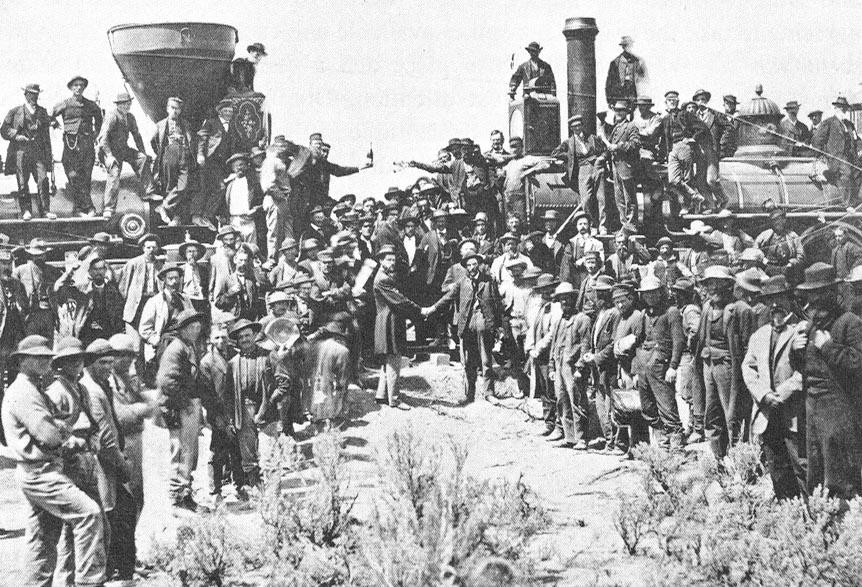

The last rails were laid at Promontory on May 10, 1869. The Union Pacific had built west from Omaha with more than 8,000 Irish, German and Italian immigrant workers, and the Central Pacific east from Sacramento with a workforce that included over 10,000 Chinese laborers.18 The trip across the continent dropped from months to about a week.18
How much was given
Two numbers get confused. The National Archives says Congress "eventually authorized four transcontinental railroads and granted 174 million acres of public lands" for the purpose.18 The Bureau of Land Management's table of disposals of the public domain, 1781 to 2025, records 94,400,000 acres "Granted to railroad corporations" directly, and another 37,130,000 acres "Granted to states for" the "Construction of railroads."17 The National Archives does not explain its figure, and its own sentence ties it to "rights-of-way," which cannot be right for a sum that large. The gap is best explained by the difference between grants promised and land actually conveyed. BLM's table counts cumulative disposals "estimated from available records," that is, land that actually left federal ownership.17 Many grants were never earned, because the promised road was not built on time, and Congress took the unearned land back: the general forfeiture act of September 29, 1890, declared "forfeited to the United States" all granted lands "opposite to and coterminous with the portion of any such railroad not now completed, and in operation."39 The Supreme Court noted in 1947, citing the Federal Coordinator of Transportation's study Public Aids to Transportation, that "other sources put the figure of federal grants-in-aid at 134,303,668 acres," granted to seventy railroads.40 That figure sits close to the BLM total and far below 174 million. The safe statement, from the BLM table, is that about 131.5 million acres of public land passed to railroads directly or through the states.
The bonds are recorded in a later act of Congress, quoted in the Sinking Fund Cases of 1879: the United States had issued subsidy bonds to the Central Pacific "to the amount of $25,885,120," and to the Union Pacific bonds "the principal sums of which amount to $27,236,512; on which the United States have paid over $10,000,000 interest over and above all reimbursements."21 In that 1878 act Congress tried to force the companies to put earnings into a sinking fund to repay the debt. Chief Justice Morrison Waite upheld the act for the Court, while acknowledging that Congress could not change the land grants "without the consent of the corporation" and that "the United States are as much bound by their contracts as are individuals."21
| Federal aid to railroads | Figure | Source |
|---|---|---|
| Land granted directly to railroad corporations, 1781 to 2025 | 94,400,000 acres | BLM Table 1-2 |
| Land granted to states for railroad construction | 37,130,000 acres | BLM Table 1-2 |
| Land granted for all transcontinental routes, as summarized by NARA (authorized, not all conveyed) | 174 million acres | National Archives |
| Federal grants-in-aid to 70 railroads, per Public Aids to Transportation as cited by the Supreme Court | 134,303,668 acres | Krug v. Santa Fe Pacific R. Co., 329 U.S. 591 (1947) |
| Subsidy bonds, Union Pacific | $27,236,512 | Act of May 7, 1878, as quoted in 99 U.S. 700 |
| Subsidy bonds, Central Pacific | $25,885,120 | Same |
| Interest paid by the United States on Union Pacific bonds beyond reimbursements, by 1878 | over $10,000,000 | Same |
The Credit Mobilier scandal
The structure invited a specific abuse. The government paid by the mile. Whoever built the miles set the price. If the same people controlled both the railroad and the construction company, they could pay themselves inflated construction contracts out of the railroad's federal bonds and land and leave the railroad, and its creditor, the United States, holding the debt.
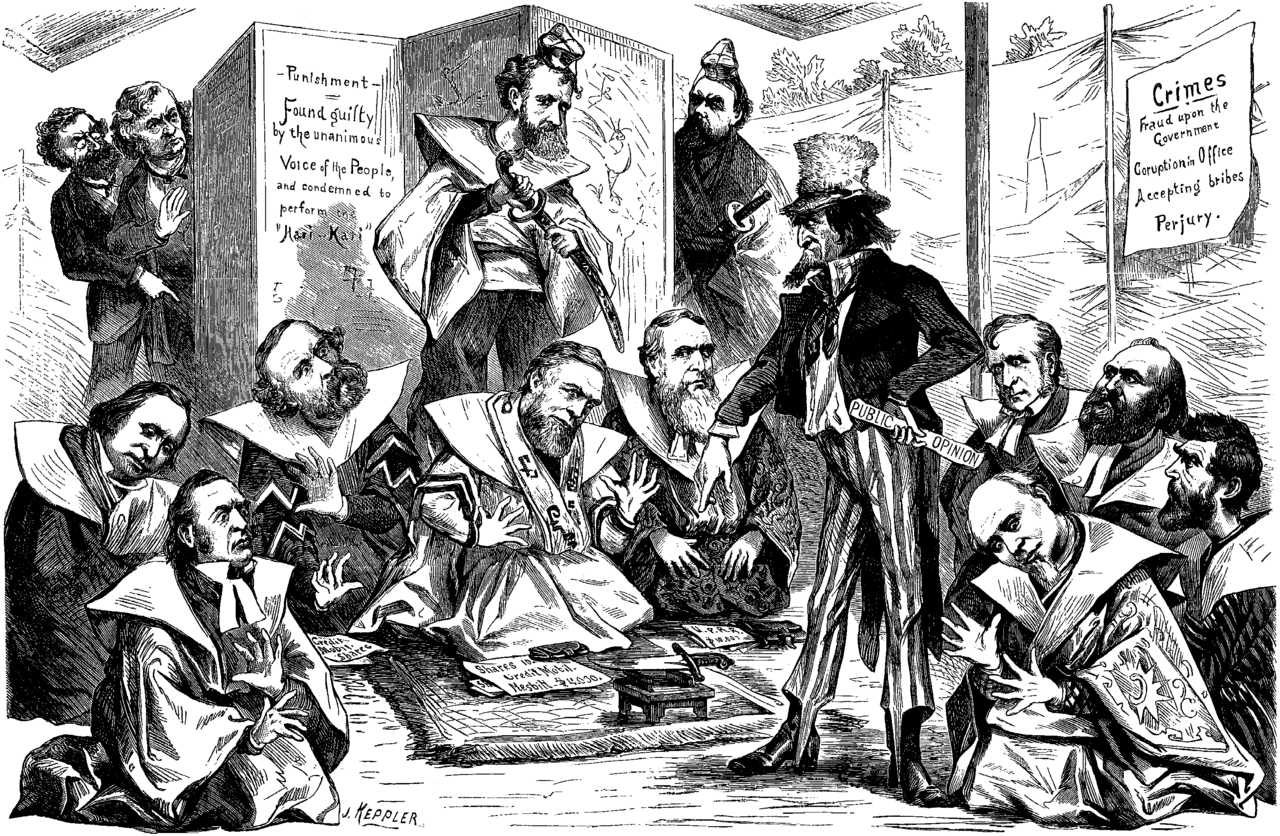
That is what the House of Representatives' own historians describe. Credit Mobilier of America "was a sham construction company chartered to build the Union Pacific Railroad by financing it with unmarketable bonds. It also provided a mechanism to dispense the immense profits from building the railroad to the board of directors and its shareholders."22 Representative Oakes Ames of Massachusetts, a chief participant, "had sold shares at bargain rates to roughly a dozen high-ranking House colleagues, including Schuyler Colfax, then-Speaker of the House (who, by 1872, was the sitting Vice President), in order to secure political clout to benefit the company."22 The New York Sun exposed the arrangement on September 4, 1872. Speaker James Blaine appointed a select committee chaired by Representative Luke Poland of Vermont in December 1872, saying "A charge of bribery of members is the gravest that can be made in a legislative body." On February 27, 1873, the House censured Ames and Representative James Brooks of New York, who was also a government director of the Union Pacific and had profited from a large block of shares.22
Look again at Brooks. He sat on the Union Pacific board as one of the directors "on the part of the government" whom the 1862 act created to watch the company.1922 The watchdog had a stake in the scheme. Congress had already, by a joint resolution of April 10, 1869, directed the Attorney General "to investigate whether or not the charter and all the franchises of the Union Pacific Railroad Company and of the Central Pacific Railroad Company have not been forfeited," whether the companies had paid illegal dividends, and whether any directors or agents had "violated any penal law."23 Four days after the censure, in the appropriations act of March 3, 1873, it ordered him to bring "a suit in equity" against the Union Pacific and everyone who had received "as profits or proceeds of contracts for construction or equipment of said road" money that "ought in equity to belong to said railroad corporation."38

The Territory of Idaho, 1863
The same wartime Congress organized Idaho. The act of March 3, 1863, "to provide a temporary Government for the Territory of Idaho," drew boundaries that ran east along the 49th parallel to the twenty-seventh degree of longitude west of Washington and south to Colorado Territory, far beyond the present state.24 The form was the Northwest Ordinance model of lesson 7, updated. Executive power was "vested in a governor, who shall hold his office for four years, and until his successor shall be appointed and qualified, unless sooner removed by the President of the United States."24 The governor, secretary, chief justice, associate justices, attorney and marshal were all appointed by the President with Senate consent.24 Judicial power went to "a supreme court, district courts, probate courts, and in justices of the peace," with justices who held office "during the period of four years."24 Those are legislative courts in Marshall's sense from Canter, judges without life tenure. The territorial legislature could pass laws on "all rightful subjects of legislation," but "no law shall be passed interfering with the primary disposal of the soil; no tax shall be imposed upon the property of the United States."24 The people of Idaho elected a legislature and a non-voting delegate. They did not choose their governor or their judges, and they could not tax or dispose of the federal land around them. Lesson 10 follows what statehood changed and what it did not.
The Freedmen's Bureau and military Reconstruction
The Bureau, March 3, 1865
Five weeks before Appomattox, Congress "established in the War Department, to continue during the present war of rebellion, and for one year thereafter, a bureau of refugees, freedmen, and abandoned lands," under a commissioner appointed with Senate consent at $3,000 a year.25 Section 4 let the commissioner set apart abandoned or confiscated land and assign "to every male citizen, whether refugee or freedman, as aforesaid," not more than forty acres, protected for three years at a rent of no more than six percent of the land's 1860 value, with an option to buy.25 President Andrew Johnson appointed Major General Oliver Otis Howard as commissioner in May 1865.26
The National Archives lists what the Bureau did: "issuing rations and clothing, operating hospitals and refugee camps, and supervising labor contracts between planters and freedpeople," helping benevolent societies found schools, legalizing marriages made in slavery, and reuniting families.26 Most of the land was never settled on freedpeople in the way the act described. Circular No. 15 of September 12, 1865, issued by Howard and approved by Johnson, provided that abandoned lands "may be restored to owners pardoned by the President," protecting only the crops then growing.37 The Bureau "was not abolished until 1872," but "the bulk of its work was conducted from June 1865 to December 1868."26
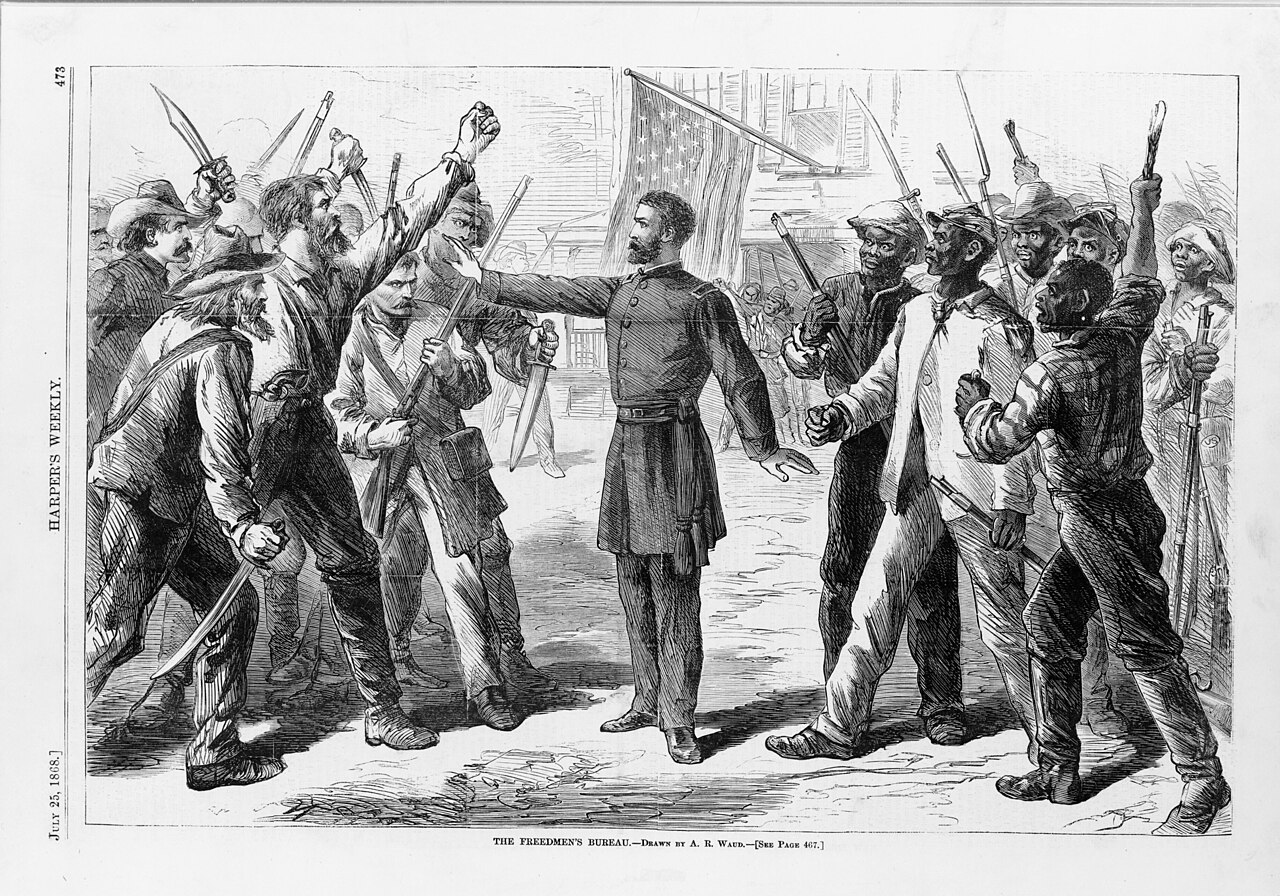
The Bureau is the period's clearest case of an institution that ended. It was born with a sunset written into its first sentence. Congress continued and enlarged it by an act of July 16, 1866, passed over Johnson's veto, and then let it close.3626 It never became permanent. The people it served got far less than the 1865 act had promised, and the land promise was undercut the same year by a circular the President approved.
The Reconstruction Act, March 2, 1867
By early 1867 the Republican Congress considered the Southern governments restored under Johnson illegitimate and had refused to seat their members.27 The Reconstruction Act's preamble declared that "no legal State governments or adequate protection for life or property now exists in the rebel States of Virginia, North Carolina, South Carolina, Georgia, Mississippi, Alabama, Louisiana, Florida, Texas, and Arkansas." It provided that "said rebel States shall be divided into military districts and made subject to the military authority of the United States": Virginia the first; North Carolina and South Carolina the second; Georgia, Alabama and Florida the third; Mississippi and Arkansas the fourth; Louisiana and Texas the fifth. The President was to assign to each "an officer of the army, not below the rank of brigadier-general."28
Johnson's veto message of the same day attacked the design in terms that echo the grievances of 1776 from lesson 4. "The power thus given to the commanding officer over all the people of each district is that of an absolute monarch. His mere will is to take the place of all law." He objected that the bill let the commander "organize military commissions or tribunals" and that "in all criminal cases a trial by jury is made indispensable by the express words of" the Constitution. "Our victories subjected the insurgents to legal obedience, not to the yoke of an arbitrary despotism."29 Congress overrode the veto that day.27
Johnson had a point, and so did Congress, and both are on the record. The act imposed military government on civilians. Section 5 of the same act required that each state's new constitution be framed "by a convention of delegates elected by the male citizens of said State, twenty-one years old and upward, of whatever race, color, or previous condition," with exceptions for those disfranchised for rebellion.28 Military rule ended state by state as the states were readmitted. The House of Representatives' historians summarize the end: "By 1877, the Democratic Party, led by many of the same officials who had sparked the secession movement and fought for the Confederacy, had regained control of southern state governments," and its "coordinated policy of discrimination, intimidation, and violence" against Black political participation was "effectively ending the federal project of Reconstruction."30
Courts and the war powers
Ex parte Milligan, 1866
Lambdin P. Milligan, an Indiana civilian who had never served in the military, was arrested at home on October 5, 1864, by order of General Alvin P. Hovey, brought before a military commission at Indianapolis on October 21, found guilty, "and sentenced to be hanged."31 The Supreme Court ordered him released. Justice David Davis wrote one of the great passages in American law:
The Constitution of the United States is a law for rulers and people, equally in war and in peace, and covers with the shield of its protection all classes of men, at all times, and under all circumstances. No doctrine, involving more pernicious consequences, was ever invented by the wit of man than that any of its provisions can be suspended during any of the great exigencies of government.31
The holding was precise. Military law "can never be applied to citizens in states which have upheld the authority of the government, and where the courts are open and their process unobstructed." In Indiana "the Federal authority was always unopposed, and its courts always open." And: "Martial rule can never exist where the courts are open, and in the proper and unobstructed exercise of their jurisdiction."31 The right to a jury, Davis wrote, "is not held by sufferance, and cannot be frittered away on any plea of state or political necessity."31 The same principle that the colonists had pressed against the vice-admiralty courts, the subject of lesson 4, was restated for a federal government at war.
Ex parte McCardle, 1869
Congress noticed what the Court could do. William McCardle, a Mississippi newspaper editor held by the military under the Reconstruction Acts, sought habeas corpus and appealed to the Supreme Court. After argument, Congress passed an act on March 27, 1868, taking away the Court's appellate jurisdiction over such habeas cases.32 Chief Justice Chase, for a unanimous Court, dismissed the appeal: "We are not at liberty to inquire into the motives of the legislature. We can only examine into its power under the Constitution; and the power to make exceptions to the appellate jurisdiction of this court is given by express words." And: "Without jurisdiction the court cannot proceed at all in any cause."32
Milligan and McCardle bracket the period. One shows a court limiting war power by the Constitution's text. The other shows Congress limiting the court by the same text, Article III's Exceptions Clause. Neither branch had the last word alone, which is the friction Madison designed, examined in lesson 5.
The size of the new government
The employment series shows the war's effect and what remained after it. Paid federal civilian employment was 36,672 in 1861 and 51,020 in 1871. By 1881 it was 100,020. The Post Office still held most of it, 56,421 workers in 1881, but the "Other" executive category, which covers Treasury, Interior and the rest, grew from 4,891 in 1861 to 12,276 in 1871 and 21,961 in 1881.2 The government that the Gilded Age inherited was twice the size of the prewar government in a decade and still growing, and it was still staffed largely by party patronage. That is where lesson 10 begins.
Through Pierson's Framework
Pierson's ordered liberty rests on a pair of duties: to hold government accountable, and to support legitimate government. A civil war tests both at their limit. The Union government was legitimate and it was fighting for its existence. Most of its emergency institutions were built in the open by statute, debated, vetoed and overridden, and tested in court. Run the module's name-versus-function test and the scorecard comes out uneven.
The income tax, the Freedmen's Bureau and military Reconstruction each ended. Good or bad, none of them defended itself on habit. They expired, or the political branches wound them down.
The national banking system and the Internal Revenue office stayed. Each had a defensible peacetime job, a uniform currency and tax collection. Each also picked up a constituency. National banks made money holding federal debt, which gave the most organized interest in the country a stake in that debt. Pierson describes the pattern in "The Acacia Illusion": "In human systems, institutional defenders may appear voluntary but are, in reality, functionally dependent."33 A banking system whose currency rested on federal bonds is a plain case of functional dependence. It was designed that way, on purpose, in wartime.
The railroad settlement is the period's strongest example of the old mercantile pattern of lesson 3: a charter, a grant of the sovereign's land, the sovereign's credit and a public service in return. The function was real. The road was built and the country was joined. The accountability failed, and it failed at the exact point designed to prevent failure. Government directors were placed on the board to watch the public's money, and one of them took the stock. The government's lien was moved behind private bondholders by statute. Pierson's warning that "the mission is replaced by the machinery, and survival becomes the goal" fits a company that took federal bonds for every forty miles while its insiders paid themselves through a captive contractor.33
The record also shows the correction. The press exposed Credit Mobilier. The House investigated in public and censured two members. Congress ordered the Attorney General to look into forfeiture, and in 1878 passed a sinking fund law that the Supreme Court upheld. Pierson's Civic Anti-Authoritarianism makes the citizen "the moral auditor of government," and says that under it "Transparency replaces secrecy, accountability replaces privilege, and moral duty replaces blind allegiance."34 In 1872 and 1873 a newspaper and a House committee did that auditing. They did it late, and they did not get the money back.
Milligan belongs in the framework too. Davis's sentence that the Constitution is "a law for rulers and people, equally in war and in peace" states the core of ordered liberty better than most modern commentary. Pierson's appendix on the Anti-Federalists warns that "No agency, no court, no presidency is immune from corruption when disconnected from the people's virtue and oversight."35 Milligan applied that warning to a wartime presidency, and McCardle showed Congress could apply it to the Court.
Hard Questions and Answers
The railroad got built and the country got joined. Why pick at the bill for the best public investment of the century?
Because the bill included a scheme that one of the government's own directors profited from. Start with the case for the investment, which is real. The road was built, and the National Archives notes it cut a cross-country trip from months to about a week.18 Private capital had declined to build it without federal help.18 The 1862 act also required the companies to carry federal mail, troops and supplies with the charges applied to the debt.19 Those are real returns. The cost side includes about 131.5 million acres of public land, over $53 million in federal bonds to the two original companies, and over $10 million in federal interest on Union Pacific bonds beyond reimbursements by 1878.1721 The investment case can be won on those numbers. It still does not answer the accountability problem: insiders took the construction profits through Credit Mobilier while the government sat behind private bondholders on a subordinated lien.2220
The Court first called the greenback unconstitutional, then changed its mind once new justices arrived. Isn't that a reshaped Court blessing a seizure?
Hepburn v. Griswold did hold the act unconstitutional for debts contracted before 1862.7 Knox v. Lee overruled that holding in 1871 and upheld the acts for all contracts.8 The Constitution grants the power to borrow money and coin money and to make laws necessary and proper to execute them. It does not mention paper legal tender. Serious readers still disagree. The record proves the sequence: the Court reversed itself after its membership changed, and said its size was part of the reason. It does not prove the motive. It also shows the government keeping gold for its own bondholders and customs while paying everyone else in paper.5 That favored the government's own creditors over everyone else's, and the criticism stands whatever one concludes about the Constitution.
Army officers ruling American civilians, with military commissions in place of juries. How is that different from what 1776 was fought over?
On the mechanics, Johnson was right, and his words are accurate quotations: he called each commander's power "that of an absolute monarch."29 The Reconstruction Act did place civilians under military authority and allowed military commissions.28 The other half of the record is the reason Congress acted. It found that "no legal State governments or adequate protection for life or property now exists" in ten states.28 The National Archives notes that the Bureau's state-level records include narrative reports on "murders and outrages" among other subjects.26 Military government was an extraordinary remedy for a breakdown of civil protection. It was also temporary, ending as each state was readmitted. Both readings rest on the documents. A reader applying Milligan's rule, that martial rule ends where courts are open and working, has to ask whether the Southern courts of 1866 protected freedpeople. The evidence the Bureau collected suggests many did not.
The Homestead Act put ordinary families on their own land. Why drag it into a story about institutions?
It did put families on land, eventually a great deal of it.17 The National Archives' own verdict on the nineteenth-century results is harsh: most land dispersed between 1862 and 1904 "went to speculators, cattle owners, miners, loggers, and railroads," and only 80 million of some 500 million acres went to homesteaders in that period.16 A law named for settlers sent most of the land elsewhere. That is the name-versus-function problem in its plainest form.
Congress pulled a case away from the Court after argument because it feared the answer. If that is allowed, what check is left?
Congress could, and did. The Court refused to ask why. McCardle upheld a repeal of one statutory route of appeal, relying on the Exceptions Clause of Article III.32 It is a real power, and Congress used it to protect its Reconstruction program from review. The text supports the holding. The use in 1868 shows the danger plainly: a majority can shield its own acts by removing the court that would judge them. Milligan and McCardle belong to the same machinery of friction, and McCardle is the half that can be turned into a weapon.
Learn more
- Pacific Railway Act of 1862 (National Archives): the full text with an introduction.
- Pacific Railway Act amendments of July 2, 1864 (13 Stat. 356): doubled land grants and the subordinated lien.
- Homestead Act of 1862 (National Archives): text and the Archives' assessment of results.
- Idaho Organic Act, March 3, 1863 (12 Stat. 808): the territorial government's charter.
- Reconstruction Act of March 2, 1867 (14 Stat. 428): the five military districts.
- Ex parte Milligan (1866): Justice Davis's opinion.
- House History: The Credit Mobilier Scandal: the House's account of its own investigation.
- Federal Reserve History: National Banking Acts: the banking system and its numbers.
- National Archives: Freedmen's Bureau records: what the Bureau did and how to read its records.
- Module 51, lesson 3: Mercantilism: the charter, land and credit pattern.
Notes
- U.S. Department of the Treasury, "Historical Debt Outstanding," TreasuryDirect, history narrative for 1860 to 1865. Read it online. ↩
- U.S. Bureau of the Census, Historical Statistics of the United States, Colonial Times to 1970, Part 2 (1975), Series Y 308 to 317, p. 1103. Read it online. ↩
- An Act to provide for the Payment of outstanding Treasury Notes, to authorize a Loan, to regulate and fix the Duties on Imports, and for other Purposes, ch. 68, 12 Stat. 178 (March 2, 1861). Read it online. ↩
- Bureau of Engraving and Printing, "Currency History," entries for 1861 and 1862. Read it online. ↩
- An Act to authorize the Issue of United States Notes, and for the Redemption or Funding thereof, and for Funding the Floating Debt of the United States, ch. 33, 12 Stat. 345 (February 25, 1862), section 1. Read it online. ↩
- Federal Reserve History, "National Banking Acts of 1863 and 1864." Read it online. ↩
- Hepburn v. Griswold, 75 U.S. (8 Wall.) 603 (1870), opinion of Chase, C.J. Read it online. ↩
- Knox v. Lee (Legal Tender Cases), 79 U.S. (12 Wall.) 457 (1871), opinion of Strong, J. Read it online. ↩
- An Act to provide increased Revenue from Imports, to pay Interest on the Public Debt, and for other Purposes, ch. 45, 12 Stat. 292 (August 5, 1861), section 49. Read it online. ↩
- National Archives, Milestone Documents, "16th Amendment to the U.S. Constitution: Federal Income Tax (1913)." Read it online. ↩
- Internal Revenue Service, IRS History Timeline (March 2019 edition), entries for 1862 and 1863 to 1864. Read it online. ↩
- An Act to provide a national Currency, secured by a Pledge of United States Stocks, ch. 58, 12 Stat. 665 (February 25, 1863). Read it online. ↩
- Office of the Comptroller of the Currency, "History." Read it online. ↩
- An Act to provide a National Currency, secured by a Pledge of United States Bonds, ch. 106, 13 Stat. 99 (June 3, 1864). Read it online. ↩
- An Act to secure Homesteads to actual Settlers on the Public Domain, ch. 75, 12 Stat. 392 (May 20, 1862), sections 1, 2 and 6, text at the National Archives. Read it online. ↩
- National Archives, Milestone Documents, "Homestead Act (1862)," introduction. Read it online. ↩
- U.S. Department of the Interior, Bureau of Land Management, Public Land Statistics 2025, Table 1-2, "Disposition of the Public Domain, 1781 to 2025." Read it online. ↩
- National Archives, Milestone Documents, "Pacific Railway Act (1862)," introduction. Read it online. ↩
- An Act to aid in the construction of a railroad and telegraph line from the Missouri River to the Pacific Ocean, ch. 120, 12 Stat. 489 (July 1, 1862), sections 1 to 6 and 11, text at the National Archives. Read it online. ↩
- An Act to amend an Act entitled "An Act to aid in the Construction of a Railroad and Telegraph Line from the Missouri River to the Pacific Ocean," ch. 216, 13 Stat. 356 (July 2, 1864), sections 4, 10 and 13. Read it online. ↩
- Sinking Fund Cases (Union Pacific Railroad Co. v. United States), 99 U.S. 700 (1879), quoting the preamble of the Act of May 7, 1878; opinion of Waite, C.J. Read it online. ↩
- U.S. House of Representatives, History, Art and Archives, "The Credit Mobilier Scandal," Historical Highlights, September 4, 1872. Read it online. ↩
- Joint Resolution for the protection of the interests of the United States in the Union Pacific Railroad Company, the Central Pacific Railroad Company, and for other purposes, No. 19, section 4, 16 Stat. 56, 57 (April 10, 1869). Read it online. ↩
- An Act to provide a temporary Government for the Territory of Idaho, ch. 117, 12 Stat. 808 (March 3, 1863), sections 1, 2, 6, 9 and 11. Read it online. ↩
- An Act to establish a Bureau for the Relief of Freedmen and Refugees, ch. 90, 13 Stat. 507 (March 3, 1865), sections 1 and 4. Read it online. ↩
- National Archives, "Freedmen's Bureau Records," Record Group 105, introduction. Read it online. ↩
- Teaching American History, "Reconstruction Acts," introduction and text. Read it online. ↩
- An Act to provide for the more efficient Government of the Rebel States, ch. 153, 14 Stat. 428 to 429 (March 2, 1867), preamble and sections 1, 2 and 5. Read it online. ↩
- Andrew Johnson, Veto Message, March 2, 1867, The American Presidency Project, University of California, Santa Barbara. Read it online. ↩
- U.S. House of Representatives, History, Art and Archives, Black Americans in Congress, "The Fifteenth Amendment in Flesh and Blood" historical essay, introduction. Read it online. ↩
- Ex parte Milligan, 71 U.S. (4 Wall.) 2 (1866), opinion of Davis, J., transcription at Wikisource; quotations checked against the official United States Reports scan at the Library of Congress, which reads "sufferance" where the Wikisource transcription has "sufference" (read it online). Read it online. ↩
- Ex parte McCardle, 74 U.S. (7 Wall.) 506 (1869), opinion of Chase, C.J. Read it online. ↩
- Jeff A. Pierson, "The Acacia Illusion: How Institutionalism Mimics Nature's Most Subtle Manipulation," in The Ordered Liberty Papers (2025). Read it online. ↩
- Jeff A. Pierson, The Ordered Liberty Papers, section on Civic Anti-Authoritarianism. Read it online. ↩
- Jeff A. Pierson, "The Anti-Federalist Warning: Institutional Power and the Fragility of Liberty," appendix to Ordered Liberty Reclaimed: A Foundation for Liberty. Read it online. ↩
- An Act to continue in force and to amend "An Act to establish a Bureau for the Relief of Freedmen and Refugees," and for other Purposes, ch. 200, 14 Stat. 173 (July 16, 1866), passed over the President's veto as the House and Senate attestations printed with the act record. Read it online. ↩
- Bureau of Refugees, Freedmen, and Abandoned Lands, Circular No. 15, September 12, 1865, signed by O. O. Howard and approved by Andrew Johnson, paragraphs VII and VIII, The American Presidency Project. Read it online. ↩
- An Act making Appropriations for the legislative, executive, and judicial Expenses of the Government for the Year ending June thirtieth, eighteen hundred and seventy-four, and for other Purposes, ch. 226, section 4, 17 Stat. 485, 509 (March 3, 1873). Read it online. ↩
- An act to forfeit certain lands heretofore granted for the purpose of aiding in the construction of railroads, and for other purposes, ch. 1040, section 1, 26 Stat. 496 (September 29, 1890). Read it online. ↩
- Krug v. Santa Fe Pacific Railroad Co., 329 U.S. 591, 592 note 2 (1947), opinion of Black, J., citing Federal Coordinator of Transportation, Section of Research, Public Aids to Transportation (1940), vol. 1, pp. 12 to 13. Read it online. ↩
Terms in this lesson
- Greenbacks
- United States notes authorized by the Legal Tender Act of February 25, 1862, $150 million of non-interest-bearing paper made legal tender for private debts, though not for import duties or interest on federal bonds.
- Comptroller of the Currency
- The Treasury officer created by the National Currency Act of February 25, 1863, to charter and supervise national banks; Hugh McCulloch was the first.
- Subsidy bonds
- Thirty-year, six percent United States bonds lent to the Pacific railroad companies at $16,000, $32,000 or $48,000 per mile depending on terrain.
- Land grant
- A transfer of alternate sections of public land along a railroad's line, five per mile on each side in 1862, raised to ten per mile on each side in 1864.
- Credit Mobilier of America
- A construction company controlled by Union Pacific insiders that took the building contracts and passed the profits to them; its stock was placed with members of Congress and exposed in 1872.
- Freedmen's Bureau
- The Bureau of Refugees, Freedmen, and Abandoned Lands, created in the War Department on March 3, 1865, and abolished in 1872.
- Military districts
- The five commands into which the Reconstruction Act of March 2, 1867, divided ten former Confederate states, each under an army officer not below brigadier general.
- Ex parte Milligan
- The 1866 Supreme Court decision that a civilian could not be tried by military commission in a state where the civil courts were open.
Sources
- Legal Tender Act, February 25, 1862, 12 Stat. 345 checked 2026-10
- Pacific Railway Act, July 1, 1862, 12 Stat. 489 checked 2026-10
- Pacific Railway Act amendments, July 2, 1864, 13 Stat. 356 checked 2026-10
- Homestead Act, May 20, 1862, 12 Stat. 392 checked 2026-10
- Act to provide a temporary Government for the Territory of Idaho, March 3, 1863, 12 Stat. 808 checked 2026-10
- Freedmen's Bureau Act, March 3, 1865, 13 Stat. 507 checked 2026-10
- Reconstruction Act, March 2, 1867, 14 Stat. 428 checked 2026-10
- Ex parte Milligan, 71 U.S. 2 (1866) checked 2026-10
- BLM Public Land Statistics 2025, Table 1-2 checked 2026-10