Lesson 14 of 15 · about 8 minutes
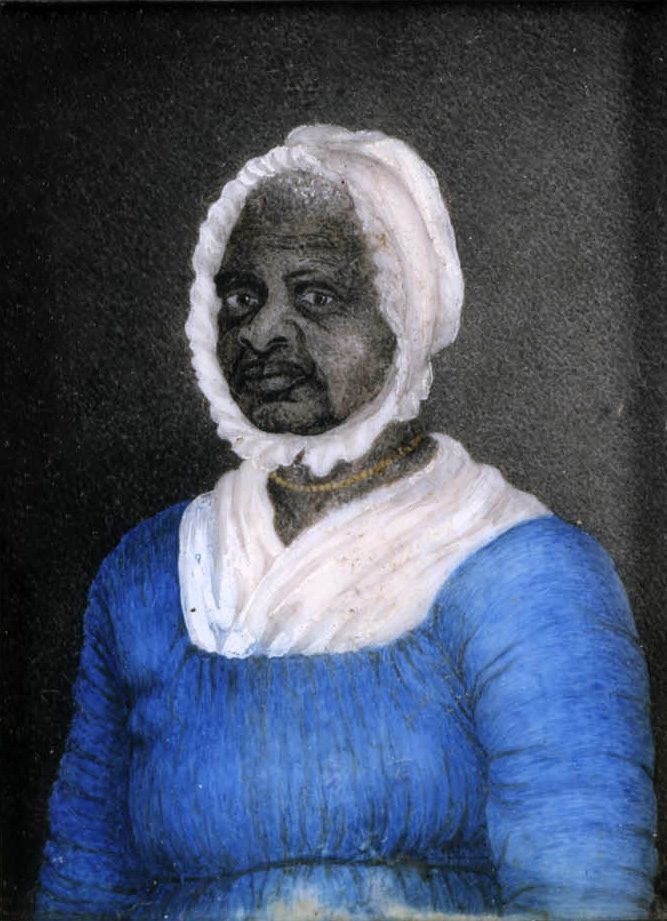
Elizabeth Freeman: Mum Bett Takes the Constitution at Its Word
You'll be able to
- Place Freeman's life in order, from Claverack, New York, to her death in 1829
- Trace how she came to know the words 'born free and equal' and what she did with them
- Describe the case of Brom and Bett against Ashley and the two arguments made for her
- Explain why a constitution's words matter only when ordinary people insist on them
- Read the inscription on her tombstone
Most of the people in this course held office or wrote speeches. Elizabeth Freeman did neither. She never learned to read or even to write her name. But she listened. When a group of local men talked about the rights of man in the house where she served the table, she heard one idea again and again, and she decided to test whether it was true. Asked years later how she had learned the law, she said: "By keepin' still and mindin' things."1
A Girl Given Away
Bett was born around 1744 in Claverack, New York, into the household of a Dutch landowner, Pieter Hogeboom. She grew up there with a younger sister, Lizzie. When Hogeboom's daughter Hannah married John Ashley, the two girls were given to the new couple and never saw their parents again.2 The Ashleys lived in Sheffield, in the far west of Massachusetts. Colonel Ashley was a man of standing there, a member of the colonial Assembly and a judge of the county Court of Common Pleas.3
The household was not gentle. The story that Bett herself told became part of local memory: Hannah Ashley struck at Lizzie with a heated kitchen shovel, and Bett put her arm in the way. In the words of Theodore Sedgwick's son, "Mum Bett interposed her arm, and received the blow; and she bore the honorable scar it left to the day of her death."4 She did not hide the wound.2
What She Heard at the Table
In January 1773 a Sheffield committee met in Ashley's house to put the town's grievances against Britain on paper. Ashley chaired it. The clerk was a young lawyer named Theodore Sedgwick. The committee produced the Sheffield Declaration, which began from this principle: "Mankind in a State of Nature are equal, free and independent of each other, and have a right to the undisturbed Enjoyment of their lives, their Liberty and Property."5 Bett, who served in the house, may well have been within earshot.
Seven years later Massachusetts adopted its own constitution. Article I of its Declaration of Rights said: "All men are born free and equal, and have certain natural, essential, and unalienable rights."6 The sentence was not a hope. It was the text of the state's fundamental law, now read aloud and discussed in the houses of the people who would live under it.
Harriet Martineau, who knew the Sedgwick family, recorded Bett's own account. While waiting at table she had heard gentlemen "talking over the Bill of Rights and the new constitution of Massachusetts; and in all they said, she never heard but that all people were born free and equal, and she thought long about it, and resolved she would try whether she did not come in among them."7 Notice the phrase "try whether." She did not say the law had been broken. She said the law was written, and she wanted to find out if it meant what it said.
Brom and Bett against Ashley
In 1781, as the story goes, Bett went to see Sedgwick. He took her case, together with the Litchfield, Connecticut, lawyer Tapping Reeve. A man named Brom joined her as a second plaintiff. Sedgwick obtained a writ of replevin, and when the Ashleys refused to release the two, the matter went to the county court at Great Barrington in August 1781.8
According to the Duc de La Rochefoucauld-Liancourt, who visited Sedgwick and recorded his account, the lawyers made two arguments. The first was "That no antecedent law had established slavery, and that the laws which seemed to suppose it were the offspring of error in the legislators." The second was "That such laws, even if they had existed, were annulled by the new Constitution."9 The jury agreed. It found that Brom and Bett were not Ashley's servants for life, and ordered thirty shillings in damages plus costs.10
Ashley appealed, and then dropped the appeal. The state's highest court had meanwhile decided another case, and Ashley accepted the lower court's ruling that Brom and Bett were not slaves.10 Her case was one of several freedom suits in Massachusetts in those years, and together they led the state's Supreme Judicial Court to end slavery there.11 Some scholars point out that no statute ever abolished slavery in Massachusetts, and that it was simply no longer practiced.
Take a position on this. The case shows what a written constitution can and cannot do. A page of text cannot free anyone. A page of text read by a free people, claimed by a person with the nerve to say that it meant her, and enforced by a jury, can. Freeman did not riot, flee, or wait for a prophet. She used the courts and the words of the law, and she won. Ordered liberty is built from cases like hers.
A Free Woman
After the verdict she took the name Elizabeth Freeman. Colonel Ashley asked her to return as a paid servant, and she declined. She went to work, for wages, in the household of Theodore and Pamela Sedgwick, first in Sheffield and then in Stockbridge.2 She became, in the words of Catharine Sedgwick, "the main pillar of the household," and the only person who could calm Pamela Sedgwick during her bouts of depression.12 She also worked as a healer, midwife and nurse. She saved enough to buy a small house and lived there among her children, grandchildren and great-grandchildren.2
She died on December 28, 1829. She is buried in the Sedgwick family plot at Stockbridge, the only person there who was not a Sedgwick. Her tombstone, written by Catharine Sedgwick's brother Charles, says: "She was born a slave and remained a slave for nearly thirty years. She could neither read nor write, yet, in her own sphere, she had no superior nor equal."13
Catharine Sedgwick remembered something Bett once told her about her years in bondage: "just to stand one minute on God's earth a free woman."2 That is what the Revolution promised in its own plainest language. She was among the first to ask the new republic to keep its word.
Freeman's Life at a Glance
- c. 1744 Born into slavery in Claverack, New York.
- 1773 Sheffield committee, chaired by John Ashley, writes the Sheffield Declaration.
- 1780 Massachusetts adopts a constitution declaring all men born free and equal.
- 1781 Sues with Brom for freedom; a Great Barrington jury rules for them in August.
- 1785 The Sedgwick family moves to Stockbridge.
- 1829 Signs her will in October; dies December 28.
Learn more
- The Slave Who Sued for Freedom: Jon Swan's account in American Heritage, with the sources it quotes.
- Elizabeth Freeman, National Women's History Museum: a short biography with a primary source page.
- African Americans and the End of Slavery in Massachusetts: documents on Freeman and Quock Walker from the Massachusetts Historical Society.
- Jury Decides in Favor of Elizabeth "Mum Bett" Freeman: a Mass Moments entry on the verdict.
- Massachusetts Constitution: the 1780 text, with Article I.
Notes
- Harriet Martineau's account of her conversation with Elizabeth Freeman, as quoted in Jon Swan, "The Slave Who Sued for Freedom," American Heritage, March 1990. Read it online. ↩
- "Elizabeth Freeman," National Women's History Museum. Read it online. ↩
- Swan, "The Slave Who Sued for Freedom," on John Ashley's career as assemblyman and judge. Read it online. ↩
- Henry Dwight Sedgwick, "The Practicability of the Abolition of Slavery," a lecture quoted in Swan, "The Slave Who Sued for Freedom." Read it online. ↩
- The Sheffield Declaration, January 1773, as quoted in Swan, "The Slave Who Sued for Freedom." Read it online. ↩
- Constitution of the Commonwealth of Massachusetts (1780), Part the First, Article I, Massachusetts Legislature. Read it online. ↩
- Jon Swan, "The Slave Who Sued for Freedom," American Heritage 41, no. 2 (March 1990), quoting Harriet Martineau, Henry Dwight Sedgwick, the Duc de La Rochefoucauld-Liancourt and Catharine Maria Sedgwick. Read it online. ↩
- Swan, "The Slave Who Sued for Freedom," on the writ of replevin and the hearing at Great Barrington. Read it online. ↩
- The Duc de La Rochefoucauld-Liancourt, Travels, as quoted in Swan, "The Slave Who Sued for Freedom." Read it online. ↩
- Swan, "The Slave Who Sued for Freedom," on the verdict, the appeal and Caldwell v. Jennison. Read it online. ↩
- "African Americans and the End of Slavery in Massachusetts," Massachusetts Historical Society. Read it online. ↩
- Catharine Maria Sedgwick, as quoted in Swan, "The Slave Who Sued for Freedom." Read it online. ↩
- Inscription on the gravestone of Elizabeth Freeman, Stockbridge, written by Charles Sedgwick, as quoted in Swan, "The Slave Who Sued for Freedom." Read it online. ↩
Terms in this lesson
- Sheffield Declaration
- A set of resolves adopted by the town of Sheffield, Massachusetts, in January 1773. It said that mankind in a state of nature are equal, free and independent.
- Writ of replevin
- A legal order to recover property wrongly held. Freeman's lawyer used it to ask the court to release her and Brom from Ashley.
- Declaration of Rights
- The first part of the Massachusetts Constitution of 1780. Its Article I says all men are born free and equal.
- Jury
- A body of local citizens who decide the facts of a case. A jury in Great Barrington decided Freeman's.
- Natural state
- In Enlightenment thought, the condition of people before government. The Sheffield Declaration claimed that in it, all are equal and free.
Sources
- Jon Swan, The Slave Who Sued for Freedom, American Heritage, March 1990 checked 2026-10
- Elizabeth Freeman, National Women's History Museum checked 2026-10
- Constitution of the Commonwealth of Massachusetts, Part the First, Article I (1780), Massachusetts Legislature checked 2026-10
- African Americans and the End of Slavery in Massachusetts, Massachusetts Historical Society checked 2026-10
- Jury Decides in Favor of Elizabeth Mum Bett Freeman, Mass Moments checked 2026-10
- Petition of Lancaster Hill, Peter Bess, Brister Slenser, Prince Hall, et al., 1777, Library of America checked 2026-10