Lesson 1 of 15 · about 8 minutes
James Madison: The Man Who Kept the Notes
You'll be able to
- Place Madison's life in order, from Virginia in 1751 to Montpelier in 1836
- Explain what Madison wanted at the Convention, what he lost, and why he called the result partly federal and partly national
- Read two of his Convention speeches and one passage from Federalist No. 51 in his own words
- Describe how the Notes of Debates were kept and why historians trust them
- Describe Madison's turn toward a Bill of Rights and his record on slavery
On May 5, 1787, James Madison arrived in Philadelphia, before the Constitutional Convention had a quorum.1 He brought a plan with him. He was no orator, and he knew it. He was also the best prepared man in the city. The Convention sat from May 27 to September 17, and for almost all of it he was in his seat near the front, writing.
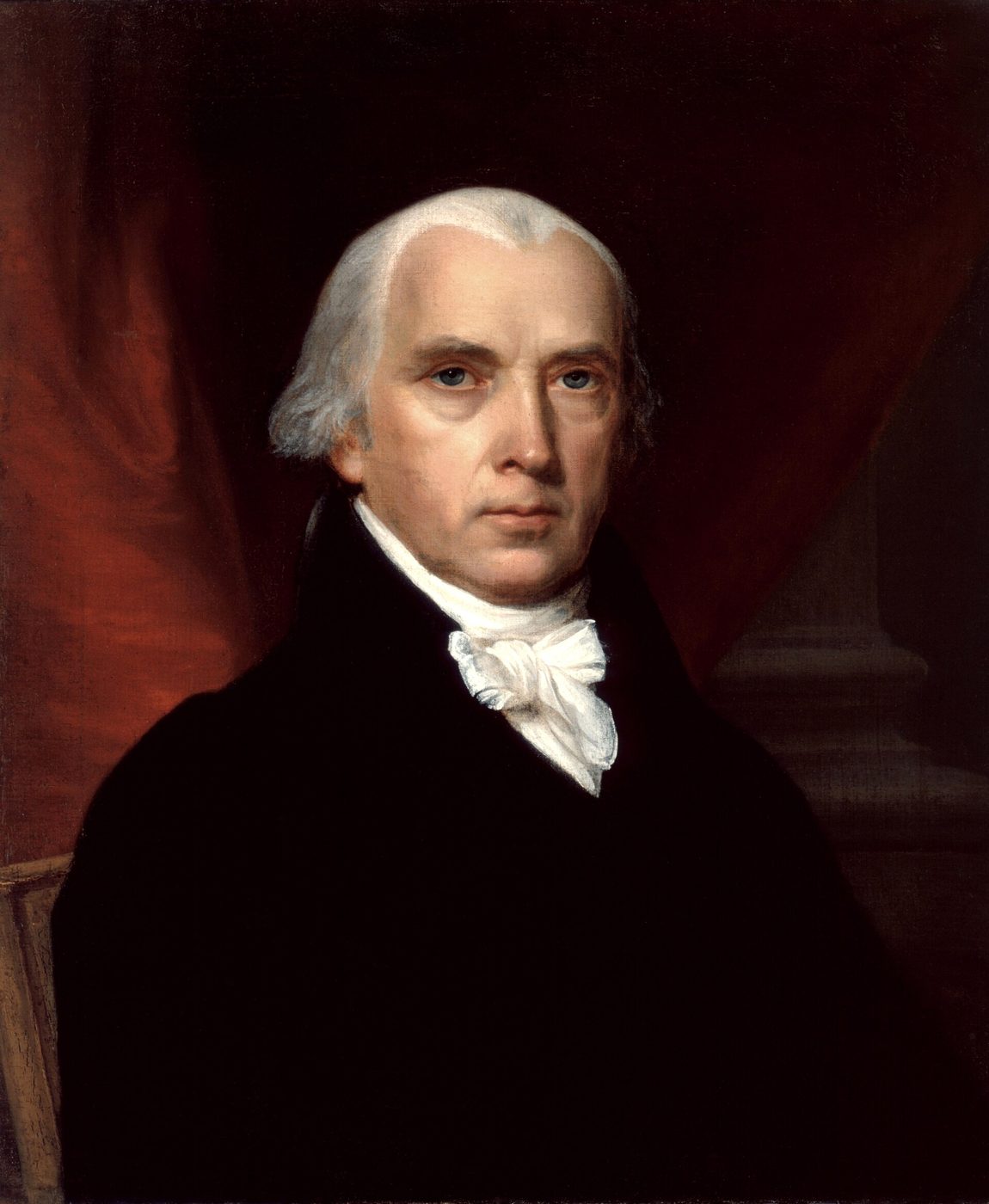
From Montpelier to Philadelphia
Madison was born in Virginia in 1751, the oldest child of a wealthy planter. He went to the College of New Jersey (now Princeton) instead of William and Mary because his family thought it healthier, and he finished the three-year course in two.2 Poor health kept him out of the army. He served instead in the Virginia convention of 1776 and in the Continental Congress from 1780 to 1783, where he watched the Articles of Confederation fail to raise money for a war it was supposed to be winning. A proposal to let Congress collect a tariff died because one state would not agree.2
That lesson pushed him toward the Mount Vernon conference of 1785 and the Annapolis meeting of 1786.2 By the spring of 1787 he wanted three things: a government that acted directly on individuals, representation in both houses by population, and a national veto over state laws.1
The Virginia Plan and What Madison Lost
Edmund Randolph presented the Virginia Plan on May 29. It put a legislature of two houses, an executive and a national judiciary over the states, and gave Congress the power to tax and regulate commerce. The Convention argued from it for the next four months, so Madison got the agenda he wanted. He did not get the outcome.1
The small states would not accept proportional votes in the Senate, and in July the Great Compromise gave each state an equal vote there. On July 17 the delegates struck down his negative on state laws, which he regarded as the anchor of the whole design. Madison also wanted impeachment tried before the Supreme Court. The Senate got it.1 Defending the finished government in Federalist No. 39, he said that in the sources of its ordinary powers it was "partly federal and partly national."3
Factions and checks
What Madison did contribute was an argument about human nature. On June 6, as he recorded it, he told the delegates that in every society interests divide: rich and poor, debtors and creditors, landed and commercial, one religious sect and another. His conclusion was blunt.
"In all cases where a majority are united by a common interest or passion, the rights of the minority are in danger."
James Madison, speech of June 6, 1787, as recorded in his Notes of Debates. 4
A republic big enough to hold many interests, he argued, would make it harder for any one of them to command a majority. The same idea runs through his later defense of the Constitution. In Federalist No. 51 he wrote that "Ambition must be made to counteract ambition," and then gave the most quoted sentences he ever wrote:
"If men were angels, no government would be necessary. If angels were to govern men, neither external nor internal controls on government would be necessary. In framing a government which is to be administered by men over men, the great difficulty lies in this: you must first enable the government to control the governed; and in the next place oblige it to control itself."
James Madison, The Federalist No. 51, February 8, 1788. 5
That second sentence is a short course in ordered liberty. A government strong enough to protect rights must also be bound, and citizens carry a standing duty to see that it stays bound.
The Notes
On May 29 the Convention adopted rules of secrecy, including that nothing spoken in the House be printed or published without leave.6 Madison kept notes anyway. He sat near the presiding officer, took down speeches in abbreviations, and wrote them up in full after each day's session. He did not publish them. He revised them later against the official journal, and they came out only after his death in 1836.1 The Convention's secretary, William Jackson, kept a thin official journal. Historians value Madison's version far more because it records who argued what.2
The Notes are third-person summaries, not transcripts, and Madison edited them. Readers should treat them as a careful participant's reconstruction. Almost everything in this module about what a delegate said in Philadelphia comes from them.
Slavery in the Notes
Madison owned slaves at Montpelier all his life.2 He also saw clearly what slavery did to the Convention. On June 30, as the large and small states fought over the Senate, he told the delegates that the real split in the country lay elsewhere. In his words, the states differed in interest mostly "from the effects of their having or not having slaves," and the division "lay between the Northern & Southern" states.7 On August 25 he objected to writing slavery into the text, saying it was wrong "to admit in the Constitution the idea that there could be property in men."8 The final text never uses the word slave. It still counted "three fifths of all other Persons" in apportioning representation and barred amendments touching the slave-trade clause before 1808.9
Ratification and the Bill of Rights
After the Convention Madison joined Alexander Hamilton and John Jay in writing The Federalist, and in Virginia he led the ratification fight against Patrick Henry. The Virginia convention endorsed the Constitution. Henry then helped keep him out of the first Senate, so Madison ran for the House.2
In the First Congress he proposed amendments. Fellow Federalists thought it a distraction, and Anti-Federalists thought the amendments too weak because they did not cut back federal power. He kept at it, and ten amendments were ratified by the states in 1791.210
After the presidency and the War of 1812 he retired to Montpelier and spent long hours editing his Convention journal. He died in 1836.2 John Quincy Adams delivered a eulogy for him.
Madison's Life at a Glance
- 1751 Born in Virginia, the oldest child of a wealthy planter.
- 1780 Begins service in the Continental Congress.
- 1787 Arrives in Philadelphia May 5; Randolph presents the Virginia Plan May 29; Convention ends September 17.
- 1788 Writes for The Federalist; leads the Virginia ratifying fight.
- 1789 Takes a House seat and proposes amendments.
- 1791 Ten amendments, the Bill of Rights, are ratified.
- 1809 Becomes the fourth president.
- 1836 Dies at Montpelier; his Notes of Debates appear in print later.
Learn more
- Madison at the Federal Convention: the Papers of James Madison editors on his goals, his defeats and the Notes.
- Madison Debates, Avalon Project: the full Notes, day by day, free online.
- Federalist No. 51: read the full essay on checks and balances.
- Federalist No. 10: Madison's argument about faction and the large republic.
- National Constitution Center biography: a readable life by historian Carol Berkin.
- The Bill of Rights, transcript: the text Madison pushed through the First Congress.
Notes
- "Madison at the Federal Convention, 27 May-17 September 1787," editorial note, The Papers of James Madison, Founders Online, National Archives. Read it online. ↩
- Carol Berkin, "James Madison," Signers' Biographies, National Constitution Center. Read it online. ↩
- [James Madison], The Federalist No. 39, "The Conformity of the Plan to Republican Principles," Avalon Project. Read it online. ↩
- James Madison, Notes of Debates in the Federal Convention of 1787, June 6, 1787, Avalon Project, Yale Law School. Read it online. ↩
- [James Madison], The Federalist No. 51 (Avalon lists the author as "Hamilton or Madison"; it is traditionally credited to Madison), "The Structure of the Government Must Furnish the Proper Checks and Balances," Avalon Project, from the New York Packet, February 8, 1788. Read it online. ↩
- Madison, Notes of Debates, May 29, 1787, the rules reported to the Convention, Avalon Project. Read it online. ↩
- Madison, Notes of Debates, June 30, 1787, Avalon Project. Read it online. ↩
- Madison, Notes of Debates, August 25, 1787, Avalon Project. Read it online. ↩
- U.S. Constitution, Article I, Section 2, and Article V, as transcribed by the National Archives. Read it online. ↩
- "The Bill of Rights: A Transcription," National Archives and Records Administration. Read it online. ↩
Terms in this lesson
- Virginia Plan
- The set of fifteen resolutions Edmund Randolph presented on May 29, 1787, based on Madison's preparation. It called for a national government of three branches with a legislature of two houses.
- Faction
- Madison's word for a group of citizens, whether a majority or a minority, united by a passion or interest against the rights of others or the good of the whole.
- Negative on state laws
- Madison's proposed power for the national legislature to veto state laws. The Convention rejected it on July 17, 1787.
- Committee of Style
- The five-member committee that turned the Convention's resolutions into the final text in September 1787. Madison served on it, and Gouverneur Morris did most of the drafting.
- Notes of Debates
- Madison's daily record of the Convention, published after his death. It is the fullest account of what delegates said.
- Separation of powers
- The division of government into legislative, executive and judicial branches, each able to check the others.
Sources
- Madison at the Federal Convention, editorial note, The Papers of James Madison, Founders Online checked 2026-10
- National Constitution Center, James Madison, Signers' Biographies checked 2026-10
- Madison Debates, May 29, Avalon Project checked 2026-10
- Madison Debates, June 6, Avalon Project checked 2026-10
- Madison Debates, June 30, Avalon Project checked 2026-10
- Madison Debates, August 25, Avalon Project checked 2026-10
- The Federalist No. 51, Avalon Project checked 2026-10
- Bill of Rights, transcript, National Archives checked 2026-10
- The Constitution of the United States, transcript, National Archives checked 2026-10