Lesson 6 of 10 · about 22 minutes
Locke, Sidney and the Right of Resistance
You'll be able to
- Explain Locke's argument that government exists to protect life, liberty and property and rests on consent
- Describe what Locke meant by a breach of trust and why he insisted that the people bear small mistakes without revolt
- Summarize Algernon Sidney's definition of liberty and the price he paid for the Discourses
- Read Jonathan Mayhew's 1750 sermon as an answer to Romans 13 that the colonists knew by heart
- Say what Jefferson claimed, and did not claim, when he named Aristotle, Cicero, Locke and Sidney in 1825
On December 7, 1683, a gray-haired man named Algernon Sidney walked onto a scaffold on Tower Hill in London and laid his neck on the block. He was sixty. He had been convicted of treason a few weeks before, and the second witness against him had not been a person. It was a manuscript found in his desk, an unfinished and unpublished book on government. The lord chief justice, George Jeffreys, ruled that the writing counted as the act. Scribere est agere, he said: to write is to act.1
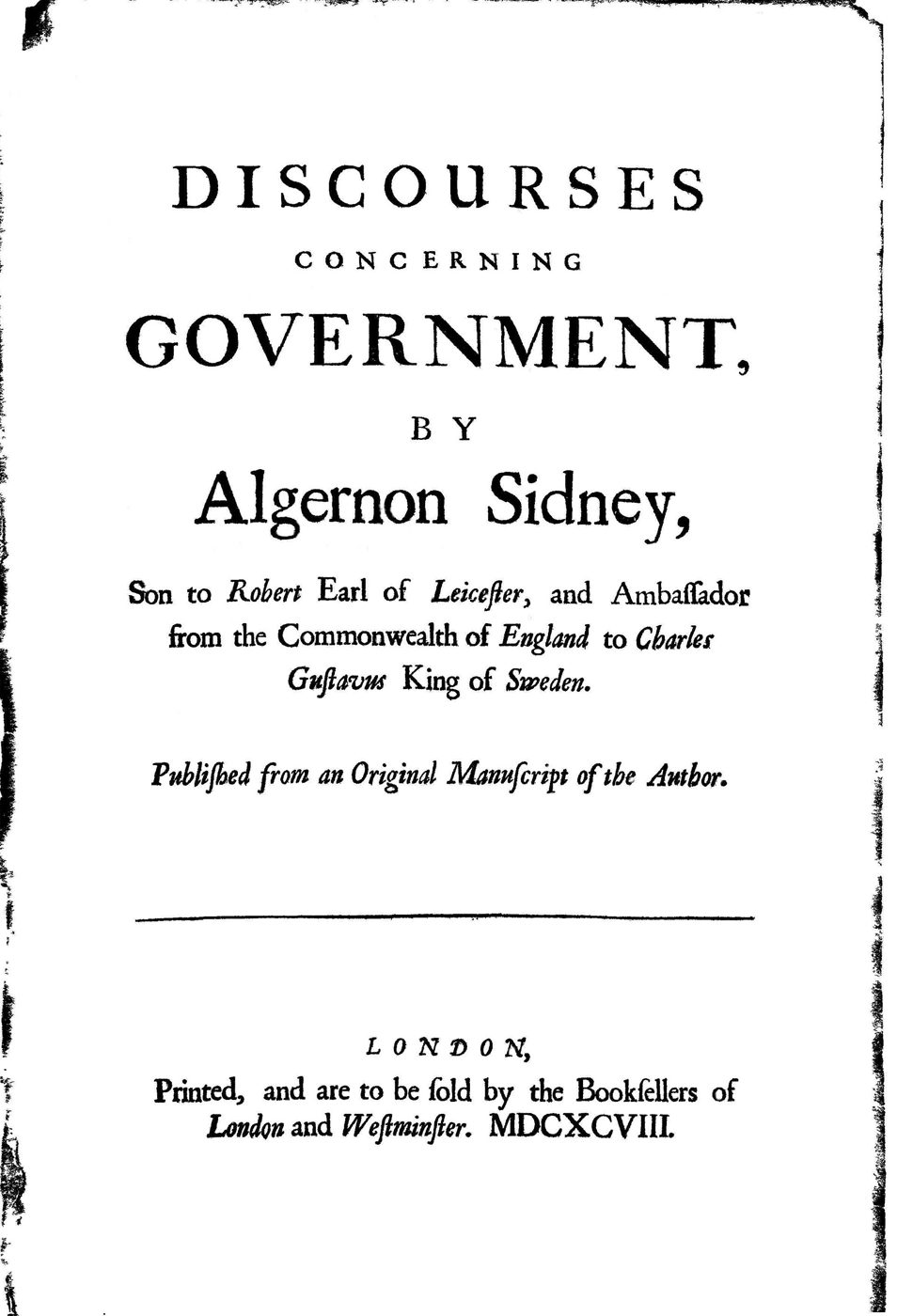
Sidney's book came out in 1698 as Discourses Concerning Government.2 A century later, American colonists were quoting it. Six years after his execution, a quiet English philosopher published his own book on the same questions without putting his name to it, and that one the colonists quoted even more. Between them they built the case that a people who suffer a long run of abuse from their rulers have a right to resist, and that the right belongs to them and not to the rulers. This lesson follows that case from Locke's study and Sidney's scaffold to a Boston pulpit in 1750 and to the letter in which Jefferson, in his old age, said where the Declaration got its authority.
Locke and the Book Without a Name
John Locke's Two Treatises of Government appeared anonymously at the end of 1689, with a title page dated 1690. By then the Glorious Revolution had put William and Mary on the English throne. Most of the writing had been done years earlier, in the Exclusion Crisis of 1679 to 1681, when Locke's patron, Lord Shaftesbury, was fighting to keep a Catholic out of the succession. Revised after Locke was driven into Dutch exile in 1683, it carried no author's name, and he did not admit he wrote it until shortly before he died.3 The First Treatise took apart Robert Filmer's claim that kings inherit absolute power from Adam, the argument lesson 1 followed. The Second Treatise is the one Americans read.
The Preface says what Locke thought the book was for. It was meant "to establish the throne of our great restorer, our present King William" and to make his title good "in the consent of the people."4 The phrase carries the whole book. Rulers hold office because those they rule agreed to it.
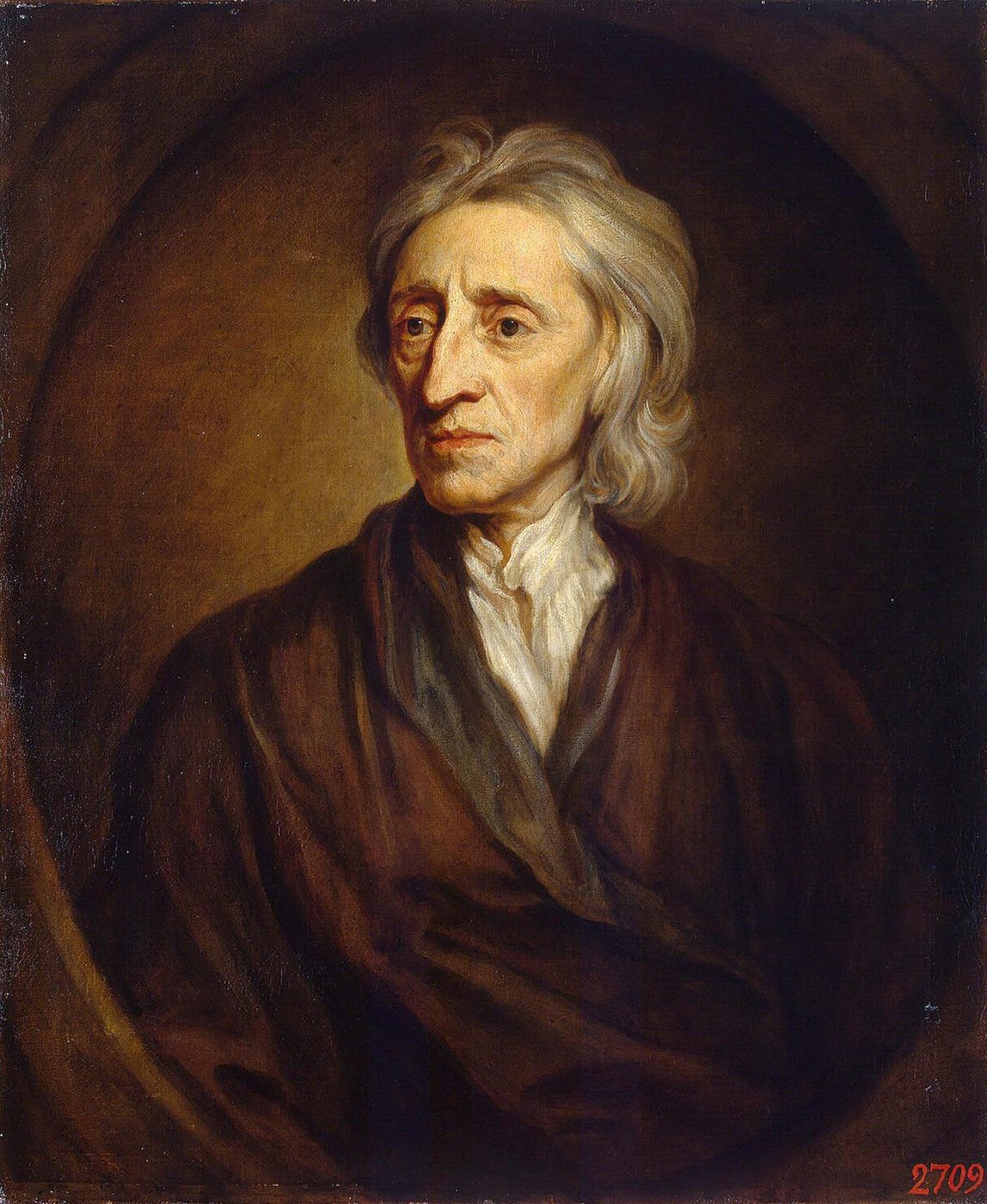
Property, in Locke's wide sense
Locke begins with men in a state of nature who are free and equal and bound by a law of reason, ground lesson 1 covered. His next step is the one that matters for resistance. Every person owns himself. Whatever he works on and makes his own becomes his property.
"Though the earth, and all inferior creatures, be common to all men, yet every man has a property in his own person: this no body has any right to but himself. The labour of his body, and the work of his hands, we may say, are properly his."
John Locke, Second Treatise of Government, 1689, chapter 5, section 27.5
Notice how much weight the word property carries. Later in the book Locke says outright that he means more than land and goods. Men enter society "for the mutual preservation of their lives, liberties and estates, which I call by the general name, property."6 So when Locke says government exists to protect property, he means life, freedom and possessions together. A ruler who seizes a man's estate and a ruler who locks him up without law have done the same kind of wrong.
Why People Choose Government
If a man in the state of nature is his own master, why would he give that up? Locke answers that the freedom is real but not safe. The enjoyment of it "is very uncertain, and constantly exposed to the invasion of others." Everyone is a king there, and "the greater part no strict observers of equity and justice."6 A man willing to part with some of his freedom for safety is not a fool. He is making a trade.
The trade has a price list. Locke names several things missing in the state of nature, and the first is the one every later American constitution tried to supply:
"The great and chief end, therefore, of men's uniting into commonwealths, and putting themselves under government, is the preservation of their property. To which in the state of nature there are many things wanting. First, There wants an established, settled, known law, received and allowed by common consent to be the standard of right and wrong, and the common measure to decide all controversies between them."
Locke, Second Treatise, chapter 9, section 124.7
An established, settled, known law. Hold onto that phrase, because Locke later accuses tyrants of replacing it with their own will. Nor can anyone be pulled into the bargain against his will. In Locke's words, "no one can be put out of this estate, and subjected to the political power of another, without his own consent."8 Government that rests on force alone has no standing in this account at all.
Notice what Locke is not saying. He does not say the people can do as they please once they are organized. The law of nature still governs them, and it governs their rulers too. Government is a trade made to secure rights, and a government that destroys them has broken the terms.
Power as a Trust
Here is the idea that made Locke dangerous to kings. He describes political power as a trust. The people lend it to a legislature and an executive for stated purposes. They do not give it away. When the people hand the lawmaking power to an assembly, that body is acting for them:
"the legislative being only a fiduciary power to act for certain ends, there remains still in the people a supreme power to remove or alter the legislative, when they find the legislative act contrary to the trust reposed in them."
Locke, Second Treatise, chapter 13, section 149.9
A fiduciary is someone who holds something for another. The word shows up in wills and in the care of other people's money. Locke applies it to the highest officers of the state. A trustee who uses the estate for his own ends can be removed, and the same goes for a king or a parliament.
The people keep that supreme power, but Locke says it cannot "take place till the government be dissolved."9 While the government stands and does its work, the community is not free to take the power back. That distinction protects order. A citizen may not decide on a bad Tuesday that the trust is broken and refuse to pay his taxes. The power to judge the trust operates when the government has actually failed.
When a Government Breaks Its Trust
What counts as a breach
Chapter 19 of the Second Treatise, "Of the Dissolution of Government," is the part that reached the Declaration. The legislators who destroy the property of the people, or reduce them to slavery under arbitrary power, have broken the bargain:
"whenever the legislators endeavour to take away, and destroy the property of the people, or to reduce them to slavery under arbitrary power, they put themselves into a state of war with the people, who are thereupon absolved from any farther obedience, and are left to the common refuge, which God hath provided for all men, against force and violence."
Locke, Second Treatise, chapter 19, section 222.10
The same section extends the rule to the executive. A king who sets up "his own arbitrary will as the law of the society" has acted against his trust as well. Locke does not mean a bad tax or a stupid law. He means a settled attempt to take away what government was made to protect.
The patience Locke demanded
People who quote Locke on revolution tend to skip section 225. It is the section Locke wrote to answer the charge that his teaching would make rebels of everyone. His answer is that revolutions do not come over small things.
"such revolutions happen not upon every little mismanagement in public affairs. Great mistakes in the ruling part, many wrong and inconvenient laws, and all the slips of human frailty, will be born by the people without mutiny or murmur. But if a long train of abuses, prevarications and artifices, all tending the same way, make the design visible to the people, and they cannot but feel what they lie under, and see whither they are going; it is not to be wondered, that they should then rouze themselves."
Locke, Second Treatise, chapter 19, section 225.11
Read it twice. Great mistakes, many wrong laws and all the slips of human frailty are to be borne without mutiny or murmur. The trigger is a long train of abuses all tending the same way, until the design becomes visible. Jefferson would write "a long train of abuses and usurpations, pursuing invariably the same object" into the Declaration eighty-seven years later. The words are close enough that nobody has ever needed a footnote to see the debt, and the Declaration adds the same counsel of patience: "Prudence, indeed, will dictate that governments long established should not be changed for light and transient causes."12
For a reader who thinks of liberty as a duty as well as a claim, this patience is the point. Locke does not hand citizens a license. He asks them to put up with a great deal, to support a government that is mostly doing its job, and to act only when the design to destroy their rights has become plain to the great body of the people.
Who judges?
Every theory of resistance faces the question of who decides when the line has been crossed. Locke asks it himself and answers it twice. Against the objection that "ill-affected and factious men" will spread the story that a prince is acting contrary to his trust, he says the people shall be the judge, because the person who appoints a deputy is the one fit to say whether the deputy has done his work:
"The people shall be judge; for who shall be judge whether his trustee or deputy acts well, and according to the trust reposed in him, but he who deputes him, and must, by having deputed him, have still a power to discard him, when he fails in his trust?"
Locke, Second Treatise, chapter 19, section 240.13
When there is no court that can decide between the people and a ruler who has put himself above the law, Locke says the only appeal left is to heaven, "whenever they judge the cause of sufficient moment." He adds a brake. The right to appeal "operates not, till the inconveniency is so great, that the majority feel it, and are weary of it, and find a necessity to have it amended."14 A handful of angry men are not a people. And in section 242 he suggests that where the law is silent or doubtful and the matter is serious, the body of the people is the proper umpire, which is as much as to say that elections, petitions and juries come before anything else.15 The appeal to heaven is a sober phrase. Locke means what is left when every earthly remedy has been tried.
Algernon Sidney: The Man Who Paid
Liberty as independence from another's will
Where Locke was careful and anonymous, Sidney was fierce and public. He was born in 1623, sat in the Long Parliament and served as a commissioner for the trial of Charles I, though he opposed the king's execution. Under Charles II he turned against the crown.16 He wrote the Discourses during the Exclusion Crisis as an answer to Filmer, and in the course of it he gave a definition of liberty that the colonists could repeat in their sleep.
"For as liberty solely consists in an independency upon the will of another, and by the name of slave we understand a man, who can neither dispose of his person nor goods, but enjoys all at the will of his master; there is no such thing in nature as a slave, if those men or nations are not slaves, who have no other title to what they enjoy, than the grace of the prince, which he may revoke whensoever he pleaseth."
Algernon Sidney, Discourses Concerning Government, 1698, chapter 1, section 5.17
The point is sharper than it first looks. A man who keeps his liberty only as long as the prince is gracious does not have liberty. He has a loan. Sidney draws the conclusion that Magna Carta, which the English had spent centuries defending, would have been a waste if it held only so long as the king was pleased. Compare Locke's "established, settled, known law." Both men put the dividing line between liberty and slavery at the same place: whether a person lives under law that binds the ruler or under the ruler's will.
The trial and the scaffold
Sidney was not a gentle theorist. He took money from the French ambassador, 500 guineas in each of two years, a fact that sits badly beside the martyr's halo, and he was drawn into the circle around Shaftesbury that the government later linked to the Rye House Plot, a scheme to assassinate Charles II and his brother.18 The trial itself drew criticism then and later. The law required two witnesses to treason. The crown had one, Lord Howard of Escrick, and used the Discourses as the other. Sidney was tried on November 7, 1683, sentenced on November 26, and beheaded on December 7.1
His last speech, delivered to the sheriff, kept the argument going to the end. "We live in an age that makes truth pass for treason," he said.19 To the Whigs who came after, and then to the Americans, that sentence made him a martyr. His book, which cost him his life, went into print fifteen years after his death and stayed in print.
Jonathan Mayhew and the Pulpit
The problem of Romans 13
For a colonial congregation, none of this would have settled much until someone dealt with a text. Paul's letter to the Romans says "Let every soul be subject unto the higher powers," and goes on to say that those who resist the power resist the ordinance of God. For generations preachers had used the passage to say that subjects owe their rulers obedience whatever the rulers do. A people who took the Bible seriously could not wave it off.
Jonathan Mayhew took it on directly. Born on Martha's Vineyard in 1720, he was the minister of the West Church in Boston. On the hundredth anniversary of the execution of Charles I, in January 1750, he preached a sermon that was printed as A Discourse Concerning Unlimited Submission and Non-Resistance to the Higher Powers. It went through London editions in 1752 and 1767, and John Adams remembered long afterward that it had been read by everybody.20
What Mayhew argued
Mayhew's reading of Paul runs on the apostle's own reasoning. Paul tells his readers to obey rulers because rulers are God's ministers for good. That gives a reason for obeying a ruler who does good, and no reason at all for obeying one who does evil. Mayhew asks how an argument built on the ruler's service to God can be turned into a command to obey a ruler who serves the devil.21
From there he states the distinction on which the rest depends:
"There is an essential difference betwixt government and tyranny; at least under such a constitution as the English. The former consists in ruling according to law and equity; the latter, in ruling contrary to law and equity."
Jonathan Mayhew, Discourse Concerning Unlimited Submission, 1750.21
He adds that a prince who sets himself above the law "loses the king in the tyrant" and no longer has a right to be obeyed. To resist such a ruler, Mayhew says, is not rebellion. Rebellion is the crime of resisting a ruler whose administration is just and legal.21 The word did the work. Once a king who breaks the law is a tyrant and not a king, resisting him is a defense of law and not an attack on it.
A word of fairness belongs here. Mayhew's theology was unorthodox. He rejected Calvinism in 1756, and at his ordination in 1747 only two ministers came to the first council.22 A Christian who disagrees with him on the Trinity can still weigh his political argument on its merits. Mayhew's reading of Romans 13 does not say that rulers are unimportant or that obedience is optional. It says that the authority Paul tells us to respect is the authority that does good, and that obedience to a power bent on evil is not what the apostle commanded.
What the Three Share and Where They Differ
| Writer | Work and date | Core claim on resistance | Where the line falls |
|---|---|---|---|
| John Locke | Second Treatise, 1689 | Government is a trust. Rulers who destroy life, liberty and property forfeit it, and the power returns to the people. | A breach of trust: a settled design to destroy the people's property. Small errors are borne without murmur. |
| Algernon Sidney | Discourses, written c. 1680 to 1683, printed 1698 | Liberty is independence from another's will. Nations hold their liberties from God and nature, not from kings. | Dependence on the will of a ruler instead of on law. A people who hold their rights by the prince's grace hold none. |
| Jonathan Mayhew | Sermon, 1750 | Government is rule by law and equity. Resisting a tyrant is a just self-defense and is not rebellion. | Ruling contrary to law and equity. Resisting a just and legal ruler is still rebellion, and a crime. |
On the surface, the three are an odd company: a retiring philosopher, a republican soldier and a Congregational preacher. They did not make the same arguments. Locke built on consent and property, Sidney on the example of free nations and the nature of liberty, Mayhew on the Bible's own logic. But all three held that government has a purpose, that rulers are bound by law, and that a people may resist a ruler who has put himself outside the law. And Locke and Mayhew both said it was a last resort and a remedy for rule contrary to law, never for law that was merely unwelcome.
What Jefferson Said in 1825
The letter to Henry Lee
On May 8, 1825, Jefferson wrote from Monticello to Henry Lee about the Declaration and where it came from. All American whigs, he said, thought alike on their rights. The Declaration was written to put that common opinion before the world. Its purpose was "Not to find out new principles, or new arguments, never before thought of."
"Neither aiming at originality of principle or sentiment, nor yet copied from any particular and previous writing, it was intended to be an expression of the American mind, and to give to that expression the proper tone and spirit called for by the occasion. All its authority rests then on the harmonizing sentiments of the day, whether expressed in conversation, in letters, printed essays, or in the elementary books of public right, as Aristotle, Cicero, Locke, Sidney, &c."
Thomas Jefferson to Henry Lee, May 8, 1825.23
Read it for what it says. Jefferson did not claim to have copied Locke. He said the Declaration was not copied from any particular previous writing, and that its authority rested on the shared opinion of the age, an opinion expressed in conversation, letters, essays and the books of public right. The four names he gave are Aristotle, Cicero, Locke and Sidney, and he followed them with "&c." Lesson 2 took up the first two. This lesson has followed the last two.
The University of Virginia resolution
Two months earlier, on March 4, 1825, the Board of Visitors of the new University of Virginia had adopted a resolution on what its professors should teach about government. It said that as to "the general principles of liberty and the rights of man, in nature and in society," the doctrines of Locke in his essay "concerning the true original extent and end of civil government" and of Sidney in his "Discourses on government" "may be considered as those generally approved by our fellow citizens of this, and the United States."24 The wording grew out of a statement of principles that Jefferson drafted that February. Whatever else you say about it, it shows that the same year he wrote to Lee, Jefferson put Locke and Sidney first in the list of authors for his university to teach.
The Declaration in This Light
Set the Declaration beside the three writers and the lines are easy to find. "To secure these rights, governments are instituted among men, deriving their just powers from the consent of the governed" is Locke on consent. The right of the people "to alter or to abolish" a government that has become destructive of those ends is Locke on the dissolution of government, with the safeguard of Locke's section 225 following right behind it. The list of grievances against the king is the long train of abuses made visible, which is what Locke said had to happen before a people could be expected to act.12
It would be easy to make too much of this. Historians still argue over how much Locke the colonists read directly and how much they got through sermons, newspapers and pamphlets, and the Second Treatise was somewhat neglected when it first appeared.25 The Stanford Encyclopedia of Philosophy gives a standard modern account of the argument.26 Jefferson's own caution in 1825 is a good guide: the Declaration drew on a shared stock of ideas that Locke and Sidney helped to make, and the colonists made them their own.
What the colonists brought to it was the Bible, which Mayhew put to work, and the habit of acting through assemblies, committees and petitions before taking up arms. For ordered liberty the practical lesson is in the patience. Locke let nothing less than a long, visible and common injury justify the final step. A citizen who has absorbed that does not treat every disappointing law as tyranny. And he does not forget, either, that a people who will not resist anything will in time be asked to bear everything.
Timeline
- 1623 Algernon Sidney is born (January 15).
- 1680 Robert Filmer's Patriarcha is first published.
- 1683 Sidney is tried for treason (November 7), sentenced (November 26) and beheaded (December 7).
- 1689 Locke's Two Treatises appear anonymously in December, dated 1690.
- 1698 Sidney's Discourses Concerning Government is printed.
- 1750 Jonathan Mayhew preaches the Discourse Concerning Unlimited Submission in Boston (January 30).
- 1776 The Declaration of Independence adopts the language of consent and a long train of abuses.
- 1825 The University of Virginia Board of Visitors names Locke and Sidney (March 4); Jefferson writes to Henry Lee (May 8).
Learn more
- Locke, Second Treatise of Government: The whole book is short. Chapters 5, 9 and 19 repay the time.
- Sidney, Discourses Concerning Government: The contents page links every section. Begin with chapter 1, section 5, then chapter 3.
- Mayhew's 1750 Discourse (excerpt): The sermon that answered Romans 13 for a generation of New Englanders.
- Jefferson to Henry Lee, 1825: A short letter that says where the Declaration got its authority.
- Stanford Encyclopedia: Locke's Political Philosophy: A careful modern account, including the debates over consent and property.
- The Declaration of Independence: Read the second paragraph and the grievances side by side with Locke's chapter 19.
Notes
- Algernon Sidney, Wikipedia, sections on the Restoration crisis and trial: arrest warrant 25 June 1683, trial 7 November 1683, sentence 26 November, execution 7 December 1683; Jeffreys's ruling "Scribere est agere." Read it online. ↩
- Algernon Sidney, Wikipedia, on the Discourses as a reply to Filmer's Patriarcha (first published 1680) and their publication in 1698. Read it online. ↩
- "Two Treatises of Government," Wikipedia: published anonymously in December 1689 with a 1690 title page, after the Glorious Revolution, and drafted in large part during the Exclusion Crisis of 1679 to 1681; Locke acknowledged it only shortly before his death. Read it online. ↩
- John Locke, Second Treatise of Government (1689), Preface, on the aim of establishing "the throne of our great restorer, our present King William" and making good his title "in the consent of the people." Read it online. ↩
- Locke, Second Treatise, chapter 5, section 27. Read it online. ↩
- Locke, Second Treatise, chapter 9, section 123. Read it online. ↩
- Locke, Second Treatise, chapter 9, section 124. Read it online. ↩
- Locke, Second Treatise, chapter 8, section 95. Read it online. ↩
- Locke, Second Treatise, chapter 13, section 149. Read it online. ↩
- Locke, Second Treatise, chapter 19, section 222. Read it online. ↩
- Locke, Second Treatise, chapter 19, section 225. Read it online. ↩
- Declaration of Independence (1776), second paragraph and the paragraph beginning "Prudence, indeed." Read it online. ↩
- Locke, Second Treatise, chapter 19, section 240. Read it online. ↩
- Locke, Second Treatise, chapter 14, section 168. Read it online. ↩
- Locke, Second Treatise, chapter 19, section 242. Read it online. ↩
- Algernon Sidney, Wikipedia, lead and early-life sections: born 15 January 1623, member of the Long Parliament and commissioner for the trial of Charles I, whom he opposed executing. Read it online. ↩
- Algernon Sidney, Discourses Concerning Government (London, 1698), chapter 1, section 5, "To depend upon the Will of a Man is Slavery." Read it online. ↩
- Algernon Sidney, Wikipedia, "Restoration Crisis: 1677 to 1683," on the 500 guineas received from the French in December 1678 and the next year, and on the Rye House Plot. Read it online. ↩
- Algernon Sidney, Wikipedia, on the speech from the scaffold, including "We live in an age that makes truth pass for treason." Read it online. ↩
- Jonathan Mayhew, Wikipedia: born 8 October 1720, died 9 July 1766, minister of the West Church in Boston; the sermon was delivered on the hundredth anniversary of the execution of Charles I (30 January 1750, new style), was published in Boston and in London in 1752 and 1767, and was remembered by John Adams as read by everybody. Read it online. ↩
- Jonathan Mayhew, A Discourse Concerning Unlimited Submission and Non-Resistance to the Higher Powers (Boston, 1750), excerpt reproduced at Founding.com, including Mayhew's quotation of Romans 13:1 and his argument from the apostle's reasoning. Read it online. ↩
- Jonathan Mayhew, Wikipedia, on his rejection of Calvinist theology in 1756 and the controversy over his Trinitarian views. Read it online. ↩
- Thomas Jefferson to Henry Lee, 8 May 1825, text as given by Teaching American History from Founders Online, National Archives. The spelling there is modernized ("harmonizing"). Read it online. ↩
- Resolution of the Board of Visitors of the University of Virginia, 4 March 1825, on the sources of the principles of the governments of Virginia and the United States, as printed at Founding.com; the minutes are in Founders Online. Read it online. Founders Online. ↩
- "Two Treatises of Government," Wikipedia, section on reception: the work was somewhat neglected when first published. Read it online. ↩
- Stanford Encyclopedia of Philosophy, "John Locke's Political Philosophy," revised 6 October 2020, for the standard modern account of Locke's argument. Read it online. ↩
Terms in this lesson
- Second Treatise of Government
- The second half of John Locke's Two Treatises of Government, published anonymously at the end of 1689. It argues that government rests on consent and exists to protect property.
- Consent of the governed
- The idea that no one can lawfully be placed under the political power of another without his own agreement.
- Trust
- Locke's picture of government power: it is lent by the people to rulers for stated ends, and it can be taken back when the rulers betray those ends.
- Property (Locke's sense)
- Locke's general name for the lives, liberties and estates of the people, not only land and goods.
- Discourses Concerning Government
- Algernon Sidney's reply to Robert Filmer's Patriarcha, published in 1698 after his execution.
- Non-resistance
- The teaching that subjects must never resist their rulers, however bad, a doctrine often drawn from Romans 13.
- Tyranny
- In Mayhew's sermon, rule contrary to law and equity, as opposed to government, which rules according to law and equity.
Sources
- Locke, Second Treatise of Government (Project Gutenberg #7370) checked 2026-10
- Sidney, Discourses Concerning Government, chapter 1, section 5 (constitution.org) checked 2026-10
- Mayhew, Discourse Concerning Unlimited Submission, 1750 (Founding.com) checked 2026-10
- Jefferson to Henry Lee, 8 May 1825 (Teaching American History) checked 2026-10
- Declaration of Independence (Avalon Project) checked 2026-10
- University of Virginia Board of Visitors, minutes of 4 March 1825 (Founders Online) checked 2026-10
- Jefferson's list of sources of the principles of American government (Founding.com) checked 2026-10
- John Locke's Political Philosophy (Stanford Encyclopedia of Philosophy) checked 2026-10
- Two Treatises of Government (Wikipedia) checked 2026-10
- Algernon Sidney (Wikipedia) checked 2026-10
- Jonathan Mayhew (Wikipedia) checked 2026-10