Lesson 5 of 10 · about 22 minutes
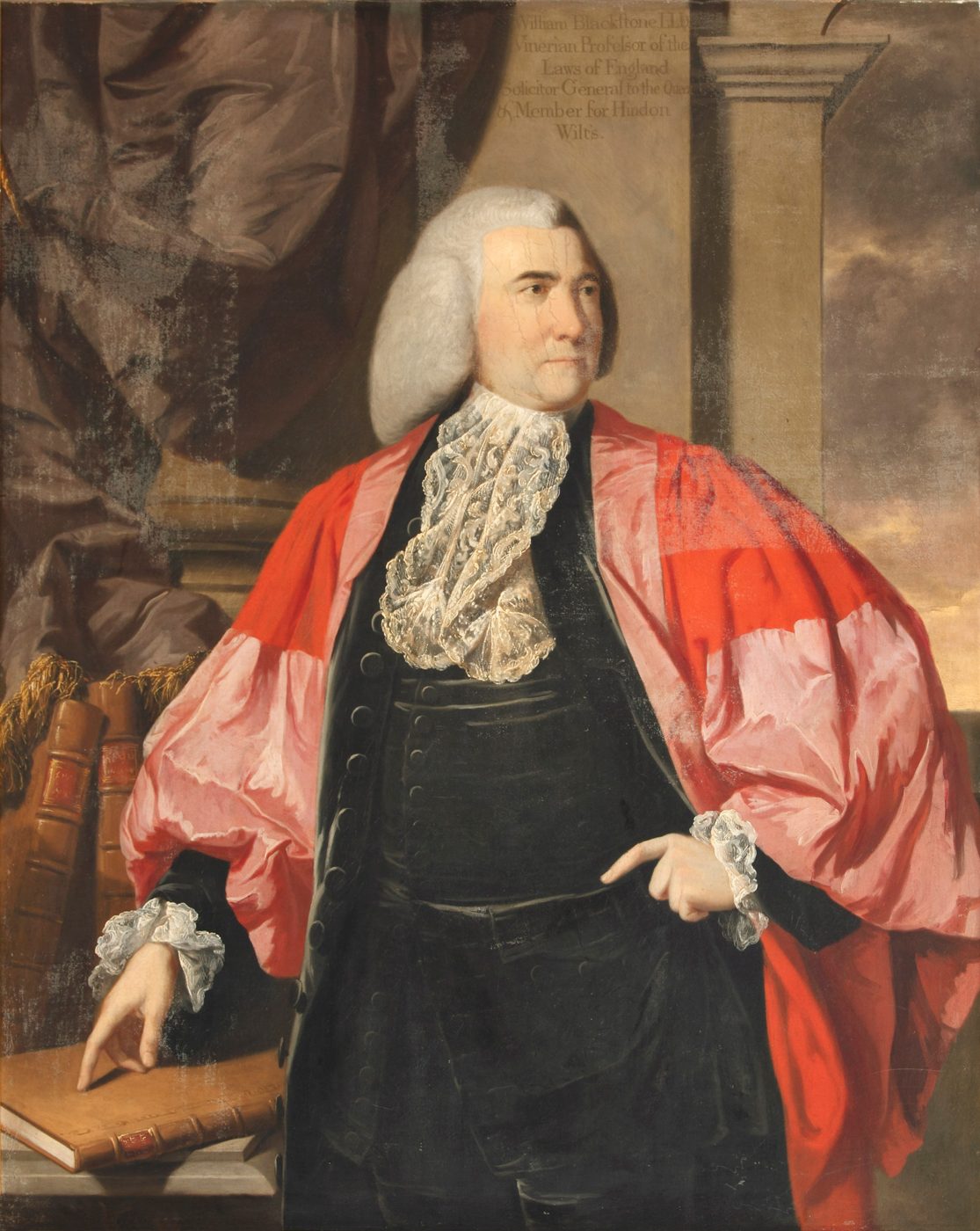
William Blackstone
You'll be able to
- Trace Blackstone's career from the Vinerian chair at Oxford to the four volumes of the Commentaries
- State what Blackstone taught about the law of nature, the law of revelation and the rights of persons
- Explain why the Commentaries sold so widely in the American colonies and who used them
- Identify the point on which the founders broke with Blackstone, parliamentary sovereignty, and why it mattered in 1776
In 1753 a thirty-year-old Oxford fellow stood up in a lecture room and began to teach English law to undergraduates. No one had done that before. English law was learned in the Inns of Court in London, by sitting in the courts, copying precedents and eating dinners with practicing lawyers. Universities taught Roman law and church law. The common law was thought to be a trade, not a subject. William Blackstone thought it was both, and over the next sixteen years he turned his lectures into the most widely read law book in the English language.1
In the colonies his book became the first thing many a young man read when he decided to become a lawyer. It told him what the law was. It also told him, in plain and confident English, where the law came from. For the purposes of this module that second lesson matters more. Blackstone put the law of nature and the law of God at the head of the English legal system and declared that no human law could stand against them. And then, on one crucial point, he told his readers that Parliament could do whatever it liked. The colonists took the first teaching with both hands and refused the second. The whole argument of 1776 lives in the space between those two answers.
The Man and the Chair
A posthumous son
Blackstone was born in London on July 10, 1723, the fourth son of a silk mercer. His father was already dead. He went to Pembroke College, Oxford, and was elected a fellow of All Souls, the college of lawyers and statesmen. He trained at the Middle Temple and was called to the bar, but he did not thrive as a pleader. He did well in the university instead, as an administrator who sorted out the finances of All Souls and as a lecturer who could make a dry subject clear.1
That last gift decided his career. In 1753 he began his lectures on the laws of England. They drew a crowd. When Charles Viner, an earlier legal scholar, left money to Oxford to endow a chair in English law, Blackstone was the obvious first holder. He was confirmed as the first Vinerian Professor on October 20, 1758.1
From lectures to volumes
The lectures turned into a book. Volume 1 appeared in November 1765, volume 2 in October 1766, volume 3 in June 1768 and volume 4 in 1769. He called the whole work Commentaries on the Laws of England. The first volume alone paid him 1,600 pounds, a very large sum in that day, and the four together paid more than 14,000.2 The work was a commercial success because it solved a real problem. A gentleman or a merchant or a student could now read, in one clear and orderly account, what the law of England said about persons, property, wrongs and crimes.
The four volumes ran in order. The first covered the rights of persons: the rights of individuals, the Parliament, the king, the courts and the family. The second covered property. The third covered private wrongs and the courts that remedied them. The fourth covered public wrongs: crimes, and the way they are tried and punished. Few earlier writers had even attempted to hold the whole of English law in one frame, and none had done it in prose so clear.
Blackstone went on to sit in Parliament for a time and in June 1770 became a justice of the Court of Common Pleas, where he remained until his death at Wallingford on February 14, 1780.1 He was a Tory, an Anglican and an institutionalist. He admired the English constitution and thought it needed defending. He would not have called himself a friend of American resistance, and the Americans who read him did not much care. They took what was true and left the rest.
The Law Above the Law
Nature and revelation
The Introduction to the Commentaries is where Blackstone sets out what law is, and in the course of it he says something a modern law school would hesitate to say. He begins with God. The Creator made man and gave him a nature, and the law of that nature is the first law. Here is the sentence the colonists remembered:
"This law of nature, being co-eval with mankind and dictated by God himself, is of course superior in obligation to any other. It is binding over all the globe, in all countries, and at all times: no human laws are of any validity, if contrary to this; and such of them as are valid derive all their force, and all their authority, mediately or immediately, from this original."
William Blackstone, Commentaries on the Laws of England, Introduction, section 2 (1765).3
Read that slowly. Superior in obligation. Binding in all countries and at all times. No human law is valid if it contradicts it. Whatever force a valid law has comes from this source. A century and a half of English jurists had said versions of that, as lesson 2 showed. Aquinas had put the same thing in other words five centuries before. Blackstone was not inventing a doctrine. He was handing it, in a clean paragraph, to every reader who bought the book.
He added a second foundation. Nature is read by reason, and reason is limited, since man's mind is fallen and clouded. So God has also spoken in Scripture. Blackstone calls this the law of revelation, and he joins the two:
"Upon these two foundations, the law of nature and the law of revelation, depend all human laws; that is to say, no human laws should be suffered to contradict these."
William Blackstone, Commentaries, Introduction, section 2.3
A secular reader may wince at it, but Blackstone's view was the ordinary view of his time and of the whole tradition this module has traced, from the Garden to Cicero to Coke. The law did not make itself. It stood on something that was already there. The framers of the Declaration would draw the same line when they wrote of "the laws of nature and of nature's God" and of rights the Creator had given.4
The rights of persons
The first volume turns that foundation into a list of rights. Blackstone treats liberty as a gift from God to man at creation, a natural liberty that men give up in part when they enter society, in exchange for the protection of civil law. Then he states what the civil law must protect. All the rights of Englishmen, he says, can be reduced to three:
"These may be reduced to three principal or primary articles; the right of personal security, the right of personal liberty; and the right of private property".
William Blackstone, Commentaries, Book 1, Chapter 1.5
He drew the purpose of government from the same place. The principal aim of society, he wrote, is "to protect individuals in the enjoyment of those absolute rights, which were vested in them by the immutable laws of nature."5 Those words could sit in the Declaration without anyone noticing the seam. Jefferson's list of life, liberty and the pursuit of happiness differs from Blackstone's three. The shape of the argument matches: rights come first, government follows, and government is judged by whether it protects them.
That is a conservative point as much as a revolutionary one. Blackstone was not telling the people to take apart the constitution. He was telling them what the constitution was for.
The Rule of Mercy in the Courts
The fourth volume deals with crime, and it contains one sentence that outlived nearly everything else in the book. In the chapter on trial and conviction, Blackstone is discussing how cautiously a court should treat circumstantial evidence of felony, and he writes:
"for the law holds, that it is better that ten guilty persons escape, than that one innocent suffer."
William Blackstone, Commentaries, Book 4, Chapter 27.6
Ten to one. The ratio is a moral claim, not a mathematical one. A just system accepts that it will let some guilty men go free, because the alternative is to punish the innocent, and the punishment of the innocent is a wrong of a different order. The Fifth, Sixth and Eighth Amendments are full of the same judgment.7 The grand jury, the right to confront accusers, the bar against self-incrimination, the demand for an impartial jury and the ban on cruel punishments all slow the state down. Each makes it harder to convict. Blackstone knew it, and he thought the price was right.
He grounded that mercy, as he grounded the rest, in a view of man. A government that can send a man to the gallows holds a power that belongs to God before it belongs to anyone, and it must use it with fear and care. A people raised on that teaching expected their courts to behave accordingly.
The Book Crosses the Atlantic
American lawyers were quick to buy the Commentaries. Sales across the water began almost at once, and before any American printer reprinted the book, over a thousand copies had gone to the colonies. The first American edition came out in Philadelphia in 1772.2
Edmund Burke noticed in Parliament. On March 22, 1775, a month before Lexington, he spoke on conciliation with America and tried to explain to his colleagues why the colonists were so hard to bully. One reason, he said, was their education. The Americans were a people devoted to the law. In his words, "I hear that they have sold nearly as many of Blackstone's Commentaries in America as in England."8 He thought that fact ought to give the ministry pause. A people who read the law, he argued, would know their rights and defend them in the law's own language.
He was right, and the evidence is in the pamphlets, the resolutions and the petitions of the decade. The colonial case against Parliament did not rest on a vague appeal to freedom. It cited charters, statutes, Magna Carta, the Bill of Rights of 1689 and the common law. It was a lawyers' case, argued by men who had studied Coke and Blackstone and found in both a standard against which to judge the Crown.
The book kept its hold after independence. In 1803 the Virginia jurist St. George Tucker published a five-volume American edition of the Commentaries with his own notes comparing English law to the Constitution and the laws of the United States. It was meant to show students where American law followed Blackstone and where it had gone its own way.9 The fact that a book about the English constitution needed an American edition in 1803 tells how deep it had gone into the training of the new republic's lawyers.
Lincoln's advice
The habit lasted into the next generation and beyond. Abraham Lincoln, who taught himself law on the Illinois frontier, never forgot the book that started him. In September 1860, two months before he was elected president, a young man named J. M. Brockman wrote to ask how to study law. Lincoln answered from Springfield:
"Begin with Blackstone's Commentaries, and after reading it carefully through, say twice, take up Chitty's Pleadings, Greenleaf's Evidence, & Story's Equity &c. in succession. Work, work, work, is the main thing."
Abraham Lincoln to J. M. Brockman, Springfield, September 25, 1860.10
So a century after Blackstone's lectures, the best lawyer in the nation was still telling beginners to start there. The book's reach tells us something about the founders' world. They did not get their idea of ordered liberty from a single thinker or a single revolution. They got it from a long, sturdy, public tradition, taught in plain language to anyone who could read.
Where the Founders Broke with Blackstone
The sovereign Parliament
Now the other half. Blackstone believed that no human law could stand against the law of nature. But he also believed that English courts could not strike down an act of Parliament, and he said so without flinching. Parliament, he wrote, is the place where the supreme and absolute power of the state resides.
"It can, in short, do every thing that is not naturally impossible; and therefore some have not scrupled to call its power, by a figure rather too bold, the omnipotence of parliament. True it is, that what they do, no authority upon earth can undo."
William Blackstone, Commentaries, Book 1, Chapter 2.11
These two doctrines sit uneasily together. If the law of nature binds all human laws, and if an act of Parliament contradicting it is invalid, then someone must be able to say so. But Blackstone says no one can. Back in the Introduction he took up Coke's famous line in Bonham's Case, which lesson 4 discussed, and he cut it down. He would allow courts to read a statute narrowly when its general words led to absurd results in a particular case. He would not allow them to reject a statute because they found it unreasonable. In his words, "if the parliament will positively enact a thing to be done which is unreasonable, I know of no power that can control it". To let the judges do otherwise, he said, "were to set the judicial power above that of the legislature, which would be subversive of all government."12
It is worth being fair to him. Blackstone was describing the English constitution as it stood after the Glorious Revolution, in which Parliament had won the long fight with the Stuart kings and had become the guardian of English liberty. For him the danger came from a king who ruled alone, not from a legislature that had beaten kings. He also saw something real: a court that can overrule the legislature whenever it finds a law unreasonable has become the government. That is a serious objection, and Americans have argued about it ever since.
Otis and the colonial answer
But for the colonists the English answer had a fatal flaw. They were not represented in Parliament. A doctrine that made Parliament omnipotent made them subjects of a body in which they had no vote. In 1761 James Otis had answered by going back to Coke. An act against the Constitution, he told the Boston court, was void.13 That is exactly the claim Blackstone refused to make.
When the Stamp Act, the Townshend duties and the Declaratory Act of 1766 came, the colonists did not agree that Parliament could do anything it wished with them. They said there were limits that came from the charters, from the rights of Englishmen and, in the end, from the law of nature. The Declaration of Independence rests the whole case on those limits. It lists the acts of a king, but the real target is a Parliament that claimed power over the colonies "in all cases whatsoever," and it complains of "the benefits of Trial by Jury" taken away.14 Blackstone's first teaching, that the law of nature binds, was used against his second, that Parliament is supreme.
The founders carried the same lesson into their own constitutions. They wrote them down and placed them above the ordinary laws that the legislature could pass, and they trusted courts with the duty to hold the legislature to them. In effect they gave Coke's idea a written home. Blackstone's problem, how to tie a sovereign legislature to a higher law, was answered by a written constitution and judicial review. The founders did not stop trusting law. They put it where it could be reached.
What Blackstone Left
It is easy to treat Blackstone as a tidy summary of English law and nothing more. That undersells him. He gave the English-speaking world its handbook of liberty at the moment when it needed one. He taught that law has a source above the will of any ruler, that persons have rights before any government exists, and that courts must lean toward mercy. Many who disagreed with him on Parliament still carried those lessons into the courts and assemblies of the new nation.
He also left a warning, though he did not mean it as one. A law that rests on nature and revelation needs someone to enforce that foundation, or it will be reduced to a courtesy that the powerful may ignore. Blackstone trusted the English Parliament to keep faith. The colonists did not trust it, and they were right not to. What this module has traced is the long effort to build the machinery that makes the higher law more than words: juries, charters, courts, written constitutions. The next lessons take up what the men of the Revolution made out of all this inheritance.
- 1723 July 10: William Blackstone is born in London.
- 1753 He begins lecturing on English law at Oxford.
- 1758 October 20: he is confirmed as the first Vinerian Professor of English Law.
- 1765 to 1769 The four volumes of the Commentaries appear, the first in November 1765 and the last in 1769.
- 1770 June: Blackstone becomes a justice of the Court of Common Pleas.
- 1772 The first American edition of the Commentaries is printed in Philadelphia.
- 1775 March 22: Burke tells Parliament that the Americans have bought nearly as many copies as the English.
- 1780 February 14: Blackstone dies at Wallingford.
- 1803 St. George Tucker publishes his annotated American edition.
- 1860 September 25: Lincoln tells a would-be lawyer to begin with Blackstone.
Where He Agreed and Where He Did Not
| Question | Blackstone | The American founders |
|---|---|---|
| Source of law | The law of nature and the law of revelation, both from God | The same: "the laws of nature and of nature's God" |
| Rights of persons | Personal security, personal liberty, private property | Life, liberty and property, later life, liberty and the pursuit of happiness |
| Purpose of government | To protect individuals in their absolute rights | "to secure these rights, governments are instituted among men"15 |
| Trial of crimes | Ten guilty may escape rather than one innocent suffer | Fifth, Sixth and Eighth Amendments slow the state down on purpose |
| Act of Parliament against natural law | No court may reject it | Otis: it is void; later, a written constitution that courts enforce |
| Parliament and the colonies | Supreme and absolute | No power to tax or bind colonists who had no vote |
Learn more
- Blackstone's Commentaries on Journal Tools: read all four books chapter by chapter, or download them free as an e-book, Word files, or page scans of John Adams's own signed copy.
- Blackstone, Commentaries, Introduction (Avalon Project): sections 2 and 3 are the heart of his teaching on the law of nature and on judges and statutes.
- Blackstone, Book 1, Chapter 1 (Avalon Project): the three absolute rights and the purpose of society.
- Blackstone, Book 1, Chapter 2 (Avalon Project): the passage on the omnipotence of Parliament.
- Blackstone, Book 4, Chapter 27 (Avalon Project): the ten-guilty-men passage appears in the discussion of presumptive evidence.
- Burke, Speech on Conciliation with America (Project Gutenberg): read the whole passage on the Americans and the law.
- Lincoln, Complete Works, vol. 6 (Internet Archive): the Brockman letter is in the correspondence for 1860.
- Commentaries on the Laws of England (Wikipedia): publication history and the editions that followed.
Notes
- "William Blackstone," Wikipedia, drawing on Wilfrid Prest's biography. Dates of birth, death, the Vinerian appointment and the Common Pleas seat. Read it online. ↩
- "Commentaries on the Laws of England," Wikipedia. Publication dates of the four volumes, the payments to Blackstone, and the first American edition of 1772. Read it online. ↩
- Blackstone, Commentaries on the Laws of England, Introduction, section 2, "Of the Nature of Laws in General." Spelling modernized from the Avalon Project text. Read it online. ↩
- The Declaration of Independence, 1776, Avalon Project text. Read it online. ↩
- Blackstone, Commentaries, Book 1, Chapter 1, "Of the Absolute Rights of Individuals." Spelling modernized. Read it online. ↩
- Blackstone, Commentaries, Book 4, Chapter 27, "Of Trial and Conviction." Spelling modernized. Read it online. ↩
- The Constitution of the United States, Amendments V, VI and VIII, Avalon Project text. Read it online. ↩
- Edmund Burke, Speech on Conciliation with the Colonies, March 22, 1775, Project Gutenberg ebook 5655. Read it online. ↩
- St. George Tucker, ed., Blackstone's Commentaries: with Notes of Reference to the Constitution and Laws of the Federal Government of the United States (Philadelphia, 1803). Described here from the account in the Wikipedia article on the Commentaries; no passage from Tucker's notes is quoted. ↩
- Abraham Lincoln to J. M. Brockman, Springfield, Illinois, September 25, 1860, in Nicolay and Hay, eds., Complete Works of Abraham Lincoln, vol. 6. Read it online, or Abraham Lincoln Online. ↩
- Blackstone, Commentaries, Book 1, Chapter 2, "Of the Parliament." Spelling modernized. Read it online. ↩
- Blackstone, Commentaries, Introduction, section 3, "Of the Laws of England," on precedent and on acts of Parliament contrary to reason. Spelling modernized. Read it online. ↩
- Lesson 4 of this module, "The Common Law," on Dr. Bonham's Case (1610) and Otis's argument in Paxton's Case (1761). ↩
- Declaration of Independence, 1776: the grievances of "imposing taxes on us without our consent" and "depriving us, in many cases, of the benefits of trial by jury," and the charge that Parliament claimed power to legislate for the colonies "in all cases whatsoever." Read it online. ↩
- Declaration of Independence, 1776: "to secure these rights, Governments are instituted among Men." Read it online. ↩
Terms in this lesson
- Commentaries on the Laws of England
- Blackstone's four-volume account of English law, published at Oxford from 1765 to 1769.
- Vinerian Professor
- The holder of the Oxford chair in English law founded with money left by Charles Viner. Blackstone was the first.
- Absolute rights
- In Blackstone's usage, the rights a person has in himself, apart from his relations to others: personal security, personal liberty and private property.
- Law of revelation
- The divine law found in Scripture, which Blackstone treated as a second foundation under all human law.
- Parliamentary sovereignty
- The doctrine that Parliament is the highest lawmaker and that no court or other body may set aside what it enacts.
- Common Pleas
- One of the three great common-law courts at Westminster. Blackstone sat on it from 1770 until he died.
Sources
- Blackstone, Commentaries, Introduction (Avalon Project) checked 2026-10
- Blackstone, Commentaries, Book 1, Chapter 1 (Avalon Project) checked 2026-10
- Blackstone, Commentaries, Book 1, Chapter 2 (Avalon Project) checked 2026-10
- Blackstone, Commentaries, Book 4, Chapter 27 (Avalon Project) checked 2026-10
- Burke, Speech on Conciliation with America, 1775 (Project Gutenberg) checked 2026-10
- Lincoln to J. M. Brockman, 1860, in Nicolay and Hay, Complete Works, vol. 6 (Internet Archive) checked 2026-10
- Declaration of Independence (Avalon Project) checked 2026-10
- William Blackstone (Wikipedia) checked 2026-10
- Commentaries on the Laws of England (Wikipedia) checked 2026-10