Lesson 3 of 9 · about 26 minutes
Independence, 1776
You'll be able to
- Trace the steps from the Olive Branch Petition of July 1775 to the vote for independence on July 2, 1776
- Give an honest range for the circulation of Common Sense and explain why the exact number is unknown
- Describe the structure of the Declaration and quote its theory of rights, its right of revolution and its closing pledge
- Say what Congress cut from Jefferson's draft, when the Declaration was actually signed, and what Trumbull's painting shows
"The Second Day of July 1776, will be the most memorable Epocha, in the History of America." John Adams wrote that sentence to his wife Abigail from Philadelphia on July 3, the day before Congress approved the Declaration. He got the date wrong, and he got almost everything else right. "I am apt to believe that it will be celebrated, by succeeding Generations, as the great anniversary Festival," he went on. It ought to be marked "with Pomp and Parade, with Shews, Games, Sports, Guns, Bells," and with bonfires, "from one End of this Continent to the other." Then he put the cost down on paper: "I am well aware of the Toil and Blood and Treasure, that it will cost Us to maintain this Declaration."1
Adams meant the vote on the Lee Resolution on July 2. The country keeps July 4, the day Congress approved the wording of the Declaration. Both dates matter, and so does a third, August 2, when most delegates put their names on the parchment. The story of how Congress got from one to the other starts a year earlier, with a petition that asked the King for peace.
The Olive Branch Petition, July 1775
The Second Continental Congress opened in Philadelphia on May 10, 1775, three weeks after Lexington and Concord. On June 14 it created the Continental Army from the militia around Boston, and the next day it unanimously named George Washington its commanding general.2 Fighting had begun. Independence had not been declared, and few colonists openly wanted it.3
So Congress did two things at once. It prepared for war, and it begged for peace. On July 6, 1775, it issued a Declaration of the Causes and Necessity of Taking Up Arms, which says "Our cause is just. Our union is perfect." It adds, "We have counted the cost of this contest, and find nothing so dreadful as voluntary slavery."4 Two days later the delegates signed a petition to the King of which John Dickinson was the primary author.5 It opens with devotion. The delegates described themselves as "attached to your Majesty's person, family, and government, with all devotion that principle and affection can inspire," and they assured the King that "we not only most ardently desire the former harmony between her and these colonies may be restored, but that a concord may be established between them upon so firm a basis as to perpetuate its blessings, uninterrupted by any future dissensions, to succeeding generations in both countries."6
That is the Olive Branch Petition, adopted July 5 and signed July 8. It asked the King to establish a lasting settlement, beginning with the repeal of the Intolerable Acts.5 On August 23, 1775, before the petition reached him, the King issued a Proclamation of Rebellion, declaring the colonies in a state of open rebellion and ordering "all Our officers ... and all Our obedient and loyal subjects, to use their utmost endeavours to withstand and suppress such rebellion."5 Richard Penn and Arthur Lee carried the petition to London and gave it to the Colonial Secretary, Lord Dartmouth. They reported back that "as his Majesty did not receive it on the throne, no answer would be given."5
The King's refusal mattered more than any speech. For ten years the colonists had said they were English subjects defending English rights. They had petitioned, as the Stamp Act Congress and the First Continental Congress had promised to do. Now the highest authority in the empire had declined to listen. The case for independence was built on that silence, and the Declaration says so in its charge that "our repeated petitions have been answered only by repeated injury."7
Common Sense, January 1776
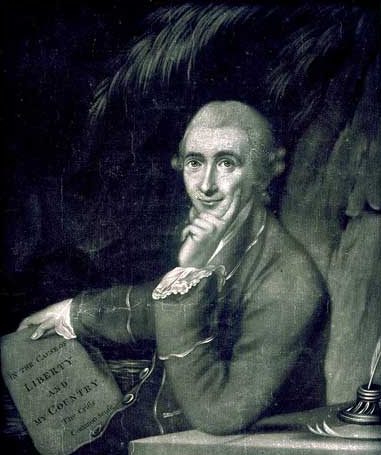
On January 10, 1776, a pamphlet called Common Sense went on sale in Philadelphia.8 The author was Thomas Paine, a former English excise officer who had arrived in the colonies in November 1774 with little but a talent for political writing, so he had been in America fourteen months.98
It said what almost no respectable colonist had said in print: reconciliation was a mistake, and the King was the problem. "Every thing that is right or natural pleads for separation," Paine wrote. "The blood of the slain, the weeping voice of nature cries, 'Tis time to part."10 He mocked the idea that an island should rule a continent: "there is something very absurd, in supposing a continent to be perpetually governed by an island."10 And he pitched the cause as bigger than any one colony: "The sun never shined on a cause of greater worth. 'Tis not the affair of a city, a country, a province, or a kingdom, but of a continent."10 It ends with a line that people still quote: "We have it in our power to begin the world over again."10
How many copies?
The pamphlet's reach is the part most often told wrong. Nobody knows how many copies were printed. Estimates range from 70,000 to 500,000, with most falling between 100,000 and 150,000.9 Only scant print records survive and no sales records. The first of the big numbers came from Paine himself, who had no way of checking them and a good reason to boast. The half-million figure came from his biographer Moncure Conway in 1892, who wrote that "in the end probably half a million copies were sold." It was a conjecture, and it has been repeated as fact ever since.11
The historian Trish Loughran counted the known printings instead. There were 25 of them, 16 in Philadelphia and only one press south of Pennsylvania, and she put the "far upper limit" at 75,000, thinking the true figure much lower.11 Ray Raphael, who reports her work, notes that even 25 printings is more than the seven of Dickinson's Letters from a Farmer, and far more than the single contemporary printing of 500 copies of The Federalist.11 A fair range, then, runs from Loughran's ceiling of 75,000 up to the 100,000 to 150,000 that most older estimates favor, and nobody can settle it. There were more readers than copies, since people borrowed pamphlets and heard them read aloud.9 Whatever the number, Raphael concludes that it likely had a significant impact, "loosening the tone and the terms of the grand debate over independence."11
One more point belongs here. Paine's view of government was bleaker than the one the Declaration would adopt. He opened with "Society in every state is a blessing, but government even in its best state is but a necessary evil; in its worst state an intolerable one."10 The Declaration, six months later, says the opposite about government's purpose: "to secure these rights, governments are instituted among men."7 The first sees government as a cost to be minimized. The second sees it as an institution with a job. Jefferson and Adams stood with the second, and so does the tradition this course follows.
From Virginia's instruction to the committee, May to June
Independence came by way of the colonies themselves. On May 15, 1776, the Virginia Convention in Williamsburg told its delegates in Congress "to propose to that respectable body to declare the United Colonies free and independent States, absolved from all allegiance to, or dependence upon, the Crown or Parliament of Great Britain."3 North Carolina had passed resolutions of its own on April 12.12 On June 7, Richard Henry Lee of Virginia rose in Congress, and John Adams seconded him.3
"Resolved, That these United Colonies are, and of right ought to be, free and independent States, that they are absolved from all allegiance to the British Crown, and that all political connection between them and the State of Great Britain is, and ought to be, totally dissolved. That it is expedient forthwith to take the most effectual measures for forming foreign Alliances. That a plan of confederation be prepared and transmitted to the respective Colonies for their consideration and approbation."
Richard Henry Lee, resolutions introduced June 7, 1776. 13
Notice that the resolution had three parts: independence, foreign alliances and a plan of confederation. Congress treated them separately. Some delegations, among them Maryland, Pennsylvania, Delaware, New Jersey and New York, had not been authorized to vote for independence, so the vote was put off three weeks.3 In the meantime, on June 11, Congress appointed the Committee of Five to draft a declaration: John Adams, Roger Sherman, Robert R. Livingston, Benjamin Franklin and Thomas Jefferson.12 The committee kept no minutes, and the recollections of Adams and Jefferson, written many years later, differ in some details.12 Jefferson wrote the draft.
The vote, July 1 to 4
Congress took up the independence clause on July 1 in a committee of the whole. At South Carolina's request it waited a day, hoping for unanimity. A trial vote showed South Carolina and Pennsylvania against, with Delaware's two delegates split. Before the vote on July 2, Edward Rutledge brought South Carolina around, two Pennsylvania delegates were persuaded to stay away, and Caesar Rodney was sent for through the night to break Delaware's tie. The Lee Resolution passed with twelve colonies in favor. New York's delegates had no instructions and abstained.3
That evening the Pennsylvania Evening Post told its readers: "This day the CONTINENTAL CONGRESS declared the UNITED COLONIES FREE and INDEPENDENT STATES."3 The Declaration itself came second. Congress read it twice on July 2, gave it a third reading on July 3 and began examining the exact wording. Debate took up the greater part of July 2, 3 and 4.1214 Late in the morning of July 4, Congress adopted it, and the Committee of Five met that evening to prepare a fair copy for the printer, John Dunlap.12 Dunlap's broadside came off the press on July 5, with John Hancock's name as President and Charles Thomson's as secretary.12 The first public readings took place on July 8 in Philadelphia, Trenton and Easton.15
What Congress cut
Jefferson later described the debate, and he did not hide his irritation. "The pusillanimous idea that we had friends in England worth keeping terms with, still haunted the minds of many. For this reason, those passages which conveyed censures on the people of England were struck out, lest they should give them offence."14 Then came the passage that cost more.
Jefferson's draft had included a charge against the King on slavery. It is a remarkable paragraph, and it was removed.
"He has waged cruel war against human nature itself, violating its most sacred rights of life and liberty in the persons of a distant people who never offended him, captivating and carrying them into slavery in another hemisphere or to incur miserable death in their transportation thither. ... Determined to keep open a market where MEN should be bought and sold, he has prostituted his negative for suppressing every legislative attempt to prohibit or to restrain this execrable commerce."
Jefferson's draft of the Declaration as originally reported by the committee, in The Writings of Thomas Jefferson. 14
Jefferson's own explanation of why Congress struck it is on record. "The clause too, reprobating the enslaving the inhabitants of Africa, was struck out in complaisance to South Carolina and Georgia, who had never attempted to restrain the importation of slaves, and who, on the contrary, still wished to continue it. Our northern brethren also, I believe, felt a little tender under those censures; for though their people have very few slaves themselves, yet they had been pretty considerable carriers of them to others."14
Read it with two things in mind. The charge is aimed at the King, for vetoing colonial laws against the trade, and it casts the colonists as bystanders. Jefferson's own note says South Carolina and Georgia wanted the trade to continue and that northern ships had carried slaves to others. And Jefferson, who wrote the paragraph, held people in slavery himself: roughly 600 enslaved people lived at Monticello over the decades.16 That contradiction sits in the same hand. The rest of the founding story is partly a record of what the country did, and failed to do, about it. Module 52, lesson 5, takes it up in full.
What the Declaration says
The finished Declaration falls into five parts, and each does a different job.
The opening paragraph gives the reason for writing. "A decent respect to the opinions of mankind requires that they should declare the causes which impel them to the separation," and it appeals to "the laws of nature and of nature's God."7 The second paragraph, the one everyone knows, states the theory. It is built in short steps, and it repays slow reading.
"We hold these truths to be self-evident: That all men are created equal; that they are endowed by their Creator with certain unalienable rights; that among these are life, liberty, and the pursuit of happiness; that, to secure these rights, governments are instituted among men, deriving their just powers from the consent of the governed; that whenever any form of government becomes destructive of these ends, it is the right of the people to alter or to abolish it, and to institute new government, laying its foundation on such principles, and organizing its powers in such form, as to them shall seem most likely to effect their safety and happiness."
The Declaration of Independence, July 4, 1776. 7
Rights come first and come from the Creator, not from the government. Governments exist to secure those rights. Their authority is "just" only when it rests on consent. And when a government turns against its purpose, the people may change it. Blackstone's Commentaries taught a version of the first of these, and where the founders parted from him on Parliament's sovereignty is the subject of module 50, lesson 5.17
The Declaration does not hurry to revolution. It adds a restraint at once: "Prudence, indeed, will dictate that governments long established should not be changed for light and transient causes; and accordingly all experience hath shown that mankind are more disposed to suffer, while evils are sufferable than to right themselves by abolishing the forms to which they are accustomed." A change needs "a long train of abuses and usurpations, pursuing invariably the same object," and then "it is their right, it is their duty, to throw off such government, and to provide new guards for their future security."7 That last word, duty, is the center of the ordered-liberty tradition. Revolution here is a last resort, governed by prudence, and justified by a record.
The third part is the record. It runs to twenty-seven charges, most of them against the King and most beginning with "He has." A sample shows what kind of grievances they are. "He has refused his assent to laws, the most wholesome and necessary for the public good." "He has dissolved representative houses repeatedly, for opposing, with manly firmness, his invasions on the rights of the people." And, aimed at Parliament, "For suspending our own legislatures, and declaring themselves invested with power to legislate for us in all cases whatsoever."7 That last charge throws the Declaratory Act's own phrase back at Parliament. Several of the charges concern assemblies: laws refused, legislatures summoned to distant places, houses dissolved, new elections put off. Lesson 1 described the colonial assemblies as the working center of self-government, and the grievance list keeps returning to them.
The fourth part answers the charge of ingratitude. "In every stage of these oppressions we have petitioned for redress in the most humble terms; our repeated petitions have been answered only by repeated injury." It also reminds "our British brethren" of the warnings they ignored.7 The fifth part is the conclusion, and it contains the act of separation itself.
"We, therefore, the representatives of the United States of America, in General Congress assembled, appealing to the Supreme Judge of the world for the rectitude of our intentions, do, in the name and by the authority of the good people of these colonies solemnly publish and declare, That these United Colonies are, and of right ought to be, FREE AND INDEPENDENT STATES ... And for the support of this declaration, with a firm reliance on the protection of Divine Providence, we mutually pledge to each other our lives, our fortunes, and our sacred honor."
The Declaration of Independence, July 4, 1776. 7
Look at what the signers appeal to. They appeal to the "Supreme Judge of the world" and to "Divine Providence," and they pledge to each other. Like the Mayflower Compact, this is a covenant: a promise made before God among a people who bind themselves. The wording that Congress left in place, the Creator, the Supreme Judge, Providence, is the language of a people who thought rights had a source above any government.
The signing
The picture of the signers crowding around a table on July 4 is a legend. The 56 delegates of the Second Continental Congress adopted the Declaration on July 4, 1776, but it was signed mostly on August 2.15 On July 19 Congress had resolved that the Declaration "be fairly engrossed on parchment with the title and stile of 'The unanimous declaration of the thirteen united states of America' & that the same when engrossed be signed by every member of Congress." The record for August 2 says that "The declaration of Independence being engrossed & compared at the table was signed by the Members."15 New York's delegates received permission from their convention to join on July 9, and word reached Congress on July 15.15 Many signers were not in Congress on July 4, and some may have added their names after August 2.15
Adams, Jefferson and Franklin each remembered the signing as taking place on July 4. Most historians have concluded they were wrong, a view the historian Mellen Chamberlain laid out in 1884 and that David McCullough later accepted. The legal historian Wilfred Ritz, in 1986, argued that Jefferson, Adams and Franklin could not all have been mistaken and that about 34 delegates signed on July 4.15 The historians disagree, and a reader should know they do. What no one disputes is that the 56 delegates put their names under a document that ends in a mutual pledge of "our lives, our fortunes, and our sacred honor."7
Trumbull's painting, and what it gets wrong
The scene that most Americans picture comes from a painting. John Trumbull's Declaration of Independence is a 12-by-18-foot oil on canvas, commissioned in 1817, purchased in 1819 and installed in the Capitol Rotunda in 1826.18 People often take it for a picture of the signing.
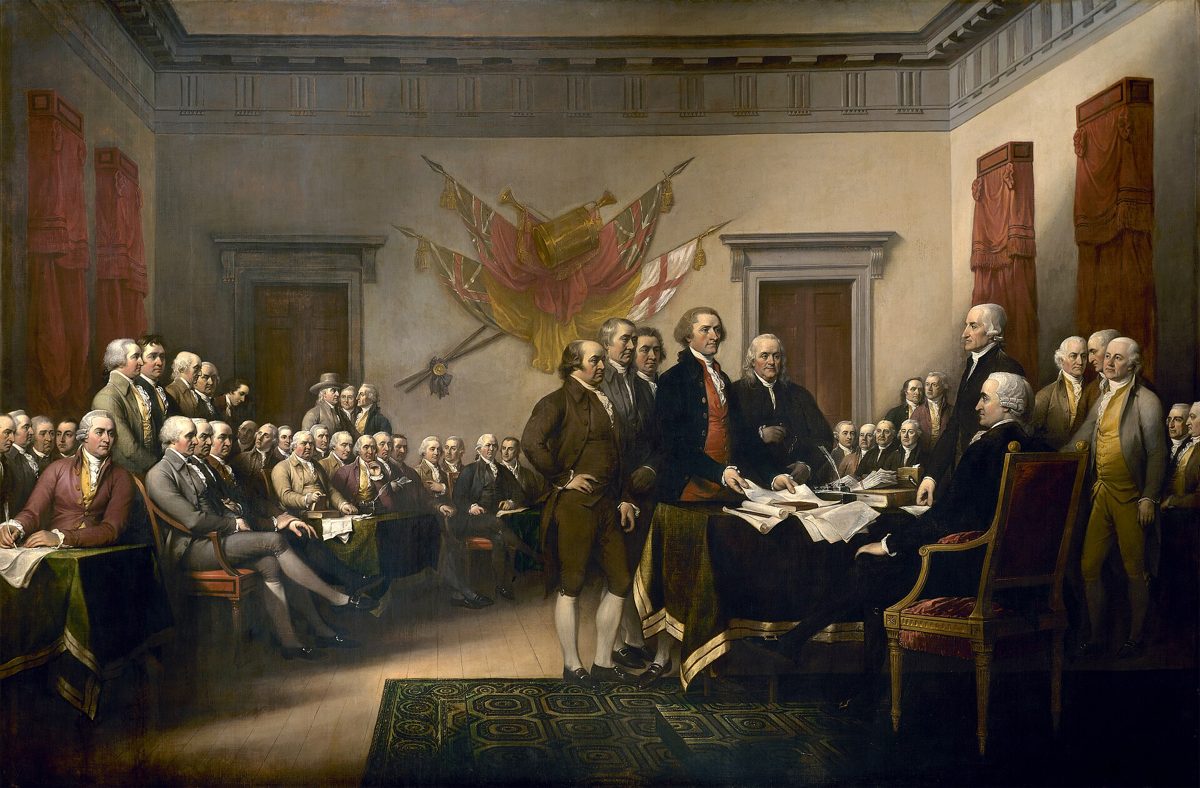
First, it does not show the signing. It shows the five-man drafting committee presenting its draft to Congress, an event that took place on June 28, 1776, and not the signing of the famous copy, which took place mainly on August 2.18 Second, the room never held those men at one time. The painting shows 42 of the 56 signers. Trumbull wanted all of them and could not find likenesses, so he used the sons of two men for whom he had no portrait: Benjamin Harrison VI for his father, and Rufus Hopkins for Stephen Hopkins. He added men who did not sign, including John Dickinson, who refused. "As the Declaration was debated and signed over a period of time when membership in Congress changed," the article notes, "the men featured in the painting never were in the same room at the same time."18
Third, the painting leaves out the fight. Nothing in the quiet room hints at the vote that was in doubt until July 2, the delegate sent for through the night, or the strike through Jefferson's slavery paragraph. Trumbull painted a calm room. The documents are a better guide to what happened in the real one: a Congress that argued, bargained and cut a passage that would have put the question of slavery before the colonies themselves.
Yet the painting is not a lie. It shows real men, painted from life where Trumbull could manage it, in the actual chamber at what is now Independence Hall.18 It gets the spirit right. These were serious men taking a serious risk, and they knew it.
- May 10, 1775 The Second Continental Congress convenes in Philadelphia.
- July 5-8, 1775 The Olive Branch Petition is adopted and signed.
- Aug. 23, 1775 The King's Proclamation of Rebellion.
- Jan. 10, 1776 Common Sense is published in Philadelphia.
- May 15, 1776 Virginia instructs its delegates to propose independence.
- June 7, 1776 Lee introduces his resolution.
- June 11, 1776 The Committee of Five is appointed.
- July 2, 1776 Twelve colonies vote for independence, New York abstaining.
- July 4, 1776 Congress adopts the Declaration. Dunlap prints it that night.
- July 19, 1776 Congress orders an engrossed copy.
- Aug. 2, 1776 Most delegates sign.
Learn more
- John Adams to Abigail Adams, July 3, 1776: the letter with the famous prediction, plus the editors' notes on how its text got garbled.
- The Olive Branch Petition: what Congress asked the King for, in its own words.
- Common Sense: forty-seven pages, free, and still readable in an hour.
- Thomas Paine's Inflated Numbers: a careful look at how many copies sold, and why we do not know.
- Jefferson's draft and his account of the debates: shows the passages Congress struck.
- The Declaration of Independence: the final text, a page and a half.
- Signing of the Declaration: the evidence on August 2 versus July 4.
- What Ordered Liberty Means (module 52): the framework behind the way this course reads the Declaration.
Notes
- John Adams to Abigail Adams, Philadelphia, July 3, 1776, Adams Family Correspondence, vol. 2, Adams Papers Digital Edition, Massachusetts Historical Society. The editors note that this is a celebrated letter whose text circulated early in garbled form. Read it online. ↩
- "Second Continental Congress," Wikipedia, on the opening of Congress on May 10, 1775, and the naming of Washington as commanding general on June 15, 1775. Read it online. ↩
- "Lee Resolution," Wikipedia: the Virginia Convention's instructions of May 15, 1776, the postponement of the vote, the vote of July 2, and New York's abstention. Read it online. ↩
- "Declaration on Taking Arms; July 6, 1775," Journals of the Continental Congress, Avalon Project. The passages quoted are in the final text. Read it online. ↩
- "Olive Branch Petition," Wikipedia: adopted July 5 and signed July 8, 1775; the report of Penn and Lee of September 2; and the Proclamation of Rebellion of August 23, 1775. Read it online. ↩
- "Petition to the King; July 8, 1775," Journals of the Continental Congress, Avalon Project. Spelling and punctuation as in that text. Read it online. ↩
- "Declaration of Independence, July 4, 1776," Avalon Project. Read it online. ↩
- "Common Sense," Wikipedia: first published January 10, 1776, when Paine had lived in America for fourteen months. Read it online. ↩
- Ray Tyler, "Common Sense: The Book of the Year (in 1776)," Teaching American History, January 10, 2023. Read it online. ↩
- Thomas Paine, Common Sense (Philadelphia: W. & T. Bradford, February 14, 1776, the enlarged edition), Project Gutenberg ebook 147. Read it online. ↩
- Ray Raphael, "Thomas Paine's Inflated Numbers," Journal of the American Revolution, March 20, 2013, discussing Trish Loughran, The Republic in Print (New York: Columbia University Press, 2007), pp. 40-58 and 253-261. Read it online. ↩
- "Committee of Five," Wikipedia: the committee appointed June 11, 1776, its members, the readings of July 2 and 3, and the vote of July 4. Read it online. ↩
- "Lee's Resolutions," June 7, 1776, Avalon Project, from Documents Illustrative of the Formation of the Union of the American States (Washington: Government Printing Office, 1927). Read it online. ↩
- "Draft of the Declaration of Independence," Teaching American History, from The Writings of Thomas Jefferson, ed. H. A. Washington (New York: John C. Riker, 1853), including Jefferson's account of the debates of July 2-4 and his text of the draft. Read it online. ↩
- "Signing of the United States Declaration of Independence," Wikipedia: the signing mostly on August 2, 1776, the Journals entries of July 19 and August 2, the dissent of Wilfred Ritz, and the first public readings on July 8. Read it online. ↩
- "Thomas Jefferson and slavery," Wikipedia: roughly 600 enslaved people lived at Monticello over the decades. Read it online. ↩
- On Blackstone and the law of nature, see module 50, lesson 5. William Blackstone. ↩
- "Declaration of Independence (Trumbull)," Wikipedia: size, dates, the event depicted, the number of signers shown and the figures who did not sign. Read it online. ↩
Terms in this lesson
- Olive Branch Petition
- Congress's last petition to King George III, adopted July 5, 1775, asking him to stop the conflict. He refused to receive it.
- Lee Resolution
- Richard Henry Lee's motion of June 7, 1776, that the United Colonies 'are, and of right ought to be, free and independent States.' Congress passed it on July 2.
- Committee of Five
- The committee appointed June 11, 1776, to draft a declaration: Jefferson, Adams, Franklin, Sherman and Robert R. Livingston.
- Unalienable rights
- Rights that belong to a person by nature and that no government may legitimately give up or take away. The word in the final text is 'unalienable.'
- Consent of the governed
- The principle that a government's just powers come from the people it governs.
- Engrossed copy
- The final, formal copy written on parchment, which is the one the delegates signed, mostly on August 2, 1776.
- Dunlap broadside
- The first printed copy of the Declaration, run off by John Dunlap in Philadelphia on the night of July 4 and morning of July 5, 1776.
Sources
- John Adams to Abigail Adams, 3 July 1776 (Adams Papers Digital Edition, Massachusetts Historical Society) checked 2026-10
- Petition to the King, July 8, 1775 (Avalon Project) checked 2026-10
- Declaration of the Causes and Necessity of Taking Up Arms, July 6, 1775 (Avalon Project) checked 2026-10
- Paine, Common Sense (Project Gutenberg) checked 2026-10
- Raphael, Thomas Paine's Inflated Numbers (Journal of the American Revolution) checked 2026-10
- Lee's Resolutions, June 7, 1776 (Avalon Project) checked 2026-10
- Draft of the Declaration of Independence, with Jefferson's note (Teaching American History) checked 2026-10
- The Declaration of Independence, July 4, 1776 (Avalon Project) checked 2026-10
- Signing of the United States Declaration of Independence (Wikipedia) checked 2026-10
- Declaration of Independence (Trumbull) (Wikipedia) checked 2026-10