Lesson 5 of 9 · about 24 minutes
The Crisis of the 1780s
You'll be able to
- Explain why the Confederation Congress could not pay its debts or enforce its treaties
- Describe how the meetings at Mount Vernon (1785) and Annapolis (1786) led to the call for a convention
- Tell what Shays' Rebellion was, what its grievances were and how it was put down
- Summarize Madison's 'Vices of the Political System' and the Congress's resolution of February 21, 1787
- State what the Northwest Ordinance of 1787 established, including its limits
"You talk, my good Sir, of employing influence to appease the present tumults in Massachusetts." George Washington wrote that to Henry Lee on October 31, 1786, from Mount Vernon. "I know not where that influence is to be found; and if attainable, that it would be a proper remedy for the disorders. Influence is no Government. Let us have one by which our lives, liberties and properties will be secured; or let us know the worst at once."1
The sentence is the theme of this lesson. A people can win independence by the force of a cause and still lose their liberty if no government exists to secure it. The 1780s were the years in which Americans found that out. They had written down their rights in 1776 and set up a league of states in 1781. They had not yet built a government that could pay a debt, keep a treaty or put down a riot.
Peace without a government
The previous lesson ended with the Articles of Confederation: a Congress that could ask the states for money and could not make them pay, a single vote for each state, and a rule that any amendment needed every state to agree. Peace in 1783 tested that design. The war debt had to be paid. Foreign treaties had to be kept. Settlers were moving west without any law to organize them. And Congress, which had voted for all of this, could not do any of it unless thirteen legislatures chose to help.
Its weakness began with attendance. The Treaty of Paris waited for months to be ratified because too few delegates were present to make a quorum, and Congress had no power to compel them to come.2 Foreign policy suffered in the same way. In 1786 Congress negotiated the Jay-Gardoqui Treaty with Spain, which would have given up American use of the Mississippi River for 25 years and strangled the economy of settlers west of the Appalachians. It was never ratified. Britain, meanwhile, kept its forts on the frontier, citing American failure to honor the treaty's promises on Loyalists and debts, and Congress had no army to force them out.2
The states did not agree on money, either. Some printed paper currency and made it legal tender for debts. Madison listed "Paper money, instalments of debts, occlusion of courts, making property a legal tender" as acts that injured citizens of other states, since "the citizens of every State, aggregately taken, stand more or less in the relation of creditors or debtors to the citizens of every other State."3 Rhode Island, where the "country party" took the legislature in 1786, forced its merchants to take devalued paper in settlement of debts, which worried Boston's merchants.4 A fair reading allows that debtors had a case, since they had been paid little in the war and hard money was scarce. A fair reading also allows that creditors and the rule of contract had a case, since a promise to pay that can be wiped out by statute is not much of a promise. Both claims are about justice, and a government has to adjudicate between them. Congress could not.
Trade barriers
Commerce was the other open wound. Each state laid its own duties, and Congress had no general power to regulate trade. By 1786, delegates at Annapolis were talking about "protectionist trade barriers that each state had erected."5 Madison named Virginia's law "restricting foreign vessels to certain ports" and similar favoritism in Maryland and New York. He wrote that the practice of putting other states' goods on the footing of foreign goods, "though not contrary to the federal articles, is certainly adverse to the spirit of the Union, and tends to beget retaliating regulations, not less expensive and vexatious in themselves than they are destructive of the general harmony."3
From Mount Vernon to Annapolis
The way out began with a dispute about a river. Maryland and Virginia shared the Potomac, and in March 1785 their commissioners met to settle questions about the river's use, fishing and jurisdiction. When the Virginia delegates had not arrived at Alexandria, Washington offered the Maryland men the hospitality of Mount Vernon, and the conference met there. On March 28 the commissioners produced a report of thirteen clauses that declared the Potomac a common waterway, and both legislatures ratified it.6 The agreement worked outside the Articles, and its success encouraged James Madison to look for more. On January 21, 1786, Virginia invited all the states to a meeting on commercial matters at Annapolis.6
The meeting convened on September 11, 1786. Twelve commissioners came from five states, New York, New Jersey, Pennsylvania, Delaware and Virginia. Four other states had named commissioners who never arrived, and nothing was heard from the rest.57 John Dickinson was elected chairman. The commissioners decided that so thin a gathering could not act on trade. They wrote a report, mainly the work of Alexander Hamilton, and adopted it unanimously on September 14.57
The report did something no one had asked it to do. It admitted that it might "seem to exceed the strict bounds of their appointment," and then asked the states for a wider convention. The commissioners said the defects in the federal system "may be found greater and more numerous" than the states had assumed, and described the country's situation as "delicate and critical." They proposed that the states appoint commissioners "to meet at Philadelphia on the second Monday in May next, to take into consideration the situation of the United States, to devise such further provisions as shall appear to them necessary to render the constitution of the Federal Government adequate to the exigencies of the Union."7
Notice the care. The commissioners had no authority to say any of this, and they said so. They were asking for a lawful process: a convention called by the states, reporting to Congress, with any result "confirmed by the Legislatures of every State."7 Later chapters turn on this point. The Constitution was written by people who had been sent to revise the Articles and who went further. The Annapolis report, at least, did not hide what it was doing.
Shays' Rebellion, 1786 to 1787
While the commissioners were still meeting, the argument over debt turned violent in Massachusetts. The rural west of the state was farm country, and many of its residents had few assets beyond their land. After 1784 British merchants stopped extending credit and demanded hard currency, which was in short supply, and New England merchants passed the demand down to their own customers.4 Governor John Hancock had declined to press poorer debtors or to prosecute delinquent taxes. He resigned in early 1785 and his successor, James Bowdoin, pressed both. The legislature added a new property tax to pay the state's share of foreign debts, and even John Adams thought the levies "heavier than the People could bear."4
The people hit by this pressure said what they felt. A farmer who signed himself "Plough Jogger" told a meeting: "I have been greatly abused, have been obliged to do more than my part in the war, been loaded with class rates, town rates, province rates, Continental rates, and all rates ... been pulled and hauled by sheriffs, constables, and collectors, and had my cattle sold for less than they were worth."4 Many were veterans who had been poorly paid. They petitioned the legislature for paper money and relief, and the legislature, where merchants held sway, refused.4
Petitions failed, and in August 1786 people moved to direct action. On August 29 a well-organized crowd at Northampton stopped the county court from sitting, calling themselves Regulators. In September, courts were shut in Worcester, Great Barrington, Concord and Taunton. James Warren wrote to John Adams on October 22, "We are now in a state of Anarchy and Confusion bordering on Civil War."4 The state answered with a mix of firmness and concession. It let some old taxes be paid in goods, offered pardons to those who took an oath, banned speech critical of the government, and suspended habeas corpus, which alarmed many.4 Daniel Shays, a Revolutionary War veteran, joined the movement and gave it his name, though he denied being its leader. Recent scholarship holds that his role was exaggerated.4
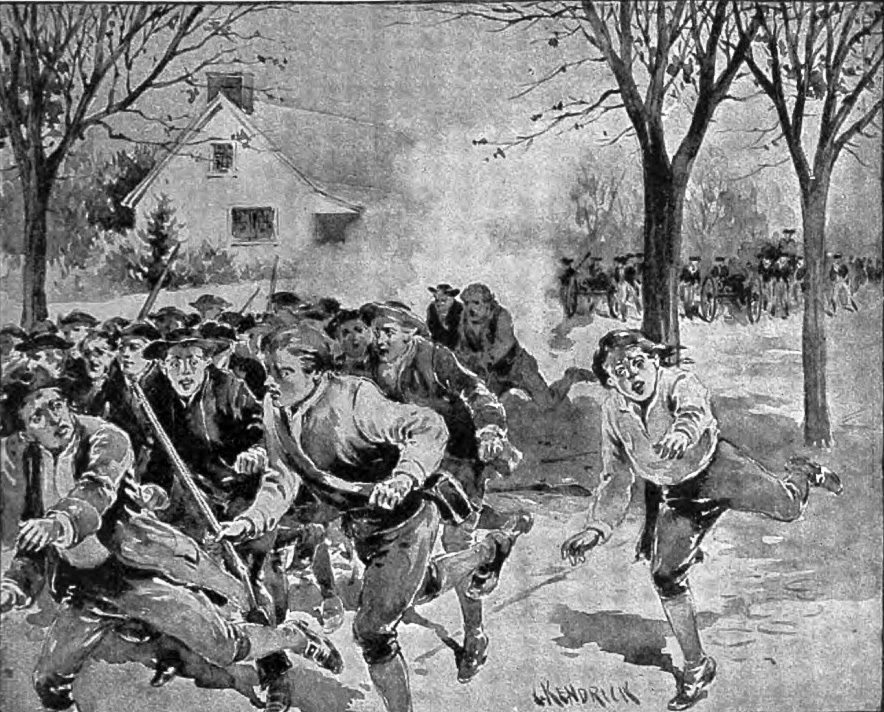
Congress could not help. The federal government was so limited under the Articles that it could not finance troops. On January 4, 1787, Governor Bowdoin proposed a privately funded army, and Benjamin Lincoln raised more than 6,000 pounds from over 125 merchants.4 On January 25 about 1,200 militia under William Shepard guarded the federal arsenal at Springfield. When Shays's column came on, Shepard fired warning shots and then two cannon loaded with grapeshot. Four rebels were killed and twenty wounded, and the advance collapsed.4 Lincoln's 3,000 men caught the rest at Petersham on February 4 after a forced march through a snowstorm, and large-scale resistance ended.4
The aftermath shows a government that wanted order without cruelty. The legislature passed a Disqualification Act on February 16, 1787, barring rebels from public office. Four thousand people signed confessions in exchange for amnesty. Eighteen men were sentenced to death, most were later pardoned or had their sentences set aside, and two, John Bly and Charles Rose, were hanged on December 6, 1787. Shays was pardoned in 1788. The voters, for their part, threw out Bowdoin in 1787 and brought back Hancock, and the legislature cut taxes and set a moratorium on debts.4 Some of what the rebels had asked for came afterward through the ballot box.
How should the rebellion be judged? Washington's letter of October 1786 is a model of balance. He did not call every farmer a villain. "If they have real grievances," he wrote, "redress them if possible; or acknowledge the justice of them, and your inability to do it in the present moment. If they have not, employ the force of government against them at once."1 That is the ordered-liberty position in a sentence. A government owes its citizens a hearing, and a hearing is not a license to close the courts. The Regulators had real grievances and had also gone outside the law that could remedy them. The first thing is why the rebellion had support. The second is why it had to be stopped. Scholars still argue about how much it influenced the Constitution.4
Madison's "Vices," April 1787
Before the convention met, James Madison set down his diagnosis. His notes, "Vices of the Political System of the United States," are dated April 1787 and list eleven defects. They begin with the states' failure to comply with requisitions and their encroachments on federal authority, and go on to violations of treaties, trespasses of states on each other, and the lack of a guaranty against internal violence.3 The core of his argument is the seventh item.
"A sanction is essential to the idea of law, as coercion is to that of Government. The federal system being destitute of both, wants the great vital principles of a Political Constitution. Under the form of such a Constitution, it is in fact nothing more than a treaty of amity, of commerce, and of alliance, between independent and Sovereign States."
James Madison, "Vices of the Political System of the United States," April 1787. 3
He was gentle about the authors of the Articles. Their mistake was "a mistaken confidence that the justice, the good faith, the honor, the sound policy of the several legislative assemblies would render superfluous any appeal to the ordinary motives by which the laws secure the obedience of individuals," and that confidence "does honor to the enthusiastic virtue of the compilers."3 The framers of the Articles had trusted virtue, and Madison no longer thought virtue was enough.
The most original part of the essay concerns the states themselves. Madison found that the greatest danger to rights was no longer a king. It was majorities in the state legislatures. In a republic, he observed, the majority makes the law. "Whenever, therefore, an apparent interest or common passion unites a majority, what is to restrain them from unjust violations of the rights and interests of the minority, or of individuals?" He listed three possible restraints, a prudent regard for the general good, respect for character, and religion, and judged each insufficient in a crowd.3 His cure was a government large enough that no single faction could easily rule it, one "sufficiently neutral between the different interests and factions" and "sufficiently controlled itself from setting up an interest adverse to that of the whole society."3 This is the first draft of the argument of Federalist 10, which the ratification lesson takes up.
Notice also what Madison does not say. He does not say that liberty needs less government. He says the opposite: that the rights of individuals are unsafe without a government strong enough to restrain the unjust acts of the majority and to bind its own parts. He is also honest about his time's own contradiction. In his discussion of majorities he adds a short remark that "Where slavery exists, the republican Theory becomes still more fallacious."3
The call, February 1787
The Annapolis report went to Congress as well as to the states. Congress took five months to act. On February 21, 1787, a committee's report proposed that Congress strongly recommend that the states send delegates to Philadelphia, and New York's delegates, on instructions from home, moved a different plan. Congress defeated New York's motion to postpone, and then took up a motion from Massachusetts. As amended, it became the resolution that called the convention.8
"Resolved that in the opinion of Congress it is expedient that on the second Monday in May next a Convention of delegates who shall have been appointed by the several states be held at Philadelphia for the sole and express purpose of revising the Articles of Confederation and reporting to Congress and the several legislatures such alterations and provisions therein as shall when agreed to in Congress and confirmed by the states render the federal constitution adequate to the exigencies of Government & the preservation of the Union."
Resolution of Congress, February 21, 1787. 8
Look at the phrase "sole and express purpose of revising the Articles of Confederation." The convention was authorized to revise, to report back, and to have its proposals approved by Congress and the states. The next lesson shows how far the delegates went beyond that, and the lesson after it how the country decided whether to accept what they wrote. Both questions begin with these words.
The Confederation's best work: the Northwest Ordinance
It would be unfair to leave the Confederation Congress at its failures. In July 1787, while the Philadelphia convention was meeting, Congress, then sitting in New York, passed its most lasting law. The Northwest Ordinance, enacted on July 13, 1787, created the Northwest Territory, the nation's first organized incorporated territory.9 It built on the Land Ordinance of 1784, which declared that states would one day be formed in the region, and the Land Ordinance of 1785, which set rules for selling the land.9
It set up a ladder. At first Congress appointed a governor, a secretary and three judges. When a district held 5,000 free adult males it could elect a house of representatives, and the territory would be divided into "not less than three nor more than five States." Once a state reached a population of 60,000, it was to be admitted "on an equal footing with the original States."109 New states would not be subjects of the old ones. The first one, Ohio, entered in 1803.9
The ordinance also contained a set of "articles of compact between the original States and the people and States in the said territory," meant to "forever remain unalterable, unless by common consent."10 The first guaranteed religious freedom: "No person, demeaning himself in a peaceable and orderly manner, shall ever be molested on account of his mode of worship or religious sentiments." The second promised habeas corpus, trial by jury, bail, moderate fines, no cruel or unusual punishments, and that "No man shall be deprived of his liberty or property, but by the judgment of his peers or the law of the land." The third read:
"Religion, morality, and knowledge, being necessary to good government and the happiness of mankind, schools and the means of education shall forever be encouraged. The utmost good faith shall always be observed towards the Indians; their lands and property shall never be taken from them without their consent."
Northwest Ordinance, Article 3, July 13, 1787. 10
This is ordered liberty in legal form: rights secured by law, and the habits that sustain a free people, religion, morality and education, named as public goods. The promise to the Indians is worth reading beside the record. The territory was contested ground, and the ordinance was passed amid violent resistance from the region's Native peoples and British outposts that had not left.9 A fair student will notice both the words and the history that followed, which this course takes up in later modules.
Article 6 is the most famous. "There shall be neither slavery nor involuntary servitude in the said territory, otherwise than in the punishment of crimes whereof the party shall have been duly convicted." It carries a proviso: a person escaping into the territory "from whom labor or service is lawfully claimed in any one of the original States, such fugitive may be lawfully reclaimed and conveyed to the person claiming his or her labor or service."10 The ban made the Ohio River an effective boundary between free and slave states in that region and helped set the stage for later conflicts.9 It was real, and it was limited: the territory was closed to new slavery but open to the return of fugitives.
The Confederation, then, could do what its design allowed. It could organize land, receive new states and declare principles. It could not tax, enforce a treaty or put down a riot without borrowed money. The founders who went to Philadelphia in the spring of 1787 were deciding how to keep what the old Congress did well and mend what it could not.
- Mar. 1785 Maryland and Virginia commissioners meet at Mount Vernon.
- Jan. 21, 1786 Virginia invites all the states to a trade meeting at Annapolis.
- Aug. 29, 1786 Regulators close the court at Northampton, Massachusetts.
- Sept. 11-14, 1786 The Annapolis Convention meets and calls for a wider convention.
- Oct. 31, 1786 Washington writes to Henry Lee: "Influence is no Government."
- Jan. 25, 1787 Shays's men are repulsed at the Springfield Armory.
- Feb. 21, 1787 Congress calls a convention to meet in Philadelphia in May.
- Apr. 1787 Madison writes the "Vices of the Political System."
- July 13, 1787 Congress passes the Northwest Ordinance.
Learn more
- Washington to Henry Lee, 1786: a short letter that shows how an alarmed Washington thought about the Massachusetts tumults.
- The Annapolis report: the brief document that asked for a convention, in the commissioners' own words.
- Madison, Vices of the Political System: his own list of what was wrong, a first draft of the thinking behind Federalist 10.
- The Northwest Ordinance: six articles of compact that governed a large part of the country.
- Shays's Rebellion: a detailed account, including how historians now see Shays's own role.
- Legitimate Authority and Its Limits (module 52): tests for when resistance to authority is justified, useful for judging Shays's Regulators.
Notes
- George Washington to Henry Lee Jr., Mount Vernon, October 31, 1786, Founders Online, National Archives, as reproduced by Teaching American History. Capitalization as in that text. Read it online. ↩
- "Articles of Confederation," Wikipedia, on the lack of a quorum in 1783-1784, the unratified Jay-Gardoqui treaty of 1786, and the British refusal to leave frontier forts. Read it online. ↩
- James Madison, "Vices of the Political System of the United States," April 1787, from The Writings of James Madison, ed. Gaillard Hunt, vol. 2, as reproduced by Teaching American History. Read it online. ↩
- "Shays's Rebellion," Wikipedia, for the causes, the events from August 1786 to February 1787, the aftermath and the quotations of Plough Jogger, James Warren and John Adams. Read it online. ↩
- "Annapolis Convention (1786)," Wikipedia: twelve delegates from five states, the protectionist trade barriers, and Hamilton as main author. Read it online. ↩
- "Mount Vernon Conference," Wikipedia: the meeting of March 1785, Washington's role as host, the report of March 28, and Virginia's invitation to all states on January 21, 1786. Read it online. ↩
- "Proceedings of Commissioners to Remedy Defects of the Federal Government," Annapolis, September 11-14, 1786, Avalon Project. Spelling and capitalization as in that text. Read it online. ↩
- "Report of Proceedings in Congress; February 21, 1787," Avalon Project, from Documents Illustrative of the Formation of the Union of the American States (Washington: Government Printing Office, 1927). Read it online. ↩
- "Northwest Ordinance," Wikipedia: the Land Ordinances of 1784 and 1785, the passage in New York in 1787, the statehood threshold of 60,000, and the effect of the slavery ban on the Ohio River boundary. Read it online. ↩
- "Northwest Ordinance; July 13, 1787," Avalon Project. Spelling as in that text. Read it online. ↩
Terms in this lesson
- Paper money
- Notes issued by a state and declared to be legal payment for debts. Debtors favored it, since it lowered the real value of what they owed, and creditors opposed it.
- Annapolis Convention
- A meeting of twelve commissioners from five states at Annapolis, September 11-14, 1786, called to discuss trade, which instead urged a wider convention at Philadelphia.
- Regulators
- The name taken by the protesters who closed courts in western Massachusetts in 1786, borrowed from an earlier North Carolina movement.
- Habeas corpus
- The ancient right to demand that a jailer bring a prisoner before a court and justify the detention.
- Faction
- In Madison's usage, a group of citizens united by a common interest or passion against the rights of others or the good of the whole.
- Northwest Ordinance
- The law of July 13, 1787, by which Congress organized the territory north of the Ohio River and promised its eventual division into states equal to the original thirteen.
Sources
- Washington to Henry Lee, October 31, 1786 (Teaching American History) checked 2026-10
- Shays's Rebellion (Wikipedia) checked 2026-10
- Mount Vernon Conference (Wikipedia) checked 2026-10
- Annapolis Convention (Wikipedia) checked 2026-10
- Proceedings of Commissioners to Remedy Defects of the Federal Government, 1786 (Avalon Project) checked 2026-10
- Madison, Vices of the Political System of the United States (Teaching American History) checked 2026-10
- Report of Proceedings in Congress, February 21, 1787 (Avalon Project) checked 2026-10
- Northwest Ordinance, July 13, 1787 (Avalon Project) checked 2026-10
- Northwest Ordinance (Wikipedia) checked 2026-10
- Articles of Confederation (Wikipedia) checked 2026-10