Lesson 9 of 9 · about 22 minutes
What Culture First Asks of Citizens
You'll be able to
- Name the institutions closest to home where culture is formed and say what each asks of an ordinary citizen
- Describe what Francis Schaeffer himself urged Christians to do in his 1982 Christian Manifesto address, including his limits on it
- Explain ordered liberty as a shared duty both to hold government accountable and to support legitimate government
- Recognize two dangers in the culture-first idea: treating custom as an excuse to defy just law, and using cultural power to coerce conscience
In 1982 Francis Schaeffer stood in the pulpit of Coral Ridge Presbyterian Church in Fort Lauderdale, Florida, to give the address version of his book A Christian Manifesto. He was 70 and had about two years to live.1 He told the congregation that Christians "have only been seeing things as bits and pieces," one issue at a time, instead of as the outcome of a change in how the culture understood reality.2 He closed in prayer. It was the calling of Christians, he said, "to do all we can," short of the perfection that only Christ's return will bring, "to see substantial healing in every area," and to carry the gospel "into the totality of life, as salt and light."2
Substantial healing in every area. That is a large assignment for ordinary people with jobs and children. But if politics really does come downstream from culture, the assignment cannot be handed to Washington or to the state capitol. It belongs to the places where culture is actually made, which are mostly small, local and close to home.
The household
The founders said often that a free government depends on a moral people, and they did not expect the government to produce the morals. In his Farewell Address of 1796, Washington wrote: "Of all the dispositions and habits which lead to political prosperity, religion and morality are indispensable supports." The man who tried to undermine them, he added, could not claim "the tribute of patriotism."3 Two years later John Adams told a brigade of the Massachusetts militia that passions unchecked by morality, "Avarice, Ambition and Revenge or Galantry, would break the strongest Cords of our Constitution." Then he wrote one of his most quoted sentences: "Our Constitution was made only for a moral and religious People."4
Habits like honesty, patience and keeping your word are learned first at a kitchen table. So are the habits C. S. Lewis worried about in The Abolition of Man, the trained affections that make a person love what is good before he can explain why. A family that reads together, eats together, prays together and argues fairly is doing civic work, whether or not anyone in it ever runs for office. Burke's "little platoon" starts here.
The congregation
Tocqueville thought religion was the "foremost of the political institutions" of America precisely because it took "no direct part in the government of society."5 Churches, synagogues and parishes teach that there is a law above the law. They also teach practical self-government: electing elders and deacons, keeping a budget, caring for the sick and the widowed, settling quarrels without a judge.
Fewer Americans belong to one than at any time Gallup has measured. In 1937, 73 percent of Americans told Gallup they were members of a church, synagogue or mosque. The figure stayed near 70 percent through 1999. By 2020 it had fallen to 47 percent, the first time below half in Gallup's eight decades of asking.6
Membership is not the same as faith, and Gallup's own analysis says most of the drop comes from people who now claim no religious preference at all.6 But for this lesson's question the number matters on its own terms. A congregation is one of the few places left where people of different ages, incomes and opinions sit in the same room every week and work on something together. When fewer people belong, fewer people practice that.
Associations and the little platoons
Tocqueville was astonished by how often Americans organized themselves without waiting for the government:
"Americans of all ages, all conditions, and all dispositions, constantly form associations. They have not only commercial and manufacturing companies, in which all take part, but associations of a thousand other kinds, religious, moral, serious, futile, extensive, or restricted, enormous or diminutive. The Americans make associations to give entertainments, to found establishments for education, to build inns, to construct churches, to diffuse books, to send missionaries to the antipodes."
Alexis de Tocqueville, Democracy in America, vol. 2 (1840), Book 2, chapter 5, trans. Henry Reeve. 7
"In democratic countries the science of association is the mother of science," he concluded; "the progress of all the rest depends upon the progress it has made."7 The volunteer fire department, the 4-H club, the Grange, the library board, the food pantry, the Little League and the quilting circle are all schools in that science. Each one teaches people to run a meeting, keep minutes, handle money honestly and disagree without walking out. Kuyper would add that each has its own purpose, which the state should protect and not swallow.8 In 1995 the political scientist Robert Putnam gave the decline of these groups a memorable name in an essay titled "Bowling Alone."9 The name stuck because people recognized their own towns in it.
Schools, local arts and local news
Schools
Every one of the writers in Lesson 7 came back to education. Lewis wrote The Abolition of Man about an English textbook. Gramsci called every relationship of hegemony "an educational relationship."10 Both sides of that argument understood that whoever teaches the children shapes the country. In most American communities, public schools are governed by elected local boards whose meetings are open to the public and whose budgets are public records. Reading the curriculum, showing up to board meetings and serving on the board are ordinary forms of culture-first citizenship. So is teaching Sunday school, coaching a team, tutoring, or running a homeschool co-op well.
Local arts
Eliot insisted that culture includes cup finals and boiled cabbage as well as cathedrals.11 The American version includes the county fair, the high school musical, the church choir, the community band and the local songwriter. These are where a community tells itself who it is. "We Shall Overcome" began as a church song and a picket-line song before it reached the floor of Congress.12 Folk, gospel, country and protest music have always worked this way in America. A song written for a dozen people in a grange hall can end up shaping how millions understand a cause.
Local news
Self-government needs citizens who know what their governments are doing, and for most of American history local newspapers told them. That is ending fast. Northwestern University's Medill School reported in 2024 that more than 3,200 print newspapers have vanished since 2005, that papers were still closing at a rate of more than two a week, and that 130 had shut down in the past year alone. In 206 counties, home to more than 3.5 million people, there is no local news outlet consistently producing original content.13 Where no one covers the county commission, the school board or the sheriff, officials answer to almost no one between elections. Subscribing to a local paper, supporting a nonprofit newsroom, writing a letter to the editor, filing a public records request, or simply attending a meeting and telling neighbors what happened are all ways to refill that empty space.
The habits of self-government
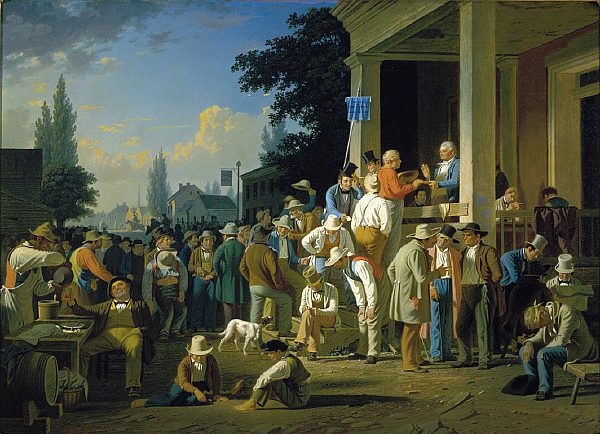
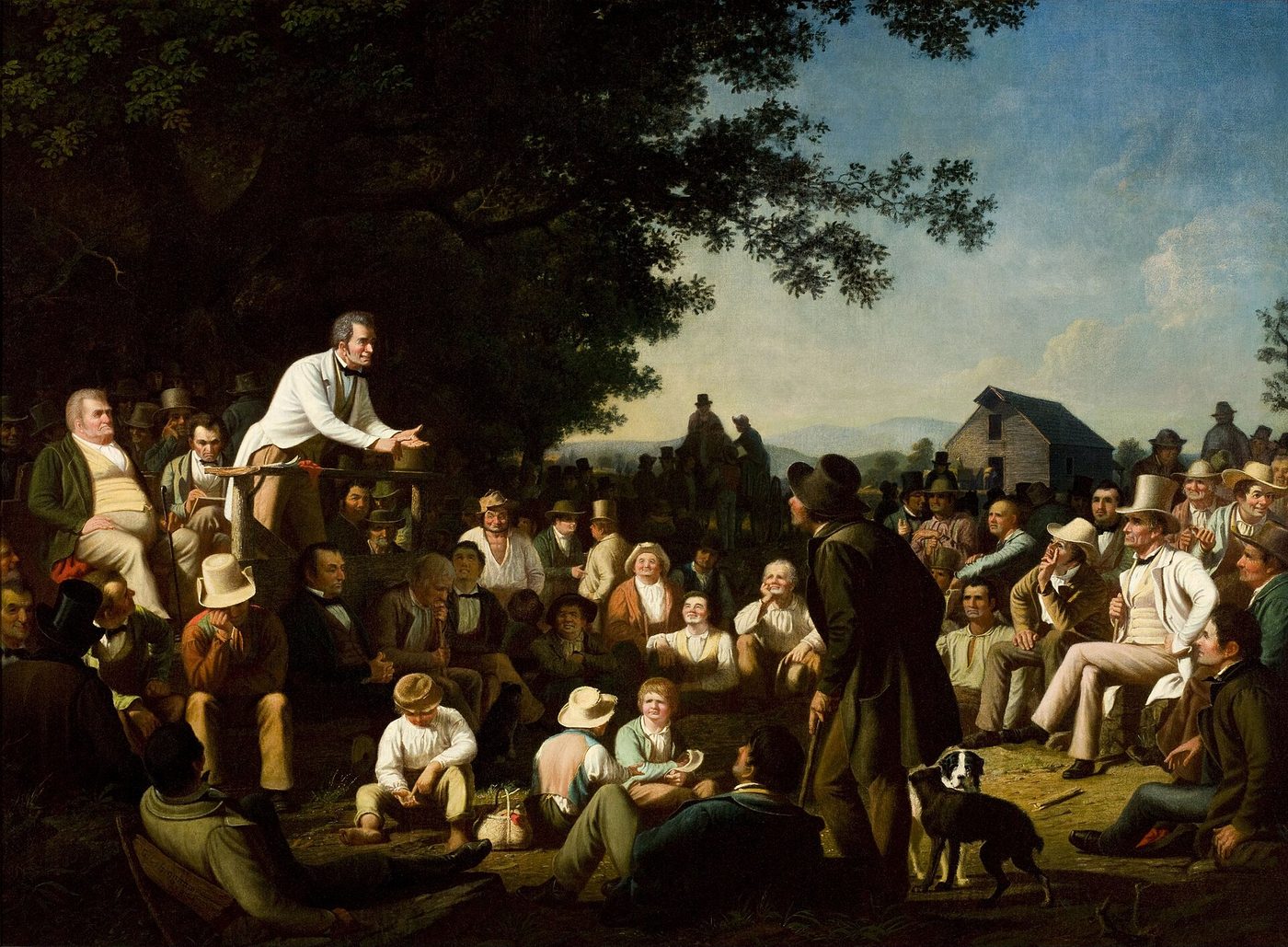
Tocqueville found the root of American liberty in the township. "Town-meetings are to liberty what primary schools are to science; they bring it within the people's reach, they teach men how to use and how to enjoy it." He added a warning: "A nation may establish a system of free government, but without the spirit of municipal institutions it cannot have the spirit of liberty."14
The spirit of municipal institutions is not mysterious. It looks like a person who reads the agenda before the meeting, asks a question during public comment, checks the budget against last year's, votes in the primary as well as the general election, serves on a jury when called, and thanks the clerk who keeps the records. None of it is glamorous. All of it is how a people keeps the habit of governing itself, and a people that loses the habit will not get it back by electing the right person to a high office.
Schaeffer's own call
Schaeffer is often remembered as a cultural critic, and the earlier lessons of this module show why. But in the 1982 address he did not tell Christians to retreat into culture and leave politics alone. He told them to use every lawful tool they had: "Every appropriate legal and political governmental means must be used." And he insisted the country still offered plenty of room to do that: "We have lots of room to move yet with our court cases, with the people we elect."2
He drew two firm lines. The first was against theocracy. People who heard Christians talk about bringing their values back into public life sometimes shouted the name of Iran's Ayatollah Khomeini, he said, and his answer was blunt: "Absolutely not! We must make absolutely plain, we are not in favor of theocracy, in name or in fact." Later in the address he repeated it: "I personally am opposed to a theocracy."2
The second line was against making the state into God. If the government commands what God forbids, Schaeffer said, there comes a point where obedience to Christ requires refusal:
"If, unhappily, we come to that place, the appropriate level must also include a disobedience to the state. If you are not doing that, you haven't thought it through. Jesus is not really on the throne. God is not central. You have made a false god central. Christ must be the final Lord and not society and not Caesar."
Francis A. Schaeffer, A Christian Manifesto, address at Coral Ridge Presbyterian Church, Fort Lauderdale, 1982. 2
Notice the word "unhappily" and the phrase "the appropriate level." Schaeffer treated disobedience as a last resort after the courts, the ballot and persuasion had been tried, and he tied it to the example of believers in the Soviet Union who were punished for teaching their own children about Christ.2 That is the old line from Acts 5:29, "We ought to obey God rather than men," held in tension with Romans 13, as Lesson 6 showed.
Ordered liberty: holding government accountable and supporting it
This course uses the phrase ordered liberty to mean liberty that recognizes a shared duty of holding government accountable and supporting legitimate government. Both halves are duties, and the culture-first idea needs both.
Holding government accountable is the half most people understand. It means watching officials, asking for records, reporting what they do, voting them out when they fail and, when it comes to that, refusing to take part in injustice. A healthy culture produces citizens who will do this. A community with no newspaper, no associations and no habit of showing up produces citizens who will not.
Supporting legitimate government is the half that gets forgotten. It means paying taxes honestly, obeying just laws when no one is watching, serving on juries, respecting election results that were fairly reached and treating officials as fellow citizens rather than enemies. John Adams described the colonists of the 1760s praying for the king and his officers as "Ministers ordained of God for their good," and switching their prayers to Congress only when the king's government began "renouncing all the Principles of Authority."15 They supported legitimate authority until it stopped being legitimate, and then they built a new one. Culture-first citizens should be the steadiest supporters of lawful government as well as its sharpest critics.
Limits and dangers of the idea
Any idea strong enough to matter can be misused. The culture-first idea has two characteristic misuses, and both have American histories.
Culture as an excuse to ignore law
The first misuse says that because law follows culture, the law should wait until the culture is ready, or that local custom outranks a just law. The Supreme Court made exactly that argument in Plessy v. Ferguson in 1896 when it upheld segregated railroad cars. A legislature, the majority said, could act "with reference to the established usages, customs, and traditions of the people," and "legislation is powerless to eradicate racial instincts."16 For sixty years that reasoning protected Jim Crow. Lesson 8 showed what happened when the courts and Congress finally refused it: the schools of the South changed faster in the six years after 1964 than in the ten years after Brown.17 A culture can be wrong. When it is, the law above custom, the one Cicero and Aquinas and the Declaration describe, is what citizens appeal to. Culture first never means culture over justice.
Culture as a pretext to coerce
The second misuse runs the other way. If culture shapes everything, the temptation is to seize the culture and force everyone into it. In the late 1930s and early 1940s, public schools in several states expelled Jehovah's Witness children who, for religious reasons, would not salute the flag. The Supreme Court at first upheld the expulsions in 1940. Three years later, in West Virginia State Board of Education v. Barnette, it reversed itself, and Justice Robert Jackson wrote one of the great sentences in American law:
"If there is any fixed star in our constitutional constellation, it is that no official, high or petty, can prescribe what shall be orthodox in politics, nationalism, religion, or other matters of opinion or force citizens to confess by word or act their faith therein."
Justice Robert H. Jackson, West Virginia State Board of Education v. Barnette, 319 U.S. 624, 642 (1943). 18
He also warned where coerced unity leads: "Those who begin coercive elimination of dissent soon find themselves exterminating dissenters. Compulsory unification of opinion achieves only the unanimity of the graveyard."18 That warning applies to every side. It applies to a school board that would force a patriotic ritual on a dissenting child, to Marcuse's call in 1965 for "intolerance against movements from the Right," which Lesson 7 quoted, and to any religious majority tempted to use public power to make its neighbors pray. Schaeffer's rejection of theocracy belongs here. Persuasion, example and the free building of institutions are the tools of culture-first citizenship. Compulsion is the tool it gives up.
Culture as an excuse to do nothing
One more misuse is quieter. Some people hear "politics is downstream from culture" and decide that politics does not matter, that voting and testifying and running for office can wait until the culture is fixed. Schaeffer did not believe that, and neither did the civil rights churches that organized car pools in Montgomery while their lawyers filed suit in federal court.19 Culture work and political work happen at the same time, often by the same people on different nights of the week.
On a weeknight in most American towns, somewhere a school board is approving a budget, a congregation is planning a funeral meal, a 4-H leader is teaching a twelve-year-old to keep records on a calf, a volunteer is shelving books at the library, and a reporter, if the town still has one, is taking notes in the back row of the county commission. Tocqueville would have recognized every one of those rooms. That is where the river starts.
Learn more
- Schaeffer, A Christian Manifesto (1982 address transcript): read his own words on theocracy, legal means and the "final bottom line."
- Washington's Farewell Address: the passage on religion, morality and public happiness is a few paragraphs past the middle.
- Tocqueville, Democracy in America, vol. 2: Book 2, chapters 5 through 7, on associations in civil and political life.
- Gallup on church membership: eight decades of data and an analysis of who is leaving.
- Medill, The State of Local News 2024: county-by-county data on newspaper closures and news deserts.
- West Virginia v. Barnette (1943): Justice Jackson's opinion is short and some of the best prose the Court has produced.
- Plessy v. Ferguson (1896): read the majority's appeal to custom, then Justice Harlan's dissent.
- John Adams to the Massachusetts Militia, 1798: the source of "made only for a moral and religious People."
Notes
- "Francis Schaeffer," Wikipedia: born January 30, 1912; died May 15, 1984, in Rochester, Minnesota. Read it online. ↩
- Francis A. Schaeffer, "A Christian Manifesto," address delivered at Coral Ridge Presbyterian Church, Fort Lauderdale, Florida, 1982, based on his book A Christian Manifesto (Westchester, IL: Crossway Books, 1981); transcript at the Internet Archive. Read it online. ↩
- George Washington, Farewell Address, September 19, 1796, Avalon Project. Read it online. ↩
- John Adams to Massachusetts Militia, October 11, 1798, Founders Online, National Archives. Read it online. ↩
- Alexis de Tocqueville, Democracy in America, vol. 1 (1835), trans. Henry Reeve, chapter 17. Read it online. ↩
- Jeffrey M. Jones, "U.S. Church Membership Falls Below Majority for First Time," Gallup, March 29, 2021. Read it online. ↩
- Alexis de Tocqueville, Democracy in America, vol. 2 (1840), trans. Henry Reeve, Book 2, chapter 5, "Of the Use Which the Americans Make of Public Associations in Civil Life." Read it online. ↩
- Abraham Kuyper, Lectures on Calvinism (Princeton, 1898), Lecture 3, "Calvinism and Politics." Read it online. ↩
- Robert D. Putnam, "Bowling Alone: America's Declining Social Capital," Journal of Democracy 6, no. 1 (January 1995): 65-78; later expanded as Bowling Alone: The Collapse and Revival of American Community (New York: Simon and Schuster, 2000). ↩
- Antonio Gramsci, Selections from the Prison Notebooks, ed. and trans. Quintin Hoare and Geoffrey Nowell Smith (New York: International Publishers, 1971), p. 350. Read it online. ↩
- T. S. Eliot, Notes Towards the Definition of Culture (London: Faber and Faber, 1948), chapter 1. Read it online. ↩
- Kate Stewart, "Tracing the Long Journey of 'We Shall Overcome,'" Folklife Today, Library of Congress, February 6, 2014. Read it online. ↩
- Zach Metzger, The State of Local News: The 2024 Report, Medill Local News Initiative, Northwestern University, Executive Summary and "News Deserts." Read it online. ↩
- Tocqueville, Democracy in America, vol. 1, chapter 5, on the township system of New England. Read it online. ↩
- John Adams to Hezekiah Niles, February 13, 1818, Founders Online, National Archives. Read it online. ↩
- Plessy v. Ferguson, 163 U.S. 537, 550-551 (1896). Read it online. ↩
- Gary Orfield and Erica Frankenberg, Brown at 60 (Civil Rights Project, UCLA, 2014), Table 3: 2.3 percent of Black Southern students in majority-white schools in 1964, 33.1 percent in 1970. Read it online. ↩
- West Virginia State Board of Education v. Barnette, 319 U.S. 624, 641-642 (1943), overruling Minersville School District v. Gobitis, 310 U.S. 586 (1940). Read it online. ↩
- "Montgomery Bus Boycott," Martin Luther King, Jr. Research and Education Institute, Stanford University, on the car pools and Browder v. Gayle. Read it online. ↩
Terms in this lesson
- Civil society
- The groups people form apart from the state, such as families, congregations, clubs, unions, charities, schools and newspapers.
- Ordered liberty
- As used in this course, liberty that recognizes a shared duty of holding government accountable and supporting legitimate government.
- News desert
- A county with no local news outlet consistently producing original reporting, as defined by Northwestern University's Medill School.
- Theocracy
- Government by clergy or by a religious body claiming direct divine authority. Schaeffer said plainly that he opposed it.
- Civil disobedience
- Open, peaceful refusal to obey a law one believes unjust, accepting the legal penalty. Schaeffer treated it as a last resort.
- Compelled speech
- A government requirement that a person say or affirm something, such as a pledge. The Supreme Court barred compulsory flag salutes in public schools in 1943.
Sources
- Francis A. Schaeffer, A Christian Manifesto, address at Coral Ridge Presbyterian Church, 1982 (Internet Archive transcript) checked 2026-10
- George Washington, Farewell Address, 1796 (Avalon Project) checked 2026-10
- John Adams to Massachusetts Militia, 11 October 1798 (Founders Online) checked 2026-10
- Alexis de Tocqueville, Democracy in America, vol. 2, trans. Henry Reeve (Project Gutenberg) checked 2026-10
- U.S. Church Membership Falls Below Majority for First Time (Gallup, 2021) checked 2026-10
- The State of Local News: The 2024 Report (Medill, Northwestern University) checked 2026-10
- West Virginia State Board of Education v. Barnette, 319 U.S. 624 (1943) checked 2026-10
- Plessy v. Ferguson, 163 U.S. 537 (1896) checked 2026-10