Lesson 4 of 9 · about 21 minutes
Schaeffer on Art, Truth and the Christian
You'll be able to
- Explain Schaeffer's 'nature and grace' and 'upper story and lower story' in plain words, with his own examples from painting
- Say what he meant by 'true truth' and why he thought the phrase was needed
- Describe how he read a work of art as an expression of its maker's worldview
- Summarize Art and the Bible and Hans Rookmaaker's Modern Art and the Death of a Culture, and the main scholarly criticisms of both
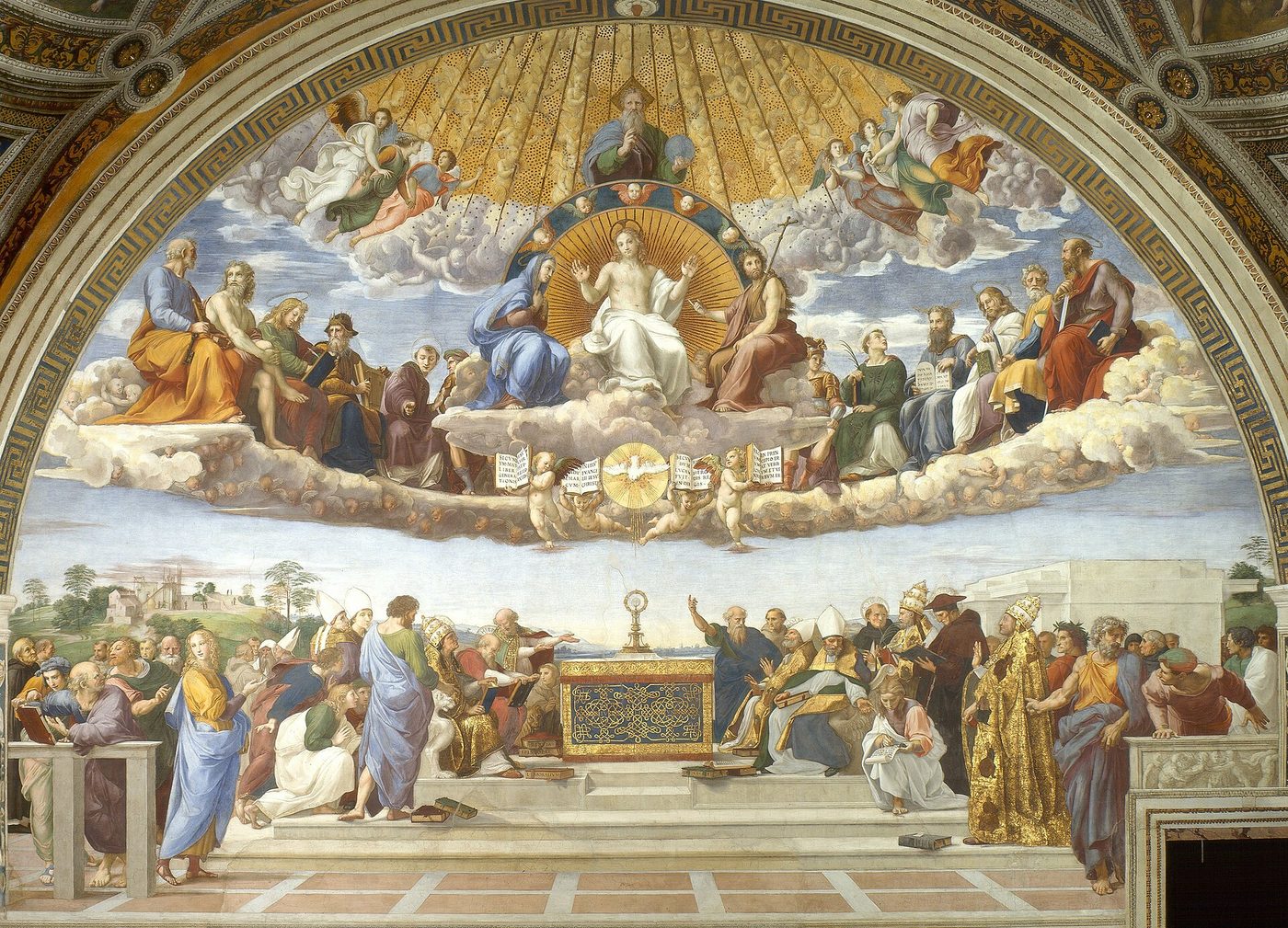
In the Stanza della Segnatura, a room in the Vatican Palace that Raphael painted between 1509 and 1511, two great frescoes face each other across the floor. On one wall is the scene usually called the Disputation of the Holy Sacrament: saints, popes and theologians gathered around an altar, with heaven opened above them. On the opposite wall is The School of Athens, the philosophers of Greece in a vaulted hall, with Plato pointing up and Aristotle holding his hand out flat toward the ground. In 1968 Francis Schaeffer used that room to explain the whole of modern thought. Raphael, he wrote, set a mural of the church on one wall "and this he balances with The School of Athens, representing classical pagan thought, on the opposite wall."1 Two walls. Two sources of truth. And the question that would, he believed, eventually tear the West apart: how do you hold them together?
This lesson is about the ideas under Schaeffer's books and films, the tools he used to read paintings and novels and laws. They came mostly from two books of 1968, Escape from Reason and The God Who Is There, and from a short book of 1973, Art and the Bible.2 Lesson 3 showed what he built with them. Lesson 6 shows the older inheritance he was drawing on (see Roots of Western Culture).
Nature and grace
Schaeffer began with Thomas Aquinas, the great thirteenth-century theologian. Aquinas, he wrote, "opened the way for the discussion of what is usually called 'nature and grace.'"3 Grace, the higher level, held God the Creator, heaven and heavenly things, the unseen, the human soul and unity. Nature, the lower, held the created world, earth and earthly things, the visible, the human body and diversity.3
He did not think the new attention to nature was bad in itself. He said the opposite. "From a biblical viewpoint nature is important because it has been created by God and is not to be despised." The body, beauty and even sexual things, he wrote, are good gifts, and "the man who regards them with contempt is really despising God's creation."3 The trouble, as he saw it, was a theological mistake underneath. In his reading of Aquinas, "the will of man was fallen, but the intellect was not." From that incomplete view of the Fall, he argued, "Man's intellect became autonomous." Natural theology and philosophy could go on without Scripture, and philosophy "began to take wings, as it were, and fly off wherever it wished."3
Nature eats up grace
Schaeffer then walked his readers through a gallery. A miniature in the Grandes Heures de Rohan, painted about 1415, shows the holy family fleeing into Egypt, huge and set against gold, while a farmer and soldiers below are tiny. "Hence there is a total pictorial representation of nature and grace," he wrote. Grace was everything. Nature hardly counted.4
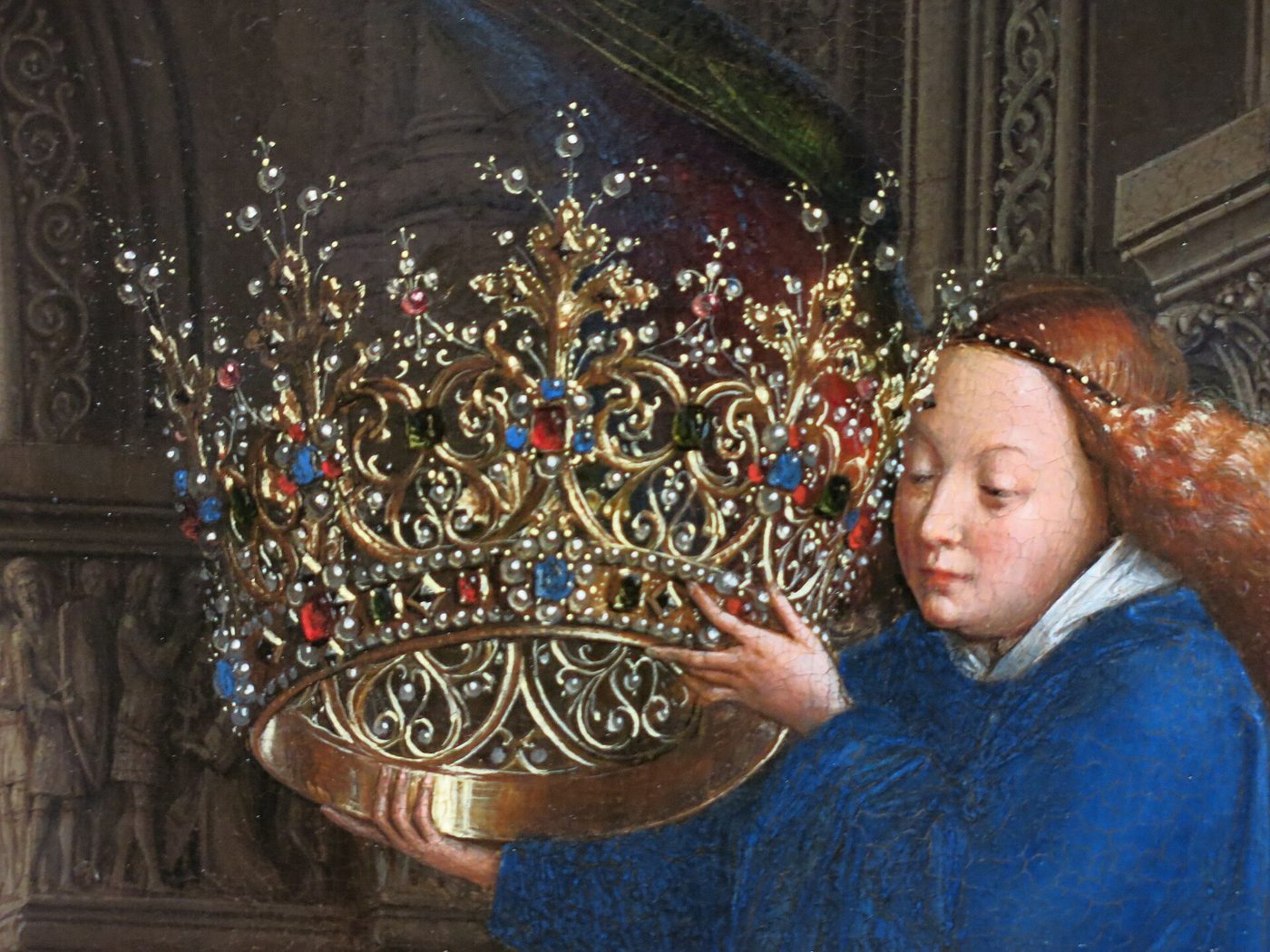
Then came Jan van Eyck. In his Madonna of Chancellor Rolin of about 1435, now in the Louvre, the chancellor kneels facing Mary at the same size she is. "Though he holds his hands in an attitude of prayer, he has become equal with Mary," Schaeffer wrote.4 A generation later Filippo Lippi painted a Madonna who was plainly a pretty Florentine girl, and in France Jean Fouquet painted the king's mistress as the Virgin. "Nature was killing grace," Schaeffer concluded.4 Then he stated the principle he would apply to everything that followed:
"The point to be stressed is that, when nature is made autonomous, it is destructive. As soon as one allows an autonomous realm one finds that the lower element begins to eat up the higher. In what follows I shall be speaking of these two elements as the 'lower story' and the 'upper story.'"
Francis A. Schaeffer, Escape from Reason (1968), chapter 1, "Nature versus Grace." 4
The upper story and the lower story
The two-story picture is Schaeffer's most useful single idea, and the easiest to misstate. It works like a house. Downstairs is everything reason and science can handle: facts, causes, particulars, the measurable. Upstairs is everything people need to live: meaning, value, love, God, freedom. In a healthy view of the world, he believed, there is a staircase between the floors. What we know by reason and what we know by revelation fit together.
The Renaissance, he argued, tried to keep both floors with human reason alone and could not. In fifteenth-century Florence the humanists revived Plato "in an attempt to re-instate ideas and ideals," and Leonardo da Vinci tried to paint "the soul," not the Christian soul but "the universal," and never succeeded.5 Over the next centuries the labels on the two floors changed. First they were grace and nature. After Kant and Rousseau they became freedom and nature, the human longing to be free set against a universe that looked more and more like a machine. After Kierkegaard they became faith and rationality.6 And the staircase was gone.
The leap
When the staircase disappears, people do not stop needing what is upstairs. They jump for it. Schaeffer called that jump "the leap," and he associated it first with the Danish writer Søren Kierkegaard, who, he said, "put away the hope of a unified field of knowledge."6 After Kierkegaard, meaning had to be reached by a leap of faith with no reasons, or by experience, or by art. That last one mattered most for Schaeffer's view of culture.
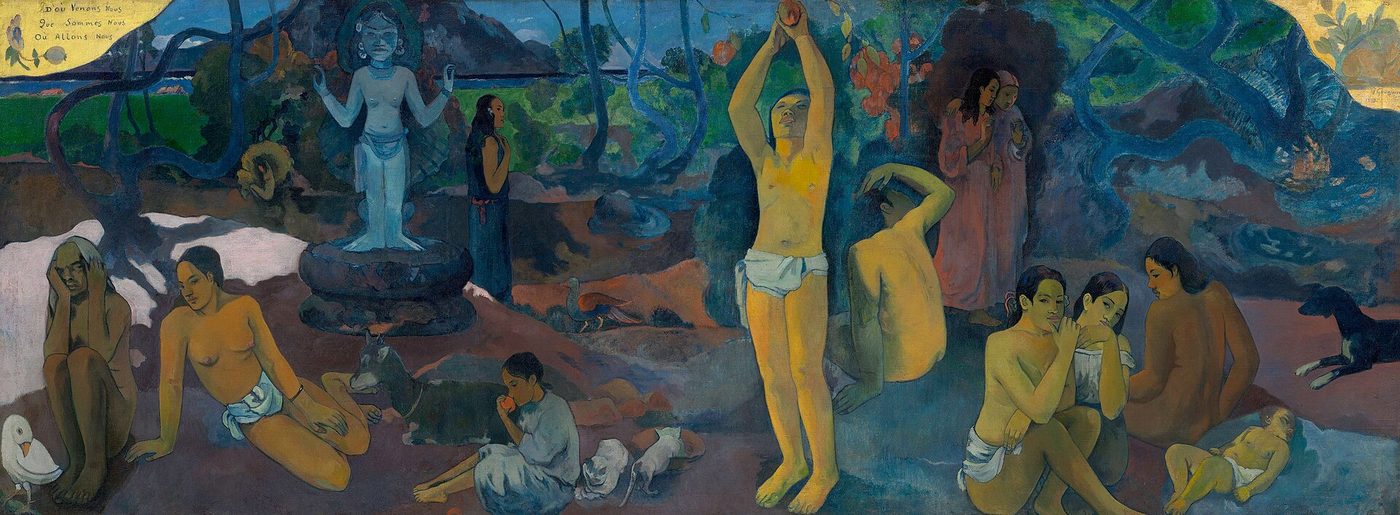
He devoted a chapter to "Art as the Upper Story Leap." He discussed the later Heidegger, who in old age told his readers to look to the poet, and Schaeffer read the advice this way: the content of the poems did not matter, only the fact that poetry exists.7 He discussed André Malraux, the French novelist who became minister of culture, whose whole life's work Schaeffer called "a gigantic expression of this chasm and leap."7 He quoted the English critic Herbert Read on Gauguin: "Gauguin substituted his love for beauty (as a painter) for man's love for his Creator."7 And he saw Leonard Bernstein's Kaddish symphony as making music "the hope upstairs."7
True truth
Against all this Schaeffer set what he took to be the Reformation's answer. The reformers, he argued, did not have "the Renaissance problem of nature and grace" at all. They had a real unity of knowledge, "not because they were clever, but because they had a unity on the basis of what God had revealed in both areas."8 God had spoken truly about himself, and truly about the cosmos and man. That is where his most famous phrase comes from:
"The biblical presentation is that, though we do not have exhaustive truth, we have from the Bible what I term 'true truth.' In this way we know true truth about God, true truth about man and something truly about nature. Thus on the basis of the Scriptures, while we do not have exhaustive knowledge, we have true and unified knowledge."
Francis A. Schaeffer, Escape from Reason (1968), chapter 2, "A Unity of Nature and Grace." 8
The doubled word sounds odd until you hear the alternative. By the 1960s many people, including many theologians, would say a religious statement was "true for me" or "true in a religious sense," meaning it had nothing to do with what actually happened. Schaeffer's "true truth" was a refusal of that move. It meant: true for God and for everyone, true in history and in fact, though we do not know everything. Udo Middelmann, president of the Francis A. Schaeffer Foundation and Schaeffer's son-in-law, later described the phrase as a statement of the authority and sufficiency of Scripture.9
For Schaeffer truth gave art room to work. He wrote that under the Reformation view there "was now possible true freedom within the revealed form. But, though art and science have freedom, they are not autonomous."8 The artist is free to paint anything in the world God made. What he is not is a little god making meaning out of nothing.
Art as the voice of a worldview
Put those pieces together and you have Schaeffer's method as a critic. Every serious work of art, he believed, says something about what its maker thinks is real. Not always in its subject. Often in its form. A Byzantine image that shows Mary as a symbol and not a woman says something about heaven and earth. A Van Eyck donor at Mary's scale says something else. A Cubist face broken into planes says something else again. Schaeffer taught a generation of evangelicals to look at a painting or a film and ask what view of the world it carried, and to take the answer seriously even when they disagreed with it.
That made him unusual. Many Christians of his time treated modern art as either a joke or a sin. Schaeffer treated it as testimony. He believed the painters, playwrights and composers of the twentieth century often showed the consequences of modern philosophy more plainly than the philosophers did, and that Christians who wanted to understand their neighbors should start by looking at what those neighbors made and loved. That is the culture-first idea of Lesson 1 turned into a habit of attention.
Art and the Bible, 1973
Schaeffer did not only criticize art. In two short essays published together in 1973 as Art and the Bible, he told Christians to make it.10 The first essay looks at how Scripture itself uses the arts. The second sets out a Christian perspective on art and how to judge it.10
The publisher's description of the current edition puts the book's purpose plainly. Many Christians, wary of graven images, had avoided artistic creativity, but the Bible affirms the arts.10 Three of Schaeffer's sentences from it have been quoted ever since:
"The lordship of Christ should include an interest in the arts."
"A Christian should use these arts to the glory of God, not just as tracts, mind you."
"The Christian is the one whose imagination should fly beyond the stars."
Francis A. Schaeffer, Art and the Bible (1973), as quoted by InterVarsity Press. 10
"Not just as tracts" is the phrase working musicians and painters remember. Schaeffer had no use for art that was only a sermon with pictures. The implication is plain enough: a Christian who paints a mountain or a bowl of pears well is doing Christian work, because the world is God's. His reason was theological. "Art is a reflection of God's creativity," he wrote, "an evidence that we are made in the image of God."11 And the bar was high. Work made to the glory of God ought to be good enough to stand next to anyone's.
Hans Rookmaaker and Modern Art and the Death of a Culture
Schaeffer's thinking about art was shaped heavily by his friend Hendrik Roelof Rookmaaker, always called Hans. Rookmaaker was born in The Hague on February 27, 1922. In the Second World War, as a Dutch naval officer, he was held as a prisoner of war, first at Stanislau and then at Neubrandenburg in Germany, and he came home a Christian. His prewar fiancee, Riki Spetter, who was Jewish, was murdered at Auschwitz on September 30, 1942.12
He met Schaeffer in 1948, through Anky Huitker, who became his wife. He earned a doctorate in art history at the University of Amsterdam with a dissertation on Gauguin, and in the mid-1960s he was invited to found the department of art history at the Free University in Amsterdam, the school Abraham Kuyper had founded (see Lesson 7).12 In 1971 he and Anky opened a Dutch branch of L'Abri.12 He served as consultant on the history of art for How Should We Then Live?13 He died suddenly on March 13, 1977, at 55.12
Rookmaaker brought Schaeffer two things: a professional art historian's eye, and the Dutch Reformational philosophy of Herman Dooyeweerd, which taught that every area of life, art included, stands under God's law and none is autonomous.12 His best-known book, Modern Art and the Death of a Culture, appeared in 1970. Crossway's 1994 reissue describes it as an examination of modern art "in a broad historical, social, and philosophical context," laying bare "the despair and nihilism that pervade our era," and showing the role Christian artists can play.14 His most quoted line is not about art at all: "Jesus didn't come to make us Christian. Jesus came to make us fully human."12
Schaeffer and Rookmaaker shared a conviction that runs through this module: a people's art is upstream of its laws. Both men also believed that the answer to bad art is better art made by people who know what is true, not censorship and not withdrawal.
What scholars have said against them
Both men drew strong criticism, some of it from people who admired them.
Aquinas
The sharpest dispute is over Aquinas. Catholic scholars have answered that Aquinas did not teach an unfallen intellect, and that he held reason was wounded by the Fall too. The Wikipedia summary of the debate notes the Catholic scholar Taylor Marshall's objection and the evangelical writer Tim LaHaye's later repetition of Schaeffer's claim.13 J. P. Moreland, in his foreword to the 2006 edition of Escape from Reason itself, agreed that critics "argue, sometimes correctly, that Schaeffer paints with too broad a brush and, as a result, somewhat misrepresents certain thinkers," and added: "I, for one, do not think his treatment of Thomas Aquinas is entirely fair or accurate."15 Moreland also reported a second complaint, that the book was "too simplistic": "how can one cover Kant and Rousseau in three and a half pages?"15
Hegel and the self-taught generalist
David Sessions argued in 2014 that Schaeffer misread Hegel almost completely, and that Hegel was trying to do something close to what Schaeffer himself wanted, to reconcile reason and reality.16 In the discussion that followed, one participant, Mark Edwards, framed the problem as that of a "generalist" facing "specialists," and Sessions conceded that the basis of Schaeffer's idea of antithesis "remains ambiguous."16
Rookmaaker and modern art
Rookmaaker's reading of modern art as a sign of death has drawn its own critics. A 2025 dissertation at Southern Baptist Theological Seminary by Scarlett Clay surveys five scholars who criticized him between 1971 and 2024: Nicholas Wolterstorff, James Romaine, Jeremy Begbie, William Dyrness and Jonathan Anderson. They found his work "lacking in various areas, including his aesthetic theory, his theology," and his reading of modern art. In their 2016 book Modern Art and the Life of a Culture, Anderson and Dyrness answered his title directly. In Clay's summary, "Rookmaaker sees death in much of modernism and a broad reflection of cultural decay," while "Anderson and Dyrness see the flourishing of religious impulses."17 Clay herself defends Rookmaaker.
What holds up
Take the criticisms at full strength and something durable is left. Schaeffer's history of ideas is too tidy. His Aquinas is a Protestant caricature. His Hegel is wrong. But his central claim, that art, thought and law grow out of what a people believes about God, man and truth, does not stand or fall with any one of those readings. Nor does his practical counsel. Look carefully at what your neighbors make and love. Take their questions as real. Make better things than the culture you criticize. That counsel shaped Christian painters, novelists, filmmakers and musicians for two generations, and Moreland's foreword says plainly that most Christian thinkers of his age called Schaeffer their intellectual father.15
Learn more
- Art and the Bible (IVP Classics): Schaeffer's 96-page call to Christians in the arts; read it in an evening.
- Escape from Reason on Wikipedia: publication history, reviews from 1969, and how it fits the trilogy.
- Hans Rookmaaker on Wikipedia: his war years, his work at the Free University and his friendship with Schaeffer.
- Modern Art and the Death of a Culture: the publisher's page for Rookmaaker's 1970 classic.
- Scarlett Clay on Rookmaaker: a 2025 dissertation summary that maps his critics and answers them.
- David Sessions on Schaeffer and Hegel: the case that Schaeffer misread the philosopher he blamed most.
- Lesson 6: Roots of Western Culture: The School of Athens and the older inheritance Schaeffer was arguing about.
Notes
- Francis A. Schaeffer, Escape from Reason, IVP Classics ed. (Downers Grove, IL: InterVarsity Press, 2006; first published London: Inter-Varsity Fellowship, 1968), chapter 1, "Leonardo da Vinci and Raphael." About the book. ↩
- "Escape from Reason," Wikipedia, on publication in 1968 and the trilogy; Internet Archive catalog record for Art and the Bible: Two Essays (1973). Read it online. ↩
- Schaeffer, Escape from Reason (2006), chapter 1, "Nature and Grace" and "Aquinas and the Autonomous." About the book. ↩
- Schaeffer, Escape from Reason (2006), chapter 1, "Nature versus Grace," on the Grandes Heures de Rohan, Van Eyck, Masaccio, Lippi and Fouquet. About the book. ↩
- Schaeffer, Escape from Reason (2006), chapter 1, "Leonardo da Vinci and Raphael." About the book. ↩
- Schaeffer, Escape from Reason (2006), chapter 3, "Kant and Rousseau," "Hegel" and "Kierkegaard and the Line of Despair," with the diagrams grace/nature, freedom/nature and faith/rationality. About the book. ↩
- Schaeffer, Escape from Reason (2006), chapter 5, "Art as the Upper Story Leap," sections on Heidegger, Malraux, Herbert Read's The Philosophy of Modern Art, and Bernstein. About the book. ↩
- Schaeffer, Escape from Reason (2006), chapter 2, "A Unity of Nature and Grace" and "The Reformation and Man." About the book. ↩
- Jeff Robinson, "Seminary journal celebrates life and legacy of Francis Schaeffer," Baptist Press, September 24, 2002, on "true truth" and Udo Middelmann. Read it online. ↩
- Francis A. Schaeffer, Art and the Bible, IVP Classics ed., foreword by Michael Card (Downers Grove, IL: InterVarsity Press, 2006), 96 pages, publisher's description and quotations. Read it online. ↩
- Francis A. Schaeffer, Art and the Bible, as quoted in "What Can Michelangelo Teach Us about Using Art to Serve God?," Christianity.com. Read it online. ↩
- "Hans Rookmaaker," Wikipedia: born February 27, 1922, The Hague; prisoner of war at Stanislau and Neubrandenburg; Riki Spetter; met Schaeffer in 1948; dissertation on Gauguin; Free University; Dutch L'Abri, 1971; died March 13, 1977; influence of Dooyeweerd; "fully human" saying. Read it online. ↩
- "How Should We Then Live?," Wikipedia, on Rookmaaker as consultant and the Catholic criticism of Schaeffer's reading of Aquinas. Read it online. ↩
- H. R. Rookmaaker, Modern Art and the Death of a Culture (Wheaton, IL: Crossway, 1994 reissue), 256 pages, publisher's description. Read it online. ↩
- J. P. Moreland, foreword to Schaeffer, Escape from Reason, IVP Classics ed. (2006), 9 to 10. About the book. ↩
- David Sessions, "Plotting Hegel on Francis Schaeffer's Line of Despair," Society for U.S. Intellectual History blog, November 21, 2014, and comments. Read it online. ↩
- Scarlett Clay, "Under an Open Sky: Hans Rookmaaker's Reformed Approach to Art and Culture," dissertation summary (Southern Baptist Theological Seminary, 2025), ArtWay; discussing Jonathan A. Anderson and William A. Dyrness, Modern Art and the Life of a Culture (Downers Grove, IL: IVP Academic, 2016). Read it online. ↩
Terms in this lesson
- Nature and grace
- The medieval pairing of the created, visible world (nature) with God, heaven and the soul (grace). Schaeffer argued that once nature was treated as independent of God, it slowly 'ate up' grace.
- Upper story and lower story
- Schaeffer's picture of modern thought as a two-story house: a lower story of facts, reason and science with no meaning, and an upper story of meaning, faith or feeling with no connection to reason.
- Autonomous
- Self-ruling, a law to itself. Schaeffer used it for any area of life or thought treated as independent of God.
- The leap
- His name for the step modern people take when they give up rational hope of meaning but still reach for it in an 'upper story' by faith, art, drugs or mysticism without reasons.
- True truth
- Schaeffer's phrase for truth that is really so for God and for us, though not exhaustive, as opposed to truth that is only true for a person or a culture.
- Neo-Platonism
- A revival of Plato's philosophy in fifteenth-century Florence, which Schaeffer said humanists used to try to put universals back into an 'upper story.'
- Reformational philosophy
- The Dutch Calvinist school of Herman Dooyeweerd and others, which held that every area of life stands under God's law. Rookmaaker brought it to Schaeffer.
Sources
- Francis A. Schaeffer, Escape from Reason (London: Inter-Varsity Fellowship, 1968; IVP Classics, 2006) checked 2026-10
- Francis A. Schaeffer, Art and the Bible (IVP Classics, 2006), publisher's page checked 2026-10
- Hans Rookmaaker (Wikipedia) checked 2026-10
- H. R. Rookmaaker, Modern Art and the Death of a Culture (Crossway reissue, 1994), publisher's page checked 2026-10
- Scarlett Clay, Under an Open Sky: Hans Rookmaaker's Reformed Approach to Art and Culture (dissertation summary, ArtWay, 2025) checked 2026-10
- David Sessions, Plotting Hegel on Francis Schaeffer's Line of Despair (Society for U.S. Intellectual History, 2014) checked 2026-10
- Baptist Press, Seminary journal celebrates life and legacy of Francis Schaeffer, 2002 checked 2026-10
- How Should We Then Live? (Wikipedia), section on criticism checked 2026-10