U.S. CONSTITUTION · Module 8
Module 8: The Second Amendment
Twenty-seven words, two clauses, and two centuries of argument over what they protect. The English and colonial roots, the 1789 drafting, the Third Amendment's quartering rule, the cases from Cruikshank to Wolford, and Idaho's own arms guarantee.
The Text
The Second Amendment, as transcribed by the National Archives, is one sentence:1
"A well regulated Militia, being necessary to the security of a free State, the right of the people to keep and bear Arms, shall not be infringed."
U.S. Const. amend. II (ratified December 15, 1791)
When Congress sent it to the states on September 25, 1789, it was "Article the fourth" of twelve. The first two failed in 1791, so the fourth became the Second.2
The opening phrase gives a reason. The rest gives a command. Justice Antonin Scalia's opinion in District of Columbia v. Heller (2008) called them the "prefatory clause" and the "operative clause," and most of the fighting since has been over how the two fit.3 Look at what the text does not do. It grants nothing. It says a right "shall not be infringed," which assumes the right is already there. And look at the verbs: "keep" means have, "bear" means carry.
The militia itself lives in Article I, Section 8:4
"To raise and support Armies, but no Appropriation of Money to that Use shall be for a longer Term than two Years;"
"To provide for calling forth the Militia to execute the Laws of the Union, suppress Insurrections and repel Invasions;"
"To provide for organizing, arming, and disciplining, the Militia, and for governing such Part of them as may be employed in the Service of the United States, reserving to the States respectively, the Appointment of the Officers, and the Authority of training the Militia according to the discipline prescribed by Congress;"
U.S. Const. art. I, sec. 8, cl. 12, 15 and 16
Congress got an army, funded two years at a time, and real power over the state militias. The states kept the officers and the training. The amendment came two years later from people who thought that balance still tilted toward the national government.
The next amendment is about soldiers too:1
"No Soldier shall, in time of peace be quartered in any house, without the consent of the Owner, nor in time of war, but in a manner to be prescribed by law."
U.S. Const. amend. III (ratified December 15, 1791)
In peacetime, no soldier lodges in your house unless you agree. In wartime, only under rules set by law.
One more clause matters for everything after 1868. The Fourteenth Amendment provides: "No State shall make or enforce any law which shall abridge the privileges or immunities of citizens of the United States; nor shall any State deprive any person of life, liberty, or property, without due process of law."5 That is the door through which the Supreme Court, in 2010, applied the Second Amendment to states and counties. Module 10 covers it.
How We Got Here
England, 1689
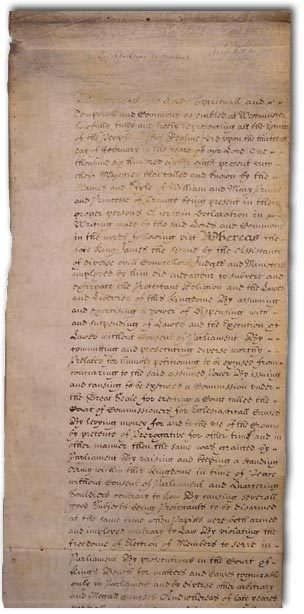
On February 13, 1689 (1688 on the old-style calendar the document uses), the Lords and Commons presented a declaration of rights to William and Mary. Its grievances against James II included "causing several good subjects being Protestants to be disarmed at the same time when papists were both armed and employed contrary to law." Its answer:6
"That the subjects which are Protestants may have arms for their defence suitable to their conditions and as allowed by law;"
English Bill of Rights (1689)
Narrow. Protestants only, scaled to station, subject to Parliament. The same list declared a peacetime standing army without Parliament's consent "against law." Arms and armies arrived together, and the pairing crossed the Atlantic. The Heller majority called the English provision "the predecessor to our Second Amendment."7
Colonies and Revolution
Colonial defense rested on local militias, and standing armies drew suspicion.8 The Declaration of Independence charged George III with keeping "Standing Armies without the Consent of our legislatures" and with "Quartering large bodies of armed troops among us."9 Pennsylvania's 1776 Declaration of Rights protected a right "to bear arms for the defence of themselves and the state." Massachusetts in 1780 said "for the common defence."10 Two states, two formulas, four years apart.
Ratification, 1788
Hamilton defended federal militia power in The Federalist No. 29 (January 10, 1788): "If a well-regulated militia be the most natural defense of a free country, it ought certainly to be under the regulation and at the disposal of that body which is constituted the guardian of the national security."11 Madison answered fears of a federal army in No. 46 by pointing to "the advantage of being armed, which the Americans possess over the people of almost every other nation."12
The conventions wanted it in writing. New Hampshire, the ninth state, on June 21, 1788: "Congress shall never disarm any Citizen unless such as are or have been in Actual Rebellion."13 Virginia, June 27: "That the people have a right to keep and bear arms; that a well regulated Militia composed of the body of the people trained to arms is the proper, natural and safe defence of a free State," with standing armies called "dangerous to liberty."14 New York, July 26, used nearly the same words.15
The First Congress, 1789
Madison's draft put the right first: "The right of the people to keep and bear arms shall not be infringed; a well armed and well regulated militia being the best security of a free country: but no person religiously scrupulous of bearing arms shall be compelled to render military service in person."16
The House committee (July 28, 1789) moved the militia clause to the front. Debate centered on the objector clause; Elbridge Gerry warned it would let "the people in power" "declare who are those religiously scrupulous, and prevent them from bearing arms." The House passed its version August 24. The Senate struck the objector clause and the phrase "composed of the body of the People," changed "the best security" to "necessary to the security," and rejected adding "for the common defence" after "bear arms." No record of Senate debate survives.17
Liberty Perspective: The Militia Clause Describes a System the Country Left Behind
The founders offered an armed citizenry and a citizen militia as the alternative to a peacetime army. Hamilton said a sound militia would remove "the inducement and the pretext" for one.18 The United States has kept a professional army in peacetime for generations, and nobody looks to a county militia for national defense. Whatever the prefatory clause does in court, the structure it describes is gone. Any honest reading of the amendment has to account for that, whichever way it cuts.
The Third Amendment, Briefly
The Petition of Right of 1628 complained that inhabitants "against their wills have been compelled to receive" soldiers "into their houses." Parliament's Quartering Act of 1765 barred quartering in colonists' private homes but made the colonies pay for barracks or lodge troops in inns and ale-houses. Another Quartering Act came in 1774, one of the Coercive Acts.19 Virginia's convention proposed that "no Soldier in time of peace ought to be quartered in any house without the consent of the owner," and the final text follows it closely.14
Then, almost nothing. "The Supreme Court has never decided a case directly implicating the Third Amendment," the Constitution Annotated reports. Its main modern role is as one of the "zones of privacy" cited in Griswold v. Connecticut (1965).20
Common Misconception: The 1774 Quartering Act Put British Soldiers in Colonists' Homes
School history says so. The record is murkier. Whether the 1774 Act allowed quartering in private homes is, per the Constitution Annotated, "the subject of some debate," and it quotes one historian who says "The act did not, as has often been asserted, provide for billeting soldiers in private" houses.19 What is not in doubt: the colonists hated quartering, the Declaration listed it, and Virginia, New Hampshire and New York all asked for a ban.
The Long Gap: 1876 to 2008
"For most of its history, the Second Amendment was not substantively addressed by the Supreme Court," says the Constitution Annotated.21 Three cases carried the load.
United States v. Cruikshank (1876)
Federal prosecutors charged men in Louisiana under the Enforcement Act with conspiring to hinder citizens "of African descent" in their rights, including "bearing arms for a lawful purpose."22 Justice Samuel Alito's McDonald opinion identified the convictions as "stemming from the infamous Colfax Massacre in Louisiana on Easter Sunday 1873."23 Chief Justice Morrison Waite threw out the count. That right "is not a right granted by the Constitution. Neither is it in any manner dependent upon that instrument for its existence." The amendment "means no more than that it shall not be infringed by Congress."22 The first idea, a right older than the Constitution, Heller later adopted when it said the amendment "codified a pre-existing right."24 The second left victims to look to their state for protection.
Liberty Perspective: A Right Recognized and Left Unprotected
Justice Alito's McDonald opinion records that after the Civil War "armed parties, often consisting of ex-Confederate soldiers serving in the state militias, forcibly took firearms from newly freed slaves," and that Congress concluded "a constitutional amendment was necessary to provide full protection for the rights of blacks."25 Eight years after that amendment, Cruikshank read the arms right as a limit on Congress alone. Justice Clarence Thomas wrote that the decision overturned "the convictions of militia members responsible for the brutal Colfax Massacre."26 The Court has never formally overruled it. In McDonald it used the Due Process Clause instead and declined to revisit the narrow 1873 reading of the Privileges or Immunities Clause: "We see no need to reconsider that interpretation here." Justice Thomas thinks that is the wrong door.
Presser v. Illinois (1886)
In December 1879 Herman Presser led about four hundred armed men of the Lehr und Wehr Verein through Chicago, without the Governor's license the Illinois Military Code required.27 Justice William Woods held that barring unauthorized armed bodies from drilling or parading did not "infringe the right of the people to keep and bear arms," and that in any case the amendment "is a limitation only upon the power of Congress and the National government, and not upon that of the States."27 But Presser also said states "cannot" disarm the people "so as to deprive the United States of their rightful resource for maintaining the public security."28
United States v. Miller (1939)
Jack Miller and Frank Layton were indicted for carrying an unregistered double-barrel shotgun with a barrel under 18 inches from Claremore, Oklahoma, to Siloam Springs, Arkansas, in violation of the National Firearms Act of 1934. The district court held the Act unconstitutional.29 Justice James McReynolds reversed:
"In the absence of any evidence tending to show that possession or use of a 'shotgun having a barrel of less than eighteen inches in length' at this time has some reasonable relationship to the preservation or efficiency of a well regulated militia, we cannot say that the Second Amendment guarantees the right to keep and bear such an instrument."
United States v. Miller, 307 U.S. 174 (1939)
The militia, he added, "comprised all males physically capable of acting in concert for the common defense."30 The report reads "No appearance for appellees."29 Then sixty-nine years of near silence. Justice John Paul Stevens later wrote that "hundreds of judges have relied on the view of the Amendment we endorsed there." Justice Scalia answered that those judges "overread Miller," which he called "an uncontested and virtually unreasoned case."31
Liberty Perspective: Sixty-Nine Years Built on a One-Sided Case
Neither side in Heller disputed the facts. In Miller, as Justice Scalia put it, "the Court heard from no one but the Government." Justice Stevens argued that decades of reliance gave the case weight anyway. Our courts test a claim by hearing both sides. For most of the twentieth century, lower courts read an entire Bill of Rights guarantee mainly through a decision where one side never showed up. Whatever you think the amendment means, that was a thin foundation.31
Heller and McDonald: An Individual Right, Applied to the States
District of Columbia v. Heller (2008)
Dick Heller, a D.C. special police officer who carried a handgun on duty, was refused registration for a handgun to keep at home. District law also required lawful firearms at home to be "unloaded and disassembled or bound by a trigger lock or similar device."32
Justice Scalia wrote for five Justices: Chief Justice John Roberts and Justices Anthony Kennedy, Clarence Thomas and Samuel Alito joined him.33 "The people," he wrote, means "all members of the political community, not an unspecified subset," and the text guarantees "the individual right to possess and carry weapons in case of confrontation." The prefatory clause "announces a purpose" but "does not limit the latter grammatically."34 The home handgun ban and the disabled-gun rule fell.35
The majority also set limits. "Like most rights, the right secured by the Second Amendment is not unlimited." Nothing in the opinion should "cast doubt on longstanding prohibitions on the possession of firearms by felons and the mentally ill, or laws forbidding the carrying of firearms in sensitive places such as schools and government buildings, or laws imposing conditions and qualifications on the commercial sale of arms," which it called "presumptively lawful." It kept the tradition against "dangerous and unusual weapons."36
Justice Stevens, joined by Justices David Souter, Ruth Bader Ginsburg and Stephen Breyer, read the amendment as adopted "to protect the right of the people of each of the several States to maintain a well-regulated militia." Justice Breyer, joined by the same three, argued that even if self-defense counted, the law was "a permissible legislative response to a serious, indeed life-threatening, problem," and proposed weighing burdens against benefits. The majority rejected that as a "judge-empowering 'interest-balancing inquiry.'"37
Common Misconception: Heller Was "Individual Right" Against "Collective Right"
Justice Stevens's dissent opens by rejecting that frame: "The question presented by this case is not whether the Second Amendment protects a 'collective right' or an 'individual right.' Surely it protects a right that can be enforced by individuals." The split was over purpose and reach: private self-defense, or militia service only.37
McDonald v. City of Chicago (2010)
Chicago and Oak Park had handgun bans like the District's and argued "the Second Amendment has no application to the States." Otis McDonald, in his late seventies, lived in a high-crime neighborhood and wanted a handgun at home.38 Five Justices disagreed with the cities. Justice Alito: "We therefore hold that the Due Process Clause of the Fourteenth Amendment incorporates the Second Amendment right recognized in Heller." Cruikshank and Presser, the opinion said, "do not preclude us," because they came before the Court's selective incorporation cases.39 The plurality added that "incorporation does not imperil every law regulating firearms."40
Justice Thomas supplied the fifth vote by another road: the right is "a privilege of American citizenship that applies to the States through the Fourteenth Amendment's Privileges or Immunities Clause."41 Justice Stevens dissented. So did Justice Breyer, joined by Justices Ginsburg and Sonia Sotomayor, finding nothing that "could warrant characterizing it as 'fundamental' insofar as it seeks to protect the keeping and bearing of arms for private self-defense purposes."42
This is the case that made the federal amendment a county matter.
Bruen, Rahimi and the History Test
New York State Rifle & Pistol Assn. v. Bruen (2022)
New York issued unrestricted carry licenses only on a showing of "proper cause," meaning "a special need for self-protection distinguishable from that of the general community." Brandon Koch and Robert Nash were turned down.43 The lower courts had used a two-step test that ended in means-end scrutiny. Justice Thomas, for six Justices, called it "one step too many"44 and set out this standard:
"When the Second Amendment's plain text covers an individual's conduct, the Constitution presumptively protects that conduct. The government must then justify its regulation by demonstrating that it is consistent with the Nation's historical tradition of firearm regulation."
New York State Rifle & Pistol Assn. v. Bruen, 597 U.S. 1 (2022)
Old and new laws must be "relevantly similar," judged by "how and why the regulations burden" armed self-defense, though a modern law need not be "a dead ringer."45 Public carry is not "a second-class right."46 A footnote said nothing in the opinion questions "the 43 States' 'shall-issue' licensing regimes."47
Justice Brett Kavanaugh, joined by the Chief Justice, stressed that States may still require carry licenses. Justice Alito: "That is all we decide." Justice Amy Coney Barrett noted the open question of whether 1791 or 1868 is the key year.48 Justice Breyer, with Justices Sotomayor and Elena Kagan, dissented: the Court "refuses to consider the government interests that justify a challenged gun regulation, regardless of how compelling those interests may be," and its own analysis showed "the practical problems with its history-only approach."49
United States v. Rahimi (2024)
In December 2019 Zackey Rahimi dragged his girlfriend, C. M., back to his car and fired a gun as she fled. A Tarrant County, Texas, court entered a restraining order, by consent, finding he posed "a credible threat" to her or their child's safety. Police later tied him to at least five more shootings. He was charged under 18 U.S.C. § 922(g)(8), and the Fifth Circuit held the statute unconstitutional.50
The Supreme Court reversed, 8 to 1. Chief Justice Roberts wrote that the Court's precedents "were not meant to suggest a law trapped in amber"; the question is consistency with "the principles that underpin our regulatory tradition." Founding-era surety laws and "going armed" laws supplied them. The holding: "An individual found by a court to pose a credible threat to the physical safety of another may be temporarily disarmed consistent with the Second Amendment."51 The Court rejected disarming people simply for not being "responsible," which it called "a vague term."52 Justice Thomas dissented: "Not a single historical regulation justifies the statute at issue."53
Caetano, Hemani and Wolford
In Caetano v. Massachusetts (2016), the Court vacated a ruling that upheld a stun gun ban because stun guns "were not in common use at the time of the Second Amendment's enactment." That reasoning, the per curiam said, was "inconsistent with Heller's clear statement" that the amendment reaches arms "not in existence at the time of the founding."54
Two decisions came down last June. In United States v. Hemani (June 18, 2026), the Court held that prosecuting Ali Hemani under § 922(g)(3) on his admitted marijuana use alone "is inconsistent with the Second Amendment." Justice Neil Gorsuch wrote for seven; Justices Alito and Kagan concurred in the judgment. The Court called the ruling "narrow" and left the felon ban and other questions alone.55 In Wolford v. Lopez (June 25, 2026), Justice Alito wrote for six Justices striking down a Hawaii law that barred permit holders from carrying onto private property open to the public without the owner's express consent. Justice Kagan dissented, seeing "a modern-day analogue of colonial and founding era laws," and Justice Ketanji Brown Jackson, joined by Justice Sotomayor, dissented separately.56 The owner still decides: the Court said owners "can admit or exclude persons who are carrying guns."57
Common Misconception: After Bruen, Almost Any Gun Law Is Unconstitutional
No. Heller's "presumptively lawful" list stands. Bruen left shall-issue licensing alone. Rahimi upheld a federal disarmament law 8 to 1. What changed in 2022 was method. The government must point to history, and a strong interest alone no longer saves a law.47
Idaho's Own Guarantee
Idaho protected the right in its own constitution long before the federal amendment reached the state. Article I, Section 11, as published by the Legislature:58
"Section 11. Right to keep and bear arms. The people have the right to keep and bear arms, which right shall not be abridged; but this provision shall not prevent the passage of laws to govern the carrying of weapons concealed on the person nor prevent passage of legislation providing minimum sentences for crimes committed while in possession of a firearm, nor prevent the passage of legislation providing penalties for the possession of firearms by a convicted felon, nor prevent the passage of any legislation punishing the use of a firearm. No law shall impose licensure, registration or special taxation on the ownership or possession of firearms or ammunition. Nor shall any law permit the confiscation of firearms, except those actually used in the commission of a felony."
Idaho Const. art. I, sec. 11
Voters adopted that text on November 7, 1978. The 1889 original read: "The people have the right to bear arms for their security and defense; but the legislature shall regulate the exercise of this right by law."59 No militia clause, then or now. The current version lists what the Legislature may regulate and flatly bars licensing, registration, special taxes and most confiscation, things the U.S. Supreme Court has never held the federal amendment forbids.
In re Brickey (1902)
L. D. Brickey was held in the Nez Perce County jail by Sheriff A. W. Kroutinger for carrying a loaded revolver inside Lewiston, in violation of an 1889 territorial ban on carrying deadly weapons in any city or town. The Idaho Supreme Court freed him on habeas corpus. Chief Justice Quarles: "The legislature may, as expressly provided in our state constitution, regulate the exercise of this right, but may not prohibit it."60 The court relied on the federal amendment as well as the state one, a century before McDonald, and said a concealed-carry ban would be a proper police measure.
The statutes
Idaho Code § 18-3302 begins with a finding that the people "reserved for themselves the right to keep and bear arms" and orders the chapter "strictly construed so as to give maximum scope to the rights retained by the people."61 Section 18-3302J declares the Legislature's "intent to wholly occupy the field of firearms regulation within this state."62 Section 18-3315B limits Idaho officials' enforcement of certain federal firearms rules.63
Landmark Cases
| Case | Citation and year | Holding | Effect and where the law moved |
|---|---|---|---|
| United States v. Cruikshank | 92 U.S. 542 (1876) | The amendment restricts only Congress. | Displaced by McDonald; never formally overruled. |
| Presser v. Illinois | 116 U.S. 252 (1886) | States may bar unlicensed private armed bodies from drilling or parading. | Its "only Congress" reading gave way in 2010. |
| United States v. Miller | 307 U.S. 174 (1939) | No showing that a short-barreled shotgun relates to militia efficiency. | Heller read it as limiting protected weapon types. |
| District of Columbia v. Heller | 554 U.S. 570 (2008) | 5 to 4: an individual right; home handgun ban struck. | Its "presumptively lawful" list recurs in later cases. |
| McDonald v. City of Chicago | 561 U.S. 742 (2010) | 5 to 4: the right binds states and localities. | Counties are bound. Thomas's alternative route has not drawn a majority. |
| Caetano v. Massachusetts | 577 U.S. 411 (2016) | Per curiam: arms are not excluded for postdating the founding. | Vacated and remanded; no final ruling on the ban. |
| N.Y. State Rifle & Pistol Assn. v. Bruen | 597 U.S. 1 (2022) | 6 to 3: "proper cause" licensing struck; text and history test. | Means-end scrutiny ended; shall-issue licensing left alone. |
| United States v. Rahimi | 602 U.S. 680 (2024) | 8 to 1: § 922(g)(8) valid as applied to a credible threat. | History means principles, not a "historical twin." |
| United States v. Hemani | 608 U.S. 772 (2026) | § 922(g)(3) prosecution on marijuana use alone fails. | Unanimous judgment; expressly narrow. |
| Wolford v. Lopez | 609 U.S. 185 (2026) | 6 to 3: Hawaii's no-carry default for private property open to the public struck. | Owners may still exclude guns. |
| In re Brickey (Idaho) | 8 Idaho 597, 70 P. 609 (1902) | Territorial ban on carry in towns violated both constitutions. | Regulate, not prohibit. The 1978 text added express bars. |
Where This Shows Up for Officials, Reporters and Citizens
Every Idaho officer swears under Idaho Code § 59-401 to "support the Constitution of the United States, and the Constitution of the State of Idaho." Both protect the right, in different words.64 The people below are invented. The statutes are real.
A sheriff and a license application
Sheriff Dana Whitlock gets a concealed weapons application from a man who calls dispatch every week to complain and was rude to her at the fair. Idaho Code § 18-3302(7) says the sheriff "must, within ninety (90) days after the filing of a license application by any person who is not disqualified as provided herein from possessing or receiving a firearm under state or federal law, issue a license." Subsection (11) lists the disqualifications, such as a felony conviction or unlawful drug use. Rudeness is not one. This is the shall-issue design Bruen left alone, with none of the discretion New York gave its officials.65
Common Misconception: In Idaho You Need a License to Carry Concealed
For most adults, no. Section 18-3302(4)(f) exempts a person over eighteen who is a citizen or current service member and not disqualified. Licenses still exist, and the sheriff must issue them to qualified applicants. Check the current text before relying on any summary: the section is amended often, and a new version takes effect January 1, 2027.66
A deputy serving a protection order
Deputy Ray Okafor serves a protection order that finds a credible threat. Federal law, 18 U.S.C. § 922(g)(8), bars the respondent from possessing firearms while it lasts, and Rahimi upheld that rule as applied to such an order. Read the order. The finding is what Rahimi relied on, and the Court said it decided "only this."51
A sheriff asked to help federal agents
Under Printz v. United States (1997), brought by Jay Printz, sheriff of Ravalli County, Montana, the federal government may not "command the States' officers, or those of their political subdivisions, to administer or enforce a federal regulatory program."67 Idaho Code § 18-3315B goes further. It bars Idaho entities from using "any personnel, funds, or other resources" to enforce federal firearms rules adopted after the act took effect "if contrary to" art. I, sec. 11, exempts "compliance with an order of the court," and calls an order to enforce such a rule "a breach of the oath of office."63 The statute leaves the constitutional judgment to the official. Neither it nor Printz lets anyone ignore a court order.
Commissioners and a fairgrounds ordinance
Commissioner Lee Haugen wants to ban guns at the county fairgrounds. Section 18-3302J(2) says no county may "adopt or enforce any law, rule, regulation, ordinance, executive order, or policy which regulates in any manner" possessing or carrying firearms, "Except as expressly authorized by state statute." Counties may regulate discharge, with exceptions. Willful violations cost $10,000 each, and good faith is no defense.62 Heller's "sensitive places" language describes what the Constitution allows. It gives a county no power the Legislature withheld.
A reporter covering a challenge
Ask what the courts ask. Does the law touch conduct the text covers? Which historical laws does the government cite, from what years, in how many places? How and why did they burden the right? Wolford gave an 1865 Louisiana law no weight: "Because this statute was neither widespread nor widely accepted, it carries no weight."56 And name the Justice when you describe an argument.
A citizen at public comment
One resident says the county can regulate nothing about guns. In Idaho that is mostly true, but because of § 18-3302J and art. I, sec. 11. The federal right "is not unlimited." Another says the amendment protects only the National Guard. The Supreme Court rejected that in 2008, and Idaho's constitution has no militia clause at all.36
Pictures, Numbers and Infographics
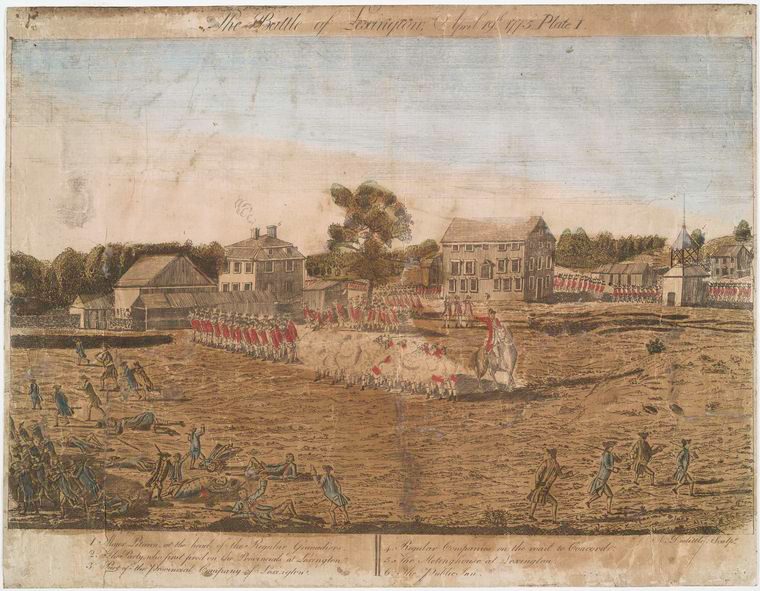
The Second Amendment is 27 words long. The pictures go back to its English and colonial roots, and the numbers measure gun ownership and federal background checks today.
By the numbers
- 27 words: the length of the Second Amendment, counted from the National Archives transcription, where it appears as "Article the fourth." National Archives, Bill of Rights transcription
- 32%: of U.S. adults said they personally own a gun in June 2023, and another 10% said someone else in their household does. Pew Research Center, 2024
- 72%: of gun owners named protection as a major reason they own a gun, up from 67% in a 2017 survey. Pew Research Center, 2024
- 39,695,315: firearm background checks run through the FBI's NICS in 2020, the highest year on record. In 2025 there were 26,123,215. FBI, NICS Firearm Checks: Month/Year, 2026
- 9,138,123: NICS checks in 1999, the system's first full year. FBI, 2026
- 546,677,990: NICS checks from November 30, 1998 through September 30, 2026. The FBI notes that checks are not a count of guns sold. FBI, 2026
Verify Independently
Every citation, quotation and case in this course should be verified independently against the official source (the U.S. Reports or the Court's own opinion, the National Archives transcription, the statute book) before you rely on it, quote it or act on it.
Check these in particular:
- United States v. Hemani, 608 U.S. 772 (2026) and Wolford, 609 U.S. 185 (2026), both decided in June 2026. These are recent; check the final official text, page numbers and holdings.
- In re Brickey, 8 Idaho 597 (1902).
Sources & Further Reading
Primary Sources: Text and History
- The Bill of Rights: A Transcription (National Archives)
- The Constitution of the United States: A Transcription (National Archives)
- The Constitution: Amendments 11-27 (National Archives)
- Declaration of Independence: A Transcription (National Archives)
- English Bill of Rights 1689 (Avalon Project, Yale Law School)
- The Federalist No. 29 and No. 46 (Avalon Project)
- Ratification documents with proposed amendments: New Hampshire, Virginia, New York (Avalon Project)
- Constitution Annotated (Congressional Research Service), as mirrored by Cornell LII: Historical Background on Second Amendment; Early Second Amendment Jurisprudence; Historical Background on Third Amendment; Overview of Third Amendment. The official edition is at constitution.congress.gov.
- National Constitution Center, Interactive Constitution: Amendment II and Amendment III
Supreme Court Opinions
- United States v. Cruikshank, 92 U.S. 542 (1876) (Cornell LII)
- Presser v. Illinois, 116 U.S. 252 (1886) (Cornell LII)
- United States v. Miller, 307 U.S. 174 (1939) (Cornell LII)
- District of Columbia v. Heller, 554 U.S. 570 (2008) (Cornell LII); Oyez
- McDonald v. City of Chicago, 561 U.S. 742 (2010) (Cornell LII); Oyez
- Caetano v. Massachusetts, 577 U.S. 411 (2016) (Cornell LII)
- New York State Rifle & Pistol Assn. v. Bruen, 597 U.S. 1 (2022) (supremecourt.gov); Oyez
- United States v. Rahimi, 602 U.S. 680 (2024) (supremecourt.gov); Oyez
- United States v. Hemani, 608 U.S. 772 (2026) (supremecourt.gov preliminary print)
- Wolford v. Lopez, 609 U.S. 185 (2026) (supremecourt.gov preliminary print)
- Printz v. United States, 521 U.S. 898 (1997) (Cornell LII)
Idaho
- Idaho Const. art. I, sec. 11 (Idaho Legislature)
- In re Brickey, 8 Idaho 597 (1902) (Harvard Caselaw Access Project)
- Idaho Code § 18-3302 (concealed weapons)
- Idaho Code § 18-3302J (preemption)
- Idaho Code § 18-3315B (federal firearms regulation)
- Idaho Code § 59-401 (official oath)
Related Lessons
- Course index: The United States Constitution
- Module 2: Article I, Congress (the militia and army powers)
- Module 5: Federalism and the States (Printz and anti-commandeering)
- Module 7: The First Amendment
- Module 9: The Fourth Through Eighth Amendments
- Module 10: The Civil War Amendments (the Fourteenth Amendment and incorporation)
- Module 12: Reading the Constitution (text, history and tradition as a method)
Knowledge Check
Test your understanding of the Second and Third Amendments. No scores are saved: this is for your own review.
1. Which state ratifying convention proposed in 1788 that "Congress shall never disarm any Citizen unless such as are or have been in Actual Rebellion"?
New Hampshire, the ninth state to ratify, sent that language as its Twelfth proposal on June 21, 1788. The language is New Hampshire's. Virginia and New York proposed a right to keep and bear arms paired with a militia "composed of" or "including" the body of the people.
2. Which of these does the current text of Idaho Const. art. I, sec. 11 forbid outright?
Since the 1978 amendment, the section says "No law shall impose licensure, registration or special taxation on the ownership or possession of firearms or ammunition." The section expressly allows concealed-carry laws, firearm sentencing enhancements and felon-possession penalties. What it forbids is licensure, registration or special taxation on ownership or possession, and confiscation except of firearms used in a felony.
3. What did McDonald v. City of Chicago (2010) hold?
Justice Alito's opinion held that "the Due Process Clause of the Fourteenth Amendment incorporates the Second Amendment right recognized in Heller." Since 2010 the right binds states, counties and cities. Only Justice Thomas relied on the Privileges or Immunities Clause. The Court did not formally overrule Cruikshank or Presser; it said they did not preclude a due process analysis.
4. Under New York State Rifle & Pistol Assn. v. Bruen (2022), once the Second Amendment's plain text covers someone's conduct, what must the government show?
Justice Thomas wrote that the government "must then justify its regulation by demonstrating that it is consistent with the Nation's historical tradition of firearm regulation." Bruen rejected means-end scrutiny as "one step too many," and a modern law need not be "a dead ringer" for an old one. Rahimi later said the history test does not require a "historical twin."
5. What did United States v. Rahimi (2024) decide?
Chief Justice Roberts wrote for eight Justices: "we conclude only this: An individual found by a court to pose a credible threat to the physical safety of another may be temporarily disarmed consistent with the Second Amendment." Justice Thomas dissented. Rahimi applied Bruen and reversed the Fifth Circuit. It also rejected the government's argument that people could be disarmed simply for not being "responsible," calling that "a vague term."
Reference Materials
Use your browser's print function (Ctrl+P / Cmd+P) to save this page as a PDF for offline reference.
- The Text: jump to section
- How We Got Here: jump to section
- The Third Amendment: jump to section
- The Long Gap, 1876 to 2008: jump to section
- Heller and McDonald: jump to section
- Bruen, Rahimi and the History Test: jump to section
- Idaho's Own Guarantee: jump to section
- Landmark Cases: jump to section
- Practice Points: jump to section
Footnotes
- U.S. Const. amends. II and III, quoted from the National Archives, "The Bill of Rights: A Transcription," https://www.archives.gov/founding-docs/bill-of-rights-transcript (fetched October 2026). The same page transcribes the 1789 Joint Resolution, in which the two amendments appear as "Article the fourth" and "Article the fifth."
- National Archives, Bill of Rights transcription page: Congress proposed 12 amendments on September 25, 1789; ten were ratified by three-fourths of the state legislatures on December 15, 1791; Article 2 was ratified in 1992 as the Twenty-seventh Amendment; Article 1 was never ratified.
- District of Columbia v. Heller, 554 U.S. 570 (2008) (opinion of the Court): "The Second Amendment is naturally divided into two parts: its prefatory clause and its operative clause." Text checked against the Harvard Caselaw Access Project copy of 554 U.S. 570.
- U.S. Const. art. I, sec. 8, cl. 12, 15 and 16, quoted from the National Archives transcription, https://www.archives.gov/founding-docs/constitution-transcript. Module 2 covers Article I.
- U.S. Const. amend. XIV, sec. 1, quoted from the National Archives, "The Constitution: Amendments 11-27," https://www.archives.gov/founding-docs/amendments-11-27.
- English Bill of Rights 1689, Avalon Project, Yale Law School, https://avalon.law.yale.edu/17th_century/england.asp. The text dates the presentation "the thirteenth day of February in the year of our Lord one thousand six hundred eighty-eight [old style date]," which is February 13, 1689 by the modern calendar. The standing-army clause appears in the same list of declared rights.
- Heller, 554 U.S. 570 (opinion of the Court): "This right has long been understood to be the predecessor to our Second Amendment."
- Constitution Annotated, Amdt2.2, "Historical Background on Second Amendment" (Congressional Research Service), as published by Cornell LII, https://www.law.cornell.edu/constitution-conan/amendment-2/historical-background-on-second-amendment.
- Declaration of Independence (1776), National Archives transcription, https://www.archives.gov/founding-docs/declaration-transcript.
- Pa. Declaration of Rights art. XIII (1776) and Mass. Declaration of Rights art. XVII (1780), as quoted in Constitution Annotated, Amdt2.2, citing Francis N. Thorpe, ed., The Federal and State Constitutions, Colonial Charters, and Other Organic Laws (1909). The state texts were not checked against Thorpe directly for this lesson.
- The Federalist No. 29 (Alexander Hamilton), "Concerning the Militia," dated Thursday, January 10, 1788, Avalon Project, https://avalon.law.yale.edu/18th_century/fed29.asp.
- The Federalist No. 46 (James Madison), From the New York Packet, Tuesday, January 29, 1788, Avalon Project, https://avalon.law.yale.edu/18th_century/fed46.asp.
- Ratification of the Constitution by the State of New Hampshire, June 21, 1788, Avalon Project, https://avalon.law.yale.edu/18th_century/ratnh.asp (proposals Tenth and Twelfth). The Avalon note records that New Hampshire was the ninth state to ratify, which made the Constitution binding under Article VII.
- Ratification of the Constitution by the State of Virginia, Avalon Project, https://avalon.law.yale.edu/18th_century/ratva.asp. The ratification is dated June 26, 1788; the declaration of rights and proposed amendments are dated "the twenty seventh day of June" 1788. Arms: Seventeenth proposal. Quartering: Eighteenth. Conscientious objectors: Nineteenth.
- Ratification of the Constitution by the State of New York, July 26, 1788, Avalon Project, https://avalon.law.yale.edu/18th_century/ratny.asp. New York also proposed that no soldier be quartered in a house in peacetime without the owner's consent.
- Madison's draft as quoted in Constitution Annotated, Amdt2.2, citing 1 Annals of Cong. 451 (1789) (Joseph Gales ed., 1834). Justice Stevens's Heller dissent quotes the same draft, with slightly different punctuation, from Neil Cogan's compilation. Founders Online did not respond to automated requests during this session, so the draft was not checked against the Madison Papers there.
- Constitution Annotated, Amdt2.2, citing The Complete Bill of Rights 264-274 (Neil H. Cogan ed., 2015) (House Committee of Eleven report, July 28, 1789; House resolution, August 24, 1789; Senate changes) and 1 Annals of Cong. 778-780 (1789) (House debate, including Gerry and Roger Sherman). The Annotated notes that any Senate debate "does not survive in recorded form."
- The Federalist No. 29: "If standing armies are dangerous to liberty, an efficacious power over the militia, in the body to whose care the protection of the State is committed, ought, as far as possible, to take away the inducement and the pretext to such unfriendly institutions."
- Constitution Annotated, Amdt3.2, "Historical Background on Third Amendment," Cornell LII, https://www.law.cornell.edu/constitution-conan/amendment-3/historical-background-on-third-amendment, citing the Petition of Right 1628, 3 Car. 1, c. 1, sec. VI; the Quartering Act of 1765, 5 Geo. 3 c. 33; and the Quartering Act of 1774, 14 Geo. 3 c. 54. The competing readings of the 1774 Act are from Fields and Hardy (1991) and David Ammerman, In the Common Cause (1974), as quoted there.
- Constitution Annotated, Amdt3.1, "Overview of Third Amendment, Quartering Soldiers," Cornell LII, https://www.law.cornell.edu/constitution-conan/amendment-3/overview-of-third-amendment-quartering-soldiers. Griswold v. Connecticut, 381 U.S. 479, 484 (1965), is cited as the Annotated cites it and was not separately fetched for this lesson. The Annotated also points to one federal appeals decision applying the amendment, Engblom v. Carey, 677 F.2d 957 (2d Cir. 1982).
- Constitution Annotated, Amdt2.3, "Early Second Amendment Jurisprudence," Cornell LII, https://www.law.cornell.edu/constitution-conan/amendment-2/early-second-amendment-jurisprudence. The Annotated also notes dicta in Robertson v. Baldwin, 165 U.S. 275, 281-82 (1897), that the right "is not infringed by laws prohibiting the carrying of concealed weapons."
- United States v. Cruikshank, 92 U.S. 542, 553 (1876) (Waite, C.J.). Indictment under the sixth section of the Enforcement Act; counts described in the reporter's statement. Text from the Harvard Caselaw Access Project copy, which lists the case in the October 1875 Term; later opinions of the Court cite it as 1876.
- McDonald v. City of Chicago, 561 U.S. 742 (2010) (opinion of Alito, J.).
- Heller, 554 U.S. 570 (opinion of the Court): "it has always been widely understood that the Second Amendment, like the First and Fourth Amendments, codified a pre-existing right."
- McDonald, 561 U.S. 742 (opinion of Alito, J.), discussing the Reconstruction record, including the Report of the Joint Committee on Reconstruction.
- McDonald, 561 U.S. 742 (Thomas, J., concurring in part and concurring in the judgment).
- Presser v. Illinois, 116 U.S. 252 (1886) (Woods, J.), argued November 23 and 24, 1885, decided January 4, 1886. Facts from the bill of exceptions as stated in the opinion; text from the Harvard Caselaw Access Project copy.
- Presser, 116 U.S. 252. The Court then found that the Illinois sections "do not have this effect."
- United States v. Miller, 307 U.S. 174 (1939) (McReynolds, J.), argued March 30, 1939, decided May 15, 1939. The report lists "No appearance for appellees" and notes that Justice Douglas "took no part in the consideration or decision of this cause."
- Miller, 307 U.S. 174. The opinion also said, of the militia clauses, "With obvious purpose to assure the continuation and render possible the effectiveness of such forces the declaration and guarantee of the Second Amendment were made."
- Heller, 554 U.S. 570 (opinion of the Court) ("an uncontested and virtually unreasoned case"; the Miller defendants "made no appearance in the case, neither filing a brief nor appearing at oral argument; the Court heard from no one but the Government"); id. (Stevens, J., dissenting) ("hundreds of judges have relied on the view of the Amendment we endorsed there; we ourselves affirmed it in 1980"). The 1980 case Justice Stevens refers to was not separately verified for this lesson.
- Heller, 554 U.S. 570 (opinion of the Court), describing D.C. Code secs. 7-2502.02(a)(4) and 7-2507.02 (2001).
- Heller, 554 U.S. 570, syllabus line: Scalia, J., delivered the opinion of the Court, joined by Roberts, C.J., and Kennedy, Thomas and Alito, JJ.; Stevens, J., dissented, joined by Souter, Ginsburg and Breyer, JJ.; Breyer, J., dissented, joined by Stevens, Souter and Ginsburg, JJ. Argued March 18, 2008; decided June 26, 2008.
- Heller, 554 U.S. 570 (opinion of the Court). The full sentence on the clauses: "The former does not limit the latter grammatically, but rather announces a purpose."
- Heller, 554 U.S. 570 (opinion of the Court) ("In sum, we hold ...").
- Heller, 554 U.S. at 626-627 and n. 26 (opinion of the Court). The pages are as cited in McDonald, 561 U.S. 742, and Caetano, 577 U.S. 411.
- Heller, 554 U.S. 570 (Stevens, J., dissenting); id. (Breyer, J., dissenting); id. at 634 (opinion of the Court) (rejecting a "judge-empowering 'interest-balancing inquiry'").
- McDonald, 561 U.S. 742 (opinion of Alito, J.). Argued March 2, 2010; decided June 28, 2010.
- McDonald, 561 U.S. 742 (opinion of Alito, J.). Alito, J., delivered the opinion of the Court as to Parts I, II-A, II-B, II-D and III, joined by Roberts, C.J., and Scalia, Kennedy and Thomas, JJ., and an opinion as to Parts II-C, IV and V joined by Roberts, C.J., and Scalia and Kennedy, JJ. The opinion also discusses Miller v. Texas, 153 U.S. 535 (1894), which is a different case from United States v. Miller (1939).
- McDonald, 561 U.S. at 786 (plurality opinion), as identified in Justice Breyer's dissent. The Court in Bruen cited McDonald, 561 U.S. at 780 (plurality opinion), for the "second-class right" language.
- McDonald, 561 U.S. 742 (Thomas, J., concurring in part and concurring in the judgment). Justice Thomas did not join Parts II-C, IV and V.
- McDonald, 561 U.S. 742 (Breyer, J., dissenting, joined by Ginsburg and Sotomayor, JJ.). Justice Stevens filed a separate dissent.
- Bruen, 597 U.S. 1 (opinion of the Court), quoting N.Y. Penal Law sec. 400.00(2)(f) and In re Klenosky, 75 App. Div. 2d 793. Decided June 23, 2022. Thomas, J., delivered the opinion of the Court, joined by Roberts, C.J., and Alito, Gorsuch, Kavanaugh and Barrett, JJ.
- New York State Rifle & Pistol Assn., Inc. v. Bruen, 597 U.S. 1 (2022) (opinion of the Court), slip opinion at https://www.supremecourt.gov/opinions/21pdf/20-843_7j80.pdf. U.S. Reports citation confirmed through CourtListener's citation lookup and the Court's own later citations, e.g., Rahimi and Hemani.
- Bruen, 597 U.S. at 24, 28-30 (opinion of the Court). Pages as cited in Hemani, 608 U.S. 772 (2026).
- Bruen, 597 U.S. 1 (opinion of the Court), quoting McDonald, 561 U.S. at 780 (plurality opinion).
- Bruen, 597 U.S. 1, n. 9 (opinion of the Court); id. (Kavanaugh, J., concurring, joined by Roberts, C.J.); Heller, 554 U.S. at 626-627; United States v. Rahimi, 602 U.S. 680 (2024).
- Bruen, 597 U.S. 1 (Kavanaugh, J., concurring); id. (Alito, J., concurring); id. (Barrett, J., concurring). The opinion of the Court itself acknowledged "an ongoing scholarly debate" over 1791 and 1868 and did not resolve it.
- Bruen, 597 U.S. 1 (Breyer, J., dissenting, joined by Sotomayor and Kagan, JJ.).
- United States v. Rahimi, 602 U.S. 680 (2024) (opinion of the Court), slip opinion at https://www.supremecourt.gov/opinions/23pdf/22-915_8o6b.pdf; 18 U.S.C. sec. 922(g)(8)(C)(i). Argued November 7, 2023; decided June 21, 2024. The Fifth Circuit decision is 61 F.4th 443 (5th Cir. 2023). U.S. Reports citation confirmed through CourtListener and through Hemani, 608 U.S. 772, which cites "602 U. S. 680, 692."
- Rahimi, 602 U.S. 680 (opinion of Roberts, C.J.), joined by Alito, Sotomayor, Kagan, Gorsuch, Kavanaugh, Barrett and Jackson, JJ. The opinion describes surety laws through 4 W. Blackstone, Commentaries on the Laws of England 251 (10th ed. 1787), and going armed laws through id. at 149.
- Rahimi, 602 U.S. 680 (opinion of the Court).
- Rahimi, 602 U.S. 680 (Thomas, J., dissenting). Justices Sotomayor (joined by Kagan), Gorsuch, Kavanaugh, Barrett and Jackson each filed concurring opinions.
- Caetano v. Massachusetts, 577 U.S. 411 (2016) (per curiam), decided March 21, 2016, text from Cornell LII, https://www.law.cornell.edu/supremecourt/text/14-10078; id. (Alito, J., joined by Thomas, J., concurring in the judgment) (facts of Jaime Caetano's case, Mass. Gen. Laws ch. 140, sec. 131J). U.S. Reports citation confirmed through CourtListener's citation lookup.
- United States v. Hemani, 608 U.S. 772 (2026), preliminary print, https://www.supremecourt.gov/opinions/25pdf/608us2r51_k4lo.pdf. Argued March 2, 2026; decided June 18, 2026; judgment affirmed. Gorsuch, J., delivered the opinion of the Court, joined by Roberts, C.J., and Thomas, Sotomayor, Kavanaugh, Barrett and Jackson, JJ.; Thomas, J., and Jackson, J. (joined by Sotomayor, J.), concurred; Alito, J., joined by Kagan, J., concurred in the judgment.
- Wolford v. Lopez, 609 U.S. 185 (2026), preliminary print, https://www.supremecourt.gov/opinions/25pdf/609us1r58_a8cf.pdf. Argued January 20, 2026; decided June 25, 2026; reversed and remanded. Alito, J., delivered the opinion of the Court, joined by Roberts, C.J., and Thomas, Gorsuch, Kavanaugh and Barrett, JJ.; Barrett, J., concurred; Kagan, J., dissented; Jackson, J., joined by Sotomayor, J., dissented. The discussion of the 1865 Louisiana statute is at 609 U.S. at 211 (opinion of the Court).
- Wolford, 609 U.S. 185 (opinion of the Court).
- Idaho Const. art. I, sec. 11, Idaho Legislature, https://legislature.idaho.gov/statutesrules/idconst/ArtI/Sect11/ (fetched October 2026). The Legislature notes that its constitution pages are updated July 1 following each session.
- Election date, source resolution (1978 SJR 116) and the 1889 text from 50constitutions.org, section history for Idaho art. I, sec. 11, and Eugene Volokh, "State Constitutional Right to Keep and Bear Arms Provisions," UCLA School of Law. The 1889 wording is confirmed by the Idaho Supreme Court's quotation of it in In re Brickey (1902).
- In re Brickey, 8 Idaho 597, 70 P. 609 (1902) (Quarles, C.J.; Sullivan and Stockslager, JJ., concurring), decided November 15, 1902, Harvard Caselaw Access Project, https://static.case.law/idaho/8/cases/0597-01.json. The Caselaw Access Project copy spells the county "Nez Perces."
- Idaho Code sec. 18-3302(1), https://legislature.idaho.gov/statutesrules/idstat/Title18/T18CH33/SECT18-3302/ (fetched October 2026). The page shows two versions, one effective until January 1, 2027 and one effective on that date; subsections (1), (4), (7) and (11)(a) through (e) cited in this lesson read the same in both.
- Idaho Code sec. 18-3302J, https://legislature.idaho.gov/statutesrules/idstat/Title18/T18CH33/SECT18-3302J/ (history: added 2008, amended 2014 and 2026). Subsection (7) lets the attorney general, or an adversely affected person or organization, sue after written notice and a cure period.
- Idaho Code sec. 18-3315B, https://legislature.idaho.gov/statutesrules/idstat/Title18/T18CH33/SECT18-3315B/ (added 2014, ch. 148; amended 2021, ch. 329). Subsection (5) assigns enforcement to the attorney general and the Legislature; the statute says no private cause of action exists under it. No Idaho appellate decision construing this section was located for this lesson.
- Idaho Code sec. 59-401, https://legislature.idaho.gov/statutesrules/idstat/Title59/T59CH4/SECT59-401/. Idaho Const. art. III, sec. 25 prescribes the same oath for legislators. Module 5 discusses both.
- Idaho Code sec. 18-3302(7) and (11); Bruen, 597 U.S. 1, n. 9 (opinion of the Court).
- Idaho Code sec. 18-3302(3)(d), (4)(f) and (7). Subsection (3)(d) separately allows concealed carry outside city limits by a person eighteen or older who is not disqualified.
- Printz v. United States, 521 U.S. 898 (1997) (Scalia, J., for a 5 to 4 Court), text from Cornell LII, https://www.law.cornell.edu/supremecourt/text/521/898. See Module 5, Federalism and the States.