U.S. CONSTITUTION · Module 7
Module 7: The First Amendment
How the First Congress wrote forty-five words on religion, speech, press, assembly and petition, and how the Supreme Court has applied them to Congress, the states and the county meeting room
How We Got Here: From Madison's Draft to "Article the Third"
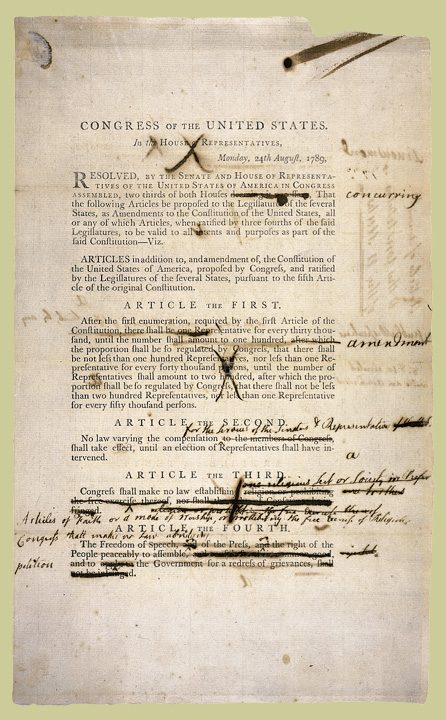
The 1787 Constitution had no bill of rights (Module 1 covers the ratification fight). The First Congress explained its amendments in the preamble to its 1789 resolution: the conventions of several States had "expressed a desire, in order to prevent misconstruction or abuse of its powers, that further declaratory and restrictive clauses should be added."1
James Madison carried the promise. On June 8, 1789, he proposed weaving new language into Article I, section 9, the list of things Congress may not do:
"The civil rights of none shall be abridged on account of religious belief or worship, nor shall any national religion be established, nor shall the full and equal rights of conscience be in any manner, or on any pretext, infringed."
"The people shall not be deprived or abridged of their right to speak, to write, or to publish their sentiments; and the freedom of the press, as one of the great bulwarks of liberty, shall be inviolable."
"The people shall not be restrained from peaceably assembling and consulting for their common good; nor from applying to the Legislature by petitions, or remonstrances, for redress of their grievances."
Madison's fourth resolution, House of Representatives, June 8, 1789 (Annals of Congress 1:434)
He proposed one more clause, for Article I, section 10: "No State shall violate the equal rights of conscience, or the freedom of the press, or the trial by jury in criminal cases." His reason: "I think there is more danger of those powers being abused by the State Governments than by the Government of the United States."2
The House, August 1789
A House committee cut the religion language to "no religion shall be established by law, nor shall the equal rights of conscience be infringed." On August 15 Mr. Sylvester feared it "might be thought to have a tendency to abolish religion altogether." Mr. Sherman called it "altogether unnecessary, inasmuch as Congress had no authority whatever delegated to them by the Constitution to make religious establishments." Madison said the words meant "that Congress should not establish a religion, and enforce the legal observation of it by law, nor compel men to worship God in any manner contrary to their conscience." He offered to add "national," and withdrew it when Mr. Gerry objected. The House adopted Mr. Livermore's wording, "Congress shall make no laws touching religion, or infringing the rights of conscience," 31 to 20. On August 20 Mr. Ames moved the version "Congress shall make no law establishing religion, or to prevent the free exercise thereof, or to infringe the rights of conscience."3
The committee's speech clause read: "The freedom of speech and of the press, and the right of the people peaceably to assemble and consult for their common good, and to apply to the Government for redress of grievances, shall not be infringed." Madison opposed a proposed right to instruct representatives: if that meant delegates "are obliged to conform to those instructions, the declaration is not true."4 On August 17 Madison called his clause binding the States "the most valuable amendment in the whole list," and the House kept it.3 Two days later the House agreed to add the amendments at the end "by way of supplement," which is why we say "First Amendment" and not Article I, section 9.2
The Senate, September 1789
On September 3 the Senate voted down "to instruct their representatives," 2 to 14, and rejected protecting the press "in as ample a manner as hath at any time been secured by the common law." On September 9 it merged religion with speech: "Congress shall make no law establishing articles of faith, or a mode of worship, or prohibiting the free exercise of religion..."4 It also killed Madison's clause binding the States.5 A conference produced the House resolution of September 24 with the final wording. Congress proposed twelve articles on September 25, 1789. Ten were ratified by December 15, 1791, and "Article the third" became the First Amendment.1
"Consult for their common good" fell out along the way. The Idaho Constitution kept it and added the instruction right the Senate rejected: art. I, § 10 protects the right "to assemble in a peaceable manner, to consult for their common good; to instruct their representatives, and to petition the legislature for the redress of grievances."6
What "freedom of the press" meant in 1789
Blackstone (1769): "The liberty of the press is indeed essential to the nature of a free state: but this consists in laying no previous restraints upon publications, and not in freedom from censure for criminal matter when published."7 No licensing. Punishment afterward was another matter. The Sedition Act of 1798 punished "false, scandalous and malicious" writing against the government. Virginia's legislature called it a "palpable and alarming" infraction, Jefferson as President pardoned those convicted, and in 1964 the Court said "the attack upon its validity has carried the day in the court of history."8 Madison had put the principle in a 1794 House speech: "the censorial power is in the people over the Government, and not in the Government over the people."9
Liberty Perspective: The Clause Madison Called Most Valuable
The House voted to bar the States from infringing conscience, press and jury trial. The Senate struck it. For 134 years after ratification, a state legislature or county board could censor a paper or jail a speaker without crossing the First Amendment. Massachusetts did not end its religious establishment until 1833.10 Some readers treat incorporation as judges reaching past the 1791 text. The record of August 17, 1789 shows the drafter wanted the States bound and said so.
The Text
The current text is the 1791 text, never amended or repealed.
Congress shall make no law respecting an establishment of religion, or prohibiting the free exercise thereof; or abridging the freedom of speech, or of the press; or the right of the people peaceably to assemble, and to petition the Government for a redress of grievances.
U.S. Const. amend. I (ratified December 15, 1791), National Archives transcription
It reaches state and local government through the Fourteenth Amendment:
... No State shall make or enforce any law which shall abridge the privileges or immunities of citizens of the United States; nor shall any State deprive any person of life, liberty, or property, without due process of law; nor deny to any person within its jurisdiction the equal protection of the laws.
U.S. Const. amend. XIV, § 1 (ratified July 9, 1868), National Archives transcription
One sentence, six guarantees.111 The Establishment Clause bars any law "respecting" an establishment, meaning concerning one, which reaches further than a formal state church. The Free Exercise Clause protects exercise, so practice as well as belief. Speech and press may not be "abridged," cut down; the clause protects a freedom that already existed. Assembly carries its own condition: "peaceably." Petition, the right to ask government to fix a wrong, is the oldest of the six.
"Congress" names who is bound, and for 134 years that was all. "No law" has never been read as absolute, and every case in this lesson is a fight over where its edges sit.
Every Idaho officer swears to "support the Constitution of the United States, and the Constitution of the State of Idaho."12 That means two sets of rules. Idaho has its own religion clause (art. I, § 4), assembly clause (§ 10) and speech clause (§ 9): "Every person may freely speak, write and publish on all subjects, being responsible for the abuse of that liberty."6
Common Misconception: "The First Amendment Applies to Everybody"
It restrains government. A private employer or a privately owned website is not "Congress" and not a State. When a public officer acts, the question is whether he acted as the government or as a private person. As the Court said in 2024, "Freed's status as a state employee is not determinative."13
From Congress to the County: Incorporation
John Barron owned a Baltimore wharf that once had the deepest water in the harbor. City street work diverted streams that filled it with sand, and he sued under the Fifth Amendment's just compensation clause. Chief Justice Marshall's 1833 answer covered the whole Bill of Rights: "These amendments contain no expression indicating an intention to apply them to the state governments. This court cannot so apply them."14
The Fourteenth Amendment (1868) barred any State from depriving a person of "liberty" without due process.11 Module 10 covers its history. For the First Amendment the change came in steps:
- Speech and press, 1925. Affirming Benjamin Gitlow's conviction for publishing "The Left Wing Manifesto," the Court still said: "we may and do assume that freedom of speech and of the press ... are among the fundamental personal rights and 'liberties' protected by the due process clause of the Fourteenth Amendment from impairment by the States."15
- Press, 1931. Near v. Minnesota struck a state gag law as "an infringement of the liberty of the press guaranteed by the Fourteenth Amendment."16
- Assembly, 1937. De Jonge v. Oregon: "peaceable assembly for lawful discussion cannot be made a crime."17
- Free exercise, 1940. Cantwell v. Connecticut: "The Fourteenth Amendment has rendered the legislatures of the states as incompetent as Congress to enact such laws."18
- Establishment, 1947. Everson: "Neither a state nor the Federal Government can set up a church."19
The county commission and the school board now answer to the same clause as Congress.
Establishment and Free Exercise
Ewing Township, New Jersey, paid bus fares for pupils, Catholic school pupils included, and a taxpayer sued. Justice Black's 1947 opinion for a 5 to 4 Court said the clause "means at least this: Neither a state nor the Federal Government can set up a church. Neither can pass laws which aid one religion, aid all religions, or prefer one religion over another." Quoting Jefferson's "wall of separation," he wrote, "That wall must be kept high and impregnable." Then it upheld the fares as part of "a general program" for all pupils.19 The wall comes from Jefferson's January 1, 1802 letter to the Danbury Baptist Association, praising the people for "building a wall of separation between Church and State."20
Common Misconception: "Separation of Church and State" Is in the Constitution
Those words appear nowhere in the Constitution. They come from Jefferson's 1802 letter, and the Court took up the metaphor in 1947. The text says "respecting an establishment of religion." Quote the text when you mean the text.
In Lemon v. Kurtzman (1971) the Court built a test of purpose, effects and "entanglement," later adding a question about whether a "reasonable observer" would see government "endorsement."21 Joseph Kennedy, a football coach in the Bremerton School District, knelt at midfield after games to pray. The district, citing its fear of Establishment Clause liability, suspended him, and he lost the job. In 2022 the Court ruled for him, 6 to 3. Justice Gorsuch wrote that the Free Exercise and Free Speech Clauses "protect an individual engaging in a personal religious observance from government reprisal; the Constitution neither mandates nor permits the government to suppress such religious expression." And: "this Court long ago abandoned Lemon and its endorsement test offshoot." The Establishment Clause now "must be interpreted by 'reference to historical practices and understandings.'"22
Justice Sotomayor, joined by Justices Breyer and Kagan, saw a different record: "This case is about whether a public school must permit a school official to kneel, bow his head, and say a prayer at the center of a school event." Kennedy, she wrote, "consistently invited others to join his prayers and for years led student athletes in prayer," and "The Court overrules Lemon v. Kurtzman."22
On free exercise, the 1990 peyote case still sets the baseline. Justice Scalia held that the clause "does not relieve an individual of the obligation to comply with a 'valid and neutral law of general applicability.'"23
Liberty Perspective: Fifty Years on a Test the Text Never Mentioned
"Respecting an establishment of religion" says nothing about entanglement or a reasonable observer. The 1789 House argued about tax support for ministers, a national church and compelled worship. Lemon swapped that history for a formula, and the Kennedy majority called its approach "abstract, and ahistorical." The dissent answered that the change unsettles decades of precedent and gives school officials less guidance. Both points are fair. For a county, the practical point is that policies written under Lemon may now rest on reasoning the Court has dropped.
Speech: Incitement, Schools and Campaigns
Charles Schenck, a Socialist party officer, was convicted under the Espionage Act for leaflets mailed to men who had passed draft exemption boards. In 1919 Justice Holmes upheld the conviction: "The question in every case is whether the words used are used in such circumstances and are of such a nature as to create a clear and present danger that they will bring about the substantive evils that Congress has a right to prevent." He added that free speech would not protect "a man in falsely shouting fire in a theatre and causing a panic."24
Six years later Holmes, dissenting in Gitlow with Justice Brandeis, wrote: "Every idea is an incitement."15 The Court kept affirming convictions, including one in 1927 under California's Criminal Syndicalism Act for helping organize the Communist Labor Party.25 Brandenburg, a Ku Klux Klan leader filmed at a rally on an Ohio farm, was fined $1,000 and sentenced to one to 10 years under Ohio's criminal syndicalism law. In 1969 a unanimous per curiam opinion reversed. Government may not "forbid or proscribe advocacy of the use of force or of law violation except where such advocacy is directed to inciting or producing imminent lawless action and is likely to incite or produce such action." Whitney "is therefore overruled."26
Common Misconception: "You Can't Yell Fire in a Crowded Theater"
Holmes wrote "falsely shouting fire in a theatre and causing a panic," in an opinion upholding a conviction over leaflets against the draft. "Falsely" and "panic" both matter, and Schenck's test has been displaced. Since 1969 punishing advocacy requires Brandenburg's intent to incite imminent lawless action, plus likelihood. An official who says a speaker can be silenced because his words are "like yelling fire" is quoting a 1919 aside.
Liberty Perspective: "No Law" and the Fifty-Year Detour
The words "make no law" did not change between 1919 and 1969. The Court's reading did, and people went to prison for leaflets in the meantime. Brandenburg moved doctrine back toward the founding-era objection to the Sedition Act: government does not get to punish political advocacy because it fears where the ideas lead.
Students
On December 14, 1965, Des Moines principals adopted a policy suspending any student who wore an armband. John Tinker, his sister Mary Beth and Christopher Eckhardt wore black armbands against the Vietnam war and were suspended. In 1969 the Court ruled for them, 7 to 2: "It can hardly be argued that either students or teachers shed their constitutional rights to freedom of speech or expression at the schoolhouse gate." And "undifferentiated fear or apprehension of disturbance is not enough." Justices Black and Harlan dissented.27
Campaign speech
Citizens United, a nonprofit corporation, released Hillary: The Movie in January 2008 and wanted to offer it on video-on-demand. Federal law, 2 U.S.C. § 441b, made it a felony for corporations to broadcast "electioneering communications" within 30 days of a primary or 60 days of a general election. In 2010 the Court struck down the ban on corporate independent expenditures, 5 to 4. Justice Kennedy: "the Government may not suppress political speech on the basis of the speaker's corporate identity." The Court overruled Austin v. Michigan Chamber of Commerce (1990) and part of McConnell v. FEC (2003), and upheld the disclaimer and disclosure rules 8 to 1, with Justice Thomas dissenting on that part. Justice Stevens, for four dissenters, wrote that "The Court's ruling threatens to undermine the integrity of elected institutions across the Nation." The majority held that such expenditures "do not give rise to corruption or the appearance of corruption."28
The Press: Prior Restraint, Libel and Sources
Minnesota's 1925 gag law let a court shut down a "malicious, scandalous and defamatory newspaper" as a nuisance. Floyd B. Olson, the Hennepin County Attorney, used it against The Saturday Press, whose articles said "a Jewish gangster was in control of gambling, bootlegging and racketeering in Minneapolis" and accused the police chief of "participation in graft." The paper was perpetually enjoined. In 1931 Chief Justice Hughes, for a 5 to 4 Court, struck the law down. A publisher had to prove his charges true and "published with good motives and for justifiable ends" or be suppressed. "This is of the essence of censorship." He allowed exceptions such as "the sailing dates of transports."16
In 1971 the government sought to stop the Times and the Washington Post from publishing a classified Vietnam study. Four days after argument, the per curiam held: "Any system of prior restraints of expression comes to this Court bearing a heavy presumption against its constitutional validity," and the government had not carried its burden. The vote was 6 to 3.29
Libel and actual malice
On March 29, 1960 the Times carried a full-page ad, "Heed Their Rising Voices," with some statements about Montgomery, Alabama that were "not accurate." L. B. Sullivan, the commissioner who supervised the police, was not named. He sued anyway. An Alabama jury awarded $500,000. In 1964 Justice Brennan wrote for the Court that a public official may not recover "for a defamatory falsehood relating to his official conduct unless he proves that the statement was made with 'actual malice', that is, with knowledge that it was false or with reckless disregard of whether it was false or not," shown with "convincing clarity." Justice Goldberg would have gone further, giving citizens and the press "an absolute, unconditional privilege to criticize official conduct."9 Idaho's clause holds a speaker "responsible for the abuse of that liberty"; Sullivan sets how far that reaches when the subject is an official.6
Reporters and confidential sources
On November 15, 1969, the Louisville Courier-Journal ran Paul Branzburg's story on two men making hashish, whom he promised not to name. A grand jury subpoenaed him and he refused. In 1972 Justice White, for a 5 to 4 Court, held there is no First Amendment privilege to refuse relevant grand jury questions, while granting that "without some protection for seeking out the news, freedom of the press could be eviscerated." Justice Powell, the fifth vote, stressed "the limited nature of the Court's holding" and wrote that "Official harassment of the press undertaken not for purposes of law enforcement but to disrupt a reporter's relationship with his news sources would have no justification." The Court left state legislatures "free, within First Amendment limits, to fashion their own standards."30 Federal courts, the Constitution Annotated reports, "have not resolved whether the common law provides a journalists' privilege." The Privacy Protection Act of 1980 limits searches for material intended for publication.31
When Government Workers and Officials Speak
Marvin Pickering, an Illinois teacher, wrote the local paper attacking his school board's handling of a 1961 bond issue and its athletic spending, and was fired. In 1968 the Court held that "absent proof of false statements knowingly or recklessly made by him, a teacher's exercise of his right to speak on issues of public importance may not furnish the basis for his dismissal from public employment."32
Richard Ceballos, a deputy in the Los Angeles County District Attorney's Office, concluded a warrant affidavit had serious misrepresentations and wrote a memo that "recommended dismissal of the case." In 2006 the Court ruled 5 to 4: "when public employees make statements pursuant to their official duties, the employees are not speaking as citizens for First Amendment purposes, and the Constitution does not insulate their communications from employer discipline."33 In 2014 a unanimous Court marked a limit: "Truthful testimony under oath by a public employee outside the scope of his ordinary job duties is speech as a citizen for First Amendment purposes."34
Liberty Perspective: The Insider Gets the Least Protection
Under Garcetti, the employee whose job is to check the paperwork has no First Amendment shield for reporting wrongdoing up the chain, while a letter to the editor on the same facts may be protected under Pickering. Four Justices dissented. Idaho law, on the books since 1994, covers part of the gap: an employer "may not take adverse action against an employee because the employee ... communicates in good faith the existence of any waste of public funds, property or manpower, or a violation or suspected violation of a law."35
Officials on social media
James Freed, city manager of Port Huron, Michigan, posted about his life and his job on a public Facebook page. After Kevin Lindke criticized the city's COVID-19 response in comments, Freed deleted them and blocked him. In 2024 a unanimous Court, per Justice Barrett, held that an official's social-media activity is state action "only if the official (1) possessed actual authority to speak on the State's behalf, and (2) purported to exercise that authority when he spoke on social media." A page labeled "this is the personal page of James R. Freed" would earn "a heavy presumption that all of his posts were personal."13
Officials criticizing each other
David Wilson, an elected community college trustee, sued his board and attacked it in the media. In 2018 the board censured him as "not only inappropriate, but reprehensible." A unanimous Court rejected his retaliation claim in 2022. "Elected representatives are expected to shoulder a degree of criticism about their public service from their constituents and their peers," and the First Amendment "cannot be used as a weapon to silence other representatives seeking to do the same." The ruling covers a "purely verbal censure."36
Assembly, Petition and the Public Meeting
England's Bill of Rights of 1689 made prosecution for petitioning illegal. The American version was tested on January 28, 1840, when the House adopted a rule that no petition "praying the abolition of slavery" would be "received by this House, or entertained in any way whatever." John Quincy Adams fought it until its repeal five years later.37
In Perry Education Ass'n (1983) the Court sorted public property into three groups. In traditional forums such as streets and parks, "the government may not prohibit all communicative activity," content rules must be "narrowly drawn to effectuate a compelling state interest," and neutral time, place and manner rules must leave "ample alternative channels." Designated forums are "public property which the State has opened for use by the public as a place for expressive activity," and the Court also described a "limited" forum open to certain groups or subjects. In nonpublic forums, rules must be "reasonable and not an effort to suppress expression merely because public officials oppose the speaker's view."38
Public comment at a board meeting
In 1976 a Madison, Wisconsin teacher named Holmquist, not a union member, told his school board at a public meeting about teachers opposed to a union "fair share" clause. The state labor commission ordered the board to stop letting non-union employees speak on bargaining issues. The Supreme Court reversed. Chief Justice Burger: "when the board sits in public meetings to conduct public business and hear the views of citizens, it may not be required to discriminate between speakers on the basis of their employment, or the content of their speech." And: "Plainly, public bodies may confine their meetings to specified subject matter and may hold nonpublic sessions to transact business."39
So a board may decide whether to open comment and may set the subject, time limits and order. It may not cut off a speaker for his view, including sharp criticism of the board. Idaho adds that "all persons shall be permitted to attend" meetings of a governing body, and that no attendee "shall be prevented or prohibited from recording"; the board "may take measures to ensure the orderly conduct" of meetings but "shall not prohibit or unreasonably restrict recording." Neither § 74-203 nor § 74-204 requires a general comment period.40
Common Misconception: "The Chair Can Rule Personal Attacks Out of Order"
A chair can enforce time limits, hold comment to the opened subject and stop real disruption. Gaveling down a speaker for criticizing a commissioner by name is different. Under City of Madison and Perry, a board that opens comment may not sort speakers by "the content of their speech" or because "public officials oppose the speaker's view." Write the rules down and apply them the same way to friends and critics.
Landmark Cases
Each case was checked against the opinion text. Supporting cases appear above.
| Case | Citation | Year | Holding | Effect today |
|---|---|---|---|---|
| Barron v. Baltimore | 32 U.S. 243 | 1833 | Bill of Rights limits only the federal government. | Displaced by Fourteenth Amendment cases. |
| Schenck v. United States | 249 U.S. 47 | 1919 | "Clear and present danger"; conviction upheld. | Test replaced by Brandenburg. |
| Gitlow v. New York | 268 U.S. 652 | 1925 | Speech and press assumed to bind States; conviction affirmed. | Start of incorporation. |
| Near v. Minnesota | 283 U.S. 697 | 1931 | State gag law struck, 5 to 4. | Rule against prior restraint. |
| Everson v. Board of Education | 330 U.S. 1 | 1947 | Establishment Clause binds States; bus fares upheld, 5 to 4. | "Wall of separation" enters case law. |
| New York Times Co. v. Sullivan | 376 U.S. 254 | 1964 | Officials must prove actual malice. | Governs officials' libel suits. |
| Tinker v. Des Moines | 393 U.S. 503 | 1969 | Student armbands protected, 7 to 2. | Student speech standard. |
| Brandenburg v. Ohio | 395 U.S. 444 | 1969 | Only incitement to imminent lawless action, likely to occur, may be punished. | Current test; overruled Whitney (1927). |
| New York Times Co. v. United States | 403 U.S. 713 | 1971 | Pentagon Papers injunction denied, 6 to 3. | Heavy presumption against prior restraint. |
| Branzburg v. Hayes | 408 U.S. 665 | 1972 | No First Amendment privilege before a grand jury, 5 to 4. | States set their own rules. |
| City of Madison v. WERC | 429 U.S. 167 | 1976 | Board hearing public views may not be forced to sort speakers by employment or content. | Public comment rule. |
| Garcetti v. Ceballos | 547 U.S. 410 | 2006 | Speech pursuant to official duties unprotected, 5 to 4. | Narrowed by Lane v. Franks (2014). |
| Citizens United v. FEC | 558 U.S. 310 | 2010 | Corporate expenditure ban struck, 5 to 4; disclosure upheld, 8 to 1. | Overruled Austin and part of McConnell. |
| Houston Community College v. Wilson | 595 U.S. 468 | 2022 | Purely verbal censure of an elected member did not violate the First Amendment. | Boards may rebuke their own. |
| Kennedy v. Bremerton School District | 597 U.S. 507 | 2022 | Coach's personal prayer protected, 6 to 3. | Lemon (1971) abandoned. |
| Lindke v. Freed | 601 U.S. 187 | 2024 | Two-part state action test for officials' social media, 9 to 0. | Governs blocking and deleting. |
Where This Shows Up for Officials, Reporters and Citizens
The commissioner running public comment
Commissioner Ruth Alder chairs a meeting with 30 minutes of comment on agenda items. A resident uses his three minutes to accuse her by name of steering a road contract. She can hold him to three minutes and the agenda. She cannot stop him for criticizing her. The resident filming it on his phone is protected by Idaho Code § 74-203(6).3940
The sheriff's Facebook page
Sheriff Tom Reyes has one page with family photos, campaign posts and, during a flood, his office's evacuation orders. He blocks a critic. Under Lindke, a post that "expressly invokes state authority to make an announcement not available elsewhere is official." The fix is two pages: an official one run under county policy, and a personal one labeled personal.13
The deputy clerk who finds a problem
A deputy clerk finds what looks like misspent grant money and writes it up for her supervisor. Under Garcetti that memo is part of her job and the First Amendment does not cover it. Idaho's Protection of Public Employees Act may, if she reports in good faith and gives the employer a chance to correct it. A letter to the editor on the same facts gets Pickering balancing.333532
The reporter with a confidential source
A weekly paper's reporter quotes an unnamed deputy about jail staffing, and a prosecutor subpoenas the name. Branzburg gives no automatic privilege, Powell's concurrence warns against harassment, and state law may give more. Know your state's rule before you promise a source anything.3031
The board that wants to censure a member
Three commissioners want to rebuke a fourth who attacks them in the paper. Wilson allows a purely verbal censure. It did not decide whether stripping duties or pay is different.36
Religion at the county building
A road crew employee bows his head and prays over lunch. Punishing that while allowing comparable secular speech runs into Kennedy.22 A request to give county money to a church building fund runs into Idaho's art. IX, § 5, which bars any county from paying "from any public fund or moneys whatever, anything in aid of any church or sectarian or religious society." This lesson did not review the Court's recent aid-program cases, such as Carson v. Makin (2022), cited in the Kennedy dissent; read them before relying on § 5 alone.41
The citizen with a petition
A resident gathers signatures on the public sidewalk outside the county building. The sidewalk is a traditional forum, so the county may regulate time, place and manner but not her message.3837
Related lessons: Module 5, Federalism and the States (the oath and Supremacy Clause); Module 6, Amending the Constitution; Module 10, The Civil War Amendments and the Fourteenth.
Pictures, Numbers and Infographics
The First Amendment is 45 words long, and fewer than one American in ten can name all five freedoms in it. The numbers below track what people know about the amendment, how religious practice is spread across the country, and how many people still work in the newsrooms the press clause protects.
By the numbers
- 45 words: the length of the First Amendment, counted from the National Archives transcription. It was the third of 12 articles Congress proposed on September 25, 1789; ten were ratified on December 15, 1791. National Archives, Bill of Rights transcription
- 79%: of U.S. adults named freedom of speech as a First Amendment right in August 2025, up from 74% in 2024. Only 12% named the right to petition. Annenberg Public Policy Center Civics Survey, 2025
- Nearly 9%: of adults could name all five First Amendment rights in 2025, while 18% could not name any. Annenberg Public Policy Center, 2025
- 62% and 29%: the shares of U.S. adults who describe themselves as Christian (62%) and as religiously unaffiliated (29%); 7% belong to other religions. Pew Research Center, 2023-24 religion study (published 2025)
- 57%: drop in newspaper newsroom employment from 2008 to 2020, from roughly 71,000 jobs to about 31,000. Pew Research Center analysis of BLS data, 2021
- About 85,000: newsroom employees across newspapers, radio, broadcast TV, cable and digital outlets in 2020, down from about 114,000 in 2008. Pew Research Center, 2021
Verify Independently
Every citation, quotation and case in this course should be verified independently against the official source (the U.S. Reports or the Court's own opinion, the National Archives transcription, the statute book) before you rely on it, quote it or act on it.
Sources & Further Reading
Primary Sources
- National Archives, The Bill of Rights: A Transcription
- National Archives, The Constitution: Amendments 11-27
- National Archives, The Constitution of the United States: A Transcription
- The Founders' Constitution, Bill of Rights, Doc. 11: House of Representatives, June 8 to Aug. 19, 1789 (Annals of Congress)
- The Founders' Constitution, Amendment I (Religion), Doc. 53: House debate, Aug. 15-20, 1789
- The Founders' Constitution, Amendment I (Speech and Press), Doc. 14: Congress, June-Sept. 1789
- Jefferson to the Danbury Baptist Association, Jan. 1, 1802 (The Founders' Constitution)
- Blackstone, Commentaries 4:150-53 (The Founders' Constitution)
- Constitution Annotated, Amendment I (Cornell LII edition)
- Oyez (oral argument audio and case summaries)
- National Constitution Center, Interactive Constitution: Amendment I
Supreme Court Opinions
- Barron v. Baltimore, 32 U.S. 243 (1833)
- Schenck v. United States, 249 U.S. 47 (1919)
- Gitlow v. New York, 268 U.S. 652 (1925)
- Near v. Minnesota, 283 U.S. 697 (1931)
- Everson v. Board of Education, 330 U.S. 1 (1947)
- New York Times Co. v. Sullivan, 376 U.S. 254 (1964)
- Tinker v. Des Moines, 393 U.S. 503 (1969)
- Brandenburg v. Ohio, 395 U.S. 444 (1969)
- New York Times Co. v. United States, 403 U.S. 713 (1971)
- Branzburg v. Hayes, 408 U.S. 665 (1972)
- City of Madison Joint School Dist. v. WERC, 429 U.S. 167 (1976)
- Perry Education Ass'n v. Perry Local Educators' Ass'n, 460 U.S. 37 (1983)
- Garcetti v. Ceballos, 547 U.S. 410 (2006)
- Citizens United v. FEC, 558 U.S. 310 (2010)
- Houston Community College System v. Wilson, 595 U.S. 468 (2022) (supremecourt.gov)
- Kennedy v. Bremerton School District, 597 U.S. 507 (2022) (supremecourt.gov)
- Lindke v. Freed, 601 U.S. 187 (2024) (supremecourt.gov)
Idaho Law
- Idaho Const. art. I, § 4 (religious liberty)
- Idaho Const. art. I, § 9 (freedom of speech)
- Idaho Const. art. I, § 10 (right of assembly)
- Idaho Const. art. III, § 25 (oath of legislators)
- Idaho Const. art. IX, § 5 (sectarian appropriations prohibited)
- Idaho Code § 59-401 (official oath)
- Idaho Code § 74-203 (open public meetings; recording)
- Idaho Code § 6-2104 (Protection of Public Employees Act)
Related Training Modules
- Module 1: From the Charters to Philadelphia
- Module 5: Federalism and the States
- Module 6: Amending the Constitution
- Module 8: The Second Amendment
- Module 9: Search, Due Process and Fair Trials (Amendments 4 to 8)
- Module 10: The Civil War Amendments and the Fourteenth
- Module 12: Reading the Constitution, Rights, Methods and Your Oath
- Course index: The United States Constitution
Knowledge Check
Test your understanding of the First Amendment. No scores are saved: this is for your own review.
1. In Madison's June 8, 1789 proposals, which clause did he later call "the most valuable amendment in the whole list"?
On August 17, 1789, Madison called the clause restraining the States the most valuable. The House kept it; the Senate struck it. It was the clause binding the States. The Senate defeated it, and the idea returned through the Fourteenth Amendment.
2. Which phrase is the actual text of the Establishment Clause?
That is the ratified text. "Separation of church and state" is Jefferson's 1802 phrase, and the other two are drafts from the House committee and the Senate. The ratified words are "respecting an establishment of religion." The other choices are a Jefferson metaphor and two 1789 drafts.
3. What test does Brandenburg v. Ohio (1969) set for punishing advocacy of force or law violation?
Brandenburg requires both intent to incite imminent lawless action and likelihood that it will occur. It overruled Whitney v. California. Brandenburg replaced the older tests: advocacy must be directed to inciting imminent lawless action and likely to produce it.
4. Under New York Times Co. v. Sullivan (1964), what must a public official prove to win libel damages over a statement about official conduct?
The actual malice rule: knowledge that the statement was false or reckless disregard of whether it was false, shown with convincing clarity. Falsity and harm are not enough. The official must prove actual malice: knowledge of falsity or reckless disregard.
5. Under Lindke v. Freed (2024), when is an official's blocking of a commenter on social media state action?
A unanimous Court set a two-part test: actual authority to speak for the State on the matter, and a purported exercise of that authority in the relevant posts. Holding office is not enough. The official must have actual authority to speak for the State and must purport to use it in the posts.
Reference Materials
Use your browser's print function (Ctrl+P / Cmd+P) to save this page as a PDF for offline reference.
- How We Got Here: From Madison's Draft to "Article the Third": jump to section
- The Text: jump to section
- From Congress to the County: Incorporation: jump to section
- Establishment and Free Exercise: jump to section
- Speech: Incitement, Schools and Campaigns: jump to section
- The Press: Prior Restraint, Libel and Sources: jump to section
- When Government Workers and Officials Speak: jump to section
- Assembly, Petition and the Public Meeting: jump to section
- Landmark Cases: jump to section
- Where This Shows Up for Officials, Reporters and Citizens: jump to section
Footnotes
- National Archives, The Bill of Rights: A Transcription, https://www.archives.gov/founding-docs/bill-of-rights-transcript. The transcription is of the enrolled Joint Resolution of September 25, 1789, proposing twelve articles. The page states that ten were ratified on December 15, 1791 (Articles 3 through 12), that Article 2 became the Twenty-seventh Amendment in 1992, and that Article 1 was never ratified. The First Amendment is "Article the third." The resolution's preamble is quoted from the same page.
- House of Representatives, Amendments to the Constitution, June 8, July 21, Aug. 13, 18-19, 1789, Annals of Congress 1:424-50, 661-65, 707-17, 757-59, 766, reprinted in The Founders' Constitution, vol. 5, Bill of Rights, Document 11 (Univ. of Chicago Press), https://press-pubs.uchicago.edu/founders/documents/bill_of_rightss11.html. Madison's fourth resolution (insertions in Art. I, sec. 9) and fifth resolution (Art. I, sec. 10), and his remarks on state governments and "independent tribunals of justice," are quoted from this text. The August 19 entry records that Sherman's motion to add the amendments "by way of supplement" carried by two-thirds of the House.
- House of Representatives, Amendments to the Constitution, Aug. 15, 17 and 20, 1789, Annals of Congress 1:729-31, 755, 766, reprinted in The Founders' Constitution, vol. 5, Amendment I (Religion), Document 53, https://press-pubs.uchicago.edu/founders/documents/amendI_religions53.html. Source of the committee text, the remarks of Sylvester, Sherman, Carroll, Madison, Huntington, Livermore and Gerry, the 31 to 20 vote on Livermore's motion, the August 17 debate on the state clause (Tucker's motion to strike rejected), and Ames's August 20 wording.
- Congress, Amendments to the Constitution, June-Sept. 1789, reprinted in The Founders' Constitution, vol. 5, Amendment I (Speech and Press), Document 14, https://press-pubs.uchicago.edu/founders/documents/amendI_speechs14.html. Contains the House committee's speech clause and the August 15 debate (Sedgwick; Madison on instruction), the Senate Journal for September 3-4 (motion to add "to instruct their representatives" lost 2 to 14, Grayson and Lee voting yea; motion to add the common-law phrase "unsuccessful"; text adopted September 4), September 9 (combined religion and speech article), and the House resolution of September 24, 1789 giving the final wording of "Article the third."
- Constitution Annotated, Historical Background on Free Speech Clause (LII edition), https://www.law.cornell.edu/constitution-conan/amendment-1/historical-background-on-free-speech-clause. States that Madison's proposal limiting the states, "[a]lthough passed by the House, ... was defeated by the Senate"; quotes Jefferson's 1788 and 1789 letters to Madison (13 and 15 Papers of Thomas Jefferson 442, 367); quotes Madison's 1794 House remark (4 Annals of Cong. 934); and states that the Sedition Act expired in 1801 without a Supreme Court ruling on its validity. The Congress.gov edition of the Constitution Annotated returned HTTP 403 to automated requests this session, so the LII edition is cited.
- Idaho Const. art. I, § 4 (guaranty of religious liberty), https://legislature.idaho.gov/statutesrules/idconst/ArtI/Sect4/; § 9 (freedom of speech), https://legislature.idaho.gov/statutesrules/idconst/ArtI/Sect9/; § 10 (right of assembly), https://legislature.idaho.gov/statutesrules/idconst/ArtI/Sect10/.
- William Blackstone, Commentaries on the Laws of England 4:150-53 (1769), reprinted in The Founders' Constitution, vol. 5, Amendment I (Speech and Press), Document 4, https://press-pubs.uchicago.edu/founders/documents/amendI_speechs4.html.
- The Sedition Act of 1798, 1 Stat. 596, as described in New York Times Co. v. Sullivan, 376 U.S. 254 (1964) (Virginia Resolutions of 1798; Jefferson's pardons). The quoted words of the Act appear in the Constitution Annotated essay on the free speech clause, which also states that the Act expired in 1801.
- New York Times Co. v. Sullivan, 376 U.S. 254 (1964) (decided Mar. 9, 1964; Brennan, J., for the Court; Black, J., and Goldberg, J., concurring), https://www.law.cornell.edu/supremecourt/text/376/254; CAP, https://static.case.law/us/376/cases/0254-01.json. The opinion quotes Madison's 1794 remark and recounts Jefferson's pardons under the Sedition Act of 1798.
- Constitution Annotated, Early Interpretations of the Religion Clauses (LII edition), https://www.law.cornell.edu/constitution-conan/amendment-1/early-interpretations-of-the-religion-clauses (most states retained elements of establishment at the Revolution; seven disestablishments occurred after the First Amendment's adoption, "with the last, Massachusetts', occurring in 1833"; Madison later called a congressional chaplain a "palpable violation" of the Constitution).
- National Archives, The Constitution: Amendments 11-27, https://www.archives.gov/founding-docs/amendments-11-27. Fourteenth Amendment: "Passed by Congress June 13, 1866. Ratified July 9, 1868." Section 1 is quoted from this page. See Module 10, The Civil War Amendments and the Fourteenth.
- Idaho Code § 59-401 (official oath for every officer "elected or appointed to fill any office created by the laws of the state of Idaho"), https://legislature.idaho.gov/statutesrules/idstat/Title59/T59CH4/SECT59-401/; Idaho Const. art. III, § 25 (oath of members of the legislature), https://legislature.idaho.gov/statutesrules/idconst/ArtIII/Sect25/. Art. III, § 25 covers legislators only; § 59-401 covers other state and local officers.
- Lindke v. Freed, 601 U.S. 187 (2024) (argued Oct. 31, 2023, decided Mar. 15, 2024; Barrett, J., "for a unanimous Court"), official reporter print, Supreme Court of the United States, https://www.supremecourt.gov/opinions/23pdf/601us1r08_a8cf.pdf (Volume 601 U.S. Part 1, pages 187-204); slip opinion, https://www.supremecourt.gov/opinions/23pdf/22-611_ap6c.pdf.
- Barron v. Mayor and City Council of Baltimore, 32 U.S. (7 Pet.) 243 (1833) (Marshall, C.J., for the Court), https://www.law.cornell.edu/supremecourt/text/32/243; Harvard Caselaw Access Project, https://static.case.law/us/32/cases/0243-01.json.
- Gitlow v. New York, 268 U.S. 652 (1925) (decided June 8, 1925; Sanford, J., for the Court; Holmes, J., dissenting, joined by Brandeis, J.: "Mr. Justice Brandeis and I are of opinion that this judgment should be reversed"), https://www.law.cornell.edu/supremecourt/text/268/652; CAP, https://static.case.law/us/268/cases/0652-01.json.
- Near v. Minnesota ex rel. Olson, 283 U.S. 697 (1931) (decided June 1, 1931; Hughes, C.J., for the Court; Butler, J., dissenting, joined by Van Devanter, McReynolds and Sutherland, JJ.), https://www.law.cornell.edu/supremecourt/text/283/697; CAP, https://static.case.law/us/283/cases/0697-01.json. The statute was Minnesota Session Laws 1925, ch. 285.
- De Jonge v. Oregon, 299 U.S. 353 (1937) (decided Jan. 4, 1937), https://www.law.cornell.edu/supremecourt/text/299/353; CAP, https://static.case.law/us/299/cases/0353-01.json.
- Cantwell v. Connecticut, 310 U.S. 296 (1940) (decided May 20, 1940), https://www.law.cornell.edu/supremecourt/text/310/296; CAP, https://static.case.law/us/310/cases/0296-01.json.
- Everson v. Board of Education of Ewing Township, 330 U.S. 1 (1947) (decided Feb. 10, 1947; Black, J., for the Court; Jackson, J., dissenting, joined by Frankfurter, J.; Rutledge, J., dissenting, joined by Frankfurter, Jackson and Burton, JJ.), https://www.law.cornell.edu/supremecourt/text/330/1; CAP, https://static.case.law/us/330/cases/0001-01.json.
- Thomas Jefferson to the Danbury Baptist Association, Jan. 1, 1802, in Writings 16:281, reprinted in The Founders' Constitution, vol. 5, Amendment I (Religion), Document 58, https://press-pubs.uchicago.edu/founders/documents/amendI_religions58.html. Founders Online (founders.archives.gov) answered automated requests this session with HTTP 202 and no content, so the Chicago reprint is cited.
- Lemon v. Kurtzman, 403 U.S. 602 (1971) (decided June 28, 1971), https://www.law.cornell.edu/supremecourt/text/403/602; CAP, https://static.case.law/us/403/cases/0602-01.json. The three-part description (purposes, effects, entanglement) is taken from the syllabus of Kennedy v. Bremerton, which cites Lemon at 612-613.
- Kennedy v. Bremerton School District, 597 U.S. 507 (2022) (argued Apr. 25, decided June 27, 2022; Gorsuch, J., for the Court, joined by Roberts, C.J., and Thomas, Alito and Barrett, JJ., and by Kavanaugh, J., except as to Part III-B; Thomas and Alito, JJ., concurring; Sotomayor, J., dissenting, joined by Breyer and Kagan, JJ.), official reporter print, https://www.supremecourt.gov/opinions/21pdf/597us2r62_d92h.pdf (Volume 597 U.S. Part 2, pages 507-579); slip opinion, https://www.supremecourt.gov/opinions/21pdf/21-418_i425.pdf. See also Constitution Annotated, Abandonment of the Lemon Test, https://www.law.cornell.edu/constitution-conan/amendment-1/abandonment-of-the-lemon-test.
- Employment Division v. Smith, 494 U.S. 872 (1990) (decided Apr. 17, 1990; Scalia, J., for the Court), https://www.law.cornell.edu/supremecourt/text/494/872; CAP, https://static.case.law/us/494/cases/0872-01.json.
- Schenck v. United States, 249 U.S. 47 (1919) (decided Mar. 3, 1919; Holmes, J., for the Court; no dissent reported), https://www.law.cornell.edu/supremecourt/text/249/47; CAP, https://static.case.law/us/249/cases/0047-01.json. The 15,000-leaflet resolution of Aug. 13, 1917 is described in the opinion as printed on LII.
- Whitney v. California, 274 U.S. 357 (1927) (decided May 16, 1927), https://www.law.cornell.edu/supremecourt/text/274/357; CAP, https://static.case.law/us/274/cases/0357-01.json. Overruled by Brandenburg v. Ohio, 395 U.S. 444, 449 (1969).
- Brandenburg v. Ohio, 395 U.S. 444 (1969) (per curiam; decided June 9, 1969; Black and Douglas, JJ., concurring; no dissent), https://www.law.cornell.edu/supremecourt/text/395/444; CAP, https://static.case.law/us/395/cases/0444-01.json.
- Tinker v. Des Moines Independent Community School District, 393 U.S. 503 (1969) (decided Feb. 24, 1969; Fortas, J., for the Court; Stewart and White, JJ., concurring; Black and Harlan, JJ., dissenting), https://www.law.cornell.edu/supremecourt/text/393/503; CAP, https://static.case.law/us/393/cases/0503-01.json.
- Citizens United v. Federal Election Commission, 558 U.S. 310 (2010) (decided Jan. 21, 2010; Kennedy, J., for the Court; Roberts, C.J., and Scalia, J., concurring; Stevens, J., joined by Ginsburg, Breyer and Sotomayor, JJ., concurring in part and dissenting in part; Thomas, J., concurring in part and dissenting in part, joining "all but Part IV"), https://www.law.cornell.edu/supremecourt/text/08-205; CAP, https://static.case.law/us/558/cases/0310-01.json. Overruling Austin v. Michigan Chamber of Commerce, 494 U.S. 652 (1990), and the part of McConnell v. Federal Election Comm'n, 540 U.S. 93, 203-209 (2003), that upheld limits on electioneering communications.
- New York Times Co. v. United States, 403 U.S. 713 (1971) (per curiam; argued June 26, decided June 30, 1971; Black, Douglas, Brennan, Stewart, White and Marshall, JJ., concurring; Burger, C.J., and Harlan and Blackmun, JJ., dissenting), https://www.law.cornell.edu/supremecourt/text/403/713; CAP, https://static.case.law/us/403/cases/0713-01.json. Harlan's dissent, joined by the Chief Justice and Blackmun, J., was confirmed on the LII text.
- Branzburg v. Hayes, 408 U.S. 665 (1972) (decided June 29, 1972; White, J., for the Court; Powell, J., concurring; Douglas, J., dissenting; Stewart, J., dissenting, joined by Brennan and Marshall, JJ.), https://www.law.cornell.edu/supremecourt/text/408/665; CAP, https://static.case.law/us/408/cases/0665-01.json.
- Constitution Annotated, Protection of Confidential Sources (LII edition), https://www.law.cornell.edu/constitution-conan/amendment-1/protection-of-confidential-sources (Federal Rule of Evidence 501; "The federal courts have not resolved whether the common law provides a journalists' privilege"; Privacy Protection Act of 1980, 42 U.S.C. § 2000aa).
- Pickering v. Board of Education of Township High School District 205, 391 U.S. 563 (1968) (decided June 3, 1968), https://www.law.cornell.edu/supremecourt/text/391/563; CAP, https://static.case.law/us/391/cases/0563-01.json.
- Garcetti v. Ceballos, 547 U.S. 410 (2006) (decided May 30, 2006; Kennedy, J., for the Court; Stevens, J., dissenting; Souter, J., dissenting, joined by Stevens and Ginsburg, JJ.; Breyer, J., dissenting), https://www.law.cornell.edu/supremecourt/text/04-473; CAP, https://static.case.law/us/547/cases/0410-01.json. Four Justices dissented, so the vote was five to four.
- Lane v. Franks, 573 U.S. 228 (2014) (argued Apr. 28, decided June 19, 2014; Sotomayor, J., for a unanimous Court; Thomas, J., concurring, joined by Scalia and Alito, JJ.), https://www.law.cornell.edu/supremecourt/text/13-483. The U.S. Reports page was confirmed from citations to "Lane v. Franks, 573 U. S. 228" in the official reporter print of Kennedy v. Bremerton.
- Idaho Protection of Public Employees Act, Idaho Code § 6-2101 (legislative intent; history note: added 1994, ch. 100), https://legislature.idaho.gov/statutesrules/idstat/Title6/T6CH21/SECT6-2101/; § 6-2104(1)(a) and (2)(a), https://legislature.idaho.gov/statutesrules/idstat/Title6/T6CH21/SECT6-2104/.
- Houston Community College System v. Wilson, 595 U.S. 468 (2022) (argued Nov. 2, 2021, decided Mar. 24, 2022; Gorsuch, J., "for a unanimous Court"), official reporter print, https://www.supremecourt.gov/opinions/21pdf/595us2r19_8n59.pdf.
- Constitution Annotated, Historical Background on Freedoms of Assembly and Petition (LII edition), https://www.law.cornell.edu/constitution-conan/amendment-1/historical-background-on-freedoms-of-assembly-and-petition (1669 Commons resolution; English Bill of Rights of 1689, ch. 5; House rule of January 28, 1840 refusing antislavery petitions, repealed five years later through the efforts of John Quincy Adams).
- Perry Education Ass'n v. Perry Local Educators' Ass'n, 460 U.S. 37 (1983) (decided Feb. 23, 1983), https://www.law.cornell.edu/supremecourt/text/460/37; CAP, https://static.case.law/us/460/cases/0037-01.json. See also Constitution Annotated, Public and Nonpublic Forums (LII edition), https://www.law.cornell.edu/constitution-conan/amendment-1/public-and-nonpublic-forums (quoting Perry's use of the term "limited" public forum).
- City of Madison Joint School District No. 8 v. Wisconsin Employment Relations Commission, 429 U.S. 167 (1976) (argued Oct. 12, decided Dec. 8, 1976; Burger, C.J., for the Court; Brennan and Stewart, JJ., concurring), https://www.law.cornell.edu/supremecourt/text/429/167; CAP, https://static.case.law/us/429/cases/0167-01.json.
- Idaho Code § 74-203(1) and (6), https://legislature.idaho.gov/statutesrules/idstat/Title74/T74CH2/SECT74-203/; see also § 74-204 (notice of meetings), https://legislature.idaho.gov/statutesrules/idstat/Title74/T74CH2/SECT74-204/. Neither section, as read on October 14, 2026, uses the word "comment."
- Idaho Const. art. IX, § 5 (sectarian appropriations prohibited), https://legislature.idaho.gov/statutesrules/idconst/ArtIX/Sect5/.