Lesson 3 of 10 · about 21 minutes
Friedman: The Public Policy Voice
You'll be able to
- Explain what Friedman's 1955 essay actually proposed, including the line it drew between paying for schools and running them, and where school choice stands as of October 2026
- Describe the negative income tax, why Nixon's Family Assistance Plan failed, and how the Earned Income Tax Credit differs from Friedman's design
- Describe the Gates Commission, its 1970 recommendation and how the draft ended in 1973
- Explain Friedman's case for flexible exchange rates and his role in the end of Bretton Woods and the birth of currency futures
- Weigh Friedman's policy record honestly, including withholding, the program he helped create and later wanted abolished
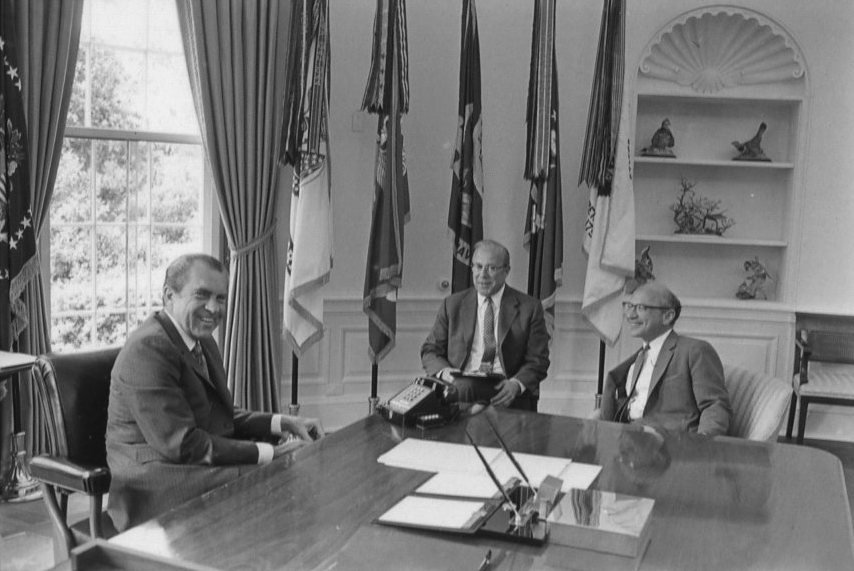
On June 8, 1971, a White House photographer caught three men in the Oval Office: Richard Nixon at his desk, George Shultz, who ran the new Office of Management and Budget, and Milton Friedman, a professor from the University of Chicago who held no government job at all.1 Nine weeks later Nixon took fifteen advisers to Camp David for three days, August 13 to 15, and came down the mountain with two decisions. The first closed the gold window, which cut the last link between the dollar and gold and started the world toward floating exchange rates, a system Friedman had argued for since 1953. The second imposed a 90-day freeze on wages and prices, the first peacetime controls of the kind.2 Friedman had put general wage and price controls on his 1962 list of things government should not do.3 He won one argument and lost another on the same weekend.
That weekend is a fair picture of his public career. Lesson 2 of this module covers Friedman the scholar, and Lesson 5 of Economic Systems covers his life and Capitalism and Freedom. This lesson follows his proposals into law, or into the wastebasket, and keeps a ledger.
A professor with a column
Most economists write for other economists. Friedman wrote for anyone with a newsstand nearby. "In 1966, I began to write a triweekly column on current affairs for Newsweek magazine," he recalled, alternating with Paul Samuelson of MIT, the leading Keynesian of the day, and Henry Wallich of Yale. He kept it up, by his own account, until it was terminated in 1983.4 Other accounts date the run from 1966 to 1984. The economics writer Laurence Siegel has argued that without the alternating columns the two men would not have been cast as opposites the way they usually are, though they had much more in common than not.5 A reader in Twin Falls or Toledo who never opened an economics journal could follow the argument over money, taxes and the draft every few weeks for seventeen years.
The column trained a habit. Friedman learned to make a case in eight hundred words, to name a policy, say who it helped and who it hurt, and propose something better. He rarely wrote "the market will handle it." He wrote that a specific law did a specific thing, and here is the alternative.
Myth: Friedman declared "We are all Keynesians now"
Time magazine put the line in his mouth on December 31, 1965. Friedman wrote to the magazine, and his letter in the February 4, 1966 issue said the quotation had been taken out of context: in one sense, he had said, everyone was a Keynesian now, and in another sense no one was a Keynesian any longer. The phrase itself is older. Henry Hazlitt had used it in a Newsweek column about a decade before, in 1954. Nixon's 1971 remark that he was "now a Keynesian in economics" is a separate statement that later got blended with Friedman's.6
Schools: the 1955 essay and what came of it
Friedman's school proposal first appeared as a chapter in a 1955 collection edited by Robert A. Solo, Economics and the Public Interest, published by Rutgers University Press. The essay, "The Role of Government in Education," runs from page 123 to page 144.7 Lesson 5 of Economic Systems gives the voucher in outline. The essay itself is more careful and more interesting than the outline, and four parts of it deserve a reading in his own words.
Paying for schools and running them
The central move is a separation. Government's financing of education, Friedman argued, "could readily be separated" from its administration of schools. His conclusion blames the growth of government schooling on the failure to separate sharply what government should finance from what it should run.7 Most public debate in 1955 treated the two as one. If the public pays, the public operates. Friedman asked why. The public pays for groceries through food assistance without running grocery stores, and it paid for the education of veterans after World War II without running their colleges. "An excellent example of a program of this sort is the United States educational program for veterans after World War II," he wrote.7
Where the public interest stops
Friedman justified public money for general schooling on the ground of a "neighborhood effect": a stable democratic society needs citizens who can read and who share some common values, and the benefit of my child's literacy falls partly on you. He did not extend the argument to every kind of training. In his view, vocational or professional education "has no neighborhood effects of the kind attributed above to general education."7 A welder's certificate or a law degree pays off mostly to the person who earns it. That line matters, because it marks Friedman as someone with a limiting principle. Public funds for the common schooling of citizens, yes. Public funds for every credential a person might want, no.
Competition, salaries and moving house
The essay predicted that "competitive private enterprise is likely to be far more efficient in meeting consumer demands than either nationalized enterprises or enterprises run to serve other purposes."7 It also made a point about teachers that is easy to miss. A voucher system, he wrote, would "make the salaries of school teachers responsive to market forces," so that good teachers in short supply could be paid more.7 And it named the choice families already had. "Parents could express their views about schools directly, by withdrawing their children from one school and sending them to another." As things stood, he observed, they could do that only by changing where they lived.7 That sentence describes the housing market of every American town with one good school district, and it explains why the price of a house so often carries the price of a school.
The segregation footnote
A fair account has to include the hard part. Friedman's second note admits that a plan like his had recently been proposed in several Southern states as a way to evade the Supreme Court's ruling against school segregation. He wrote that his first reaction was to count this against the plan. He then changed his mind, on the ground that principles are best tested in extreme cases. He stated that he opposed both forced segregation and what he called "forced nonsegregation," and that if a publicly run system left him only those two choices he would choose forced nonsegregation as the lesser evil. Privately run schools, he argued, would make either choice unnecessary, and if opponents of segregation persuaded their neighbors, mixed schools would grow and a gradual transition would take place.8
Readers will judge that note differently. Opponents of vouchers cite it as proof that the idea was tainted from the start, since the first people eager to try it in the South wanted to keep schools segregated. Supporters reply that Friedman faced the problem in print, in 1955, and that many modern programs are aimed at low-income families; the 2025 federal credit, for one, is limited to households at or below 300 percent of the area median income. Both points hold. The first is a warning that any funding mechanism can serve bad ends. The second is evidence about how the mechanism has been used since.
From an essay to 75 programs
Milton and Rose Friedman put their own money behind the idea in 1996, when they founded the Milton and Rose D. Friedman Foundation in Indianapolis. In 2016 it renamed itself EdChoice.9 In March 2026 EdChoice reported that "More than 1.5 million students currently participate in 75 school choice programs in 34 states nationwide," and that five states had what it called truly universal programs.10 Those figures come from an advocate for school choice, and they count tax-credit scholarships and education savings accounts along with vouchers proper.
The federal government joined in 2025. The budget reconciliation law signed on July 4, 2025, Public Law 119-21, created a nonrefundable federal tax credit equal to 100 percent of a donation to a scholarship granting organization, up to $1,700 a year per taxpayer, beginning with tax year 2027. States decide whether to take part. A student qualifies if household income is not greater than 300 percent of the area median gross income.11 Idaho opted in. Governor Brad Little signed Executive Order 2026-03 on February 16, 2026, after the state had filed its intent to participate on January 20, and directed the State Department of Education to carry it out.12 Lesson 5 of Economic Systems covers Idaho's own 2025 tax credit, House Bill 93, and the Louisiana lottery study that found large negative effects on test scores in one voucher program.
The opponents' best case deserves its own sentence. Public schools carry fixed costs, buildings, buses and special education services among them, that do not fall when one child leaves, so money that follows the child can leave the remaining children worse off. Private schools that take public funds often face lighter testing and reporting rules, which makes it hard for taxpayers to know what they bought. Friedman's answer, in 1955 and after, was that the public school system had no strong reason to improve as long as its customers could not leave, and that minimum standards could be enforced on any school that took vouchers, much as health inspectors check restaurants. The argument now turns mostly on evidence about particular programs, which is how he said economic arguments should be settled.
A floor under income
The negative income tax is the second idea of Friedman's that every civics student hears about. The basic design, explained in Lesson 5 of Economic Systems, pays a family a cash supplement through the tax system when its income falls below a set level, and reduces the supplement gradually as earnings rise. Here the question is what happened when Washington tried to build one.
The arithmetic of a 50 percent rate
Robert Moffitt of Johns Hopkins describes a version Friedman suggested after Capitalism and Freedom, which had given no numbers: a guarantee of $3,600 a year for a family of four, in 1978 dollars, with a 50 percent rate.13 A family with no earnings gets $3,600. A family that earns $2,000 loses half of that, $1,000, from its payment, so it receives $2,600 and has $4,600 in all. Work always leaves the family better off, by half of each dollar earned. The payment reaches zero at $7,200 of earnings, the break-even point. Compare that with a program that cuts benefits a full dollar for each dollar earned, which leaves a family no better off for working at all.
Nixon's Family Assistance Plan
Richard Nixon proposed a version in a televised address in August 1969. The Family Assistance Plan would have paid a family of four with no other income a maximum of $1,600 a year.14 Daniel Patrick Moynihan, then a White House adviser, pressed hard for it. The House of Representatives passed the plan in April 1970, and Nixon called the vote "a battle won in a crusade for reform that we cannot afford to lose."15 The Senate Finance Committee balked. Its December 1970 version dropped the plan in favor of trial projects. The House passed it again in June 1971 as part of H.R. 1, and the Senate Finance Committee removed it again in September 1972. H.R. 1 passed the Senate on October 5, 1972, by a vote of 68 to 5, with no family assistance in it.14
Friedman did not cheer the plan on. In testimony to Congress in 1969, Moffitt reports, he objected that it would be layered on top of the existing programs instead of replacing them. Stacked together, the benefit reductions of several programs would create very high combined tax rates on the poor, and the simplicity that was the whole point of the idea would be lost. He also warned that offering job training only to people on welfare might draw people onto welfare to get it.13 His idea was a replacement. Congress could only imagine an addition, and the addition failed on its own terms.
Testing the idea in the field
The federal government ran experiments on the negative income tax between 1968 and 1982. The first, in New Jersey from 1968 to 1972, followed 1,357 families for three years. Others ran in rural Iowa and North Carolina, in Gary, Indiana, and in Seattle and Denver, the largest of the four, from 1971 to 1982.16 The results gave both sides something. Payments did reduce work. Summaries of the experiments put the reduction for husbands at about two weeks of full-time work a year, with larger reductions for wives, single mothers and young people.16 Moffitt reports that in Seattle and Denver a lower benefit-reduction rate drew more married couples onto the program and reduced their work, while for single mothers a lower rate usually, though not always, increased hours.13 Critics of a guaranteed income took the first finding as decisive. Defenders noted that the effects were modest and that the old welfare system had worse incentives.
The credit that survived
What Congress did enact was narrower. The Earned Income Tax Credit began in 1975. In 2025, its fiftieth year, the IRS reported that "approximately 23 million workers and families had received about $64 billion total from the EITC" as of December 2024, and that eligible taxpayers received $2,743 on average for tax year 2023.17 Moffitt calls the credit a negative income tax on a vaster scale than Friedman imagined, and notes that its spending passed cash welfare spending in 1996. In 2000 the credit cost $26 billion, against $14 billion for the main cash welfare program.13
The difference from Friedman's plan is the work test. The credit pays nothing to a family with no earnings, and it phases in as earnings rise before it phases out. That reflects a judgment voters and legislators of both parties have made since 1975: help for people who work, in the form of cash, delivered through the tax code. Friedman got the delivery system and the cash. He did not get the replacement of the other programs, which still run alongside the credit.
Ending the draft
On no issue did Friedman have more effect. In May 1967 he wrote "The Case for a Voluntary Army," and the Richard Nixon Foundation calls him the original inspiration for an all-volunteer force.18 Soon after taking office in 1969, Nixon asked for a commission to study ending the draft, and Thomas S. Gates, a former Secretary of Defense, agreed to chair it.
The fifteen members of the President's Commission on an All-Volunteer Armed Force were picked to include skeptics. Alongside Friedman and his old Chicago friend W. Allen Wallis sat the economist Alan Greenspan, the retired generals Alfred Gruenther and Lauris Norstad, Father Theodore Hesburgh of Notre Dame, Roy Wilkins of the NAACP, and a Georgetown University law student named Stephen Herbits.19 The report went to the president on February 21, 1970.18 Its central sentence was blunt.
"We unanimously believe that the nation's interests will be better served by an all-volunteer force, supported by an effective stand-by draft, than by a mixed force of volunteers and conscripts."
The Report of the President's Commission on an All-Volunteer Armed Force (1970).19
Wilkins did not sign. An illness in December and an operation in January kept him out of the last five meetings, and in a letter to Nixon dated February 6, 1970, he wrote that it would not be proper to sign but endorsed the basic idea of moving toward an all-volunteer force.19 The commission's main tool was pay. It proposed raising the average basic pay of enlisted men in their first two years from $180 to $315 a month, effective July 1, 1970, and officer basic pay in the first two years from $428 to $578. It estimated the cost for fiscal 1971 at about $3.3 billion gross and $2.7 billion after the added pay came back as income tax.19 It also asked for a standby draft system to be ready by June 30, 1971.
Look at those pay numbers and the economic argument makes itself. If the military needed to pay $315 a month to fill its ranks with volunteers and was paying draftees $180, the young men it drafted were covering the difference out of their own pockets, a cost that never appeared in the federal budget. The commission said so in plain words. The draft was a payment in kind that took the form of involuntary service, and "This is a hidden tax which persists only because it is obscure." It put the tax on draftees and draft-induced volunteers at $2 billion a year, an average of $3,600 per man.19 Ending the draft moved that cost from the draftees to the taxpayers, where the voters could see it.
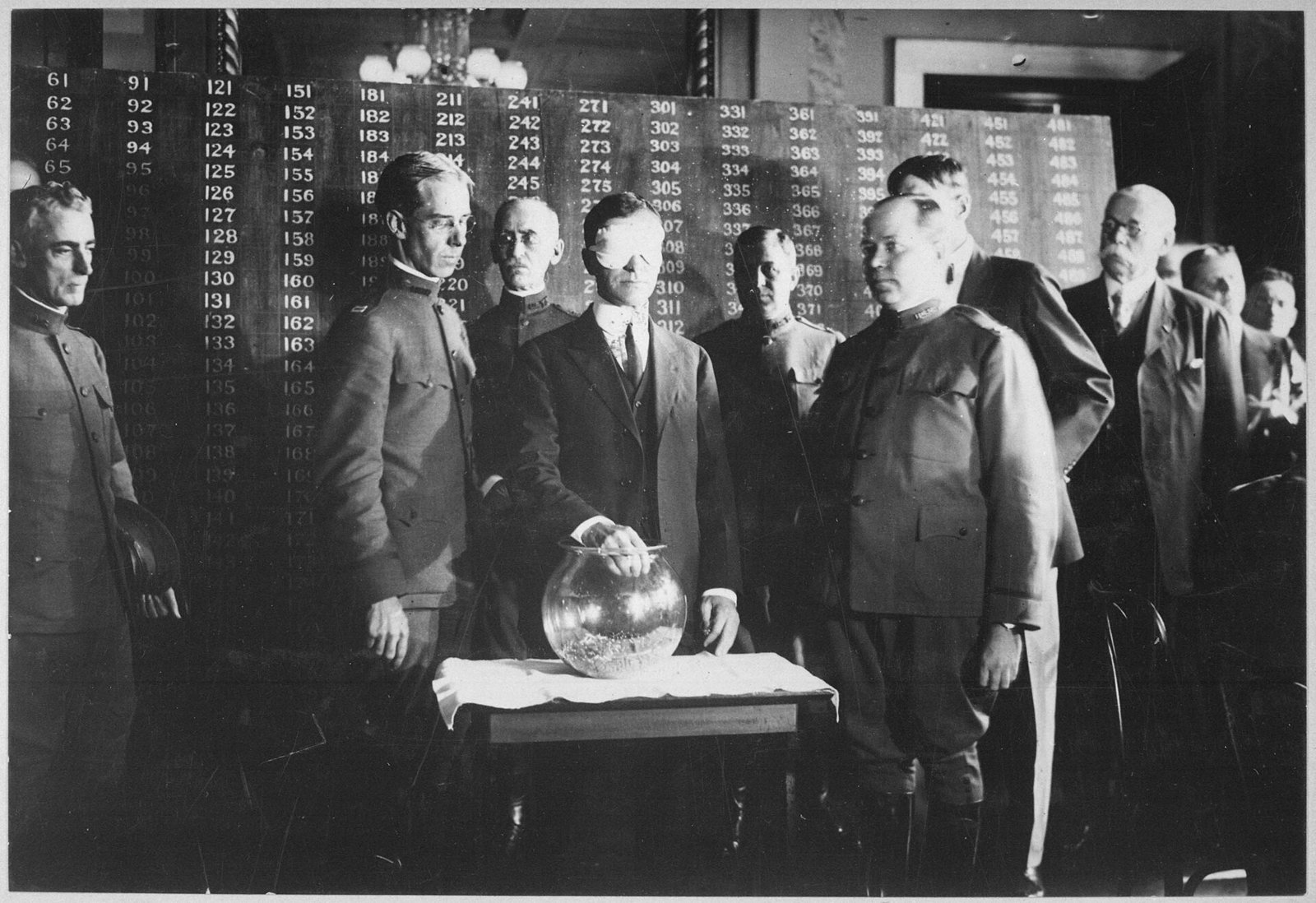
The best-known moment of the commission's work came when General William Westmoreland, then Army chief of staff, said he did not want to command "an army of mercenaries." Friedman's reply, as the economist Donald Boudreaux tells it: "General, would you rather command an army of slaves?"20 On January 27, 1973, after the Paris Peace Accords, Defense Secretary Melvin Laird announced that "the Armed Forces henceforth will depend exclusively on volunteer soldiers, sailors, airmen and Marines." It ended 25 years of uninterrupted conscription.21
The case for the citizen soldier
The objection to a volunteer force has never been only about money, and it deserves a hearing on its own ground. A republic that hires its soldiers may find it easier to go to war, since the sons of the comfortable no longer face the draft notice. A professional force can drift apart from the citizens it defends, drawn from a narrower band of regions, families and incomes. And there is an old tradition, older than the Constitution, that defense is a duty every citizen owes, which a government should not simply buy from some of them. People who hold an ordered view of liberty, in which freedom carries obligations to the common good, will feel the weight of that argument.
Friedman's reply was that compulsion is the wrong way to honor a duty. A conscript serves because he is forced, and the cost falls hardest on the young men who can least avoid it. Defenders of the volunteer force add that a soldier who chose the job tends to stay in it longer and train deeper than one counting the days to discharge. Whether a country that does not share the burden of its wars will choose them more carelessly is a question the record has not settled. It is fair to put it to anyone who thinks the matter closed.
Letting currencies float
After the war the free world ran on fixed exchange rates. Under the Bretton Woods system, other currencies were pegged to the dollar and the dollar was convertible into gold for foreign governments. When a country's prices drifted out of line, the peg forced painful adjustments at home or trade controls at the border.
Friedman's essay "The Case for Flexible Exchange Rates," printed in his Essays in Positive Economics (University of Chicago Press, 1953), argued for letting the market set the price of currencies.22 His best-known illustration came from the clock. Imagine someone who objects to daylight saving time: "Isn't it absurd to change the clock in summer when exactly the same result could be achieved by having each individual change his habits? All that is required is that everyone decide to come to his office an hour earlier, have lunch an hour earlier, etc."23 It is much easier to change one price, the clock, than to get millions of people to change their schedules together. A flexible exchange rate does the same for a whole economy. One price moves instead of every wage and price in the country.
The Camp David decisions of August 1971 closed the gold window. A few months later the Smithsonian Agreement tried to keep rates pegged, and Bretton Woods ended soon after.2 By 1973 the major currencies were floating, as Friedman had recommended two decades earlier.
A $7,500 paper and a new market
Floating rates created a new risk for every importer, exporter and banker, and Leo Melamed, chairman of the Chicago Mercantile Exchange, saw a market in it. He wanted to trade futures contracts in foreign currencies and worried that his board would think the idea crazy. So he asked Friedman for a feasibility study. Friedman wrote "The Need for Futures Markets in Currencies" in 1971 for what Melamed called "the modest stipend of $7,500." The paper stated flatly, "Bretton Woods is now dead."24 The exchange began trading futures on several currencies in 1972.25 The financial futures markets that farmers, lenders and businesses now use to hedge against swings in prices and rates grew from that start.
Friedman's position had a test case abroad that he did not choose. In 1979 Chile, run by economists trained at his own university, pegged its peso to the dollar. The overvalued peso and high interest rates fed the crash of 1982, when output fell by about 14 percent. The peg was a departure from the floating rates Friedman favored, and defenders of the Chilean reforms point to it, along with the regional debt crisis, as the cause of the crash.26 Lesson 6 takes up the Chilean story.
The machinery he regretted
The most uncomfortable entry in Friedman's public record dates from before he was famous. From 1941 to 1943 he worked at the Treasury Department on wartime tax policy.4 The government needed revenue fast, and the income tax, which then reached far more Americans than before the war, was paid in a lump the following year. Friedman was one of the small technical group that worked on collecting it at the source instead.27 The Current Tax Payment Act of 1943, signed June 9, 1943, compelled employers to withhold federal income tax from workers' paychecks.28
Half a century later the Friedmans wrote about it in their memoir, Two Lucky People (1998). During the war, they said, "we concentrated single-mindedly on the promotion of the war effort. We gave next to no consideration to any longer-run consequences." Then the sentence most often quoted from the book:
"It never occurred to me at the time that I was helping to develop machinery that would make possible a government that I would come to criticize severely as too large, too intrusive, too destructive of freedom. Yet, that was precisely what I was doing."
Milton and Rose D. Friedman, Two Lucky People (University of Chicago Press, 1998), as quoted by Amity Shlaes, Hoover Digest, 1999.29
"There is an important lesson here," they added. "It is far easier to introduce a government program than to get rid of it."29 In a 1995 interview with Reason he called withholding "a great mistake for peacetime" and said he wished there were some way of abolishing it.27 No such way has been found. Withholding is the reason most Americans never write a check for most of their income tax, and the reason a tax increase can pass with less resistance than its size would seem to invite.
It is to Friedman's credit that he said all this himself. Plenty of public figures bury the parts of their record that cut against their later views. He put his in a memoir.
Free to Choose and the Reagan years
Friedman's widest audience came from television. Bob Chitester, the owner of a public station in Erie, Pennsylvania, persuaded the Friedmans to make a series, and with W. Allen Wallis's help raised $2.5 million to produce it.30 Filming began in March 1978 and ran about eight months. The finished Free to Choose had ten one-hour programs, each a half-hour documentary and a half-hour debate with critics, and the first aired on PBS in January 1980.4 The opening episode, "The Power of the Market," is the one in which Friedman holds up a pencil and explains that no single person on earth knows how to make one. The book, written with Rose and published by Harcourt Brace Jovanovich, was the best-selling nonfiction book of 1980.4
Reagan
Friedman's friendship with Ronald Reagan began with a lost cause. In early 1973 Governor Reagan was campaigning for California's Proposition 1, a constitutional amendment to limit how much the state could spend each year, and Friedman spent a day flying around the state with him in a small plane, holding a press conference at every stop. The measure was narrowly defeated. At the last stop a reporter asked Friedman whether he would back Reagan for president, and he said yes. "I have never been disappointed since," he wrote in 2004, adding that the Proposition 1 effort "started a movement."31 Friedman was an unofficial adviser to Reagan's 1980 campaign and served on the President's Economic Policy Advisory Board throughout his presidency.4
Across the Atlantic, Margaret Thatcher's government took up the monetary side of his work. A June 9, 1980 statement on the Medium-Term Financial Strategy, held in the Thatcher Foundation archive, describes the plan as essentially a monetarist strategy, built around targets for money growth.32 Lesson 2 explains why such targets proved hard to hit once the relation between money and spending broke down in the 1980s.
The fight he never won
One cause brought Friedman more hate mail than praise from his usual allies. On September 7, 1989, he published an open letter in The Wall Street Journal to William Bennett, President George H. W. Bush's drug policy director. He wrote that decriminalizing drugs was even more urgent than when he had first argued for it in 1972, and told Bennett that his mistake was to miss that the very measures he favored were a major source of the evils he deplored.33 His argument was that prohibition creates the profits that fund violent gangs and corrupt police, and that drug use is a tragedy for the user that criminal law converts into a disaster for everyone else. Many conservatives answered that law teaches as well as punishes, and that legal drugs would mean more addicts. As of October 2026 federal law still prohibits the drugs he wrote about, while many states have legalized marijuana. Neither side has persuaded the other.
The ledger
Friedman judged scientific theories by their predictions. Public proposals can be judged by a plainer test: did anyone adopt them, and what happened? The table sets out the main ones as of October 2026.
| Proposal | First made | What happened | Status, October 2026 |
|---|---|---|---|
| End peacetime conscription | 1967 essay; Gates Commission, 1970 | Volunteer force announced January 27, 1973 | Adopted. Draft registration remains on the books. |
| Flexible exchange rates | 1953 essay | Gold window closed August 1971; major currencies floating by 1973 | Adopted for the dollar and most major currencies |
| School vouchers | 1955 essay | Friedman Foundation, 1996; state programs spread; federal tax credit law, July 4, 2025 | Partly adopted: 75 programs in 34 states, 1.5 million students (EdChoice, 2026) |
| Negative income tax replacing other programs | Capitalism and Freedom, 1962 | Family Assistance Plan passed the House twice, died in the Senate; EITC enacted 1975 | A work-tested cousin adopted; the replacement never happened |
| Steady growth of money | 1960 | Fed targeted reserves from October 1979 to 1982 | Tried and abandoned (see Lesson 2) |
| No wage and price controls | 1962 list | Nixon froze wages and prices, August 1971 | Rejected then; no general controls since the 1970s |
| Limits on government spending | California Proposition 1, 1973 | Narrowly defeated | Similar limits later passed in other states |
| Abolish withholding | His later view of his own 1943 work | Never seriously considered | Not adopted |
| Decriminalize drugs | 1972; open letter of 1989 | Federal prohibition continues; many states legalize marijuana | Not adopted federally |
Read across the rows and a pattern shows. Friedman won where he could point to a cost that was hidden and make it visible. The draft concealed a tax on young men. The fixed exchange rate concealed the price of defending a peg. He lost where his proposal asked a government to give something up, whether a revenue machine like withholding, a set of programs that the negative income tax would have replaced, or the moral authority claimed by drug law. And on schools the fight is still going, seventy-one years after the essay, which suggests that he picked the right ground for a long one.
Remember: Friedman's public proposals almost always kept a role for government: it would pay for schooling, set a floor under income and enforce the rules of the game. His target was the way government did these things, by running the schools, managing the poor through dozens of programs and forcing young men into uniform.
Lesson 4 turns to the economist Friedman most admired and most often argued with on money, Friedrich Hayek.
Learn more
- The Role of Government in Education (1955): The essay itself, short and plain, including the segregation note.
- The Gates Commission report: The 1970 report that ended the draft, with the pay tables and Roy Wilkins's letter.
- Moffitt on the negative income tax: A careful economist's history of the idea, the experiments and the EITC.
- The end of gold convertibility: The Fed's own account of the Camp David weekend.
- Friedman and currency futures: Leo Melamed's story of the $7,500 paper.
- The Greedy Hand in a Velvet Glove: Amity Shlaes on withholding, with the passage from Friedman's memoir.
- Freedom's Friend: Friedman's own short account of Reagan, from 2004.
- CRS on the federal scholarship tax credit: The nonpartisan explanation of the 2025 law and how states opt in.
- An Open Letter to Bill Bennett: Friedman's 1989 case against drug prohibition.
Notes
- White House Photo Office, contact sheet WHPO-6503, frames 02A-06A and 06, "President Nixon seated at his Oval Office desk during a meeting with George Shultz and Milton Friedman," June 8, 1971, Richard Nixon Presidential Library. View it online. ↩
- Federal Reserve History, "Nixon Ends Convertibility of U.S. Dollars to Gold and Announces Wage/Price Controls," on the Camp David meeting of August 13-15, 1971, the closing of the gold window, the 90-day freeze, the 10 percent import surcharge and the Smithsonian Agreement. Read it online. ↩
- Milton Friedman, Capitalism and Freedom (University of Chicago Press, 1962), end of ch. 2, item 4 of the list of unjustified government activities, "rent control" and "general wage and price controls." Publisher page. ↩
- Milton Friedman, Biographical, Nobel Prize, with 2005 addendum: Treasury, 1941-43; the triweekly Newsweek column from 1966, alternating with Paul Samuelson and Henry Wallich, until it was "terminated in 1983"; the Free to Choose series and book; and membership on the President's Economic Policy Advisory Board. Read it online. ↩
- Laurence B. Siegel, "Samuelson, Friedman and the Debate that Shaped Economic Policy," Advisor Perspectives, October 11, 2021, reviewing Nicholas Wapshott, Samuelson Friedman. Donald J. Boudreaux, "Milton Friedman, A Centennial Appreciation," Cato Institute, July 30, 2012, also dates the column 1966 through 1984. Read it online. ↩
- "We are all Keynesians now," on the Time attribution of December 31, 1965, Friedman's letter of February 4, 1966, Henry Hazlitt's earlier use ("The Policy is Inflation," Newsweek, July 5, 1954) and Nixon's remark reported by the New York Times on January 7, 1971. Friedman's letter is paraphrased. Read it online. ↩
- Milton Friedman, "The Role of Government in Education," in Robert A. Solo, ed., Economics and the Public Interest (New Brunswick, NJ: Rutgers University Press, 1955), pp. 123-144. Quotations are from the text reprinted by EdChoice, which cites both the 1955 version and the revised chapter in Capitalism and Freedom (1962). Read it online. ↩
- Friedman, "The Role of Government in Education" (1955), note 2, paraphrased. Read it online. ↩
- "EdChoice," on its founding in 1996 in Indianapolis by Milton and Rose D. Friedman and its 2016 change of name. Read it online. ↩
- EdChoice, "The Idea That Changed American Education" (March 2026). Read it online. ↩
- Congressional Research Service, "Federal Tax Credit Scholarship Program Included in P.L. 119-21, the FY2025 Reconciliation Law," R48724 (2025): signed July 4, 2025; credit of 100 percent of qualified contributions up to $1,700; tax years beginning in 2027; voluntary state participation; eligibility up to 300 percent of area median gross income. Read it online. ↩
- Office of the Governor of Idaho, "Gov. Little expands education freedom, issues executive order opting into federal scholarship tax credit program," February 19, 2026, on Executive Order 2026-03, signed February 16, 2026. Read it online. ↩
- Robert A. Moffitt, "The Negative Income Tax and the Evolution of U.S. Welfare Policy," Journal of Economic Perspectives 17, no. 3 (Summer 2003), pp. 119-140, on the $3,600 guarantee and 50 percent rate, Friedman's 1969 testimony, the Seattle-Denver results and the growth of the EITC. Read it online. ↩
- "Family Assistance Plan," on the August 1969 address, the $1,600 maximum for a family of four, House passage in April 1970 and June 1971, the Senate Finance Committee's actions in December 1970 and September 1972, and Senate passage of H.R. 1 by 68 to 5 on October 5, 1972. Read it online. ↩
- Richard Nixon, "Statement About House Approval of the Family Assistance Act of 1970," April 16, 1970, The American Presidency Project. Read it online. ↩
- "Negative income tax," section on the U.S. experiments of 1968 to 1982 (New Jersey, rural Iowa and North Carolina, Gary, Seattle-Denver) and their labor-supply results. Read it online. ↩
- Internal Revenue Service, "IRS, national partners launch EITC Awareness Day on 50th anniversary of the Earned Income Tax Credit," IR-2025-20, January 31, 2025. Read it online. ↩
- Richard Nixon Foundation, "45 Years Later: Nixon and the Gates Commission" (February 2015), on Friedman's May 1967 essay and the presentation of the report on February 21, 1970. Read it online. ↩
- The Report of the President's Commission on an All-Volunteer Armed Force (Washington: Government Printing Office, 1970): list of members, the unanimous conclusion, the pay proposals, the fiscal 1971 cost estimate, the standby draft date, and Roy Wilkins's letter of February 6, 1970. Read it online. ↩
- Donald J. Boudreaux, "Milton Friedman, A Centennial Appreciation," Cato Institute (originally in Newsday), July 30, 2012. Read it online. ↩
- Amy Zipkin, "Military draft ended 50 years ago," The Washington Post, reprinted in Stars and Stripes, January 27, 2023, quoting Melvin R. Laird's announcement of January 27, 1973. Read it online. ↩
- Milton Friedman, "The Case for Flexible Exchange Rates," in Essays in Positive Economics (University of Chicago Press, 1953). Publisher page. ↩
- Friedman, "The Case for Flexible Exchange Rates," p. 173, excerpt. Read the excerpt. ↩
- Timothy Taylor, "When Milton Friedman Blessed Foreign Exchange Futures Markets," Conversable Economist, October 5, 2011, summarizing Leo Melamed's account in the Cato Journal, Fall 2011, and Friedman's paper "The Need for Futures Markets in Currencies" (1971). Read it online. ↩
- CME Group, "The Genesis of Currency Futures and the International Monetary Market." Read it online. ↩
- "Crisis of 1982," on the 1979 peg of the Chilean peso to the dollar, the fall of GDP by 14.3 percent, the overvalued peso and high interest rates, and the dispute between defenders of the reforms, who point to the regional crisis, and historians such as Gabriel Salazar and Julio Pinto. Read it online. ↩
- Katherine Mangu-Ward, "Milton Friedman Helped Invent Income Tax Withholding," Reason, April 18, 2016, quoting Brian Doherty's 1995 interview with Friedman. Read it online. ↩
- "Current Tax Payment Act of 1943," Pub. L. 78-68, ch. 120, 57 Stat. 126, approved June 9, 1943. Read it online. ↩
- Amity Shlaes, "The Greedy Hand in a Velvet Glove," Hoover Digest 1999, no. 3 (reprinted from The Wall Street Journal, April 15, 1999), quoting Milton and Rose D. Friedman, Two Lucky People: Memoirs (University of Chicago Press, 1998). Read it online. ↩
- "Free to Choose (TV series)," on Bob Chitester of WQLN-TV, the $2.5 million budget raised with W. Allen Wallis's help, the first broadcast on January 11, 1980 and the episode "The Power of the Market." Read it online. ↩
- Milton Friedman, "Freedom's Friend," The Wall Street Journal, June 11, 2004, reprinted in Hoover Digest 2004, no. 3. Read it online. Quoted by Virginia Postrel at Dynamist. ↩
- Margaret Thatcher Foundation, "Statement to Regional City Editors (The Medium-Term Financial Strategy in Perspective)," June 9, 1980, Lawson Papers, Christ Church, Oxford. Read it online. ↩
- Milton Friedman, "An Open Letter to Bill Bennett," The Wall Street Journal, September 7, 1989, paraphrased here. The university copy formerly online is now available only through the Internet Archive. Read the archived copy. ↩

Check yourself
1. In his 1955 essay 'The Role of Government in Education,' what distinction did Friedman draw?
The essay says government financing of education could readily be separated from government administration of schools, and its conclusion blames the failure to separate the two questions. Source: Friedman, in Robert A. Solo, ed., Economics and the Public Interest (Rutgers University Press, 1955), pp. 123-144, reprinted by EdChoice.
2. What was Friedman's main objection to Nixon's Family Assistance Plan, according to Robert Moffitt's account of his 1969 testimony?
Moffitt (Journal of Economic Perspectives, 2003) reports that Friedman objected that the plan would sit on top of existing programs, producing high cumulative tax rates and losing the administrative simplicity of a true negative income tax.
3. What did the Gates Commission recommend to President Nixon in February 1970?
The report, presented February 21, 1970, said 'We unanimously believe that the nation's interests will be better served by an all-volunteer force,' recommended a standby draft system, and proposed raising first-term enlisted basic pay from $180 to $315 a month.
4. What happened at Camp David in August 1971 that bore on Friedman's ideas?
The Federal Reserve History essay on the end of gold convertibility describes the August 13-15, 1971 Camp David meeting, the closing of the gold window, the 90-day freeze and the 10 percent import surcharge. Friedman's 1962 list of unjustified activities included general wage and price controls.
5. What did Friedman later say about his wartime work at the Treasury on income tax withholding?
In Two Lucky People (quoted by Amity Shlaes in the Hoover Digest, 1999) the Friedmans wrote that it never occurred to him he was helping develop machinery for a government he would come to criticize, and in a 1995 Reason interview he called withholding 'a great mistake for peacetime.'
6. As of October 2026, which of these Friedman proposals has come closest to full adoption in the United States?
Defense Secretary Melvin Laird announced on January 27, 1973 that the armed forces would henceforth depend exclusively on volunteers. Withholding remains, the negative income tax was never enacted in its pure form, and drug prohibition remains federal law.
Terms in this lesson
- Neighborhood effect
- Friedman's term for a cost or benefit that falls on people outside a transaction. He argued that general schooling for citizenship has one, which justifies public funding, while vocational training does not.
- Education savings account
- A state account funded with public money that parents may spend on approved education costs such as tuition, tutoring and curriculum. It descends from Friedman's voucher idea.
- Scholarship granting organization
- A nonprofit that collects donations and pays private school or education scholarships. The 2025 federal law gives donors a tax credit of up to $1,700 a year for gifts to them, starting in 2027.
- Earned Income Tax Credit
- A refundable federal tax credit for low and moderate income workers, created in 1975. It resembles a negative income tax but pays only people with earnings.
- All-volunteer force
- An armed force filled entirely by enlistment at market pay, with no conscription. The United States has had one since 1973.
- Flexible exchange rate
- A price of one currency in terms of another that is set by supply and demand in the market instead of by government decree.
- Bretton Woods system
- The postwar arrangement of fixed exchange rates tied to a dollar convertible into gold for foreign governments. It broke down after August 1971.
- Withholding
- The collection of income tax by employers from each paycheck, required by the Current Tax Payment Act of 1943.
Sources
- Milton Friedman, The Role of Government in Education (1955), EdChoice reprint checked 2026-10
- Milton Friedman, Biographical, Nobel Prize checked 2026-10
- Robert A. Moffitt, The Negative Income Tax and the Evolution of U.S. Welfare Policy (Journal of Economic Perspectives, 2003) checked 2026-10
- The Report of the President's Commission on an All-Volunteer Armed Force (1970) checked 2026-10
- Federal Reserve History, Nixon Ends Convertibility of U.S. Dollars to Gold checked 2026-10
- IRS, EITC has helped America's working families since 1975 (IR-2025-20) checked 2026-10
- Congressional Research Service, Federal Tax Credit Scholarship Program in P.L. 119-21 (R48724) checked 2026-10
- Office of the Governor of Idaho, Executive Order 2026-03 press release checked 2026-10
- Amity Shlaes, The Greedy Hand in a Velvet Glove (Hoover Digest, 1999) checked 2026-10
- Milton Friedman, Freedom's Friend (Wall Street Journal, 2004; Hoover Digest) checked 2026-10
- EdChoice, The Idea That Changed American Education (2026) checked 2026-10
- Leo Melamed on Friedman's 1971 currency futures paper (Conversable Economist) checked 2026-10