Lesson 6 of 10 · about 22 minutes
The Incarceration of Japanese Americans
You'll be able to
- Describe Executive Order 9066, Public Law 503 and the sequence of orders that sent about 120,000 people to War Relocation Authority camps
- Explain what Minidoka was, where it stood in the Magic Valley, and how its residents answered the loyalty questionnaire and the call for volunteers
- Read the key passages of Hirabayashi, Korematsu and Ex parte Endo, including the dissents of Murphy and Jackson
- Trace the correction: the 1983 commission report, the coram nobis reversals, the Civil Liberties Act of 1988 and Trump v. Hawaii in 2018
- State why Ordered Liberty treats the episode as a breach, and why a lawful-looking order and a court's approval did not cure it
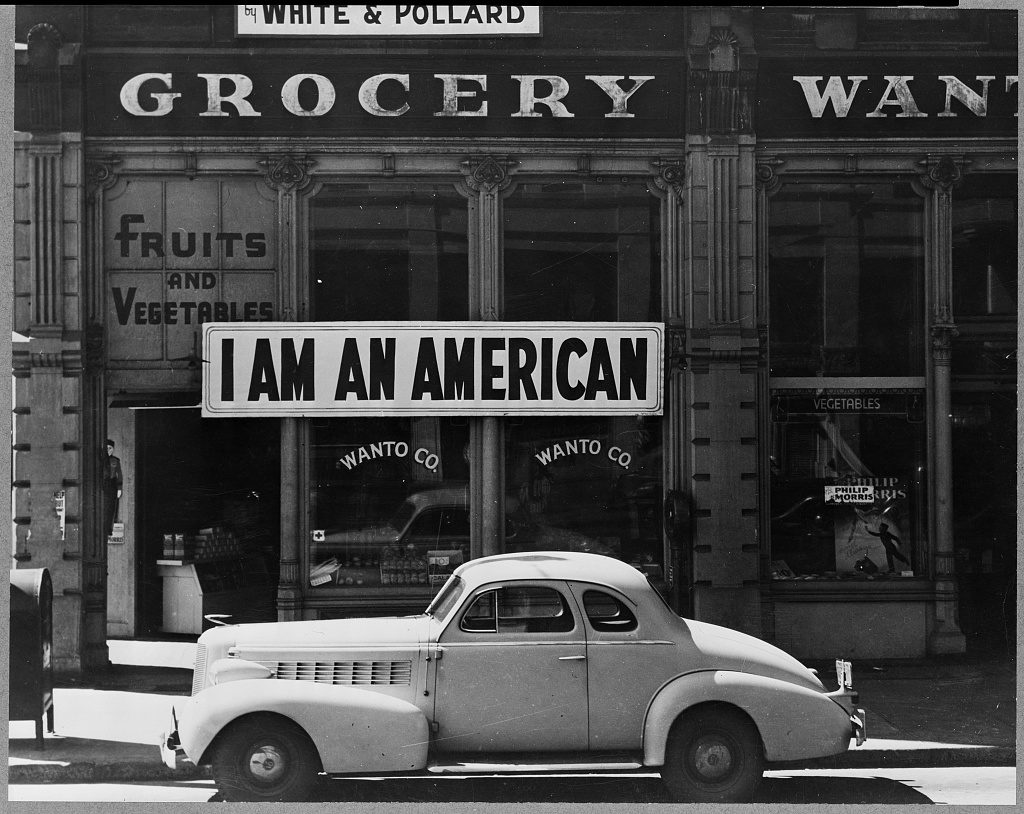
On December 8, 1941, the day after the bombing of Pearl Harbor, a man in Oakland hung a long banner across the front of his grocery store. It read I AM AN AMERICAN. The store was the Wanto Company, owned by the Matsuda family, and the man who ordered the sign was a graduate of the University of California.1 Dorothea Lange photographed it in March 1942. By then the shop was shut, closed under orders that sent people of Japanese descent away from the coast, and its owner was bound for a camp.
Eventually more than nine thousand people who had been through the same sorting lived on a sagebrush plain near Hunt, Idaho, north of Twin Falls.2 The camp is called Minidoka. It belongs in a course on ordered liberty because it is the clearest American case of a government taking liberty from people for who they were and not for anything they did. It did so under written law, with a court's approval, while most of the public looked on.
February 19, 1942
An order that names no one
Franklin Roosevelt signed Executive Order 9066 on February 19, 1942. Read it with care, because what it leaves out matters. It never mentions Japan, Japanese people or any ethnic group. It authorized the Secretary of War and his commanders, "whenever he or any designated Commander deems such action necessary or desirable," to prescribe military areas "from which any or all persons may be excluded."3 Any commander. Any area. Any persons. The order handed a general a power no statute had defined and no court had reviewed, and it left him to say whom it reached.
Congress supplied the penalty. On March 21, 1942, it passed Public Law 503. Anyone who entered, remained in or left a military area contrary to a commander's order, and who knew or should have known of it, was guilty of a misdemeanor, punishable by a fine of up to $5,000 or a year in prison.4 An Army order now carried criminal force against civilians who had been charged with nothing.
From proclamation to deadline
General John DeWitt, who commanded the Western Defense Command, issued Public Proclamation No. 1 on March 2, 1942, declaring military areas along the Pacific Coast. Civilian exclusion orders followed, one region at a time. Civilian Exclusion Order No. 34, dated May 3, told "all persons of Japanese ancestry, both alien and non-alien" in Alameda County, California, to be out by noon on May 8.5 Five days. A 23-year-old shipyard welder named Fred Korematsu did not report, and his case comes later in this lesson.6
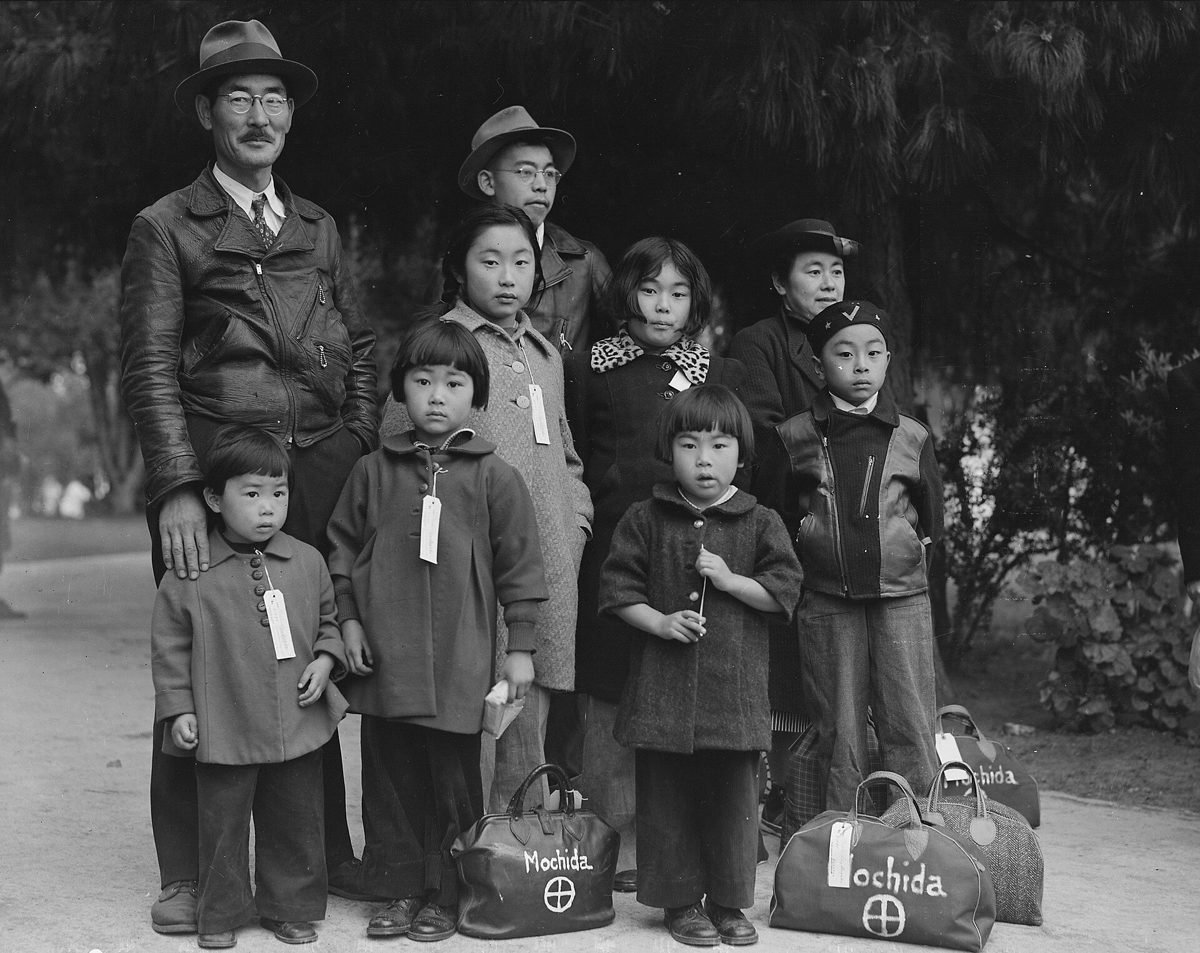
The Army sent people first to assembly centers and then to ten camps run by the War Relocation Authority, in Arizona, Arkansas, California, Colorado, Idaho, Utah and Wyoming.7
The numbers
The Park Service puts the figure at approximately 110,000 people removed from the West Coast, two-thirds of them American citizens, and over 120,000 incarcerated in all once people from Hawaii and elsewhere were counted.8 The citizens were Nisei, the American-born children of immigrants. Their parents, the Issei, had come from Japan, and the law barred them from becoming citizens, so they were aliens by statute after decades of living here.9 The Park Service calls the whole episode the single largest forced relocation of people in United States history.8
Two words compete for the camps. "Internment" is the legal term for holding enemy aliens, and it fits poorly when most of those held were citizens. This lesson follows the Park Service and says "incarceration."10
What the commission found about the reason
The reason given was military necessity. Four decades later a commission created by Congress went looking for it. In the summary of Personal Justice Denied it concluded that "the promulgation of Executive Order 9066 was not justified by military necessity, and the decisions which followed from it, detention, ending detention and ending exclusion, were not driven by analysis of military conditions." The causes, it said, were "race prejudice, war hysteria and a failure of political leadership."11
General DeWitt's own Final Report spoke in the language of race. Justice Frank Murphy quoted it in dissent. The report called all individuals of Japanese descent "subversive," said they belonged to "an enemy race" whose "racial strains are undiluted," and counted "over 112,000 potential enemies" along the coast.12 Murphy pointed out that nobody had explained why Japanese Americans were not given the individual hearings that persons of German and Italian ancestry received.12
Minidoka, Near Hunt, Idaho
A camp on 33,000 acres of sagebrush
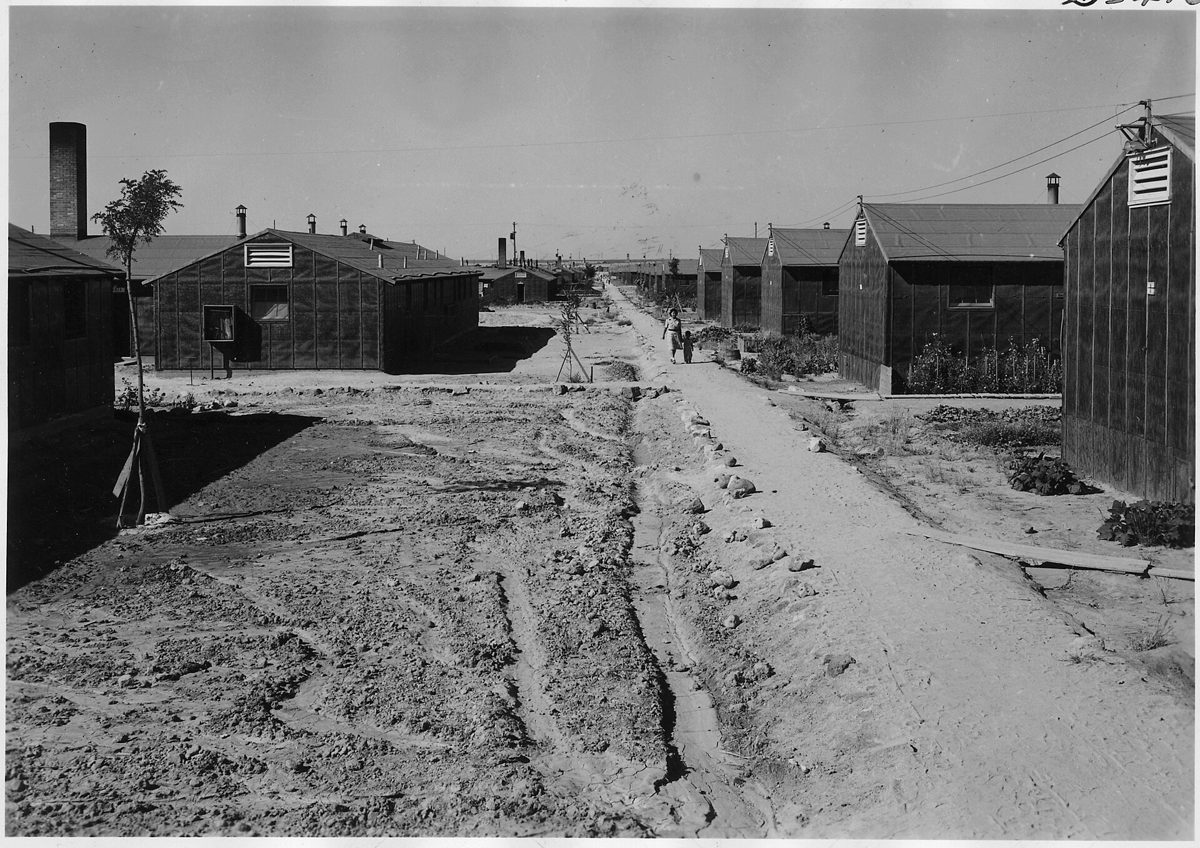
The commission's table lists the site as Minidoka (Hunt), in south-central Idaho, planned for 10,000 people.13 The first incarcerees arrived on August 10, 1942. The grounds covered about 33,000 acres of arid sagebrush desert, roughly twenty miles northeast of Twin Falls, and the population peaked at 9,397 on March 1, 1943.2 Guard towers, barbed wire and tar-paper barracks stood where the plain had been empty.7
Idaho did not give them a warm welcome. At a meeting of western governors and federal officials in Salt Lake City on April 7, 1942, Utah's Governor Herbert Maw proposed that states run the camps. The Governor of Idaho agreed with him and advocated rounding up and supervising all those who had already entered his state, in the commission's account. Wyoming's governor wanted concentration camps. Only Colorado's took a moderate line.13 Densho's encyclopedia says that Governor Chase Clark took a strongly anti-Japanese stance after Pearl Harbor.2 The same commission reports another Idaho, and an inconvenient one. Western farmers feared for their sugar beet crops, petitioned the White House for help in May 1942, and the agricultural leave program that followed let evacuees leave the camps to work the fields.14
The first winter
The Park Service tells one story from that first December. An elderly man named Edward Abe went out to gather wood for the artwork and furniture he made. He did not come back. His body was found a few days later, about two miles from camp, and he had died of exposure and exhaustion.15 Nobody at Minidoka had been charged with a crime. The commission's phrase for all of them is "without individual review or any probative evidence against them."11
Two Questions and an Honor Roll
Questions 27 and 28
In February 1943 registration teams went into the camps with a questionnaire for every adult. Question 27 asked draft-age men: "Are you willing to serve in the armed forces of the United States on combat duty, wherever ordered?" Question 28 asked everyone: "Will you swear unqualified allegiance to the United States of America and faithfully defend the United States from any or all attack by foreign or domestic forces, and forswear any form of allegiance or obedience to the Japanese emperor, or any other foreign government, power or organization?"9
Picture an Issei farmer of seventy answering the second one. He had no citizenship and could get none. A yes meant renouncing the only nationality he had. A no meant being marked disloyal. The commission called the question unfair and unanswerable for the Issei.9 The Nisei had their own complaint. Many saw a trick in it, since to forswear an allegiance to the emperor implied they had once held one.9
Minidoka's answers were the best the government got. The commission reported that Minidoka had the highest number of positive responses and credited the project director, who consulted Issei leaders before any meetings and allowed thorough discussion. At Tule Lake, in the commission's words, discussion was cursory.9 Densho adds that a disproportionately high percentage of the men at Minidoka volunteered for the segregated Nisei unit of the Army.2
The unit and the sign
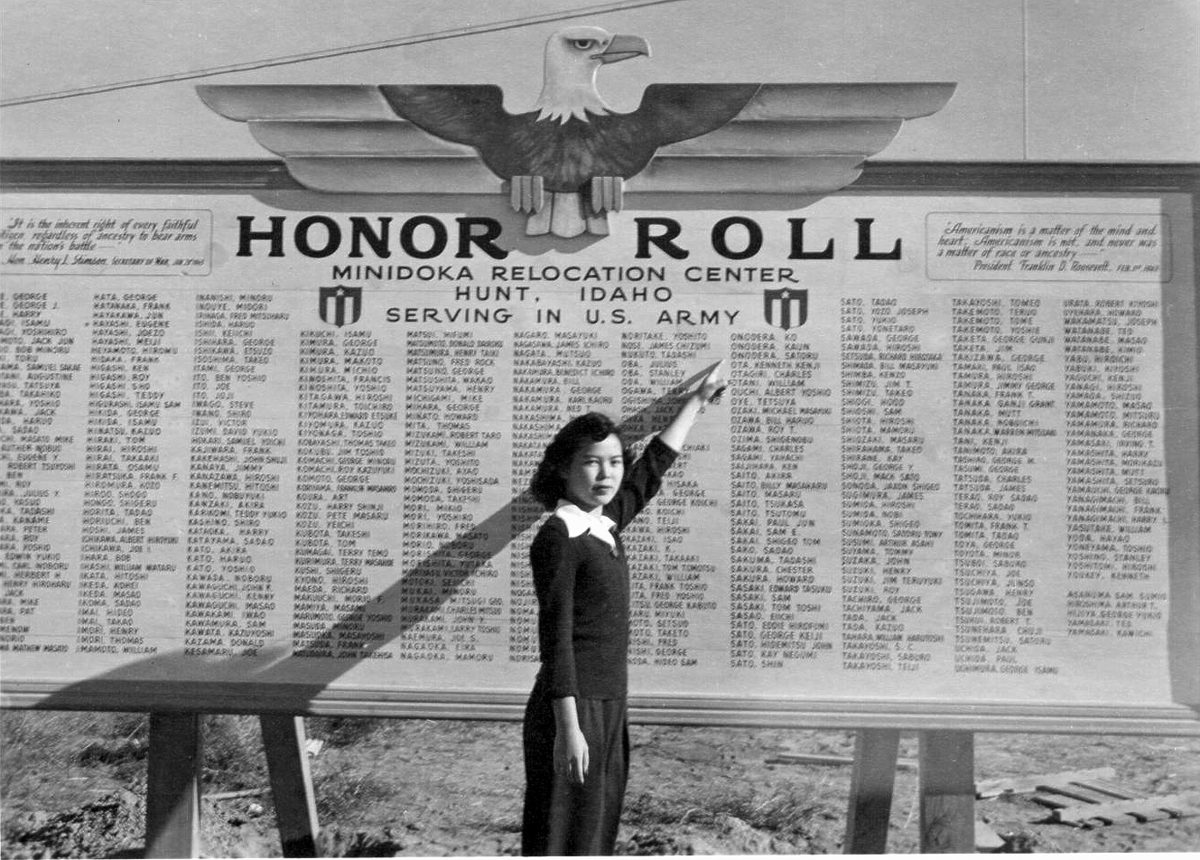
That unit was the 442nd Regimental Combat Team. About 33,000 Nisei served in the military during the war. The 442nd took 9,486 casualties in seven major campaigns, including 600 killed, and more than 18,000 men served with it.16 When Roosevelt approved the combat team in early 1943, he wrote that "Americanism is a matter of the mind and heart; Americanism is not, and never was, a matter of race or ancestry."9 A War Relocation Authority photographer recorded the honor roll at Minidoka, a three-panel board topped with an eagle: HONOR ROLL, MINIDOKA RELOCATION CENTER, HUNT, IDAHO, SERVING IN U.S. ARMY. Columns of names fill all three panels.17 Behind the board, the soldiers' families lived inside the fence.
Three Rulings and a Dissent
Hirabayashi and Yasui, June 1943
Gordon Hirabayashi failed to report to the Civil Control Station and broke the curfew. Minoru Yasui, an Oregon lawyer, broke the Portland curfew on March 28, 1942, as a test case.18 On June 21, 1943, the Supreme Court decided both. Chief Justice Stone wrote for the Court in Hirabayashi and sustained the curfew, only the curfew, because the Court could not "reject as unfounded the judgment of the military authorities and of Congress that there were disloyal members of that population, whose number and strength could not be precisely and quickly ascertained."19 In the same opinion he conceded the principle: "Distinctions between citizens solely because of their ancestry are by their very nature odious to a free people whose institutions are founded upon the doctrine of equality."19 Having said that, the Court let the curfew stand. It declined to review the exclusion conviction.19 The harder question went down the road.
Korematsu, December 1944
The road ended on December 18, 1944. By a vote of six to three the Court sustained Fred Korematsu's conviction for remaining in San Leandro, California.20 Justice Black's opinion contains the strangest run of sentences in the cases. It opens with a rule: "all legal restrictions which curtail the civil rights of a single racial group are immediately suspect." Courts "must subject them to the most rigid scrutiny. Pressing public necessity may sometimes justify the existence of such restrictions; racial antagonism never can."21 Then it declines to apply the rule. "Compulsory exclusion of large groups of citizens from their homes, except under circumstances of direst emergency and peril, is inconsistent with our basic governmental institutions," Black wrote, and he found the emergency enough. "But hardships are part of war, and war is an aggregation of hardships." The Court was "dealing specifically with nothing but an exclusion order," and "Korematsu was not excluded from the Military Area because of hostility to him or his race."21
Three justices saw the case differently. Justice Roberts described the trap the order set. Korematsu "dare not remain in his home, or voluntarily leave the area, without incurring criminal penalties," and the only way to avoid punishment "was to go to an Assembly Center and submit himself to military imprisonment."22 Justice Murphy wrote that the exclusion "goes over 'the very brink of constitutional power' and falls into the ugly abyss of racism," and he closed: "I dissent, therefore, from this legalization of racism."12
"A military order, however unconstitutional, is not apt to last longer than the military emergency. ... But once a judicial opinion rationalizes such an order to show that it conforms to the Constitution, or rather rationalizes the Constitution to show that the Constitution sanctions such an order, the Court for all time has validated the principle of racial discrimination in criminal procedure and of transplanting American citizens. The principle then lies about like a loaded weapon ready for the hand of any authority that can bring forward a plausible claim of an urgent need."
Justice Robert H. Jackson, dissenting, Korematsu v. United States, 1944.23
Jackson looked further down the road than the rest of the Court. A general's order would have died with the war. A holding that the order was constitutional would stay on the books, ready for the next official with an emergency in hand. His warning reads differently after 2018, as the last section of this lesson shows.
Endo, the same day
That same day the Court decided Ex parte Endo. Mitsuye Endo, a citizen from Sacramento, had petitioned for habeas corpus in July 1942 and had been held in camps since. Justice Douglas wrote that the authority to detain a citizen as protection against espionage or sabotage "is exhausted at least when his loyalty is conceded." Then he added: "A citizen who is concededly loyal presents no problem of espionage or sabotage. Loyalty is a matter of the heart and mind not of race, creed, or color."24 The day before, December 17, the exclusion orders had been rescinded by Public Proclamation No. 21, and the Solicitor General had sent Chief Justice Stone a copy, "presumably in the hope of mooting any decision in the Endo case," as the commission put it.25 The camps emptied through 1945. Minidoka closed that October.2
- Dec. 7, 1941 Japan attacks Pearl Harbor.
- Feb. 19, 1942 Roosevelt signs Executive Order 9066.
- Mar. 21, 1942 Congress passes Public Law 503, setting criminal penalties.
- May 8, 1942 Deadline for Alameda County under Civilian Exclusion Order No. 34.
- Aug. 10, 1942 First incarcerees arrive at Minidoka near Hunt, Idaho.
- Feb. 1943 Loyalty questionnaire given in the camps.
- Mar. 1, 1943 Minidoka reaches its peak population of 9,397.
- June 21, 1943 Hirabayashi and Yasui decided.
- Dec. 18, 1944 Korematsu and Ex parte Endo decided.
- Oct. 1945 Minidoka closes.
- Nov. 10, 1983 Korematsu's conviction overturned on coram nobis.
- Aug. 10, 1988 Civil Liberties Act signed.
- June 26, 2018 Trump v. Hawaii says Korematsu was gravely wrong the day it was decided.
The Reckoning
A commission, then two reversals
Congress authorized the Commission on Wartime Relocation and Internment of Civilians in 1980.20 The commission reported in December 1982 and made its recommendations in June 1983. Its finding on the cause appears above. It added a plain sentence of judgment: "A grave injustice was done to American citizens and resident aliens of Japanese ancestry who, without individual review or any probative evidence against them, were excluded, removed and detained by the United States during World War II."11 It recommended a joint resolution of apology and pardons for people convicted under the curfew and exclusion laws.26
The courts moved before the pardons did. An historian searching government files had found documents showing that the Federal Government suppressed findings in the 1940s that Japanese Americans on the West Coast were not security threats. On that record Judge Marilyn Hall Patel of the Northern District of California overturned Fred Korematsu's conviction on November 10, 1983. She concluded that senior officials knew there was no factual basis for the claim of military necessity when they went to the Supreme Court in 1944.20 The old case, she wrote, "stands as a constant caution that in times of war or declared military necessity our institutions must be vigilant in protecting constitutional guarantees."27 The Ninth Circuit reached the same place in Hirabayashi's case on September 24, 1987, and put it flatly: "The Hirabayashi and Korematsu decisions have never occupied an honored place in our history."28
The Civil Liberties Act of 1988
On August 10, 1988, President Reagan signed the Civil Liberties Act. Its first purposes were to "acknowledge the fundamental injustice" of the evacuation, relocation and internment, and to "apologize on behalf of the people of the United States." Congress found that the actions were "motivated largely by racial prejudice, wartime hysteria, and a failure of political leadership," and it provided $20,000 for each eligible survivor.29 Few statutes in American history admit a national error and attach a check to the admission.
Reagan's signing remarks reward a slow reading. He did not condemn the people who had made the decision. The nation was at war, he said, and "it's not for us today to pass judgment upon those who may have made mistakes while engaged in that great struggle." Then he drew the line: "we must recognize that the internment of Japanese-Americans was just that: a mistake." He knew what money could and could not do. "No payment can make up for those lost years," he said. "So, what is most important in this bill has less to do with property than with honor. For here we admit a wrong; here we reaffirm our commitment as a nation to equal justice under the law."30
Korematsu, disowned in 2018
In 2018 the Supreme Court came back to the case from an odd direction. Trump v. Hawaii upheld a presidential proclamation limiting entry from several countries, and the dissent compared it to Korematsu. Chief Justice Roberts, for the majority, took the opportunity to say what the Court thought. Korematsu, he wrote, "was gravely wrong the day it was decided, has been overruled in the court of history," and, "to be clear," it "has no place in law under the Constitution."31 The last phrase is Justice Jackson's, borrowed from his 1944 dissent. Justice Sotomayor, in dissent, welcomed what she called "the important step of finally overruling Korematsu."32 Whatever label fits, the Court that decided Korematsu had been told, by the Court itself, that it had no place in law.
The site today
On January 17, 2001, President Clinton proclaimed the Minidoka Internment National Monument.33 Congress renamed it Minidoka National Historic Site in 2008.34 An all-volunteer group, the Minidoka Pilgrimage Planning Committee, organizes an annual pilgrimage in which survivors, descendants and allies visit the site.35
Ordered Liberty Applied to the Incarceration
A lawful order that failed the test of justice
The incarceration is treated in three papers of the framework: "Ordered Liberty Reclaimed," the Concord Principle of Resistance and "The Ordered Liberty Papers." "Ordered Liberty Reclaimed" and the Concord Principle of Resistance classify it as a grave violation of due process, equal protection and property rights, and state that in hindsight it was "not only unconstitutional but morally indefensible; driven more by racial prejudice and political hysteria than by military necessity."36 The government acted under an executive order, a federal statute and a Supreme Court ruling. By the usual test of legality, it was lawful. By the test of Ordered Liberty, it was a breach. The framework holds that an order which punishes the innocent "is unjust, even if it is temporarily legal."36 Korematsu, named beside Dred Scott, is the framework's example of why a court's approval settles nothing. Courts, the framework states, "may review and overturn unjust orders, but they can also err."36
The records in this lesson show the facts the framework applies. The government never accused Hirabayashi, Yasui, Korematsu or Mitsuye Endo of sabotage. It acted on their ancestry. The Concord Principle of Resistance describes the threat as "rooted in collective punishment rather than individual guilt."37 That phrase marks the breach. Power given to protect the country was turned on a group of its own people, and no one was asked what any individual had done.
Nonviolent endurance and moral standing
The Concord Principle of Resistance asks what the people removed might have done, and it answers with care. Violent defensive force, it states, "may have been morally justifiable in this context, particularly if individuals had resisted imminent detention or the forcible seizure of property." The threat was real and came from the state. But force "would have almost certainly resulted in mass tragedy," and would have fed the very prejudice behind the order. That Japanese Americans did not resist by force, in the framework's words, "reflects the extraordinary restraint of the Japanese American community under extreme injustice."37
The framework draws a lasting conclusion from this. "In moral retrospect," it states, "their nonviolent endurance became one of the strongest long-term indictments of the government's abuse of power." The framework does not call violence wrong in principle. It holds that the absence of violence in this case preserved a moral high ground that led to national reckoning, apology and legal reform.37 "The Ordered Liberty Papers" add that citizens and leaders who resisted the policy peacefully or protested its injustice "acted within moral right," and describe the state's conduct as "lawful authority abandoning moral legitimacy."38
The record shows the same pattern. Hirabayashi and Yasui took their refusals to the courts. Korematsu did too, once he was arrested. None of them used force. They lost, and it took forty years and a trove of buried documents before the courts said they had been right.
Where the failure sat
The breach did not rest on one man's signature. The President signed the order, Congress wrote the penalty, a general carried it out, and a majority of the Supreme Court looked at a record with no individual cause in it and wrote that hardships are part of war. State governors, Idaho's among them, pressed for tighter control of the people already within their borders. A free people depends on each of these safeguards, and in 1942 each one gave way.
The framework does not make that generation into monsters. Earl Warren, who as California's Attorney General supported the removal, wrote in his memoirs that the order was "not in keeping with our American concept of freedom and the rights of citizens," and said he had acted "impulsively," in response to "fear, get-tough military psychology, propaganda, and racial antagonism."27 Warren's passage describes how an honorable official under pressure signs what he later cannot defend. The duty of scrutiny in the framework has to work before the pressure peaks, when saying no is still unpopular.
The survivors are getting old. The Pilgrimage committee says as much: "Every year, there are fewer and fewer people able to share their stories. We need to hear their stories while we still can."39
Learn more
- Minidoka National Historic Site: Visiting information and history from the National Park Service for the site near Hunt, Idaho, north of Twin Falls.
- Densho Encyclopedia: Minidoka: A careful account of the camp, its population and its daily life, from the nonprofit that records the incarceration.
- Personal Justice Denied: The full commission report, chapter by chapter. Chapter 6 on the relocation centers and chapter 7 on loyalty are the best places to start.
- Korematsu v. United States: Read Justice Black's majority and then Murphy and Jackson in dissent. The contrast is the lesson.
- Ex parte Endo: The same day's ruling that ended the detention of loyal citizens, in a short and carefully limited opinion.
- Civil Liberties Act of 1988: Congress's findings and apology, in the statute's own words. Section 2 is a single page.
- Reagan's remarks on signing the Act: Five minutes of reading. Notice what he declines to blame on the wartime generation and what he insists on admitting.
- Trump v. Hawaii: The 2018 opinion in which the Court said Korematsu was gravely wrong the day it was decided.
Notes
- Dorothea Lange, photograph of the Wanto Company store, Oakland, California, March 1942, Library of Congress. The full caption says the "I am an American" sign was placed in the window on December 8, the day after Pearl Harbor, that the store closed after evacuation orders, and that the owner was a University of California graduate. A summary on the same record names the family as the Matsudas and says Lange took the picture while working for the War Relocation Authority. Read it online. ↩
- Densho Encyclopedia, "Minidoka." The entry gives August 10, 1942 as the day incarcerees arrived, a peak population of 9,397 on March 1, 1943, a location roughly twenty miles northeast of Twin Falls, and describes the site as arid sagebrush desert. Read it online. ↩
- Executive Order 9066, "Authorizing the Secretary of War to Prescribe Military Areas," February 19, 1942, National Archives transcript. Read it online. ↩
- Act of March 21, 1942, chap. 191, Public Law 77-503, 56 Stat. 173. The statute makes it a misdemeanor, punishable by a fine of up to $5,000 or imprisonment of up to one year, to enter, remain in or leave a military area contrary to the commander's order. Read it online. ↩
- Korematsu v. United States, 323 U.S. 214 (1944), Justice Black for the Court, describing Public Proclamation No. 1 of March 2, 1942, and Civilian Exclusion Order No. 34 of May 3, 1942, which set noon on May 8 as the deadline for Alameda County. Read it online. ↩
- S. Res. 126, 109th Congress (2005), findings on Fred Korematsu: born in Oakland on January 30, 1919; the resolution calls him 22 years old and a shipyard welder when he refused to report, though by his birth date he was 23 when he was arrested on May 30, 1942, for remaining in a military area. Read it online. ↩
- National Park Service, Minidoka National Historic Site, "History and Culture," describing the tar-paper barracks, guard towers and fences. Read it online. ↩
- National Park Service, "Japanese American Incarceration," World War II in the American Pacific. Source for the removal of approximately 110,000 people, two-thirds of them American citizens, from the West Coast, for the total of over 120,000 incarcerated, and for the phrase "the single largest forced relocation of people in U.S. history." Read it online. ↩
- Commission on Wartime Relocation and Internment of Civilians, Personal Justice Denied, chapter 7, "Loyalty: Leave and Segregation," on the registration of February 1943, the text of Questions 27 and 28, Minidoka's responses and President Roosevelt's letter on the combat team. Read it online. ↩
- The Park Service and Densho both use "incarceration" for the camps. The commission used the three verbs "excluded, removed and detained," and the Supreme Court majority in Korematsu said it found it "unjustifiable to call them concentration camps." Justice Roberts, dissenting, called relocation centers "a euphemism for concentration camps." ↩
- Commission on Wartime Relocation and Internment of Civilians, Personal Justice Denied, Part 1 (December 1982), Summary, National Archives. Read it online. ↩
- Korematsu v. United States, 323 U.S. 214 (1944), Justice Murphy dissenting, including his discussion of General DeWitt's Final Report and of the treatment of German and Italian Americans. Read it online. ↩
- Commission on Wartime Relocation and Internment of Civilians, Personal Justice Denied, chapter 6, "The Relocation Centers," on the April 7, 1942 meeting in Salt Lake City and on the camp sites and their capacity. Read it online. ↩
- Commission on Wartime Relocation and Internment of Civilians, Personal Justice Denied, chapter 6, on the agricultural leave program that began in May 1942, for sugar beets and other crops. Read it online. ↩
- National Park Service, Minidoka National Historic Site, "People," on Edward Abe and Minoru Yasui. Read it online. ↩
- Commission on Wartime Relocation and Internment of Civilians, Personal Justice Denied, chapter 10, "Military Service": about 33,000 Nisei served, and the 442nd Regimental Combat Team took 9,486 casualties, including 600 killed, with more than 18,000 men serving in it over the war. Read it online. ↩
- War Relocation Authority photograph, "Honor roll" at the Minidoka War Relocation Center, National Archives (210-CMB-i2-1348), Records of the War Relocation Authority. Read it online. ↩
- Yasui v. United States, 320 U.S. 115 (1943), decided June 21, 1943. Yasui was charged with violating the Portland curfew on March 28, 1942. Read it online. ↩
- Hirabayashi v. United States, 320 U.S. 81 (1943), decided June 21, 1943, Chief Justice Stone for the Court. Read it online. ↩
- S. Res. 126, 109th Congress (2005), honoring Fred T. Korematsu, GovInfo. Its findings record the 6-to-3 vote in Korematsu, the coram nobis ruling of Judge Marilyn Hall Patel on November 10, 1983, and the creation of the Commission by Congress in 1980. Read it online. ↩
- Korematsu v. United States, 323 U.S. 214 (1944), opinion of the Court by Justice Black. The "rigid scrutiny" passage opens the discussion. The language about "compulsory exclusion" and "hardships are part of war" appears later in the opinion, as does the sentence about hostility to him or his race. Read it online. ↩
- Korematsu v. United States, 323 U.S. 214 (1944), Justice Roberts dissenting. Read it online. ↩
- Korematsu v. United States, 323 U.S. 214 (1944), Justice Jackson dissenting. Read it online. ↩
- Ex parte Endo, 323 U.S. 283 (1944), decided December 18, 1944, Justice Douglas for the Court. Read it online. ↩
- Commission on Wartime Relocation and Internment of Civilians, Personal Justice Denied, chapter 8, "Ending the Exclusion," on Public Proclamation No. 21 of December 17, 1944. Read it online. ↩
- Commission on Wartime Relocation and Internment of Civilians, Personal Justice Denied, Part 2: Recommendations (June 1983), National Archives. Read it online. ↩
- David Sklansky, "Japanese Internment Case Not 'Good Law,'" Stanford Lawyer, Stanford Law School, November 18, 2016, quoting Judge Patel's opinion in Korematsu v. United States, 584 F. Supp. 1406 (N.D. Cal. 1984) and Earl Warren's memoirs. Read it online. ↩
- Hirabayashi v. United States, 828 F.2d 591 (9th Cir. 1987), decided September 24, 1987. Read it online. ↩
- Civil Liberties Act of 1988, Public Law 100-383, sections 1 and 2 and section 105, 102 Stat. 903, signed August 10, 1988. Read it online. ↩
- Ronald Reagan, "Remarks on Signing the Bill Providing Restitution for the Wartime Internment of Japanese-American Civilians," August 10, 1988, The American Presidency Project. Read it online. ↩
- Trump v. Hawaii, No. 17-965, decided June 26, 2018, Chief Justice Roberts for the Court. Read it online. ↩
- Trump v. Hawaii, No. 17-965 (2018), Justice Sotomayor dissenting. Read it online. ↩
- Proclamation 7395, "Establishment of the Minidoka Internment National Monument," January 17, 2001 (transcript of the Federal Register document). Read it online. ↩
- National Park Service, Minidoka National Historic Site Foundation Document Overview. It records that the monument was established on January 17, 2001, and that Public Law 110-229 of May 8, 2008, expanded it and renamed it Minidoka National Historic Site. Read it online. ↩
- Stephen Kitajo, "The Trail to Minidoka Pilgrimage," Pacific Citizen, August 7, 2015, and Samantha Wright, "Pilgrimage to Idaho's Minidoka site keeps history alive," KISU, July 6, 2023. Both name the Minidoka Pilgrimage Planning Committee as the organizer. Read the Pacific Citizen article. ↩
- Jeff A. Pierson, "Ordered Liberty Reclaimed: A Foundation for Liberty," v3.1 (July 13, 2025), section "Japanese American Internment, 1942," and the section "Who Decides When an Order Is Unjust?" Read it on this site. ↩
- Jeff A. Pierson, "The Concord Principle of Resistance," Draft 7 (2025), section on applying the principle, "Relocation of Japanese Americans (1942)." Read it on this site. ↩
- Jeff A. Pierson, "The Ordered Liberty Papers" (2025), section on examples of the Concord Principle in practice, "The Japanese Relocation Camps (1942-1945)." Download it from this site (Word). ↩
- Stephen Kitajo, "The Trail to Minidoka Pilgrimage," Pacific Citizen, August 7, 2015, quoting the Minidoka Pilgrimage Planning Committee. Read it online. ↩


Terms in this lesson
- Executive Order 9066
- The order Franklin Roosevelt signed on February 19, 1942, that let the Secretary of War and military commanders set areas from which any or all persons could be excluded. It never named Japanese Americans, and it was used almost only against them.
- Nisei and Issei
- Nisei are the American-born children of Japanese immigrants, and citizens by birth. Issei are the immigrants themselves, who were barred by law from becoming citizens.
- The civilian agency, created in March 1942, that ran the ten camps where people removed from the West Coast were held. The camps were called relocation centers.
- Loyalty questionnaire
- A form given to camp residents in early 1943. Question 27 asked about willingness to serve in combat and Question 28 asked for an oath of allegiance that Issei, who could not become citizens, found impossible to answer cleanly.
- Coram nobis
- A rare writ that lets a court reopen a long-final criminal judgment because of a fundamental error or newly found facts. Korematsu, Hirabayashi and Yasui used it in the 1980s.
- Strict scrutiny
- The test that courts apply to laws that sort people by race. The government must show a compelling reason and a close fit. Justice Black stated the idea in Korematsu and then upheld the order anyway.
- Breach of ordered liberty
- In Ordered Liberty usage, official action that betrays the covenant between citizens and government, even when it is wrapped in law. Punishing people for their ancestry rather than for anything they did is the plainest example in this lesson.
Sources
- Executive Order 9066 (Feb. 19, 1942), National Archives transcript checked 2026-10
- Public Law 77-503 (Mar. 21, 1942), 56 Stat. 173, GovInfo checked 2026-10
- Personal Justice Denied, Report of the Commission on Wartime Relocation and Internment of Civilians, National Archives checked 2026-10
- Korematsu v. United States, 323 U.S. 214 (1944), Cornell LII checked 2026-10
- Hirabayashi v. United States, 320 U.S. 81 (1943), Cornell LII checked 2026-10
- Ex parte Endo, 323 U.S. 283 (1944), Cornell LII checked 2026-10
- Hirabayashi v. United States, 828 F.2d 591 (9th Cir. 1987) checked 2026-10
- Civil Liberties Act of 1988, Public Law 100-383, 102 Stat. 903, GovInfo checked 2026-10
- Trump v. Hawaii, No. 17-965 (2018), Cornell LII checked 2026-10
- Ronald Reagan, Remarks on signing the Civil Liberties Act, Aug. 10, 1988, American Presidency Project checked 2026-10
- National Park Service, Japanese American Incarceration checked 2026-10
- Densho Encyclopedia, Minidoka checked 2026-10
- Proclamation 7395, Minidoka Internment National Monument (Jan. 17, 2001) checked 2026-10