Lesson 4 of 10 · about 19 minutes
Capitalism: Prices, Property and Profit
You'll be able to
- Explain how private property, voluntary exchange and prices work together to coordinate economic activity
- Describe the role of profit and loss as signals and discipline, and Hayek's argument about knowledge in prices
- Define creative destruction and the entrepreneur's role, and explain why the weavers of Calton opposed the power loom
- Summarize Hernando de Soto's argument about formal property rights and the dispute over it
- Read the long-run American income record from the Maddison Project data, including the Depression, and state what the data can and cannot show
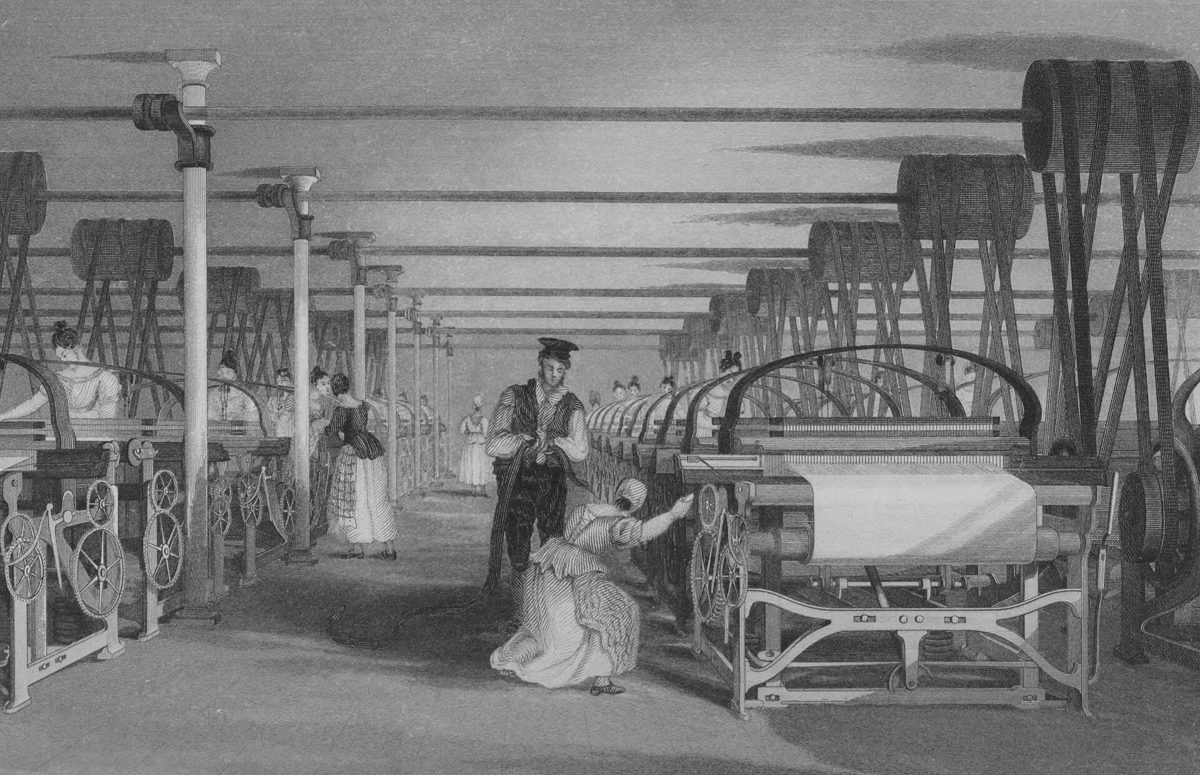
In 1816, two thousand weavers in the Calton district of Glasgow marched on the power-loom mills and tried to smash them. They threw stones at the workers inside.1 Ten years later, in Lancashire, weavers rioted again, this time across a county.1 The weavers had reason to be afraid.
The record of those mills tells two stories at once. The number of power looms in the United Kingdom went from 2,400 in 1803 to 14,650 in 1820, 55,500 in 1829, 100,000 in 1833 and 250,000 in 1857.1 Until about 1830 the handloom was still the more important machine economically, and then the roles reversed.1 In the longer run, cheaper cloth raised demand and stimulated exports, and industrial employment grew, though much of it was low-paid. The power loom opened mill work to women, and it brought a darker side: children worked in the mills.1 A student of economics has to hold all of that in view. Capitalism is the system that builds the mills, and it is also the system that sends the weavers into the street.
What the word means
Robert Hessen, in the Concise Encyclopedia of Economics, notes that "capitalism" was coined by socialists in the mid-nineteenth century as a term of disparagement. He prefers "economic individualism," whose basic premise is "that the pursuit of self-interest and the right to own private property are morally defensible and legally legitimate," with the corollary "that the state exists to protect individual rights." Subject to certain restrictions, individuals "are free to decide where to invest, what to produce or sell, and what prices to charge."2 Adam Smith's name for it was the system of natural liberty.
The working parts are plain. Private property gives people title to what they make or buy. Voluntary exchange moves things to those who value them more. Prices tell everyone what is scarce. Profit and loss reward those who serve others well and discipline those who do not. Entrepreneurs try new things. The rule of law holds the whole frame together. Each of those deserves a closer look.
Property
The founders thought property was larger than land. James Madison, writing in the National Gazette on March 29, 1792, gave "property" a broad meaning that took in a man's opinions, his person and his faculties, and then drew the consequence:
"In a word, as a man is said to have a right to his property, he may be equally said to have a property in his rights. Where an excess of power prevails, property of no sort is duly respected. No man is safe in his opinions, his person, his faculties, or his possessions."
James Madison, "Property," National Gazette, March 29, 1792. 3
In Federalist No. 10 he named the protection of the faculties from which property springs as the first object of government: "The diversity in the faculties of men, from which the rights of property originate, is not less an insuperable obstacle to a uniformity of interests. The protection of these faculties is the first object of government."4
Economists care about property for a plain reason. A person who knows that what he builds will be his has reason to build it, and a person who can sell what he owns has reason to put it to its best use. A farmer who may lose the field next year will not drain it. A shopkeeper who expects the building to be seized will not paint the sign.
Hernando de Soto and the problem of paper
The Peruvian economist Hernando de Soto asked what happens when people hold property but cannot prove it. His Institute for Liberty and Democracy in Lima set up a small two-sewing-machine garment factory in a shantytown and tried to register it legally. It took 289 days and cost 31 times the monthly minimum wage. In the Philippines, obtaining legal title to a piece of property took 168 steps involving 53 agencies and could take up to 25 years.5 In The Mystery of Capital (2000) de Soto estimated that 85 percent of urban parcels and 40 to 53 percent of rural parcels in developing nations are held in a way that keeps them from creating capital, and that these untitled assets are worth $9.3 trillion of "dead capital."5
His point was that rich countries became rich in part because they built systems that turn possessions into capital: a title, a record, a mortgage, a name on a deed. A house with a deed can secure a loan to start a business. A house without one is shelter.
De Soto's work has drawn pushback worth stating. Scholars have disputed whether land titles really improve access to credit, and the results of a land-titling program in Peru under Alberto Fujimori found that titles did not give poor Peruvians greater access to credit.6 Others have questioned the statistical basis of his estimates.6 What survives is the narrower claim, which is hard to deny: when the law makes it ruinously slow and costly for ordinary people to own and register what they have, the poor stay outside the economy.
Property in American law
The Fifth Amendment says no person shall "be deprived of life, liberty, or property, without due process of law; nor shall private property be taken for public use, without just compensation."7 The same sentence ties liberty and property together, as Madison did. Idaho's constitution repeats the compensation rule in Article I, section 14: "Private property may be taken for public use, but not until a just compensation, to be ascertained in the manner prescribed by law, shall be paid therefor." The same section also declares the use of land for irrigation reservoirs, canals, ditches and flumes to be a public use, which tells you something about how much water ditches meant to the people who wrote it.8 In both documents the protection runs in one direction, against the government that holds the power to take. A property right that the state can ignore at will is a permission.
Voluntary exchange
When you buy bread you give up money you value less than the bread, and the baker gives up bread he values less than the money. Both sides expect to gain, or the trade would not happen. Smith put it in a line: "Give me that which I want, and you shall have this which you want, is the meaning of every such offer."9 The value comes from the exchange itself, a point that is easy to miss. An economy is a vast number of such bargains, each of which leaves both parties better off in their own judgment.
The word "voluntary" carries weight. A trade made at gunpoint is a robbery. A trade made under fraud is a theft. That is why Smith insisted on the "laws of justice" and why the defenders of free markets, from Smith to Friedman, assign government the job of enforcing contracts and punishing fraud.
Prices as signals
Lesson 1 introduced Hayek's tin example. A second look at his essay shows what he thought was at stake. He wrote:
"The most significant fact about this system is the economy of knowledge with which it operates, or how little the individual participants need to know in order to be able to take the right action. In abbreviated form, by a kind of symbol, only the most essential information is passed on and passed on only to those concerned."
Friedrich Hayek, "The Use of Knowledge in Society," American Economic Review 35, no. 4 (1945): 519-530. 10
A price condenses an enormous amount of information. When the price of diesel rises, a trucker in Idaho does not need to know whether the cause is a refinery fire, a war or a change in demand. He needs to know that diesel costs more, and he adjusts. Hayek thought the mechanism deserved wonder: "if it were the result of deliberate human design, and if the people guided by the price changes understood that their decisions have significance far beyond their immediate aim, this mechanism would have been acclaimed as one of the greatest triumphs of the human mind. Its misfortune is the double one that it is not the product of human design and that the people guided by it usually do not know why they are made to do what they do."10
That is why price controls are never merely local. A price held below the level that reflects scarcity tells buyers that the good is plentiful when it is not. The lesson that follows from Hayek's argument is that tampering with prices destroys information the economy needs.
Profit and loss
Profit has an ugly reputation. In this account it plays two roles. It is a signal: revenue that exceeds the cost of the resources used suggests that buyers value the product more than the best alternative use of those resources. Loss is the reverse signal. And profit and loss together are a discipline. The baker who guesses wrong bakes less next week or goes out of business, and the person who bears the loss is the owner who made the decision.
Ludwig von Mises, the Austrian economist, built an argument on this in 1920. If a public body owns all the means of production, he said, capital goods are only transfers within a single owner, not objects of exchange, so they get no market prices. Without those prices planners cannot compare the cost of alternative ways to build a factory or run a railway. He wrote that "rational economic activity is impossible in a socialist commonwealth."11 The reply came from socialists such as Oskar Lange and Abba Lerner, who proposed a trial-and-error market socialism in which planners would adjust prices until shortages and surpluses vanished. Hayek's rejoinder was that the relevant knowledge is dispersed, tacit and always changing, and cannot be gathered in one place.11 Lessons 6 and 7 look at how that debate ended in practice.
The entrepreneur
Where do new products come from? Israel Kirzner, a student of Mises, wrote Competition and Entrepreneurship (1973), which criticizes the textbook model of "perfect competition" for leaving the entrepreneur out. In Kirzner's account the entrepreneur is an alert arbitrageur and an agent of economic discovery, someone who notices that a good is selling for one price here and could fetch more there, or that a need nobody serves can be served.12 Smith's boy who tied a string to the valve to save himself work was an entrepreneur of a small kind. So is a man who sees a closed grain elevator in a small Idaho town and decides to buy it.
Creative destruction
Joseph Schumpeter (1883 to 1950), an Austrian-American economist who taught at Harvard from 1932, gave the process its name in Capitalism, Socialism and Democracy (1942):
"The opening up of new markets, foreign or domestic, and the organizational development from the craft shop and factory to such concerns as U. S. Steel illustrate the same process of industrial mutation"
"that incessantly revolutionizes the economic structure from within, incessantly destroying the old one, incessantly creating a new one. This process of Creative Destruction is the essential fact about capitalism."
Joseph Schumpeter, Capitalism, Socialism and Democracy (New York: Harper, 1942), ch. VII. The two parts belong to one sentence, with a parenthetical remark about the biological term "mutation" between them. 13
The weavers of Calton were creative destruction's casualties. Schumpeter did not pretend otherwise. He argued that the system must be judged over decades or centuries, not snapshots: "there is no point in appraising the performance of that process ex visu of a given point of time; we must judge its performance over time, as it unfolds through decades or centuries."13 He also doubted that capitalism would last. Part II of his book asks "Can Capitalism Survive?" and he answers no, adding that "if a doctor predicts that his patient will die presently, this does not mean that he desires it."14 Section titles in that part include "Crumbling Walls" and "Growing Hostility."14 A defender of capitalism can read Schumpeter as an ally on the facts and an opponent on the forecast.
Competition, and its enemies
Everything above assumes that sellers compete. Smith did not assume that they like to. His warning from Book 1, chapter 10, covered in lesson 3, is that "people of the same trade seldom meet together, even for merriment and diversion, but the conversation ends in a conspiracy against the public, or in some contrivance to raise prices."15 A market economy therefore needs more than property and trade. It needs open entry, so that a high price or a poor product invites a rival, and law that does not hand incumbents a shield. The licensing cartels, protective tariffs and chartered monopolies of the mercantile age were each a way for sellers to escape the discipline of competition by using the law, which is why Smith and Friedman both came down so hard on them.
The rule of law
None of these parts works without a legal frame. Smith's condition was that a man be left free to pursue his interest "as long as he does not violate the laws of justice."16 Contracts must be enforced, fraud must be punished, property must be protected from the powerful as well as from the thief. De Soto's Lima experiment shows what happens when the frame is too heavy. Where it is too light, powerful men take what they want. And where it is applied by favor, the economy turns into a contest for influence, which is the mercantile state again. The capitalist case is therefore a case for a particular kind of government, strong enough to enforce rules and restrained enough to stay out of the market's decisions.
The American record
How have the parts performed together? The Maddison Project Database, kept by the Groningen Growth and Development Centre, estimates real GDP per capita across countries and centuries in 2011 international dollars. For the United States it gives about $2,674 in 1820, $8,038 in 1900, $15,240 in 1950, $36,982 in 1990 and $58,487 in 2022.17 That is growth of about twenty-two times in two centuries.
| Country | 1820 | 1900 | 1950 | 1990 | 2022 |
|---|---|---|---|---|---|
| United States | $2,674 | $8,038 | $15,240 | $36,982 | $58,487 |
| United Kingdom | $3,306 | $7,594 | $11,061 | $26,189 | $38,407 |
| France | $1,809 | $4,584 | $8,266 | $28,129 | $39,066 |
| China | $882 | $972 | $799 | $2,982 | $19,238 |
| India | n/a (1850: $947) | $955 | $987 | $2,087 | $7,766 |
Three cautions go with these numbers. The first is that early estimates are soft; the compilers rebuild them from fragments. The second is that a rising average hides who gains and who loses, as the Calton weavers learned. The third is that the figures show where economies ended up but cannot by themselves show why. Technology, education, geography, trade and peace all play parts, and a comparison of countries with different systems, which lesson 8 takes up, is a better test than a single country's history.
The same data show the costs. US real GDP per capita fell from $11,954 in 1929 to $8,048 in 1933, a drop of about a third.17 That was the Great Depression, a collapse inside a capitalist economy. Milton Friedman and Anna Schwartz traced it to a failure of the money supply, as lesson 5 explains, and not to private property or exchange as such. Whoever sets out to judge capitalism has to count the decline as well as the climb.
The best case against, and a reply
The sharpest argument against a market economy runs like this. Markets reward what people will pay for, and need is not always backed by money. People begin life with unequal starting points. Those displaced by change bear costs that the gainers do not repay, and children in the 1830s mills were the proof. A society may fairly decide that some things, including health, schooling and a decent minimum, should not depend on what a family can buy.
The defender of capitalism has four replies. Growth of the size shown above is the only thing in history that has pulled whole populations out of poverty at scale, and a society that wants to help the poor needs to have wealth to share. The harms the critics list, from child labor to the Depression, were problems of law and money that reformers corrected, and they were not features of voluntary exchange. Smith himself backed public schooling and the enforcement of justice. And every alternative must also allocate scarce goods; the question is whether officials will do it with better knowledge than the people on the spot, and the 20th century's attempts to try are the subject of lessons 6 and 7. The honest summary is that the debate over how much safety net, rule and public provision to wrap around the market is a real debate among people who accept that markets do the heavy lifting. Lesson 9 gives the critics their best case in full.
Ask of any economic claim the three questions from lesson 1. Who decides? Who pays? Who bears the loss when the decision is wrong? In a market the answers are the buyer and seller, the buyer and seller, and the owner. When they are different, someone else's money is on the table.
Learn more
- Hayek, The Use of Knowledge in Society: The central text on prices and dispersed knowledge.
- Madison, Property: A one-page essay on how broadly the founders understood property.
- Schumpeter, The Process of Creative Destruction: A short chapter with the famous passage.
- Hessen, Capitalism: A defender's overview, with the history of the word.
- The economic calculation problem: Mises, Hayek and the market socialists, with objections.
- Hernando de Soto: His ideas and the criticisms of them.
- Maddison Project Database: The data behind the chart, with documentation.
Notes
- "Power loom," overview article: the 1816 Calton weavers' attack on power-loom mills, the 1826 Lancashire power-loom riots, the growth of power looms in the United Kingdom (2,400 in 1803; 14,650 in 1820; 55,500 in 1829; 100,000 in 1833; 250,000 in 1857), the effect on demand, women's employment and child labor. Read it online. ↩
- Robert Hessen, "Capitalism," The Concise Encyclopedia of Economics (Liberty Fund). Read it online. ↩
- James Madison, "Property," National Gazette, March 29, 1792, in The Papers of James Madison, vol. 14, pp. 266-68; The Founders' Constitution, vol. 1, ch. 16, doc. 23. Read it online. ↩
- James Madison, The Federalist No. 10 (November 22, 1787). Read it online. ↩
- Summary of Hernando de Soto, The Mystery of Capital: Why Capitalism Triumphs in the West and Fails Everywhere Else (New York: Basic Books, 2000): the Lima garment factory (289 days, 31 times the monthly minimum wage), the Philippines (168 steps, 53 agencies, up to 25 years) and the estimate of $9.3 trillion in "dead capital." These are de Soto's figures as reported in the summary. Read the summary. ↩
- "Hernando de Soto Polar," sections on the reception of his work: scholars' disputes over titling and credit access, the findings of the land-title program under Alberto Fujimori, and criticism of the statistical basis of his first book, The Other Path. Read it online. ↩
- U.S. Constitution, Fifth Amendment (1791). Read it online. ↩
- Idaho Constitution, Article I, section 14, "Right of eminent domain." Read it online. ↩
- Adam Smith, The Wealth of Nations (1776), Book 1, ch. 2. Read it online. ↩
- F. A. Hayek, "The Use of Knowledge in Society," American Economic Review 35, no. 4 (September 1945): 519-530, part III. Read it online. ↩
- "Economic calculation problem," summarizing Ludwig von Mises, "Economic Calculation in the Socialist Commonwealth" (1920) and the replies of Lange, Lerner and Hayek. Read it online. ↩
- "Israel Kirzner": the entrepreneur as alert arbitrageur and agent of economic discovery; Competition and Entrepreneurship (Chicago: University of Chicago Press, 1973). Read it online. ↩
- Joseph A. Schumpeter, Capitalism, Socialism and Democracy (New York: Harper, 1942), ch. VII, "The Process of Creative Destruction." Read the chapter excerpt. ↩
- "Capitalism, Socialism and Democracy," summary of the book, Part II, "Can Capitalism Survive?" Read it online. ↩
- Smith, The Wealth of Nations, Book 1, ch. 10, part 2. Read it online. ↩
- Smith, The Wealth of Nations, Book 4, ch. 9. Read it online. ↩
- Maddison Project Database 2023, Groningen Growth and Development Centre; Jutta Bolt and Jan Luiten van Zanden, "Maddison style estimates of the evolution of the world economy: A new 2023 update," Journal of Economic Surveys (2024). Real GDP per capita in 2011 international dollars; values for the United States, United Kingdom, France, China and India read from the "Full data" sheet. Read it online. ↩
Check yourself
1. Which sentence comes from James Madison's essay 'Property' (1792)?
Madison wrote this in the National Gazette on March 29, 1792, arguing that property in the broad sense includes a man's opinions, his person and the free use of his faculties, and that government is instituted to protect property of every sort.
2. What did Schumpeter call the process by which new methods and firms incessantly destroy the old ones?
In Capitalism, Socialism and Democracy (1942) he wrote that industrial mutation incessantly revolutionizes the economic structure from within, 'incessantly destroying the old one, incessantly creating a new one. This process of Creative Destruction is the essential fact about capitalism.'
3. In Hernando de Soto's Lima experiment, how long did it take to register a small two-sewing-machine garment factory legally?
De Soto's team spent 289 days and an amount equal to 31 times the monthly minimum wage getting the little workshop licensed, a result he used to argue that red tape locks the poor out of the legal property system.
4. According to Hayek, what is the most significant fact about the price system?
Hayek wrote that 'the most significant fact about this system is the economy of knowledge with which it operates,' and added that its adjustments are probably never 'perfect.'
5. According to the Maddison Project Database 2023, by roughly what factor did United States real GDP per capita grow between 1820 and 2022?
US GDP per capita rose from about $2,674 in 1820 to about $58,487 in 2022 (2011 international dollars), roughly 22 times. The data also show a fall of about a third between 1929 and 1933.
Terms in this lesson
- Private property
- The right of persons to own, use, trade and bequeath things, including land, tools and their own labor.
- Voluntary exchange
- A trade both sides agree to because each expects to gain. Without gains on both sides, one would refuse.
- Price signal
- The information carried by a price about what is scarce and what is plentiful, which tells buyers and sellers how to adjust.
- Profit and loss
- Profit means revenue exceeds the cost of the resources used. Loss means the reverse, and it tells owners to stop or change course.
- Entrepreneur
- A person who spots an opportunity, organizes resources and bears the risk of failure. Kirzner stressed alertness to opportunities others have missed.
- Creative destruction
- Schumpeter's name for the process by which new products and methods displace old ones.
- Dead capital
- De Soto's term for assets, such as informally held homes, that cannot be used as collateral or traded because they lack formal legal title.
- Rule of law
- The principle that law applies to everyone, including officials, and protects persons and property from arbitrary power.
Sources
- Hayek, The Use of Knowledge in Society (1945) checked 2026-10
- Madison, Property (National Gazette, March 29, 1792), The Founders' Constitution checked 2026-10
- Madison, Federalist No. 10 (Avalon Project) checked 2026-10
- Schumpeter, Capitalism, Socialism and Democracy, chapter VII (excerpt) checked 2026-10
- Smith, The Wealth of Nations (Gutenberg 3300) checked 2026-10
- Robert Hessen, Capitalism (Concise Encyclopedia of Economics) checked 2026-10
- Economic calculation problem (Mises 1920, Hayek) checked 2026-10
- Israel Kirzner checked 2026-10
- Hernando de Soto, The Mystery of Capital: summary checked 2026-10
- Hernando de Soto Polar (with critics) checked 2026-10
- Power loom checked 2026-10
- Maddison Project Database 2023, Groningen Growth and Development Centre checked 2026-10
- Capitalism, Socialism and Democracy (summary of the book) checked 2026-10